Electronic forums & algebraic
communication
Pili Royo
DIPE
IES Montilivi
Girona- 2006
PDTR
Moodle & algebraic communication
ALGEBRAIC CO-CONSTUCTION
THROUGH CONVERSATION IN
VIRTUAL ENVIRONMENTS
(STUDENTS 13-14 YEARS OLD)
ABSTRACT
The aims of the study are:
• Analyzing the hypothetical
trajectories observed in
conversation forums on the virtual
environment Moodle.
• And to find the characteristics of
forum as learning mediator of
algebra.
TASKS
• Analysis of the effective
interactions in the co-
construction of knowledge
through the forums .
• Analysis of individual process
FRAMEWORK (I)
• Algebra as a set of assertions in which it is
possible to produce meaning in terms of
numbers and arithmetical operations (Lins and
Giménez , 1997)
• Constructivist conception of teaching and
learning (Coll, 2002) and coconstruction ( )
• The forum of conversation, as a CMO form, can
turn out a useful instrument to solve or discuss
problems jointly (Balacheff y Soury 1998, Murillo
2004, Hoyles, Noss…1999, Trouche 2004)
FRAMEWORK (II)
• Algebra learning and teaching should be
based on problem situations leading to
symbolizing. But we also have to take into
account the different ways present in
algebraic thinking in early grades:
analyzing relationships between
quantities, noticing structure, studying
change, generalizing, problem solving,
modelling, justifying, proving, predicting,
(Kieran, 2004, pg 149)
FRAMEWORK (III)
•
The condition of transformation agents assigned
to the TIC, is worthy to be taken into account for
conceiving deliberate interventions to change the
pedagogical models, the practices in the
classroom and the curricular contents in
educative systems, in order to lead to the
students towards a significant and satisfactory
learning (Rojano, 2003, pg 138)
• Translating word problems into equations
involves one of fundamentals issues of transition
from arithmetic to algebra, in terms of symbolism
as well as reasoning.
METHODOLOGY
• Population:
3 groups of 2nd course of ESO (13-14 years old) , pertaining to a public secondary
school, during the course 2005-06.
• Context. Environment
The whole class attended the computer classroom once a week.
Of the participant groups in the experience. Three of them followed the elaborated
curricular material with regard to the project . The other group served as reference
group.
At the end of this experience, the students responded to a written individual test.
• Data analysis
As data, the dialogues of the forums and the results of the written individual test have
been collected. The analysis of these data was made based on some of the
investigation questions. Students have also answered a survey about their assessment
of the tool.
PHASES
2. Using conversation forums to discuss
and to look for strategies of resolution of
algebraic problems, in a collaborative
environment.
1. Design & Implementation of a moodle –
algebra course
Phase I
Phase II
“THE SCREEN ACTIVITIES”
THE PROBLEMS
of the forums
• A PING-PONG MATCH
If in a ping-pong championship n players play, which is
the total number of parties that will gamble?
 HENS AND PIGS
In a farm there are 18 animals, hens and pigs all
together. The number of legs is 50. How many hens
and how many pigs are they?
• DIVISIONS
Which is the smaller number of three numbers that
when dividing it successively by 4 by 5 and 6, always
obtains 3 of remainder?
DISCUSSION
A. FROM THE FORUMS
B. FROM THE WRITTEN INDIVIDUAL
TEST
C. FROM THE SURVEY
D. THE ROLE OF THE TEACHER
DISCUSSION
• Children read the interventions of their partners much
more times than they write in the forum. This can be
associated at more reflexive interventions when they do.
• The coexistence of both types, actual and online
interventions, must be taken into account as a better way
than only one of them.
• Interactions between students of similar and different
cognitive levels take place.
• In the design of these forums, the teacher has to
consider the difficulty of some mathematical expressions.
• Significant learning is produced. It is possible to see it
through the evolution on the interventions and through
the results on the written individual test.
A.FROM THE FORUMS
Significative learning is produced
B. DISCUSSION
Written
individual test
After forums
Students doing Arithmetic relations
Just good students do this in control group
Just students with difficulties
do this in experimental group
Problem G.
Middle level students solving by
using symbolic language skills
Problem G
Other methods just in the experimental
group
Problema G
Explicit explanations were found in the
experimental group (I)
en without a good symbolic manipulation
Explicit explanations were found in the
experimental group (II)
Explicit explanations were found in the
experimental group (III)
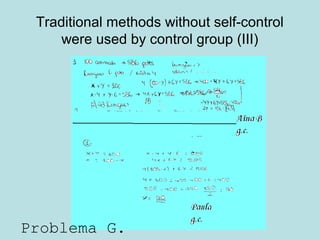
Traditional methods without self-control
were used by control group (III)
Problema G.
Many relations were found even
without good final results
Many relations were found
Some talks and strategies during the
experiment were “applied” to a new situation
They achieve self-
confidence on their
own strategies
Some conversation constrictions
The need of complementary
ressources (inside moodle, but out
of the forum)
The need of variability observations
Activity 1
• Show the multiplication x (y + 2) by filling in the
rectangle. What is your answer? Change the value of x by
dragging the x-slider. X(y+2)=
http://matti.usu.edu/nlvm/nav/vlibrary.html
ALGEBRA AND GEOMETRY
DISCUSSION
• Children didn’t percieve 7 weeks (once
a week) as a long time doing the task.
As they say, it allows you “to take your
time”.
• Children think this way is better than
others because they have access to
more “opinions”.
C. FROM THE SURVEY
D. THE ROLE OF THE TEACHER
• Design and organization of the learning experience.
• Selection of representative algebraic problems to
encourage discourse.
• Guide and scaffolding when necessary.
• Promoting the participation of all the students
• Promoting on a progressive way the abstraction and the
generalization.
• Promoting the reflection, the conjecture and the
experimentation.
• Assessment and evaluation of the activity.
DISCUSSION

Electronic forums&algebraic communication

  • 1.
    Electronic forums &algebraic communication Pili Royo DIPE IES Montilivi Girona- 2006 PDTR
  • 2.
    Moodle & algebraiccommunication ALGEBRAIC CO-CONSTUCTION THROUGH CONVERSATION IN VIRTUAL ENVIRONMENTS (STUDENTS 13-14 YEARS OLD)
  • 3.
    ABSTRACT The aims ofthe study are: • Analyzing the hypothetical trajectories observed in conversation forums on the virtual environment Moodle. • And to find the characteristics of forum as learning mediator of algebra.
  • 4.
    TASKS • Analysis ofthe effective interactions in the co- construction of knowledge through the forums . • Analysis of individual process
  • 5.
    FRAMEWORK (I) • Algebraas a set of assertions in which it is possible to produce meaning in terms of numbers and arithmetical operations (Lins and Giménez , 1997) • Constructivist conception of teaching and learning (Coll, 2002) and coconstruction ( ) • The forum of conversation, as a CMO form, can turn out a useful instrument to solve or discuss problems jointly (Balacheff y Soury 1998, Murillo 2004, Hoyles, Noss…1999, Trouche 2004)
  • 6.
    FRAMEWORK (II) • Algebralearning and teaching should be based on problem situations leading to symbolizing. But we also have to take into account the different ways present in algebraic thinking in early grades: analyzing relationships between quantities, noticing structure, studying change, generalizing, problem solving, modelling, justifying, proving, predicting, (Kieran, 2004, pg 149)
  • 7.
    FRAMEWORK (III) • The conditionof transformation agents assigned to the TIC, is worthy to be taken into account for conceiving deliberate interventions to change the pedagogical models, the practices in the classroom and the curricular contents in educative systems, in order to lead to the students towards a significant and satisfactory learning (Rojano, 2003, pg 138) • Translating word problems into equations involves one of fundamentals issues of transition from arithmetic to algebra, in terms of symbolism as well as reasoning.
  • 9.
    METHODOLOGY • Population: 3 groupsof 2nd course of ESO (13-14 years old) , pertaining to a public secondary school, during the course 2005-06. • Context. Environment The whole class attended the computer classroom once a week. Of the participant groups in the experience. Three of them followed the elaborated curricular material with regard to the project . The other group served as reference group. At the end of this experience, the students responded to a written individual test. • Data analysis As data, the dialogues of the forums and the results of the written individual test have been collected. The analysis of these data was made based on some of the investigation questions. Students have also answered a survey about their assessment of the tool.
  • 10.
    PHASES 2. Using conversationforums to discuss and to look for strategies of resolution of algebraic problems, in a collaborative environment. 1. Design & Implementation of a moodle – algebra course
  • 11.
  • 13.
  • 14.
  • 15.
    THE PROBLEMS of theforums • A PING-PONG MATCH If in a ping-pong championship n players play, which is the total number of parties that will gamble?  HENS AND PIGS In a farm there are 18 animals, hens and pigs all together. The number of legs is 50. How many hens and how many pigs are they? • DIVISIONS Which is the smaller number of three numbers that when dividing it successively by 4 by 5 and 6, always obtains 3 of remainder?
  • 16.
    DISCUSSION A. FROM THEFORUMS B. FROM THE WRITTEN INDIVIDUAL TEST C. FROM THE SURVEY D. THE ROLE OF THE TEACHER
  • 17.
    DISCUSSION • Children readthe interventions of their partners much more times than they write in the forum. This can be associated at more reflexive interventions when they do. • The coexistence of both types, actual and online interventions, must be taken into account as a better way than only one of them. • Interactions between students of similar and different cognitive levels take place. • In the design of these forums, the teacher has to consider the difficulty of some mathematical expressions. • Significant learning is produced. It is possible to see it through the evolution on the interventions and through the results on the written individual test. A.FROM THE FORUMS
  • 18.
  • 19.
  • 20.
  • 21.
    Students doing Arithmeticrelations Just good students do this in control group Just students with difficulties do this in experimental group Problem G.
  • 22.
    Middle level studentssolving by using symbolic language skills Problem G
  • 23.
    Other methods justin the experimental group Problema G
  • 24.
    Explicit explanations werefound in the experimental group (I) en without a good symbolic manipulation
  • 25.
    Explicit explanations werefound in the experimental group (II)
  • 26.
    Explicit explanations werefound in the experimental group (III)
  • 27.
    Traditional methods withoutself-control were used by control group (III) Problema G.
  • 28.
    Many relations werefound even without good final results
  • 29.
  • 30.
    Some talks andstrategies during the experiment were “applied” to a new situation
  • 31.
    They achieve self- confidenceon their own strategies
  • 32.
    Some conversation constrictions Theneed of complementary ressources (inside moodle, but out of the forum) The need of variability observations
  • 33.
    Activity 1 • Showthe multiplication x (y + 2) by filling in the rectangle. What is your answer? Change the value of x by dragging the x-slider. X(y+2)= http://matti.usu.edu/nlvm/nav/vlibrary.html ALGEBRA AND GEOMETRY
  • 35.
    DISCUSSION • Children didn’tpercieve 7 weeks (once a week) as a long time doing the task. As they say, it allows you “to take your time”. • Children think this way is better than others because they have access to more “opinions”. C. FROM THE SURVEY
  • 36.
    D. THE ROLEOF THE TEACHER • Design and organization of the learning experience. • Selection of representative algebraic problems to encourage discourse. • Guide and scaffolding when necessary. • Promoting the participation of all the students • Promoting on a progressive way the abstraction and the generalization. • Promoting the reflection, the conjecture and the experimentation. • Assessment and evaluation of the activity. DISCUSSION