Physics Presentation:
  Electronic Flash
          Group 10:
      MIRAFLORES, Trixie
        DATOC, Hillary
Electronic Flash
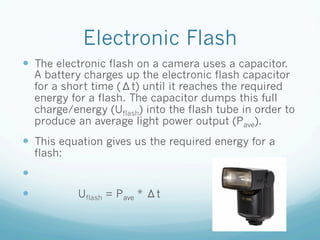
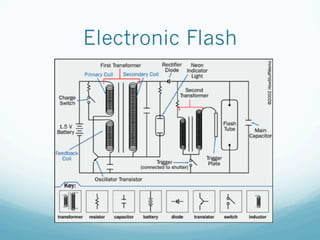
—  The electronic flash on a camera uses a capacitor.
      A battery charges up the electronic flash capacitor
      for a short time ( t) until it reaches the required
      energy for a flash. The capacitor dumps this full
      charge/energy (Uflash) into the flash tube in order to
      produce an average light power output (Pave).
—  This equation gives us the required energy for a
      flash:
—   
—             Uflash = Pave *   t
Electronic Flash
—  This amount of energy is related to the energy stored in
      a capacitor. Not all electrical energy in a capacitor can
      be converted to light. The rest of the converted product
      is made up of thermal energy. Every conversion of
      electrical energy to light has its own output. The
      relation between the electrical energy and the light
      power output is:

—   
—             Uflash = (e/ 100) * Ucapacitor , where e = percent
      efficiency in producing light power output, Uflash = light
      power output, Ucapacitor = electrical energy stored in the
      capacitor
Electronic Flash
—  Capacitors used by electronic flashes usually
      recharge after every flash by using resistors. The
      value of resistance can be measured using the
      equation:

—   
—              R = T/C, where R = resistance, T = time
      constant (time between every capacitor recharge),
      C = capacitance. The unit of R is ohm.
Electronic Flash
Examples
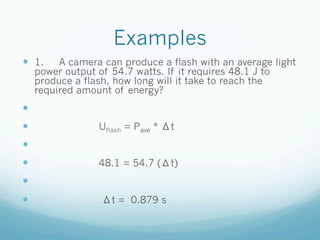
—  1.     A camera can produce a flash with an average light
      power output of 54.7 watts. If it requires 48.1 J to
      produce a flash, how long will it take to reach the
      required amount of energy?
—   
—                 Uflash = Pave *   t
— 
—                 48.1 = 54.7 (     t)
—   
—                    t = 0.879 s
Examples
—  2.    A capacitor used by an electric flash recharges after
      every 1.2 seconds. Given that its resistor has a value of
      5335 ohms, what is its capacitance?

—   
—                  R = T/C
—   
—                  5335 ohms = 1.2 s /C

—   
—                  C = 6402 F
Examples
—  3. An electronic flash attachment for a camera has a
      light power output of 250 watts. If the camera has a
      percent efficiency of 93%, how much electrical energy is
      stored in its capacitor?
—   
—         Uflash = (e/ 100) * Ucapacitor
—     

—          250 watts = (93/100) * Ucapacitor
—   
—         Ucapacitor = 268.8
Electronic flash

Electronic flash

  • 1.
    Physics Presentation: Electronic Flash Group 10: MIRAFLORES, Trixie DATOC, Hillary
  • 2.
    Electronic Flash —  Theelectronic flash on a camera uses a capacitor. A battery charges up the electronic flash capacitor for a short time ( t) until it reaches the required energy for a flash. The capacitor dumps this full charge/energy (Uflash) into the flash tube in order to produce an average light power output (Pave). —  This equation gives us the required energy for a flash: —    —  Uflash = Pave * t
  • 3.
    Electronic Flash —  Thisamount of energy is related to the energy stored in a capacitor. Not all electrical energy in a capacitor can be converted to light. The rest of the converted product is made up of thermal energy. Every conversion of electrical energy to light has its own output. The relation between the electrical energy and the light power output is: —    —  Uflash = (e/ 100) * Ucapacitor , where e = percent efficiency in producing light power output, Uflash = light power output, Ucapacitor = electrical energy stored in the capacitor
  • 4.
    Electronic Flash —  Capacitorsused by electronic flashes usually recharge after every flash by using resistors. The value of resistance can be measured using the equation: —    —  R = T/C, where R = resistance, T = time constant (time between every capacitor recharge), C = capacitance. The unit of R is ohm.
  • 5.
  • 6.
    Examples —  1. A camera can produce a flash with an average light power output of 54.7 watts. If it requires 48.1 J to produce a flash, how long will it take to reach the required amount of energy? —    —  Uflash = Pave * t —  —  48.1 = 54.7 ( t) —    —  t = 0.879 s
  • 7.
    Examples —  2. A capacitor used by an electric flash recharges after every 1.2 seconds. Given that its resistor has a value of 5335 ohms, what is its capacitance? —    —  R = T/C —    —  5335 ohms = 1.2 s /C —    —  C = 6402 F
  • 8.
    Examples —  3. Anelectronic flash attachment for a camera has a light power output of 250 watts. If the camera has a percent efficiency of 93%, how much electrical energy is stored in its capacitor? —    —  Uflash = (e/ 100) * Ucapacitor —    —  250 watts = (93/100) * Ucapacitor —    —  Ucapacitor = 268.8