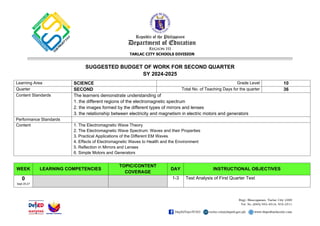
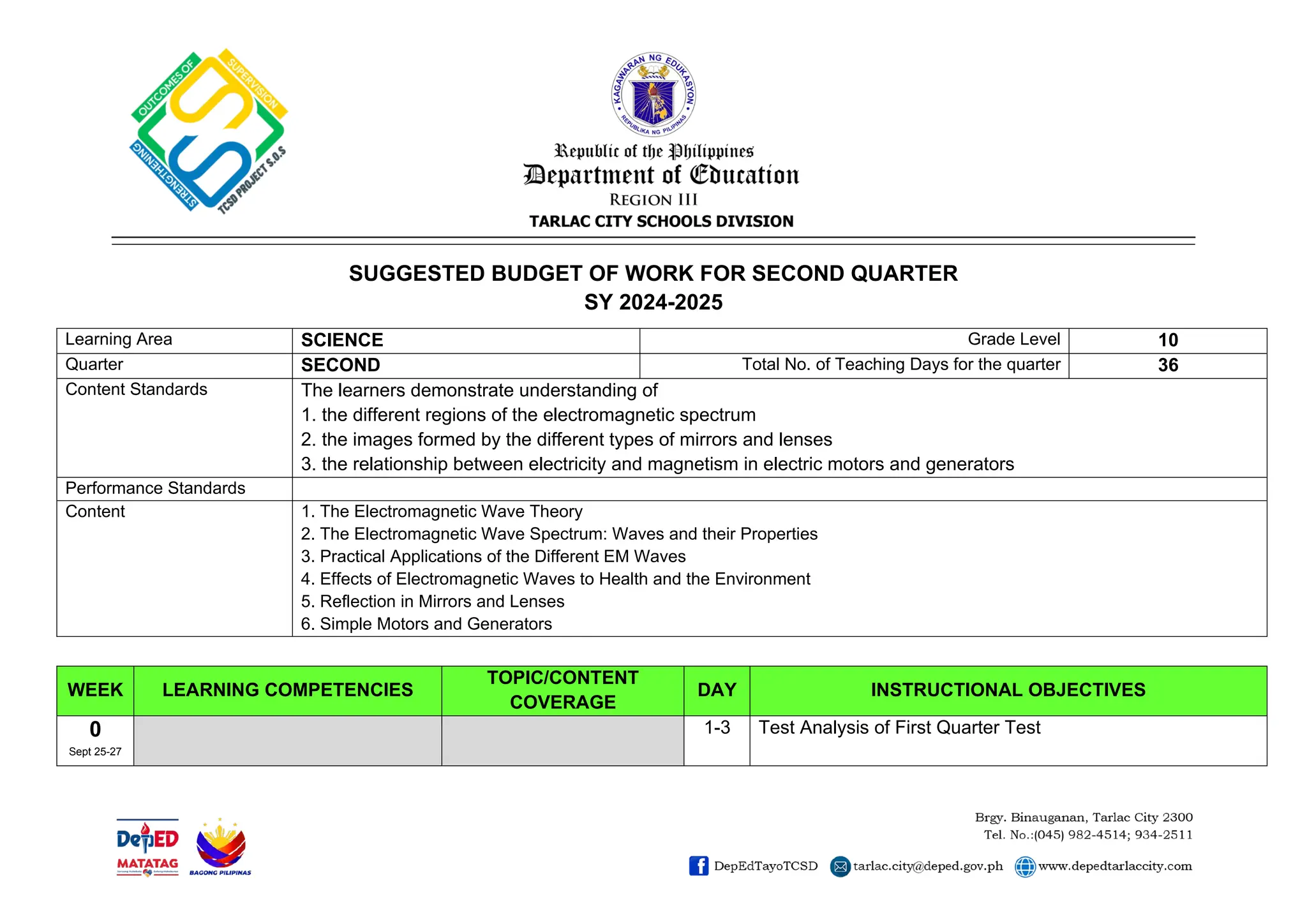
SUGGESTED BUDGET OF WORK FOR SECOND QUARTER
SY 2024-2025
Learning Area SCIENCE Grade Level 10
Quarter SECOND Total No. of Teaching Days for the quarter 36
Content Standards The learners demonstrate understanding of
1. the different regions of the electromagnetic spectrum
2. the images formed by the different types of mirrors and lenses
3. the relationship between electricity and magnetism in electric motors and generators
Performance Standards
Content 1. The Electromagnetic Wave Theory
2. The Electromagnetic Wave Spectrum: Waves and their Properties
3. Practical Applications of the Different EM Waves
4. Effects of Electromagnetic Waves to Health and the Environment
5. Reflection in Mirrors and Lenses
6. Simple Motors and Generators
WEEK LEARNING COMPETENCIES
TOPIC/CONTENT
COVERAGE
DAY INSTRUCTIONAL OBJECTIVES
0
Sept 25-27
1-3 Test Analysis of First Quarter Test
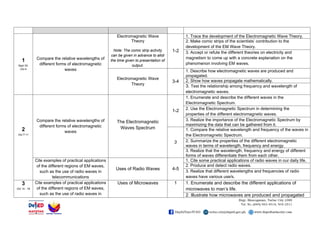
1
Sept 30-
Oct 4
Compare the relative wavelengths of
different forms of electromagnetic
waves
Electromagnetic Wave
Theory
Note: The comic strip activity
can be given in advance to allot
the time given to presentation of
output.
1-2
1. Trace the development of the Electromagnetic Wave Theory.
2. Make comic strips of the scientists’ contribution to the
development of the EM Wave Theory.
3. Accept or refute the different theories on electricity and
magnetism to come up with a concrete explanation on the
phenomenon involving EM waves.
Electromagnetic Wave
Theory
3-4
1. Describe how electromagnetic waves are produced and
propagated.
2. Show how waves propagate mathematically.
3. Test the relationship among frequency and wavelength of
electromagnetic waves.
2
Oct 7-11
Compare the relative wavelengths of
different forms of electromagnetic
waves
The Electromagnetic
Waves Spectrum
1-2
1. Enumerate and describe the different waves in the
Electromagnetic Spectrum.
2. Use the Electromagnetic Spectrum in determining the
properties of the different electromagnetic waves.
3. Realize the importance of the Electromagnetic Spectrum by
maximizing the data that can be gathered from it.
3
1. Compare the relative wavelength and frequency of the waves in
the Electromagnetic Spectrum.
2. Summarize the properties of the different electromagnetic
waves in terms of wavelength, frequency and energy.
3. Realize that the wavelength, frequency and energy of different
forms of waves differentiate them from each other.
Cite examples of practical applications
of the different regions of EM waves,
such as the use of radio waves in
telecommunications
Uses of Radio Waves 4-5
1. Cite some practical applications of radio waves in our daily life.
2. Produce and detect radio waves.
3. Realize that different wavelengths and frequencies of radio
waves have various use/s.
3
Oct 14 - 18
Cite examples of practical applications
of the different regions of EM waves,
such as the use of radio waves in
Uses of Microwaves 1 1. Enumerate and describe the different applications of
microwaves to man’s life.
2. Illustrate how microwaves are produced and propagated
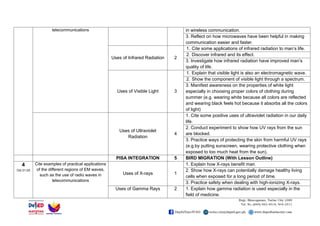
telecommunications in wireless communication.
3. Reflect on how microwaves have been helpful in making
communication easier and faster.
Uses of Infrared Radiation 2
1. Cite some applications of infrared radiation to man’s life.
2. Discover infrared and its effect.
3. Investigate how infrared radiation have improved man’s
quality of life.
Uses of Visible Light 3
1. Explain that visible light is also an electromagnetic wave.
2. Show the component of visible light through a spectrum.
3. Manifest awareness on the properties of white light
especially in choosing proper colors of clothing during
summer (e.g. wearing white because all colors are reflected
and wearing black feels hot because it absorbs all the colors
of light)
Uses of Ultraviolet
Radiation
4
1. Cite some positive uses of ultraviolet radiation in our daily
life.
2. Conduct experiment to show how UV rays from the sun
are blocked.
3. Practice ways of protecting the skin from harmful UV rays
(e.g.by putting sunscreen, wearing protective clothing when
exposed to too much heat from the sun).
PISA INTEGRATION 5 BIRD MIGRATION (With Lesson Outline)
4
Oct 21-25
Cite examples of practical applications
of the different regions of EM waves,
such as the use of radio waves in
telecommunications
Uses of X-rays 1
1. Explain how X-rays benefit man.
2. Show how X-rays can potentially damage healthy living
cells when exposed for a long period of time.
3. Practice safety when dealing with high-ionizing X-rays.
Uses of Gamma Rays 2 1. Explain how gamma radiation is used especially in the
field of medicine.
2. Show how gamma radiation is used in medicine
especially in treating cancer through radiotherapy.
3. Practice safety when dealing with high-ionizing gamma
radiation.
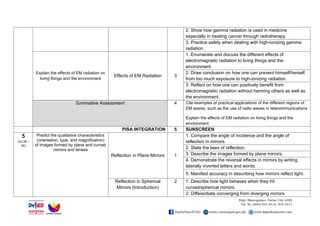
Explain the effects of EM radiation on
living things and the environment
Effects of EM Radiation 3
1. Enumerate and discuss the different effects of
electromagnetic radiation to living things and the
environment.
2. Draw conclusion on how one can prevent himself/herself
from too much exposure to high-ionizing radiation.
3. Reflect on how one can positively benefit from
electromagnetic radiation without harming others as well as
the environment.
Summative Assessment 4 Cite examples of practical applications of the different regions of
EM waves, such as the use of radio waves in telecommunications
Explain the effects of EM radiation on living things and the
environment
PISA INTEGRATION 5 SUNSCREEN
5
Oct 28 –
30)
Predict the qualitative characteristics
(orientation, type, and magnification)
of images formed by plane and curved
mirrors and lenses
Reflection in Plane Mirrors 1
1. Compare the angle of incidence and the angle of
reflection in mirrors.
2. State the laws of reflection.
3. Describe the images formed by plane mirrors.
4. Demonstrate the reversal effects in mirrors by writing
laterally inverted letters and words.
5. Manifest accuracy in describing how mirrors reflect light.
Reflection in Spherical
Mirrors (Introduction)
2 1. Describe how light behaves when they hit
curved/spherical mirrors.
2. Differentiate converging from diverging mirrors.
3. Describe the images formed by curved mirrors using an
improvised optical bench apparatus.
4. Reflect on why curved mirrors produce various types,
orientation, and size of images.
PISA INTEGRATION 3 ACID RAIN
6
(Nov 4-
8)
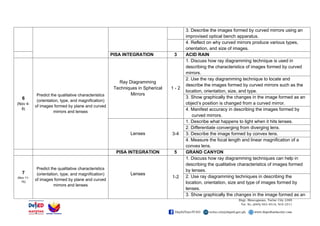
Predict the qualitative characteristics
(orientation, type, and magnification)
of images formed by plane and curved
mirrors and lenses
Ray Diagramming
Techniques in Spherical
Mirrors
1 - 2
1. Discuss how ray diagramming technique is used in
describing the characteristics of images formed by curved
mirrors.
2. Use the ray diagramming technique to locate and
describe the images formed by curved mirrors such as the
location, orientation, size, and type.
3. Show graphically the changes in the image formed as an
object’s position is changed from a curved mirror.
4. Manifest accuracy in describing the images formed by
curved mirrors.
Lenses 3-4
1. Describe what happens to light when it hits lenses.
2. Differentiate converging from diverging lens.
3. Describe the image formed by convex lens.
4. Measure the focal length and linear magnification of a
convex lens.
PISA INTEGRATION 5 GRAND CANYON
7
(Nov 11-
15)
Predict the qualitative characteristics
(orientation, type, and magnification)
of images formed by plane and curved
mirrors and lenses
Lenses
1-2
1. Discuss how ray diagramming techniques can help in
describing the qualitative characteristics of images formed
by lenses.
2. Use ray diagramming techniques in describing the
location, orientation, size and type of images formed by
lenses.
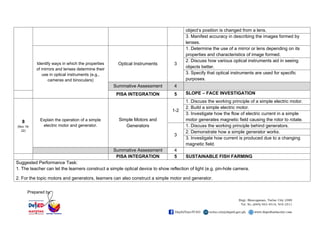
3. Show graphically the changes in the image formed as an
object’s position is changed from a lens.
3. Manifest accuracy in describing the images formed by
lenses.
Identify ways in which the properties
of mirrors and lenses determine their
use in optical instruments (e.g.,
cameras and binoculars)
Optical Instruments 3
1. Determine the use of a mirror or lens depending on its
properties and characteristics of image formed.
2. Discuss how various optical instruments aid in seeing
objects better.
3. Specify that optical instruments are used for specific
purposes.
Summative Assessment 4
PISA INTEGRATION 5 SLOPE – FACE INVESTIGATION
8
(Nov 18-
22)
Explain the operation of a simple
electric motor and generator.
Simple Motors and
Generators
1-2
1. Discuss the working principle of a simple electric motor.
2. Build a simple electric motor.
3. Investigate how the flow of electric current in a simple
motor generates magnetic field causing the rotor to rotate.
3
1. Discuss the working principle behind generators.
2. Demonstrate how a simple generator works.
3. Investigate how current is produced due to a changing
magnetic field.
Summative Assessment 4
PISA INTEGRATION 5 SUSTAINABLE FISH FARMING
Suggested Performance Task:
1. The teacher can let the learners construct a simple optical device to show reflection of light (e.g. pin-hole camera.
2. For the topic motors and generators, learners can also construct a simple motor and generator.
Prepared by:
VERNALYN P. MEDRANO
Master Teacher II
Checked:
Noted:
AIISA C. CORPUZ PhD
Education Program Supervisor ROBERT E. OSONGCO EdD
CID Chief

BOW-Q2-SCIENCE-GRADE-10-MELCs VER 1.docx

  • 1.
    SUGGESTED BUDGET OFWORK FOR SECOND QUARTER SY 2024-2025 Learning Area SCIENCE Grade Level 10 Quarter SECOND Total No. of Teaching Days for the quarter 36 Content Standards The learners demonstrate understanding of 1. the different regions of the electromagnetic spectrum 2. the images formed by the different types of mirrors and lenses 3. the relationship between electricity and magnetism in electric motors and generators Performance Standards Content 1. The Electromagnetic Wave Theory 2. The Electromagnetic Wave Spectrum: Waves and their Properties 3. Practical Applications of the Different EM Waves 4. Effects of Electromagnetic Waves to Health and the Environment 5. Reflection in Mirrors and Lenses 6. Simple Motors and Generators WEEK LEARNING COMPETENCIES TOPIC/CONTENT COVERAGE DAY INSTRUCTIONAL OBJECTIVES 0 Sept 25-27 1-3 Test Analysis of First Quarter Test
  • 2.
    1 Sept 30- Oct 4 Comparethe relative wavelengths of different forms of electromagnetic waves Electromagnetic Wave Theory Note: The comic strip activity can be given in advance to allot the time given to presentation of output. 1-2 1. Trace the development of the Electromagnetic Wave Theory. 2. Make comic strips of the scientists’ contribution to the development of the EM Wave Theory. 3. Accept or refute the different theories on electricity and magnetism to come up with a concrete explanation on the phenomenon involving EM waves. Electromagnetic Wave Theory 3-4 1. Describe how electromagnetic waves are produced and propagated. 2. Show how waves propagate mathematically. 3. Test the relationship among frequency and wavelength of electromagnetic waves. 2 Oct 7-11 Compare the relative wavelengths of different forms of electromagnetic waves The Electromagnetic Waves Spectrum 1-2 1. Enumerate and describe the different waves in the Electromagnetic Spectrum. 2. Use the Electromagnetic Spectrum in determining the properties of the different electromagnetic waves. 3. Realize the importance of the Electromagnetic Spectrum by maximizing the data that can be gathered from it. 3 1. Compare the relative wavelength and frequency of the waves in the Electromagnetic Spectrum. 2. Summarize the properties of the different electromagnetic waves in terms of wavelength, frequency and energy. 3. Realize that the wavelength, frequency and energy of different forms of waves differentiate them from each other. Cite examples of practical applications of the different regions of EM waves, such as the use of radio waves in telecommunications Uses of Radio Waves 4-5 1. Cite some practical applications of radio waves in our daily life. 2. Produce and detect radio waves. 3. Realize that different wavelengths and frequencies of radio waves have various use/s. 3 Oct 14 - 18 Cite examples of practical applications of the different regions of EM waves, such as the use of radio waves in Uses of Microwaves 1 1. Enumerate and describe the different applications of microwaves to man’s life. 2. Illustrate how microwaves are produced and propagated
  • 3.
    telecommunications in wirelesscommunication. 3. Reflect on how microwaves have been helpful in making communication easier and faster. Uses of Infrared Radiation 2 1. Cite some applications of infrared radiation to man’s life. 2. Discover infrared and its effect. 3. Investigate how infrared radiation have improved man’s quality of life. Uses of Visible Light 3 1. Explain that visible light is also an electromagnetic wave. 2. Show the component of visible light through a spectrum. 3. Manifest awareness on the properties of white light especially in choosing proper colors of clothing during summer (e.g. wearing white because all colors are reflected and wearing black feels hot because it absorbs all the colors of light) Uses of Ultraviolet Radiation 4 1. Cite some positive uses of ultraviolet radiation in our daily life. 2. Conduct experiment to show how UV rays from the sun are blocked. 3. Practice ways of protecting the skin from harmful UV rays (e.g.by putting sunscreen, wearing protective clothing when exposed to too much heat from the sun). PISA INTEGRATION 5 BIRD MIGRATION (With Lesson Outline) 4 Oct 21-25 Cite examples of practical applications of the different regions of EM waves, such as the use of radio waves in telecommunications Uses of X-rays 1 1. Explain how X-rays benefit man. 2. Show how X-rays can potentially damage healthy living cells when exposed for a long period of time. 3. Practice safety when dealing with high-ionizing X-rays. Uses of Gamma Rays 2 1. Explain how gamma radiation is used especially in the field of medicine.
  • 4.
    2. Show howgamma radiation is used in medicine especially in treating cancer through radiotherapy. 3. Practice safety when dealing with high-ionizing gamma radiation. Explain the effects of EM radiation on living things and the environment Effects of EM Radiation 3 1. Enumerate and discuss the different effects of electromagnetic radiation to living things and the environment. 2. Draw conclusion on how one can prevent himself/herself from too much exposure to high-ionizing radiation. 3. Reflect on how one can positively benefit from electromagnetic radiation without harming others as well as the environment. Summative Assessment 4 Cite examples of practical applications of the different regions of EM waves, such as the use of radio waves in telecommunications Explain the effects of EM radiation on living things and the environment PISA INTEGRATION 5 SUNSCREEN 5 Oct 28 – 30) Predict the qualitative characteristics (orientation, type, and magnification) of images formed by plane and curved mirrors and lenses Reflection in Plane Mirrors 1 1. Compare the angle of incidence and the angle of reflection in mirrors. 2. State the laws of reflection. 3. Describe the images formed by plane mirrors. 4. Demonstrate the reversal effects in mirrors by writing laterally inverted letters and words. 5. Manifest accuracy in describing how mirrors reflect light. Reflection in Spherical Mirrors (Introduction) 2 1. Describe how light behaves when they hit curved/spherical mirrors. 2. Differentiate converging from diverging mirrors.
  • 5.
    3. Describe theimages formed by curved mirrors using an improvised optical bench apparatus. 4. Reflect on why curved mirrors produce various types, orientation, and size of images. PISA INTEGRATION 3 ACID RAIN 6 (Nov 4- 8) Predict the qualitative characteristics (orientation, type, and magnification) of images formed by plane and curved mirrors and lenses Ray Diagramming Techniques in Spherical Mirrors 1 - 2 1. Discuss how ray diagramming technique is used in describing the characteristics of images formed by curved mirrors. 2. Use the ray diagramming technique to locate and describe the images formed by curved mirrors such as the location, orientation, size, and type. 3. Show graphically the changes in the image formed as an object’s position is changed from a curved mirror. 4. Manifest accuracy in describing the images formed by curved mirrors. Lenses 3-4 1. Describe what happens to light when it hits lenses. 2. Differentiate converging from diverging lens. 3. Describe the image formed by convex lens. 4. Measure the focal length and linear magnification of a convex lens. PISA INTEGRATION 5 GRAND CANYON 7 (Nov 11- 15) Predict the qualitative characteristics (orientation, type, and magnification) of images formed by plane and curved mirrors and lenses Lenses 1-2 1. Discuss how ray diagramming techniques can help in describing the qualitative characteristics of images formed by lenses. 2. Use ray diagramming techniques in describing the location, orientation, size and type of images formed by lenses. 3. Show graphically the changes in the image formed as an
  • 6.
    object’s position ischanged from a lens. 3. Manifest accuracy in describing the images formed by lenses. Identify ways in which the properties of mirrors and lenses determine their use in optical instruments (e.g., cameras and binoculars) Optical Instruments 3 1. Determine the use of a mirror or lens depending on its properties and characteristics of image formed. 2. Discuss how various optical instruments aid in seeing objects better. 3. Specify that optical instruments are used for specific purposes. Summative Assessment 4 PISA INTEGRATION 5 SLOPE – FACE INVESTIGATION 8 (Nov 18- 22) Explain the operation of a simple electric motor and generator. Simple Motors and Generators 1-2 1. Discuss the working principle of a simple electric motor. 2. Build a simple electric motor. 3. Investigate how the flow of electric current in a simple motor generates magnetic field causing the rotor to rotate. 3 1. Discuss the working principle behind generators. 2. Demonstrate how a simple generator works. 3. Investigate how current is produced due to a changing magnetic field. Summative Assessment 4 PISA INTEGRATION 5 SUSTAINABLE FISH FARMING Suggested Performance Task: 1. The teacher can let the learners construct a simple optical device to show reflection of light (e.g. pin-hole camera. 2. For the topic motors and generators, learners can also construct a simple motor and generator. Prepared by:
  • 7.
    VERNALYN P. MEDRANO MasterTeacher II Checked: Noted: AIISA C. CORPUZ PhD Education Program Supervisor ROBERT E. OSONGCO EdD CID Chief