B.J.P.S Samiti’s
M.V.HERWADKAR ENGLISH MEDIUM HIGH SCHOOL
Electricity
Program:
Semester:
Course: NAME OF THE COURSE
1
M.V.HERWADKAR ENGLISH MEDIUM SCHOOL
2
Electricity :It is the presence or flow of charges
Charge:
 It is the property of an atom
 It can be (+)ve or (–)ve
 Like charges repel each other and unlike charges attract
each other
 Its S.I unit is coulomb
M.V.HERWADKAR ENGLISH MEDIUM SCHOOL
3
 Charge on one electron is e=-1.6x10⁻¹⁹C
 No of electrons in 1 coulomb of charge
n=6.25x10¹⁸
Current:
 It is rate of flow of charge.
 Current I=Charge/time
 S.I unit of current is Ampere
M.V.HERWADKAR ENGLISH MEDIUM SCHOOL
4
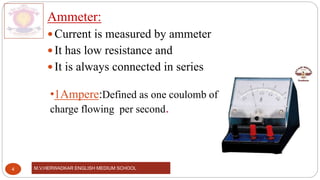
Ammeter:
 Current is measured by ammeter
 It has low resistance and
 It is always connected in series
•1Ampere:Defined as one coulomb of
charge flowing per second.
M.V.HERWADKAR ENGLISH MEDIUM SCHOOL
5
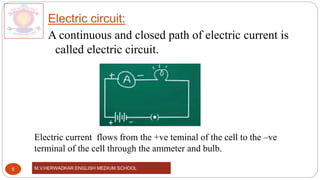
Electric circuit:
A continuous and closed path of electric current is
called electric circuit.
Electric current flows from the +ve teminal of the cell to the –ve
terminal of the cell through the ammeter and bulb.
M.V.HERWADKAR ENGLISH MEDIUM SCHOOL
6
 Potential difference:
Work done to move a unit charge from one point to
another point of the conductor
 Potential difference V=Work/charge
 S.I unit of potential difference is Volt
Potential difference is measured by Voltmeter.
One Volt: When 1 Joule of work is done to carry one
coulomb (1C) of charge from one point to another of a
current carrying conductor then the potential difference is
send to be I Volt.
M.V.HERWADKAR ENGLISH MEDIUM SCHOOL
7
 Voltmeter :
 It is an instrument, used to measure the potential
difference .
 It is always connected in parallel across the points
between which the potential difference is to be
measured.
 It has high resistance.
M.V.HERWADKAR ENGLISH MEDIUM SCHOOL
8
M.V.HERWADKAR ENGLISH MEDIUM SCHOOL
9
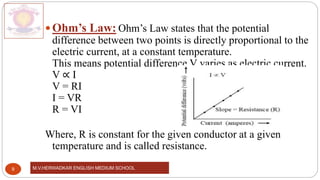
 Ohm’s Law: Ohm’s Law states that the potential
difference between two points is directly proportional to the
electric current, at a constant temperature.
This means potential difference V varies as electric current.
V ∝ I
V = RI
I = VR
R = VI
Where, R is constant for the given conductor at a given
temperature and is called resistance.
M.V.HERWADKAR ENGLISH MEDIUM SCHOOL
10
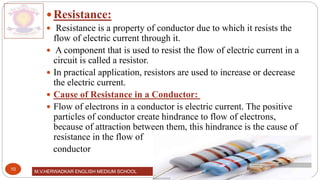
 Resistance:
 Resistance is a property of conductor due to which it resists the
flow of electric current through it.
 A component that is used to resist the flow of electric current in a
circuit is called a resistor.
 In practical application, resistors are used to increase or decrease
the electric current.
 Cause of Resistance in a Conductor:
 Flow of electrons in a conductor is electric current. The positive
particles of conductor create hindrance to flow of electrons,
because of attraction between them, this hindrance is the cause of
resistance in the flow of
conductor
M.V.HERWADKAR ENGLISH MEDIUM SCHOOL
11
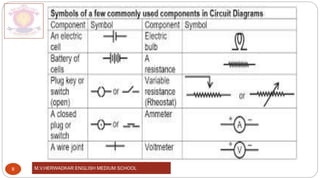
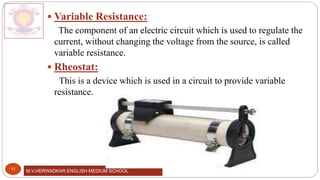
 Variable Resistance:
The component of an electric circuit which is used to regulate the
current, without changing the voltage from the source, is called
variable resistance.
 Rheostat:
This is a device which is used in a circuit to provide variable
resistance.
M.V.HERWADKAR ENGLISH MEDIUM SCHOOL
12
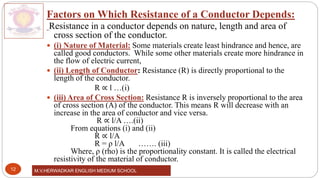
Factors on Which Resistance of a Conductor Depends:
Resistance in a conductor depends on nature, length and area of
cross section of the conductor.
 (i) Nature of Material: Some materials create least hindrance and hence, are
called good conductors. While some other materials create more hindrance in
the flow of electric current,
 (ii) Length of Conductor: Resistance (R) is directly proportional to the
length of the conductor.
R ∝ l …(i)
 (iii) Area of Cross Section: Resistance R is inversely proportional to the area
of cross section (A) of the conductor. This means R will decrease with an
increase in the area of conductor and vice versa.
R ∝ l/A ….(ii)
From equations (i) and (ii)
R ∝ l/A
R = ρ l/A ……. (iii)
Where, ρ (rho) is the proportionality constant. It is called the electrical
resistivity of the material of conductor.
M.V.HERWADKAR ENGLISH MEDIUM SCHOOL
13
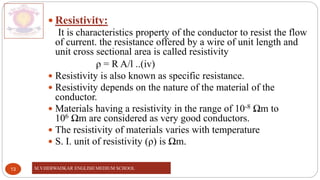
 Resistivity:
It is characteristics property of the conductor to resist the flow
of current. the resistance offered by a wire of unit length and
unit cross sectional area is called resistivity
ρ = R A/l ..(iv)
 Resistivity is also known as specific resistance.
 Resistivity depends on the nature of the material of the
conductor.
 Materials having a resistivity in the range of 10-8 Ωm to
106 Ωm are considered as very good conductors.
 The resistivity of materials varies with temperature
 S. I. unit of resistivity (ρ) is Ωm.
14
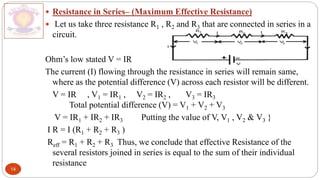
 Resistance in Series– (Maximum Effective Resistance)
 Let us take three resistance R1 , R2 and R3 that are connected in series in a
circuit.
Ohm’s low stated V = IR
The current (I) flowing through the resistance in series will remain same,
where as the potential difference (V) across each resistor will be different.
V = IR , V1 = IR1 , V2 = IR2 , V3 = IR3
Total potential difference (V) = V1 + V2 + V3
V = IR1 + IR2 + IR3 Putting the value of V, V1 , V2 & V3 }
I R = I (R1 + R2 + R3 )
Reff = R1 + R2 + R3 Thus, we conclude that effective Resistance of the
several resistors joined in series is equal to the sum of their individual
resistance
M.V.HERWADKAR ENGLISH MEDIUM SCHOOL
15
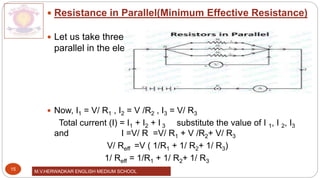
 Resistance in Parallel(Minimum Effective Resistance)
 Let us take three R1 , R2 and R3 , that are connected in
parallel in the electric circuit.
 Now, I1 = V/ R1 , I2 = V /R2 , I3 = V/ R3
Total current (I) = I1 + I2 + I 3 substitute the value of I 1, I 2, I3
and I =V/ R =V/ R1 + V /R2+ V/ R3
V/ Reff =V ( 1/R1 + 1/ R2+ 1/ R3)
1/ Reff = 1/R1 + 1/ R2+ 1/ R3
M.V.HERWADKAR ENGLISH MEDIUM SCHOOL
16
 Disadvantage of series connection in on electric circuit :–
 If one appliances stop working due to some defect then all
the other appliances stop working
 All the appliances have only one switch due which they
cant be turned on and off separately
 All the appliances do not get same voltage as voltage gets
divided in series combination
 The equivalent resistance increases too much due which the
amount of current flowing becomes very small.
M.V.HERWADKAR ENGLISH MEDIUM SCHOOL
17
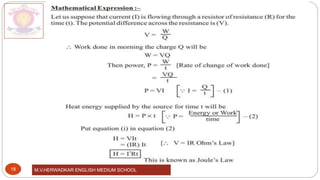
 Heating effect of Electric Current : when an electric current passes through a
conductor (resistor) the conductor becomes hot after some time and produces
heat. This is called heating effect of electric current.
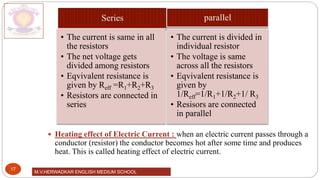
• The current is same in all
the resistors
• The net voltage gets
divided among resistors
• Eqvivalent resistance is
given by Reff =R1+R2+R3
• Resistors are connected in
series
• The current is divided in
individual resistor
• The voltage is same
across all the resistors
• Eqvivalent resistance is
given by
1/Reff=1/R1+1/R2+1/ R3
• Resisors are connected
in parallel
M.V.HERWADKAR ENGLISH MEDIUM SCHOOL
18
M.V.HERWADKAR ENGLISH MEDIUM SCHOOL
19
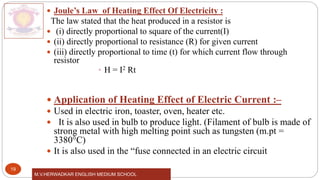
 Joule’s Law of Heating Effect Of Electricity :
The law stated that the heat produced in a resistor is
 (i) directly proportional to square of the current(I)
 (ii) directly proportional to resistance (R) for given current
 (iii) directly proportional to time (t) for which current flow through
resistor
• H = I2 Rt
 Application of Heating Effect of Electric Current :–
 Used in electric iron, toaster, oven, heater etc.
 It is also used in bulb to produce light. (Filament of bulb is made of
strong metal with high melting point such as tungsten (m.pt =
3380°C)
 It is also used in the “fuse connected in an electric circuit
M.V.HERWADKAR ENGLISH MEDIUM SCHOOL
20
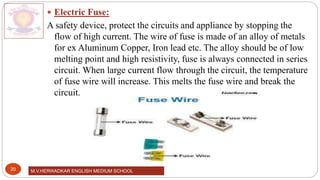
 Electric Fuse:
A safety device, protect the circuits and appliance by stopping the
flow of high current. The wire of fuse is made of an alloy of metals
for ex Aluminum Copper, Iron lead etc. The alloy should be of low
melting point and high resistivity, fuse is always connected in series
circuit. When large current flow through the circuit, the temperature
of fuse wire will increase. This melts the fuse wire and break the
circuit.
M.V.HERWADKAR ENGLISH MEDIUM SCHOOL
21
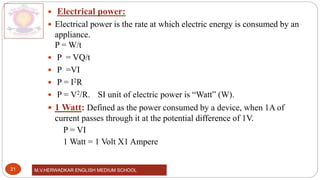
 Electrical power:
 Electrical power is the rate at which electric energy is consumed by an
appliance.
P = W/t
 P = VQ/t
 P =VI
 P = I2R
 P = V2/R. SI unit of electric power is “Watt” (W).
 1 Watt: Defined as the power consumed by a device, when 1A of
current passes through it at the potential difference of 1V.
P = VI
1 Watt = 1 Volt X1 Ampere
M.V.HERWADKAR ENGLISH MEDIUM SCHOOL
22
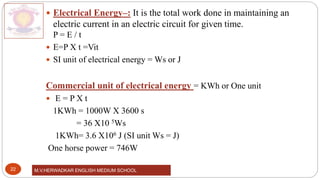
 Electrical Energy–: It is the total work done in maintaining an
electric current in an electric circuit for given time.
P = E / t
 E=P X t =Vit
 SI unit of electrical energy = Ws or J
Commercial unit of electrical energy = KWh or One unit
 E = P X t
1KWh = 1000W X 3600 s
= 36 X10 5Ws
1KWh= 3.6 X10⁶ J (SI unit Ws = J)
One horse power = 746W

electricity class10.pptx

  • 1.
    B.J.P.S Samiti’s M.V.HERWADKAR ENGLISHMEDIUM HIGH SCHOOL Electricity Program: Semester: Course: NAME OF THE COURSE 1
  • 2.
    M.V.HERWADKAR ENGLISH MEDIUMSCHOOL 2 Electricity :It is the presence or flow of charges Charge:  It is the property of an atom  It can be (+)ve or (–)ve  Like charges repel each other and unlike charges attract each other  Its S.I unit is coulomb
  • 3.
    M.V.HERWADKAR ENGLISH MEDIUMSCHOOL 3  Charge on one electron is e=-1.6x10⁻¹⁹C  No of electrons in 1 coulomb of charge n=6.25x10¹⁸ Current:  It is rate of flow of charge.  Current I=Charge/time  S.I unit of current is Ampere
  • 4.
    M.V.HERWADKAR ENGLISH MEDIUMSCHOOL 4 Ammeter:  Current is measured by ammeter  It has low resistance and  It is always connected in series •1Ampere:Defined as one coulomb of charge flowing per second.
  • 5.
    M.V.HERWADKAR ENGLISH MEDIUMSCHOOL 5 Electric circuit: A continuous and closed path of electric current is called electric circuit. Electric current flows from the +ve teminal of the cell to the –ve terminal of the cell through the ammeter and bulb.
  • 6.
    M.V.HERWADKAR ENGLISH MEDIUMSCHOOL 6  Potential difference: Work done to move a unit charge from one point to another point of the conductor  Potential difference V=Work/charge  S.I unit of potential difference is Volt Potential difference is measured by Voltmeter. One Volt: When 1 Joule of work is done to carry one coulomb (1C) of charge from one point to another of a current carrying conductor then the potential difference is send to be I Volt.
  • 7.
    M.V.HERWADKAR ENGLISH MEDIUMSCHOOL 7  Voltmeter :  It is an instrument, used to measure the potential difference .  It is always connected in parallel across the points between which the potential difference is to be measured.  It has high resistance.
  • 8.
  • 9.
    M.V.HERWADKAR ENGLISH MEDIUMSCHOOL 9  Ohm’s Law: Ohm’s Law states that the potential difference between two points is directly proportional to the electric current, at a constant temperature. This means potential difference V varies as electric current. V ∝ I V = RI I = VR R = VI Where, R is constant for the given conductor at a given temperature and is called resistance.
  • 10.
    M.V.HERWADKAR ENGLISH MEDIUMSCHOOL 10  Resistance:  Resistance is a property of conductor due to which it resists the flow of electric current through it.  A component that is used to resist the flow of electric current in a circuit is called a resistor.  In practical application, resistors are used to increase or decrease the electric current.  Cause of Resistance in a Conductor:  Flow of electrons in a conductor is electric current. The positive particles of conductor create hindrance to flow of electrons, because of attraction between them, this hindrance is the cause of resistance in the flow of conductor
  • 11.
    M.V.HERWADKAR ENGLISH MEDIUMSCHOOL 11  Variable Resistance: The component of an electric circuit which is used to regulate the current, without changing the voltage from the source, is called variable resistance.  Rheostat: This is a device which is used in a circuit to provide variable resistance.
  • 12.
    M.V.HERWADKAR ENGLISH MEDIUMSCHOOL 12 Factors on Which Resistance of a Conductor Depends: Resistance in a conductor depends on nature, length and area of cross section of the conductor.  (i) Nature of Material: Some materials create least hindrance and hence, are called good conductors. While some other materials create more hindrance in the flow of electric current,  (ii) Length of Conductor: Resistance (R) is directly proportional to the length of the conductor. R ∝ l …(i)  (iii) Area of Cross Section: Resistance R is inversely proportional to the area of cross section (A) of the conductor. This means R will decrease with an increase in the area of conductor and vice versa. R ∝ l/A ….(ii) From equations (i) and (ii) R ∝ l/A R = ρ l/A ……. (iii) Where, ρ (rho) is the proportionality constant. It is called the electrical resistivity of the material of conductor.
  • 13.
    M.V.HERWADKAR ENGLISH MEDIUMSCHOOL 13  Resistivity: It is characteristics property of the conductor to resist the flow of current. the resistance offered by a wire of unit length and unit cross sectional area is called resistivity ρ = R A/l ..(iv)  Resistivity is also known as specific resistance.  Resistivity depends on the nature of the material of the conductor.  Materials having a resistivity in the range of 10-8 Ωm to 106 Ωm are considered as very good conductors.  The resistivity of materials varies with temperature  S. I. unit of resistivity (ρ) is Ωm.
  • 14.
    14  Resistance inSeries– (Maximum Effective Resistance)  Let us take three resistance R1 , R2 and R3 that are connected in series in a circuit. Ohm’s low stated V = IR The current (I) flowing through the resistance in series will remain same, where as the potential difference (V) across each resistor will be different. V = IR , V1 = IR1 , V2 = IR2 , V3 = IR3 Total potential difference (V) = V1 + V2 + V3 V = IR1 + IR2 + IR3 Putting the value of V, V1 , V2 & V3 } I R = I (R1 + R2 + R3 ) Reff = R1 + R2 + R3 Thus, we conclude that effective Resistance of the several resistors joined in series is equal to the sum of their individual resistance
  • 15.
    M.V.HERWADKAR ENGLISH MEDIUMSCHOOL 15  Resistance in Parallel(Minimum Effective Resistance)  Let us take three R1 , R2 and R3 , that are connected in parallel in the electric circuit.  Now, I1 = V/ R1 , I2 = V /R2 , I3 = V/ R3 Total current (I) = I1 + I2 + I 3 substitute the value of I 1, I 2, I3 and I =V/ R =V/ R1 + V /R2+ V/ R3 V/ Reff =V ( 1/R1 + 1/ R2+ 1/ R3) 1/ Reff = 1/R1 + 1/ R2+ 1/ R3
  • 16.
    M.V.HERWADKAR ENGLISH MEDIUMSCHOOL 16  Disadvantage of series connection in on electric circuit :–  If one appliances stop working due to some defect then all the other appliances stop working  All the appliances have only one switch due which they cant be turned on and off separately  All the appliances do not get same voltage as voltage gets divided in series combination  The equivalent resistance increases too much due which the amount of current flowing becomes very small.
  • 17.
    M.V.HERWADKAR ENGLISH MEDIUMSCHOOL 17  Heating effect of Electric Current : when an electric current passes through a conductor (resistor) the conductor becomes hot after some time and produces heat. This is called heating effect of electric current. • The current is same in all the resistors • The net voltage gets divided among resistors • Eqvivalent resistance is given by Reff =R1+R2+R3 • Resistors are connected in series • The current is divided in individual resistor • The voltage is same across all the resistors • Eqvivalent resistance is given by 1/Reff=1/R1+1/R2+1/ R3 • Resisors are connected in parallel
  • 18.
  • 19.
    M.V.HERWADKAR ENGLISH MEDIUMSCHOOL 19  Joule’s Law of Heating Effect Of Electricity : The law stated that the heat produced in a resistor is  (i) directly proportional to square of the current(I)  (ii) directly proportional to resistance (R) for given current  (iii) directly proportional to time (t) for which current flow through resistor • H = I2 Rt  Application of Heating Effect of Electric Current :–  Used in electric iron, toaster, oven, heater etc.  It is also used in bulb to produce light. (Filament of bulb is made of strong metal with high melting point such as tungsten (m.pt = 3380°C)  It is also used in the “fuse connected in an electric circuit
  • 20.
    M.V.HERWADKAR ENGLISH MEDIUMSCHOOL 20  Electric Fuse: A safety device, protect the circuits and appliance by stopping the flow of high current. The wire of fuse is made of an alloy of metals for ex Aluminum Copper, Iron lead etc. The alloy should be of low melting point and high resistivity, fuse is always connected in series circuit. When large current flow through the circuit, the temperature of fuse wire will increase. This melts the fuse wire and break the circuit.
  • 21.
    M.V.HERWADKAR ENGLISH MEDIUMSCHOOL 21  Electrical power:  Electrical power is the rate at which electric energy is consumed by an appliance. P = W/t  P = VQ/t  P =VI  P = I2R  P = V2/R. SI unit of electric power is “Watt” (W).  1 Watt: Defined as the power consumed by a device, when 1A of current passes through it at the potential difference of 1V. P = VI 1 Watt = 1 Volt X1 Ampere
  • 22.
    M.V.HERWADKAR ENGLISH MEDIUMSCHOOL 22  Electrical Energy–: It is the total work done in maintaining an electric current in an electric circuit for given time. P = E / t  E=P X t =Vit  SI unit of electrical energy = Ws or J Commercial unit of electrical energy = KWh or One unit  E = P X t 1KWh = 1000W X 3600 s = 36 X10 5Ws 1KWh= 3.6 X10⁶ J (SI unit Ws = J) One horse power = 746W