
Elasticity
How responsive are you???
Adapted from http://welkerswikinomics.com/blog/ww-study-guides-3/
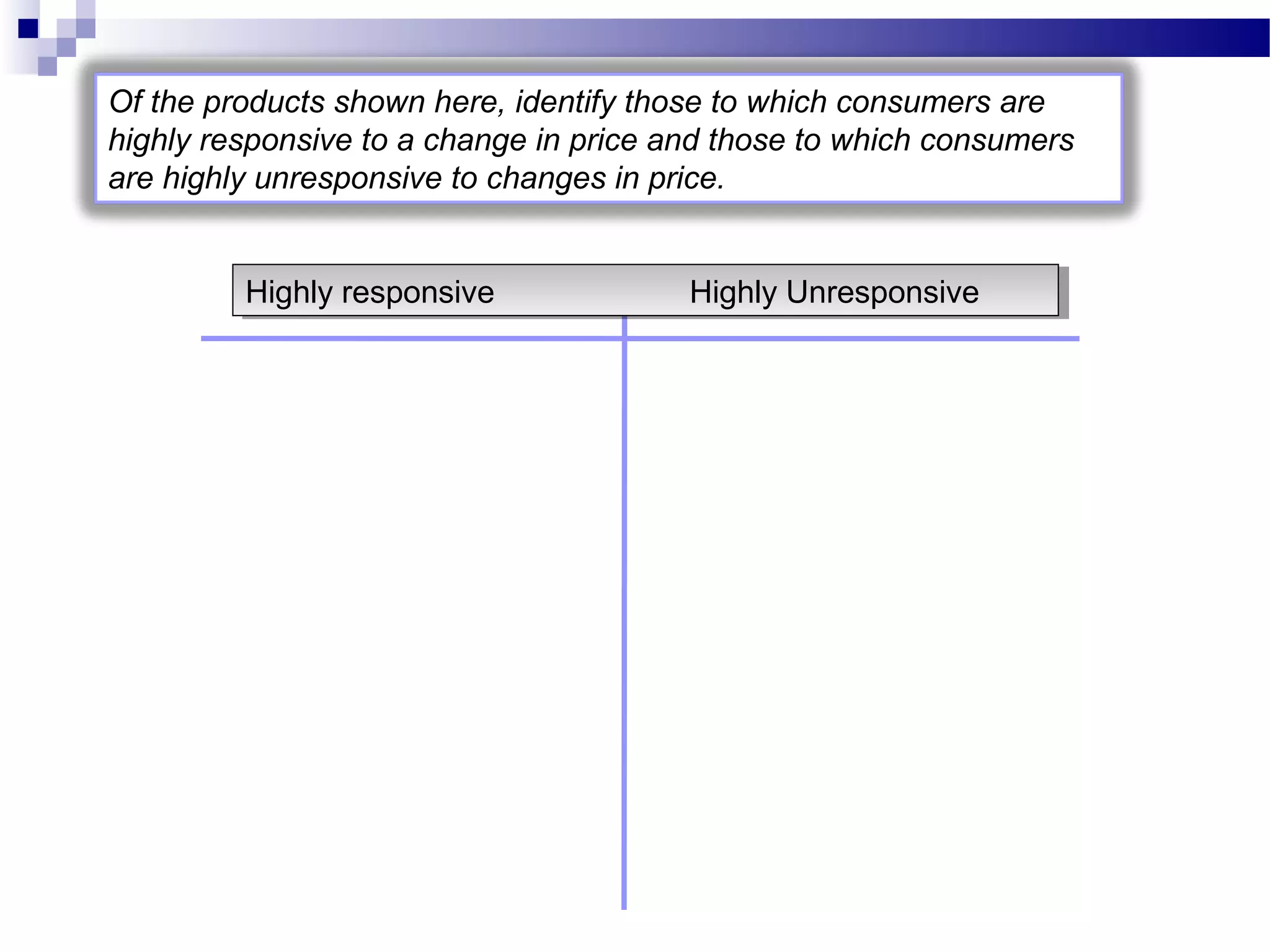
Of the products shown here, identify those to which consumers are
highly responsive to a change in price and those to which consumers
are highly unresponsive to changes in price.
Highly responsive Highly UnresponsiveHighly responsive Highly Unresponsive
Elasticity of Demand
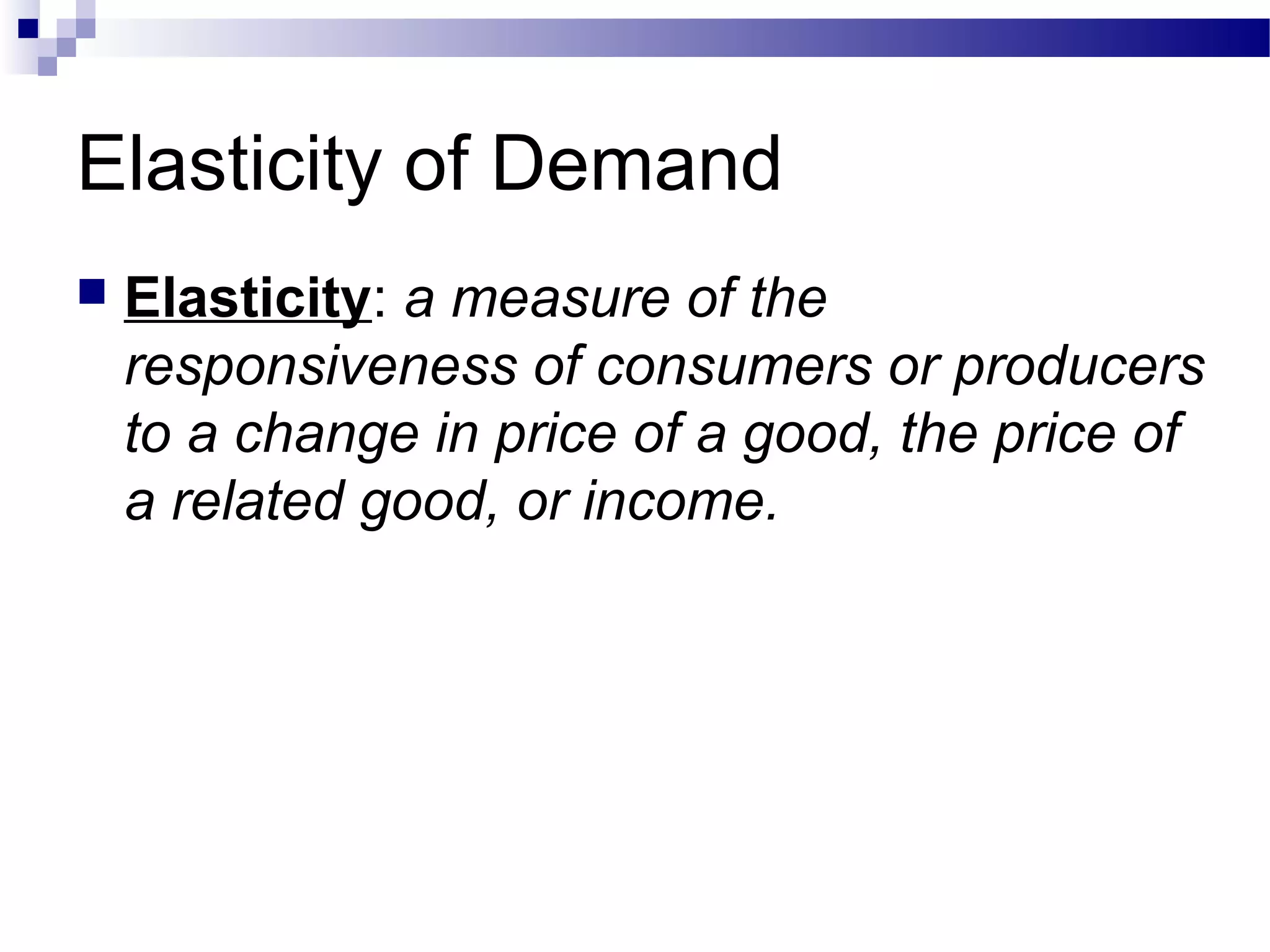
 Elasticity: a measure of the
responsiveness of consumers or producers
to a change in price of a good, the price of
a related good, or income.
Elasticity of Demand
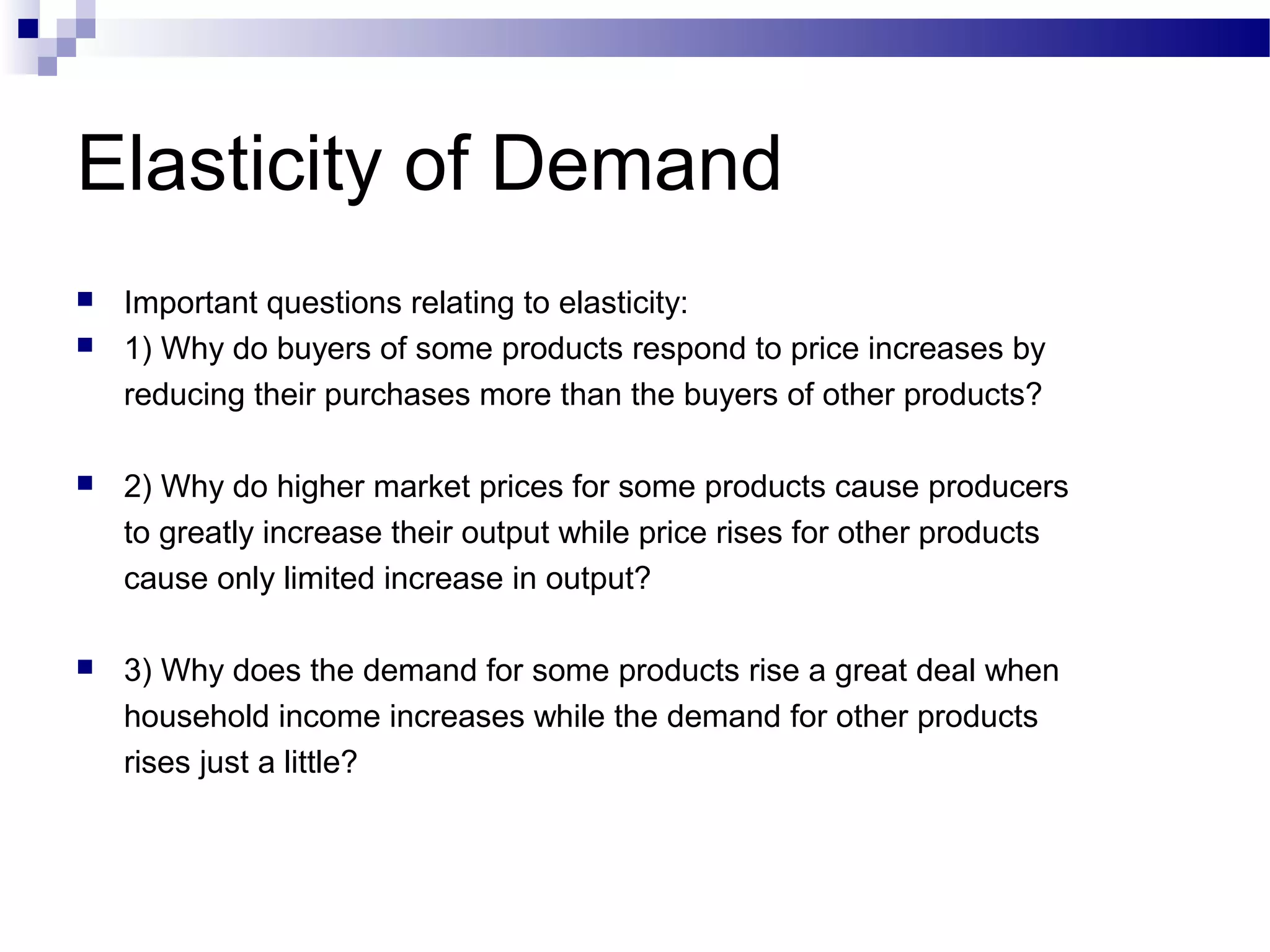
 Important questions relating to elasticity:
 1) Why do buyers of some products respond to price increases by
reducing their purchases more than the buyers of other products?
 2) Why do higher market prices for some products cause producers
to greatly increase their output while price rises for other products
cause only limited increase in output?
 3) Why does the demand for some products rise a great deal when
household income increases while the demand for other products
rises just a little?
Price Elasticity of Demand
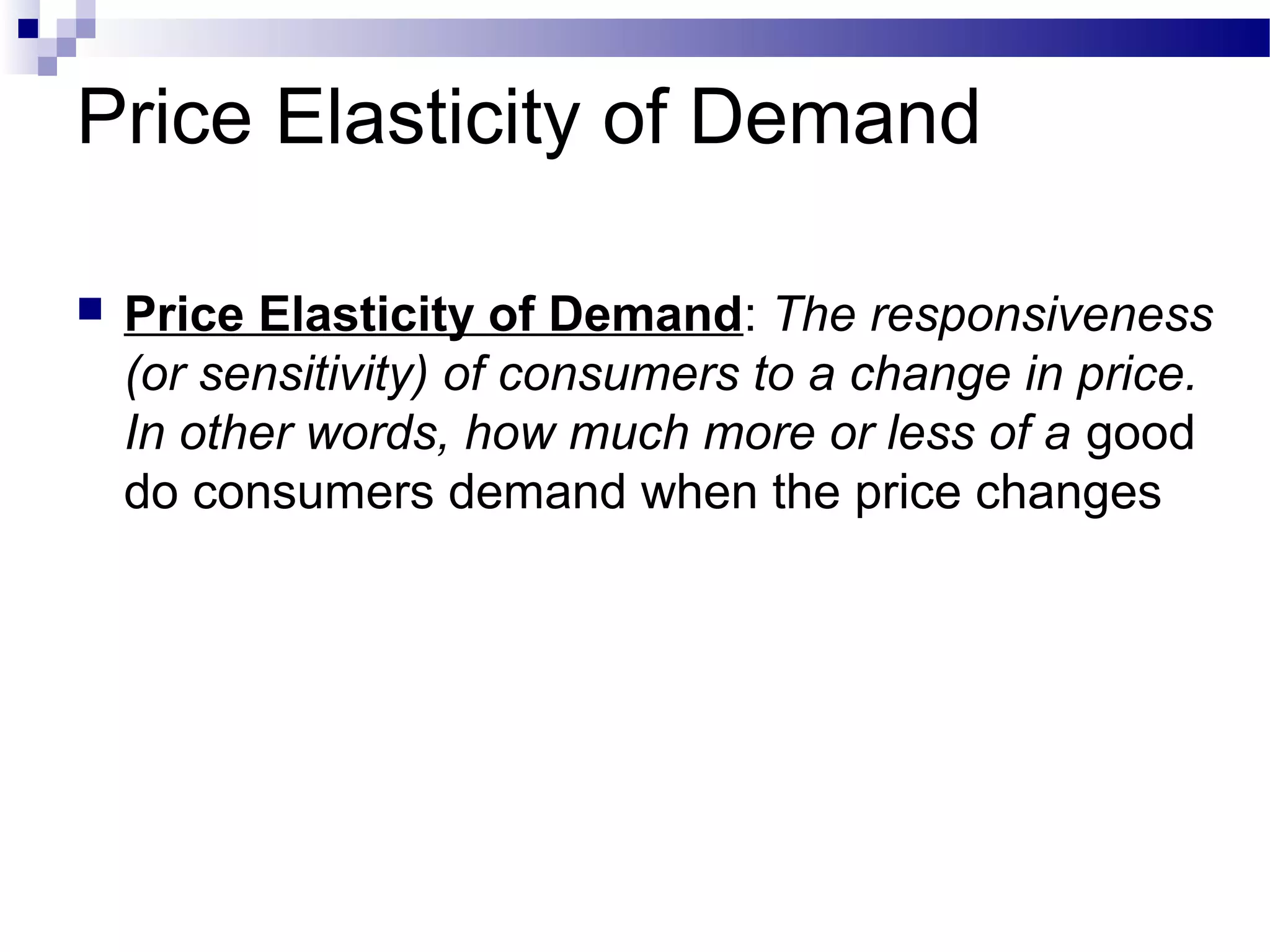
 Price Elasticity of Demand: The responsiveness
(or sensitivity) of consumers to a change in price.
In other words, how much more or less of a good
do consumers demand when the price changes
Elasticity of Demand
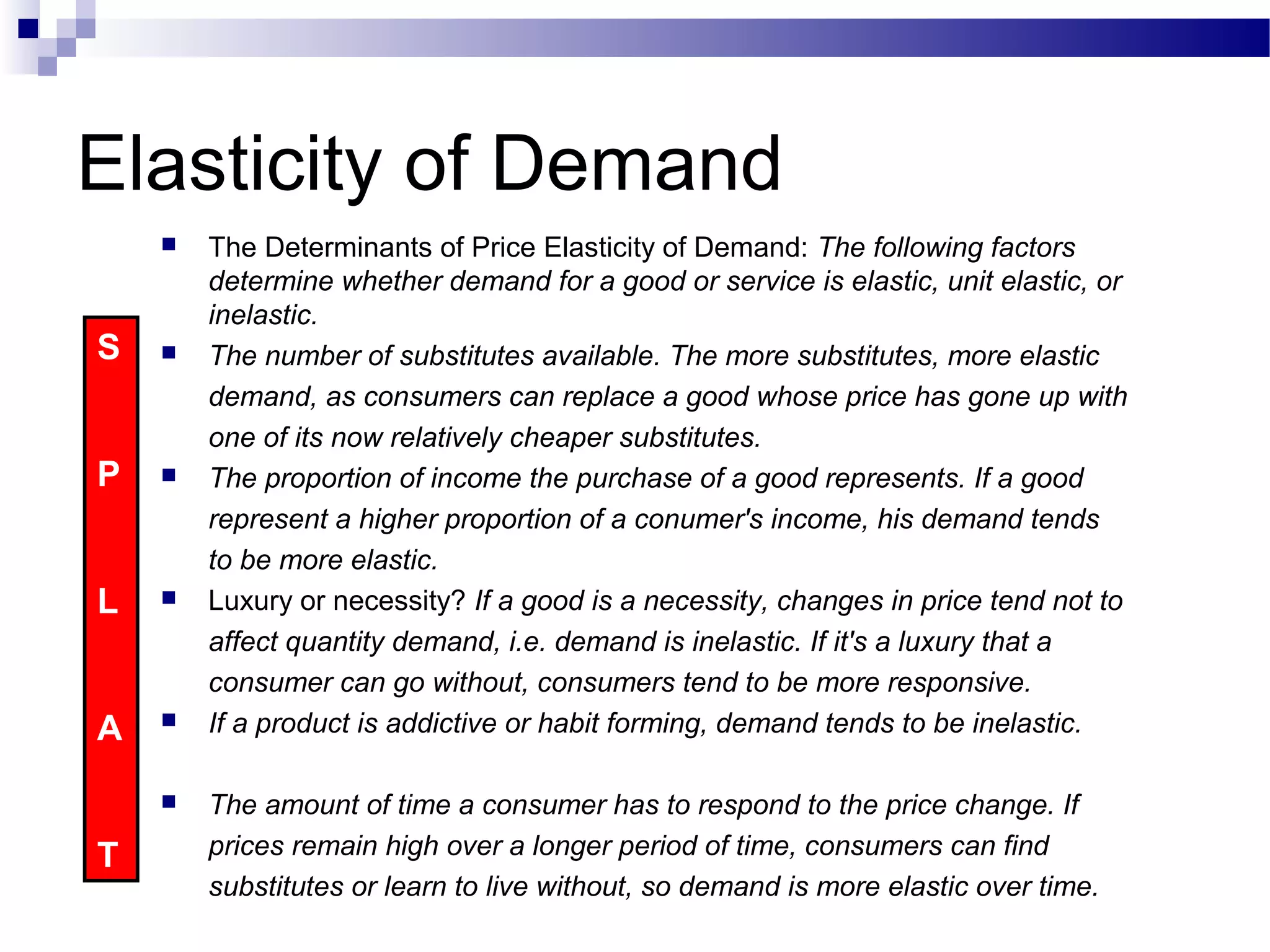
 The Determinants of Price Elasticity of Demand: The following factors
determine whether demand for a good or service is elastic, unit elastic, or
inelastic.
 The number of substitutes available. The more substitutes, more elastic
demand, as consumers can replace a good whose price has gone up with
one of its now relatively cheaper substitutes.
 The proportion of income the purchase of a good represents. If a good
represent a higher proportion of a conumer's income, his demand tends
to be more elastic.
 Luxury or necessity? If a good is a necessity, changes in price tend not to
affect quantity demand, i.e. demand is inelastic. If it's a luxury that a
consumer can go without, consumers tend to be more responsive.
 If a product is addictive or habit forming, demand tends to be inelastic.
 The amount of time a consumer has to respond to the price change. If
prices remain high over a longer period of time, consumers can find
substitutes or learn to live without, so demand is more elastic over time.
S
P
L
A
T
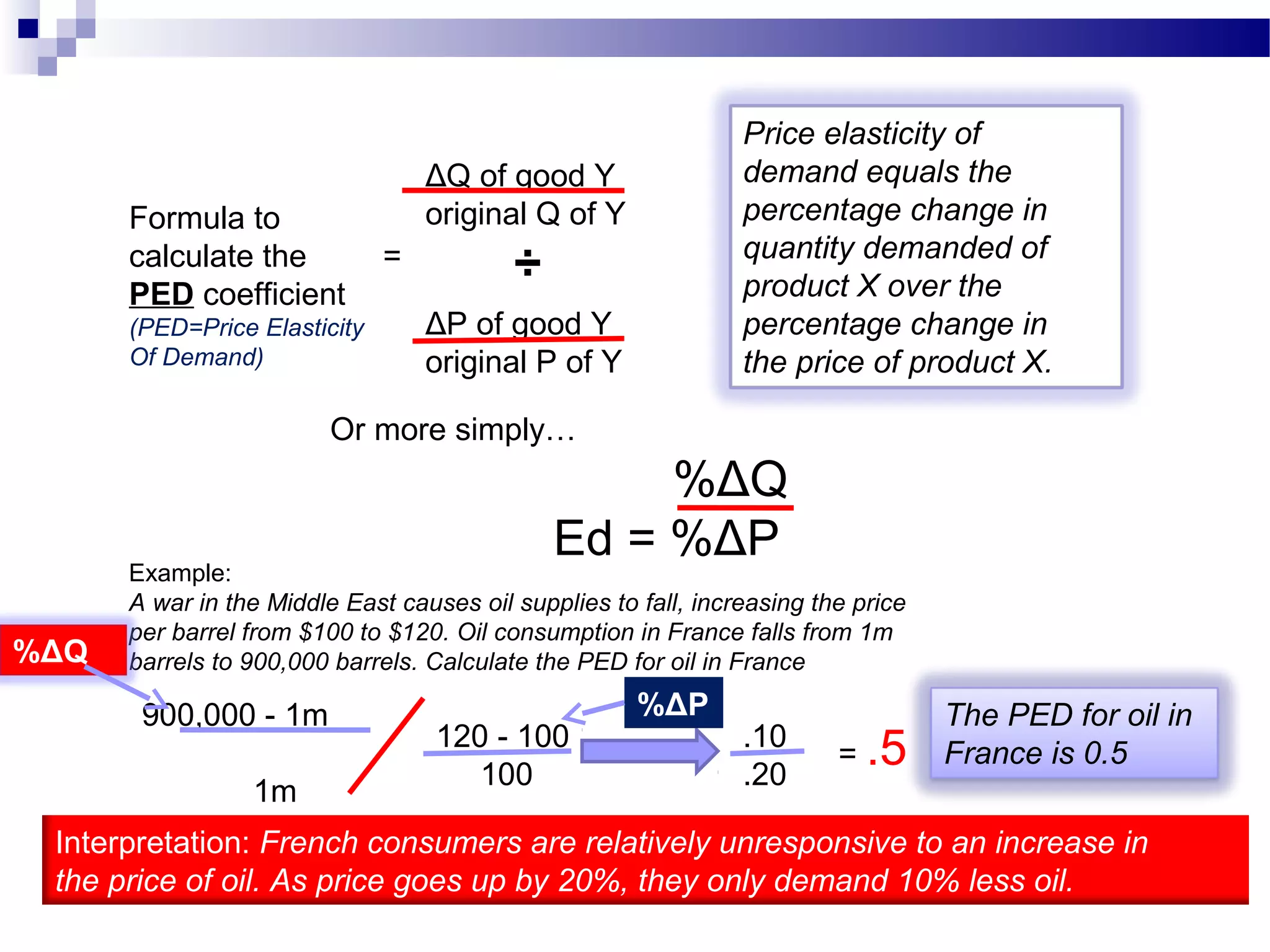
Formula to
calculate the =
PED coefficient
(PED=Price Elasticity
Of Demand)
ΔQ of good Y
original Q of Y
÷
ΔP of good Y
original P of Y
Price elasticity of
demand equals the
percentage change in
quantity demanded of
product X over the
percentage change in
the price of product X.
Or more simply…
%ΔQ
Ed = %ΔP
Example:
A war in the Middle East causes oil supplies to fall, increasing the price
per barrel from $100 to $120. Oil consumption in France falls from 1m
barrels to 900,000 barrels. Calculate the PED for oil in France
900,000 - 1m
1m
120 - 100
100
.10
.20
= .5
The PED for oil in
France is 0.5
Interpretation: French consumers are relatively unresponsive to an increase in
the price of oil. As price goes up by 20%, they only demand 10% less oil.
%ΔQ
%ΔP
$10
$9
$8
$7
$6
$5
$4
$3
$2
$1
1 2 3 4 5 6 7 8 9 10
x
x
Quantity of _____________
Price
of
_____
0
%ΔPrice
% ΔQuantity
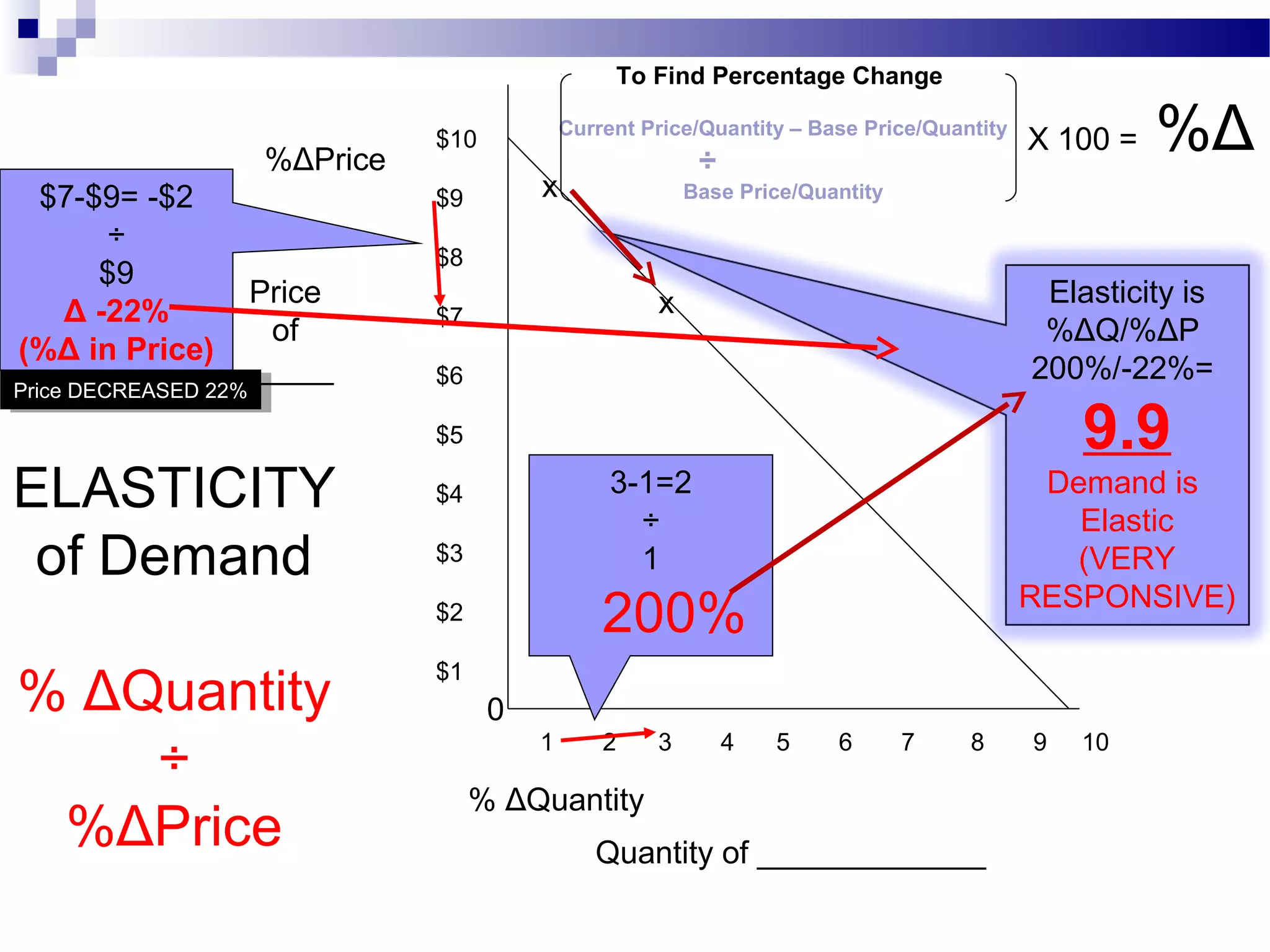
To Find Percentage Change
Current Price/Quantity – Base Price/Quantity
÷
Base Price/Quantity
X 100 = %Δ
ELASTICITY
of Demand
% ΔQuantity
÷
%ΔPrice
$7-$9= -$2
÷
$9
Δ -22%
(%Δ in Price)
3-1=2
÷
1
200%
Elasticity is
%ΔQ/%ΔP
200%/-22%=
9.9
Demand is
Elastic
(VERY
RESPONSIVE)
Price DECREASED 22%Price DECREASED 22%
Elasticity of Demand
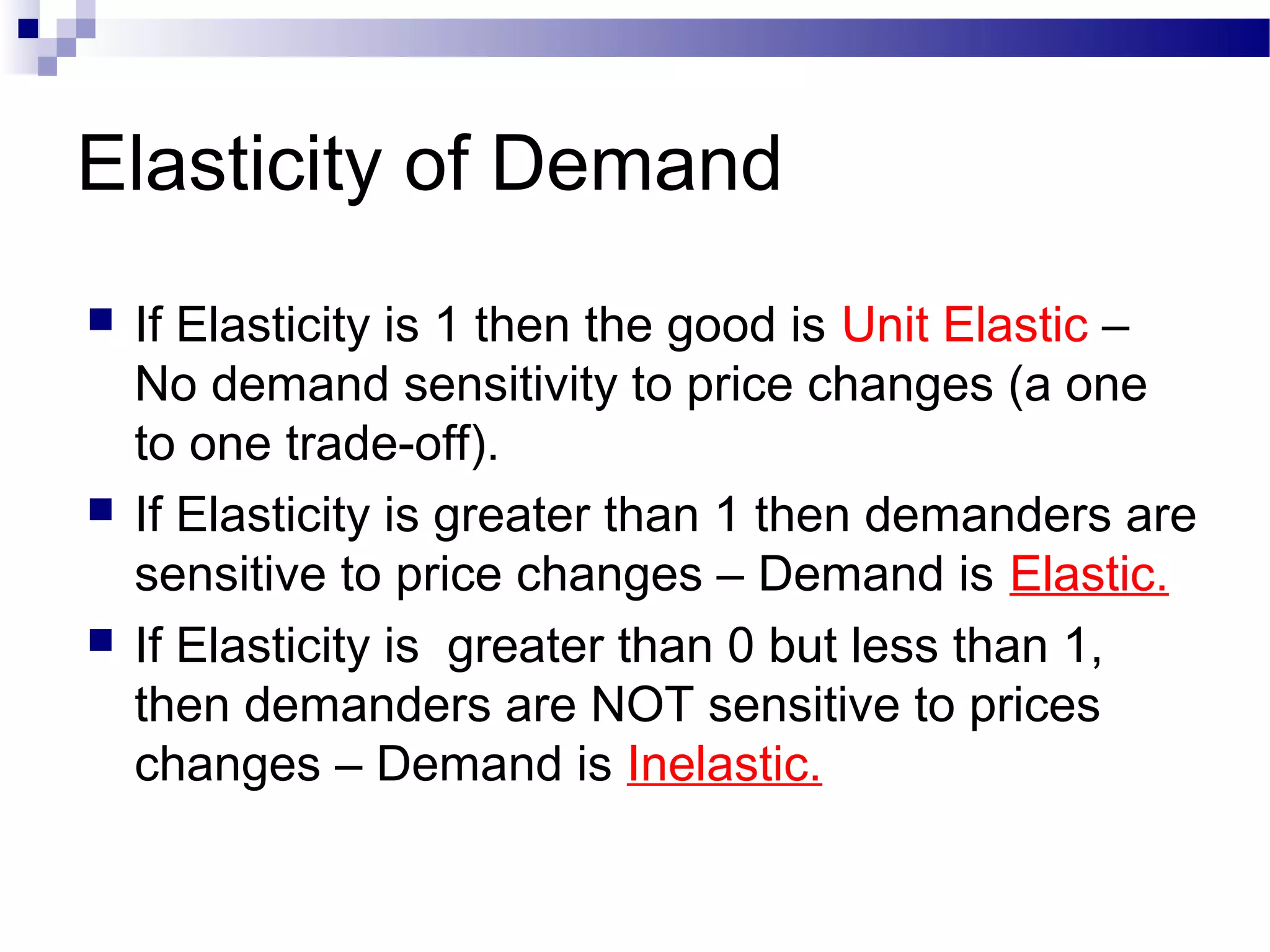
 If Elasticity is 1 then the good is Unit Elastic –
No demand sensitivity to price changes (a one
to one trade-off).
 If Elasticity is greater than 1 then demanders are
sensitive to price changes – Demand is Elastic.
 If Elasticity is greater than 0 but less than 1,
then demanders are NOT sensitive to prices
changes – Demand is Inelastic.
Elasticity of Demand
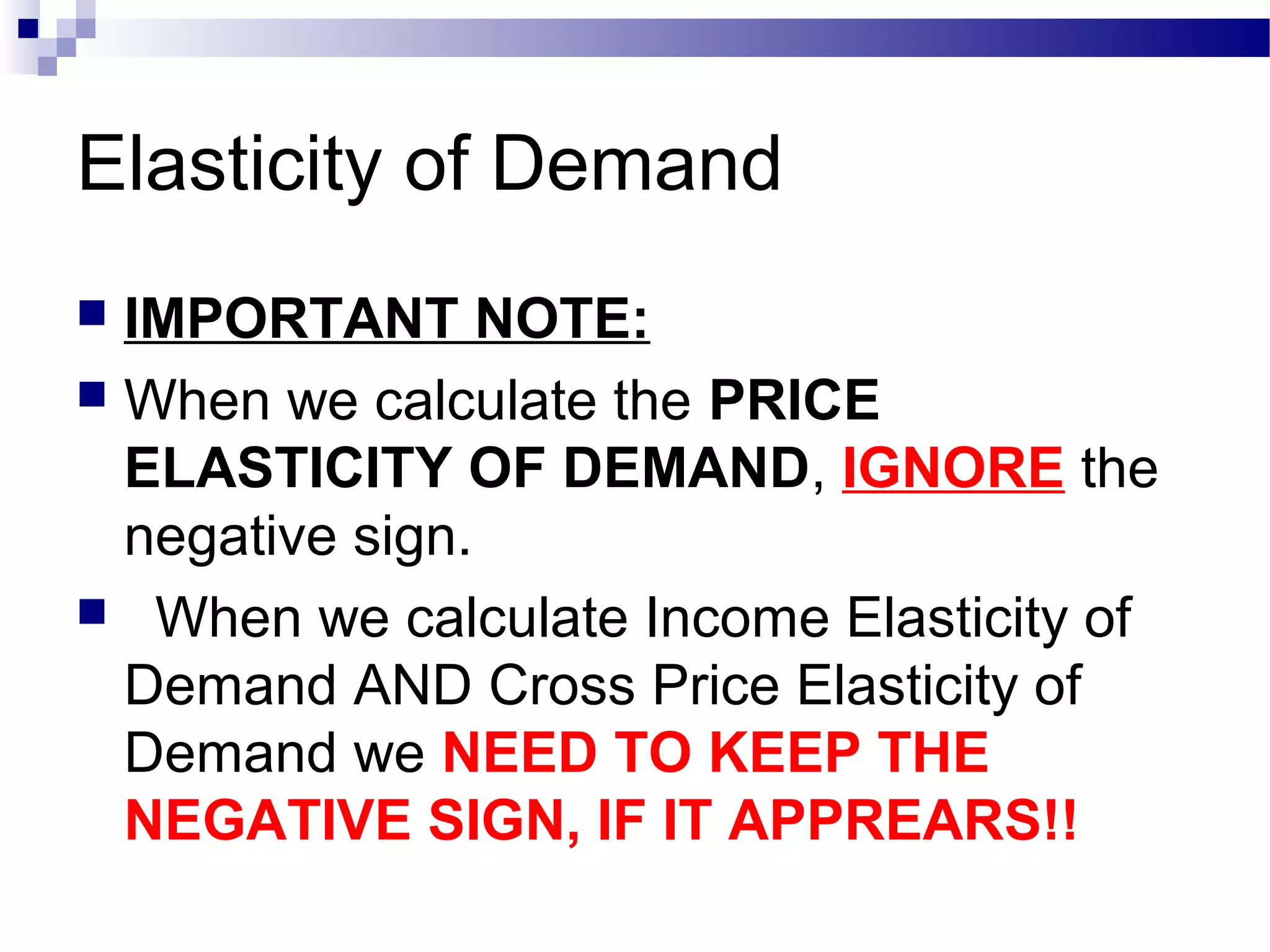
 IMPORTANT NOTE:
 When we calculate the PRICE
ELASTICITY OF DEMAND, IGNORE the
negative sign.
 When we calculate Income Elasticity of
Demand AND Cross Price Elasticity of
Demand we NEED TO KEEP THE
NEGATIVE SIGN, IF IT APPREARS!!
$10
$9
$8
$7
$6
$5
$4
$3
$2
$1
1 2 3 4 5 6 7 8 9 10
Quantity of _____________
Price
of
_____
0
% ΔQuantity
ELASTICITY
of Demand
% ΔQuantity
÷
%ΔPrice
x
x
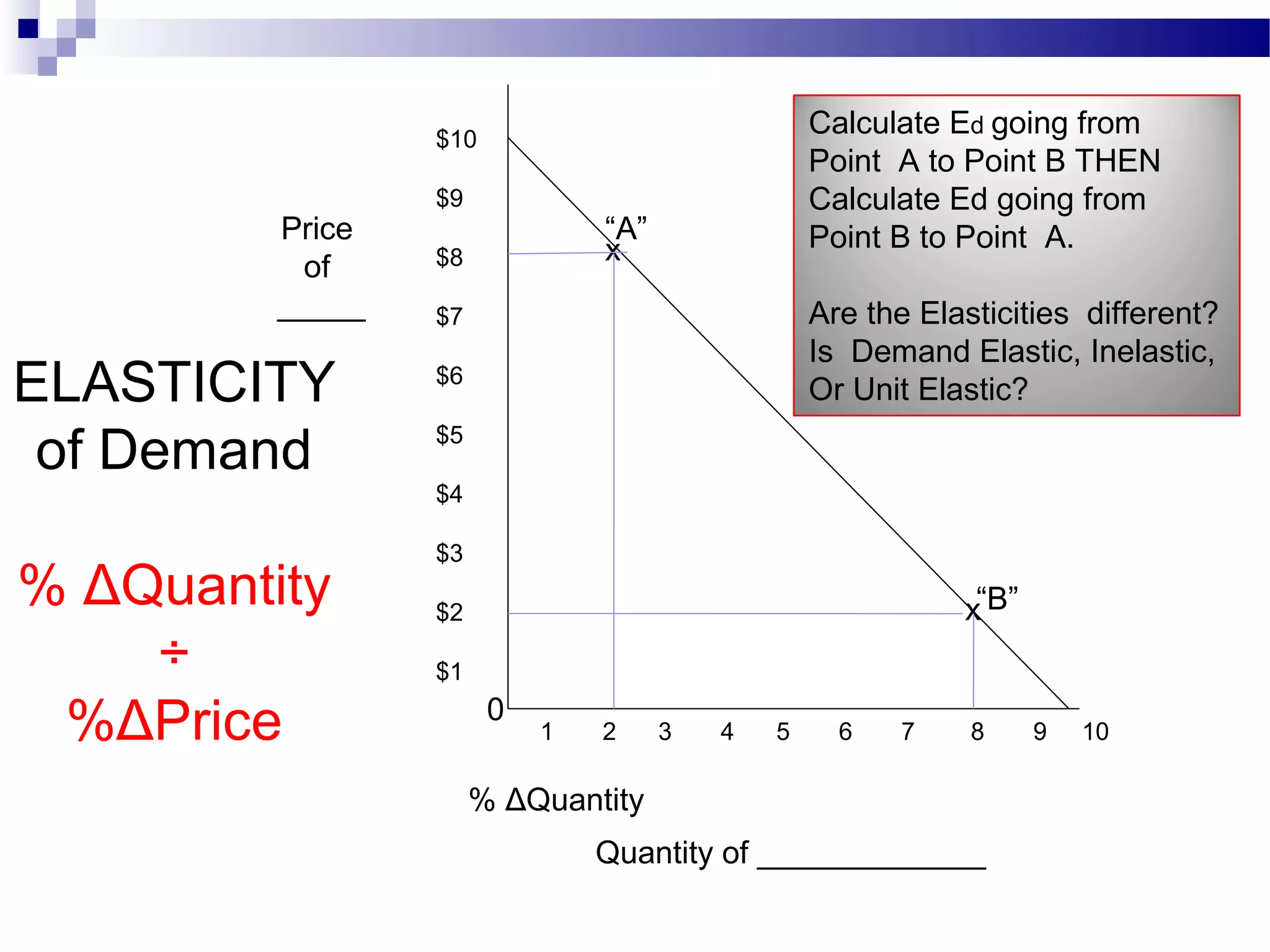
Calculate Ed going from
Point A to Point B THEN
Calculate Ed going from
Point B to Point A.
Are the Elasticities different?
Is Demand Elastic, Inelastic,
Or Unit Elastic?
“A”
“B”
$10
$9
$8
$7
$6
$5
$4
$3
$2
$1
1 2 3 4 5 6 7 8 9 10
Quantity of _____________
Price
of
_____
0
% ΔQuantity
ELASTICITY
of Demand
% ΔQuantity
÷
%ΔPrice
x
x
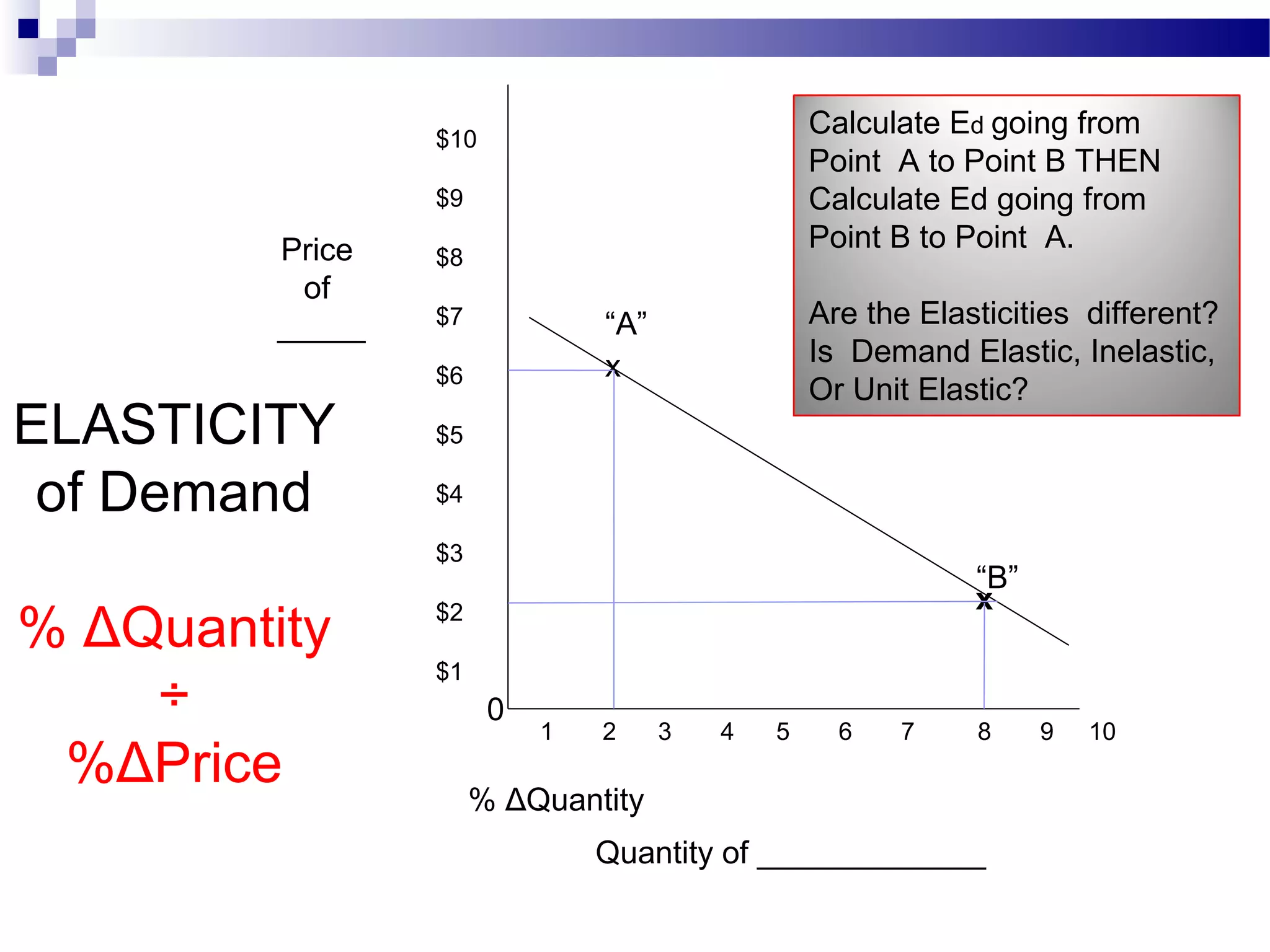
Calculate Ed going from
Point A to Point B THEN
Calculate Ed going from
Point B to Point A.
Are the Elasticities different?
Is Demand Elastic, Inelastic,
Or Unit Elastic?
“A”
“B”
$10
$9
$8
$7
$6
$5
$4
$3
$2
$1
1 2 3 4 5 6 7 8 9 10
Quantity of _____________
Price
of
_____
0
% ΔQuantity
ELASTICITY
of Demand
% ΔQuantity
÷
%ΔPrice
x
x“B”
“A”
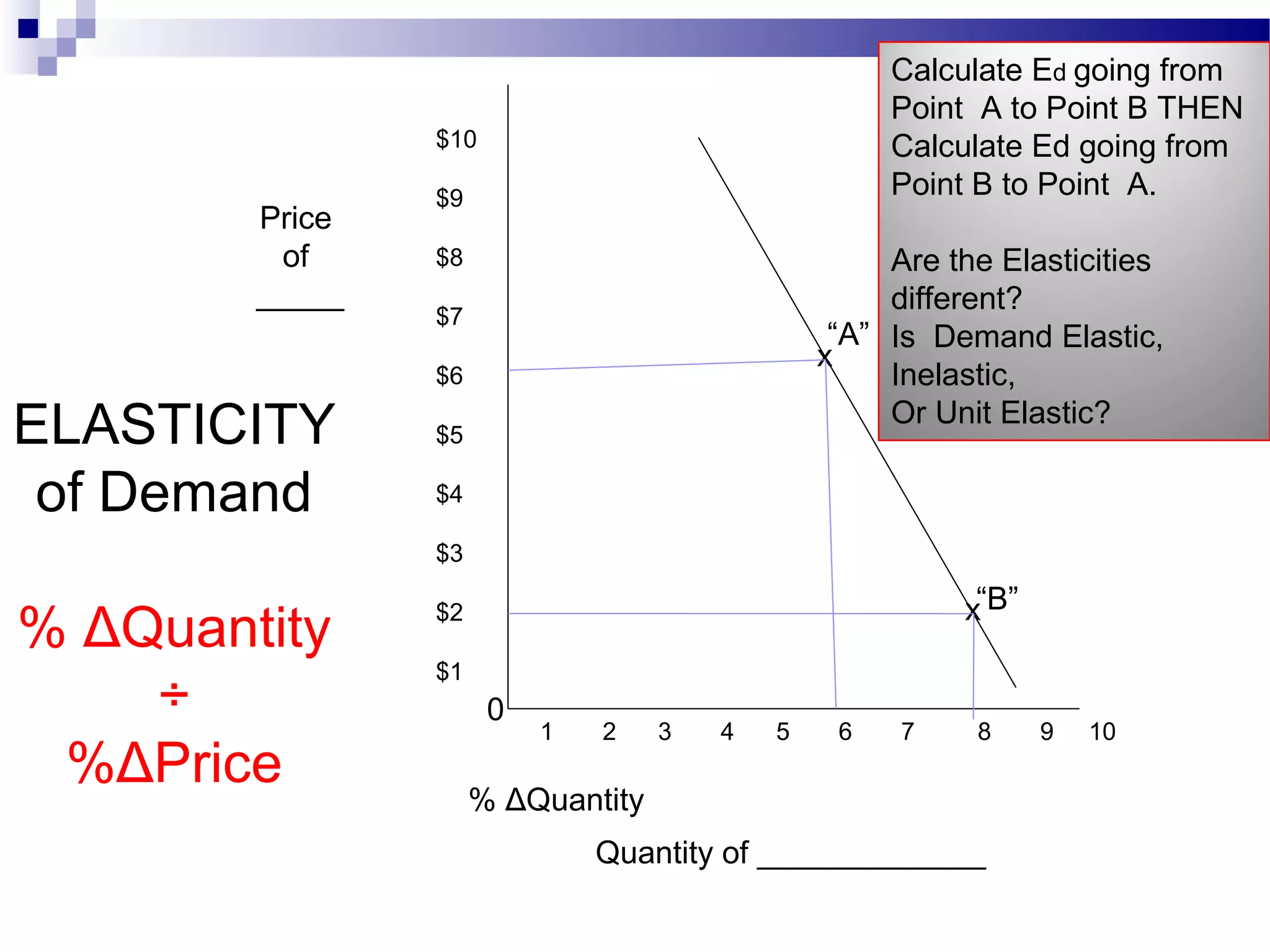
Calculate Ed going from
Point A to Point B THEN
Calculate Ed going from
Point B to Point A.
Are the Elasticities
different?
Is Demand Elastic,
Inelastic,
Or Unit Elastic?
Elasticity
 WHAT TO DO???
 How do we know what the true Elasticity
is between two points if we get a different
number each time?
 ANOTHER formula---The MID-POINT
FORMULA
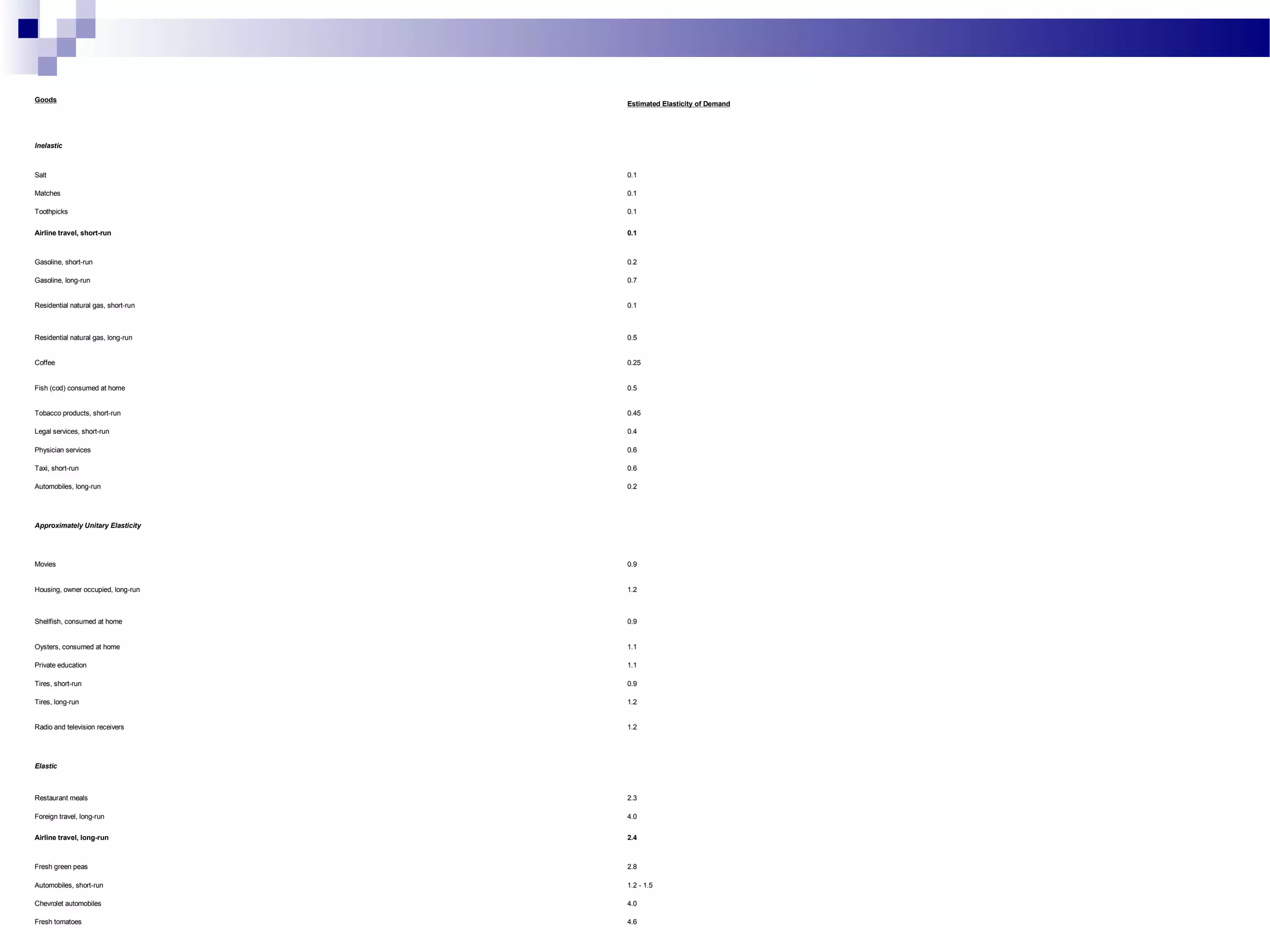
Goods
Estimated Elasticity of Demand
Inelastic
Salt 0.1
Matches 0.1
Toothpicks 0.1
Airline travel, short-run 0.1
Gasoline, short-run 0.2
Gasoline, long-run 0.7
Residential natural gas, short-run 0.1
Residential natural gas, long-run 0.5
Coffee 0.25
Fish (cod) consumed at home 0.5
Tobacco products, short-run 0.45
Legal services, short-run 0.4
Physician services 0.6
Taxi, short-run 0.6
Automobiles, long-run 0.2
Approximately Unitary Elasticity
Movies 0.9
Housing, owner occupied, long-run 1.2
Shellfish, consumed at home 0.9
Oysters, consumed at home 1.1
Private education 1.1
Tires, short-run 0.9
Tires, long-run 1.2
Radio and television receivers 1.2
Elastic
Restaurant meals 2.3
Foreign travel, long-run 4.0
Airline travel, long-run 2.4
Fresh green peas 2.8
Automobiles, short-run 1.2 - 1.5
Chevrolet automobiles 4.0
Fresh tomatoes 4.6
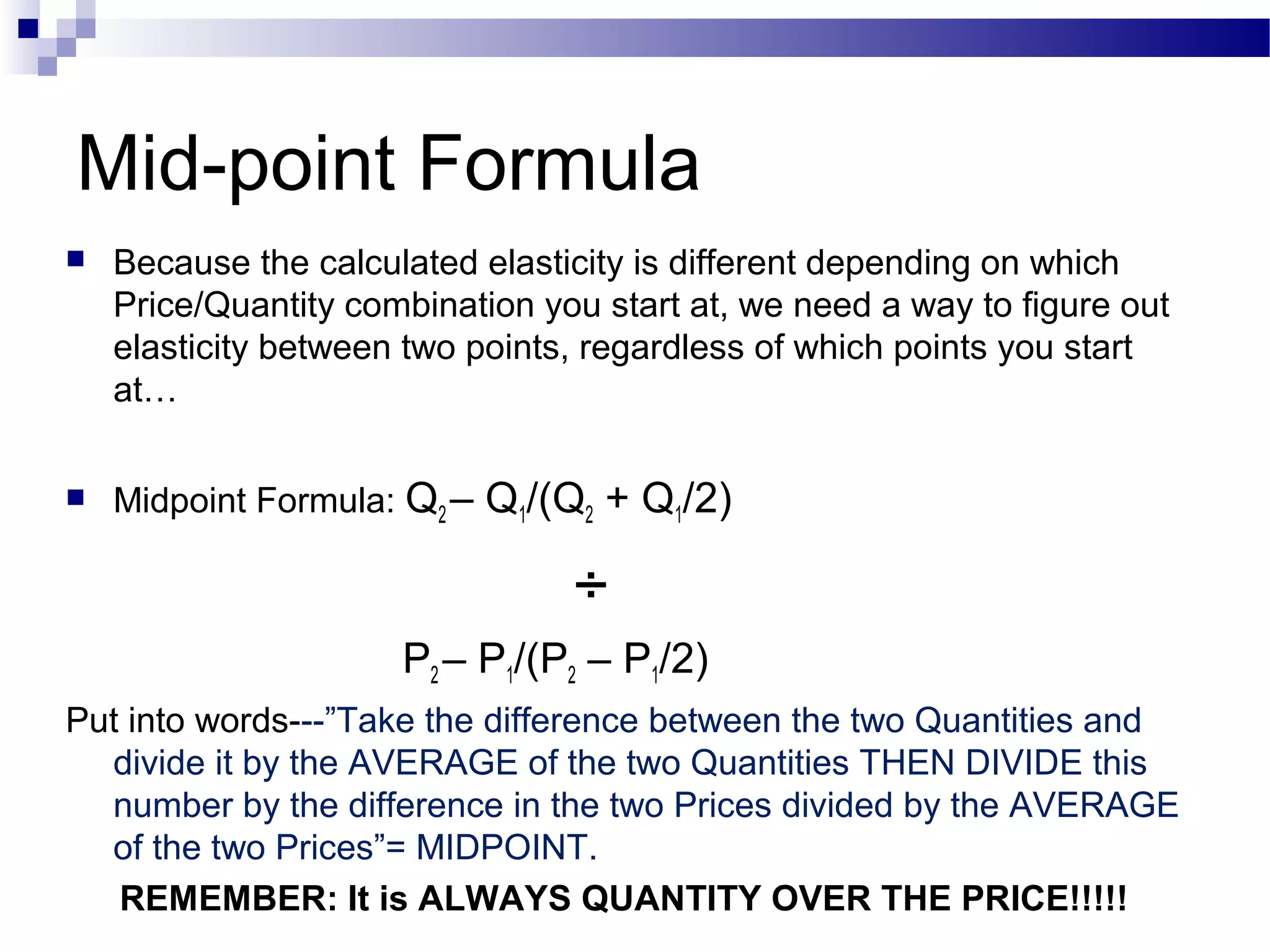
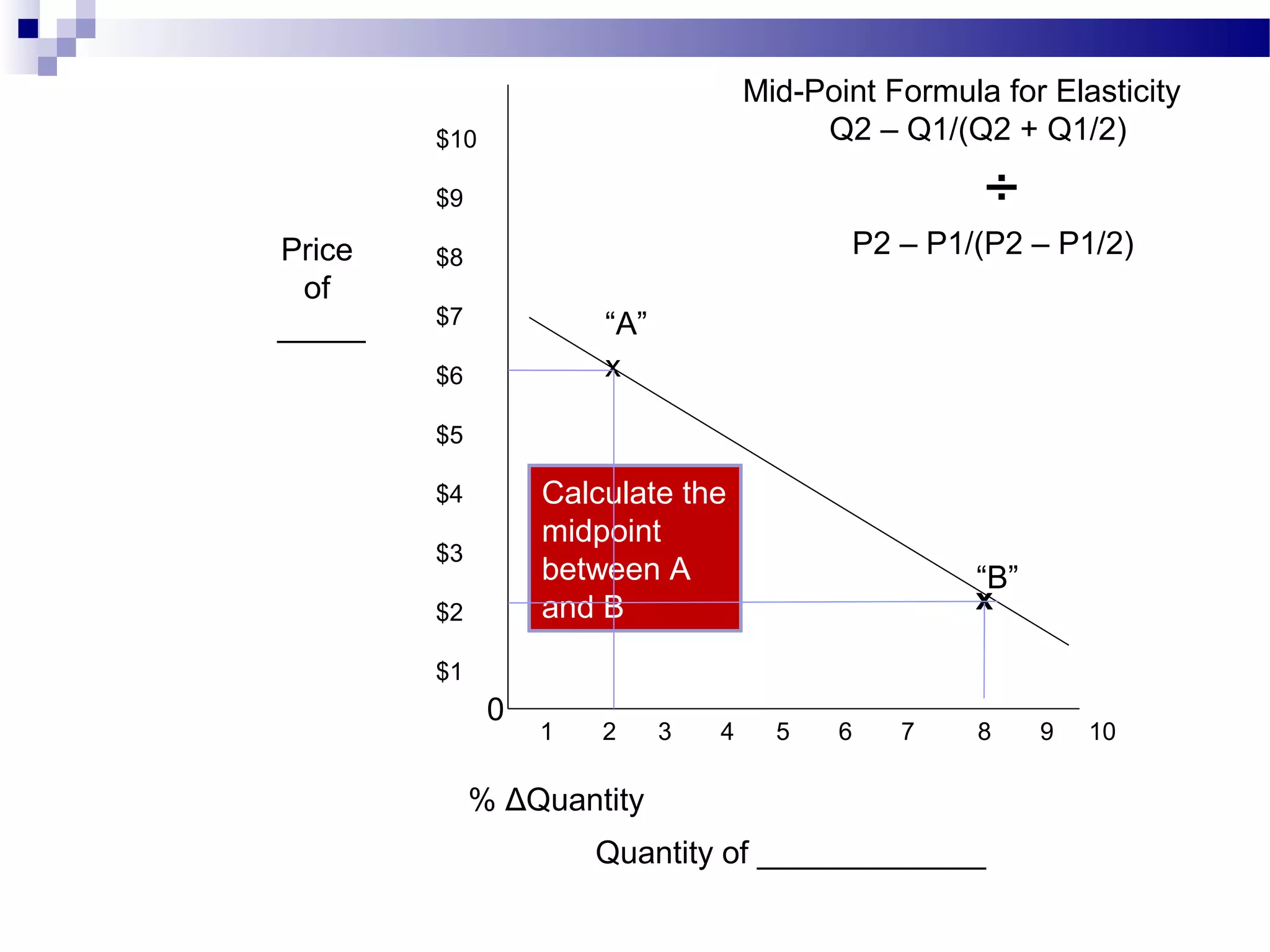
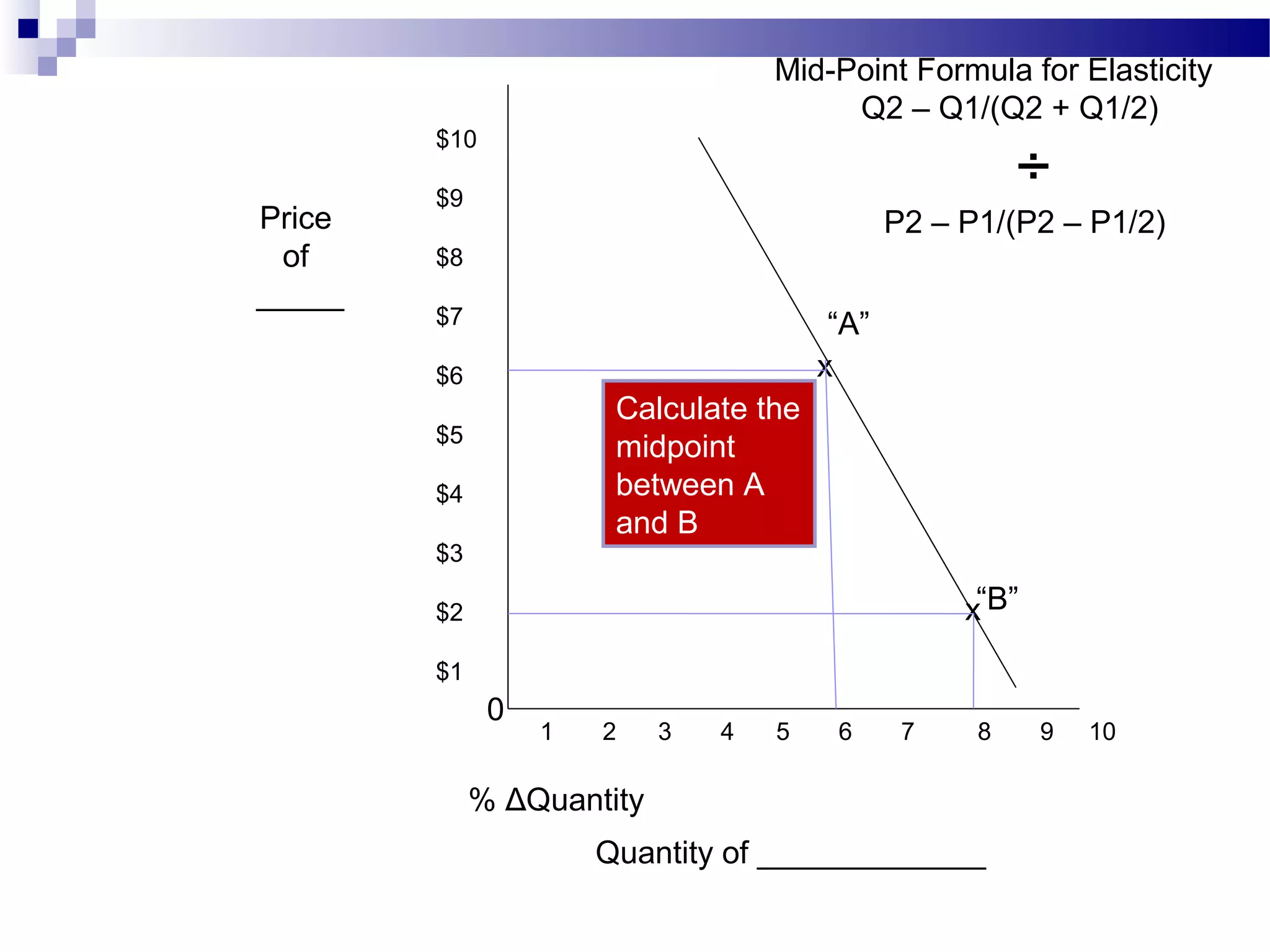
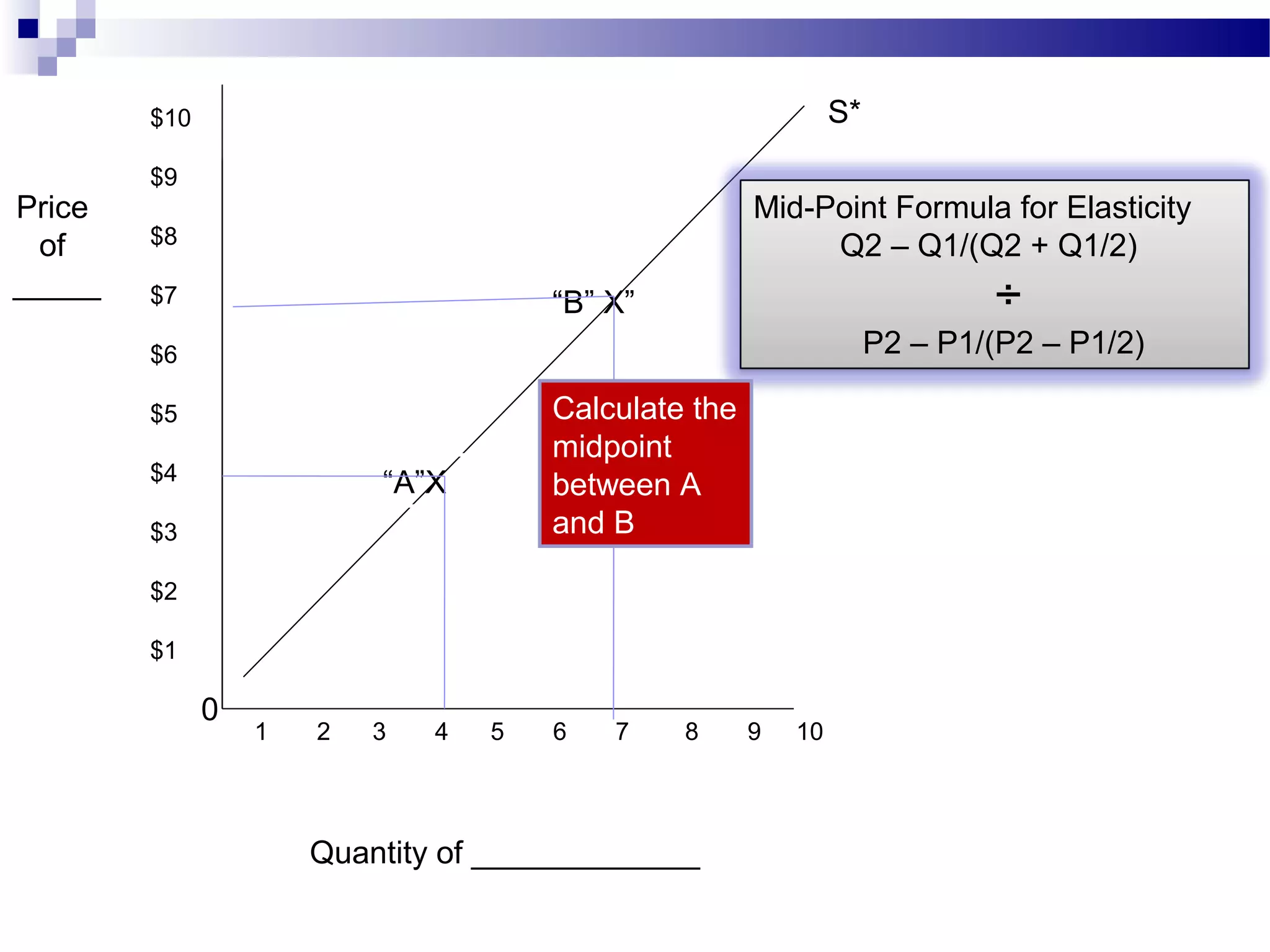
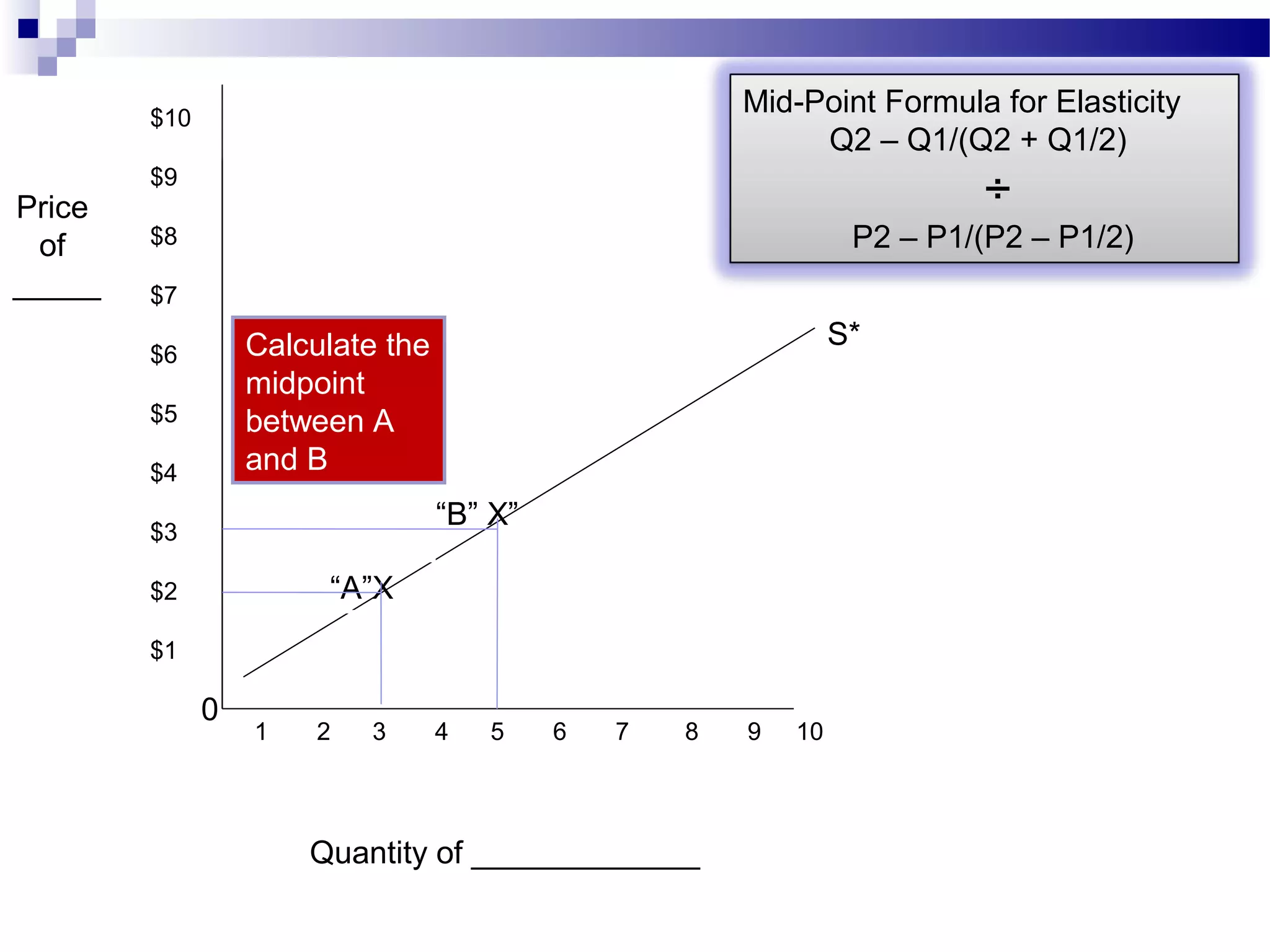
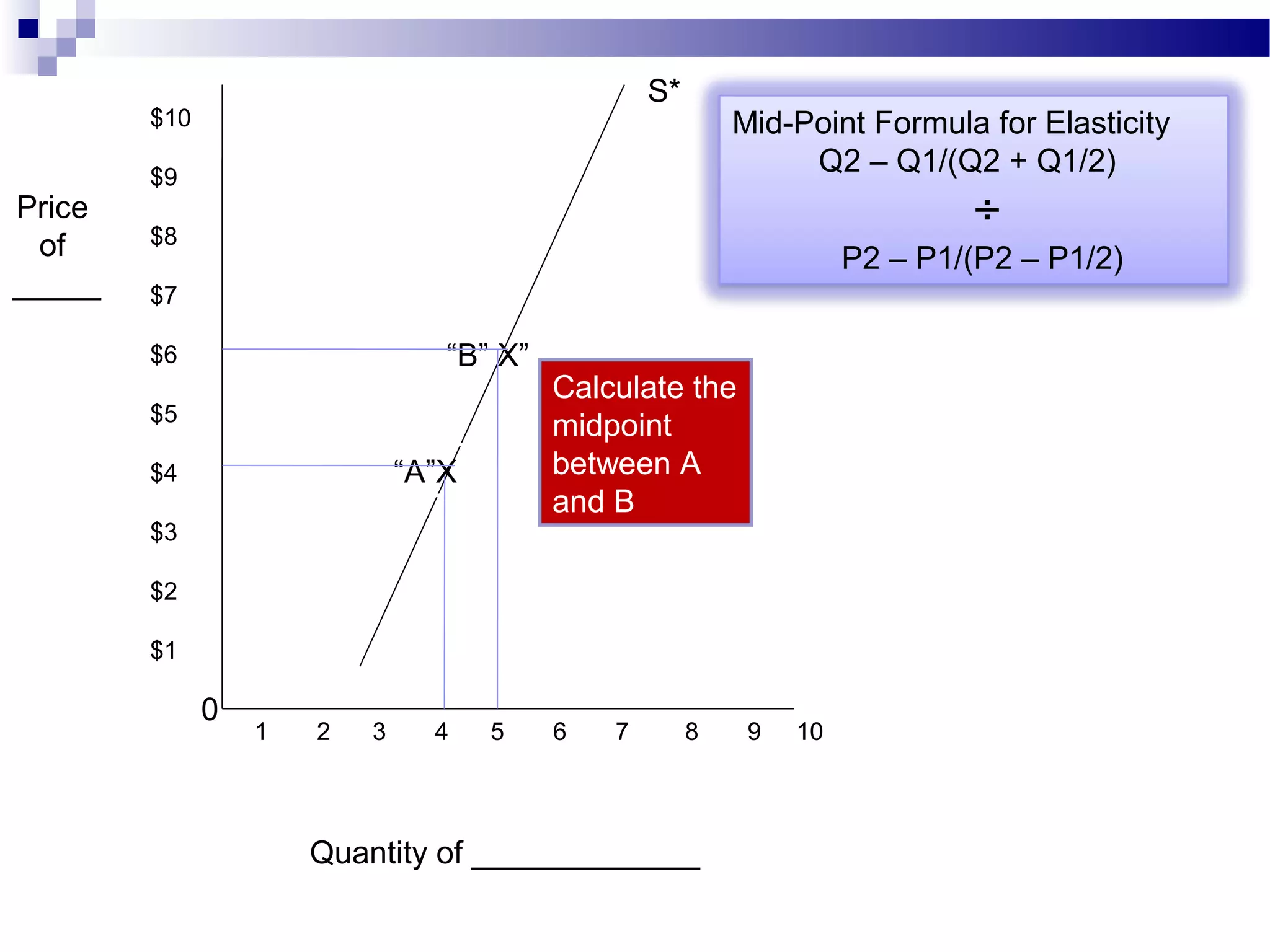
Mid-point Formula
 Because the calculated elasticity is different depending on which
Price/Quantity combination you start at, we need a way to figure out
elasticity between two points, regardless of which points you start
at…
 Midpoint Formula: Q2 – Q1/(Q2 + Q1/2)
÷
P2 – P1/(P2 – P1/2)
Put into words---”Take the difference between the two Quantities and
divide it by the AVERAGE of the two Quantities THEN DIVIDE this
number by the difference in the two Prices divided by the AVERAGE
of the two Prices”= MIDPOINT.
REMEMBER: It is ALWAYS QUANTITY OVER THE PRICE!!!!!
$10
$9
$8
$7
$6
$5
$4
$3
$2
$1
1 2 3 4 5 6 7 8 9 10
Quantity of _____________
Price
of
_____
0
% ΔQuantity
x
x
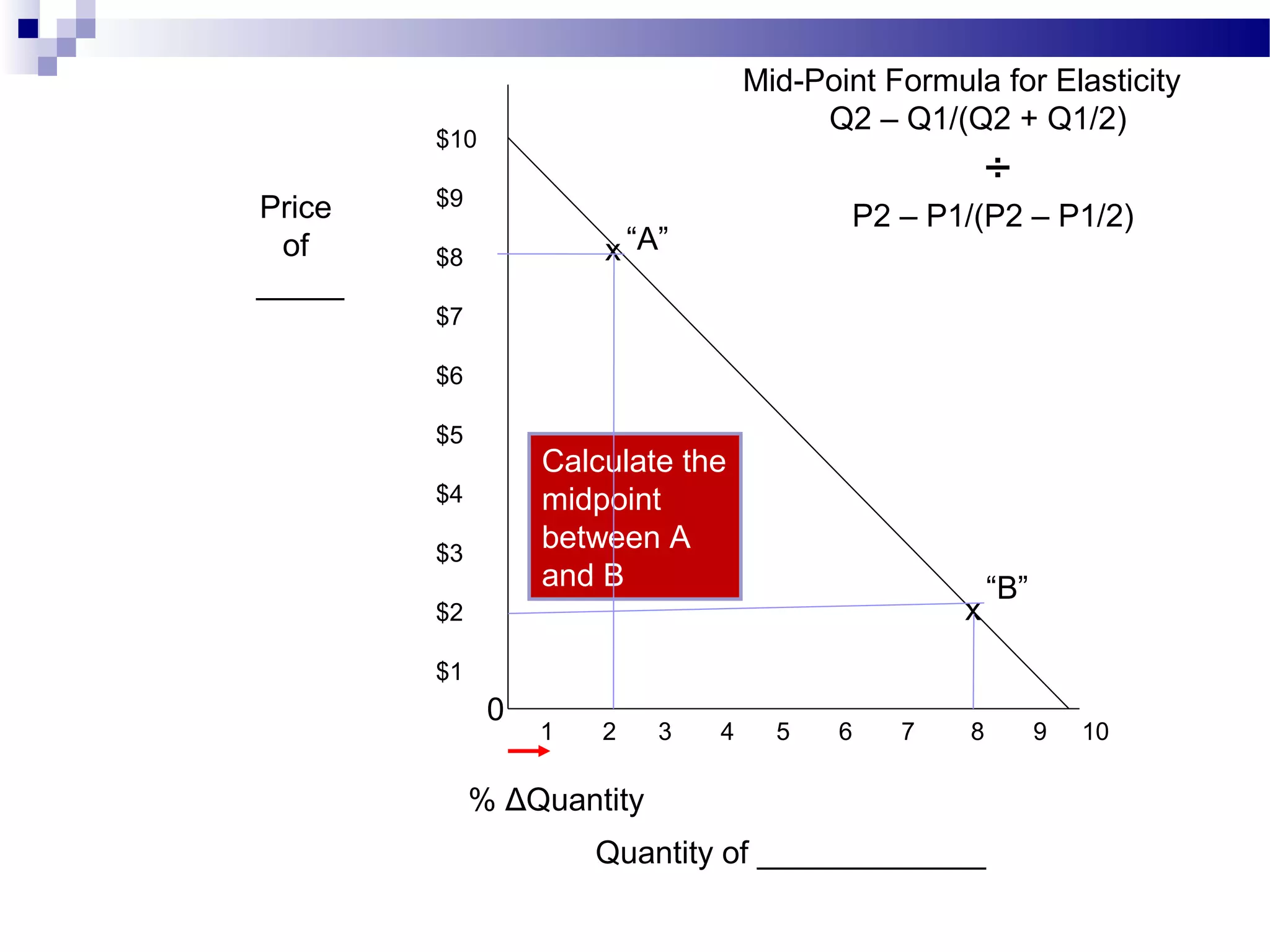
Mid-Point Formula for Elasticity
Q2 – Q1/(Q2 + Q1/2)
÷
P2 – P1/(P2 – P1/2)
“A”
“B”
Calculate the
midpoint
between A
and B
$10
$9
$8
$7
$6
$5
$4
$3
$2
$1
1 2 3 4 5 6 7 8 9 10
Quantity of _____________
Price
of
_____
0
% ΔQuantity
x
x
“A”
“B”
Mid-Point Formula for Elasticity
Q2 – Q1/(Q2 + Q1/2)
÷
P2 – P1/(P2 – P1/2)
Calculate the
midpoint
between A
and B
$10
$9
$8
$7
$6
$5
$4
$3
$2
$1
1 2 3 4 5 6 7 8 9 10
Quantity of _____________
Price
of
_____
0
% ΔQuantity
x
x“B”
“A”
Mid-Point Formula for Elasticity
Q2 – Q1/(Q2 + Q1/2)
÷
P2 – P1/(P2 – P1/2)
Calculate the
midpoint
between A
and B
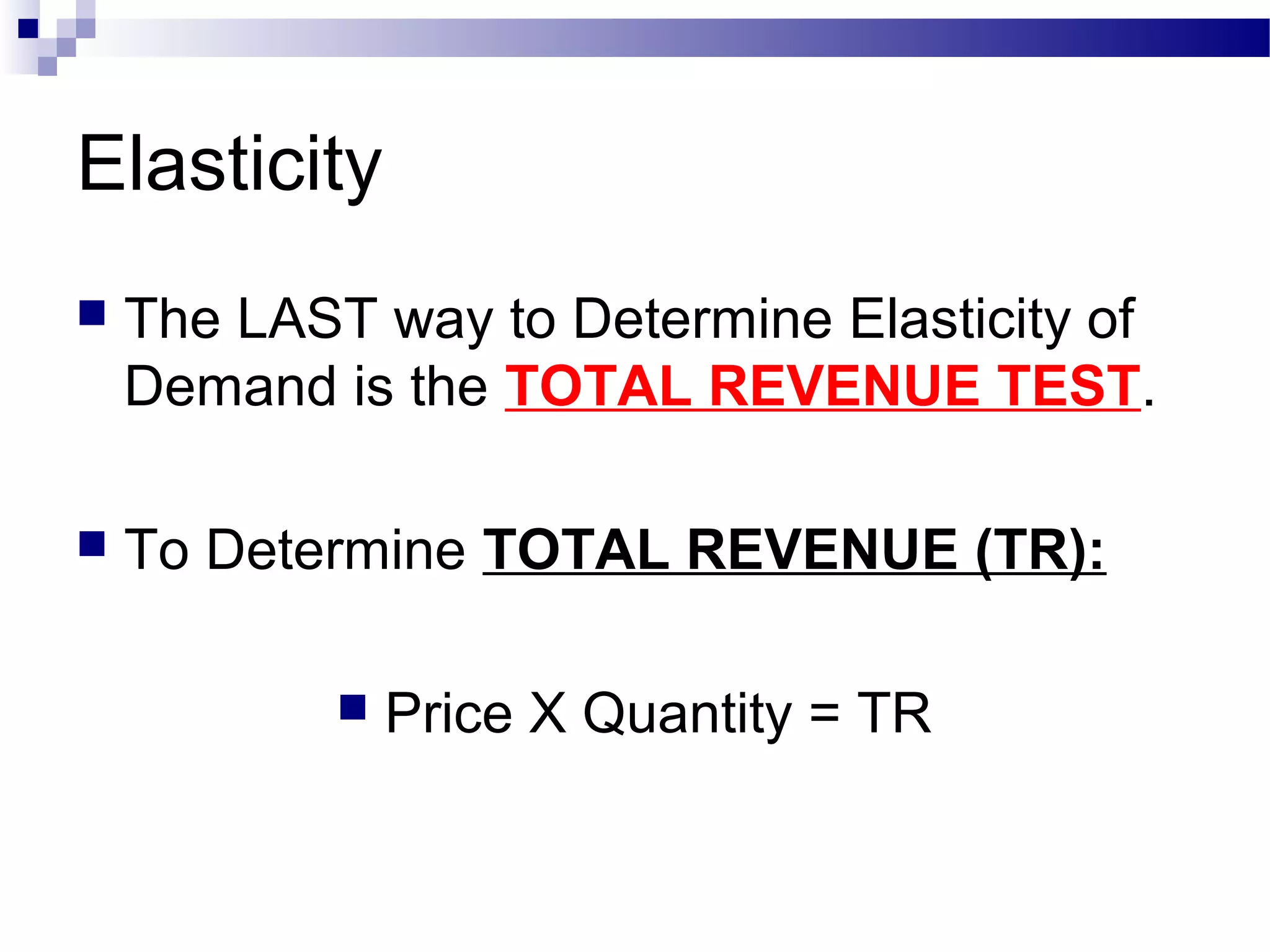
Elasticity
 The LAST way to Determine Elasticity of
Demand is the TOTAL REVENUE TEST.
 To Determine TOTAL REVENUE (TR):
 Price X Quantity = TR
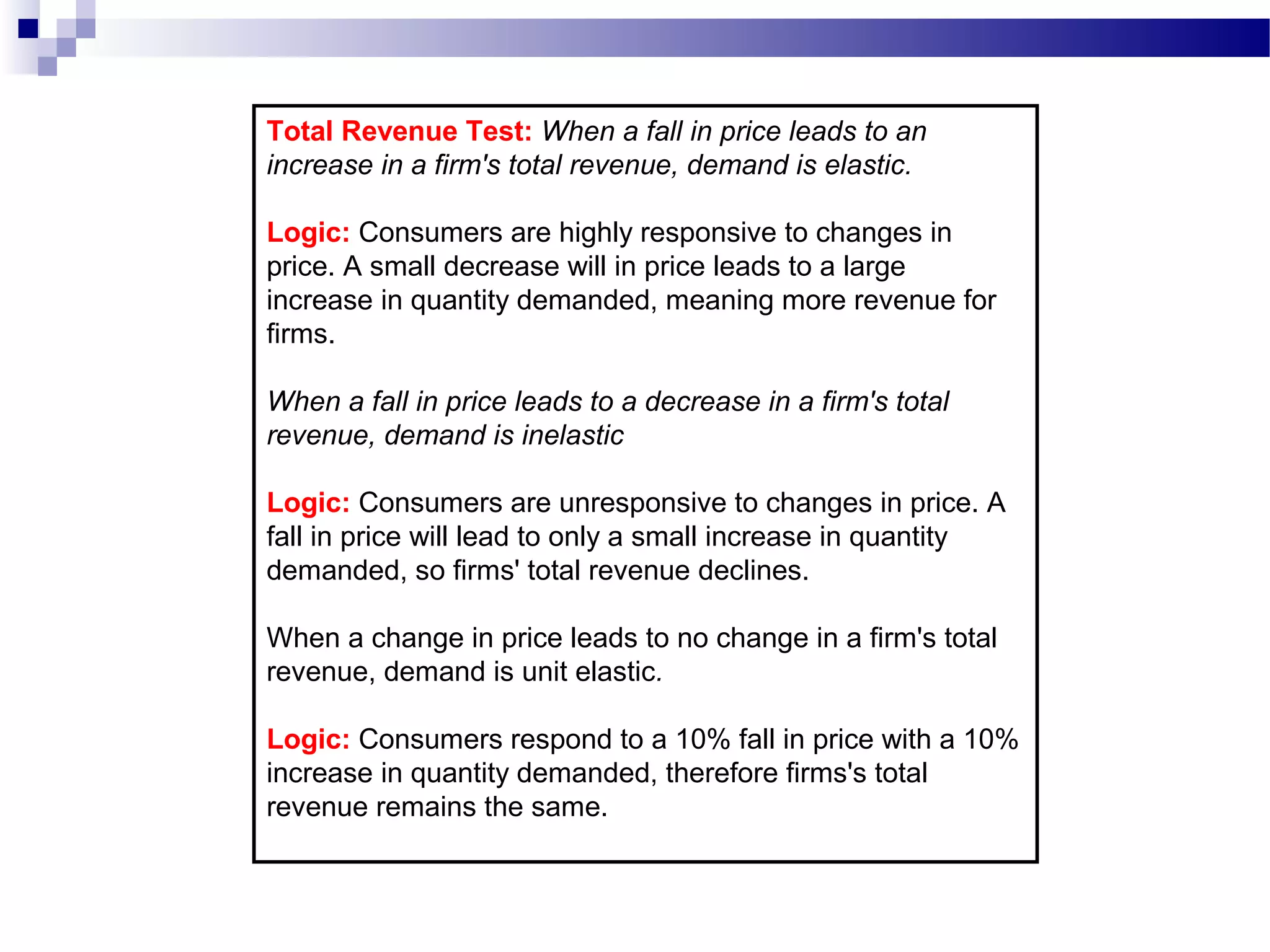
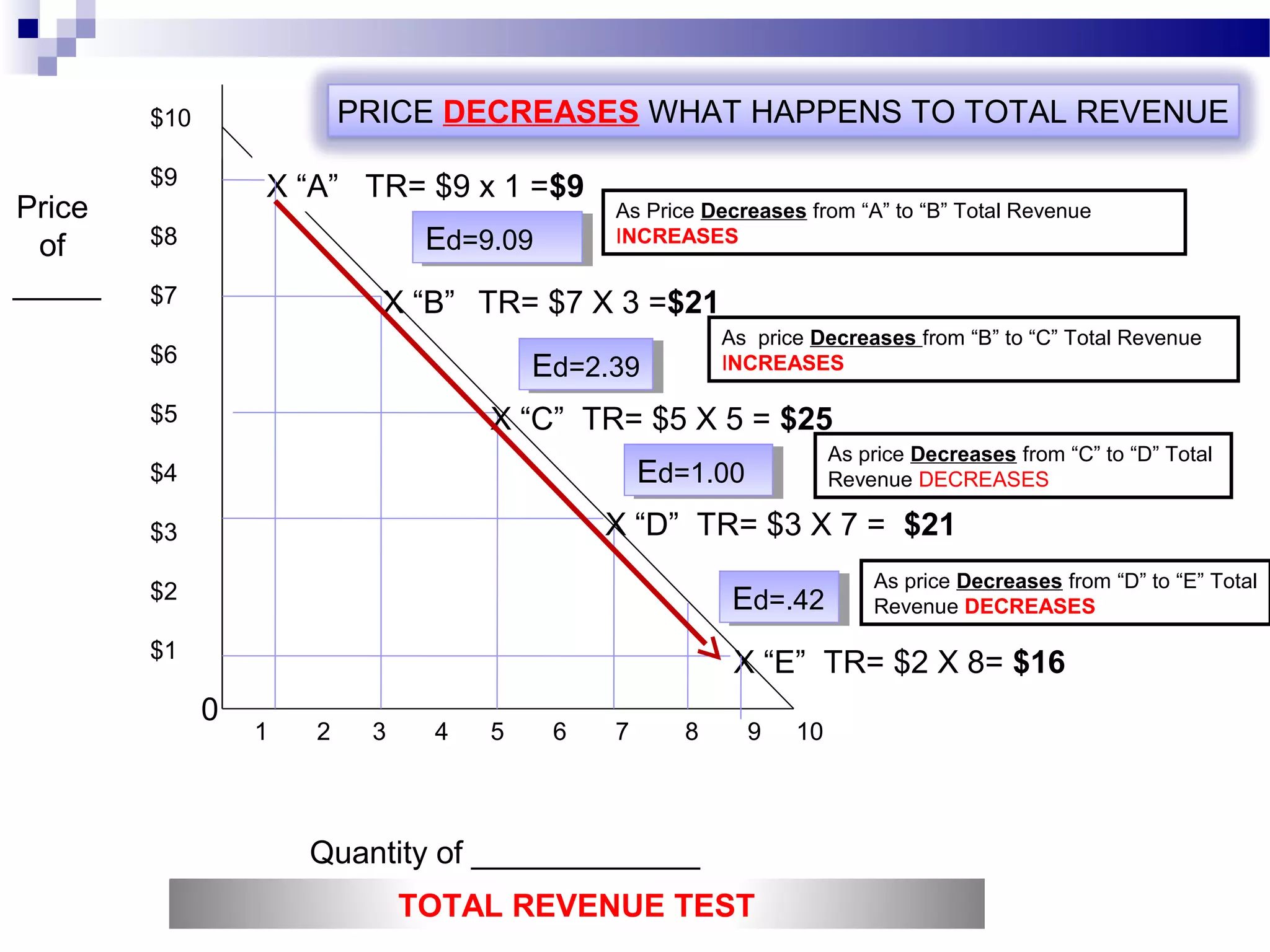
Total Revenue Test: When a fall in price leads to an
increase in a firm's total revenue, demand is elastic.
Logic: Consumers are highly responsive to changes in
price. A small decrease will in price leads to a large
increase in quantity demanded, meaning more revenue for
firms.
When a fall in price leads to a decrease in a firm's total
revenue, demand is inelastic
Logic: Consumers are unresponsive to changes in price. A
fall in price will lead to only a small increase in quantity
demanded, so firms' total revenue declines.
When a change in price leads to no change in a firm's total
revenue, demand is unit elastic.
Logic: Consumers respond to a 10% fall in price with a 10%
increase in quantity demanded, therefore firms's total
revenue remains the same.
$10
$9
$8
$7
$6
$5
$4
$3
$2
$1
1 2 3 4 5 6 7 8 9 10
Quantity of _____________
Price
of
_____
0
X “A” TR= $9 x 1 =$9
X “B”
X “C” TR= $5 X 5 = $25
X “D” TR= $3 X 7 = $21
X “E” TR= $2 X 8= $16
TR= $7 X 3 =$21
As Price Decreases from “A” to “B” Total Revenue
INCREASES
As price Decreases from “B” to “C” Total Revenue
INCREASES
As price Decreases from “C” to “D” Total
Revenue DECREASES
As price Decreases from “D” to “E” Total
Revenue DECREASES
PRICE DECREASES WHAT HAPPENS TO TOTAL REVENUE
TOTAL REVENUE TEST
Ed=9.09Ed=9.09
Ed=2.39Ed=2.39
Ed=1.00Ed=1.00
Ed=.42Ed=.42
$10
$9
$8
$7
$6
$5
$4
$3
$2
$1
1 2 3 4 5 6 7 8 9 10
Quantity of _____________
Price
of
_____
0
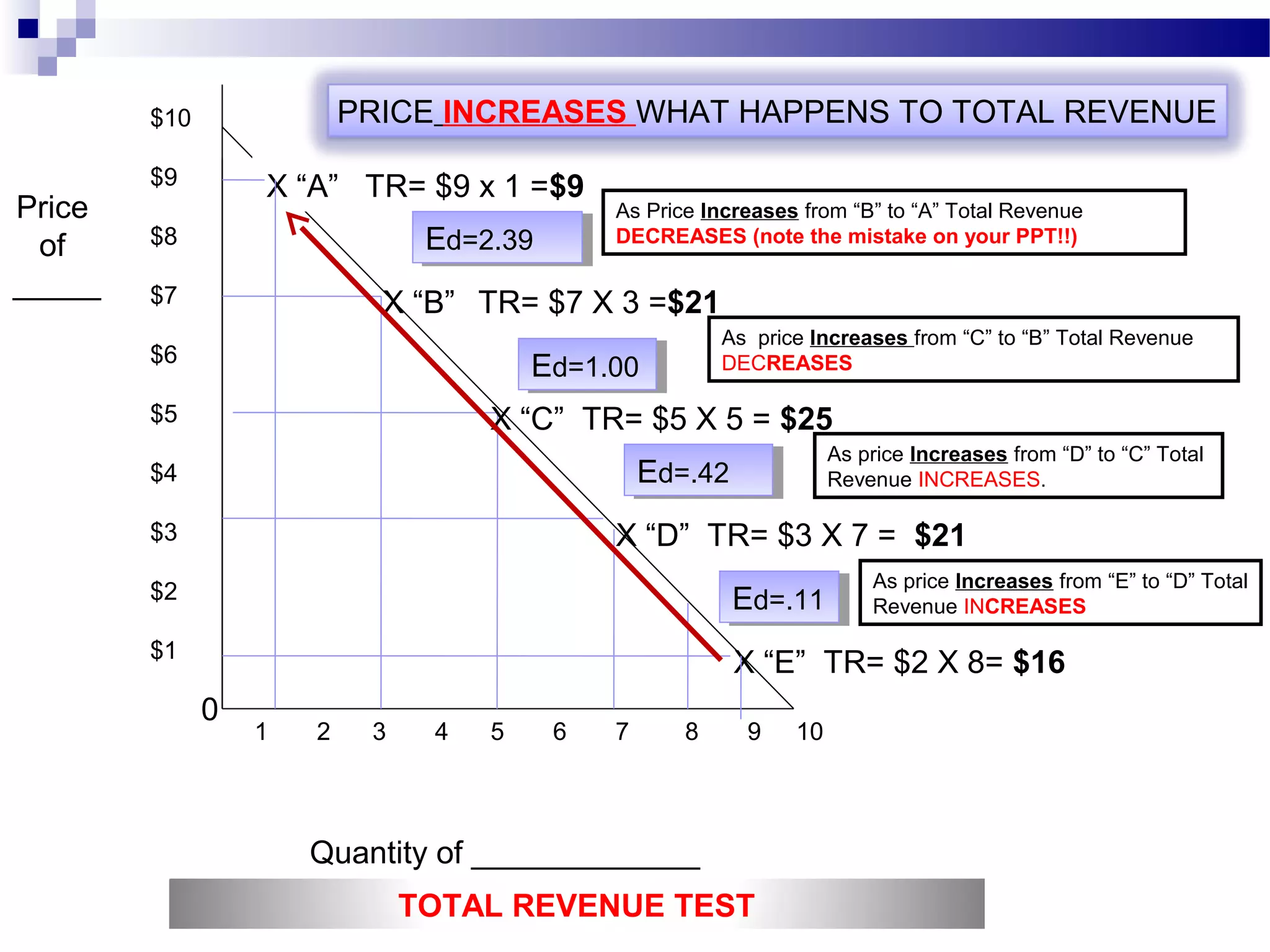
X “A” TR= $9 x 1 =$9
X “B”
X “C” TR= $5 X 5 = $25
X “D” TR= $3 X 7 = $21
X “E” TR= $2 X 8= $16
TR= $7 X 3 =$21
As Price Increases from “B” to “A” Total Revenue
DECREASES (note the mistake on your PPT!!)
As price Increases from “C” to “B” Total Revenue
DECREASES
As price Increases from “D” to “C” Total
Revenue INCREASES.
As price Increases from “E” to “D” Total
Revenue INCREASES
PRICE INCREASES WHAT HAPPENS TO TOTAL REVENUE
TOTAL REVENUE TEST
Ed=2.39Ed=2.39
Ed=1.00Ed=1.00
Ed=.42Ed=.42
Ed=.11Ed=.11
$10
$9
$8
$7
$6
$5
$4
$3
$2
$1
1 2 3 4 5 6 7 8 9 10
Quantity of _____________
Price
of
_____
0
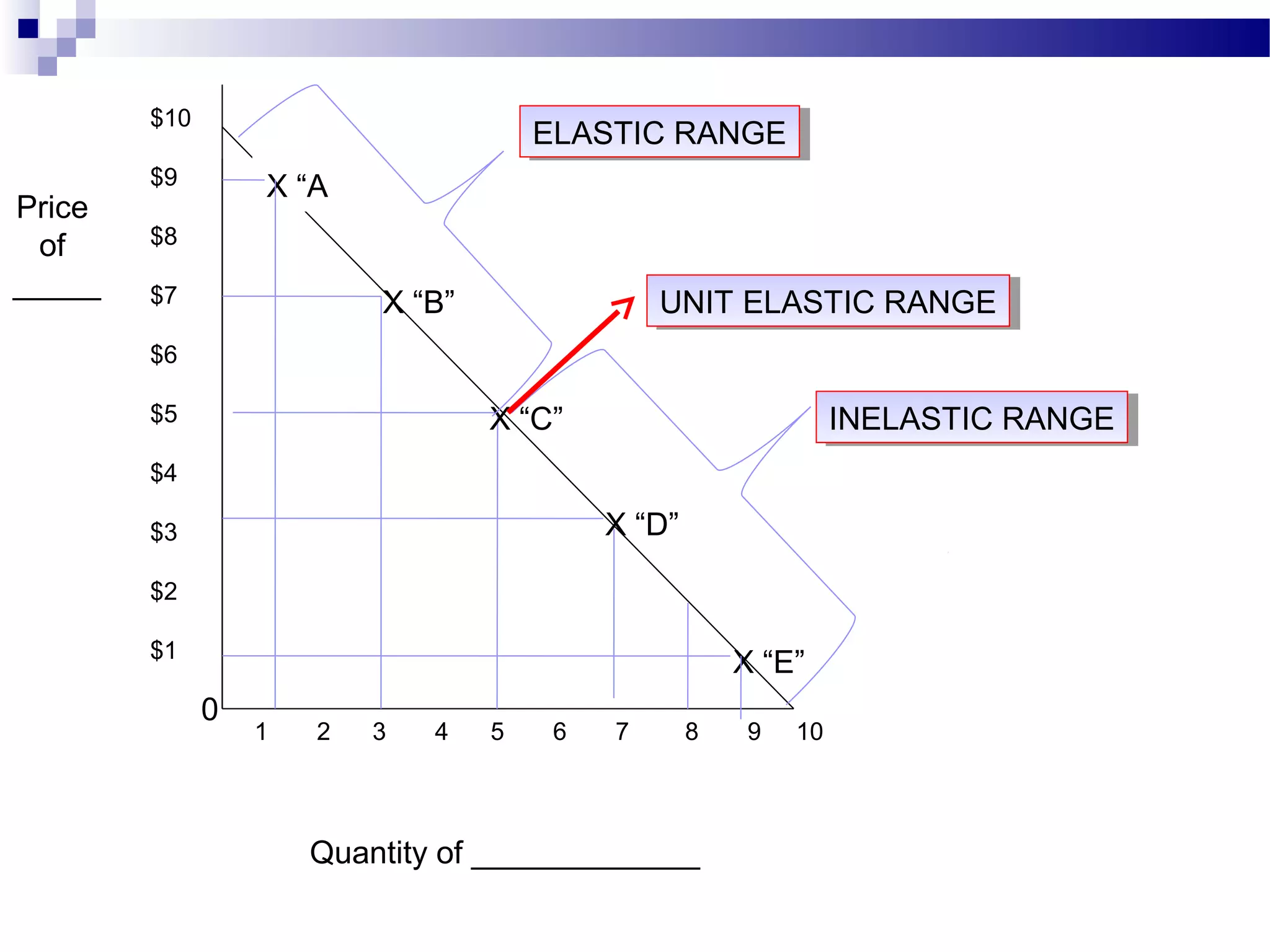
X “A
X “B”
X “C”
X “D”
X “E”
ELASTIC RANGEELASTIC RANGE
INELASTIC RANGEINELASTIC RANGE
UNIT ELASTIC RANGEUNIT ELASTIC RANGE
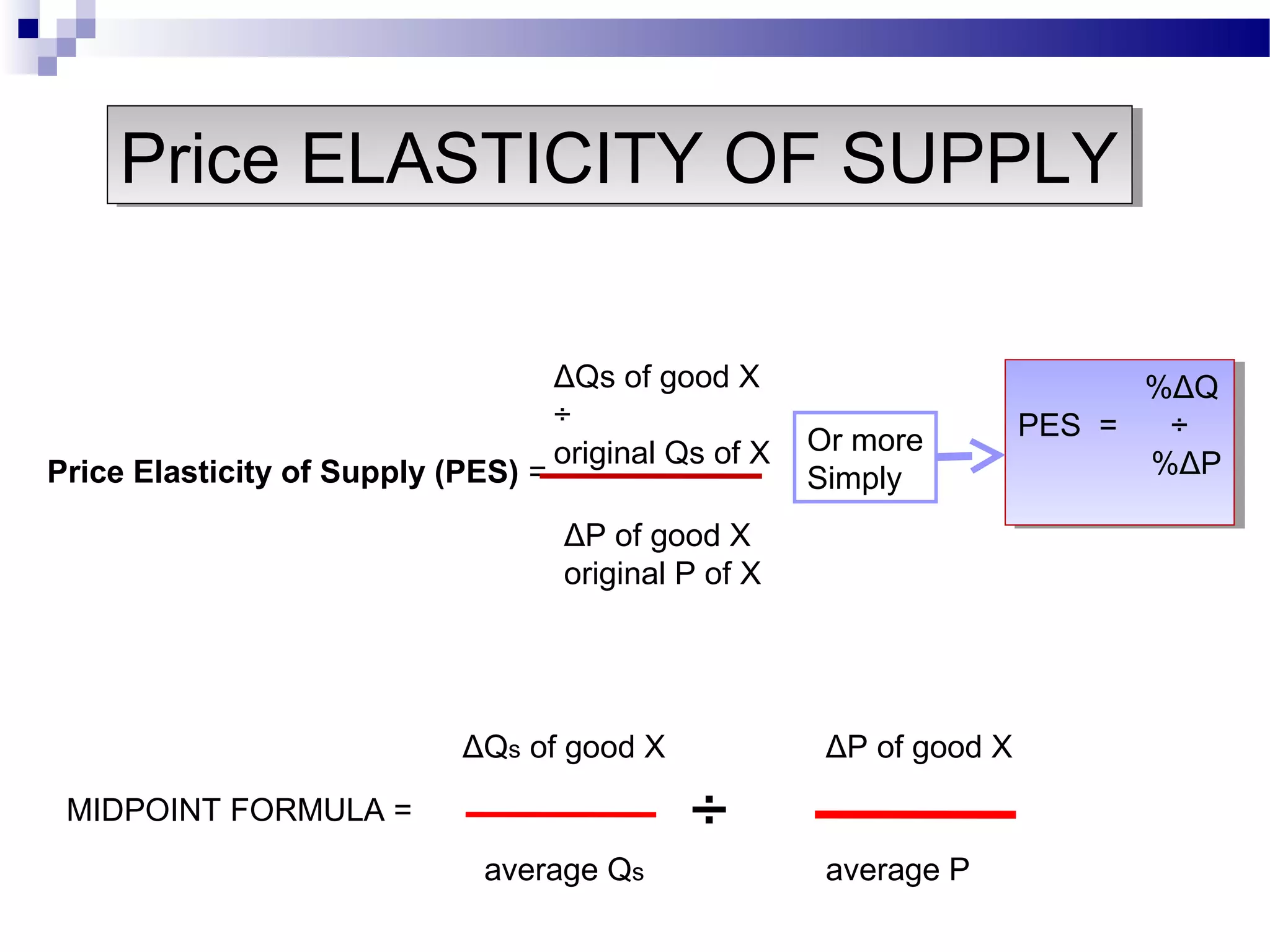
Elasticity of Supply
 Price Elasticity of Supply: The responsiveness of
producers to a change in price.
 Formulas are the same as Demand!!
Price Elasticity of Supply (PES) =
ΔQs of good X
÷
original Qs of X
ΔP of good X
original P of X
%ΔQ
PES = ÷
%ΔP
%ΔQ
PES = ÷
%ΔP
Or more
Simply
ΔQs of good X ΔP of good X
÷
average Qs average P
MIDPOINT FORMULA =
Price ELASTICITY OF SUPPLYPrice ELASTICITY OF SUPPLY
$10
$9
$8
$7
$6
$5
$4
$3
$2
$1
1 2 3 4 5 6 7 8 9 10
Quantity of _____________
Price
of
_____
0
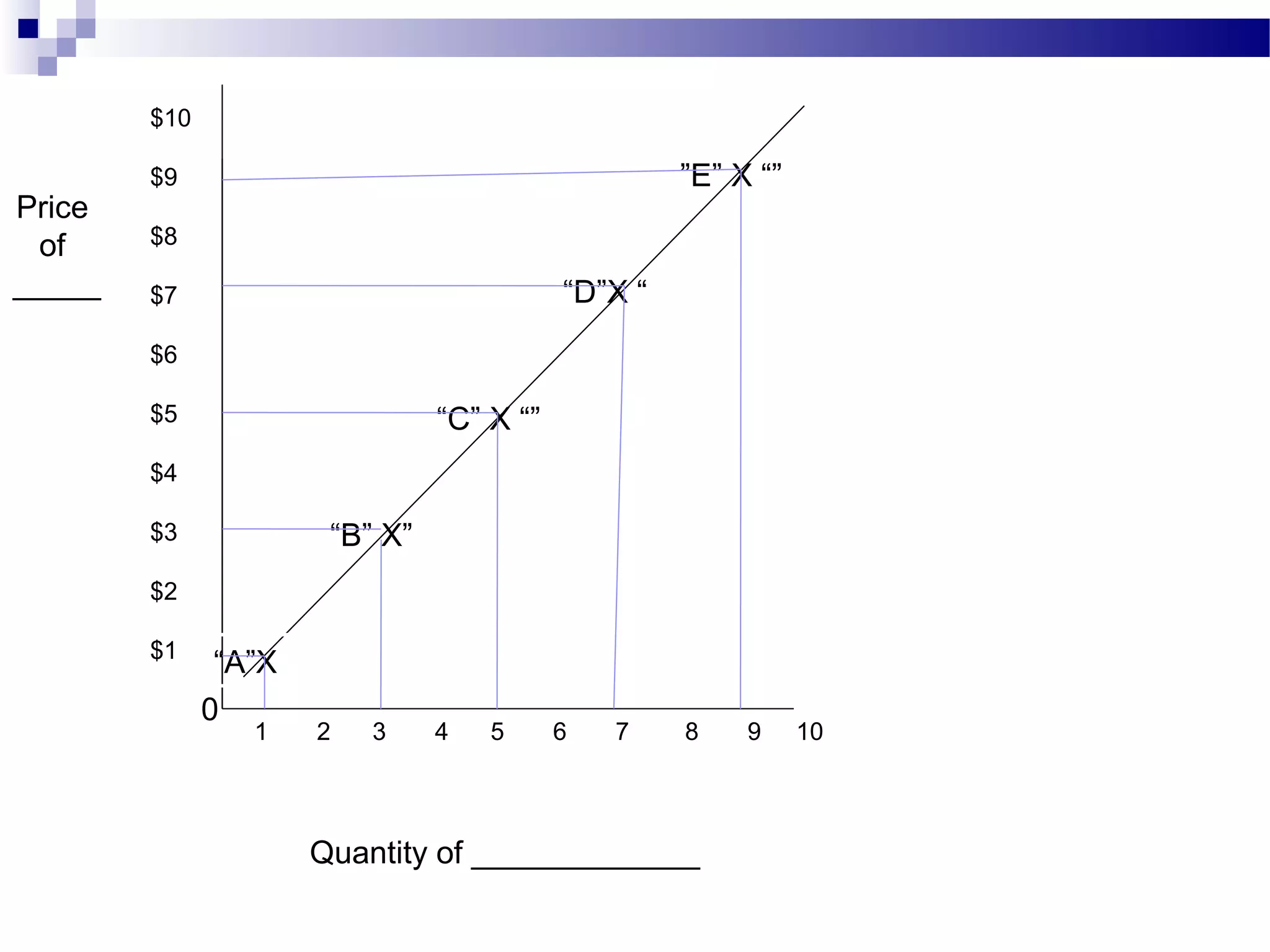
“A”X
“B” X”
“C” X “”
“D”X “
”E” X “”
$10
$9
$8
$7
$6
$5
$4
$3
$2
$1
1 2 3 4 5 6 7 8 9 10
Quantity of _____________
Price
of
_____
0
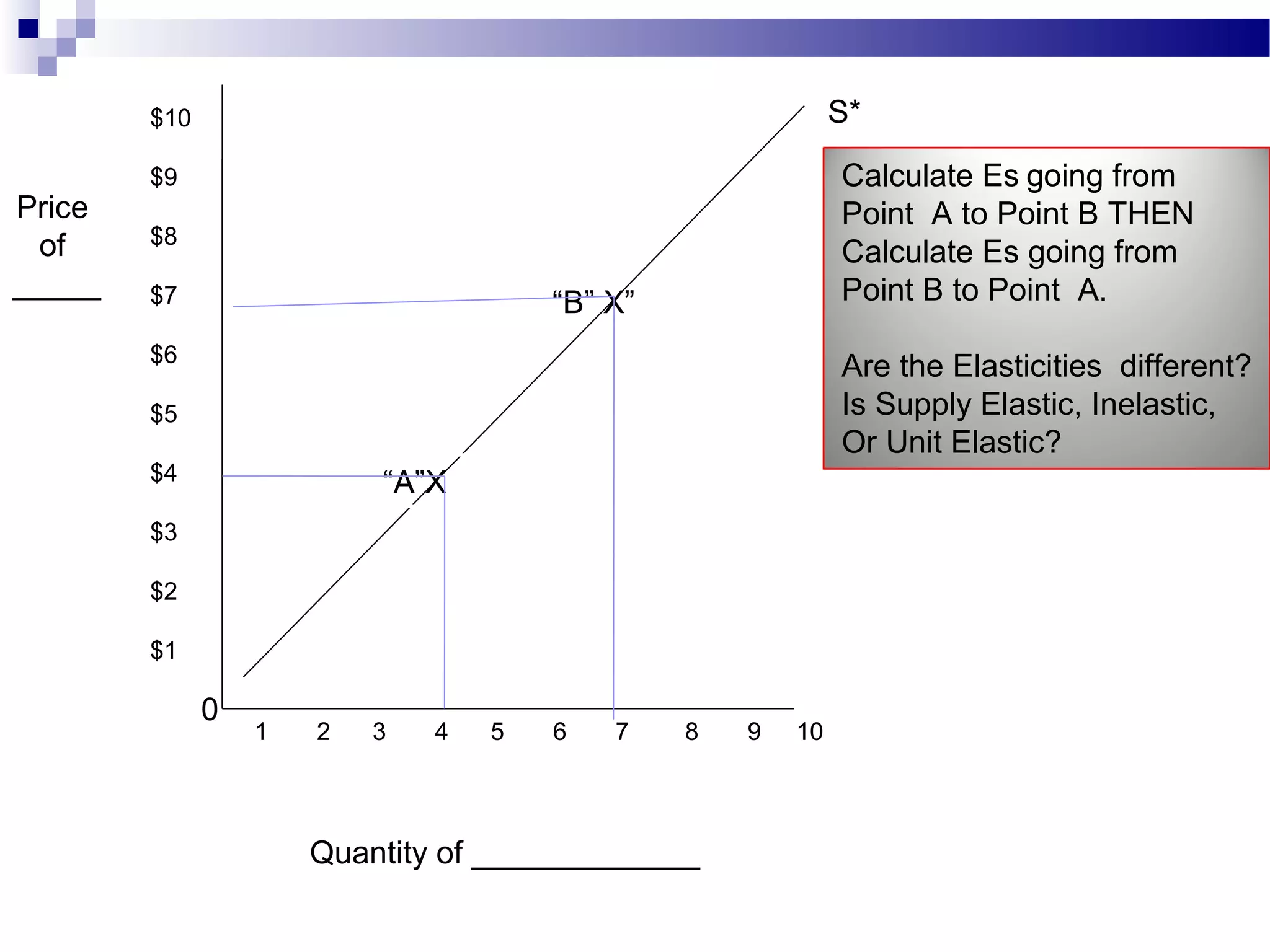
“A”X
“B” X”
S*
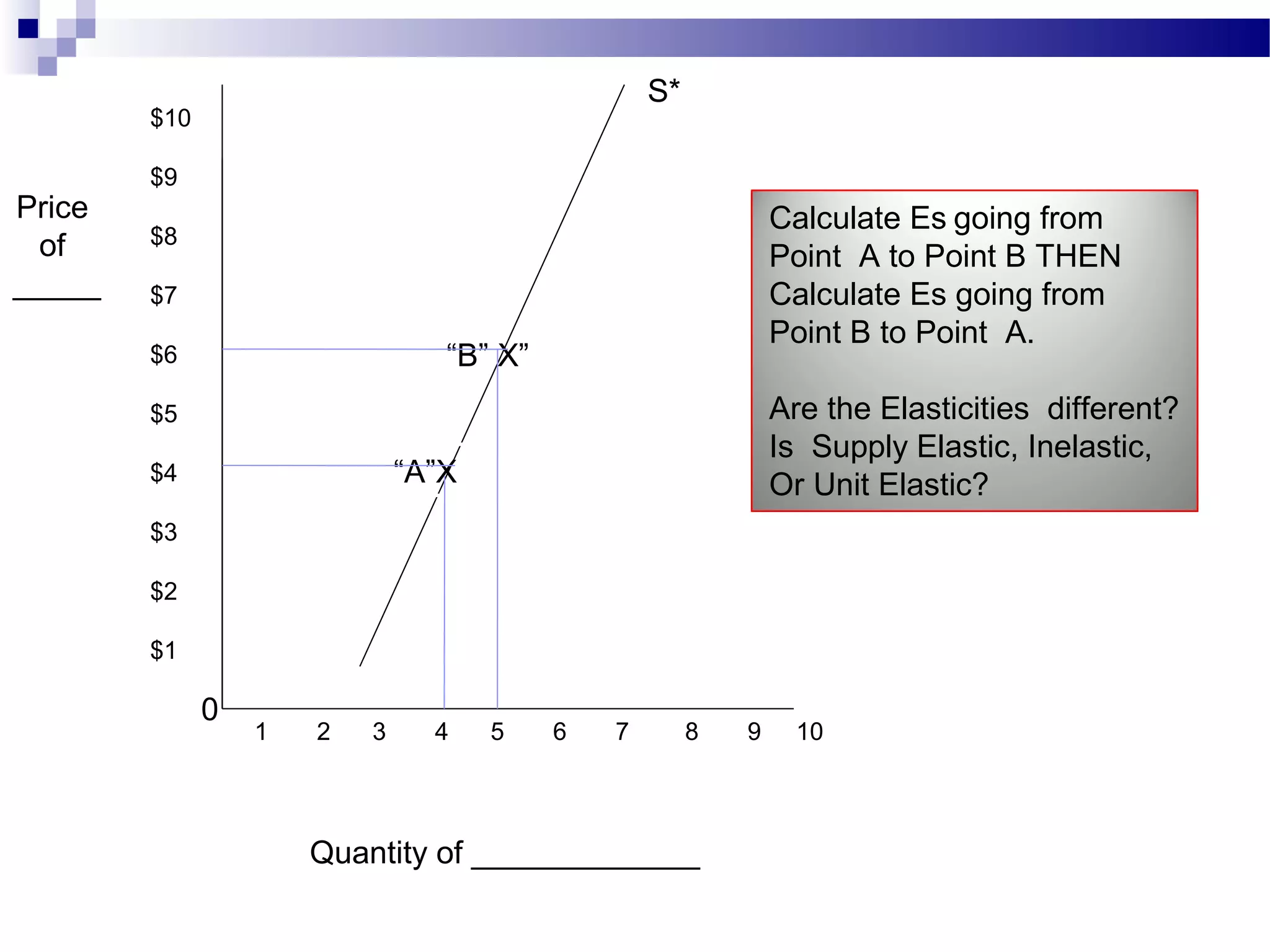
Calculate Es going from
Point A to Point B THEN
Calculate Es going from
Point B to Point A.
Are the Elasticities different?
Is Supply Elastic, Inelastic,
Or Unit Elastic?
$10
$9
$8
$7
$6
$5
$4
$3
$2
$1
1 2 3 4 5 6 7 8 9 10
Quantity of _____________
Price
of
_____
0
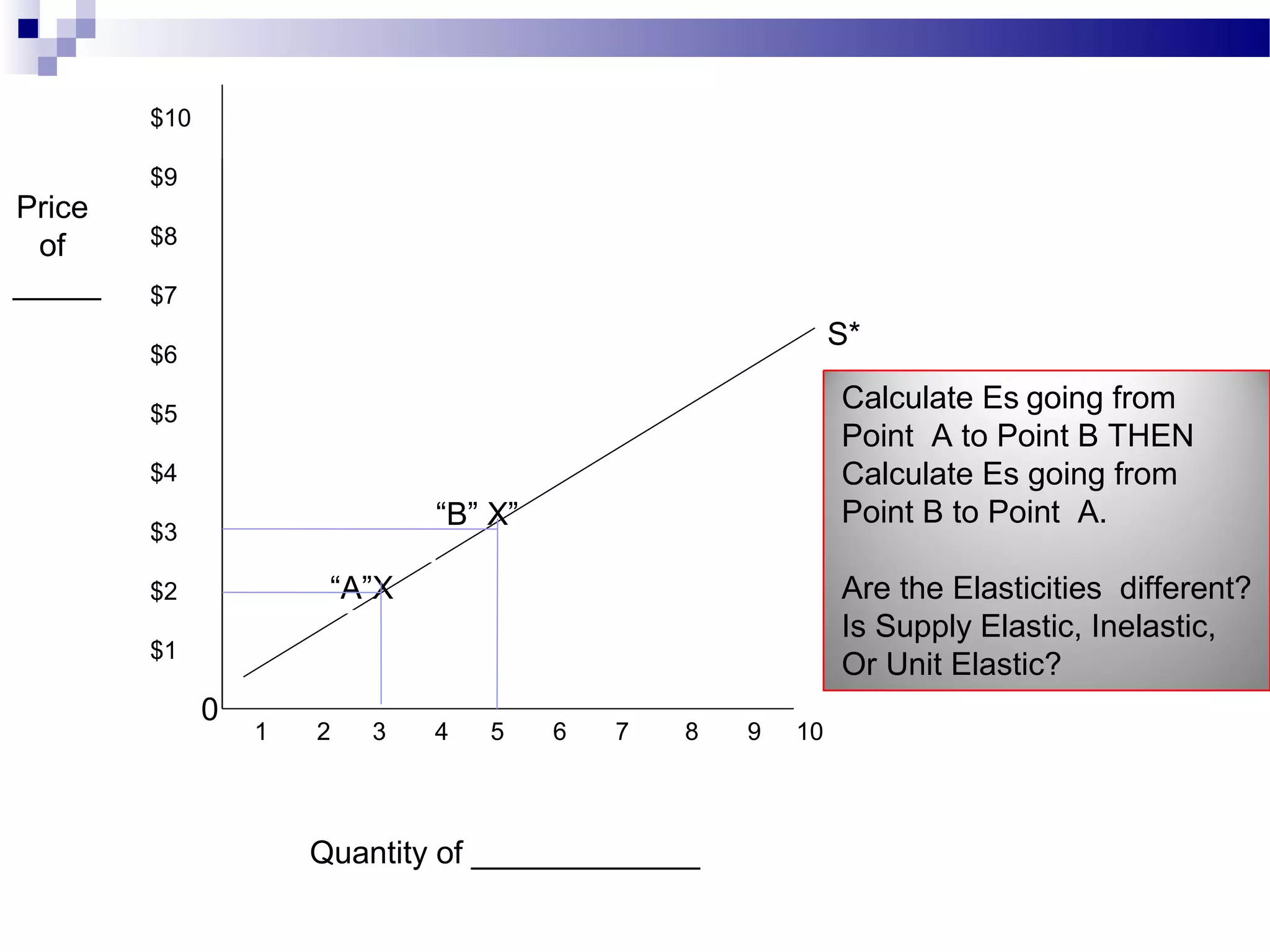
“A”X
“B” X”
S*
Calculate Es going from
Point A to Point B THEN
Calculate Es going from
Point B to Point A.
Are the Elasticities different?
Is Supply Elastic, Inelastic,
Or Unit Elastic?
$10
$9
$8
$7
$6
$5
$4
$3
$2
$1
1 2 3 4 5 6 7 8 9 10
Quantity of _____________
Price
of
_____
0
“A”X
“B” X”
S*
Calculate Es going from
Point A to Point B THEN
Calculate Es going from
Point B to Point A.
Are the Elasticities different?
Is Supply Elastic, Inelastic,
Or Unit Elastic?
$10
$9
$8
$7
$6
$5
$4
$3
$2
$1
1 2 3 4 5 6 7 8 9 10
Quantity of _____________
Price
of
_____
0
“A”X
“B” X”
S*
Mid-Point Formula for Elasticity
Q2 – Q1/(Q2 + Q1/2)
÷
P2 – P1/(P2 – P1/2)
Calculate the
midpoint
between A
and B
$10
$9
$8
$7
$6
$5
$4
$3
$2
$1
1 2 3 4 5 6 7 8 9 10
Quantity of _____________
Price
of
_____
0
“A”X
“B” X”
S*
Mid-Point Formula for Elasticity
Q2 – Q1/(Q2 + Q1/2)
÷
P2 – P1/(P2 – P1/2)
Calculate the
midpoint
between A
and B
$10
$9
$8
$7
$6
$5
$4
$3
$2
$1
1 2 3 4 5 6 7 8 9 10
Quantity of _____________
Price
of
_____
0
“A”X
“B” X”
S*
Mid-Point Formula for Elasticity
Q2 – Q1/(Q2 + Q1/2)
÷
P2 – P1/(P2 – P1/2)
Calculate the
midpoint
between A
and B
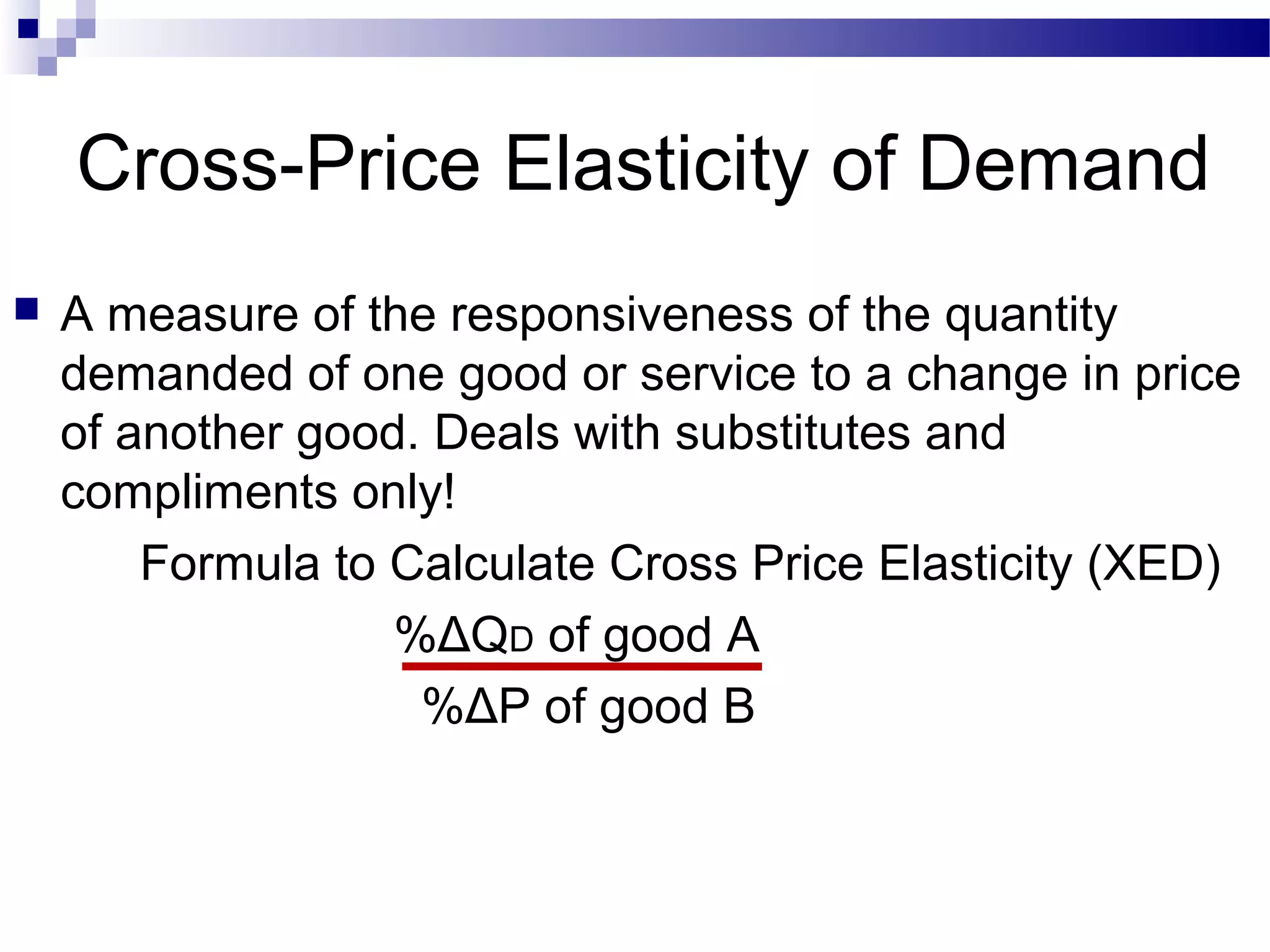
Cross-Price Elasticity of Demand
 A measure of the responsiveness of the quantity
demanded of one good or service to a change in price
of another good. Deals with substitutes and
compliments only!
Formula to Calculate Cross Price Elasticity (XED)
%ΔQD of good A
%ΔP of good B
Cross-Price Elasticity of Demand
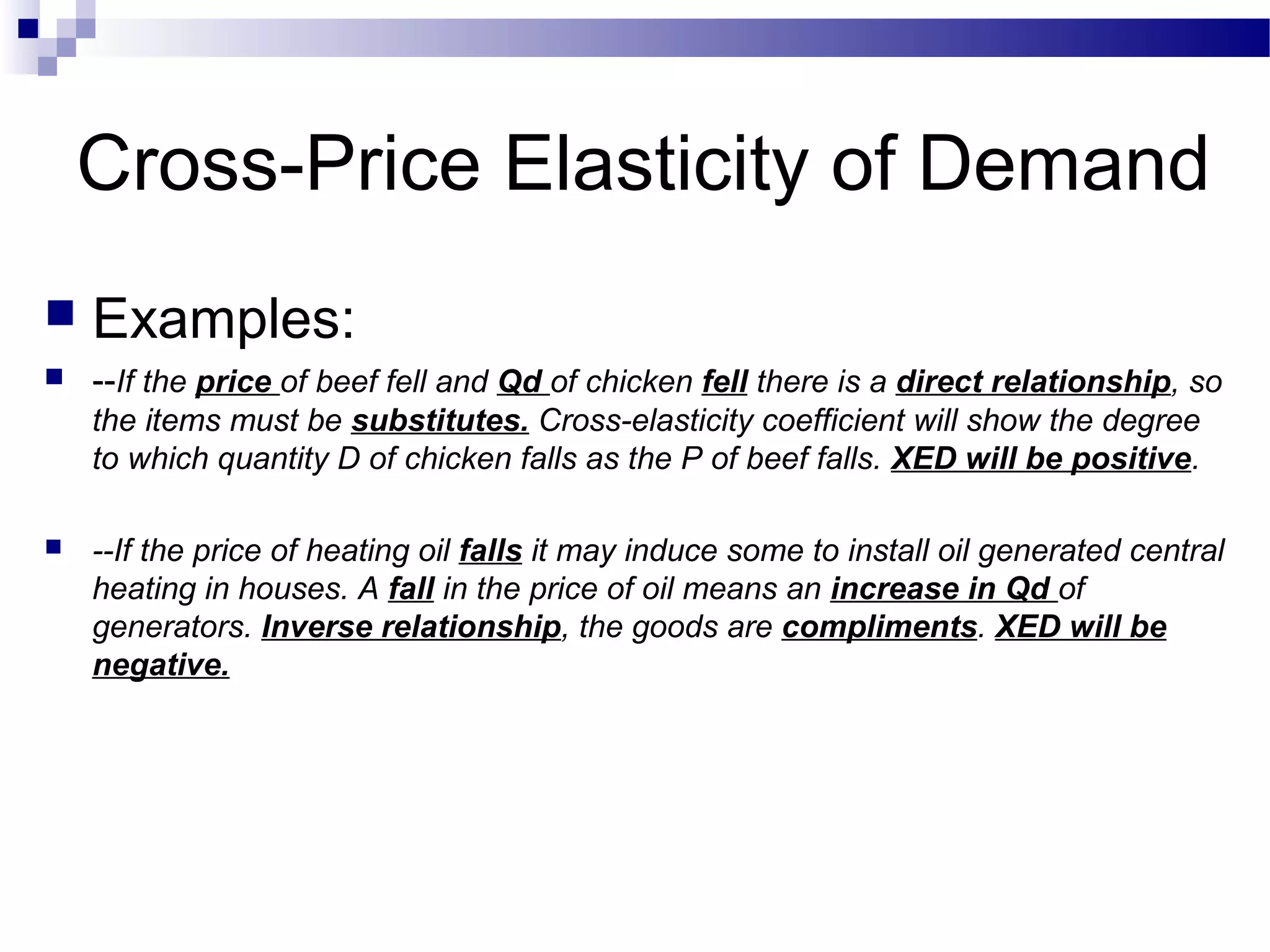
 Examples:
 --If the price of beef fell and Qd of chicken fell there is a direct relationship, so
the items must be substitutes. Cross-elasticity coefficient will show the degree
to which quantity D of chicken falls as the P of beef falls. XED will be positive.
 --If the price of heating oil falls it may induce some to install oil generated central
heating in houses. A fall in the price of oil means an increase in Qd of
generators. Inverse relationship, the goods are compliments. XED will be
negative.
Cross-Price Elasticity of Demand
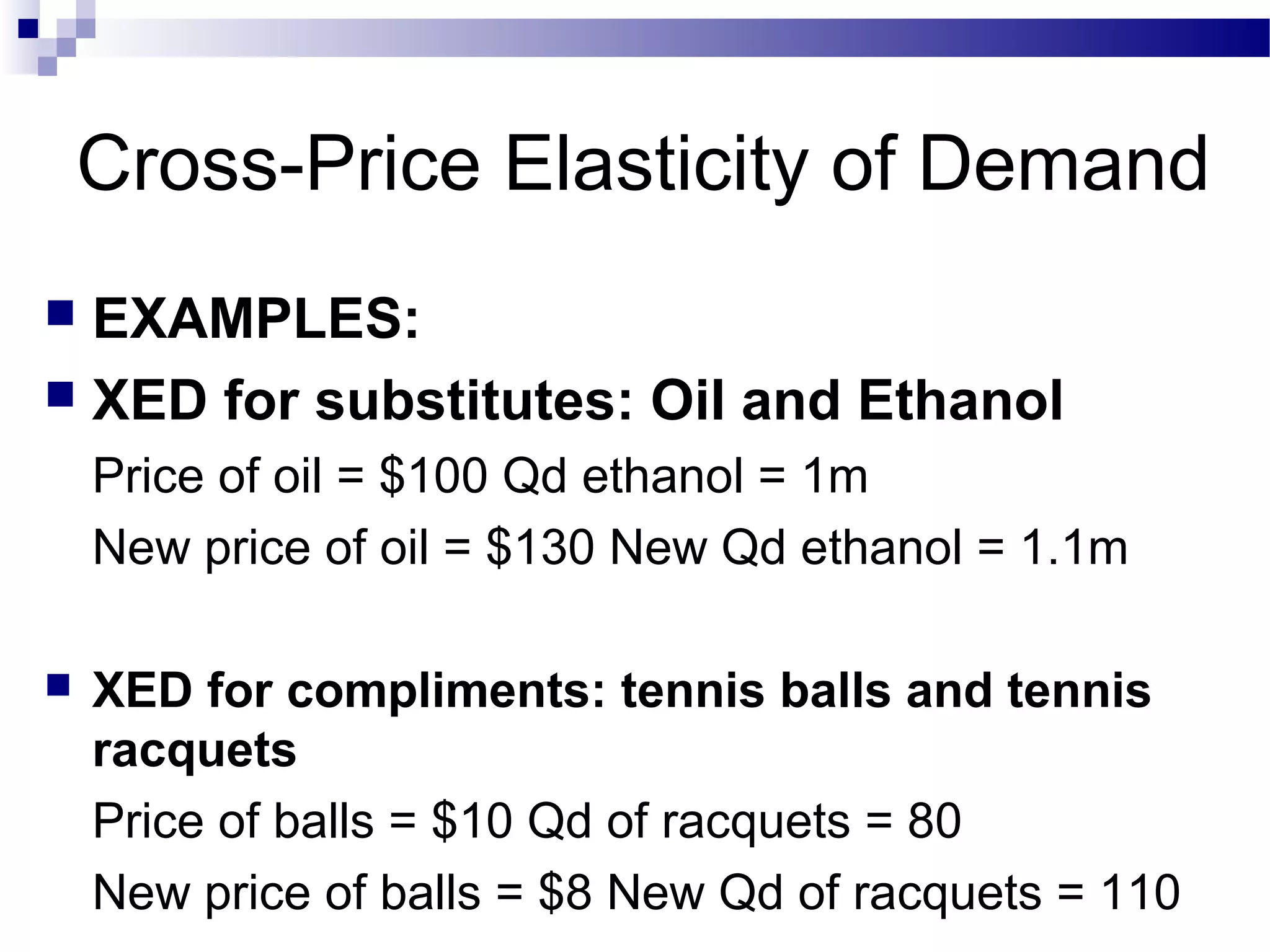
 EXAMPLES:
 XED for substitutes: Oil and Ethanol
Price of oil = $100 Qd ethanol = 1m
New price of oil = $130 New Qd ethanol = 1.1m
 XED for compliments: tennis balls and tennis
racquets
Price of balls = $10 Qd of racquets = 80
New price of balls = $8 New Qd of racquets = 110
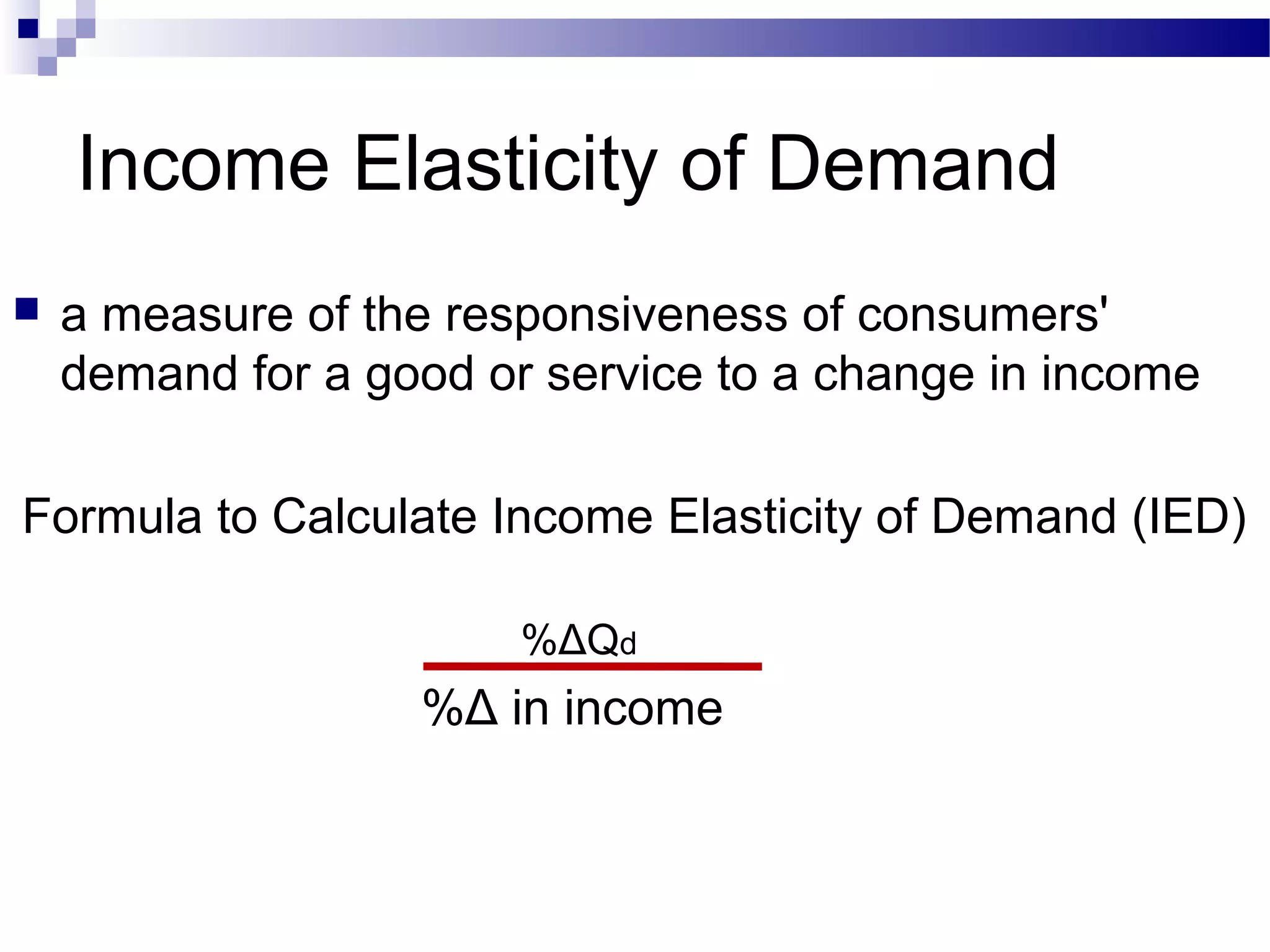
Income Elasticity of Demand
 a measure of the responsiveness of consumers'
demand for a good or service to a change in income
Formula to Calculate Income Elasticity of Demand (IED)
%ΔQd
%Δ in income
Income Elasticity of Demand
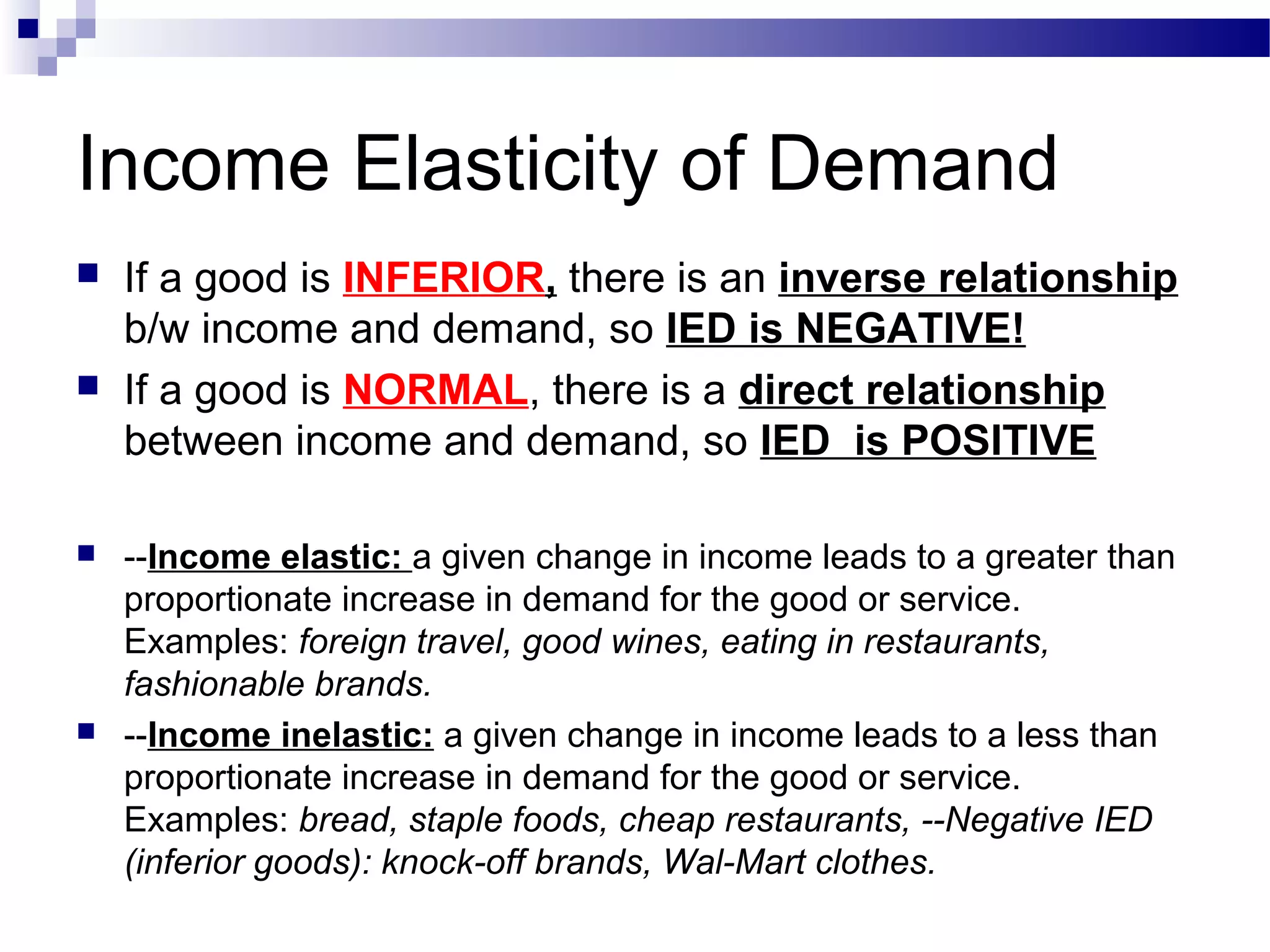
 If a good is INFERIOR, there is an inverse relationship
b/w income and demand, so IED is NEGATIVE!
 If a good is NORMAL, there is a direct relationship
between income and demand, so IED is POSITIVE
 --Income elastic: a given change in income leads to a greater than
proportionate increase in demand for the good or service.
Examples: foreign travel, good wines, eating in restaurants,
fashionable brands.
 --Income inelastic: a given change in income leads to a less than
proportionate increase in demand for the good or service.
Examples: bread, staple foods, cheap restaurants, --Negative IED
(inferior goods): knock-off brands, Wal-Mart clothes.

Elasticity of Demand and Supply (longer edition)

  • 1.
    Elasticity How responsive areyou??? Adapted from http://welkerswikinomics.com/blog/ww-study-guides-3/
  • 2.
    Of the productsshown here, identify those to which consumers are highly responsive to a change in price and those to which consumers are highly unresponsive to changes in price. Highly responsive Highly UnresponsiveHighly responsive Highly Unresponsive
  • 3.
    Elasticity of Demand Elasticity: a measure of the responsiveness of consumers or producers to a change in price of a good, the price of a related good, or income.
  • 4.
    Elasticity of Demand Important questions relating to elasticity:  1) Why do buyers of some products respond to price increases by reducing their purchases more than the buyers of other products?  2) Why do higher market prices for some products cause producers to greatly increase their output while price rises for other products cause only limited increase in output?  3) Why does the demand for some products rise a great deal when household income increases while the demand for other products rises just a little?
  • 5.
    Price Elasticity ofDemand  Price Elasticity of Demand: The responsiveness (or sensitivity) of consumers to a change in price. In other words, how much more or less of a good do consumers demand when the price changes
  • 6.
    Elasticity of Demand The Determinants of Price Elasticity of Demand: The following factors determine whether demand for a good or service is elastic, unit elastic, or inelastic.  The number of substitutes available. The more substitutes, more elastic demand, as consumers can replace a good whose price has gone up with one of its now relatively cheaper substitutes.  The proportion of income the purchase of a good represents. If a good represent a higher proportion of a conumer's income, his demand tends to be more elastic.  Luxury or necessity? If a good is a necessity, changes in price tend not to affect quantity demand, i.e. demand is inelastic. If it's a luxury that a consumer can go without, consumers tend to be more responsive.  If a product is addictive or habit forming, demand tends to be inelastic.  The amount of time a consumer has to respond to the price change. If prices remain high over a longer period of time, consumers can find substitutes or learn to live without, so demand is more elastic over time. S P L A T
  • 7.
    Formula to calculate the= PED coefficient (PED=Price Elasticity Of Demand) ΔQ of good Y original Q of Y ÷ ΔP of good Y original P of Y Price elasticity of demand equals the percentage change in quantity demanded of product X over the percentage change in the price of product X. Or more simply… %ΔQ Ed = %ΔP Example: A war in the Middle East causes oil supplies to fall, increasing the price per barrel from $100 to $120. Oil consumption in France falls from 1m barrels to 900,000 barrels. Calculate the PED for oil in France 900,000 - 1m 1m 120 - 100 100 .10 .20 = .5 The PED for oil in France is 0.5 Interpretation: French consumers are relatively unresponsive to an increase in the price of oil. As price goes up by 20%, they only demand 10% less oil. %ΔQ %ΔP
  • 8.
    $10 $9 $8 $7 $6 $5 $4 $3 $2 $1 1 2 34 5 6 7 8 9 10 x x Quantity of _____________ Price of _____ 0 %ΔPrice % ΔQuantity To Find Percentage Change Current Price/Quantity – Base Price/Quantity ÷ Base Price/Quantity X 100 = %Δ ELASTICITY of Demand % ΔQuantity ÷ %ΔPrice $7-$9= -$2 ÷ $9 Δ -22% (%Δ in Price) 3-1=2 ÷ 1 200% Elasticity is %ΔQ/%ΔP 200%/-22%= 9.9 Demand is Elastic (VERY RESPONSIVE) Price DECREASED 22%Price DECREASED 22%
  • 9.
    Elasticity of Demand If Elasticity is 1 then the good is Unit Elastic – No demand sensitivity to price changes (a one to one trade-off).  If Elasticity is greater than 1 then demanders are sensitive to price changes – Demand is Elastic.  If Elasticity is greater than 0 but less than 1, then demanders are NOT sensitive to prices changes – Demand is Inelastic.
  • 10.
    Elasticity of Demand IMPORTANT NOTE:  When we calculate the PRICE ELASTICITY OF DEMAND, IGNORE the negative sign.  When we calculate Income Elasticity of Demand AND Cross Price Elasticity of Demand we NEED TO KEEP THE NEGATIVE SIGN, IF IT APPREARS!!
  • 11.
    $10 $9 $8 $7 $6 $5 $4 $3 $2 $1 1 2 34 5 6 7 8 9 10 Quantity of _____________ Price of _____ 0 % ΔQuantity ELASTICITY of Demand % ΔQuantity ÷ %ΔPrice x x Calculate Ed going from Point A to Point B THEN Calculate Ed going from Point B to Point A. Are the Elasticities different? Is Demand Elastic, Inelastic, Or Unit Elastic? “A” “B”
  • 12.
    $10 $9 $8 $7 $6 $5 $4 $3 $2 $1 1 2 34 5 6 7 8 9 10 Quantity of _____________ Price of _____ 0 % ΔQuantity ELASTICITY of Demand % ΔQuantity ÷ %ΔPrice x x Calculate Ed going from Point A to Point B THEN Calculate Ed going from Point B to Point A. Are the Elasticities different? Is Demand Elastic, Inelastic, Or Unit Elastic? “A” “B”
  • 13.
    $10 $9 $8 $7 $6 $5 $4 $3 $2 $1 1 2 34 5 6 7 8 9 10 Quantity of _____________ Price of _____ 0 % ΔQuantity ELASTICITY of Demand % ΔQuantity ÷ %ΔPrice x x“B” “A” Calculate Ed going from Point A to Point B THEN Calculate Ed going from Point B to Point A. Are the Elasticities different? Is Demand Elastic, Inelastic, Or Unit Elastic?
  • 14.
    Elasticity  WHAT TODO???  How do we know what the true Elasticity is between two points if we get a different number each time?  ANOTHER formula---The MID-POINT FORMULA
  • 15.
    Goods Estimated Elasticity ofDemand Inelastic Salt 0.1 Matches 0.1 Toothpicks 0.1 Airline travel, short-run 0.1 Gasoline, short-run 0.2 Gasoline, long-run 0.7 Residential natural gas, short-run 0.1 Residential natural gas, long-run 0.5 Coffee 0.25 Fish (cod) consumed at home 0.5 Tobacco products, short-run 0.45 Legal services, short-run 0.4 Physician services 0.6 Taxi, short-run 0.6 Automobiles, long-run 0.2 Approximately Unitary Elasticity Movies 0.9 Housing, owner occupied, long-run 1.2 Shellfish, consumed at home 0.9 Oysters, consumed at home 1.1 Private education 1.1 Tires, short-run 0.9 Tires, long-run 1.2 Radio and television receivers 1.2 Elastic Restaurant meals 2.3 Foreign travel, long-run 4.0 Airline travel, long-run 2.4 Fresh green peas 2.8 Automobiles, short-run 1.2 - 1.5 Chevrolet automobiles 4.0 Fresh tomatoes 4.6
  • 16.
    Mid-point Formula  Becausethe calculated elasticity is different depending on which Price/Quantity combination you start at, we need a way to figure out elasticity between two points, regardless of which points you start at…  Midpoint Formula: Q2 – Q1/(Q2 + Q1/2) ÷ P2 – P1/(P2 – P1/2) Put into words---”Take the difference between the two Quantities and divide it by the AVERAGE of the two Quantities THEN DIVIDE this number by the difference in the two Prices divided by the AVERAGE of the two Prices”= MIDPOINT. REMEMBER: It is ALWAYS QUANTITY OVER THE PRICE!!!!!
  • 17.
    $10 $9 $8 $7 $6 $5 $4 $3 $2 $1 1 2 34 5 6 7 8 9 10 Quantity of _____________ Price of _____ 0 % ΔQuantity x x Mid-Point Formula for Elasticity Q2 – Q1/(Q2 + Q1/2) ÷ P2 – P1/(P2 – P1/2) “A” “B” Calculate the midpoint between A and B
  • 18.
    $10 $9 $8 $7 $6 $5 $4 $3 $2 $1 1 2 34 5 6 7 8 9 10 Quantity of _____________ Price of _____ 0 % ΔQuantity x x “A” “B” Mid-Point Formula for Elasticity Q2 – Q1/(Q2 + Q1/2) ÷ P2 – P1/(P2 – P1/2) Calculate the midpoint between A and B
  • 19.
    $10 $9 $8 $7 $6 $5 $4 $3 $2 $1 1 2 34 5 6 7 8 9 10 Quantity of _____________ Price of _____ 0 % ΔQuantity x x“B” “A” Mid-Point Formula for Elasticity Q2 – Q1/(Q2 + Q1/2) ÷ P2 – P1/(P2 – P1/2) Calculate the midpoint between A and B
  • 20.
    Elasticity  The LASTway to Determine Elasticity of Demand is the TOTAL REVENUE TEST.  To Determine TOTAL REVENUE (TR):  Price X Quantity = TR
  • 21.
    Total Revenue Test:When a fall in price leads to an increase in a firm's total revenue, demand is elastic. Logic: Consumers are highly responsive to changes in price. A small decrease will in price leads to a large increase in quantity demanded, meaning more revenue for firms. When a fall in price leads to a decrease in a firm's total revenue, demand is inelastic Logic: Consumers are unresponsive to changes in price. A fall in price will lead to only a small increase in quantity demanded, so firms' total revenue declines. When a change in price leads to no change in a firm's total revenue, demand is unit elastic. Logic: Consumers respond to a 10% fall in price with a 10% increase in quantity demanded, therefore firms's total revenue remains the same.
  • 22.
    $10 $9 $8 $7 $6 $5 $4 $3 $2 $1 1 2 34 5 6 7 8 9 10 Quantity of _____________ Price of _____ 0 X “A” TR= $9 x 1 =$9 X “B” X “C” TR= $5 X 5 = $25 X “D” TR= $3 X 7 = $21 X “E” TR= $2 X 8= $16 TR= $7 X 3 =$21 As Price Decreases from “A” to “B” Total Revenue INCREASES As price Decreases from “B” to “C” Total Revenue INCREASES As price Decreases from “C” to “D” Total Revenue DECREASES As price Decreases from “D” to “E” Total Revenue DECREASES PRICE DECREASES WHAT HAPPENS TO TOTAL REVENUE TOTAL REVENUE TEST Ed=9.09Ed=9.09 Ed=2.39Ed=2.39 Ed=1.00Ed=1.00 Ed=.42Ed=.42
  • 23.
    $10 $9 $8 $7 $6 $5 $4 $3 $2 $1 1 2 34 5 6 7 8 9 10 Quantity of _____________ Price of _____ 0 X “A” TR= $9 x 1 =$9 X “B” X “C” TR= $5 X 5 = $25 X “D” TR= $3 X 7 = $21 X “E” TR= $2 X 8= $16 TR= $7 X 3 =$21 As Price Increases from “B” to “A” Total Revenue DECREASES (note the mistake on your PPT!!) As price Increases from “C” to “B” Total Revenue DECREASES As price Increases from “D” to “C” Total Revenue INCREASES. As price Increases from “E” to “D” Total Revenue INCREASES PRICE INCREASES WHAT HAPPENS TO TOTAL REVENUE TOTAL REVENUE TEST Ed=2.39Ed=2.39 Ed=1.00Ed=1.00 Ed=.42Ed=.42 Ed=.11Ed=.11
  • 24.
    $10 $9 $8 $7 $6 $5 $4 $3 $2 $1 1 2 34 5 6 7 8 9 10 Quantity of _____________ Price of _____ 0 X “A X “B” X “C” X “D” X “E” ELASTIC RANGEELASTIC RANGE INELASTIC RANGEINELASTIC RANGE UNIT ELASTIC RANGEUNIT ELASTIC RANGE
  • 25.
    Elasticity of Supply Price Elasticity of Supply: The responsiveness of producers to a change in price.  Formulas are the same as Demand!!
  • 26.
    Price Elasticity ofSupply (PES) = ΔQs of good X ÷ original Qs of X ΔP of good X original P of X %ΔQ PES = ÷ %ΔP %ΔQ PES = ÷ %ΔP Or more Simply ΔQs of good X ΔP of good X ÷ average Qs average P MIDPOINT FORMULA = Price ELASTICITY OF SUPPLYPrice ELASTICITY OF SUPPLY
  • 27.
    $10 $9 $8 $7 $6 $5 $4 $3 $2 $1 1 2 34 5 6 7 8 9 10 Quantity of _____________ Price of _____ 0 “A”X “B” X” “C” X “” “D”X “ ”E” X “”
  • 28.
    $10 $9 $8 $7 $6 $5 $4 $3 $2 $1 1 2 34 5 6 7 8 9 10 Quantity of _____________ Price of _____ 0 “A”X “B” X” S* Calculate Es going from Point A to Point B THEN Calculate Es going from Point B to Point A. Are the Elasticities different? Is Supply Elastic, Inelastic, Or Unit Elastic?
  • 29.
    $10 $9 $8 $7 $6 $5 $4 $3 $2 $1 1 2 34 5 6 7 8 9 10 Quantity of _____________ Price of _____ 0 “A”X “B” X” S* Calculate Es going from Point A to Point B THEN Calculate Es going from Point B to Point A. Are the Elasticities different? Is Supply Elastic, Inelastic, Or Unit Elastic?
  • 30.
    $10 $9 $8 $7 $6 $5 $4 $3 $2 $1 1 2 34 5 6 7 8 9 10 Quantity of _____________ Price of _____ 0 “A”X “B” X” S* Calculate Es going from Point A to Point B THEN Calculate Es going from Point B to Point A. Are the Elasticities different? Is Supply Elastic, Inelastic, Or Unit Elastic?
  • 31.
    $10 $9 $8 $7 $6 $5 $4 $3 $2 $1 1 2 34 5 6 7 8 9 10 Quantity of _____________ Price of _____ 0 “A”X “B” X” S* Mid-Point Formula for Elasticity Q2 – Q1/(Q2 + Q1/2) ÷ P2 – P1/(P2 – P1/2) Calculate the midpoint between A and B
  • 32.
    $10 $9 $8 $7 $6 $5 $4 $3 $2 $1 1 2 34 5 6 7 8 9 10 Quantity of _____________ Price of _____ 0 “A”X “B” X” S* Mid-Point Formula for Elasticity Q2 – Q1/(Q2 + Q1/2) ÷ P2 – P1/(P2 – P1/2) Calculate the midpoint between A and B
  • 33.
    $10 $9 $8 $7 $6 $5 $4 $3 $2 $1 1 2 34 5 6 7 8 9 10 Quantity of _____________ Price of _____ 0 “A”X “B” X” S* Mid-Point Formula for Elasticity Q2 – Q1/(Q2 + Q1/2) ÷ P2 – P1/(P2 – P1/2) Calculate the midpoint between A and B
  • 34.
    Cross-Price Elasticity ofDemand  A measure of the responsiveness of the quantity demanded of one good or service to a change in price of another good. Deals with substitutes and compliments only! Formula to Calculate Cross Price Elasticity (XED) %ΔQD of good A %ΔP of good B
  • 35.
    Cross-Price Elasticity ofDemand  Examples:  --If the price of beef fell and Qd of chicken fell there is a direct relationship, so the items must be substitutes. Cross-elasticity coefficient will show the degree to which quantity D of chicken falls as the P of beef falls. XED will be positive.  --If the price of heating oil falls it may induce some to install oil generated central heating in houses. A fall in the price of oil means an increase in Qd of generators. Inverse relationship, the goods are compliments. XED will be negative.
  • 36.
    Cross-Price Elasticity ofDemand  EXAMPLES:  XED for substitutes: Oil and Ethanol Price of oil = $100 Qd ethanol = 1m New price of oil = $130 New Qd ethanol = 1.1m  XED for compliments: tennis balls and tennis racquets Price of balls = $10 Qd of racquets = 80 New price of balls = $8 New Qd of racquets = 110
  • 37.
    Income Elasticity ofDemand  a measure of the responsiveness of consumers' demand for a good or service to a change in income Formula to Calculate Income Elasticity of Demand (IED) %ΔQd %Δ in income
  • 38.
    Income Elasticity ofDemand  If a good is INFERIOR, there is an inverse relationship b/w income and demand, so IED is NEGATIVE!  If a good is NORMAL, there is a direct relationship between income and demand, so IED is POSITIVE  --Income elastic: a given change in income leads to a greater than proportionate increase in demand for the good or service. Examples: foreign travel, good wines, eating in restaurants, fashionable brands.  --Income inelastic: a given change in income leads to a less than proportionate increase in demand for the good or service. Examples: bread, staple foods, cheap restaurants, --Negative IED (inferior goods): knock-off brands, Wal-Mart clothes.