RoP Hooks
Shane.Macaulay@IOACTIVE.com
Introduction
• K2 / ktwo@ktwo.ca
• Shane.Macaulay @ioactive.com
Intro/Outline
• Hooking/Tracing
• What is a binary doing?
• Can we modify/detour
• Frustrations/Hurdles
• Friendly inputs
• Symbol support
TOOL / CODE
• Github.com/K2
• inVtero.net
• Evolution from CSW14 (process detection)
• Cross platform (Windows, *BSD, Linux) memory analysis
• Cross micro-architechture (sandy bridge, sky lake, …)
• Cross hypervisor (based on auto-magic VMCS / EPTP extraction)
• Includes nested support
• EhTrace (pronounced “A Trace”)
• What were going to cover this time @CSW ! 
• Let me know if I missed any code in the check-in!!
EhTrace
• Aboot time for a trace eh?
• Uses VEH under the covers
• Need to be a little careful
• Don’t want to alter or change
behavior of what were looking at
Hooking execution
• Detours
• Requires an instruction length decoder
• Rewrites function prolog into a specialized function which performs logging, analysis
etc…
• Usually static, can be dynamic/jitter,
• may jmp to a leaf like detour which can work without knowing the function
prototype/stack requirements
• Most of the time you will need symbols or really good logic in the hooker to not
break execution
What’s the problem again?
• Debuggers are slow
• Second process context switching is fairly expensive
• Logic for conditional breakpoints is exponentially more expensive
• Checksums
• Malicious binaries often checksum their code to validate they are not being analyzed
• Highly secure environments may checksum their binaries to make sure they are not
tampered with
Ret2 code
• Original libc work, Solar designer
• http://seclists.org/bugtraq/1997/Aug/63
• Handy since most overflows contain a pointer to useful addresses
• Your input
• System libraries
• Still used to this day (RoP)
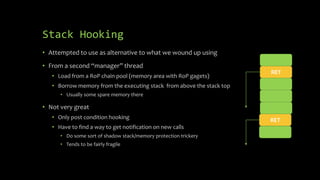
Stack Hooking
• Attempted to use as alternative to what we wound up using
• From a second “manager” thread
• Load from a RoP chain pool (memory area with RoP gagets)
• Borrow memory from the executing stack from above the stack top
• Usually some spare memory there
• Not very great
• Only post condition hooking
• Have to find a way to get notification on new calls
• Do some sort of shadow stack/memory protection trickery
• Tends to be fairly fragile
RET
RET
EhTrace – how it works
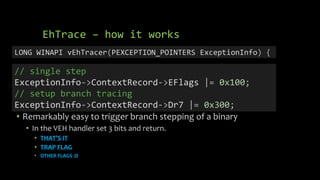
• Remarkably easy to trigger branch stepping of a binary
• In the VEH handler set 3 bits and return.
• THAT’S IT
• TRAP FLAG
• OTHER FLAGS :D
LONG WINAPI vEhTracer(PEXCEPTION_POINTERS ExceptionInfo) {
// single step
ExceptionInfo->ContextRecord->EFlags |= 0x100;
// setup branch tracing
ExceptionInfo->ContextRecord->Dr7 |= 0x300;
EhTrace – RoP Hooks
• Register a VEH handler CreateRemoteThread(… &VeH_RoP,..);
• VeH_RoP – use a RoP gadget finder (there are many)
• Handler only needs to set the 3 bits then exit with continue status
• Using the exception dispatcher were able to now get the preconditions we
missed with the stack/shadow model
What else is it good for?
• Branch stepping is pretty sweet!
• A lot more than detours on functions
• Basic block analysis
• Code coverages
• Can we put this into a DBI (Dynamic Binary Instrumentation) framework?
• Do we need to emulate? Isn’t that slow?
• If were dealing with a malicious binary we have several things to consider.
• Of course we need to also watch out for an otherwise non-mal binary doing something
that might disrupt our trace
Maintaining control
• Maybe use page protection to force an exception on execution (don’t want to
place an int3 obviously)
• When page is attempted to be executed we check to see what emulation is needed
• If somebody tries to take over VEH
• What about intra-block stuff?
• Can’t they just write over our VEH handler in memory?
• Sure, maybe register 2! Also setup the VEH continue handler
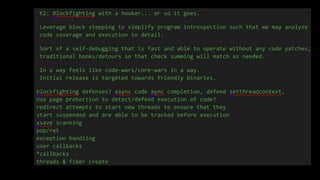
Blockfighting with a hooker
• BlockFighter has to be smart, fast and in total control!
• Much like a StreetFighterII champ!
BlockFighting
BlockFighting
• Simplified analysis
• Using capstone we & the branch step
• At the point of any jmp/ret/call control transfer we can stop our
fight until the next round
• Round 2 FIGHT!
• Actually were so good we always “give second round”!
• That means really that if there’s a conditional we need to follow through a conditional
• Jne – we follow the non-jump to ensure we complete the context until a ret/jmp/call
BlockFighting
• Watch the eflags & DR any manipulation will cause problems for us
• DEBUG_MSR ?
• Lots of things probably
• Overall however we have a platform to build primitives on that can eventually do
battle in a structured way
• Maybe combine blockfighter with stack injection to ensure we have additional post-
condition checks on our flag/branch-step/veh state
Coverage
• Can you hear me now?
• Flame graph
• Current minimal state includes RIP, LAST_RIP, TID, FLAGS and ESP
• This is sufficient to build any code graph! Intra-procedural, call graph or full trace
• FLAMING BlockFighter!
• http://www.brendangregg.com/FlameGraphs
CPU FLAME GRAPH
• CLICK HERE
• Orig from here -> http://www.brendangregg.com/FlameGraphs/cpu-bash-
flamegraph.svg
(PowerPoint doesn’t do SVG’z)
We have all the data required for generating these, however it’s a TODO
Upcoming stuff…
• MSAGL graphmaps – fun/interactive mesh graph, sort of looks like an expandable
spiderweb!
• SVG builder (without the .pl scripts from Brendan)
• Tighter Symbols (graphs and images not as fun without English eh?)
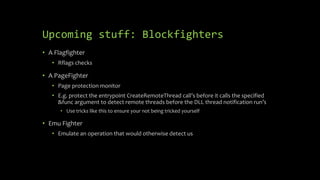
Upcoming stuff: Blockfighters
• A Flagfighter
• Rflags checks
• A PageFighter
• Page protection monitor
• E.g. protect the entrypoint CreateRemoteThread call’s before it calls the specified
&func argument to detect remote threads before the DLL thread notification run’s
• Use tricks like this to ensure your not being tricked yourself
• Emu Fighter
• Emulate an operation that would otherwise detect us
Private implementations differ!
• Your fighters will be various
• i.e. if your not using any system/runtime API you don’t need to worry about locking as
much (obviously)
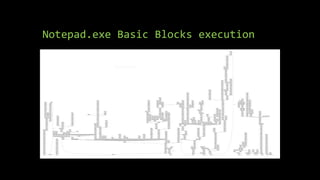
Notepad.exe Basic Blocks execution
Questions?
• Feedback, bugs & Feature requests please
• https://github.com/K2
Thank you
•

EhTrace -- RoP Hooks

  • 1.
  • 2.
    Introduction • K2 /ktwo@ktwo.ca • Shane.Macaulay @ioactive.com
  • 3.
    Intro/Outline • Hooking/Tracing • Whatis a binary doing? • Can we modify/detour • Frustrations/Hurdles • Friendly inputs • Symbol support
  • 4.
    TOOL / CODE •Github.com/K2 • inVtero.net • Evolution from CSW14 (process detection) • Cross platform (Windows, *BSD, Linux) memory analysis • Cross micro-architechture (sandy bridge, sky lake, …) • Cross hypervisor (based on auto-magic VMCS / EPTP extraction) • Includes nested support • EhTrace (pronounced “A Trace”) • What were going to cover this time @CSW !  • Let me know if I missed any code in the check-in!!
  • 5.
    EhTrace • Aboot timefor a trace eh? • Uses VEH under the covers • Need to be a little careful • Don’t want to alter or change behavior of what were looking at
  • 6.
    Hooking execution • Detours •Requires an instruction length decoder • Rewrites function prolog into a specialized function which performs logging, analysis etc… • Usually static, can be dynamic/jitter, • may jmp to a leaf like detour which can work without knowing the function prototype/stack requirements • Most of the time you will need symbols or really good logic in the hooker to not break execution
  • 7.
    What’s the problemagain? • Debuggers are slow • Second process context switching is fairly expensive • Logic for conditional breakpoints is exponentially more expensive • Checksums • Malicious binaries often checksum their code to validate they are not being analyzed • Highly secure environments may checksum their binaries to make sure they are not tampered with
  • 8.
    Ret2 code • Originallibc work, Solar designer • http://seclists.org/bugtraq/1997/Aug/63 • Handy since most overflows contain a pointer to useful addresses • Your input • System libraries • Still used to this day (RoP)
  • 9.
    Stack Hooking • Attemptedto use as alternative to what we wound up using • From a second “manager” thread • Load from a RoP chain pool (memory area with RoP gagets) • Borrow memory from the executing stack from above the stack top • Usually some spare memory there • Not very great • Only post condition hooking • Have to find a way to get notification on new calls • Do some sort of shadow stack/memory protection trickery • Tends to be fairly fragile RET RET
  • 10.
    EhTrace – howit works • Remarkably easy to trigger branch stepping of a binary • In the VEH handler set 3 bits and return. • THAT’S IT • TRAP FLAG • OTHER FLAGS :D LONG WINAPI vEhTracer(PEXCEPTION_POINTERS ExceptionInfo) { // single step ExceptionInfo->ContextRecord->EFlags |= 0x100; // setup branch tracing ExceptionInfo->ContextRecord->Dr7 |= 0x300;
  • 11.
    EhTrace – RoPHooks • Register a VEH handler CreateRemoteThread(… &VeH_RoP,..); • VeH_RoP – use a RoP gadget finder (there are many) • Handler only needs to set the 3 bits then exit with continue status • Using the exception dispatcher were able to now get the preconditions we missed with the stack/shadow model
  • 12.
    What else isit good for? • Branch stepping is pretty sweet! • A lot more than detours on functions • Basic block analysis • Code coverages • Can we put this into a DBI (Dynamic Binary Instrumentation) framework? • Do we need to emulate? Isn’t that slow? • If were dealing with a malicious binary we have several things to consider. • Of course we need to also watch out for an otherwise non-mal binary doing something that might disrupt our trace
  • 13.
    Maintaining control • Maybeuse page protection to force an exception on execution (don’t want to place an int3 obviously) • When page is attempted to be executed we check to see what emulation is needed • If somebody tries to take over VEH • What about intra-block stuff? • Can’t they just write over our VEH handler in memory? • Sure, maybe register 2! Also setup the VEH continue handler
  • 14.
    Blockfighting with ahooker • BlockFighter has to be smart, fast and in total control! • Much like a StreetFighterII champ!
  • 15.
  • 16.
    BlockFighting • Simplified analysis •Using capstone we & the branch step • At the point of any jmp/ret/call control transfer we can stop our fight until the next round • Round 2 FIGHT! • Actually were so good we always “give second round”! • That means really that if there’s a conditional we need to follow through a conditional • Jne – we follow the non-jump to ensure we complete the context until a ret/jmp/call
  • 17.
    BlockFighting • Watch theeflags & DR any manipulation will cause problems for us • DEBUG_MSR ? • Lots of things probably • Overall however we have a platform to build primitives on that can eventually do battle in a structured way • Maybe combine blockfighter with stack injection to ensure we have additional post- condition checks on our flag/branch-step/veh state
  • 18.
    Coverage • Can youhear me now? • Flame graph • Current minimal state includes RIP, LAST_RIP, TID, FLAGS and ESP • This is sufficient to build any code graph! Intra-procedural, call graph or full trace • FLAMING BlockFighter! • http://www.brendangregg.com/FlameGraphs
  • 19.
    CPU FLAME GRAPH •CLICK HERE • Orig from here -> http://www.brendangregg.com/FlameGraphs/cpu-bash- flamegraph.svg (PowerPoint doesn’t do SVG’z) We have all the data required for generating these, however it’s a TODO
  • 20.
    Upcoming stuff… • MSAGLgraphmaps – fun/interactive mesh graph, sort of looks like an expandable spiderweb! • SVG builder (without the .pl scripts from Brendan) • Tighter Symbols (graphs and images not as fun without English eh?)
  • 21.
    Upcoming stuff: Blockfighters •A Flagfighter • Rflags checks • A PageFighter • Page protection monitor • E.g. protect the entrypoint CreateRemoteThread call’s before it calls the specified &func argument to detect remote threads before the DLL thread notification run’s • Use tricks like this to ensure your not being tricked yourself • Emu Fighter • Emulate an operation that would otherwise detect us
  • 22.
    Private implementations differ! •Your fighters will be various • i.e. if your not using any system/runtime API you don’t need to worry about locking as much (obviously)
  • 23.
  • 24.
    Questions? • Feedback, bugs& Feature requests please • https://github.com/K2
  • 25.