Bringing Concurrency
to Ruby
Charles Oliver Nutter	

@headius
Me, about 40 weeks of the year
Me, the other 12 weeks of the year
Concurrency
Parallelism?
Concurrency
• Two or more jobs	

• Making progress	

• Over a given time span
Parallelism
• Two or more computations	

• Executing at the same moment in time
Examples
• Thread APIs: concurrency	

• Actore APIs: concurrency	

• Native thread, process: parallelism	

• If the underlying system supports it	

• SIMD, GPU, vector operations: parallelism
You Need Both
• Work that can split into concurrent jobs	

• Platform that runs those jobs in parallel	

• In an ideal world, scales with job count	

• In our world, each job adds overhead
Process-level
Concurrency
• Separate processes running concurrently	

• As parallel as OS/CPU can make them	

• Low risk due to isolated memory space	

• High memory requirements	

• High communication overhead
Thread-level
Concurrency
• Threads in-process running concurrently	

• As parallel as OS/CPU can make them	

• Higher risk due to shared memory space	

• Lower memory requirements	

• Low communication overhead
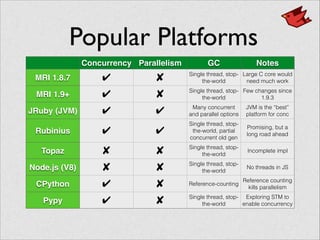
Popular Platforms
Concurrency Parallelism GC Notes
MRI 1.8.7 ✔ ✘ Single thread, stop-
the-world
Large C core would
need much work
MRI 1.9+ ✔ ✘ Single thread, stop-
the-world
Few changes since
1.9.3
JRuby (JVM) ✔ ✔ Many concurrent
and parallel options
JVM is the “best”
platform for conc
Rubinius ✔ ✔
Single thread, stop-
the-world, partial
concurrent old gen
Promising, but a
long road ahead
Topaz ✘ ✘ Single thread, stop-
the-world
Incomplete impl
Node.js (V8) ✘ ✘ Single thread, stop-
the-world
No threads in JS
CPython ✔ ✘ Reference-counting
Reference counting
kills parallelism
Pypy ✔ ✘ Single thread, stop-
the-world
Exploring STM to
enable concurrency
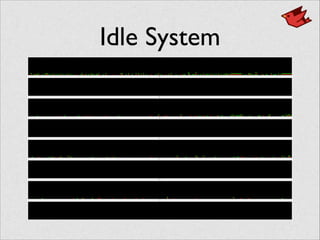
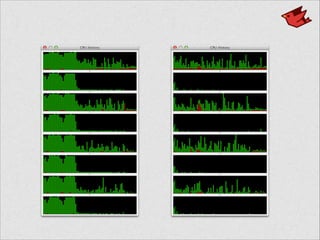
Idle System
MRI 1.8.7, One Thread
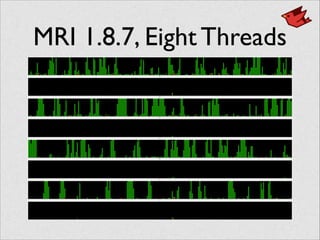
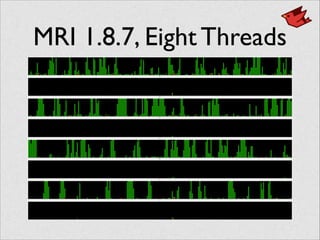
MRI 1.8.7, Eight Threads
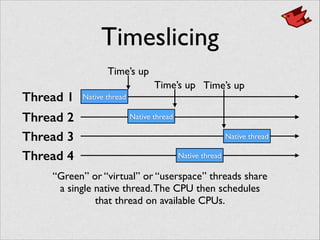
Timeslicing
Thread 1
Thread 2
Thread 3
Thread 4
Native thread
Native thread
Native thread
Native thread
“Green” or “virtual” or “userspace” threads share	

a single native thread.The CPU then schedules	

that thread on available CPUs.
Time’s up
Time’s up Time’s up
MRI 1.8.7, Eight Threads
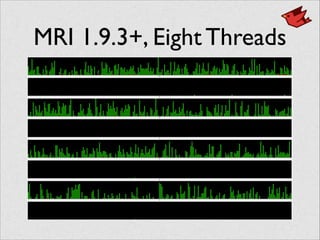
MRI 1.9.3+, Eight Threads
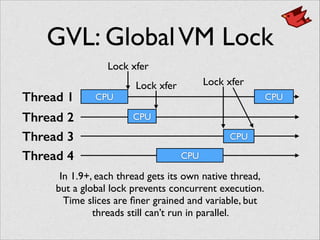
GVL: GlobalVM Lock
Thread 1
Thread 2
Thread 3
Thread 4
CPU
CPU
CPU
CPU
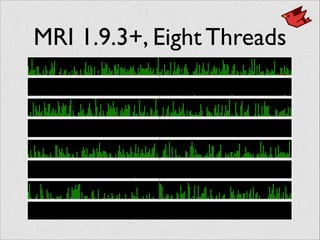
In 1.9+, each thread gets its own native thread,	

but a global lock prevents concurrent execution.	

Time slices are finer grained and variable, but	

threads still can’t run in parallel.
Lock xfer
CPU
Lock xfer Lock xfer
GVL: GlobalVenue Lock
MRI 1.9.3+, Eight Threads
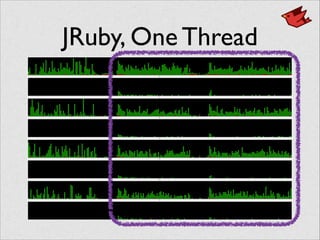
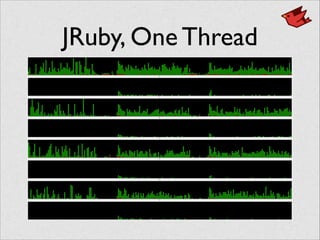
JRuby, One Thread
Why Do We See
Parallelism?
• Hotspot JVM has many background threads	

• GC with concurrent and parallel options	

• JIT threads	

• Signal handling	

• Monitoring and management
JRuby, One Thread
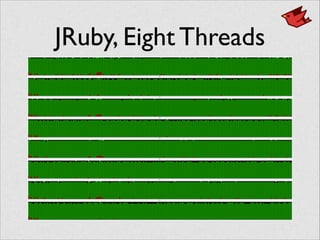
JRuby, Eight Threads
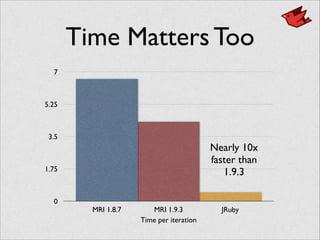
Time Matters Too
0
1.75
3.5
5.25
7
Time per iteration
MRI 1.8.7 MRI 1.9.3 JRuby
Nearly 10x	

faster than	

1.9.3
Rules of Concurrency
1. Don’t do it, if you don’t have to.	

2. If you must do it, don’t share data.	

3. If you must share data, make it immutable.	

4. If it must be mutable, coordinate all access.
#1: Don’t
• Many problems won’t benefit	

• Explicitly sequential things, e.g	

• Bad code can get worse	

• Multiply perf, GC, alloc overhead by N	

• Fixes may not be easy (esp. in Ruby)	

• The risks can get tricky to address
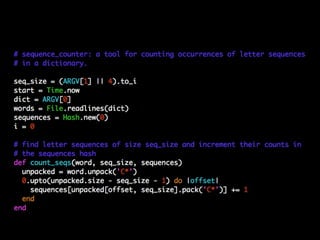
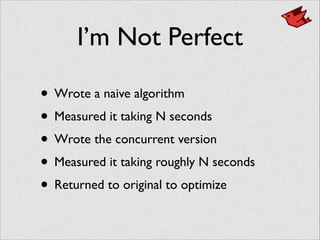
I’m Not Perfect
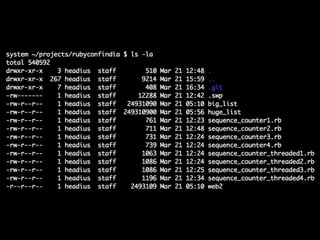
• Wrote a naive algorithm	

• Measured it taking N seconds	

• Wrote the concurrent version	

• Measured it taking roughly N seconds	

• Returned to original to optimize
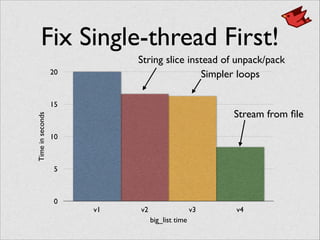
Fix Single-thread First!Timeinseconds
0
5
10
15
20
big_list time
v1 v2 v3 v4
String slice instead of unpack/pack
Simpler loops
Stream from file
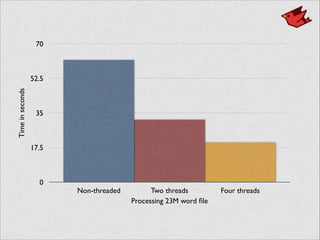
Timeinseconds
0
17.5
35
52.5
70
Processing 23M word file
Non-threaded Two threads Four threads
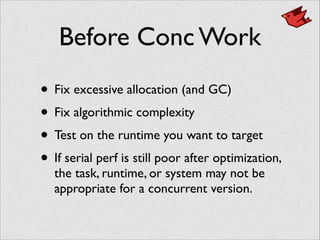
Before Conc Work
• Fix excessive allocation (and GC)	

• Fix algorithmic complexity	

• Test on the runtime you want to target	

• If serial perf is still poor after optimization,
the task, runtime, or system may not be
appropriate for a concurrent version.
Concurrency won’t help code
that’s using up all hardware
resources.
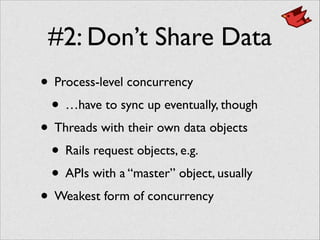
#2: Don’t Share Data
• Process-level concurrency	

• …have to sync up eventually, though	

• Threads with their own data objects	

• Rails request objects, e.g.	

• APIs with a “master” object, usually	

• Weakest form of concurrency
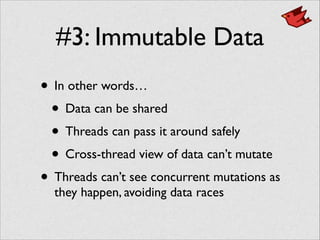
#3: Immutable Data
• In other words…	

• Data can be shared	

• Threads can pass it around safely	

• Cross-thread view of data can’t mutate	

• Threads can’t see concurrent mutations as
they happen, avoiding data races
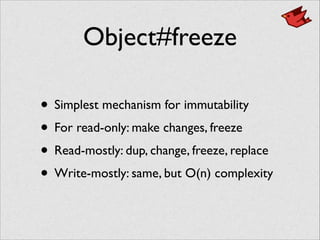
Object#freeze
• Simplest mechanism for immutability	

• For read-only: make changes, freeze	

• Read-mostly: dup, change, freeze, replace	

• Write-mostly: same, but O(n) complexity
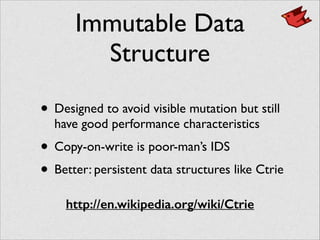
Immutable Data
Structure
• Designed to avoid visible mutation but still
have good performance characteristics	

• Copy-on-write is poor-man’s IDS	

• Better: persistent data structures like Ctrie
http://en.wikipedia.org/wiki/Ctrie
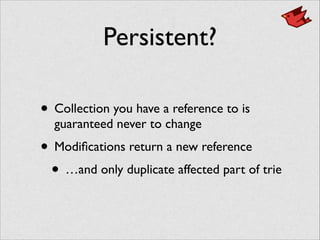
Persistent?
• Collection you have a reference to is
guaranteed never to change	

• Modifications return a new reference	

• …and only duplicate affected part of trie
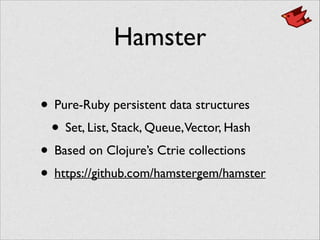
Hamster
• Pure-Ruby persistent data structures	

• Set, List, Stack, Queue,Vector, Hash	

• Based on Clojure’s Ctrie collections	

• https://github.com/hamstergem/hamster
person = Hamster.hash(!
:name => “Simon",!
:gender => :male)!
# => {:name => "Simon", :gender => :male}!
 !
person[:name]!
# => "Simon"!
person.get(:gender)!
# => :male!
 !
friend = person.put(:name, "James")!
# => {:name => "James", :gender => :male}!
person!
# => {:name => "Simon", :gender => :male}!
friend[:name]!
# => "James"!
person[:name]!
# => "Simon"
Coming Soon
• Reimplementation by Smit Shah	

• Mostly “native” impl of Ctrie	

• Considerably better perf than Hamster	

• https://github.com/Who828/persistent_data_structures
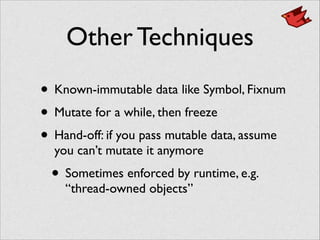
Other Techniques
• Known-immutable data like Symbol, Fixnum	

• Mutate for a while, then freeze	

• Hand-off: if you pass mutable data, assume
you can’t mutate it anymore	

• Sometimes enforced by runtime, e.g.
“thread-owned objects”
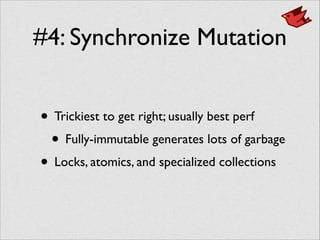
#4: Synchronize Mutation
• Trickiest to get right; usually best perf	

• Fully-immutable generates lots of garbage	

• Locks, atomics, and specialized collections
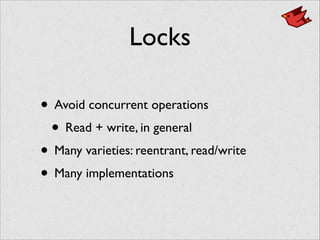
Locks
• Avoid concurrent operations	

• Read + write, in general	

• Many varieties: reentrant, read/write	

• Many implementations
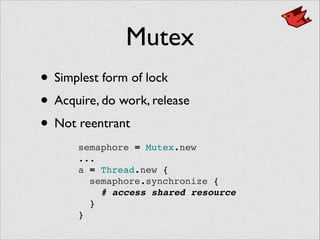
Mutex
• Simplest form of lock	

• Acquire, do work, release	

• Not reentrant
semaphore = Mutex.new!
...!
a = Thread.new {!
semaphore.synchronize {!
# access shared resource!
}!
}
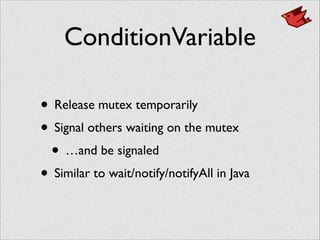
ConditionVariable
• Release mutex temporarily	

• Signal others waiting on the mutex	

• …and be signaled	

• Similar to wait/notify/notifyAll in Java
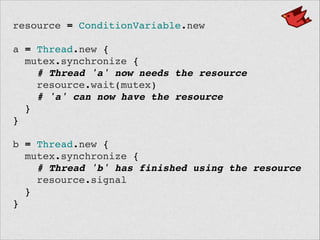
resource = ConditionVariable.new!
 !
a = Thread.new {!
mutex.synchronize {!
# Thread 'a' now needs the resource!
resource.wait(mutex)!
# 'a' can now have the resource!
}!
}!
 !
b = Thread.new {!
mutex.synchronize {!
# Thread 'b' has finished using the resource!
resource.signal!
}!
}!
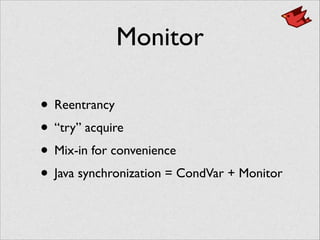
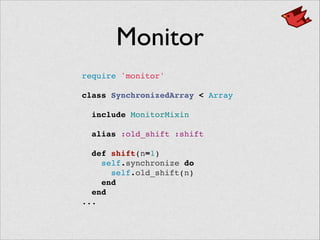
Monitor
• Reentrancy	

• “try” acquire	

• Mix-in for convenience	

• Java synchronization = CondVar + Monitor
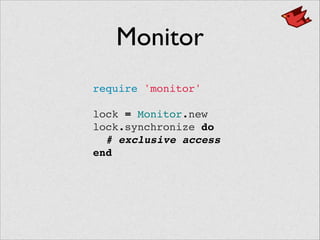
Monitor
require 'monitor'!
 !
lock = Monitor.new!
lock.synchronize do!
# exclusive access!
end
Monitor
require 'monitor'!
 !
class SynchronizedArray < Array!
 !
include MonitorMixin!
 !
alias :old_shift :shift!
 !
def shift(n=1)!
self.synchronize do!
self.old_shift(n)!
end!
end!
...
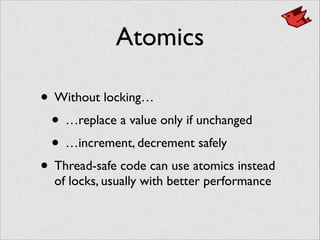
Atomics
• Without locking…	

• …replace a value only if unchanged	

• …increment, decrement safely	

• Thread-safe code can use atomics instead
of locks, usually with better performance
atomic
• Atomic operations for Ruby	

• https://github.com/headius/ruby-atomic
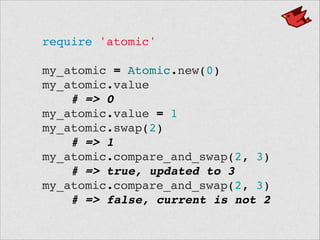
require 'atomic'!
 !
my_atomic = Atomic.new(0)!
my_atomic.value!
# => 0!
my_atomic.value = 1!
my_atomic.swap(2)!
# => 1!
my_atomic.compare_and_swap(2, 3)!
# => true, updated to 3!
my_atomic.compare_and_swap(2, 3)!
# => false, current is not 2
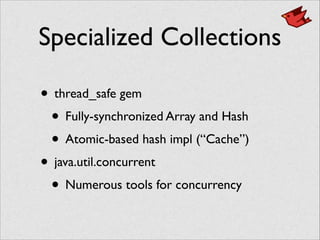
Specialized Collections
• thread_safe gem	

• Fully-synchronized Array and Hash	

• Atomic-based hash impl (“Cache”)	

• java.util.concurrent	

• Numerous tools for concurrency
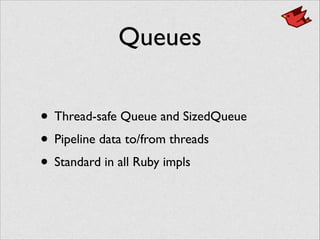
Queues
• Thread-safe Queue and SizedQueue	

• Pipeline data to/from threads	

• Standard in all Ruby impls
thread_count = (ARGV[2] || 1).to_i!
queue = SizedQueue.new(thread_count * 4)!
!
word_file.each_line.each_slice(50) do |words|!
queue << words!
end!
queue << nil # terminating condition
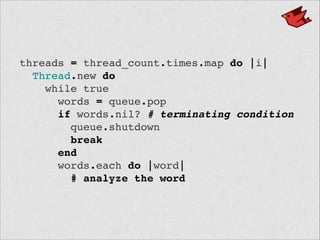
threads = thread_count.times.map do |i|!
Thread.new do!
while true!
words = queue.pop!
if words.nil? # terminating condition!
queue.shutdown!
break!
end!
words.each do |word|!
# analyze the word
Putting It All Together
• These are a lot of tools to sort out	

• Others have sorted them out for you
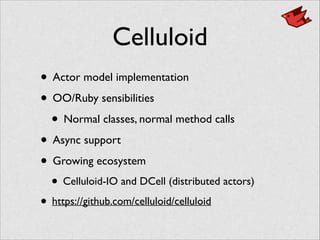
Celluloid
• Actor model implementation	

• OO/Ruby sensibilities	

• Normal classes, normal method calls	

• Async support	

• Growing ecosystem	

• Celluloid-IO and DCell (distributed actors)	

• https://github.com/celluloid/celluloid
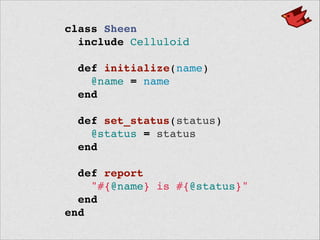
class Sheen!
include Celluloid!
 !
def initialize(name)!
@name = name!
end!
 !
def set_status(status)!
@status = status!
end!
 !
def report!
"#{@name} is #{@status}"!
end!
end
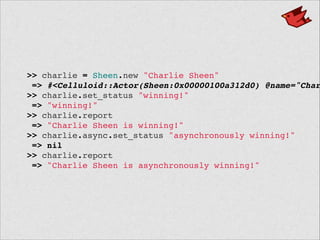
>> charlie = Sheen.new "Charlie Sheen"!
=> #<Celluloid::Actor(Sheen:0x00000100a312d0) @name="Char
>> charlie.set_status "winning!"!
=> "winning!"!
>> charlie.report!
=> "Charlie Sheen is winning!"!
>> charlie.async.set_status "asynchronously winning!"!
=> nil!
>> charlie.report!
=> "Charlie Sheen is asynchronously winning!"
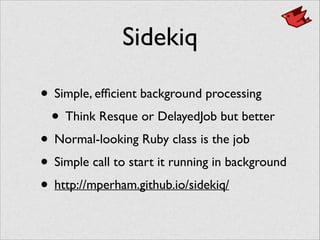
Sidekiq
• Simple, efficient background processing	

• Think Resque or DelayedJob but better	

• Normal-looking Ruby class is the job	

• Simple call to start it running in background	

• http://mperham.github.io/sidekiq/
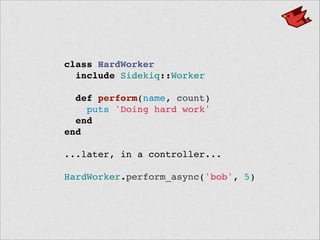
class HardWorker!
include Sidekiq::Worker!
 !
def perform(name, count)!
puts 'Doing hard work'!
end!
end!
!
...later, in a controller...!
 !
HardWorker.perform_async('bob', 5)
Concurrent Ruby
• Grab bag of concurrency patterns	

• Actor,Agent, Channel, Future, Promise,
ScheduledTask,TimerTask, Supervisor	

• Thread pools, executors, timeouts,
conditions, latches, atomics	

• May grow into a central lib for conc stuff	

• https://github.com/jdantonio/concurrent-ruby
…all the examples I’ve shown you and more
Recap
• The future of Ruby is concurrent	

• The tools are there to help you	

• Let’s all help move Ruby forward
Thank you!
• Charles Oliver Nutter	

• headius@headius.com	

• @headius

Bringing Concurrency to Ruby - RubyConf India 2014

  • 1.
  • 3.
    Me, about 40weeks of the year
  • 4.
    Me, the other12 weeks of the year
  • 10.
  • 11.
  • 12.
    Concurrency • Two ormore jobs • Making progress • Over a given time span
  • 13.
    Parallelism • Two ormore computations • Executing at the same moment in time
  • 14.
    Examples • Thread APIs:concurrency • Actore APIs: concurrency • Native thread, process: parallelism • If the underlying system supports it • SIMD, GPU, vector operations: parallelism
  • 18.
    You Need Both •Work that can split into concurrent jobs • Platform that runs those jobs in parallel • In an ideal world, scales with job count • In our world, each job adds overhead
  • 19.
    Process-level Concurrency • Separate processesrunning concurrently • As parallel as OS/CPU can make them • Low risk due to isolated memory space • High memory requirements • High communication overhead
  • 20.
    Thread-level Concurrency • Threads in-processrunning concurrently • As parallel as OS/CPU can make them • Higher risk due to shared memory space • Lower memory requirements • Low communication overhead
  • 21.
    Popular Platforms Concurrency ParallelismGC Notes MRI 1.8.7 ✔ ✘ Single thread, stop- the-world Large C core would need much work MRI 1.9+ ✔ ✘ Single thread, stop- the-world Few changes since 1.9.3 JRuby (JVM) ✔ ✔ Many concurrent and parallel options JVM is the “best” platform for conc Rubinius ✔ ✔ Single thread, stop- the-world, partial concurrent old gen Promising, but a long road ahead Topaz ✘ ✘ Single thread, stop- the-world Incomplete impl Node.js (V8) ✘ ✘ Single thread, stop- the-world No threads in JS CPython ✔ ✘ Reference-counting Reference counting kills parallelism Pypy ✔ ✘ Single thread, stop- the-world Exploring STM to enable concurrency
  • 22.
  • 24.
  • 25.
  • 26.
    Timeslicing Thread 1 Thread 2 Thread3 Thread 4 Native thread Native thread Native thread Native thread “Green” or “virtual” or “userspace” threads share a single native thread.The CPU then schedules that thread on available CPUs. Time’s up Time’s up Time’s up
  • 27.
  • 28.
  • 29.
    GVL: GlobalVM Lock Thread1 Thread 2 Thread 3 Thread 4 CPU CPU CPU CPU In 1.9+, each thread gets its own native thread, but a global lock prevents concurrent execution. Time slices are finer grained and variable, but threads still can’t run in parallel. Lock xfer CPU Lock xfer Lock xfer
  • 30.
  • 31.
  • 32.
  • 33.
  • 34.
    Why Do WeSee Parallelism? • Hotspot JVM has many background threads • GC with concurrent and parallel options • JIT threads • Signal handling • Monitoring and management
  • 35.
  • 36.
  • 37.
    Time Matters Too 0 1.75 3.5 5.25 7 Timeper iteration MRI 1.8.7 MRI 1.9.3 JRuby Nearly 10x faster than 1.9.3
  • 38.
    Rules of Concurrency 1.Don’t do it, if you don’t have to. 2. If you must do it, don’t share data. 3. If you must share data, make it immutable. 4. If it must be mutable, coordinate all access.
  • 39.
    #1: Don’t • Manyproblems won’t benefit • Explicitly sequential things, e.g • Bad code can get worse • Multiply perf, GC, alloc overhead by N • Fixes may not be easy (esp. in Ruby) • The risks can get tricky to address
  • 44.
    I’m Not Perfect •Wrote a naive algorithm • Measured it taking N seconds • Wrote the concurrent version • Measured it taking roughly N seconds • Returned to original to optimize
  • 45.
    Fix Single-thread First!Timeinseconds 0 5 10 15 20 big_listtime v1 v2 v3 v4 String slice instead of unpack/pack Simpler loops Stream from file
  • 46.
    Timeinseconds 0 17.5 35 52.5 70 Processing 23M wordfile Non-threaded Two threads Four threads
  • 47.
    Before Conc Work •Fix excessive allocation (and GC) • Fix algorithmic complexity • Test on the runtime you want to target • If serial perf is still poor after optimization, the task, runtime, or system may not be appropriate for a concurrent version.
  • 48.
    Concurrency won’t helpcode that’s using up all hardware resources.
  • 49.
    #2: Don’t ShareData • Process-level concurrency • …have to sync up eventually, though • Threads with their own data objects • Rails request objects, e.g. • APIs with a “master” object, usually • Weakest form of concurrency
  • 50.
    #3: Immutable Data •In other words… • Data can be shared • Threads can pass it around safely • Cross-thread view of data can’t mutate • Threads can’t see concurrent mutations as they happen, avoiding data races
  • 51.
    Object#freeze • Simplest mechanismfor immutability • For read-only: make changes, freeze • Read-mostly: dup, change, freeze, replace • Write-mostly: same, but O(n) complexity
  • 52.
    Immutable Data Structure • Designedto avoid visible mutation but still have good performance characteristics • Copy-on-write is poor-man’s IDS • Better: persistent data structures like Ctrie http://en.wikipedia.org/wiki/Ctrie
  • 53.
    Persistent? • Collection youhave a reference to is guaranteed never to change • Modifications return a new reference • …and only duplicate affected part of trie
  • 54.
    Hamster • Pure-Ruby persistentdata structures • Set, List, Stack, Queue,Vector, Hash • Based on Clojure’s Ctrie collections • https://github.com/hamstergem/hamster
  • 55.
    person = Hamster.hash(! :name=> “Simon",! :gender => :male)! # => {:name => "Simon", :gender => :male}!  ! person[:name]! # => "Simon"! person.get(:gender)! # => :male!  ! friend = person.put(:name, "James")! # => {:name => "James", :gender => :male}! person! # => {:name => "Simon", :gender => :male}! friend[:name]! # => "James"! person[:name]! # => "Simon"
  • 56.
    Coming Soon • Reimplementationby Smit Shah • Mostly “native” impl of Ctrie • Considerably better perf than Hamster • https://github.com/Who828/persistent_data_structures
  • 57.
    Other Techniques • Known-immutabledata like Symbol, Fixnum • Mutate for a while, then freeze • Hand-off: if you pass mutable data, assume you can’t mutate it anymore • Sometimes enforced by runtime, e.g. “thread-owned objects”
  • 58.
    #4: Synchronize Mutation •Trickiest to get right; usually best perf • Fully-immutable generates lots of garbage • Locks, atomics, and specialized collections
  • 59.
    Locks • Avoid concurrentoperations • Read + write, in general • Many varieties: reentrant, read/write • Many implementations
  • 60.
    Mutex • Simplest formof lock • Acquire, do work, release • Not reentrant semaphore = Mutex.new! ...! a = Thread.new {! semaphore.synchronize {! # access shared resource! }! }
  • 61.
    ConditionVariable • Release mutextemporarily • Signal others waiting on the mutex • …and be signaled • Similar to wait/notify/notifyAll in Java
  • 62.
    resource = ConditionVariable.new!  ! a= Thread.new {! mutex.synchronize {! # Thread 'a' now needs the resource! resource.wait(mutex)! # 'a' can now have the resource! }! }!  ! b = Thread.new {! mutex.synchronize {! # Thread 'b' has finished using the resource! resource.signal! }! }!
  • 63.
    Monitor • Reentrancy • “try”acquire • Mix-in for convenience • Java synchronization = CondVar + Monitor
  • 64.
    Monitor require 'monitor'!  ! lock =Monitor.new! lock.synchronize do! # exclusive access! end
  • 65.
    Monitor require 'monitor'!  ! class SynchronizedArray< Array!  ! include MonitorMixin!  ! alias :old_shift :shift!  ! def shift(n=1)! self.synchronize do! self.old_shift(n)! end! end! ...
  • 66.
    Atomics • Without locking… •…replace a value only if unchanged • …increment, decrement safely • Thread-safe code can use atomics instead of locks, usually with better performance
  • 67.
    atomic • Atomic operationsfor Ruby • https://github.com/headius/ruby-atomic
  • 68.
    require 'atomic'!  ! my_atomic =Atomic.new(0)! my_atomic.value! # => 0! my_atomic.value = 1! my_atomic.swap(2)! # => 1! my_atomic.compare_and_swap(2, 3)! # => true, updated to 3! my_atomic.compare_and_swap(2, 3)! # => false, current is not 2
  • 69.
    Specialized Collections • thread_safegem • Fully-synchronized Array and Hash • Atomic-based hash impl (“Cache”) • java.util.concurrent • Numerous tools for concurrency
  • 70.
    Queues • Thread-safe Queueand SizedQueue • Pipeline data to/from threads • Standard in all Ruby impls
  • 71.
    thread_count = (ARGV[2]|| 1).to_i! queue = SizedQueue.new(thread_count * 4)! ! word_file.each_line.each_slice(50) do |words|! queue << words! end! queue << nil # terminating condition
  • 72.
    threads = thread_count.times.mapdo |i|! Thread.new do! while true! words = queue.pop! if words.nil? # terminating condition! queue.shutdown! break! end! words.each do |word|! # analyze the word
  • 73.
    Putting It AllTogether • These are a lot of tools to sort out • Others have sorted them out for you
  • 74.
    Celluloid • Actor modelimplementation • OO/Ruby sensibilities • Normal classes, normal method calls • Async support • Growing ecosystem • Celluloid-IO and DCell (distributed actors) • https://github.com/celluloid/celluloid
  • 75.
    class Sheen! include Celluloid!  ! definitialize(name)! @name = name! end!  ! def set_status(status)! @status = status! end!  ! def report! "#{@name} is #{@status}"! end! end
  • 76.
    >> charlie =Sheen.new "Charlie Sheen"! => #<Celluloid::Actor(Sheen:0x00000100a312d0) @name="Char >> charlie.set_status "winning!"! => "winning!"! >> charlie.report! => "Charlie Sheen is winning!"! >> charlie.async.set_status "asynchronously winning!"! => nil! >> charlie.report! => "Charlie Sheen is asynchronously winning!"
  • 77.
    Sidekiq • Simple, efficientbackground processing • Think Resque or DelayedJob but better • Normal-looking Ruby class is the job • Simple call to start it running in background • http://mperham.github.io/sidekiq/
  • 78.
    class HardWorker! include Sidekiq::Worker!  ! defperform(name, count)! puts 'Doing hard work'! end! end! ! ...later, in a controller...!  ! HardWorker.perform_async('bob', 5)
  • 79.
    Concurrent Ruby • Grabbag of concurrency patterns • Actor,Agent, Channel, Future, Promise, ScheduledTask,TimerTask, Supervisor • Thread pools, executors, timeouts, conditions, latches, atomics • May grow into a central lib for conc stuff • https://github.com/jdantonio/concurrent-ruby
  • 80.
    …all the examplesI’ve shown you and more
  • 81.
    Recap • The futureof Ruby is concurrent • The tools are there to help you • Let’s all help move Ruby forward
  • 82.
    Thank you! • CharlesOliver Nutter • headius@headius.com • @headius