Building MapAttack: A
real-time geolocation
         game
      Kyle Drake
geoloqi.com


              What is Geoloqi?


geoloqi.com
geoloqi.com


      Real-world solutions
for thousands around the globe
geoloqi.com


 Real-Time Location Tracking


Real-World Interactive Experiences
geoloqi.com


Personal Location
geoloqi.com


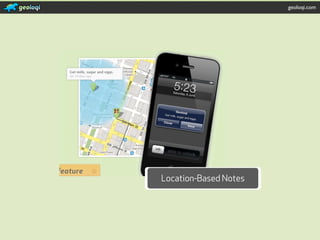
Location-Based Notes
geoloqi.com


YOUR GPS GETS WEIRD.


     WE HELP FIX THAT.
geoloqi.com


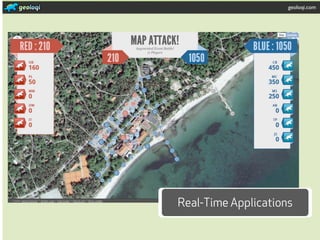
Real-Time Applications
geoloqi.com
geoloqi.com


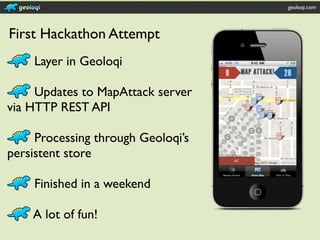
First Hackathon Attempt
    Layer in Geoloqi

     Updates to MapAttack server
via HTTP REST API

     Processing through Geoloqi’s
persistent store

    Finished in a weekend

    A lot of fun!
geoloqi.com


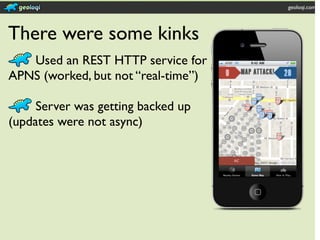
There were some kinks
   Used an REST HTTP service for
APNS (worked, but not “real-time”)

     Server was getting backed up
(updates were not async)
geoloqi.com


  MapAttack Server Issues
     Blocking IO (requests to Geoloqi API held
everything up)

     Lots of concurrent traffic

      Events had to be broadcast to all phones/
clients in the game synchronously
geoloqi.com


 HOW WE
DEALT WITH
    IT
geoloqi.com
geoloqi.com


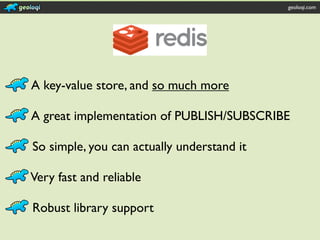
A key-value store, and so much more

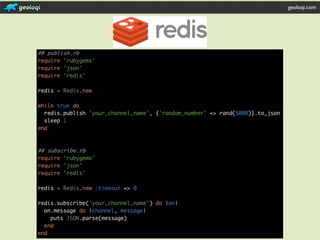
A great implementation of PUBLISH/SUBSCRIBE

So simple, you can actually understand it

Very fast and reliable

Robust library support
geoloqi.com
geoloqi.com
geoloqi.com
geoloqi.com


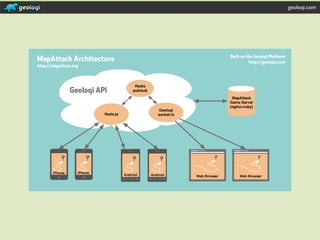
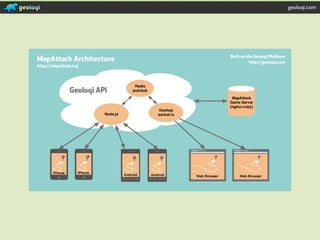
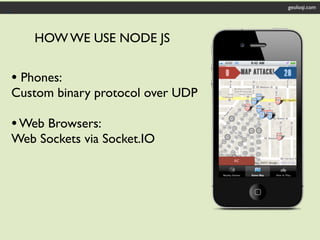
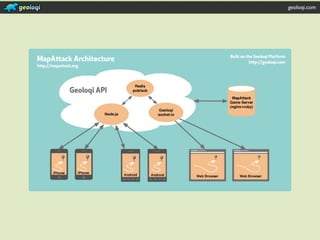
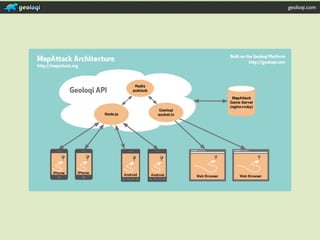
    HOW WE USE NODE JS


• Phones:
Custom binary protocol over UDP

• Web Browsers:
Web Sockets via Socket.IO
geoloqi.com


Socket.IO is awesome
 Adapter Pattern for realtime

 Web Sockets, Flash, Long Polling!

 One interface for everything

 Easy to implement: ~100 LOC
geoloqi.com
geoloqi.com


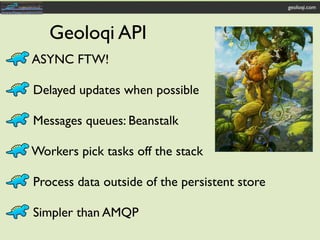
   Geoloqi API
ASYNC FTW!

Delayed updates when possible

Messages queues: Beanstalk

Workers pick tasks off the stack

Process data outside of the persistent store

Simpler than AMQP
geoloqi.com
geoloqi.com


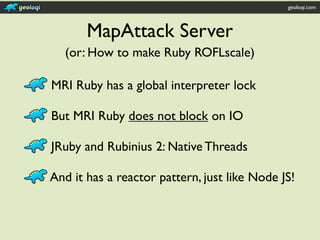
       MapAttack Server
  (or: How to make Ruby ROFLscale)

MRI Ruby has a global interpreter lock

But MRI Ruby does not block on IO

JRuby and Rubinius 2: Native Threads

And it has a reactor pattern, just like Node JS!
geoloqi.com


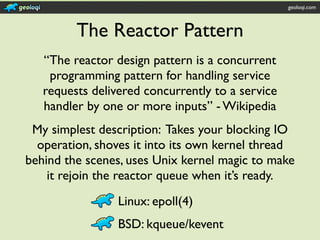
         The Reactor Pattern
   “The reactor design pattern is a concurrent
    programming pattern for handling service
   requests delivered concurrently to a service
   handler by one or more inputs” - Wikipedia
 My simplest description: Takes your blocking IO
  operation, shoves it into its own kernel thread
behind the scenes, uses Unix kernel magic to make
    it rejoin the reactor queue when it’s ready.
                 Linux: epoll(4)
                 BSD: kqueue/kevent
geoloqi.com


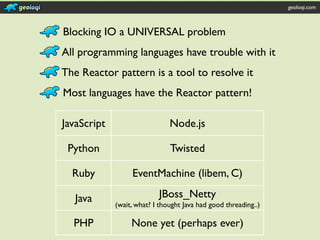
Blocking IO a UNIVERSAL problem
All programming languages have trouble with it
The Reactor pattern is a tool to resolve it
Most languages have the Reactor pattern!

JavaScript                     Node.js

 Python                        Twisted

  Ruby            EventMachine (libem, C)

   Java                    JBoss_Netty
             (wait, what? I thought Java had good threading..)

  PHP             None yet (perhaps ever)
geoloqi.com


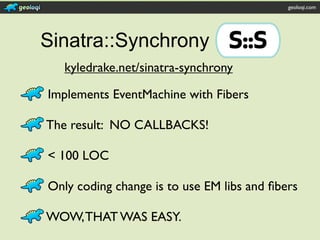
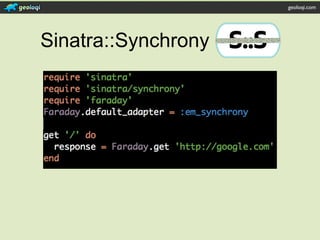
Sinatra::Synchrony
   kyledrake.net/sinatra-synchrony

Implements EventMachine with Fibers

The result: NO CALLBACKS!

< 100 LOC

Only coding change is to use EM libs and fibers

WOW, THAT WAS EASY.
geoloqi.com


Sinatra::Synchrony
geoloqi.com
geoloqi.com


Let’s Talk Performance.
geoloqi.com


Make the relevant data
stay outside of the slow
   persistence store.
geoloqi.com


If you’re trying to solve a problem by
  ROFLscaling your persistent store,
         you’re doing it wrong.
geoloqi.com


        Examples of doing it wrong
     “Let’s rewrite everything to use TrendDB”

     Using EC2 for a single-master DB “because it scales”

     Buying something from Oracle

    “Ruby/PHP/JS is too slow for this, let’s rewrite it in
TrendLang”

     Most NoSQL solutions have dark secrets you don’t
know about. Global write locks, single write master, et
cetera
geoloqi.com


If you must speed up your persistent
   store, here’s my practical advice.
geoloqi.com


                   Real Hardware FTW?
        Single master database? Get a real server! Really!

        Cloud is only as fast as the fastest available HDD

        EBS performance is not great, even in RAID0 stripe
See orion.heroku.com/past/2009/7/29/io_performance_on_ebs
and perfcap.blogspot.com/2011/03/understanding-and-using-amazon-ebs.html
and blog.dt.org/index.php/2010/06/amazon-ec2-io-performance-local-emphemeral-disks-vs-raid0-
striped-ebs-volumes/
and endevver.com/2010/03/cost-analysis-of-an-amazon-ec2-deployment.html
and mysqlperformanceblog.com/2011/02/21/death-match-ebs-versus-ssd-price-performance-and-
qos
and google.com/search?q=heroku+ebs+performance


        High end Xeon, 32GB ECC, fast 220GB SSD: ~$2K
geoloqi.com


            Real Hardware FTW?
The paradigm is diversifying, and the reason is SSD.

Say hello to the Fusion-io ioDrive Octal.
PCIe x16 slot
5.12TB
6.0 GB/s read
4.4 GB/s write
1.19 MILLION IOPS

Cost: $100,000 (plus $10 S&H).
It’s a steal at this price.. but it will get cheaper.
geoloqi.com


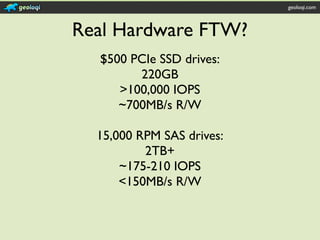
Real Hardware FTW?
  $500 PCIe SSD drives:
        220GB
     >100,000 IOPS
     ~700MB/s R/W

  15,000 RPM SAS drives:
          2TB+
      ~175-210 IOPS
      <150MB/s R/W
geoloqi.com


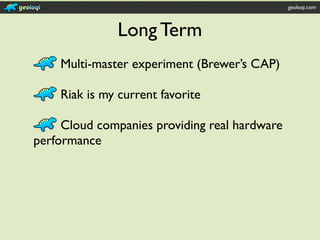
               Long Term
    Multi-master experiment (Brewer’s CAP)

    Riak is my current favorite

     Cloud companies providing real hardware
performance
geoloqi.com


In Summary
geoloqi.com


Geo-location games
     are FUN!
geoloqi.com


 Use the Geoloqi API to make
geolocation games! We did the
      hard work for you.
geoloqi.com


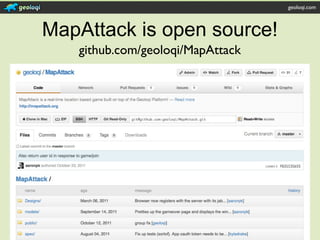
MapAttack is open source!
   github.com/geoloqi/MapAttack
Text
geoloqi.com


Other uses of Geoloqi
geoloqi.com


Thanks!

Building MapAttack

  • 1.
    Building MapAttack: A real-timegeolocation game Kyle Drake
  • 2.
    geoloqi.com What is Geoloqi? geoloqi.com
  • 3.
    geoloqi.com Real-world solutions for thousands around the globe
  • 4.
    geoloqi.com Real-Time LocationTracking Real-World Interactive Experiences
  • 5.
  • 6.
  • 7.
    geoloqi.com YOUR GPS GETSWEIRD. WE HELP FIX THAT.
  • 8.
  • 9.
  • 10.
    geoloqi.com First Hackathon Attempt Layer in Geoloqi Updates to MapAttack server via HTTP REST API Processing through Geoloqi’s persistent store Finished in a weekend A lot of fun!
  • 15.
    geoloqi.com There were somekinks Used an REST HTTP service for APNS (worked, but not “real-time”) Server was getting backed up (updates were not async)
  • 16.
    geoloqi.com MapAttackServer Issues Blocking IO (requests to Geoloqi API held everything up) Lots of concurrent traffic Events had to be broadcast to all phones/ clients in the game synchronously
  • 17.
  • 18.
  • 19.
    geoloqi.com A key-value store,and so much more A great implementation of PUBLISH/SUBSCRIBE So simple, you can actually understand it Very fast and reliable Robust library support
  • 20.
  • 21.
  • 22.
  • 23.
    geoloqi.com HOW WE USE NODE JS • Phones: Custom binary protocol over UDP • Web Browsers: Web Sockets via Socket.IO
  • 24.
    geoloqi.com Socket.IO is awesome Adapter Pattern for realtime Web Sockets, Flash, Long Polling! One interface for everything Easy to implement: ~100 LOC
  • 25.
  • 26.
    geoloqi.com Geoloqi API ASYNC FTW! Delayed updates when possible Messages queues: Beanstalk Workers pick tasks off the stack Process data outside of the persistent store Simpler than AMQP
  • 27.
  • 28.
    geoloqi.com MapAttack Server (or: How to make Ruby ROFLscale) MRI Ruby has a global interpreter lock But MRI Ruby does not block on IO JRuby and Rubinius 2: Native Threads And it has a reactor pattern, just like Node JS!
  • 29.
    geoloqi.com The Reactor Pattern “The reactor design pattern is a concurrent programming pattern for handling service requests delivered concurrently to a service handler by one or more inputs” - Wikipedia My simplest description: Takes your blocking IO operation, shoves it into its own kernel thread behind the scenes, uses Unix kernel magic to make it rejoin the reactor queue when it’s ready. Linux: epoll(4) BSD: kqueue/kevent
  • 30.
    geoloqi.com Blocking IO aUNIVERSAL problem All programming languages have trouble with it The Reactor pattern is a tool to resolve it Most languages have the Reactor pattern! JavaScript Node.js Python Twisted Ruby EventMachine (libem, C) Java JBoss_Netty (wait, what? I thought Java had good threading..) PHP None yet (perhaps ever)
  • 31.
    geoloqi.com Sinatra::Synchrony kyledrake.net/sinatra-synchrony Implements EventMachine with Fibers The result: NO CALLBACKS! < 100 LOC Only coding change is to use EM libs and fibers WOW, THAT WAS EASY.
  • 32.
  • 33.
  • 34.
  • 35.
    geoloqi.com Make the relevantdata stay outside of the slow persistence store.
  • 36.
    geoloqi.com If you’re tryingto solve a problem by ROFLscaling your persistent store, you’re doing it wrong.
  • 37.
    geoloqi.com Examples of doing it wrong “Let’s rewrite everything to use TrendDB” Using EC2 for a single-master DB “because it scales” Buying something from Oracle “Ruby/PHP/JS is too slow for this, let’s rewrite it in TrendLang” Most NoSQL solutions have dark secrets you don’t know about. Global write locks, single write master, et cetera
  • 38.
    geoloqi.com If you mustspeed up your persistent store, here’s my practical advice.
  • 39.
    geoloqi.com Real Hardware FTW? Single master database? Get a real server! Really! Cloud is only as fast as the fastest available HDD EBS performance is not great, even in RAID0 stripe See orion.heroku.com/past/2009/7/29/io_performance_on_ebs and perfcap.blogspot.com/2011/03/understanding-and-using-amazon-ebs.html and blog.dt.org/index.php/2010/06/amazon-ec2-io-performance-local-emphemeral-disks-vs-raid0- striped-ebs-volumes/ and endevver.com/2010/03/cost-analysis-of-an-amazon-ec2-deployment.html and mysqlperformanceblog.com/2011/02/21/death-match-ebs-versus-ssd-price-performance-and- qos and google.com/search?q=heroku+ebs+performance High end Xeon, 32GB ECC, fast 220GB SSD: ~$2K
  • 40.
    geoloqi.com Real Hardware FTW? The paradigm is diversifying, and the reason is SSD. Say hello to the Fusion-io ioDrive Octal. PCIe x16 slot 5.12TB 6.0 GB/s read 4.4 GB/s write 1.19 MILLION IOPS Cost: $100,000 (plus $10 S&H). It’s a steal at this price.. but it will get cheaper.
  • 41.
    geoloqi.com Real Hardware FTW? $500 PCIe SSD drives: 220GB >100,000 IOPS ~700MB/s R/W 15,000 RPM SAS drives: 2TB+ ~175-210 IOPS <150MB/s R/W
  • 42.
    geoloqi.com Long Term Multi-master experiment (Brewer’s CAP) Riak is my current favorite Cloud companies providing real hardware performance
  • 43.
  • 44.
  • 45.
    geoloqi.com Use theGeoloqi API to make geolocation games! We did the hard work for you.
  • 46.
    geoloqi.com MapAttack is opensource! github.com/geoloqi/MapAttack
  • 47.
  • 48.
  • 49.