Eglinton Station Open House
May 30, 2016
Eglinton Crosstown LRT
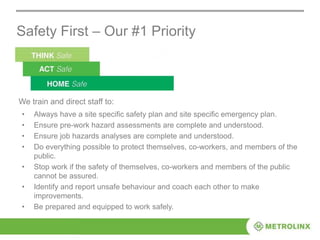
Safety First – Our #1 Priority
• Always have a site specific safety plan and site specific emergency plan.
• Ensure pre-work hazard assessments are complete and understood.
• Ensure job hazards analyses are complete and understood.
• Do everything possible to protect themselves, co-workers, and members of the
public.
• Stop work if the safety of themselves, co-workers and members of the public
cannot be assured.
• Identify and report unsafe behaviour and coach each other to make
improvements.
• Be prepared and equipped to work safely.
We train and direct staff to:
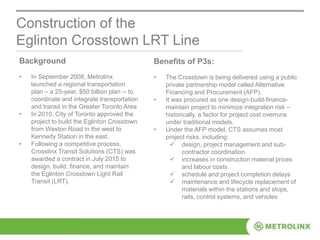
Construction of the
Eglinton Crosstown LRT Line
Background
• In September 2008, Metrolinx
launched a regional transportation
plan – a 25-year, $50 billion plan -- to
coordinate and integrate transportation
and transit in the Greater Toronto Area
• In 2010, City of Toronto approved the
project to build the Eglinton Crosstown
from Weston Road in the west to
Kennedy Station in the east.
• Following a competitive process,
Crosslinx Transit Solutions (CTS) was
awarded a contract in July 2015 to
design, build, finance, and maintain
the Eglinton Crosstown Light Rail
Transit (LRT).
Benefits of P3s:
• The Crosstown is being delivered using a public
private partnership model called Alternative
Financing and Procurement (AFP).
• It was procured as one design-build-finance-
maintain project to minimize integration risk –
historically, a factor for project cost overruns
under traditional models.
• Under the AFP model, CTS assumes most
project risks, including:
 design, project management and sub-
contractor coordination
 increases in construction material prices
and labour costs
 schedule and project completion delays
 maintenance and lifecycle replacement of
materials within the stations and stops,
rails, control systems, and vehicles
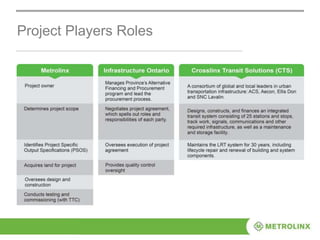
Project Players Roles
What are we building – a new modern LRT
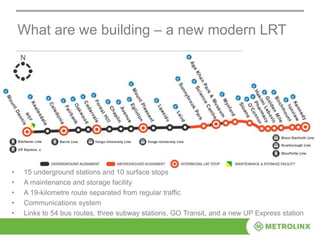
• 15 underground stations and 10 surface stops
• A maintenance and storage facility
• A 19-kilometre route separated from regular traffic
• Communications system
• Links to 54 bus routes, three subway stations, GO Transit, and a new UP Express station
13
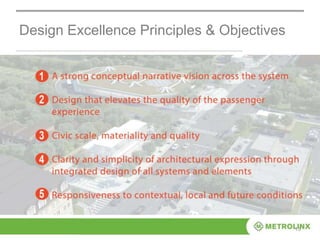
Design Excellence Principles & Objectives
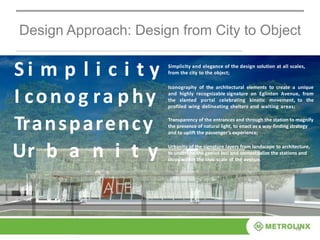
Design Approach: Design from City to Object
14
S i m p l i c i t y
I conog ra phy
Transparency
Ur b a n i t y
Simplicity and elegance of the design solution at all scales,
from the city to the object;
Iconography of the architectural elements to create a unique
and highly recognizable signature on Eglinton Avenue, from
the slanted portal celebrating kinetic movement, to the
profiled wing delineating shelters and waiting areas;
Transparency of the entrances and through the station to magnify
the presence of natural light, to enact as a way-finding strategy
and to uplift the passenger’s experience;
Urbanity of the signature layers from landscape to architecture,
to underline the genius loci and contextualize the stations and
stops within the civic scale of the avenue.
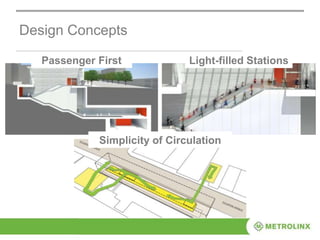
Design Concepts
• Passenger First
Passenger First Light-filled Stations
Simplicity of Circulation
16
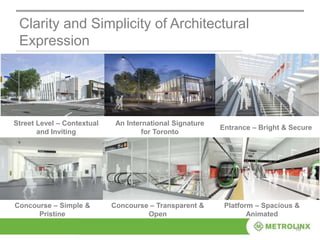
Clarity and Simplicity of Architectural
Expression
Street Level – Contextual
and Inviting
An International Signature
for Toronto
Entrance – Bright & Secure
Concourse – Simple &
Pristine
Concourse – Transparent &
Open
Platform – Spacious &
Animated
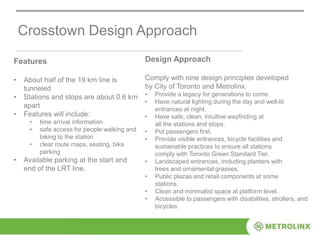
Crosstown Design Approach
Features
• About half of the 19 km line is
tunneled
• Stations and stops are about 0.6 km
apart
• Features will include:
• time arrival information
• safe access for people walking and
biking to the station
• clear route maps, seating, bike
parking
• Available parking at the start and
end of the LRT line.
Design Approach
Comply with nine design principles developed
by City of Toronto and Metrolinx.
• Provide a legacy for generations to come.
• Have natural lighting during the day and well-lit
entrances at night.
• Have safe, clean, intuitive wayfinding at
all the stations and stops.
• Put passengers first.
• Provide visible entrances, bicycle facilities and
sustainable practices to ensure all stations
comply with Toronto Green Standard Tier.
• Landscaped entrances, including planters with
trees and ornamental grasses.
• Public plazas and retail components at some
stations.
• Clean and minimalist space at platform level.
• Accessible to passengers with disabilities, strollers, and
bicycles.
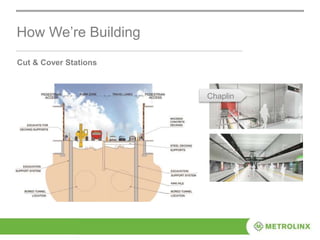
How We’re Building
Cut & Cover Stations
Chaplin
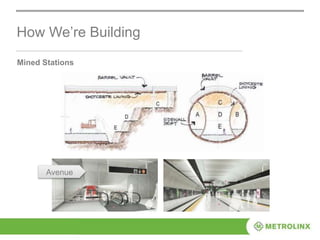
How We’re Building
Mined Stations
Avenue
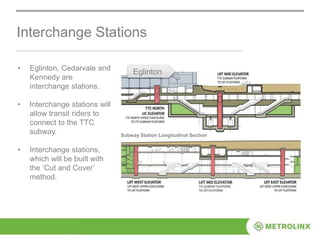
• Eglinton, Cedarvale and
Kennedy are
interchange stations.
• Interchange stations will
allow transit riders to
connect to the TTC
subway.
• Interchange stations,
which will be built with
the ‘Cut and Cover’
method.
Interchange Stations
Subway Station Longitudinal Section
Eglinton
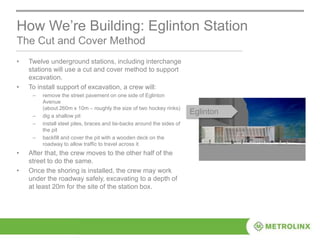
How We’re Building: Eglinton Station
The Cut and Cover Method
Eglinton
• Twelve underground stations, including interchange
stations will use a cut and cover method to support
excavation.
• To install support of excavation, a crew will:
– remove the street pavement on one side of Eglinton
Avenue
(about 260m x 10m – roughly the size of two hockey rinks)
– dig a shallow pit
– install steel piles, braces and tie-backs around the sides of
the pit
– backfill and cover the pit with a wooden deck on the
roadway to allow traffic to travel across it
• After that, the crew moves to the other half of the
street to do the same.
• Once the shoring is installed, the crew may work
under the roadway safely, excavating to a depth of
at least 20m for the site of the station box.
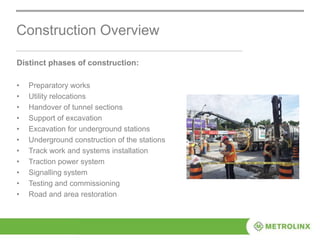
Construction Overview
Distinct phases of construction:
• Preparatory works
• Utility relocations
• Handover of tunnel sections
• Support of excavation
• Excavation for underground stations
• Underground construction of the stations
• Track work and systems installation
• Traction power system
• Signalling system
• Testing and commissioning
• Road and area restoration
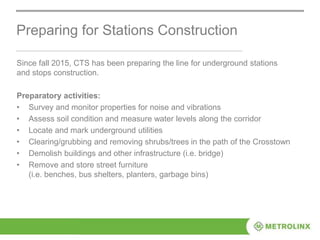
Preparing for Stations Construction
Since fall 2015, CTS has been preparing the line for underground stations
and stops construction.
Preparatory activities:
• Survey and monitor properties for noise and vibrations
• Assess soil condition and measure water levels along the corridor
• Locate and mark underground utilities
• Clearing/grubbing and removing shrubs/trees in the path of the Crosstown
• Demolish buildings and other infrastructure (i.e. bridge)
• Remove and store street furniture
(i.e. benches, bus shelters, planters, garbage bins)
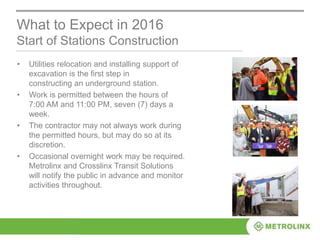
• Utilities relocation and installing support of
excavation is the first step in
constructing an underground station.
• Work is permitted between the hours of
7:00 AM and 11:00 PM, seven (7) days a
week.
• The contractor may not always work during
the permitted hours, but may do so at its
discretion.
• Occasional overnight work may be required.
Metrolinx and Crosslinx Transit Solutions
will notify the public in advance and monitor
activities throughout.
What to Expect in 2016
Start of Stations Construction
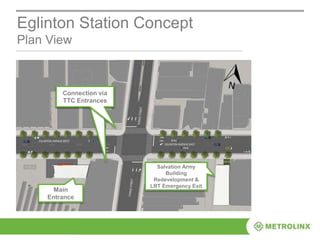
Eglinton Station Concept
Plan View
Main
Entrance
Salvation Army
Building
Redevelopment &
LRT Emergency Exit
Connection via
TTC Entrance
Connection via
TTC Entrances
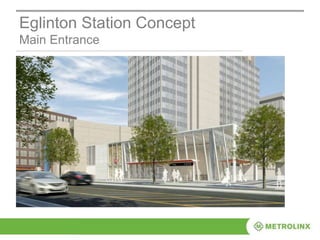
Eglinton Station Concept
Main Entrance
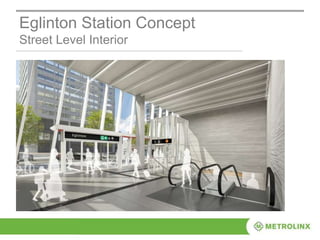
Eglinton Station Concept
Street Level Interior
Eglinton Station Concept
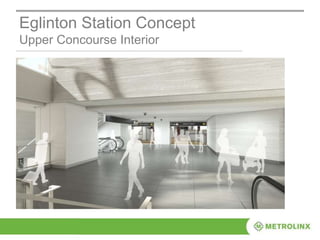
Upper Concourse Interior
Eglinton Station Concept
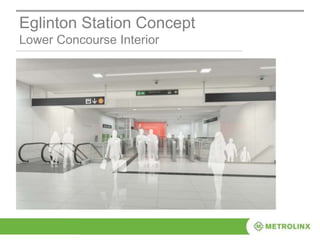
Lower Concourse Interior
Eglinton Station Concept
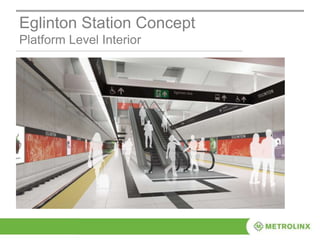
Platform Level Interior
Eglinton Station Concept
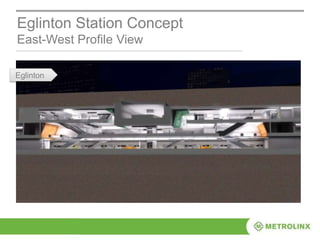
East-West Profile View
AllenRd
Eglinton
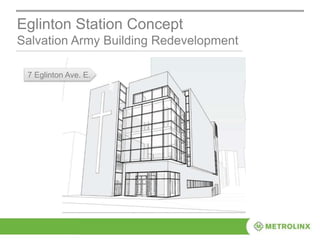
Eglinton Station Concept
Salvation Army Building Redevelopment
AllenRd
7 Eglinton Ave. E.
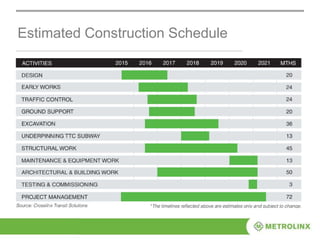
Estimated Construction Schedule
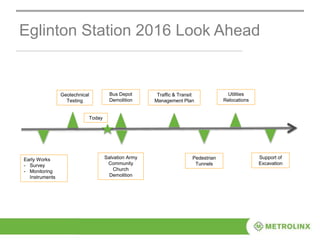
Eglinton Station 2016 Look Ahead
Geotechnical
Testing
Bus Depot
Demolition
Salvation Army
Community
Church
Demolition
Utilities
Relocations
Support of
Excavation
Traffic & Transit
Management Plan
Early Works
- Survey
- Monitoring
Instruments
Pedestrian
Tunnels
Today
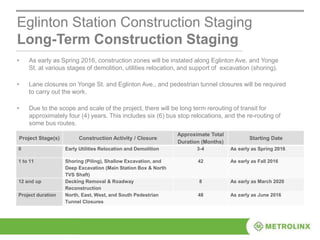
Eglinton Station Construction Staging
Long-Term Construction Staging
• As early as Spring 2016, construction zones will be instated along Eglinton Ave. and Yonge
St. at various stages of demolition, utilities relocation, and support of excavation (shoring).
• Lane closures on Yonge St. and Eglinton Ave., and pedestrian tunnel closures will be required
to carry out the work.
• Due to the scope and scale of the project, there will be long term rerouting of transit for
approximately four (4) years. This includes six (6) bus stop relocations, and the re-routing of
some bus routes.
Project Stage(s) Construction Activity / Closure
Approximate Total
Duration (Months)
Starting Date
0 Early Utilities Relocation and Demolition 3-4 As early as Spring 2016
1 to 11 Shoring (Piling), Shallow Excavation, and
Deep Excavation (Main Station Box & North
TVS Shaft)
42 As early as Fall 2016
12 and up Decking Removal & Roadway
Reconstruction
8 As early as March 2020
Project duration North, East, West, and South Pedestrian
Tunnel Closures
48 As early as June 2016
Eglinton Station Construction Impacts
Long-Term Pedestrian Tunnel Closures
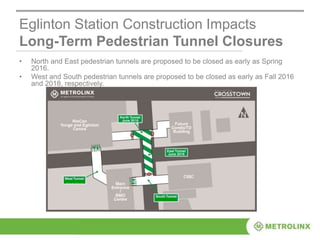
• North and East pedestrian tunnels are proposed to be closed as early as Spring
2016.
• West and South pedestrian tunnels are proposed to be closed as early as Fall 2016
and 2018, respectively.
Eglinton Station Construction Staging
Long-Term Proposed Bus Re-routing
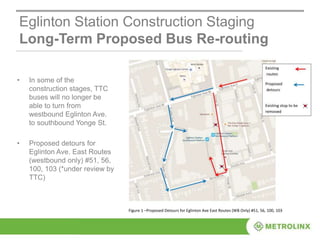
• In some of the
construction stages, TTC
buses will no longer be
able to turn from
westbound Eglinton Ave.
to southbound Yonge St.
• Proposed detours for
Eglinton Ave. East Routes
(westbound only) #51, 56,
100, 103 (*under review by
TTC)
Figure 1 –Proposed Detours for Eglinton Ave East Routes (WB Only) #51, 56, 100, 103
Eglinton Station Construction Staging
Long-Term Proposed Bus Stop Relocations
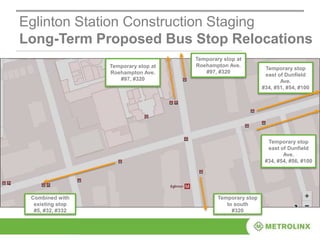
Temporary stop
east of Dunfield
Ave.
#34, #51, #54, #100
Combined with
existing stop
#5, #32, #332
Temporary stop
east of Dunfield
Ave.
#34, #54, #56, #100
Temporary stop at
Roehampton Ave.
#97, #320
Temporary stop
to south
#320
Temporary stop at
Roehampton Ave.
#97, #320
Eglinton Station Construction Impacts
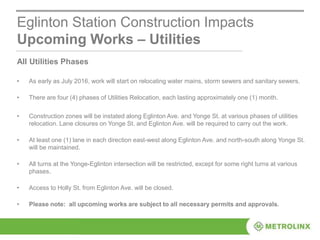
Upcoming Works – Utilities
All Utilities Phases
• As early as July 2016, work will start on relocating water mains, storm sewers and sanitary sewers.
• There are four (4) phases of Utilities Relocation, each lasting approximately one (1) month.
• Construction zones will be instated along Eglinton Ave. and Yonge St. at various phases of utilities
relocation. Lane closures on Yonge St. and Eglinton Ave. will be required to carry out the work.
• At least one (1) lane in each direction east-west along Eglinton Ave. and north-south along Yonge St.
will be maintained.
• All turns at the Yonge-Eglinton intersection will be restricted, except for some right turns at various
phases.
• Access to Holly St. from Eglinton Ave. will be closed.
• Please note: all upcoming works are subject to all necessary permits and approvals.
Eglinton Station Construction Impacts
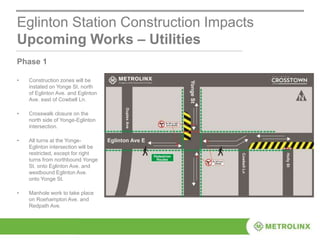
Upcoming Works – Utilities
Phase 1
• Construction zones will be
instated on Yonge St. north
of Eglinton Ave. and Eglinton
Ave. east of Cowbell Ln.
• Crosswalk closure on the
north side of Yonge-Eglinton
intersection.
• All turns at the Yonge-
Eglinton intersection will be
restricted, except for right
turns from northbound Yonge
St. onto Eglinton Ave. and
westbound Eglinton Ave.
onto Yonge St.
• Manhole work to take place
on Roehampton Ave. and
Redpath Ave.
Eglinton Station Construction Impacts
Upcoming Works – Utilities
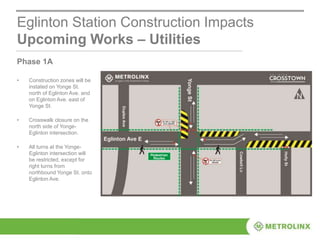
Phase 1A
• Construction zones will be
instated on Yonge St.
north of Eglinton Ave. and
on Eglinton Ave. east of
Yonge St.
• Crosswalk closure on the
north side of Yonge-
Eglinton intersection.
• All turns at the Yonge-
Eglinton intersection will
be restricted, except for
right turns from
northbound Yonge St. onto
Eglinton Ave.
Eglinton Station Construction Impacts
Upcoming Works – Utilities
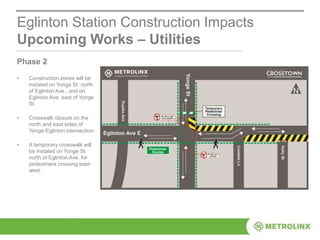
Phase 2
• Construction zones will be
instated on Yonge St. north
of Eglinton Ave., and on
Eglinton Ave. east of Yonge
St.
• Crosswalk closure on the
north and east sides of
Yonge-Eglinton intersection.
• A temporary crosswalk will
be instated on Yonge St.
north of Eglinton Ave. for
pedestrians crossing east-
west.
Eglinton Station Construction Impacts
Upcoming Works – Utilities
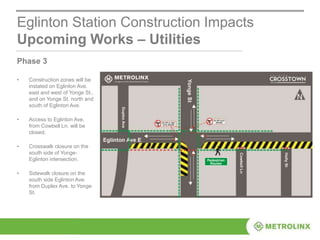
Phase 3
• Construction zones will be
instated on Eglinton Ave.
east and west of Yonge St.,
and on Yonge St. north and
south of Eglinton Ave.
• Access to Eglinton Ave.
from Cowbell Ln. will be
closed.
• Crosswalk closure on the
south side of Yonge-
Eglinton intersection.
• Sidewalk closure on the
south side Eglinton Ave.
from Duplex Ave. to Yonge
St.
Eglinton Station Construction Impacts
Upcoming Works – Utilities
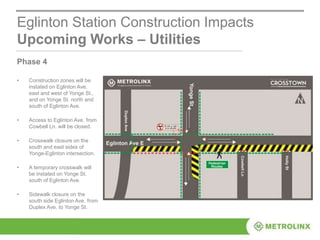
Phase 4
• Construction zones will be
instated on Eglinton Ave.
east and west of Yonge St.,
and on Yonge St. north and
south of Eglinton Ave.
• Access to Eglinton Ave. from
Cowbell Ln. will be closed.
• Crosswalk closure on the
south and east sides of
Yonge-Eglinton intersection.
• A temporary crosswalk will
be instated on Yonge St.
south of Eglinton Ave.
• Sidewalk closure on the
south side Eglinton Ave. from
Duplex Ave. to Yonge St.
Eglinton Station Construction Staging
Upcoming Works – Shoring
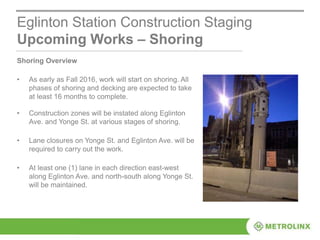
Shoring Overview
• As early as Fall 2016, work will start on shoring. All
phases of shoring and decking are expected to take
at least 16 months to complete.
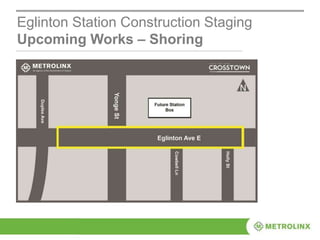
• Construction zones will be instated along Eglinton
Ave. and Yonge St. at various stages of shoring.
• Lane closures on Yonge St. and Eglinton Ave. will be
required to carry out the work.
• At least one (1) lane in each direction east-west
along Eglinton Ave. and north-south along Yonge St.
will be maintained.
Eglinton Station Construction Staging
Upcoming Works – Shoring
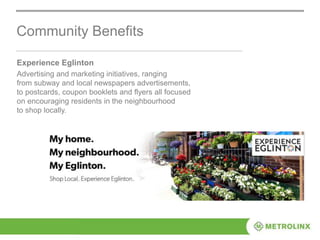
Experience Eglinton
Advertising and marketing initiatives, ranging
from subway and local newspapers advertisements,
to postcards, coupon booklets and flyers all focused
on encouraging residents in the neighbourhood
to shop locally.
Community Benefits
Commit to Social Procurement and Local Investment
− seek to maximize procurement and business opportunities to
businesses located along the Project corridor.
Community Benefits – Employment
The Eglinton Crosstown LRT is the first major infrastructure project in Ontario to
include a Community Benefits Framework.
Partner with Local Workforce Agencies
− recruit candidates from the Project corridor and from historically
disadvantaged communities.
Work with Subcontractors
− maximize opportunities for apprentices on each site.
Stay in Touch
416-782-8118
www.thecrosstown.ca
crosstown@metrolinx.com
facebook.com/thecrosstown
twitter.com/crosstownTO
instagram.com/eglinton_crosstown
Crosstown West Office
1848 Eglinton Ave W (at Dufferin)
Crosstown East Office
660 Eglinton Ave E (at Bayview)
Eglinton Station Open House

Eglinton Station Open House

  • 1.
    Eglinton Station OpenHouse May 30, 2016 Eglinton Crosstown LRT
  • 9.
    Safety First –Our #1 Priority • Always have a site specific safety plan and site specific emergency plan. • Ensure pre-work hazard assessments are complete and understood. • Ensure job hazards analyses are complete and understood. • Do everything possible to protect themselves, co-workers, and members of the public. • Stop work if the safety of themselves, co-workers and members of the public cannot be assured. • Identify and report unsafe behaviour and coach each other to make improvements. • Be prepared and equipped to work safely. We train and direct staff to:
  • 10.
    Construction of the EglintonCrosstown LRT Line Background • In September 2008, Metrolinx launched a regional transportation plan – a 25-year, $50 billion plan -- to coordinate and integrate transportation and transit in the Greater Toronto Area • In 2010, City of Toronto approved the project to build the Eglinton Crosstown from Weston Road in the west to Kennedy Station in the east. • Following a competitive process, Crosslinx Transit Solutions (CTS) was awarded a contract in July 2015 to design, build, finance, and maintain the Eglinton Crosstown Light Rail Transit (LRT). Benefits of P3s: • The Crosstown is being delivered using a public private partnership model called Alternative Financing and Procurement (AFP). • It was procured as one design-build-finance- maintain project to minimize integration risk – historically, a factor for project cost overruns under traditional models. • Under the AFP model, CTS assumes most project risks, including:  design, project management and sub- contractor coordination  increases in construction material prices and labour costs  schedule and project completion delays  maintenance and lifecycle replacement of materials within the stations and stops, rails, control systems, and vehicles
  • 11.
  • 12.
    What are webuilding – a new modern LRT • 15 underground stations and 10 surface stops • A maintenance and storage facility • A 19-kilometre route separated from regular traffic • Communications system • Links to 54 bus routes, three subway stations, GO Transit, and a new UP Express station
  • 13.
  • 14.
    Design Approach: Designfrom City to Object 14 S i m p l i c i t y I conog ra phy Transparency Ur b a n i t y Simplicity and elegance of the design solution at all scales, from the city to the object; Iconography of the architectural elements to create a unique and highly recognizable signature on Eglinton Avenue, from the slanted portal celebrating kinetic movement, to the profiled wing delineating shelters and waiting areas; Transparency of the entrances and through the station to magnify the presence of natural light, to enact as a way-finding strategy and to uplift the passenger’s experience; Urbanity of the signature layers from landscape to architecture, to underline the genius loci and contextualize the stations and stops within the civic scale of the avenue.
  • 15.
    Design Concepts • PassengerFirst Passenger First Light-filled Stations Simplicity of Circulation
  • 16.
    16 Clarity and Simplicityof Architectural Expression Street Level – Contextual and Inviting An International Signature for Toronto Entrance – Bright & Secure Concourse – Simple & Pristine Concourse – Transparent & Open Platform – Spacious & Animated
  • 17.
    Crosstown Design Approach Features •About half of the 19 km line is tunneled • Stations and stops are about 0.6 km apart • Features will include: • time arrival information • safe access for people walking and biking to the station • clear route maps, seating, bike parking • Available parking at the start and end of the LRT line. Design Approach Comply with nine design principles developed by City of Toronto and Metrolinx. • Provide a legacy for generations to come. • Have natural lighting during the day and well-lit entrances at night. • Have safe, clean, intuitive wayfinding at all the stations and stops. • Put passengers first. • Provide visible entrances, bicycle facilities and sustainable practices to ensure all stations comply with Toronto Green Standard Tier. • Landscaped entrances, including planters with trees and ornamental grasses. • Public plazas and retail components at some stations. • Clean and minimalist space at platform level. • Accessible to passengers with disabilities, strollers, and bicycles.
  • 18.
    How We’re Building Cut& Cover Stations Chaplin
  • 19.
  • 20.
    • Eglinton, Cedarvaleand Kennedy are interchange stations. • Interchange stations will allow transit riders to connect to the TTC subway. • Interchange stations, which will be built with the ‘Cut and Cover’ method. Interchange Stations Subway Station Longitudinal Section Eglinton
  • 21.
    How We’re Building:Eglinton Station The Cut and Cover Method Eglinton • Twelve underground stations, including interchange stations will use a cut and cover method to support excavation. • To install support of excavation, a crew will: – remove the street pavement on one side of Eglinton Avenue (about 260m x 10m – roughly the size of two hockey rinks) – dig a shallow pit – install steel piles, braces and tie-backs around the sides of the pit – backfill and cover the pit with a wooden deck on the roadway to allow traffic to travel across it • After that, the crew moves to the other half of the street to do the same. • Once the shoring is installed, the crew may work under the roadway safely, excavating to a depth of at least 20m for the site of the station box.
  • 22.
    Construction Overview Distinct phasesof construction: • Preparatory works • Utility relocations • Handover of tunnel sections • Support of excavation • Excavation for underground stations • Underground construction of the stations • Track work and systems installation • Traction power system • Signalling system • Testing and commissioning • Road and area restoration
  • 23.
    Preparing for StationsConstruction Since fall 2015, CTS has been preparing the line for underground stations and stops construction. Preparatory activities: • Survey and monitor properties for noise and vibrations • Assess soil condition and measure water levels along the corridor • Locate and mark underground utilities • Clearing/grubbing and removing shrubs/trees in the path of the Crosstown • Demolish buildings and other infrastructure (i.e. bridge) • Remove and store street furniture (i.e. benches, bus shelters, planters, garbage bins)
  • 24.
    • Utilities relocationand installing support of excavation is the first step in constructing an underground station. • Work is permitted between the hours of 7:00 AM and 11:00 PM, seven (7) days a week. • The contractor may not always work during the permitted hours, but may do so at its discretion. • Occasional overnight work may be required. Metrolinx and Crosslinx Transit Solutions will notify the public in advance and monitor activities throughout. What to Expect in 2016 Start of Stations Construction
  • 25.
    Eglinton Station Concept PlanView Main Entrance Salvation Army Building Redevelopment & LRT Emergency Exit Connection via TTC Entrance Connection via TTC Entrances
  • 26.
  • 27.
  • 28.
  • 29.
  • 30.
  • 31.
    Eglinton Station Concept East-WestProfile View AllenRd Eglinton
  • 32.
    Eglinton Station Concept SalvationArmy Building Redevelopment AllenRd 7 Eglinton Ave. E.
  • 33.
  • 34.
    Eglinton Station 2016Look Ahead Geotechnical Testing Bus Depot Demolition Salvation Army Community Church Demolition Utilities Relocations Support of Excavation Traffic & Transit Management Plan Early Works - Survey - Monitoring Instruments Pedestrian Tunnels Today
  • 35.
    Eglinton Station ConstructionStaging Long-Term Construction Staging • As early as Spring 2016, construction zones will be instated along Eglinton Ave. and Yonge St. at various stages of demolition, utilities relocation, and support of excavation (shoring). • Lane closures on Yonge St. and Eglinton Ave., and pedestrian tunnel closures will be required to carry out the work. • Due to the scope and scale of the project, there will be long term rerouting of transit for approximately four (4) years. This includes six (6) bus stop relocations, and the re-routing of some bus routes. Project Stage(s) Construction Activity / Closure Approximate Total Duration (Months) Starting Date 0 Early Utilities Relocation and Demolition 3-4 As early as Spring 2016 1 to 11 Shoring (Piling), Shallow Excavation, and Deep Excavation (Main Station Box & North TVS Shaft) 42 As early as Fall 2016 12 and up Decking Removal & Roadway Reconstruction 8 As early as March 2020 Project duration North, East, West, and South Pedestrian Tunnel Closures 48 As early as June 2016
  • 36.
    Eglinton Station ConstructionImpacts Long-Term Pedestrian Tunnel Closures • North and East pedestrian tunnels are proposed to be closed as early as Spring 2016. • West and South pedestrian tunnels are proposed to be closed as early as Fall 2016 and 2018, respectively.
  • 37.
    Eglinton Station ConstructionStaging Long-Term Proposed Bus Re-routing • In some of the construction stages, TTC buses will no longer be able to turn from westbound Eglinton Ave. to southbound Yonge St. • Proposed detours for Eglinton Ave. East Routes (westbound only) #51, 56, 100, 103 (*under review by TTC) Figure 1 –Proposed Detours for Eglinton Ave East Routes (WB Only) #51, 56, 100, 103
  • 38.
    Eglinton Station ConstructionStaging Long-Term Proposed Bus Stop Relocations Temporary stop east of Dunfield Ave. #34, #51, #54, #100 Combined with existing stop #5, #32, #332 Temporary stop east of Dunfield Ave. #34, #54, #56, #100 Temporary stop at Roehampton Ave. #97, #320 Temporary stop to south #320 Temporary stop at Roehampton Ave. #97, #320
  • 39.
    Eglinton Station ConstructionImpacts Upcoming Works – Utilities All Utilities Phases • As early as July 2016, work will start on relocating water mains, storm sewers and sanitary sewers. • There are four (4) phases of Utilities Relocation, each lasting approximately one (1) month. • Construction zones will be instated along Eglinton Ave. and Yonge St. at various phases of utilities relocation. Lane closures on Yonge St. and Eglinton Ave. will be required to carry out the work. • At least one (1) lane in each direction east-west along Eglinton Ave. and north-south along Yonge St. will be maintained. • All turns at the Yonge-Eglinton intersection will be restricted, except for some right turns at various phases. • Access to Holly St. from Eglinton Ave. will be closed. • Please note: all upcoming works are subject to all necessary permits and approvals.
  • 40.
    Eglinton Station ConstructionImpacts Upcoming Works – Utilities Phase 1 • Construction zones will be instated on Yonge St. north of Eglinton Ave. and Eglinton Ave. east of Cowbell Ln. • Crosswalk closure on the north side of Yonge-Eglinton intersection. • All turns at the Yonge- Eglinton intersection will be restricted, except for right turns from northbound Yonge St. onto Eglinton Ave. and westbound Eglinton Ave. onto Yonge St. • Manhole work to take place on Roehampton Ave. and Redpath Ave.
  • 41.
    Eglinton Station ConstructionImpacts Upcoming Works – Utilities Phase 1A • Construction zones will be instated on Yonge St. north of Eglinton Ave. and on Eglinton Ave. east of Yonge St. • Crosswalk closure on the north side of Yonge- Eglinton intersection. • All turns at the Yonge- Eglinton intersection will be restricted, except for right turns from northbound Yonge St. onto Eglinton Ave.
  • 42.
    Eglinton Station ConstructionImpacts Upcoming Works – Utilities Phase 2 • Construction zones will be instated on Yonge St. north of Eglinton Ave., and on Eglinton Ave. east of Yonge St. • Crosswalk closure on the north and east sides of Yonge-Eglinton intersection. • A temporary crosswalk will be instated on Yonge St. north of Eglinton Ave. for pedestrians crossing east- west.
  • 43.
    Eglinton Station ConstructionImpacts Upcoming Works – Utilities Phase 3 • Construction zones will be instated on Eglinton Ave. east and west of Yonge St., and on Yonge St. north and south of Eglinton Ave. • Access to Eglinton Ave. from Cowbell Ln. will be closed. • Crosswalk closure on the south side of Yonge- Eglinton intersection. • Sidewalk closure on the south side Eglinton Ave. from Duplex Ave. to Yonge St.
  • 44.
    Eglinton Station ConstructionImpacts Upcoming Works – Utilities Phase 4 • Construction zones will be instated on Eglinton Ave. east and west of Yonge St., and on Yonge St. north and south of Eglinton Ave. • Access to Eglinton Ave. from Cowbell Ln. will be closed. • Crosswalk closure on the south and east sides of Yonge-Eglinton intersection. • A temporary crosswalk will be instated on Yonge St. south of Eglinton Ave. • Sidewalk closure on the south side Eglinton Ave. from Duplex Ave. to Yonge St.
  • 45.
    Eglinton Station ConstructionStaging Upcoming Works – Shoring Shoring Overview • As early as Fall 2016, work will start on shoring. All phases of shoring and decking are expected to take at least 16 months to complete. • Construction zones will be instated along Eglinton Ave. and Yonge St. at various stages of shoring. • Lane closures on Yonge St. and Eglinton Ave. will be required to carry out the work. • At least one (1) lane in each direction east-west along Eglinton Ave. and north-south along Yonge St. will be maintained.
  • 46.
    Eglinton Station ConstructionStaging Upcoming Works – Shoring
  • 47.
    Experience Eglinton Advertising andmarketing initiatives, ranging from subway and local newspapers advertisements, to postcards, coupon booklets and flyers all focused on encouraging residents in the neighbourhood to shop locally. Community Benefits
  • 48.
    Commit to SocialProcurement and Local Investment − seek to maximize procurement and business opportunities to businesses located along the Project corridor. Community Benefits – Employment The Eglinton Crosstown LRT is the first major infrastructure project in Ontario to include a Community Benefits Framework. Partner with Local Workforce Agencies − recruit candidates from the Project corridor and from historically disadvantaged communities. Work with Subcontractors − maximize opportunities for apprentices on each site.
  • 49.

Editor's Notes

  • #35 Geotech – March Demolitions – Beginning of April TTMP – April 16 (for utilities), May 19 (rest) Pedestrian Tunnels – June/July Utilities – Late April – May SOE – July/Aug (to December) Excavating – at Salvation Army 2017
  • #36 These relocations will take place in order to allow for construction and excavation of the future station.
  • #40 These relocations will take place in order to allow for construction and excavation of the future station.
  • #41 These relocations will take place in order to allow for construction and excavation of the future station.
  • #42 These relocations will take place in order to allow for construction and excavation of the future station.
  • #43 These relocations will take place in order to allow for construction and excavation of the future station.
  • #44 These relocations will take place in order to allow for construction and excavation of the future station.
  • #45 These relocations will take place in order to allow for construction and excavation of the future station.
  • #46 These relocations will take place in order to allow for construction and excavation of the future station.
  • #47 These relocations will take place in order to allow for construction and excavation of the future station.