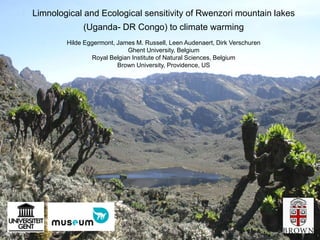
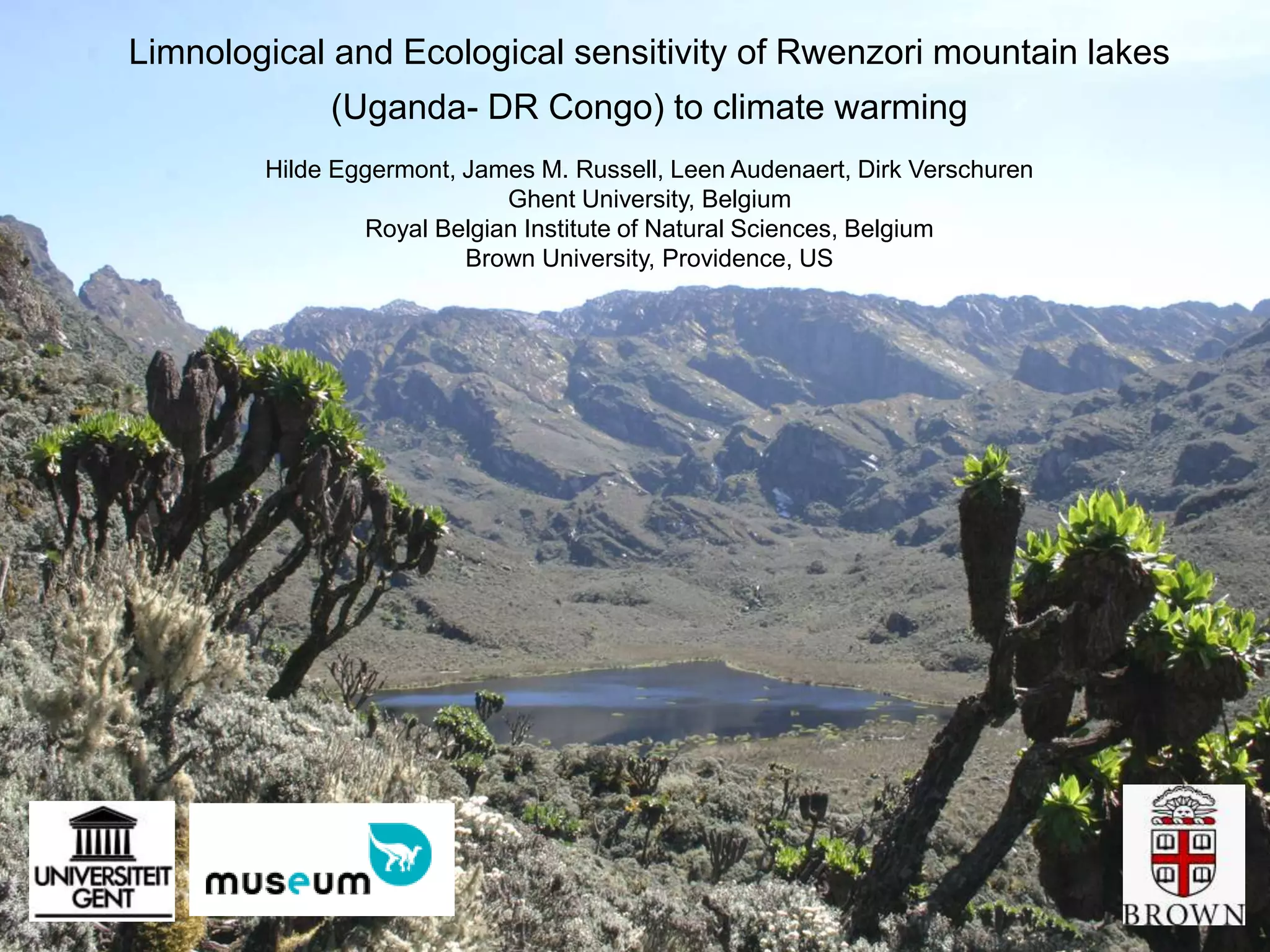
Limnological and Ecological sensitivity of Rwenzori mountain lakes
             (Uganda- DR Congo) to climate warming
        Hilde Eggermont, James M. Russell, Leen Audenaert, Dirk Verschuren
                            Ghent University, Belgium
                Royal Belgian Institute of Natural Sciences, Belgium
                         Brown University, Providence, US
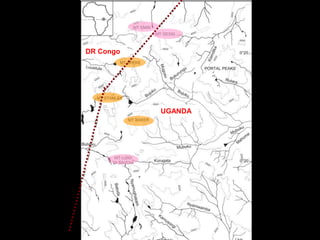
DR Congo


           UGANDA
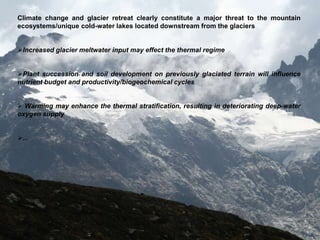
Climate change and glacier retreat clearly constitute a major threat to the mountain
ecosystems/unique cold-water lakes located downstream from the glaciers


Increased glacier meltwater input may effect the thermal regime


Plant succession and soil development on previously glaciated terrain will influence
nutrient budget and productivity/biogeochemical cycles


 Warming may enhance the thermal stratification, resulting in deteriorating deep-water
oxygen supply


...
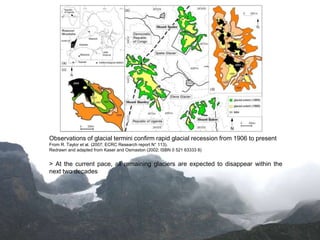
Observations of glacial termini confirm rapid glacial recession from 1906 to present
From R. Taylor et al. (2007; ECRC Research report N° 113).
Redrawn and adapted from Kaser and Osmaston (2002; ISBN 0 521 63333 8)


> At the current pace, all remaining glaciers are expected to disappear within the
next two decades
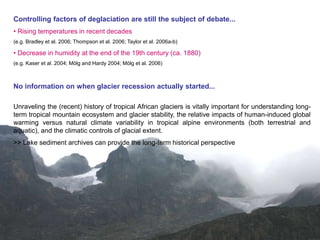
Controlling factors of deglaciation are still the subject of debate...
• Rising temperatures in recent decades
(e.g. Bradley et al. 2006; Thompson et al. 2006; Taylor et al. 2006a-b)

• Decrease in humidity at the end of the 19th century (ca. 1880)
(e.g. Kaser et al. 2004; Mölg and Hardy 2004; Mölg et al. 2006)


No information on when glacier recession actually started...

Unraveling the (recent) history of tropical African glaciers is vitally important for understanding long-
term tropical mountain ecosystem and glacier stability, the relative impacts of human-induced global
warming versus natural climate variability in tropical alpine environments (both terrestrial and
aquatic), and the climatic controls of glacial extent.
>> Lake sediment archives can provide the long-term historical perspective
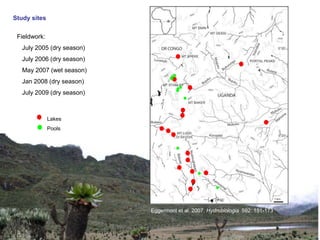
Study sites

 Fieldwork:
   July 2005 (dry season)
   July 2006 (dry season)
   May 2007 (wet season)
   Jan 2008 (dry season)
   July 2009 (dry season)


              Lakes
              Pools


                            Eggermont et al. 2007. Hydrobiologia 592: 151-173
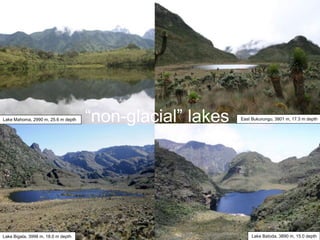
Lake Mahoma, 2990 m, 25.6 m depth   “non-glacial” lakes                     East Bukurungu, 3801 m, 17.3 m depth


                                           East Bukurungu, 3801 m, 17.3 m
Lake Bigata, 3998 m, 18.0 m depth          depth                                 Lake Batoda, 3890 m, 15.0 depth
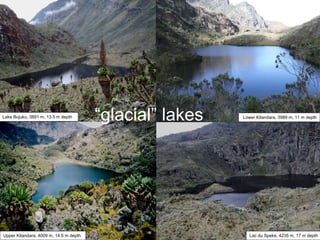
Lake Bujuku, 3891 m, 13.5 m depth       “glacial” lakes   Lower Kitandara, 3989 m, 11 m depth


Upper Kitandara, 4009 m, 14.5 m depth                        Lac du Speke, 4235 m, 17 m depth
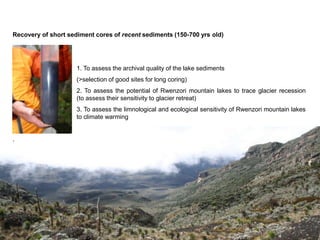
Recovery of short sediment cores of recent sediments (150-700 yrs old)


                     1. To assess the archival quality of the lake sediments
                     (>selection of good sites for long coring)
                     2. To assess the potential of Rwenzori mountain lakes to trace glacier recession
    (i.e.            (to assess their sensitivity to glacier retreat)
                     3. To assess the limnological and ecological sensitivity of Rwenzori mountain lakes
                     to climate warming


.
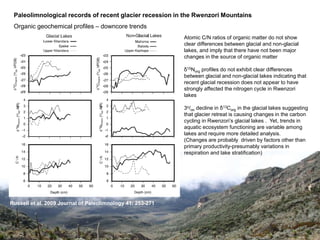
Paleolimnological records of recent glacier recession in the Rwenzori Mountains
 Organic geochemical profiles – downcore trends
                                                            Atomic C/N ratios of organic matter do not show
                                                            clear differences between glacial and non-glacial
                                                            lakes, and imply that there have not been major
                                                            changes in the source of organic matter

                                                            δ15Norg profiles do not exhibit clear differences
                                                            between glacial and non-glacial lakes indicating that
                                                            recent glacial recession does not appear to have
                                                            strongly affected the nitrogen cycle in Rwenzori
                                                            lakes

                                                            3o/oo decline in δ13Corg in the glacial lakes suggesting
                                                            that glacier retreat is causing changes in the carbon
                                                            cycling in Rwenzori’s glacial lakes . Yet, trends in
                                                            aquatic ecosystem functioning are variable among
                                                            lakes and require more detailed analysis.
                                                            (Changes are probably driven by factors other than
                                                            primary productivity-presumably variations in
                                                            respiration and lake stratification)


Russell et al. 2009 Journal of Paleolimnology 41: 253-271
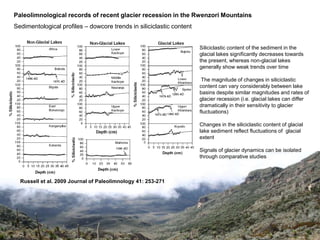
Paleolimnological records of recent glacier recession in the Rwenzori Mountains
Sedimentological profiles – dowcore trends in siliciclastic content


                                                                      Siliciclastic content of the sediment in the
                                                                      glacial lakes significantly decreases towards
                                                                      the present, whereas non-glacial lakes
                                                                      generally show weak trends over time

                                                                       The magnitude of changes in siliciclastic
                                                                      content can vary considerably between lake
                                                                      basins despite similar magnitudes and rates of
                                                                      glacier recession (i.e. glacial lakes can differ
                                                                      dramatically in their sensitivity to glacier
                                                                      fluctuations)

                                                                      Changes in the siliciclastic content of glacial
                                                                      lake sediment reflect fluctuations of glacial
                                                                      extent

                                                                      Signals of glacier dynamics can be isolated
                                                                      through comparative studies


  Russell et al. 2009 Journal of Paleolimnology 41: 253-271
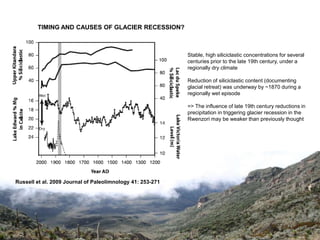
TIMING AND CAUSES OF GLACIER RECESSION?


                                                            Stable, high siliciclastic concentrations for several
                                                            centuries prior to the late 19th century, under a
                                                            regionally dry climate

                                                            Reduction of siliciclastic content (documenting
                                                            glacial retreat) was underway by ~1870 during a
                                                            regionally wet episode

                                                            => The influence of late 19th century reductions in
                                                            precipitation in triggering glacier recession in the
                                                            Rwenzori may be weaker than previously thought


Russell et al. 2009 Journal of Paleolimnology 41: 253-271
Recovery of short sediment cores of recent sediments (150-700 yrs old)


                     1. To assess the archival quality of the lake sediments
                     (>selection of good sites for long coring)
                     2. To assess the potential of Rwenzori mountain lakes to trace glacier recession
                     (to assess their sensitivity to glacier retreat)
                     3. To assess the limnological and ecological sensitivity of Rwenzori mountain lakes
                     to climate warming (= assess whether they are sensitive to climate-driven
                     environmental change of the same order of magnitude as that expected from
                     current and future anthropogenic global warming)


.
Recovery of short sediment cores of recent sediments (150-700 yrs old)
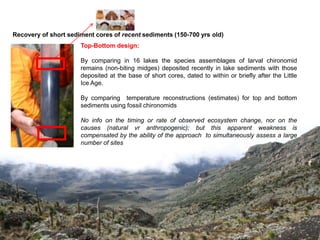
                      Top-Bottom design:

                      By comparing in 16 lakes the species assemblages of larval chironomid
                      remains (non-biting midges) deposited recently in lake sediments with those
                      deposited at the base of short cores, dated to within or briefly after the Little
                      Ice Age.

                      By comparing temperature reconstructions (estimates) for top and bottom
                      sediments using fossil chironomids

                      No info on the timing or rate of observed ecosystem change, nor on the
                      causes (natural vr anthropogenic); but this apparent weakness is
                      compensated by the ability of the approach to simultaneously assess a large
                      number of sites
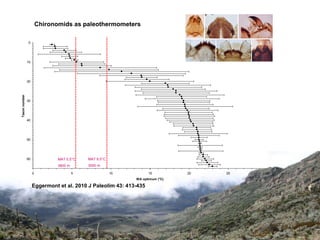
Chironomids as paleothermometers

               0


               10


               20
Taxon number


               30


               40


               50


               60              MAT 5.5°C    MAT 9.5°C
                               3800 m       3000 m

                    0                   5               10         15          20   25   30
                                                             WA optimum (°C)

                    Eggermont et al. 2010 J Paleolim 43: 413-435
Predicted Mean Annual Air Temperature (°C)
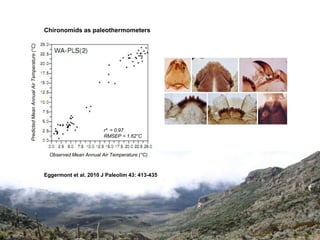
                                             Chironomids as paleothermometers


                                                                     r² = 0.97
                                                                     RMSEP = 1.62°C


                                               Observed Mean Annual Air Temperature (°C)


                                             Eggermont et al. 2010 J Paleolim 43: 413-435
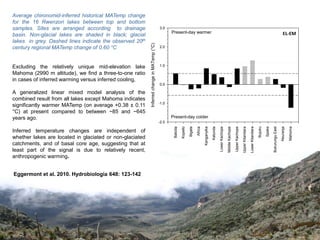
Average chironomid-inferred historical MATemp change
for the 16 Rwenzori lakes between top and bottom
samples. Sites are arranged according to drainage                                           3.0
                                                                                            3.0
                                                                                                   Present-day warmer
                                                                                                   Present-day warmer                                                                                                                                                      EL-EM
basin. Non-glacial lakes are shaded in black; glacial                                                                                                                                                                                                                   Combined
lakes in grey. Dashed lines indicate the observed 20th


                                                           Inferred change in MATemp (°C)
                                                          Inferred change in MATemp (°C)
century regional MATemp change of 0.60 °C                                                   2.0
                                                                                            2.0


Excluding the relatively unique mid-elevation lake                                          1.0
                                                                                            1.0
Mahoma (2990 m altitude), we find a three-to-one ratio
in cases of inferred warming versus inferred cooling,
                                                                                            0.0
                                                                                            0.0
A generalized linear mixed model analysis of the
combined result from all lakes except Mahoma indicates
                                                                                            -1.0
significantly warmer MATemp (on average +0.38 ± 0.11                                        -1.0

°C) at present compared to between ~85 and ~645
years ago.                                                                                         Present-day colder
                                                                                                   Present-day colder
                                                                                            -2.0
                                                                                            -2.0


                                                                                                             Kopello
                                                                                                    Batoda


                                                                                                                       Bigata

                                                                                                                                Africa


                                                                                                                                                      Katunda
                                                                                                                                         Kanganyika


                                                                                                                                                                                 Middle Kachope


                                                                                                                                                                                                                                                                Speke
                                                                                                                                                                                                                                                       Bujuku


                                                                                                                                                                                                                                                                                                    Mahoma
                                                                                                                                                                                                                                                                        Bukurungu East

                                                                                                                                                                                                                                                                                         Nsuranja
                                                                                                                                                                 Lower Kachope


                                                                                                                                                                                                  Upper Kachope

                                                                                                                                                                                                                  Upper Kitandara

                                                                                                                                                                                                                                     Lower Kitandara
                                                                                                             Kopello
                                                                                                    Batoda


                                                                                                                       Bigata

                                                                                                                                Africa


                                                                                                                                                      Katunda


                                                                                                                                                                                                                                                                Speke
                                                                                                                                         Kanganyika


                                                                                                                                                                                                                                                       Bujuku
                                                                                                                                                                                 Middle Kachope


                                                                                                                                                                                                                                                                        Bukurungu East

                                                                                                                                                                                                                                                                                         Nsuranja

                                                                                                                                                                                                                                                                                                    Mahoma
                                                                                                                                                                Lower Kachope


                                                                                                                                                                                                  Upper Kachope

                                                                                                                                                                                                                  Upper Kitandara

                                                                                                                                                                                                                                    Lower Kitandara
Inferred temperature changes are independent of
whether lakes are located in glaciated or non-glaciated
catchments, and of basal core age, suggesting that at
least part of the signal is due to relatively recent,
anthropogenic warming.


Eggermont et al. 2010. Hydrobiologia 648: 123-142
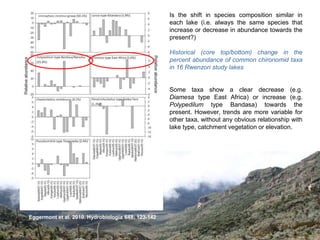
Is the shift in species composition similar in
                                                    each lake (i.e. always the same species that
                                                    increase or decrease in abundance towards the
                                                    present?)

                                                    Historical (core top/bottom) change in the
                                                    percent abundance of common chironomid taxa
                                                    in 16 Rwenzori study lakes


                                                    Some taxa show a clear decrease (e.g.
                                                    Diamesa type East Africa) or increase (e.g.
                                                    Polypedilum type Bandasa) towards the
                                                    present. However, trends are more variable for
                                                    other taxa, without any obvious relationship with
                                                    lake type, catchment vegetation or elevation.


Eggermont et al. 2010. Hydrobiologia 648: 123-142
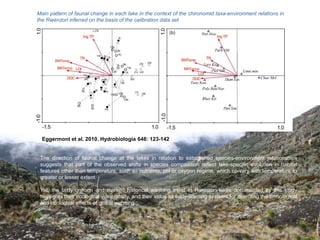
Main pattern of faunal change in each lake in the context of the chironomid taxa-environment relations in
the Rwenzori inferred on the basis of the calibration data set


  Eggermont et al. 2010. Hydrobiologia 648: 123-142


 The direction of faunal change at the lakes in relation to established species-environment relationships
 suggests that part of the observed shifts in species composition reflect lake-specific evolution in habitat
 features other than temperature, such as nutrients, pH or oxygen regime, which co-vary with temperature to
 greater or lesser extent.

 Yet, the fairly uniform and marked historical warming trend in Rwenzori lakes documented by this study
 highlights their ecological vulnerability, and their value as early-warning systems for detecting the limnological
 and ecological effects of global warming.
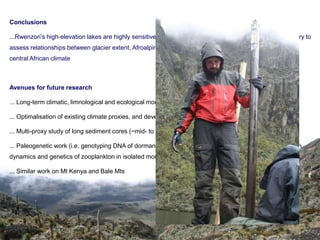
Conclusions

...Rwenzori’s high-elevation lakes are highly sensitive to alpine glaciation and constitute a unique laboratory to
assess relationships between glacier extent, Afroalpine ecosystem processes, and (long-term) changes in
central African climate


Avenues for future research

... Long-term climatic, limnological and ecological monitoring

... Optimalisation of existing climate proxies, and development of new ones

... Multi-proxy study of long sediment cores (~mid- to late Holocene) from selected lake sites

... Paleogenetic work (i.e. genotyping DNA of dormant eggs to reconstruct long-term changes in population
dynamics and genetics of zooplankton in isolated mountain regions)

... Similar work on Mt Kenya and Bale Mts

Limnological and Ecological sensitivity of Rwenzori mountain lakes (Uganda - DR Congo) to climate warming [Hilde Eggermont]

  • 1.
    Limnological and Ecologicalsensitivity of Rwenzori mountain lakes (Uganda- DR Congo) to climate warming Hilde Eggermont, James M. Russell, Leen Audenaert, Dirk Verschuren Ghent University, Belgium Royal Belgian Institute of Natural Sciences, Belgium Brown University, Providence, US
  • 3.
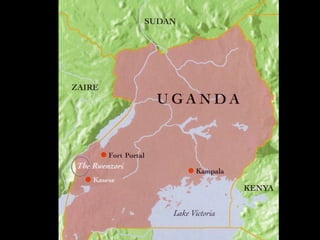
    DR Congo UGANDA
  • 5.
    Climate change andglacier retreat clearly constitute a major threat to the mountain ecosystems/unique cold-water lakes located downstream from the glaciers Increased glacier meltwater input may effect the thermal regime Plant succession and soil development on previously glaciated terrain will influence nutrient budget and productivity/biogeochemical cycles  Warming may enhance the thermal stratification, resulting in deteriorating deep-water oxygen supply ...
  • 6.
    Observations of glacialtermini confirm rapid glacial recession from 1906 to present From R. Taylor et al. (2007; ECRC Research report N° 113). Redrawn and adapted from Kaser and Osmaston (2002; ISBN 0 521 63333 8) > At the current pace, all remaining glaciers are expected to disappear within the next two decades
  • 7.
    Controlling factors ofdeglaciation are still the subject of debate... • Rising temperatures in recent decades (e.g. Bradley et al. 2006; Thompson et al. 2006; Taylor et al. 2006a-b) • Decrease in humidity at the end of the 19th century (ca. 1880) (e.g. Kaser et al. 2004; Mölg and Hardy 2004; Mölg et al. 2006) No information on when glacier recession actually started... Unraveling the (recent) history of tropical African glaciers is vitally important for understanding long- term tropical mountain ecosystem and glacier stability, the relative impacts of human-induced global warming versus natural climate variability in tropical alpine environments (both terrestrial and aquatic), and the climatic controls of glacial extent. >> Lake sediment archives can provide the long-term historical perspective
  • 8.
    Study sites Fieldwork: July 2005 (dry season) July 2006 (dry season) May 2007 (wet season) Jan 2008 (dry season) July 2009 (dry season) Lakes Pools Eggermont et al. 2007. Hydrobiologia 592: 151-173
  • 9.
    Lake Mahoma, 2990m, 25.6 m depth “non-glacial” lakes East Bukurungu, 3801 m, 17.3 m depth East Bukurungu, 3801 m, 17.3 m Lake Bigata, 3998 m, 18.0 m depth depth Lake Batoda, 3890 m, 15.0 depth
  • 10.
    Lake Bujuku, 3891m, 13.5 m depth “glacial” lakes Lower Kitandara, 3989 m, 11 m depth Upper Kitandara, 4009 m, 14.5 m depth Lac du Speke, 4235 m, 17 m depth
  • 11.
    Recovery of shortsediment cores of recent sediments (150-700 yrs old) 1. To assess the archival quality of the lake sediments (>selection of good sites for long coring) 2. To assess the potential of Rwenzori mountain lakes to trace glacier recession (i.e. (to assess their sensitivity to glacier retreat) 3. To assess the limnological and ecological sensitivity of Rwenzori mountain lakes to climate warming .
  • 12.
    Paleolimnological records ofrecent glacier recession in the Rwenzori Mountains Organic geochemical profiles – downcore trends Atomic C/N ratios of organic matter do not show clear differences between glacial and non-glacial lakes, and imply that there have not been major changes in the source of organic matter δ15Norg profiles do not exhibit clear differences between glacial and non-glacial lakes indicating that recent glacial recession does not appear to have strongly affected the nitrogen cycle in Rwenzori lakes 3o/oo decline in δ13Corg in the glacial lakes suggesting that glacier retreat is causing changes in the carbon cycling in Rwenzori’s glacial lakes . Yet, trends in aquatic ecosystem functioning are variable among lakes and require more detailed analysis. (Changes are probably driven by factors other than primary productivity-presumably variations in respiration and lake stratification) Russell et al. 2009 Journal of Paleolimnology 41: 253-271
  • 13.
    Paleolimnological records ofrecent glacier recession in the Rwenzori Mountains Sedimentological profiles – dowcore trends in siliciclastic content Siliciclastic content of the sediment in the glacial lakes significantly decreases towards the present, whereas non-glacial lakes generally show weak trends over time The magnitude of changes in siliciclastic content can vary considerably between lake basins despite similar magnitudes and rates of glacier recession (i.e. glacial lakes can differ dramatically in their sensitivity to glacier fluctuations) Changes in the siliciclastic content of glacial lake sediment reflect fluctuations of glacial extent Signals of glacier dynamics can be isolated through comparative studies Russell et al. 2009 Journal of Paleolimnology 41: 253-271
  • 14.
    TIMING AND CAUSESOF GLACIER RECESSION? Stable, high siliciclastic concentrations for several centuries prior to the late 19th century, under a regionally dry climate Reduction of siliciclastic content (documenting glacial retreat) was underway by ~1870 during a regionally wet episode => The influence of late 19th century reductions in precipitation in triggering glacier recession in the Rwenzori may be weaker than previously thought Russell et al. 2009 Journal of Paleolimnology 41: 253-271
  • 15.
    Recovery of shortsediment cores of recent sediments (150-700 yrs old) 1. To assess the archival quality of the lake sediments (>selection of good sites for long coring) 2. To assess the potential of Rwenzori mountain lakes to trace glacier recession (to assess their sensitivity to glacier retreat) 3. To assess the limnological and ecological sensitivity of Rwenzori mountain lakes to climate warming (= assess whether they are sensitive to climate-driven environmental change of the same order of magnitude as that expected from current and future anthropogenic global warming) .
  • 16.
    Recovery of shortsediment cores of recent sediments (150-700 yrs old) Top-Bottom design: By comparing in 16 lakes the species assemblages of larval chironomid remains (non-biting midges) deposited recently in lake sediments with those deposited at the base of short cores, dated to within or briefly after the Little Ice Age. By comparing temperature reconstructions (estimates) for top and bottom sediments using fossil chironomids No info on the timing or rate of observed ecosystem change, nor on the causes (natural vr anthropogenic); but this apparent weakness is compensated by the ability of the approach to simultaneously assess a large number of sites
  • 17.
    Chironomids as paleothermometers 0 10 20 Taxon number 30 40 50 60 MAT 5.5°C MAT 9.5°C 3800 m 3000 m 0 5 10 15 20 25 30 WA optimum (°C) Eggermont et al. 2010 J Paleolim 43: 413-435
  • 18.
    Predicted Mean AnnualAir Temperature (°C) Chironomids as paleothermometers r² = 0.97 RMSEP = 1.62°C Observed Mean Annual Air Temperature (°C) Eggermont et al. 2010 J Paleolim 43: 413-435
  • 19.
    Average chironomid-inferred historicalMATemp change for the 16 Rwenzori lakes between top and bottom samples. Sites are arranged according to drainage 3.0 3.0 Present-day warmer Present-day warmer EL-EM basin. Non-glacial lakes are shaded in black; glacial Combined lakes in grey. Dashed lines indicate the observed 20th Inferred change in MATemp (°C) Inferred change in MATemp (°C) century regional MATemp change of 0.60 °C 2.0 2.0 Excluding the relatively unique mid-elevation lake 1.0 1.0 Mahoma (2990 m altitude), we find a three-to-one ratio in cases of inferred warming versus inferred cooling, 0.0 0.0 A generalized linear mixed model analysis of the combined result from all lakes except Mahoma indicates -1.0 significantly warmer MATemp (on average +0.38 ± 0.11 -1.0 °C) at present compared to between ~85 and ~645 years ago. Present-day colder Present-day colder -2.0 -2.0 Kopello Batoda Bigata Africa Katunda Kanganyika Middle Kachope Speke Bujuku Mahoma Bukurungu East Nsuranja Lower Kachope Upper Kachope Upper Kitandara Lower Kitandara Kopello Batoda Bigata Africa Katunda Speke Kanganyika Bujuku Middle Kachope Bukurungu East Nsuranja Mahoma Lower Kachope Upper Kachope Upper Kitandara Lower Kitandara Inferred temperature changes are independent of whether lakes are located in glaciated or non-glaciated catchments, and of basal core age, suggesting that at least part of the signal is due to relatively recent, anthropogenic warming. Eggermont et al. 2010. Hydrobiologia 648: 123-142
  • 20.
    Is the shiftin species composition similar in each lake (i.e. always the same species that increase or decrease in abundance towards the present?) Historical (core top/bottom) change in the percent abundance of common chironomid taxa in 16 Rwenzori study lakes Some taxa show a clear decrease (e.g. Diamesa type East Africa) or increase (e.g. Polypedilum type Bandasa) towards the present. However, trends are more variable for other taxa, without any obvious relationship with lake type, catchment vegetation or elevation. Eggermont et al. 2010. Hydrobiologia 648: 123-142
  • 21.
    Main pattern offaunal change in each lake in the context of the chironomid taxa-environment relations in the Rwenzori inferred on the basis of the calibration data set Eggermont et al. 2010. Hydrobiologia 648: 123-142 The direction of faunal change at the lakes in relation to established species-environment relationships suggests that part of the observed shifts in species composition reflect lake-specific evolution in habitat features other than temperature, such as nutrients, pH or oxygen regime, which co-vary with temperature to greater or lesser extent. Yet, the fairly uniform and marked historical warming trend in Rwenzori lakes documented by this study highlights their ecological vulnerability, and their value as early-warning systems for detecting the limnological and ecological effects of global warming.
  • 22.
    Conclusions ...Rwenzori’s high-elevation lakesare highly sensitive to alpine glaciation and constitute a unique laboratory to assess relationships between glacier extent, Afroalpine ecosystem processes, and (long-term) changes in central African climate Avenues for future research ... Long-term climatic, limnological and ecological monitoring ... Optimalisation of existing climate proxies, and development of new ones ... Multi-proxy study of long sediment cores (~mid- to late Holocene) from selected lake sites ... Paleogenetic work (i.e. genotyping DNA of dormant eggs to reconstruct long-term changes in population dynamics and genetics of zooplankton in isolated mountain regions) ... Similar work on Mt Kenya and Bale Mts