OBESITY
THE RISING
CHALLENGE!
YASHRA NAVEED
ERP#14142
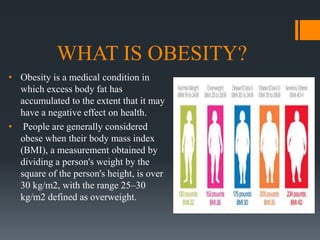
WHAT IS OBESITY?
• Obesity is a medical condition in
which excess body fat has
accumulated to the extent that it may
have a negative effect on health.
• People are generally considered
obese when their body mass index
(BMI), a measurement obtained by
dividing a person's weight by the
square of the person's height, is over
30 kg/m2, with the range 25–30
kg/m2 defined as overweight.
ALARMING SITUATION!
World Population: 7,505,257,673
Obesity Population : 774,000,000
 Nearly 650 million obese adults on the planet have body mass
index (BMI) over 30. There are also about 125 million obese
children and adolescents in the entire world according to a BMI
over 30.
 Nearly two-thirds of the UK population is either overweight or
obese.
 Across the United States, more than one in three adults and one in
six children (ages 2-19) are obese — and one in 11 young children
(ages 2-5) are obese.
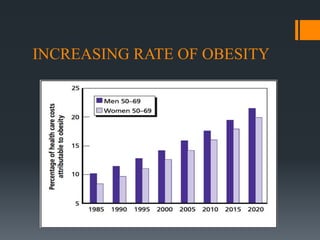
INCREASING RATE OF OBESITY
CAUSES OF OBESITY
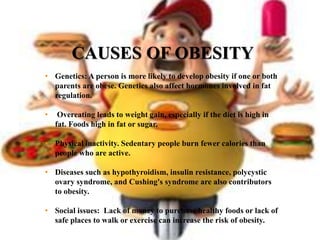
• Genetics: A person is more likely to develop obesity if one or both
parents are obese. Genetics also affect hormones involved in fat
regulation.
• Overeating leads to weight gain, especially if the diet is high in
fat. Foods high in fat or sugar.
• Physical inactivity. Sedentary people burn fewer calories than
people who are active.
• Diseases such as hypothyroidism, insulin resistance, polycystic
ovary syndrome, and Cushing's syndrome are also contributors
to obesity.
• Social issues: Lack of money to purchase healthy foods or lack of
safe places to walk or exercise can increase the risk of obesity.
MENTAL ILLNESS
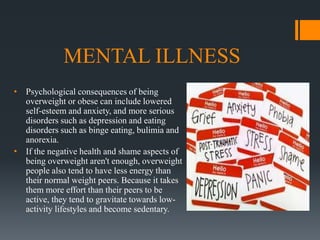
• Psychological consequences of being
overweight or obese can include lowered
self-esteem and anxiety, and more serious
disorders such as depression and eating
disorders such as binge eating, bulimia and
anorexia.
• If the negative health and shame aspects of
being overweight aren't enough, overweight
people also tend to have less energy than
their normal weight peers. Because it takes
them more effort than their peers to be
active, they tend to gravitate towards low-
activity lifestyles and become sedentary.
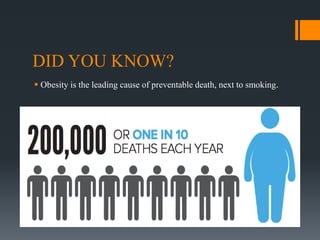
DID YOU KNOW?
 Obesity is the leading cause of preventable death, next to smoking.
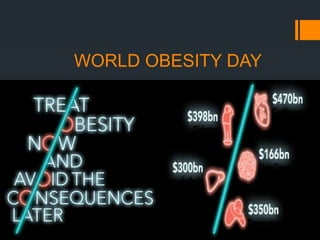
WORLD OBESITY DAY
BUT IT’S NEVER TOO LATE
• Start doing exercise.
• Choose a healthy diet.
• Sleep for minimum 8 hours.
https://www.youtube.com/watch?v=Rpa0_I
Vpxgg
THANK YOU!

Egc presentation

  • 1.
  • 2.
    WHAT IS OBESITY? •Obesity is a medical condition in which excess body fat has accumulated to the extent that it may have a negative effect on health. • People are generally considered obese when their body mass index (BMI), a measurement obtained by dividing a person's weight by the square of the person's height, is over 30 kg/m2, with the range 25–30 kg/m2 defined as overweight.
  • 3.
    ALARMING SITUATION! World Population:7,505,257,673 Obesity Population : 774,000,000  Nearly 650 million obese adults on the planet have body mass index (BMI) over 30. There are also about 125 million obese children and adolescents in the entire world according to a BMI over 30.  Nearly two-thirds of the UK population is either overweight or obese.  Across the United States, more than one in three adults and one in six children (ages 2-19) are obese — and one in 11 young children (ages 2-5) are obese.
  • 4.
  • 5.
    CAUSES OF OBESITY •Genetics: A person is more likely to develop obesity if one or both parents are obese. Genetics also affect hormones involved in fat regulation. • Overeating leads to weight gain, especially if the diet is high in fat. Foods high in fat or sugar. • Physical inactivity. Sedentary people burn fewer calories than people who are active. • Diseases such as hypothyroidism, insulin resistance, polycystic ovary syndrome, and Cushing's syndrome are also contributors to obesity. • Social issues: Lack of money to purchase healthy foods or lack of safe places to walk or exercise can increase the risk of obesity.
  • 7.
    MENTAL ILLNESS • Psychologicalconsequences of being overweight or obese can include lowered self-esteem and anxiety, and more serious disorders such as depression and eating disorders such as binge eating, bulimia and anorexia. • If the negative health and shame aspects of being overweight aren't enough, overweight people also tend to have less energy than their normal weight peers. Because it takes them more effort than their peers to be active, they tend to gravitate towards low- activity lifestyles and become sedentary.
  • 8.
    DID YOU KNOW? Obesity is the leading cause of preventable death, next to smoking.
  • 9.
  • 10.
    BUT IT’S NEVERTOO LATE • Start doing exercise. • Choose a healthy diet. • Sleep for minimum 8 hours. https://www.youtube.com/watch?v=Rpa0_I Vpxgg
  • 11.