Efficient Market Hypothesis 
Presentation By: 
Prathmesh Kulkarni(F-14) 
Kamlesh Pawar (F-23)
Introduction 
ď‚— An efficient capital market is a market that is 
efficient in processing information. 
ď‚— In other words, the market quickly and correctly 
adjusts to new information. 
ď‚— In an information of efficient market, the prices of 
securities observed at any time are based on 
“correct” evaluation of all information available at 
that time. 
ď‚— Therefore, in an efficient market, prices 
immediately and fully reflect available information.
Definition 
• "In an efficient market, competition among the 
many intelligent participants leads to a 
situation where, at any point in time, actual 
prices of individual securities already reflect 
the effects of information based both on 
events that have already occurred and on 
events which, as of now, the market expects 
to take place in the future. In other words, in 
an efficient market at any point in time the 
actual price of a security will be a good 
estimate of its intrinsic value." 
- Professor Eugene Fama,
The Efficient Markets Hypothesis 
ď‚— The Efficient Markets Hypothesis (EMH) is made 
up of three progressively stronger forms: 
ď‚— Weak Form 
ď‚— Semi-strong Form 
ď‚— Strong Form
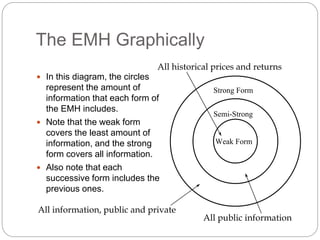
The EMH Graphically 
ď‚— In this diagram, the circles 
All historical prices and returns 
represent the amount of 
information that each form of 
the EMH includes. 
ď‚— Note that the weak form 
covers the least amount of 
information, and the strong 
form covers all information. 
ď‚— Also note that each 
successive form includes the 
previous ones. 
Strong Form 
Semi-Strong 
Weak Form 
All information, public and private 
All public information
The Weak Form 
ď‚— The weak form of the EMH says that past prices, 
volume, and other market statistics provide no 
information that can be used to predict future prices. 
ď‚— If stock price changes are random, then past prices 
cannot be used to forecast future prices. 
ď‚— Price changes should be random because it is 
information that drives these changes, and 
information arrives randomly. 
ď‚— Prices should change very quickly and to the correct 
level when new information arrives (see next slide). 
ď‚— This form of the EMH, if correct, repudiates technical 
analysis. 
ď‚— Most research supports the notion that the markets 
are weak form efficient.
The Semi-strong Form 
ď‚— The semi-strong form says that prices fully reflect all 
publicly available information and expectations about 
the future. 
ď‚— This suggests that prices adjust very rapidly to new 
information, and that old information cannot be used 
to earn superior returns. 
ď‚— The semi-strong form, if correct, repudiates 
fundamental analysis. 
ď‚— Most studies find that the markets are reasonably 
efficient in this sense, but the evidence is somewhat 
mixed.
The Strong Form 
ď‚— The strong form says that prices fully reflect all 
information, whether publicly available or not. 
ď‚— Even the knowledge of material, non-public 
information cannot be used to earn superior 
results. 
ď‚— Most studies have found that the markets are not 
efficient in this sense.
Summary of Tests of the EMH 
ď‚— Weak form is supported, so technical analysis cannot 
consistently outperform the market. 
ď‚— Semi-strong form is mostly supported , so 
fundamental analysis cannot consistently outperform 
the market. 
ď‚— Strong form is generally not supported. If you have 
secret (“insider”) information, you CAN use it to earn 
excess returns on a consistent basis. 
ď‚— Ultimately, most believe that the market is very 
efficient, though not perfectly efficient. It is unlikely 
that any system of analysis could consistently and 
significantly beat the market (adjusted for costs and 
risk) over the long run.
Efficientmarkethypothesis 111019030158-phpapp01

Efficientmarkethypothesis 111019030158-phpapp01

  • 1.
    Efficient Market Hypothesis Presentation By: Prathmesh Kulkarni(F-14) Kamlesh Pawar (F-23)
  • 2.
    Introduction  Anefficient capital market is a market that is efficient in processing information.  In other words, the market quickly and correctly adjusts to new information.  In an information of efficient market, the prices of securities observed at any time are based on “correct” evaluation of all information available at that time.  Therefore, in an efficient market, prices immediately and fully reflect available information.
  • 3.
    Definition • "Inan efficient market, competition among the many intelligent participants leads to a situation where, at any point in time, actual prices of individual securities already reflect the effects of information based both on events that have already occurred and on events which, as of now, the market expects to take place in the future. In other words, in an efficient market at any point in time the actual price of a security will be a good estimate of its intrinsic value." - Professor Eugene Fama,
  • 4.
    The Efficient MarketsHypothesis ď‚— The Efficient Markets Hypothesis (EMH) is made up of three progressively stronger forms: ď‚— Weak Form ď‚— Semi-strong Form ď‚— Strong Form
  • 5.
    The EMH Graphically ď‚— In this diagram, the circles All historical prices and returns represent the amount of information that each form of the EMH includes. ď‚— Note that the weak form covers the least amount of information, and the strong form covers all information. ď‚— Also note that each successive form includes the previous ones. Strong Form Semi-Strong Weak Form All information, public and private All public information
  • 6.
    The Weak Form ď‚— The weak form of the EMH says that past prices, volume, and other market statistics provide no information that can be used to predict future prices. ď‚— If stock price changes are random, then past prices cannot be used to forecast future prices. ď‚— Price changes should be random because it is information that drives these changes, and information arrives randomly. ď‚— Prices should change very quickly and to the correct level when new information arrives (see next slide). ď‚— This form of the EMH, if correct, repudiates technical analysis. ď‚— Most research supports the notion that the markets are weak form efficient.
  • 7.
    The Semi-strong Form ď‚— The semi-strong form says that prices fully reflect all publicly available information and expectations about the future. ď‚— This suggests that prices adjust very rapidly to new information, and that old information cannot be used to earn superior returns. ď‚— The semi-strong form, if correct, repudiates fundamental analysis. ď‚— Most studies find that the markets are reasonably efficient in this sense, but the evidence is somewhat mixed.
  • 8.
    The Strong Form ď‚— The strong form says that prices fully reflect all information, whether publicly available or not. ď‚— Even the knowledge of material, non-public information cannot be used to earn superior results. ď‚— Most studies have found that the markets are not efficient in this sense.
  • 9.
    Summary of Testsof the EMH  Weak form is supported, so technical analysis cannot consistently outperform the market.  Semi-strong form is mostly supported , so fundamental analysis cannot consistently outperform the market.  Strong form is generally not supported. If you have secret (“insider”) information, you CAN use it to earn excess returns on a consistent basis.  Ultimately, most believe that the market is very efficient, though not perfectly efficient. It is unlikely that any system of analysis could consistently and significantly beat the market (adjusted for costs and risk) over the long run.