Efficient use of water
EDUCATIONAL INNOVATION AND RESEARCH PROJECT ON THE
DEVELOPMENT OF THE CURRICULUM DURING THE ACADEMIC YEAR 2014-
2015.
Results Obtained in
consumption measurements
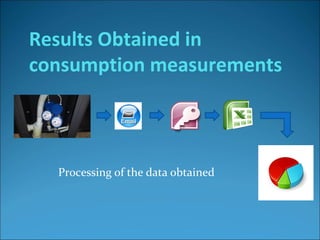
    Processing of the data obtained
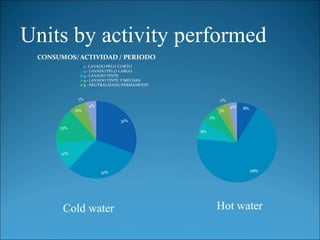
Units by activity performed
Hot waterCold water
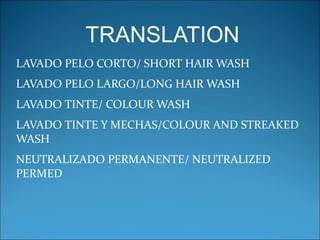
TRANSLATION
LAVADO PELO CORTO/ SHORT HAIR WASH
LAVADO PELO LARGO/LONG HAIR WASH
LAVADO TINTE/ COLOUR WASH
LAVADO TINTE Y MECHAS/COLOUR AND STREAKED 
WASH
NEUTRALIZADO PERMANENTE/ NEUTRALIZED 
PERMED
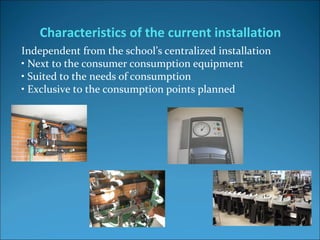
Independent from the school’s centralized installation 
• Next to the consumer consumption equipment
• Suited to the needs of consumption
• Exclusive to the consumption points planned
Characteristics of the current installation
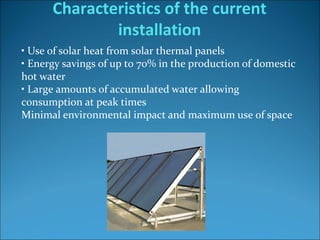
• Use of solar heat from solar thermal panels 
• Energy savings of up to 70% in the production of domestic 
hot water
• Large amounts of accumulated water allowing 
consumption at peak times
Minimal environmental impact and maximum use of space
Characteristics of the current
installation
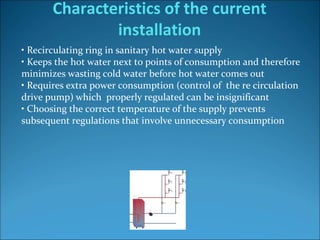
• Recirculating ring in sanitary hot water supply
• Keeps the hot water next to points of consumption and therefore 
minimizes wasting cold water before hot water comes out
• Requires extra power consumption (control of  the re circulation 
drive pump) which  properly regulated can be insignificant
• Choosing the correct temperature of the supply prevents 
subsequent regulations that involve unnecessary consumption
Characteristics of the current
installation
• Supply Equipment / wastewater (used) management
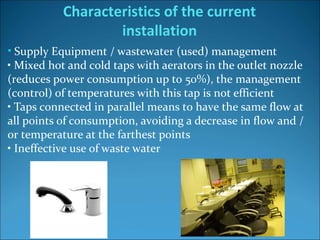
• Mixed hot and cold taps with aerators in the outlet nozzle 
(reduces power consumption up to 50%), the management 
(control) of temperatures with this tap is not efficient
• Taps connected in parallel means to have the same flow at 
all points of consumption, avoiding a decrease in flow and / 
or temperature at the farthest points
• Ineffective use of waste water 
Characteristics of the current
installation
• Decalcification
• Consumption measuring equipment, meters
• Fixed temperature of consumption (ACS)
                   Thermostatic faucets
                   Thermostatic valve supply at head 
• Recovery of residual heat in the evacuation
• Use of wastewater for other uses
• Marketing aimed at a more responsible use of water
Proposals for savings in the supply
and exploitation in the evacuation
• Decalcification
●
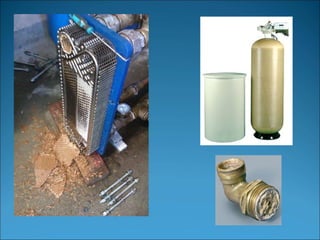
Device capable of removing calcareous components found in the 
water 
●
Increased efficiency of equipment (lime precipitation reduce transmission 
capacity and flows of equipment)
●
Increased comfort by having cleaner water helps wash head and skin 
(interaction with the body)
●
Cleaning action of products more effective (water cleaner, less cleaning 
requirement)
●
According to the device used, it may involve waste  of the treated  water 
(high lime  content that is discarded)
Proposals for savings in the supply
and exploitation in the evacuation
…30%
…50%
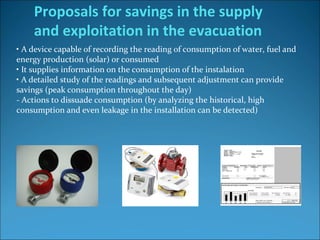
• A device capable of recording the reading of consumption of water, fuel and 
energy production (solar) or consumed
• It supplies information on the consumption of the instalation 
• A detailed study of the readings and subsequent adjustment can provide 
savings (peak consumption throughout the day)
- Actions to dissuade consumption (by analyzing the historical, high 
consumption and even leakage in the installation can be detected)
Proposals for savings in the supply
and exploitation in the evacuation
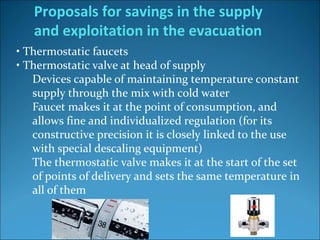
• Thermostatic faucets
• Thermostatic valve at head of supply
Devices capable of maintaining temperature constant
supply through the mix with cold water
Faucet makes it at the point of consumption, and
allows fine and individualized regulation (for its
constructive precision it is closely linked to the use
with special descaling equipment)
The thermostatic valve makes it at the start of the set
of points of delivery and sets the same temperature in
all of them
Proposals for savings in the supply
and exploitation in the evacuation
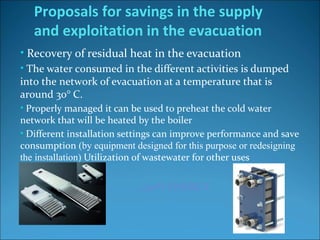
• Recovery of residual heat in the evacuation
• The water consumed in the different activities is dumped
into the network of evacuation at a temperature that is
around 30° C.
• Properly managed it can be used to preheat the cold water
network that will be heated by the boiler
• Different installation settings can improve performance and save
consumption (by equipment designed for this purpose or redesigning
the installation) Utilization of wastewater for other uses
Proposals for savings in the supply
and exploitation in the evacuation
…40% ENERGY
• Utilization of wastewater for other uses
• Poured water to the network can be easily exploited in other
applications not requiring such restrictive water quality how
of human consumption
• Through a simple physical and chemical treatment water can be
reused as flushing water in the toilets and urinals from the Center
(there is no contact with the user and only fulfills the Mission of
evacuate residues)
FILTRATION + DECANTING + CHLORINATION + BACTERICIDE
…20%
Proposals for savings in the supply
and exploitation in the evacuation
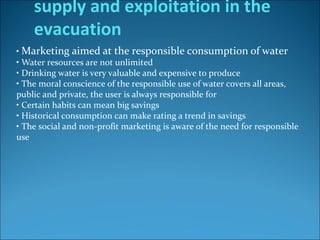
• Marketing aimed at the responsible consumption of water
• Water resources are not unlimited
• Drinking water is very valuable and expensive to produce
• The moral conscience of the responsible use of water covers all areas,
public and private, the user is always responsible for
• Certain habits can mean big savings
• Historical consumption can make rating a trend in savings
• The social and non-profit marketing is aware of the need for responsible
use
supply and exploitation in the
evacuation
Economic balance,
investments
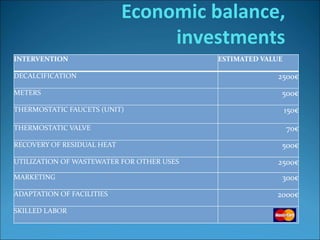
INTERVENTION ESTIMATED VALUE
DECALCIFICATION 2500€
METERS 500€
THERMOSTATIC FAUCETS (UNIT) 150€
THERMOSTATIC VALVE 70€
RECOVERY OF RESIDUAL HEAT 500€
UTILIZATION OF WASTEWATER FOR OTHER USES 2500€
MARKETING 300€
ADAPTATION OF FACILITIES 2000€
SKILLED LABOR
Conclusions
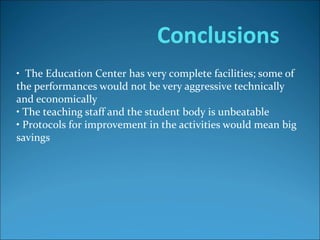
• The Education Center has very complete facilities; some of
the performances would not be very aggressive technically
and economically
• The teaching staff and the student body is unbeatable
• Protocols for improvement in the activities would mean big
savings
WATER SAVING MEASURES
HAIR SALON WORKS
PROTOCOLS
HAIR HYGIENE
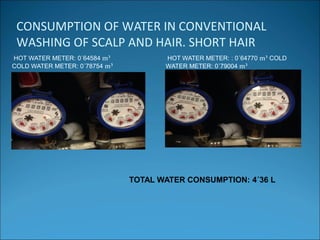
CONSUMPTION OF WATER IN CONVENTIONAL
WASHING OF SCALP AND HAIR. SHORT HAIR
HOT WATER METER: 0´64584 m³
COLD WATER METER: 0´78754 m³
HOT WATER METER: : 0´64770 m³ COLD
WATER METER: 0´79004 m³
TOTAL WATER CONSUMPTION: 4´36 L
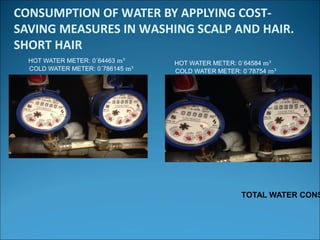
CONSUMPTION OF WATER BY APPLYING COST-
SAVING MEASURES IN WASHING SCALP AND HAIR.
SHORT HAIR
HOT WATER METER: 0´64463 m³
COLD WATER METER: 0´786145 m³
HOT WATER METER: 0´64584 m³
COLD WATER METER: 0´78754 m³
TOTAL WATER CONS
PROTOCOL
-Brush hair.
-Apply shampoo into a dispenser and add hot water.
-Move it without stirring
-Apply the foam on hair and scalp.
-Make a first application of shampoo and massage into hair and scalp.
-Remove the excess of foam.
-Make a second application of shampoo and massage.
-Rinse
-Apply conditioner.
-Rinse
TECHNIQUE DESIGNED FOR WASHING
HAIR AND SCALP
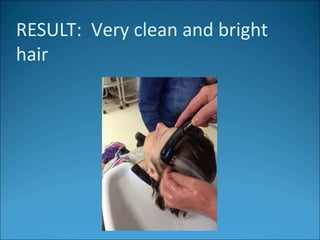
RESULT: Very clean and bright
hair
DYE WASHING
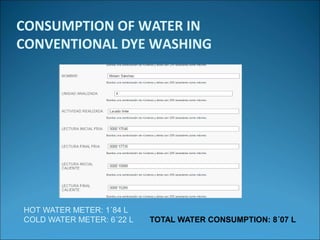
CONSUMPTION OF WATER IN
CONVENTIONAL DYE WASHING
HOT WATER METER: 1´84 L
COLD WATER METER: 6´22 L TOTAL WATER CONSUMPTION: 8´07 L
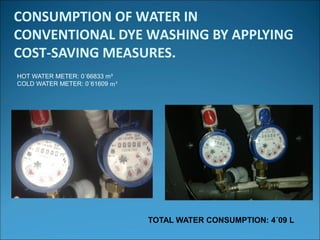
CONSUMPTION OF WATER IN
CONVENTIONAL DYE WASHING BY APPLYING
COST-SAVING MEASURES.
HOT WATER METER: 0´66833 m³
COLD WATER METER: 0´61609 m³
TOTAL WATER CONSUMPTION: 4´09 L
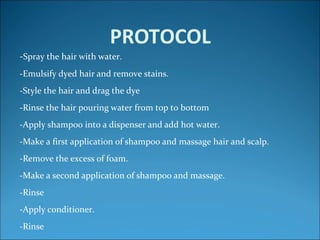
PROTOCOL
-Spray the hair with water.
-Emulsify dyed hair and remove stains.
-Style the hair and drag the dye
-Rinse the hair pouring water from top to bottom
-Apply shampoo into a dispenser and add hot water.
-Make a first application of shampoo and massage hair and scalp.
-Remove the excess of foam.
-Make a second application of shampoo and massage.
-Rinse
-Apply conditioner.
-Rinse
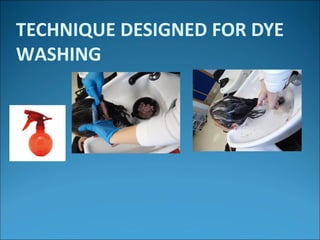
TECHNIQUE DESIGNED FOR DYE
WASHING
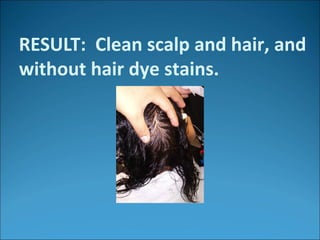
RESULT: Clean scalp and hair, and
without hair dye stains.
WASHING OF HIGHLIGHTS
CONSUMPTION OF WATER IN
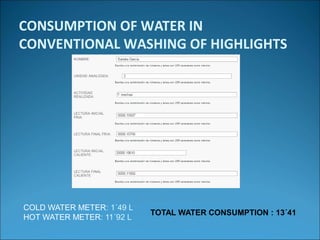
CONVENTIONAL WASHING OF HIGHLIGHTS
COLD WATER METER: 1´49 L
HOT WATER METER: 11´92 L
TOTAL WATER CONSUMPTION : 13´41
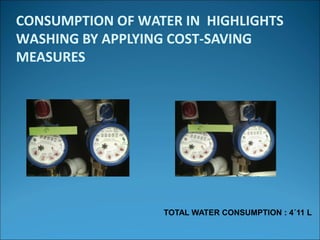
CONSUMPTION OF WATER IN HIGHLIGHTS
WASHING BY APPLYING COST-SAVING
MEASURES
TOTAL WATER CONSUMPTION : 4´11 L
PROTOCOL
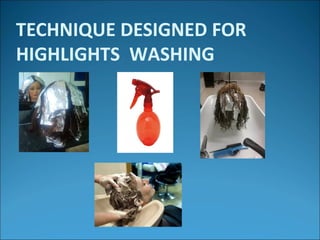
-Removal of bleaching or colouring with water sprayer
-Begin by opening the packages in the area of the neck and work​​
up
-Apply shampoo into a dispenser and add hot water.
-Make a first application of shampoo and massage hair and scalp.
-Remove the excess of foam.
-Make a second application of shampoo and massage.
-Rinse
-Apply conditioner.
-Rinser.
TECHNIQUE DESIGNED FOR
HIGHLIGHTS WASHING
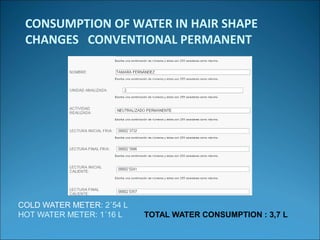
PERMANENT NEUTRALISATION
CONSUMPTION OF WATER IN HAIR SHAPE
CHANGES CONVENTIONAL PERMANENT
COLD WATER METER: 2´54 L
HOT WATER METER: 1´16 L TOTAL WATER CONSUMPTION : 3,7 L
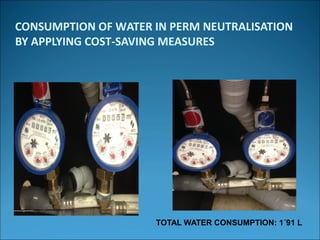
CONSUMPTION OF WATER IN PERM NEUTRALISATION
BY APPLYING COST-SAVING MEASURES
TOTAL WATER CONSUMPTION: 1´91 L
PROTOCOL
-Washing of hair and scalp (shampooing the hair using the saving
technique).
-Apply shampoo into a dispenser and add hot water.
-Make a first application shampoo and massage into scalp and
hair.
-Rinse
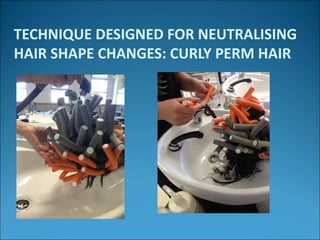
-Perform the rolling up technique. Exposure time.
-Rinse pouring water from the top.
-Neutralized.
-Rinsing
TECHNIQUE DESIGNED FOR NEUTRALISING
HAIR SHAPE CHANGES: CURLY PERM HAIR
NEUTRALIZED HAIR
STRAIGHTENER
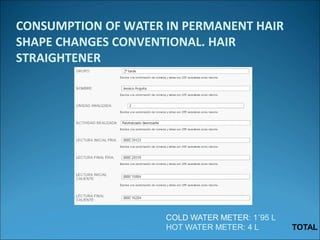
CONSUMPTION OF WATER IN PERMANENT HAIR
SHAPE CHANGES CONVENTIONAL. HAIR
STRAIGHTENER
COLD WATER METER: 1´95 L
HOT WATER METER: 4 L TOTAL W
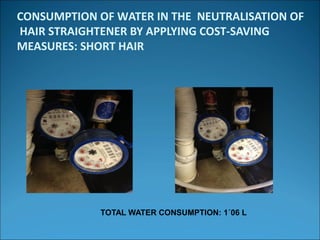
CONSUMPTION OF WATER IN THE NEUTRALISATION OF
HAIR STRAIGHTENER BY APPLYING COST-SAVING
MEASURES: SHORT HAIR
TOTAL WATER CONSUMPTION: 1´06 L
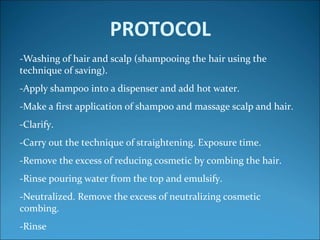
PROTOCOL
-Washing of hair and scalp (shampooing the hair using the
technique of saving).
-Apply shampoo into a dispenser and add hot water.
-Make a first application of shampoo and massage scalp and hair.
-Clarify.
-Carry out the technique of straightening. Exposure time.
-Remove the excess of reducing cosmetic by combing the hair.
-Rinse pouring water from the top and emulsify.
-Neutralized. Remove the excess of neutralizing cosmetic
combing.
-Rinse
TECHNIQUE DESIGNED FOR THE
NEUTRALISATION OF HAIR SHAPE CHANGES:
STRAIGHTENING OF SHORT HAIR PERM
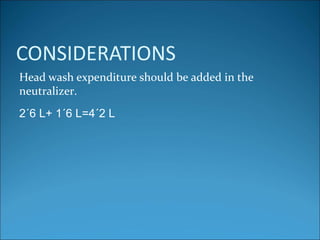
CONSIDERATIONS
Head wash expenditure should be added in the
neutralizer.
2´6 L+ 1´6 L=4´2 L
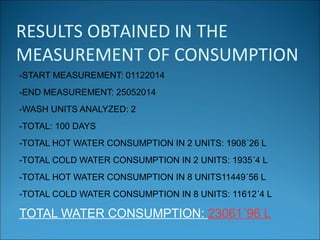
RESULTS OBTAINED IN THE
MEASUREMENT OF CONSUMPTION
-START MEASUREMENT: 01122014
-END MEASUREMENT: 25052014
-WASH UNITS ANALYZED: 2
-TOTAL: 100 DAYS
-TOTAL HOT WATER CONSUMPTION IN 2 UNITS: 1908´26 L
-TOTAL COLD WATER CONSUMPTION IN 2 UNITS: 1935´4 L
-TOTAL HOT WATER CONSUMPTION IN 8 UNITS11449´56 L
-TOTAL COLD WATER CONSUMPTION IN 8 UNITS: 11612´4 L
TOTAL WATER CONSUMPTION: 23061´96 L
WITH THE DESIGNED WATER SAVING
MEASURES
"CONSUMPTION OF WATER WILL BE
REDUCED TO HALF"
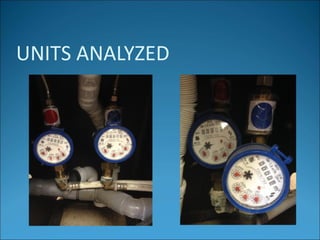
UNITS ANALYZED
Thank you for your attention
and involvement in the
project
"None of us is as good as all of us
together."

Efficient use of water

Editor's Notes

  • #12 <número>
  • #14 <número>