Mastering Effective
Communication
• Key Skills for Clear and Impactful Interaction
• Your Name | Date
Introduction
• Communication is the foundation of relationships, teamwork, and leadership.
• Effective communication = message sent = message received and understood.
• "The art of communication is the language of leadership." – James Humes
What is Effective Communication?
• The exchange of ideas, thoughts, or information in a way that achieves understanding.
• Involves clarity, empathy, and feedback.
• Two main forms: Verbal & Non-verbal.
Why Effective Communication
Matters
• • Builds trust and rapport
• • Improves teamwork and productivity
• • Reduces misunderstandings and conflicts
• • Boosts personal and professional relationships
Elements of Communication
• • Sender – creates message
• • Message – information being communicated
• • Channel – method of delivery
• • Receiver – person who gets the message
• • Feedback – response from the receiver
• • Noise – anything that distorts the message
The Communication Process
Diagram
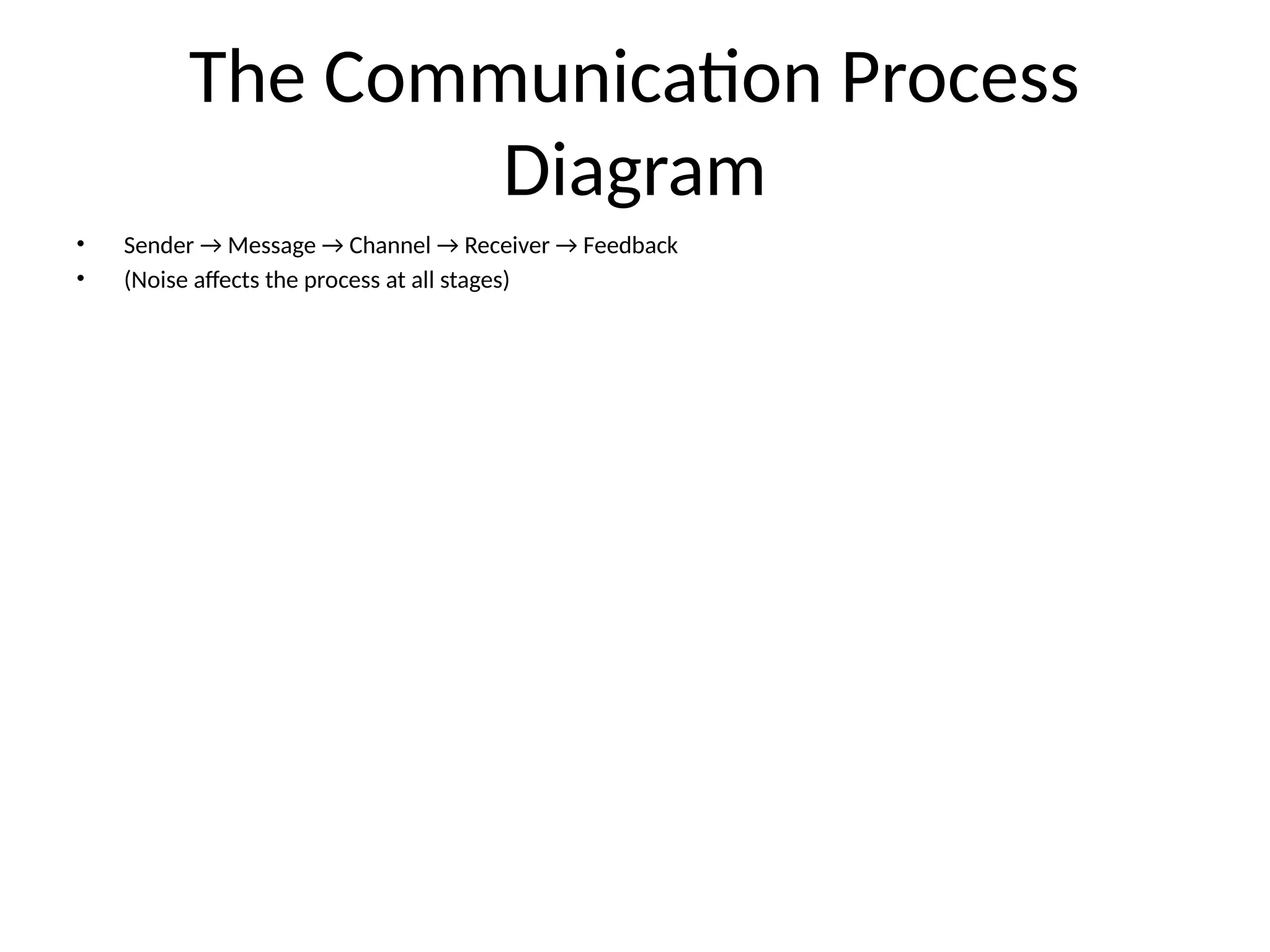
• Sender → Message → Channel → Receiver → Feedback
• (Noise affects the process at all stages)
Types of Communication
• 1. Verbal – spoken or written words
• 2. Non-verbal – body language, facial expressions
• 3. Visual – charts, graphs, images
• 4. Listening – active, reflective, empathetic
The 7 Cs of Effective
Communication
• Clear • Concise • Concrete • Correct • Coherent • Complete • Courteous
Active Listening
• • Give full attention
• • Avoid interrupting
• • Use verbal nods
• • Summarize to confirm understanding
• • Show empathy
Non-Verbal Communication
• • Body language – posture, gestures
• • Facial expressions – smile, eye contact
• • Tone of voice – warmth, confidence
• • Appearance – professional and appropriate
Common Communication Barriers
• • Language differences
• • Distractions & noise
• • Cultural misunderstandings
• • Assumptions & stereotypes
• • Emotional interference
Overcoming Communication
Barriers
• • Simplify language
• • Minimize distractions
• • Clarify and confirm understanding
• • Be culturally sensitive
• • Manage emotions
Digital Communication Tips
• • Keep messages clear & concise
• • Use proper tone and etiquette
• • Avoid all caps
• • Check grammar
• • Be mindful of time zones
Communication in Teams
• • Encourage open dialogue
• • Use 'I' statements
• • Provide constructive feedback
• • Foster inclusivity
• • Use collaboration tools
The Role of Feedback
• • Positive feedback: reinforces good performance
• • Constructive feedback: helps improve
• • Be specific, timely, respectful
Public Speaking Essentials
• • Know your audience
• • Structure your message
• • Use visual aids
• • Practice tone and pace
• • Handle nerves
Real-Life Examples
• • Workplace miscommunication → costly mistakes
• • Cross-cultural meeting success → clear, respectful communication
Quick Self-Assessment
• Ask yourself:
• • Did I listen actively?
• • Was my message clear?
• • Did I consider the other perspective?
• • Did I confirm understanding?
Key Takeaways
• • Communication is learnable
• • Balance verbal, non-verbal, listening skills
• • Overcome barriers
• • Feedback = growth
Closing & Q&A
• "Good communication is the bridge between confusion and clarity."
• Thank you!
• Questions?

effective_communication_presentation.pptx

  • 1.
    Mastering Effective Communication • KeySkills for Clear and Impactful Interaction • Your Name | Date
  • 2.
    Introduction • Communication isthe foundation of relationships, teamwork, and leadership. • Effective communication = message sent = message received and understood. • "The art of communication is the language of leadership." – James Humes
  • 3.
    What is EffectiveCommunication? • The exchange of ideas, thoughts, or information in a way that achieves understanding. • Involves clarity, empathy, and feedback. • Two main forms: Verbal & Non-verbal.
  • 4.
    Why Effective Communication Matters •• Builds trust and rapport • • Improves teamwork and productivity • • Reduces misunderstandings and conflicts • • Boosts personal and professional relationships
  • 5.
    Elements of Communication •• Sender – creates message • • Message – information being communicated • • Channel – method of delivery • • Receiver – person who gets the message • • Feedback – response from the receiver • • Noise – anything that distorts the message
  • 6.
    The Communication Process Diagram •Sender → Message → Channel → Receiver → Feedback • (Noise affects the process at all stages)
  • 7.
    Types of Communication •1. Verbal – spoken or written words • 2. Non-verbal – body language, facial expressions • 3. Visual – charts, graphs, images • 4. Listening – active, reflective, empathetic
  • 8.
    The 7 Csof Effective Communication • Clear • Concise • Concrete • Correct • Coherent • Complete • Courteous
  • 9.
    Active Listening • •Give full attention • • Avoid interrupting • • Use verbal nods • • Summarize to confirm understanding • • Show empathy
  • 10.
    Non-Verbal Communication • •Body language – posture, gestures • • Facial expressions – smile, eye contact • • Tone of voice – warmth, confidence • • Appearance – professional and appropriate
  • 11.
    Common Communication Barriers •• Language differences • • Distractions & noise • • Cultural misunderstandings • • Assumptions & stereotypes • • Emotional interference
  • 12.
    Overcoming Communication Barriers • •Simplify language • • Minimize distractions • • Clarify and confirm understanding • • Be culturally sensitive • • Manage emotions
  • 13.
    Digital Communication Tips •• Keep messages clear & concise • • Use proper tone and etiquette • • Avoid all caps • • Check grammar • • Be mindful of time zones
  • 14.
    Communication in Teams •• Encourage open dialogue • • Use 'I' statements • • Provide constructive feedback • • Foster inclusivity • • Use collaboration tools
  • 15.
    The Role ofFeedback • • Positive feedback: reinforces good performance • • Constructive feedback: helps improve • • Be specific, timely, respectful
  • 16.
    Public Speaking Essentials •• Know your audience • • Structure your message • • Use visual aids • • Practice tone and pace • • Handle nerves
  • 17.
    Real-Life Examples • •Workplace miscommunication → costly mistakes • • Cross-cultural meeting success → clear, respectful communication
  • 18.
    Quick Self-Assessment • Askyourself: • • Did I listen actively? • • Was my message clear? • • Did I consider the other perspective? • • Did I confirm understanding?
  • 19.
    Key Takeaways • •Communication is learnable • • Balance verbal, non-verbal, listening skills • • Overcome barriers • • Feedback = growth
  • 20.
    Closing & Q&A •"Good communication is the bridge between confusion and clarity." • Thank you! • Questions?