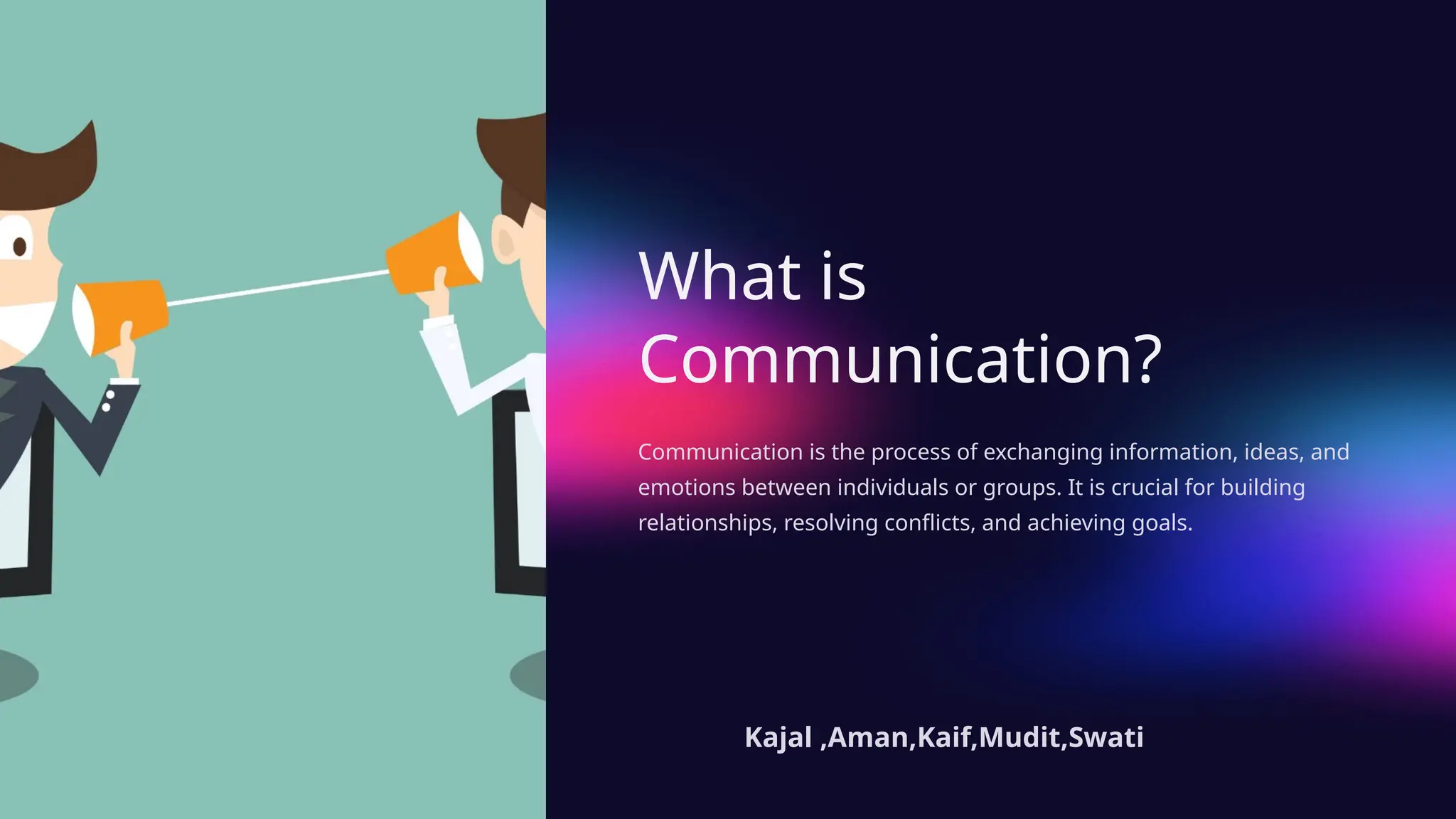
What is
Communication?
Communication isthe process of exchanging information, ideas, and
emotions between individuals or groups. It is crucial for building
relationships, resolving conflicts, and achieving goals.
Kajal ,Aman,Kaif,Mudit,Swati
2.
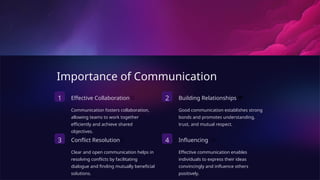
Importance of Communication
1Effective Collaboration 🤝
Communication fosters collaboration,
allowing teams to work together
efficiently and achieve shared
objectives.
2 Building Relationships ❤️
Good communication establishes strong
bonds and promotes understanding,
trust, and mutual respect.
3 Conflict Resolution ✨
Clear and open communication helps in
resolving conflicts by facilitating
dialogue and finding mutually beneficial
solutions.
4 Influencing ✍️
Effective communication enables
individuals to express their ideas
convincingly and influence others
positively.
3.
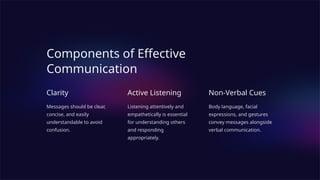
Components of Effective
Communication
Clarity
Messagesshould be clear,
concise, and easily
understandable to avoid
confusion.
Active Listening
Listening attentively and
empathetically is essential
for understanding others
and responding
appropriately.
Non-Verbal Cues
Body language, facial
expressions, and gestures
convey messages alongside
verbal communication.
4.
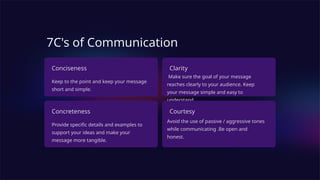
7C's of Communication
Conciseness
Keepto the point and keep your message
short and simple.
Clarity
Make sure the goal of your message
reaches clearly to your audience. Keep
your message simple and easy to
understand.
Concreteness
Provide specific details and examples to
support your ideas and make your
message more tangible.
Courtesy
Avoid the use of passive / aggressive tones
while communicating .Be open and
honest.
5.
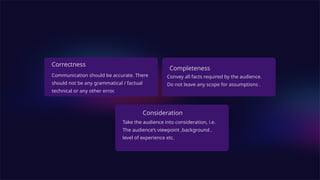
Correctness
Communication should beaccurate. There
should not be any grammatical / factual
technical or any other error.
Completeness
Convey all facts required by the audience.
Do not leave any scope for assumptions .
Consideration
Take the audience into consideration, i.e.
The audience’s viewpoint ,background ,
level of experience etc.
6.
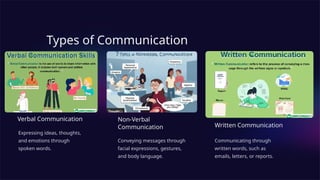
Types of Communication
VerbalCommunication
Expressing ideas, thoughts,
and emotions through
spoken words.
Non-Verbal
Communication
Conveying messages through
facial expressions, gestures,
and body language.
Written Communication
Communicating through
written words, such as
emails, letters, or reports.
7.
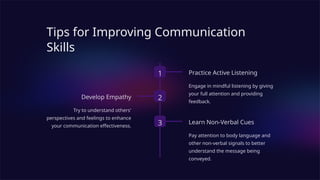
Tips for ImprovingCommunication
Skills
1 Practice Active Listening
Engage in mindful listening by giving
your full attention and providing
feedback.
2
Develop Empathy
Try to understand others'
perspectives and feelings to enhance
your communication effectiveness. 3 Learn Non-Verbal Cues
Pay attention to body language and
other non-verbal signals to better
understand the message being
conveyed.
8.
Conclusion
Communication is afundamental skill that plays a vital role in building relationships, achieving
goals, and fostering collaboration. By understanding its importance, components, and different
types, as well as improving communication skills, we can enhance our personal and professional
interactions.