These slides are to be used as a guide to
writing success stories. The format that involves
using “situation/background, programme/project activities,
results/impact, and conclusion/restatement,” is a
standard “success story” format that can be used
for multiple audiences and for numerous
development programmes
Definition of Success
The Merriam-Webster Online Dictionary defines
success as an “outcome” or “result” – “a degree or
measure of succeeding” or a “favorable or desired
outcome.”
What is a Success Story?
A success story is the successful – favorable or
desired result or outcome of a programme (and/or
sub-projects). In other words, you want to paint a
picture as to how the sub-projects/activities made
a difference in the lives of the people it serves.
So considerthese factors when you write
success story
Pretend the reader knows nothing whatsoever about your programme.
Don’t assume anything!
Remember… You are telling a short story about what you want to
achieve in a programme (always go back to the purpose of the
programme).
Tells the reader why and how your programme was implemented.
Tells the results or the impact of the programme.
Tells the measurable results or how programme success was achieved.
Defines the public value of a programme.
Why write Success Stories?
 To show how the public fund/grant is used
 To document that Urban Development used funds for
intended purposes, which is… to make positive and
lasting impacts in the lives of Afghan citizens.
 To share programme ideas and to learn what works
and what doesn’t work.
 show development and extension.
When to write Success Stories?
 When you have something important to report and you have
impact data to back up your work.
 When you are proud of a programme.
 Ongoing -- Don’t wait until you are told to write one by your
supervisor or at the end of the year.
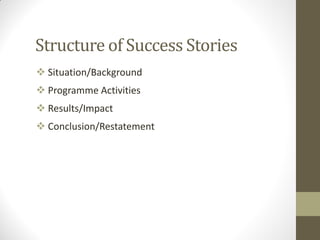
Structure of Success Stories
 Situation/Background
 Programme Activities
 Results/Impact
 Conclusion/Restatement
Situation/Background
 Why does the programme exist in the first place? (in
short story, we may skip this part)
 What are you trying to achieve (the purpose of the
programme/sub-projects)?
 Why is this programme important to the people of
Afghanistan?
Programme Activities
How was the programme implemented?
 What steps did you take to carry out the programme – fulfill the
programme objectives?
 Who is your target audience?
 What were they asked or required to do?
Results/ Impacts
What was achieved as a result of this programme (and/or
sub-projects/activities)?
 What behavior changed?
 How the life of people changed?
 What actions are being put into place to ensure
your desired results?
Conclusion/Restatement
How do you restate your thesis statements?
Start with an expression of (in summary, finally, in
conclusion, with conclusion etc).
Try to restate thesis statements; means you need to repeat
thesis statements with different ideas and words.
Try to end with importance (quotes), recommendations,
prediction or future plan.
10 Tips for writing an effectivesuccessstory
1. Writing for your reader, not yourself
o Your reader is interested in his or her cause, not your program or project!
2. Develop an angle
o When identifying an angle, ask yourself what it is that you want your reader to think, do, or
feel after reading your story.
o As you write, frequently re-read what you have written and ask yourself “what is this story
about?”
3. Create an emotional hook
o Ask a question which paint a picture of the people behind the facts e.g. who was at risk? Who
was suffering? Etc
4. Avoid wordiness and run-an sentence and jargon
o Eliminate unnecessary words and sentences. Be concise and to the point.
5. Focus on facts not fluff
o Broad sweeping statements and grandiose words can destroy the credibility of your story.
Know the facts about your program and clearly state what you know.
Cont…
6. Follow the format
o Make the story easy on the eyes.
o Use white space to reduce the density of the text.
o Use bullets to highlight important points. In some instances only the bullets will be
read.
o Keep your story to one page.
7. Follow the 80/20 rule to effective writing
o 80% is research and planning, 20% is writing.
8. Give it a rest
o One of the best ways to write well is to put what you have written aside for a day and
then re-read your story with a fresh mind.
9. Remember, success stories are the tip of the
program’s iceberg!
o Does your program capture outcomes?
Helpful Tips
Keep paragraphs short – no more than 5-6 sentences.
Keep story to no more than two pages.
Avoid using passive voice (e.g., “Trainings were provided.”).
Use active voice (e.g., “X partner provided Y trainings.”), and
be clear about who is doing the action in every sentence.
Limit use of acronyms. If you use acronyms, spell them out on
first mention
Use plain language
Avoid jargon. readers often skip over terms they don’t
understand, hoping to get their meaning from the rest of the
sentence
Keep messages simple and concise.
Use pictures

Effective success story writing

  • 2.
    These slides areto be used as a guide to writing success stories. The format that involves using “situation/background, programme/project activities, results/impact, and conclusion/restatement,” is a standard “success story” format that can be used for multiple audiences and for numerous development programmes
  • 3.
    Definition of Success TheMerriam-Webster Online Dictionary defines success as an “outcome” or “result” – “a degree or measure of succeeding” or a “favorable or desired outcome.”
  • 4.
    What is aSuccess Story? A success story is the successful – favorable or desired result or outcome of a programme (and/or sub-projects). In other words, you want to paint a picture as to how the sub-projects/activities made a difference in the lives of the people it serves.
  • 5.
    So considerthese factorswhen you write success story Pretend the reader knows nothing whatsoever about your programme. Don’t assume anything! Remember… You are telling a short story about what you want to achieve in a programme (always go back to the purpose of the programme). Tells the reader why and how your programme was implemented. Tells the results or the impact of the programme. Tells the measurable results or how programme success was achieved. Defines the public value of a programme.
  • 6.
    Why write SuccessStories?  To show how the public fund/grant is used  To document that Urban Development used funds for intended purposes, which is… to make positive and lasting impacts in the lives of Afghan citizens.  To share programme ideas and to learn what works and what doesn’t work.  show development and extension.
  • 7.
    When to writeSuccess Stories?  When you have something important to report and you have impact data to back up your work.  When you are proud of a programme.  Ongoing -- Don’t wait until you are told to write one by your supervisor or at the end of the year.
  • 8.
    Structure of SuccessStories  Situation/Background  Programme Activities  Results/Impact  Conclusion/Restatement
  • 9.
    Situation/Background  Why doesthe programme exist in the first place? (in short story, we may skip this part)  What are you trying to achieve (the purpose of the programme/sub-projects)?  Why is this programme important to the people of Afghanistan?
  • 10.
    Programme Activities How wasthe programme implemented?  What steps did you take to carry out the programme – fulfill the programme objectives?  Who is your target audience?  What were they asked or required to do?
  • 11.
    Results/ Impacts What wasachieved as a result of this programme (and/or sub-projects/activities)?  What behavior changed?  How the life of people changed?  What actions are being put into place to ensure your desired results?
  • 12.
    Conclusion/Restatement How do yourestate your thesis statements? Start with an expression of (in summary, finally, in conclusion, with conclusion etc). Try to restate thesis statements; means you need to repeat thesis statements with different ideas and words. Try to end with importance (quotes), recommendations, prediction or future plan.
  • 13.
    10 Tips forwriting an effectivesuccessstory 1. Writing for your reader, not yourself o Your reader is interested in his or her cause, not your program or project! 2. Develop an angle o When identifying an angle, ask yourself what it is that you want your reader to think, do, or feel after reading your story. o As you write, frequently re-read what you have written and ask yourself “what is this story about?” 3. Create an emotional hook o Ask a question which paint a picture of the people behind the facts e.g. who was at risk? Who was suffering? Etc 4. Avoid wordiness and run-an sentence and jargon o Eliminate unnecessary words and sentences. Be concise and to the point. 5. Focus on facts not fluff o Broad sweeping statements and grandiose words can destroy the credibility of your story. Know the facts about your program and clearly state what you know.
  • 14.
    Cont… 6. Follow theformat o Make the story easy on the eyes. o Use white space to reduce the density of the text. o Use bullets to highlight important points. In some instances only the bullets will be read. o Keep your story to one page. 7. Follow the 80/20 rule to effective writing o 80% is research and planning, 20% is writing. 8. Give it a rest o One of the best ways to write well is to put what you have written aside for a day and then re-read your story with a fresh mind. 9. Remember, success stories are the tip of the program’s iceberg! o Does your program capture outcomes?
  • 15.
    Helpful Tips Keep paragraphsshort – no more than 5-6 sentences. Keep story to no more than two pages. Avoid using passive voice (e.g., “Trainings were provided.”). Use active voice (e.g., “X partner provided Y trainings.”), and be clear about who is doing the action in every sentence. Limit use of acronyms. If you use acronyms, spell them out on first mention Use plain language Avoid jargon. readers often skip over terms they don’t understand, hoping to get their meaning from the rest of the sentence Keep messages simple and concise. Use pictures