MedNet Attachment 3a 1
Definition of Negotiation
Negotiation is a dispute resolution
approach where two or more parties,
who have disagreeing positions, values,
and interests, and competing needs and
goals, attempt to jointly search for
mutually acceptable solutions to their
common problems.
MedNet Attachment 3a 2
Positional Bargaining Approach
Positional bargaining revolves around
POSITIONS (i.e. demands and proposals),
whereas interest-based negotiation revolves
around the REASONS (i.e. interests) behind
the positions.
Two Types:
Hard Positional Bargaining; and
Soft Positional Bargaining.
MedNet Attachment 3a 3
Soft Positional
How the
Other Side is
Regarded
Friends or important people to
be pleased
Goal of
Negotiation
Any agreement that will not
adversely affect relationship with
the other party.
MedNet Attachment 3a 4
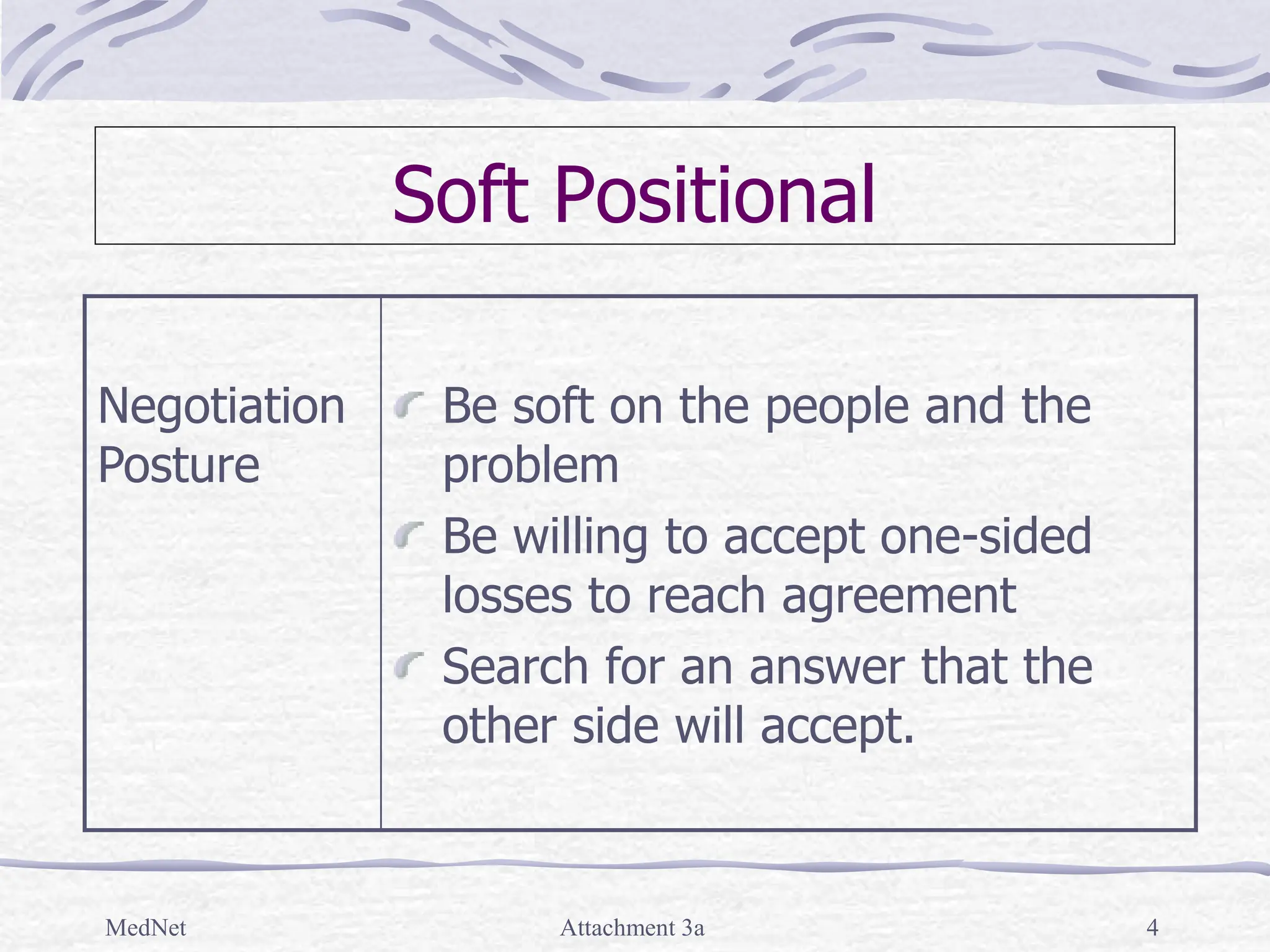
Soft Positional
Negotiation
Posture
Be soft on the people and the
problem
Be willing to accept one-sided
losses to reach agreement
Search for an answer that the
other side will accept.
MedNet Attachment 3a 5
Hard Positional
How the Other
Side is
Regarded
Adversaries
Goal Victory = Defeat of the Other
Party
MedNet Attachment 3a 6
Hard Positional
Negotiation
Posture
Be hard on the problem and the
people:
Insist on own position
Apply pressures and make
threats
Search for the answer that YOU
will accept (without
consideration of the other
party)
MedNet Attachment 3a 7
Interest-based Negotiation
How the
Other Side is
Regarded
A co-stakeholder
A co-problem solver
Goal A wise outcome reached
efficiently and amicably.
MedNet Attachment 3a 8
Key Principles & Elements of
Interest-Based Negotiation
• Make a sound diagnosis of the conflict: Identify
People Problem(s) and Substantive Problem(s).
• Focus on interests, rather than on positions.
• Invent Options for Mutual Gains.
• Use Objective Criteria in choosing the best option.
• Develop your BATNA, and know & prepare for
their BATNA.
MedNet Attachment 3a 9
1. Make a SOUND DIAGNOSIS of
the CONFLICT
• Identify the different parties/stakeholders to the conflict;
• Define the different sources of the conflict.
• Identify people problem(s) and substantive problem(s)
> People problem refers to problems related to:
perceptions, emotions & communications.
> Substantive problem refers to issues which the parties
want to resolve through negotiation.
> Identifying people problem(s) and substantive
problem(s) is a way of diagnosing conflicts.
MedNet Attachment 3a 10
1. Make a SOUND DIAGNOSIS of
the CONFLICT
• Analyze the power relations of the parties.
• Assess the present state of the conflict,
and if the parties are equally motivated
and ready to confront and resolve it; and
• Assess if the present structure encourages
a side-by-side process of solving the
problem.
MedNet Attachment 3a 11
Importance of sound diagnosis
of conflict
• Recognizing and acknowledging people problems
helps establish a positive negotiation climate.
This leads to a more focused discussion of
substantive problems.
• Helps in identifying the most appropriate
response to the conflict.
• Helps in the formulation of a more
comprehensive solution to the dispute.
• Facilitates the smoother resolution/ management
of conflicts.
MedNet Attachment 3a 12
2. Focus on INTERESTS, rather than
on POSITIONS
• Positions are one’s
proposed actions or
solutions to the problem.
• Interests are the
reasons behind
one’s positions.
MedNet Attachment 3a 13
Exercise: Identify INTERESTS and
POSITIONS, and assess the need to
focus on interests rather than on
positions.
We cannot
ban commercial
fishing in the municipal
waters because they
help us raise our
municipal revenues
Vice-Mayor
You have to ban
commercial fishing in
the municipal waters
because they affect our
fish catch and destroy
our coral reefs.
Small Fishers’
Association
MedNet Attachment 3a 14
Why Focus on INTERESTS, rather than on
POSITIONS, and How?
• If interests are common or compatible,
the potentials of negotiation can be
exhausted.
• In finding and addressing common or
compatible interests, we make the
negotiation a side-by-side problem
solving process.
• Discover, communicate and analyse
interests. Ask why or why not.
MedNet Attachment 3a 15
3. Invent Options for Mutual Gains
• Options are our alternative
proposals if the positions
are in total conflict
• Options seek to satisfy
common or compatible
interests.
• Done in a brainstorming
manner. No outright
rejection of proposals.
Options 1, 2,
3, 4, 5
MedNet Attachment 3a 16
Importance of Inventing Options for
Mutual Gains
• Allows the negotiators to creatively think of
other possible actions or solutions to their
problems.
• Enables the negotiators to find elegant
solutions to the problem.
• Is a way of finding mutually acceptable and
gainful solutions in an efficient manner.
MedNet Attachment 3a 17
4. Use Objective Criteria in Choosing
the Best Option
• Objective criteria refers to
the negotiators’ standard
for selecting best option.
• Possible basis: cost
effectiveness, market,
efficiency, experts’
advise, tradition, etc.
• Laws
• EIA, ECCs
• Scientific
Studies
MedNet Attachment 3a 18
Importance of the Use of
Objective Criteria
• Leads the negotiators to make decisions based
on merits and not on pressures.
• Nobody feels taken because the decision is based
on a mutually acceptable standard for best
option.
• Gives the negotiators a common framework for
evaluating the generated options.
MedNet Attachment 3a 19
5. Develop your BATNA, and Know
and Prepare for their BATNA
• BATNA means Best
Alternative to a
Negotiated Agreement
• It refers to alternative
course(s) of action if
the negotiation fails.
I would rather do
my BATNA than
give in
MedNet Attachment 3a 20
Three Types of BATNA
1. Walk-away alternative: When one chooses to
resolve a problem without the other party’s
involvement.
2. Interactive alternative: When one party exerts
pressure on the other party/ies for the
recognition of their value in the resolution of
the conflict. (i.e. boycott, strike, rally, etc.)
3. Third Party alternative: When one seeks for the
intervention of a third party to resolve the
conflict (i.e. court, mediator, arbitrator)
MedNet Attachment 3a 21
The Values of BATNA
• Addresses power imbalance;
• Can change the rules of the game from hard
negotiation to interest-based negotiation
• Brings the hard negotiators to their senses.
• Shows the consequences of a no agreement

Effective Negotiation in conflict resolution

  • 1.
    MedNet Attachment 3a1 Definition of Negotiation Negotiation is a dispute resolution approach where two or more parties, who have disagreeing positions, values, and interests, and competing needs and goals, attempt to jointly search for mutually acceptable solutions to their common problems.
  • 2.
    MedNet Attachment 3a2 Positional Bargaining Approach Positional bargaining revolves around POSITIONS (i.e. demands and proposals), whereas interest-based negotiation revolves around the REASONS (i.e. interests) behind the positions. Two Types: Hard Positional Bargaining; and Soft Positional Bargaining.
  • 3.
    MedNet Attachment 3a3 Soft Positional How the Other Side is Regarded Friends or important people to be pleased Goal of Negotiation Any agreement that will not adversely affect relationship with the other party.
  • 4.
    MedNet Attachment 3a4 Soft Positional Negotiation Posture Be soft on the people and the problem Be willing to accept one-sided losses to reach agreement Search for an answer that the other side will accept.
  • 5.
    MedNet Attachment 3a5 Hard Positional How the Other Side is Regarded Adversaries Goal Victory = Defeat of the Other Party
  • 6.
    MedNet Attachment 3a6 Hard Positional Negotiation Posture Be hard on the problem and the people: Insist on own position Apply pressures and make threats Search for the answer that YOU will accept (without consideration of the other party)
  • 7.
    MedNet Attachment 3a7 Interest-based Negotiation How the Other Side is Regarded A co-stakeholder A co-problem solver Goal A wise outcome reached efficiently and amicably.
  • 8.
    MedNet Attachment 3a8 Key Principles & Elements of Interest-Based Negotiation • Make a sound diagnosis of the conflict: Identify People Problem(s) and Substantive Problem(s). • Focus on interests, rather than on positions. • Invent Options for Mutual Gains. • Use Objective Criteria in choosing the best option. • Develop your BATNA, and know & prepare for their BATNA.
  • 9.
    MedNet Attachment 3a9 1. Make a SOUND DIAGNOSIS of the CONFLICT • Identify the different parties/stakeholders to the conflict; • Define the different sources of the conflict. • Identify people problem(s) and substantive problem(s) > People problem refers to problems related to: perceptions, emotions & communications. > Substantive problem refers to issues which the parties want to resolve through negotiation. > Identifying people problem(s) and substantive problem(s) is a way of diagnosing conflicts.
  • 10.
    MedNet Attachment 3a10 1. Make a SOUND DIAGNOSIS of the CONFLICT • Analyze the power relations of the parties. • Assess the present state of the conflict, and if the parties are equally motivated and ready to confront and resolve it; and • Assess if the present structure encourages a side-by-side process of solving the problem.
  • 11.
    MedNet Attachment 3a11 Importance of sound diagnosis of conflict • Recognizing and acknowledging people problems helps establish a positive negotiation climate. This leads to a more focused discussion of substantive problems. • Helps in identifying the most appropriate response to the conflict. • Helps in the formulation of a more comprehensive solution to the dispute. • Facilitates the smoother resolution/ management of conflicts.
  • 12.
    MedNet Attachment 3a12 2. Focus on INTERESTS, rather than on POSITIONS • Positions are one’s proposed actions or solutions to the problem. • Interests are the reasons behind one’s positions.
  • 13.
    MedNet Attachment 3a13 Exercise: Identify INTERESTS and POSITIONS, and assess the need to focus on interests rather than on positions. We cannot ban commercial fishing in the municipal waters because they help us raise our municipal revenues Vice-Mayor You have to ban commercial fishing in the municipal waters because they affect our fish catch and destroy our coral reefs. Small Fishers’ Association
  • 14.
    MedNet Attachment 3a14 Why Focus on INTERESTS, rather than on POSITIONS, and How? • If interests are common or compatible, the potentials of negotiation can be exhausted. • In finding and addressing common or compatible interests, we make the negotiation a side-by-side problem solving process. • Discover, communicate and analyse interests. Ask why or why not.
  • 15.
    MedNet Attachment 3a15 3. Invent Options for Mutual Gains • Options are our alternative proposals if the positions are in total conflict • Options seek to satisfy common or compatible interests. • Done in a brainstorming manner. No outright rejection of proposals. Options 1, 2, 3, 4, 5
  • 16.
    MedNet Attachment 3a16 Importance of Inventing Options for Mutual Gains • Allows the negotiators to creatively think of other possible actions or solutions to their problems. • Enables the negotiators to find elegant solutions to the problem. • Is a way of finding mutually acceptable and gainful solutions in an efficient manner.
  • 17.
    MedNet Attachment 3a17 4. Use Objective Criteria in Choosing the Best Option • Objective criteria refers to the negotiators’ standard for selecting best option. • Possible basis: cost effectiveness, market, efficiency, experts’ advise, tradition, etc. • Laws • EIA, ECCs • Scientific Studies
  • 18.
    MedNet Attachment 3a18 Importance of the Use of Objective Criteria • Leads the negotiators to make decisions based on merits and not on pressures. • Nobody feels taken because the decision is based on a mutually acceptable standard for best option. • Gives the negotiators a common framework for evaluating the generated options.
  • 19.
    MedNet Attachment 3a19 5. Develop your BATNA, and Know and Prepare for their BATNA • BATNA means Best Alternative to a Negotiated Agreement • It refers to alternative course(s) of action if the negotiation fails. I would rather do my BATNA than give in
  • 20.
    MedNet Attachment 3a20 Three Types of BATNA 1. Walk-away alternative: When one chooses to resolve a problem without the other party’s involvement. 2. Interactive alternative: When one party exerts pressure on the other party/ies for the recognition of their value in the resolution of the conflict. (i.e. boycott, strike, rally, etc.) 3. Third Party alternative: When one seeks for the intervention of a third party to resolve the conflict (i.e. court, mediator, arbitrator)
  • 21.
    MedNet Attachment 3a21 The Values of BATNA • Addresses power imbalance; • Can change the rules of the game from hard negotiation to interest-based negotiation • Brings the hard negotiators to their senses. • Shows the consequences of a no agreement