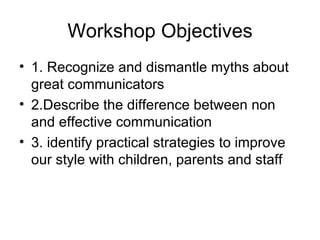
Workshop Objectives 1. Recognize and dismantle myths about great communicators 2.Describe the difference between non and effective communication 3. identify practical strategies to improve our style with children, parents and staff
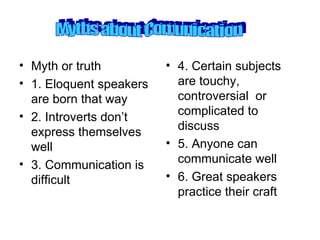
Myth or truth 1. Eloquent speakers are born that way 2. Introverts don’t express themselves well 3. Communication is difficult  4. Certain subjects are touchy, controversial  or complicated to discuss 5. Anyone can communicate well 6. Great speakers practice their craft Myths about Comunication
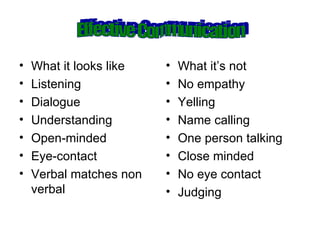
What it looks like Listening Dialogue Understanding Open-minded Eye-contact Verbal matches non verbal What it’s not No empathy Yelling Name calling One person talking Close minded No eye contact Judging Effective Communication
Eye contact ( and close proximity) Simple (and age app. lang) Check ( for understanding) Help ( follow thru and praise for efforts) Be (vulnerable and apologize if needed) Speak( pleasantly and be firm with positive guidance) Build and Demonstrate (build self esteem and model expectation) Starategies withChildren
Give ( or clarify information) Provide ( guidance and direction) Respectfully ( support and share teamwork) Be ( able to accept constructive criticism) Collaborate and mentor (work together and reinforce leadership values) Strategies with Staff
Don’t show (favoritisms) Exhibit (confidentiality) Extra time ( be caring and patience with personal issues) Few consequences ( treat everyone the same) Management
Honest yet encouraging (feedback) Offer suggestions (when asked) Ask questions (for clarity don’t assume) Respect (their values) Explain ( ECE jargon don’t be defensive) Show ( gratitiude and appreciation) Dialogue and Empower (talk/listen and build up) Strategies with Parents
What Would You Do? If a child does not do what you ask repeatedly You hear a teacher tell another co-worker that you are lazy and don’t do anything unless the director is around A parent tells you that they feel their child is not learning in your class and that’s why he is misbehaving A parent is constantly sticking their hands in the snack to get their child something to eat Wrap Up?

Effective communication workshop

  • 1.
    Workshop Objectives 1.Recognize and dismantle myths about great communicators 2.Describe the difference between non and effective communication 3. identify practical strategies to improve our style with children, parents and staff
  • 2.
    Myth or truth1. Eloquent speakers are born that way 2. Introverts don’t express themselves well 3. Communication is difficult 4. Certain subjects are touchy, controversial or complicated to discuss 5. Anyone can communicate well 6. Great speakers practice their craft Myths about Comunication
  • 3.
    What it lookslike Listening Dialogue Understanding Open-minded Eye-contact Verbal matches non verbal What it’s not No empathy Yelling Name calling One person talking Close minded No eye contact Judging Effective Communication
  • 4.
    Eye contact (and close proximity) Simple (and age app. lang) Check ( for understanding) Help ( follow thru and praise for efforts) Be (vulnerable and apologize if needed) Speak( pleasantly and be firm with positive guidance) Build and Demonstrate (build self esteem and model expectation) Starategies withChildren
  • 5.
    Give ( orclarify information) Provide ( guidance and direction) Respectfully ( support and share teamwork) Be ( able to accept constructive criticism) Collaborate and mentor (work together and reinforce leadership values) Strategies with Staff
  • 6.
    Don’t show (favoritisms)Exhibit (confidentiality) Extra time ( be caring and patience with personal issues) Few consequences ( treat everyone the same) Management
  • 7.
    Honest yet encouraging(feedback) Offer suggestions (when asked) Ask questions (for clarity don’t assume) Respect (their values) Explain ( ECE jargon don’t be defensive) Show ( gratitiude and appreciation) Dialogue and Empower (talk/listen and build up) Strategies with Parents
  • 8.
    What Would YouDo? If a child does not do what you ask repeatedly You hear a teacher tell another co-worker that you are lazy and don’t do anything unless the director is around A parent tells you that they feel their child is not learning in your class and that’s why he is misbehaving A parent is constantly sticking their hands in the snack to get their child something to eat Wrap Up?