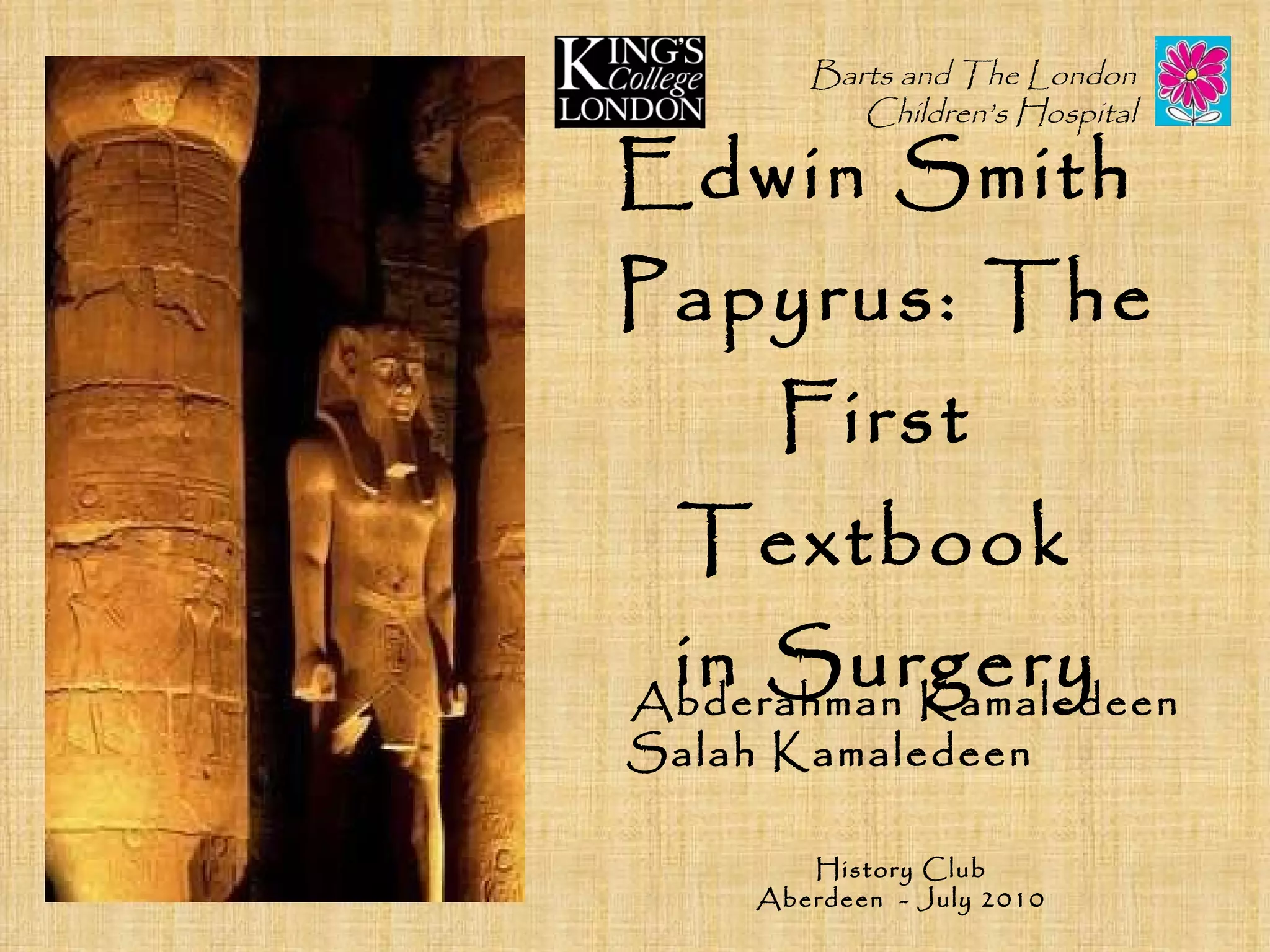

Edwin Smith  Papyrus: The First  Textbook  in Surgery Abderahman Kamaledeen   Salah Kamaledeen  Barts and The London Children’s Hospital History Club Aberdeen  - July 2010
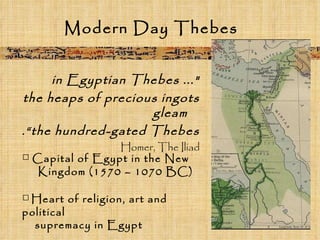
Modern Day Thebes "... in Egyptian Thebes  the heaps of precious ingots gleam  the hundred-gated Thebes”.   Homer, The Iliad   □  Capital of Egypt in the New Kingdom (1570 – 1070 BC) □   Heart of religion, art and political  supremacy in Egypt
Luxor
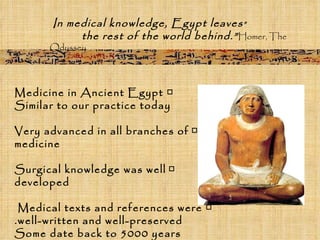
□  Medicine in Ancient Egypt Similar to our practice today □   Very advanced in all branches of medicine □   Surgical knowledge was well developed □  Medical texts and references were  well-written and well-preserved. Some date back to 5000 years “ In medical knowledge, Egypt leaves  the rest of the world behind.”  Homer,   The Odyssey
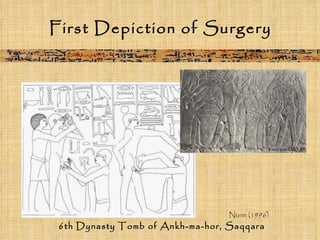
First Depiction of Surgery 6th Dynasty Tomb of Ankh-ma-hor, Saqqara Nunn (1996)
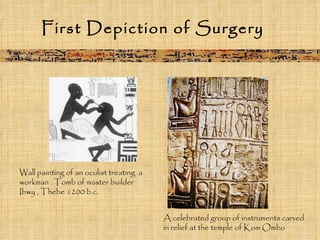
First Depiction of Surgery A celebrated group of instruments carved in relief at the temple of Kom Ombo Wall painting of an oculist treating  a workman . Tomb of master builder Ibwy , Thebe 1200 b.c.
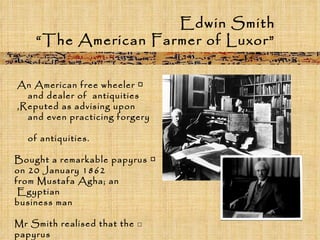
Edwin Smith “ The American Farmer of Luxor” □  An American free wheeler  and dealer of  antiquities  Reputed as advising upon,  and even practicing forgery  of antiquities. □  Bought a remarkable papyrus on 20 January 1862 from Mustafa Agha; an Egyptian  business man □   Mr Smith realised that the papyrus is a unique ancient Egyptian medical treatise.
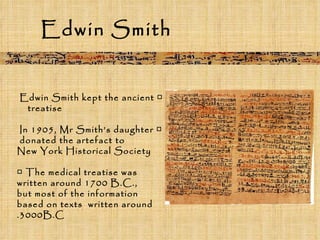
Edwin Smith □  Edwin Smith kept the ancient  treatise  □  In 1905, Mr Smith’s daughter  donated the artefact to  New York Historical Society □  The medical treatise was written around 1700 B.C.,  but most of the information based on texts  written around 3000B.C.
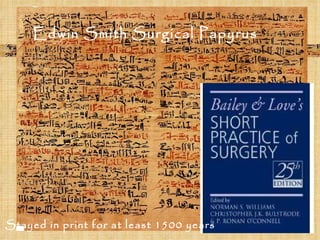
Edwin Smith Surgical Papyrus Stayed in print for at least 1500 years
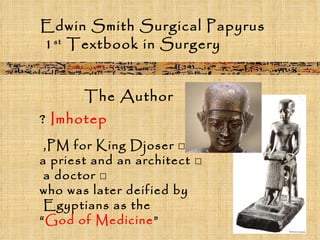
Imhotep  ? □  PM for King Djoser,  □   a priest and an architect  □   a doctor  who was later deified by Egyptians as the  “ God of Medicine ” The Author Edwin Smith Surgical Papyrus 1 st  Textbook in Surgery
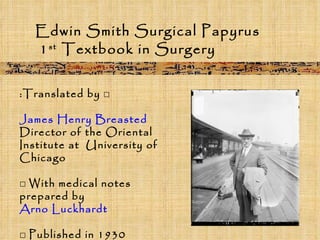
Edwin Smith Surgical Papyrus 1 st  Textbook in Surgery □  Translated by: James Henry Breasted Director of the Oriental Institute at  University of Chicago □  With medical notes prepared by Arno Luckhardt □  Published in 1930
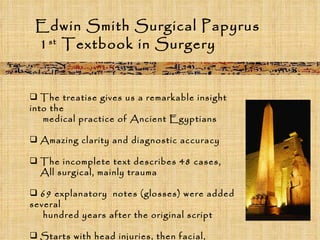
Edwin Smith Surgical Papyrus 1 st  Textbook in Surgery The treatise gives us a remarkable insight  into the  medical practice of Ancient Egyptians  Amazing clarity and diagnostic accuracy The incomplete text describes 48 cases,  All surgical, mainly trauma 69 explanatory  notes (glosses) were added several  hundred years after the original script Starts with head injuries, then facial, cervical, thoracic, upper limb and spinal injuries
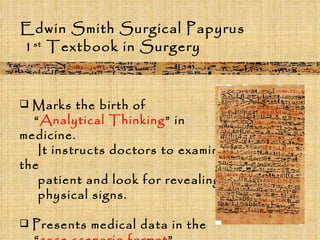
Marks the birth of  “ Analytical Thinking ” in medicine.  It instructs doctors to examine the patient and look for revealing  physical signs. Presents medical data in the  “ case scenario format ” Edwin Smith Surgical Papyrus 1 st  Textbook in Surgery
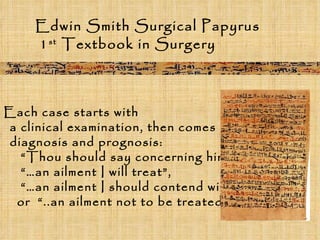
Edwin Smith Surgical Papyrus 1 st  Textbook in Surgery Each case starts with  a clinical examination, then comes  diagnosis and prognosis:  “ Thou should say concerning him…  “… an ailment I will treat”,  “… an ailment I should contend with”  or  “..an ailment not to be treated”
Case 2 Title :  Instructions concerning a [gaping] wound  [in his head], penetrating to the bone. Examination :  If thou examinest a man having a [gaping] wound [in] his [head], penetrating to the bone,  thou shouldst pal[pate hi]s [wound].  If thou findest his skull [uninjured, not hav]ing a perforation in it... Instructions concerning a [gaping] wound  [in his head],  penetrating to the bone.
Case 2 Diagnosis :  Thou shouldst say regarding [him]: "One hav[ing a gaping wou]nd in his head.  An ailment which I will treat.“ Treatment :  [Thou] shouldst bind [fresh meat upon it the first day; thou shouldst apply for him two strips of linen, and treat afterward with grease, honey, (and) lin]t every day until he recovers. Gloss : As for: "Two strips of linen," [it means] two bands [of linen which one applies upon the two lips of the gaping wound in order to cause that one join] to the other.
Case 4 Instructions concerning a gaping wound in his head penetrating to the bone and splitting his skull  Examination :  If thou examinest a man having a gaping wound in his head, penetrating to the bone, thou shouldst palpate his wound. .., he discharges blood from both his nostrils (and) from both his ears, he suffers with stiffness in his neck, so that he is unable to look at his two shoulders and his breast...
Diagnosis :  Thou shouldst say regarding him: “ One having a gaping wound in his head, penetrating to the bone, (and) splitting his skull; while he discharges blood from both his nostrils (and) from both his ears, (and) he suffers with stiffness in his neck.  An ailment with which I will contend.” Case 4
Treatment :  Now when thou findest that the skull of that man is split, thou shouldst not bind him, (but) moor (him) until the period of his injury passes by.  His treatment is sitting. Make for him two supports of brick, until thou knowest he has reached a decisive point. Thou shouldst do likewise for every man whom thou findest having a split skull... Gloss : As for "(Until) thou knowest he has reached a decisive point," it means (until thou knowest whether he will die or he will live; for he is (a case of) "an ailment with which I will contend.” Case 4
Case  33 Instructions concerning a crushed vertebra in his neck Examination :  If thou examinest a man having a crushed vertebra in his neck (and) thou findest that one vertebra has fallen into the next one, while he is voiceless and cannot speak;  his falling head downward has caused that one verte bra crush into the next one;  (and) shouldst thou find that he is unconscious of his two arms and his two legs because of it...
Case  33 Diagnosis :  Thou shouldst say concerning him: "One having a crushed vertebra in his neck;  he is unconscious of his two arms (and) his two legs, (and) he is speechless.  An ailment not to be treated.“…
Case  35 Instructions concerning  a break in his collar-bone Examination :  If thou examinest a man having a break in his collar-bone (and) thou shouldst find his collar-bone short and separated from its fellow. Diagnosis :  Thou shouldst say concerning him: "One having a break in his collar-bone. An ailment which I will treat."
Treatment :  Thou shouldst place him prostrate on back, with something folded between his two shoulder-blades; thou shouldst spread out with his two shoulders in order to stretch apart his collar-bone until that break falls into its place. Thou shouldst make for him two splints of linen, (and) thou shouldst apply one of them both on the inside of his upper arm. Thou shouldst bind it with ymrw, (and) treat it afterward with honey every day, until he recovers. Case  35
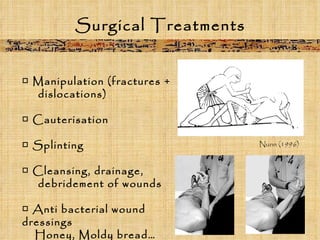
Surgical Treatments □  Manipulation (fractures +  dislocations) □  Cauterisation □  Splinting □  Cleansing, drainage,  debridement of wounds □  Anti bacterial wound dressings  Honey, Moldy bread… Nunn (1996)
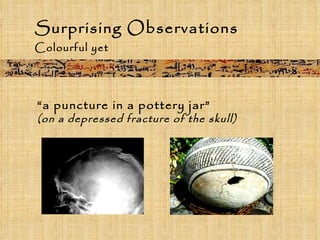
Surprising Observations   Colourful yet accurate “ a puncture in a pottery jar”  (on a depressed fracture of the skull)
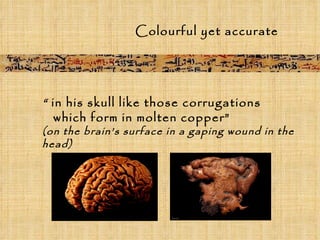
Colourful yet accurate “  in his skull like those corrugations  which form in molten copper”   (on the brain’s surface in a gaping wound in the head)
□   1 st  written evidence of scientific reasoning (observation to conclusion) □  1 st  description of brain, meninges  and CSF □   1 st  evidence of systematic triage  (ailment to treat /not to treat) □   1 st  use of splints and bandages □   1 st  to note effects on lower limb from head trauma First Prize   In  a number of things!
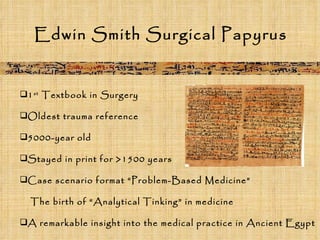
Edwin Smith Surgical Papyrus  1 st  Textbook in Surgery Oldest trauma reference 5000-year old Stayed in print for >1500 years Case scenario format “Problem-Based Medicine” The birth of “Analytical Tinking” in medicine A remarkable insight into the medical practice in Ancient Egypt
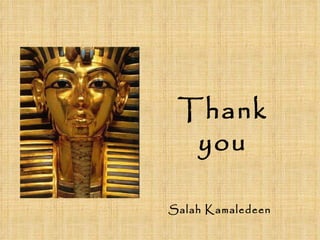
Thank you Salah Kamaledeen

Edwin smith papyrus 1st texbook in surgery 07

  • 1.
    Edwin Smith Papyrus: The First Textbook in Surgery Abderahman Kamaledeen Salah Kamaledeen Barts and The London Children’s Hospital History Club Aberdeen - July 2010
  • 2.
    Modern Day Thebes"... in Egyptian Thebes the heaps of precious ingots gleam the hundred-gated Thebes”. Homer, The Iliad □ Capital of Egypt in the New Kingdom (1570 – 1070 BC) □ Heart of religion, art and political supremacy in Egypt
  • 3.
  • 4.
    □ Medicinein Ancient Egypt Similar to our practice today □ Very advanced in all branches of medicine □ Surgical knowledge was well developed □ Medical texts and references were well-written and well-preserved. Some date back to 5000 years “ In medical knowledge, Egypt leaves the rest of the world behind.” Homer, The Odyssey
  • 5.
    First Depiction ofSurgery 6th Dynasty Tomb of Ankh-ma-hor, Saqqara Nunn (1996)
  • 6.
    First Depiction ofSurgery A celebrated group of instruments carved in relief at the temple of Kom Ombo Wall painting of an oculist treating a workman . Tomb of master builder Ibwy , Thebe 1200 b.c.
  • 7.
    Edwin Smith “The American Farmer of Luxor” □ An American free wheeler and dealer of antiquities Reputed as advising upon, and even practicing forgery of antiquities. □ Bought a remarkable papyrus on 20 January 1862 from Mustafa Agha; an Egyptian business man □ Mr Smith realised that the papyrus is a unique ancient Egyptian medical treatise.
  • 8.
    Edwin Smith □ Edwin Smith kept the ancient treatise □ In 1905, Mr Smith’s daughter donated the artefact to New York Historical Society □ The medical treatise was written around 1700 B.C., but most of the information based on texts written around 3000B.C.
  • 9.
    Edwin Smith SurgicalPapyrus Stayed in print for at least 1500 years
  • 10.
    Imhotep ?□ PM for King Djoser, □ a priest and an architect □ a doctor who was later deified by Egyptians as the “ God of Medicine ” The Author Edwin Smith Surgical Papyrus 1 st Textbook in Surgery
  • 11.
    Edwin Smith SurgicalPapyrus 1 st Textbook in Surgery □ Translated by: James Henry Breasted Director of the Oriental Institute at University of Chicago □ With medical notes prepared by Arno Luckhardt □ Published in 1930
  • 12.
    Edwin Smith SurgicalPapyrus 1 st Textbook in Surgery The treatise gives us a remarkable insight into the medical practice of Ancient Egyptians Amazing clarity and diagnostic accuracy The incomplete text describes 48 cases, All surgical, mainly trauma 69 explanatory notes (glosses) were added several hundred years after the original script Starts with head injuries, then facial, cervical, thoracic, upper limb and spinal injuries
  • 13.
    Marks the birthof “ Analytical Thinking ” in medicine. It instructs doctors to examine the patient and look for revealing physical signs. Presents medical data in the “ case scenario format ” Edwin Smith Surgical Papyrus 1 st Textbook in Surgery
  • 14.
    Edwin Smith SurgicalPapyrus 1 st Textbook in Surgery Each case starts with a clinical examination, then comes diagnosis and prognosis: “ Thou should say concerning him… “… an ailment I will treat”, “… an ailment I should contend with” or “..an ailment not to be treated”
  • 15.
    Case 2 Title: Instructions concerning a [gaping] wound [in his head], penetrating to the bone. Examination : If thou examinest a man having a [gaping] wound [in] his [head], penetrating to the bone, thou shouldst pal[pate hi]s [wound]. If thou findest his skull [uninjured, not hav]ing a perforation in it... Instructions concerning a [gaping] wound [in his head], penetrating to the bone.
  • 16.
    Case 2 Diagnosis: Thou shouldst say regarding [him]: "One hav[ing a gaping wou]nd in his head. An ailment which I will treat.“ Treatment : [Thou] shouldst bind [fresh meat upon it the first day; thou shouldst apply for him two strips of linen, and treat afterward with grease, honey, (and) lin]t every day until he recovers. Gloss : As for: "Two strips of linen," [it means] two bands [of linen which one applies upon the two lips of the gaping wound in order to cause that one join] to the other.
  • 17.
    Case 4 Instructionsconcerning a gaping wound in his head penetrating to the bone and splitting his skull Examination : If thou examinest a man having a gaping wound in his head, penetrating to the bone, thou shouldst palpate his wound. .., he discharges blood from both his nostrils (and) from both his ears, he suffers with stiffness in his neck, so that he is unable to look at his two shoulders and his breast...
  • 18.
    Diagnosis : Thou shouldst say regarding him: “ One having a gaping wound in his head, penetrating to the bone, (and) splitting his skull; while he discharges blood from both his nostrils (and) from both his ears, (and) he suffers with stiffness in his neck. An ailment with which I will contend.” Case 4
  • 19.
    Treatment : Now when thou findest that the skull of that man is split, thou shouldst not bind him, (but) moor (him) until the period of his injury passes by. His treatment is sitting. Make for him two supports of brick, until thou knowest he has reached a decisive point. Thou shouldst do likewise for every man whom thou findest having a split skull... Gloss : As for "(Until) thou knowest he has reached a decisive point," it means (until thou knowest whether he will die or he will live; for he is (a case of) "an ailment with which I will contend.” Case 4
  • 20.
    Case 33Instructions concerning a crushed vertebra in his neck Examination : If thou examinest a man having a crushed vertebra in his neck (and) thou findest that one vertebra has fallen into the next one, while he is voiceless and cannot speak; his falling head downward has caused that one verte bra crush into the next one; (and) shouldst thou find that he is unconscious of his two arms and his two legs because of it...
  • 21.
    Case 33Diagnosis : Thou shouldst say concerning him: "One having a crushed vertebra in his neck; he is unconscious of his two arms (and) his two legs, (and) he is speechless. An ailment not to be treated.“…
  • 22.
    Case 35Instructions concerning a break in his collar-bone Examination : If thou examinest a man having a break in his collar-bone (and) thou shouldst find his collar-bone short and separated from its fellow. Diagnosis : Thou shouldst say concerning him: "One having a break in his collar-bone. An ailment which I will treat."
  • 23.
    Treatment : Thou shouldst place him prostrate on back, with something folded between his two shoulder-blades; thou shouldst spread out with his two shoulders in order to stretch apart his collar-bone until that break falls into its place. Thou shouldst make for him two splints of linen, (and) thou shouldst apply one of them both on the inside of his upper arm. Thou shouldst bind it with ymrw, (and) treat it afterward with honey every day, until he recovers. Case 35
  • 24.
    Surgical Treatments □ Manipulation (fractures + dislocations) □ Cauterisation □ Splinting □ Cleansing, drainage, debridement of wounds □ Anti bacterial wound dressings Honey, Moldy bread… Nunn (1996)
  • 25.
    Surprising Observations Colourful yet accurate “ a puncture in a pottery jar” (on a depressed fracture of the skull)
  • 26.
    Colourful yet accurate“ in his skull like those corrugations which form in molten copper” (on the brain’s surface in a gaping wound in the head)
  • 27.
    1 st written evidence of scientific reasoning (observation to conclusion) □ 1 st description of brain, meninges and CSF □ 1 st evidence of systematic triage (ailment to treat /not to treat) □ 1 st use of splints and bandages □ 1 st to note effects on lower limb from head trauma First Prize In a number of things!
  • 28.
    Edwin Smith SurgicalPapyrus 1 st Textbook in Surgery Oldest trauma reference 5000-year old Stayed in print for >1500 years Case scenario format “Problem-Based Medicine” The birth of “Analytical Tinking” in medicine A remarkable insight into the medical practice in Ancient Egypt
  • 29.
    Thank you SalahKamaledeen