Governance and cyberinfrastructure
in the Earth system sciences
Paul N. Edwards
School of Information and Dept. of History, University of Michigan
EarthCube goal
“…to design, build, and maintain an easy-to-use
system based on existing resources that embraces
open-source culture and methods to align
technology development with scientific needs.”
Richard et al. “Community‐developed Geoscience Cyberinfrastructure.” Eos 95, no. 20 (2014):
165-166
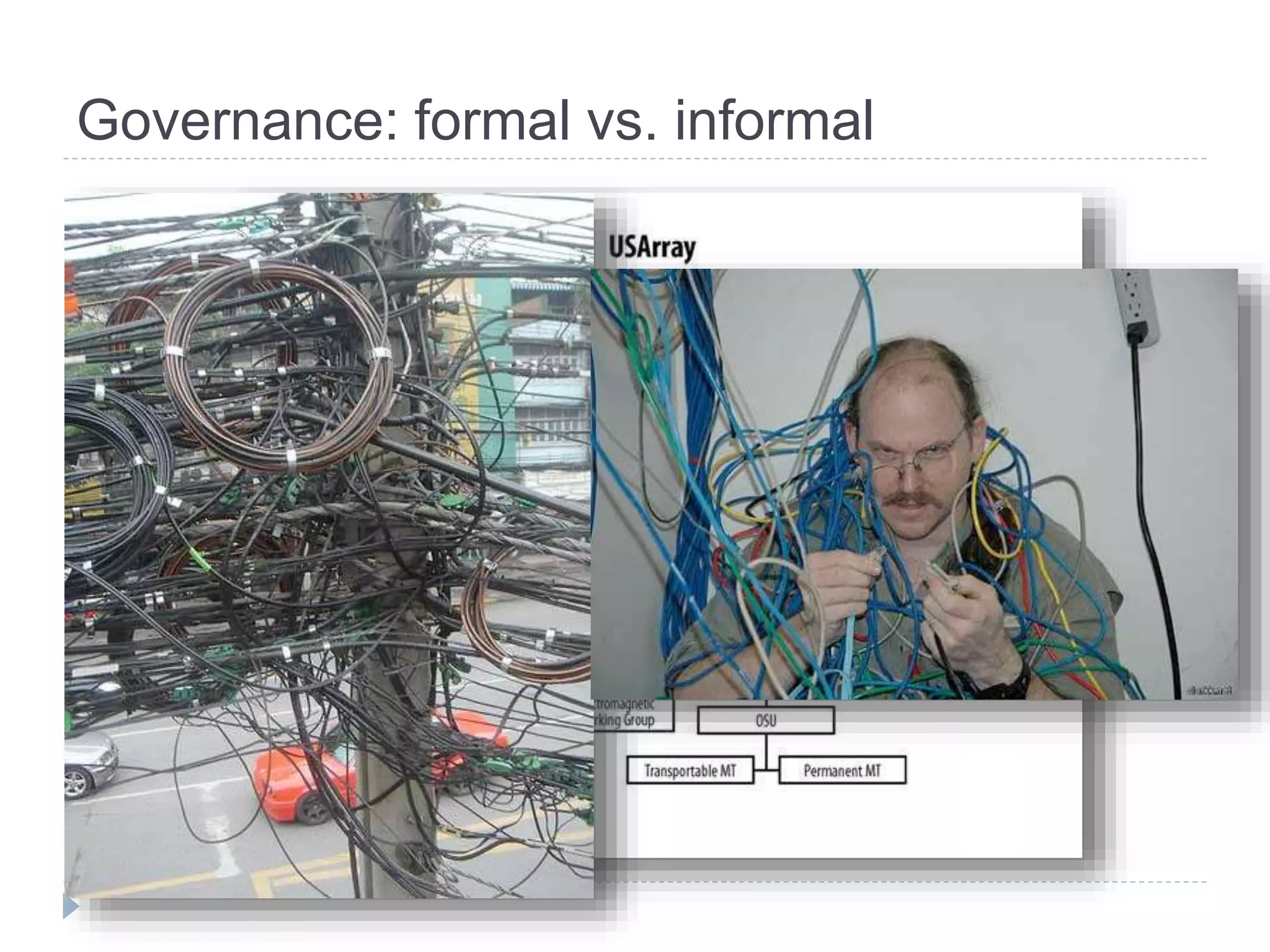
Governance: formal vs. informal
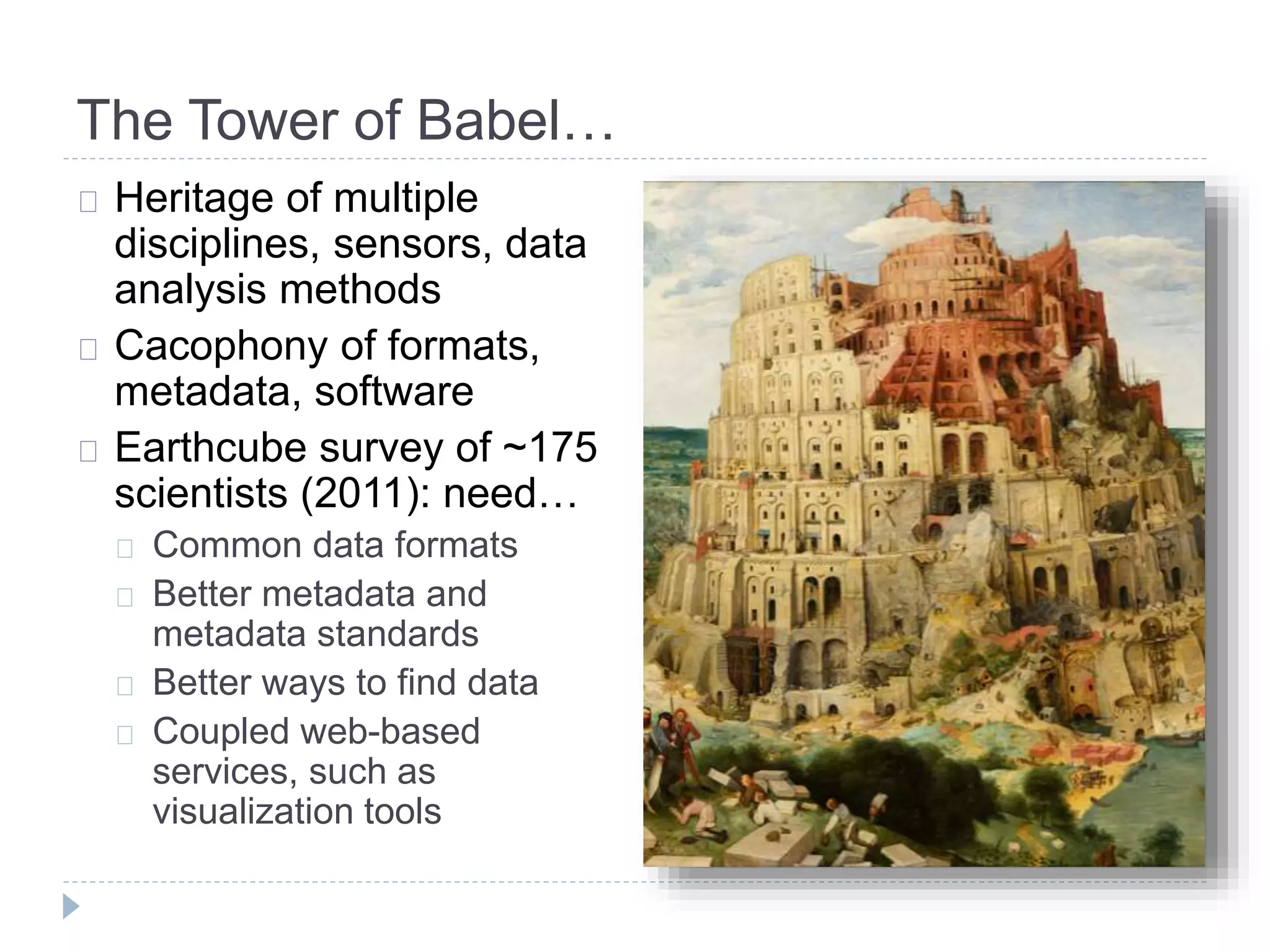
The Tower of Babel…
Heritage of multiple
disciplines, sensors, data
analysis methods
Cacophony of formats,
metadata, software
Earthcube survey of ~175
scientists (2011): need…
Common data formats
Better metadata and
metadata standards
Better ways to find data
Coupled web-based
services, such as
visualization tools
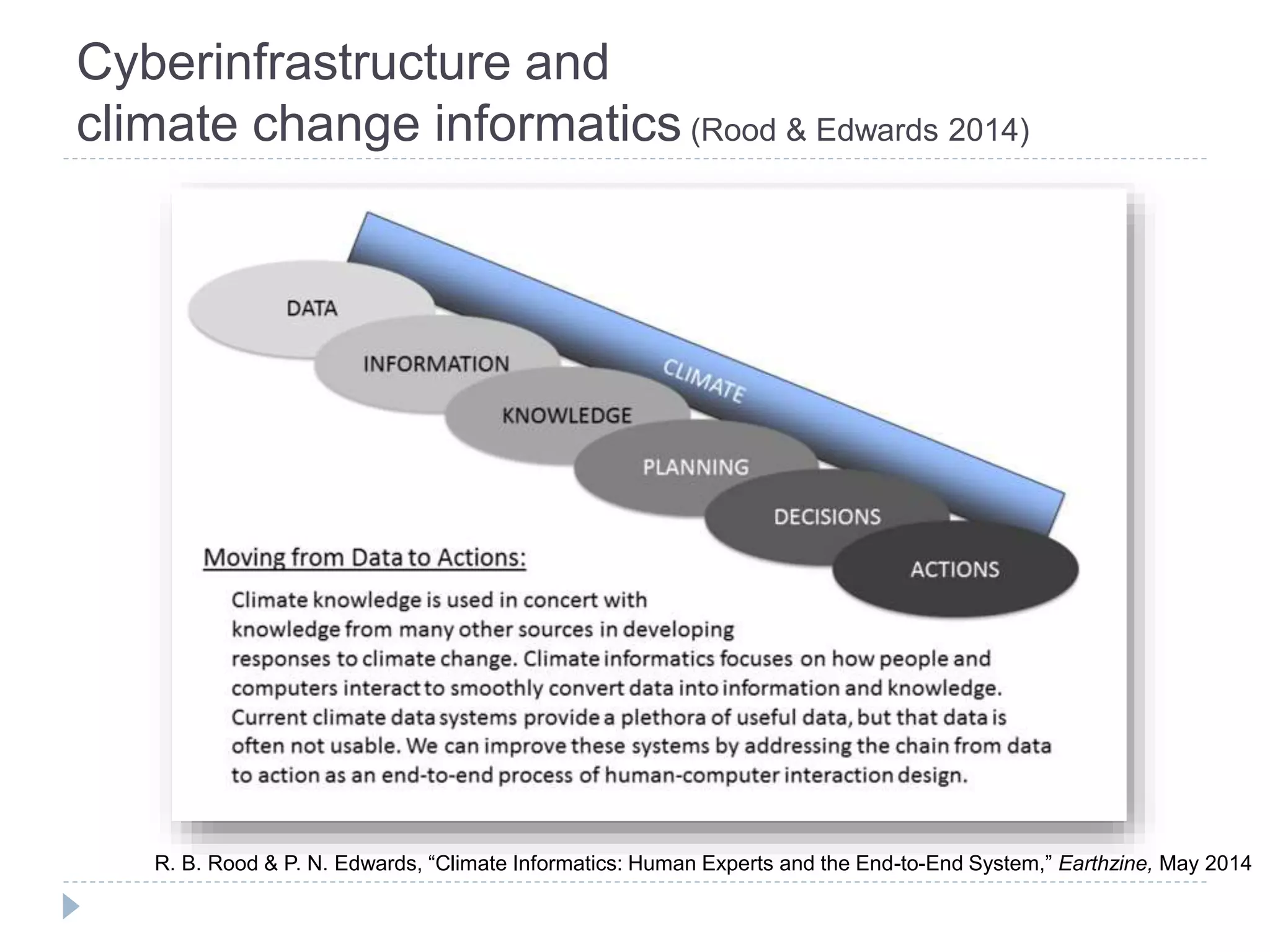
Cyberinfrastructure and
climate change informatics (Rood & Edwards 2014)
R. B. Rood & P. N. Edwards, “Climate Informatics: Human Experts and the End-to-End System,” Earthzine, May 2014
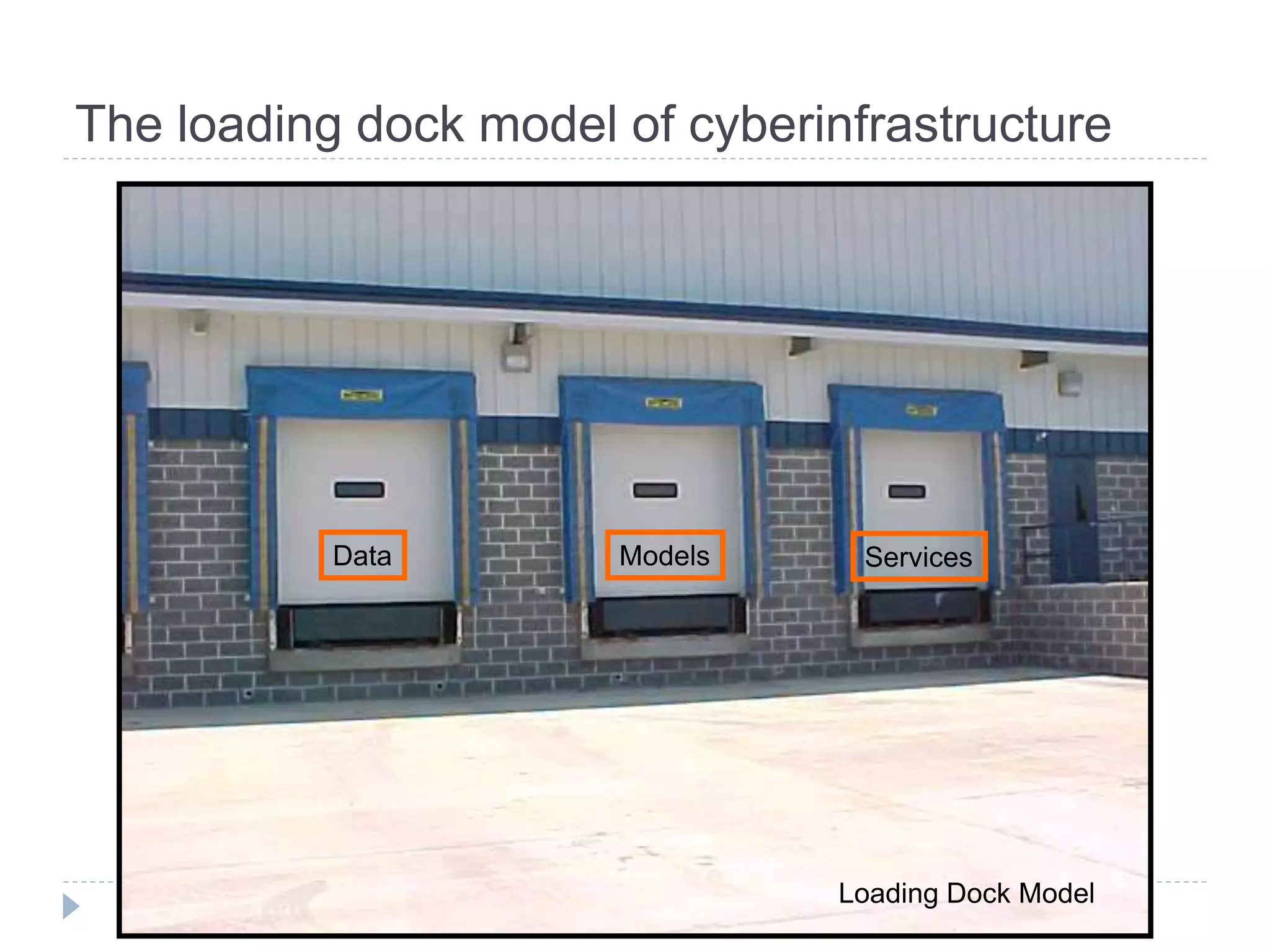
The loading dock model of cyberinfrastructure
Data Models Services
Loading Dock Model
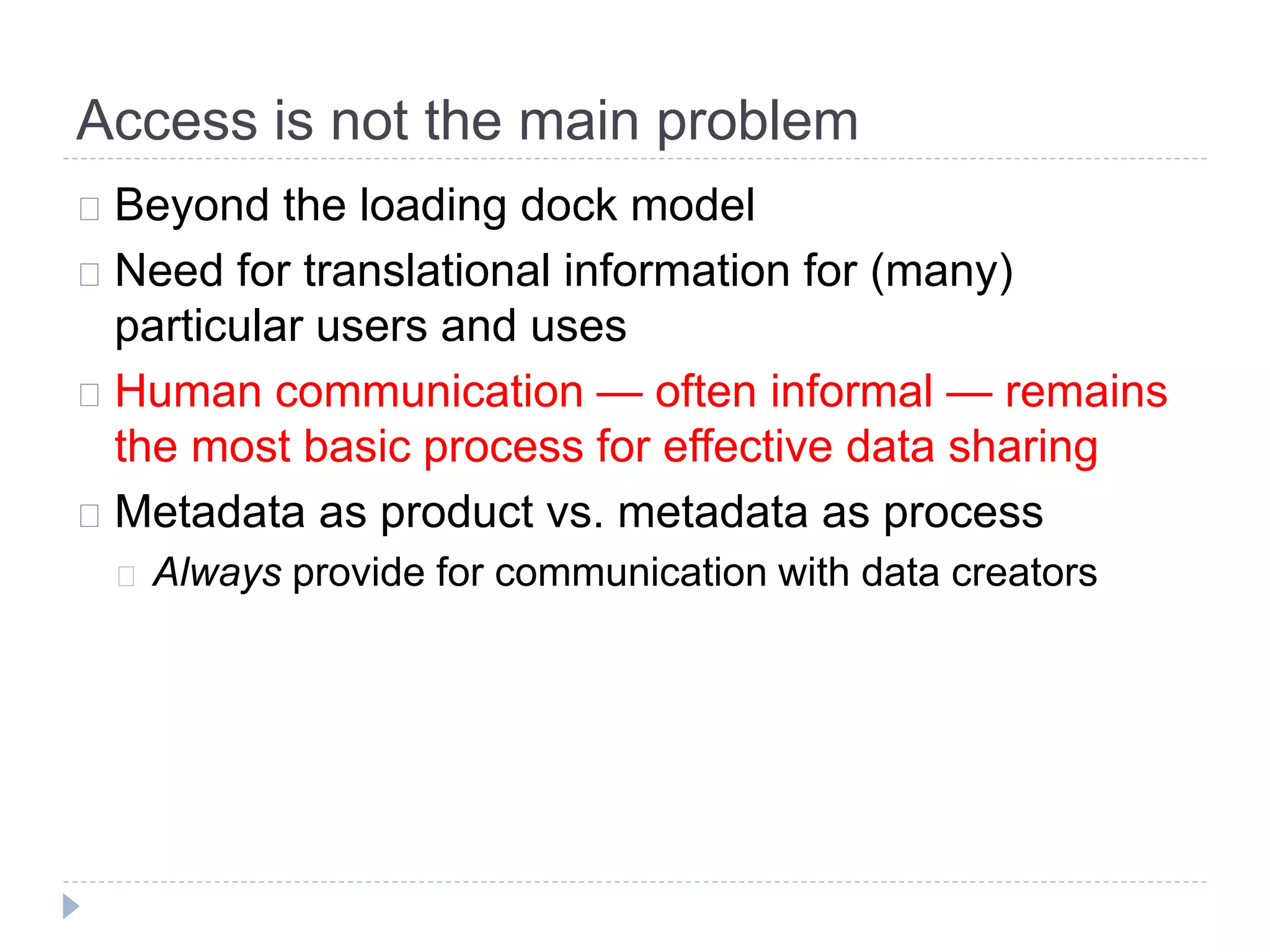
Access is not the main problem
Beyond the loading dock model
Need for translational information for (many)
particular users and uses
Human communication — often informal — remains
the most basic process for effective data sharing
Metadata as product vs. metadata as process
Always provide for communication with data creators
This morning
A little history of infrastructure
… and of governance in meteorology
What is governance?
Governance and software in Earth system science
This morning
A little history of infrastructure
… and of governance in meteorology
What is governance?
Governance and software in Earth system science
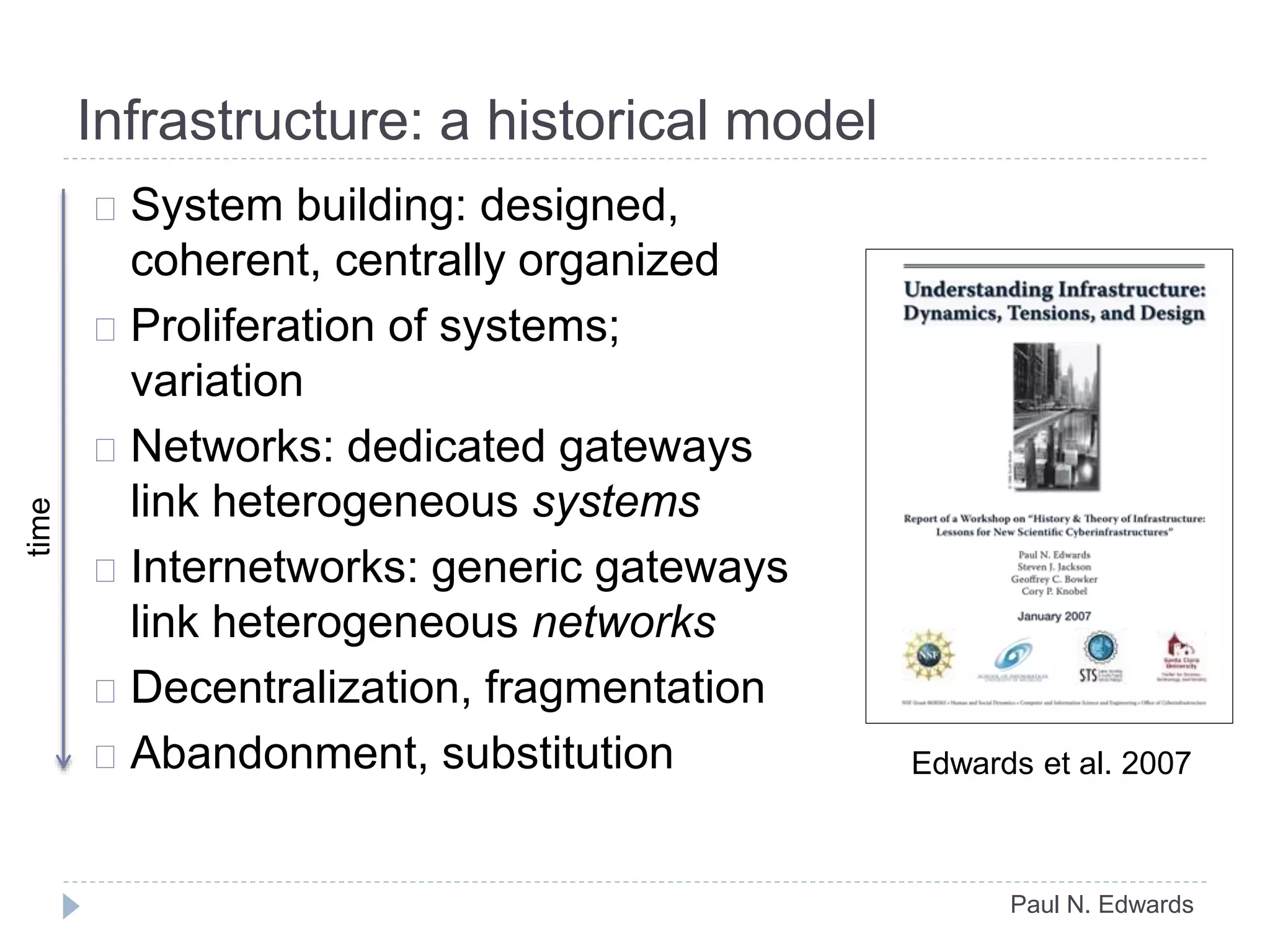
Infrastructure: a historical model
Paul N. Edwards
System building: designed,
coherent, centrally organized
Proliferation of systems;
variation
Networks: dedicated gateways
link heterogeneous systems
Internetworks: generic gateways
link heterogeneous networks
Decentralization, fragmentation
Abandonment, substitution
time
Edwards et al. 2007
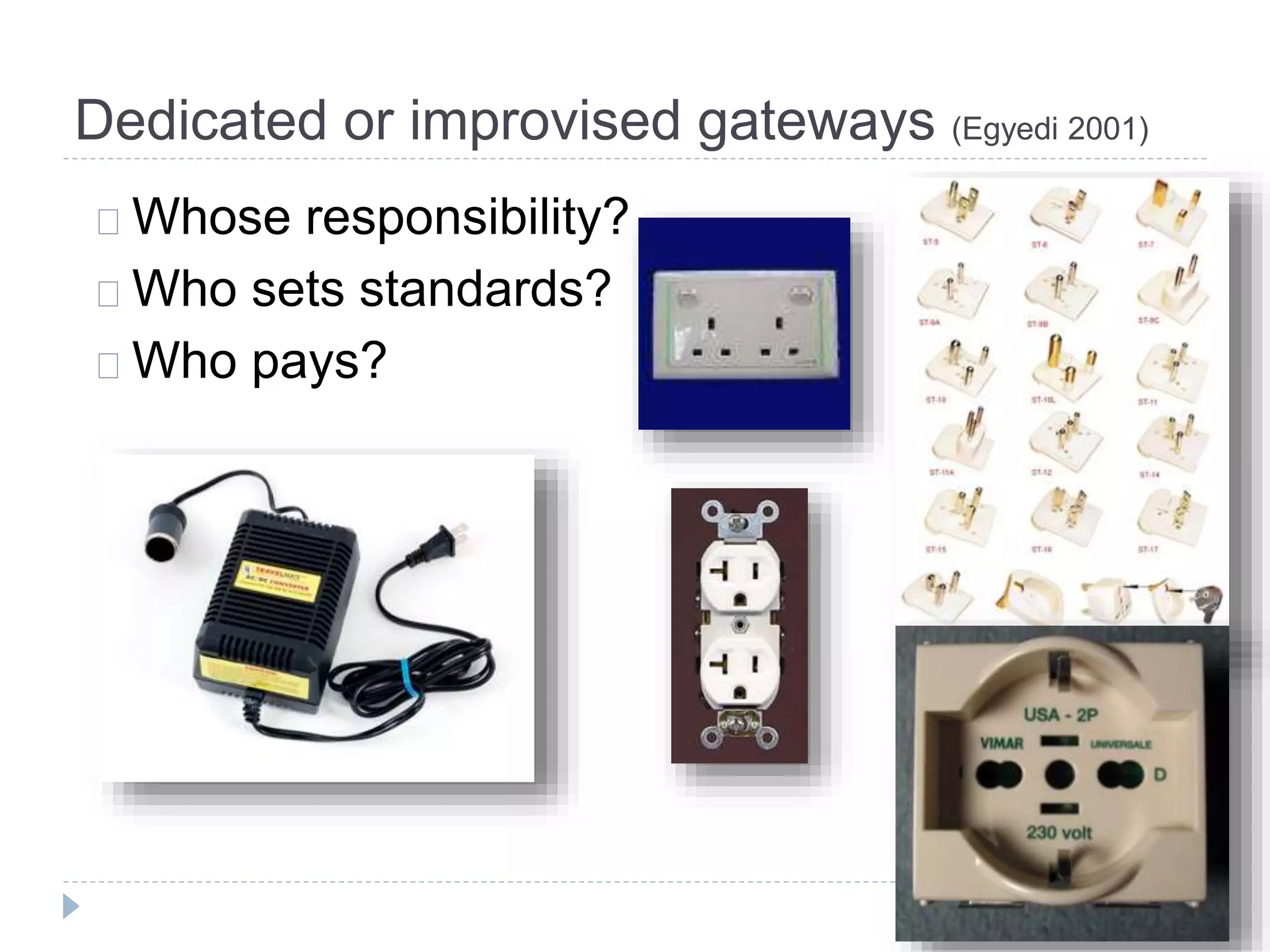
Dedicated or improvised gateways (Egyedi 2001)
Paul N. Edwards
Whose responsibility?
Who sets standards?
Who pays?
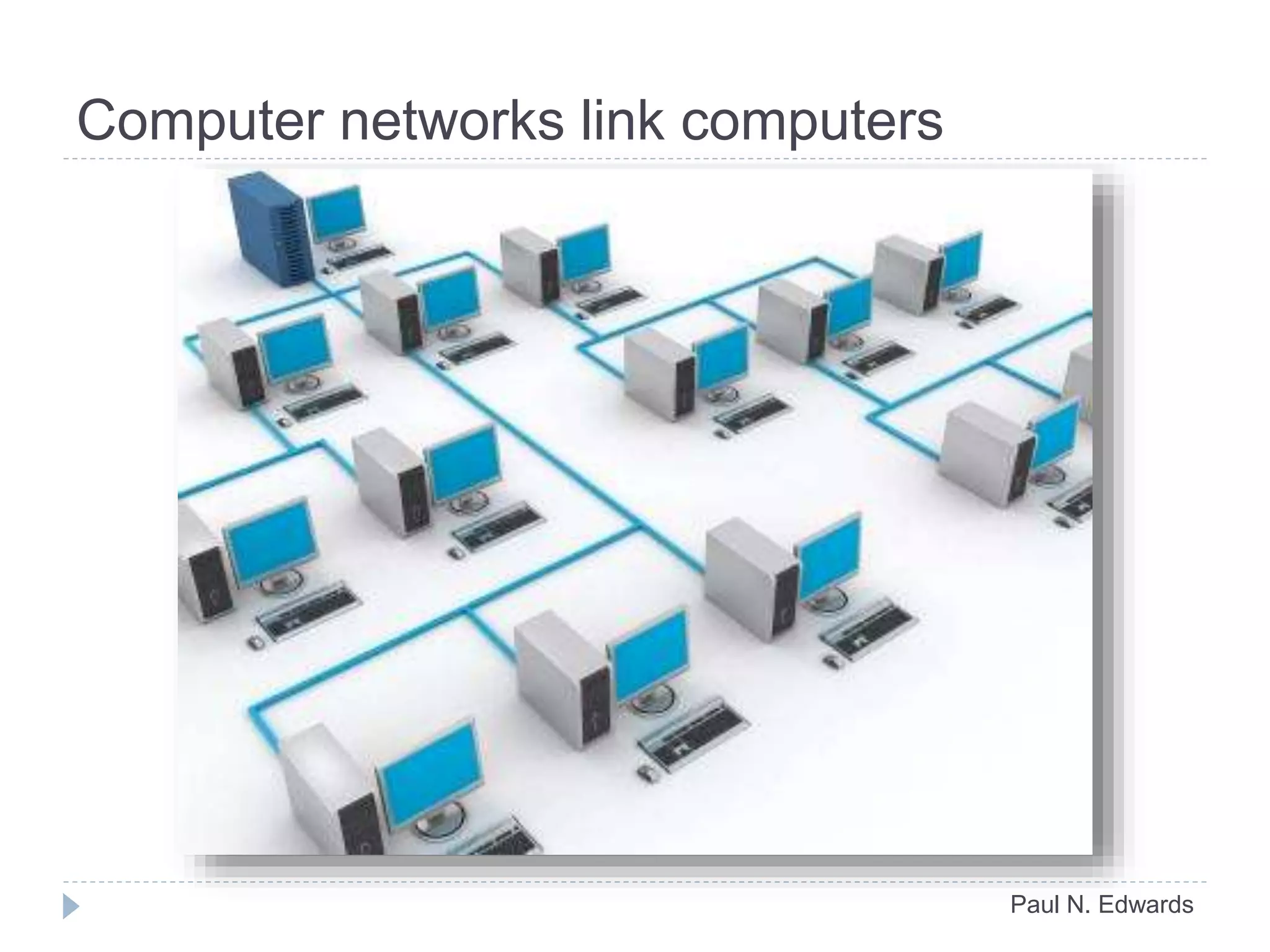
Computer networks link computers
Paul N. Edwards
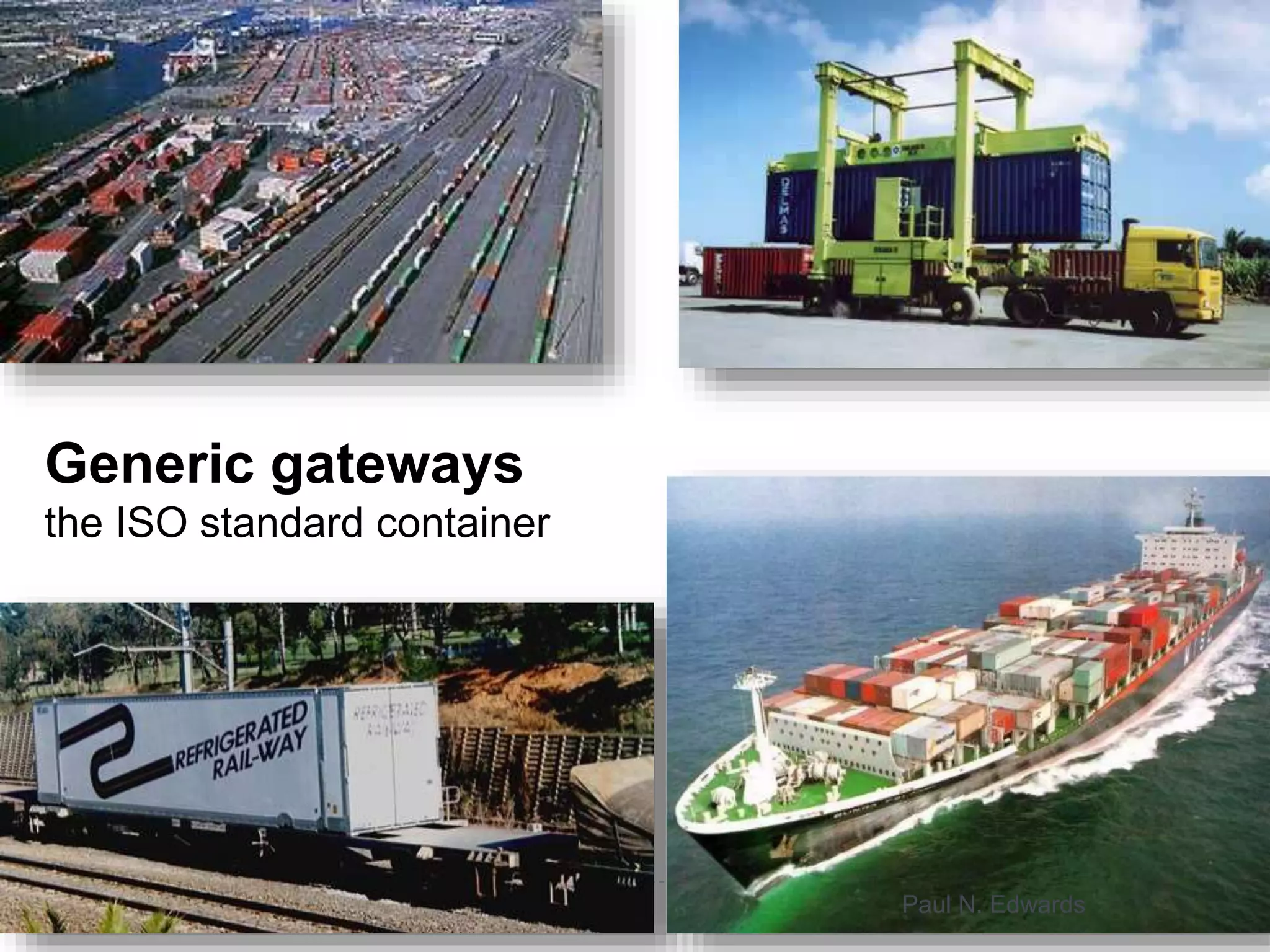
Generic gateways
the ISO standard container
Paul N. Edwards
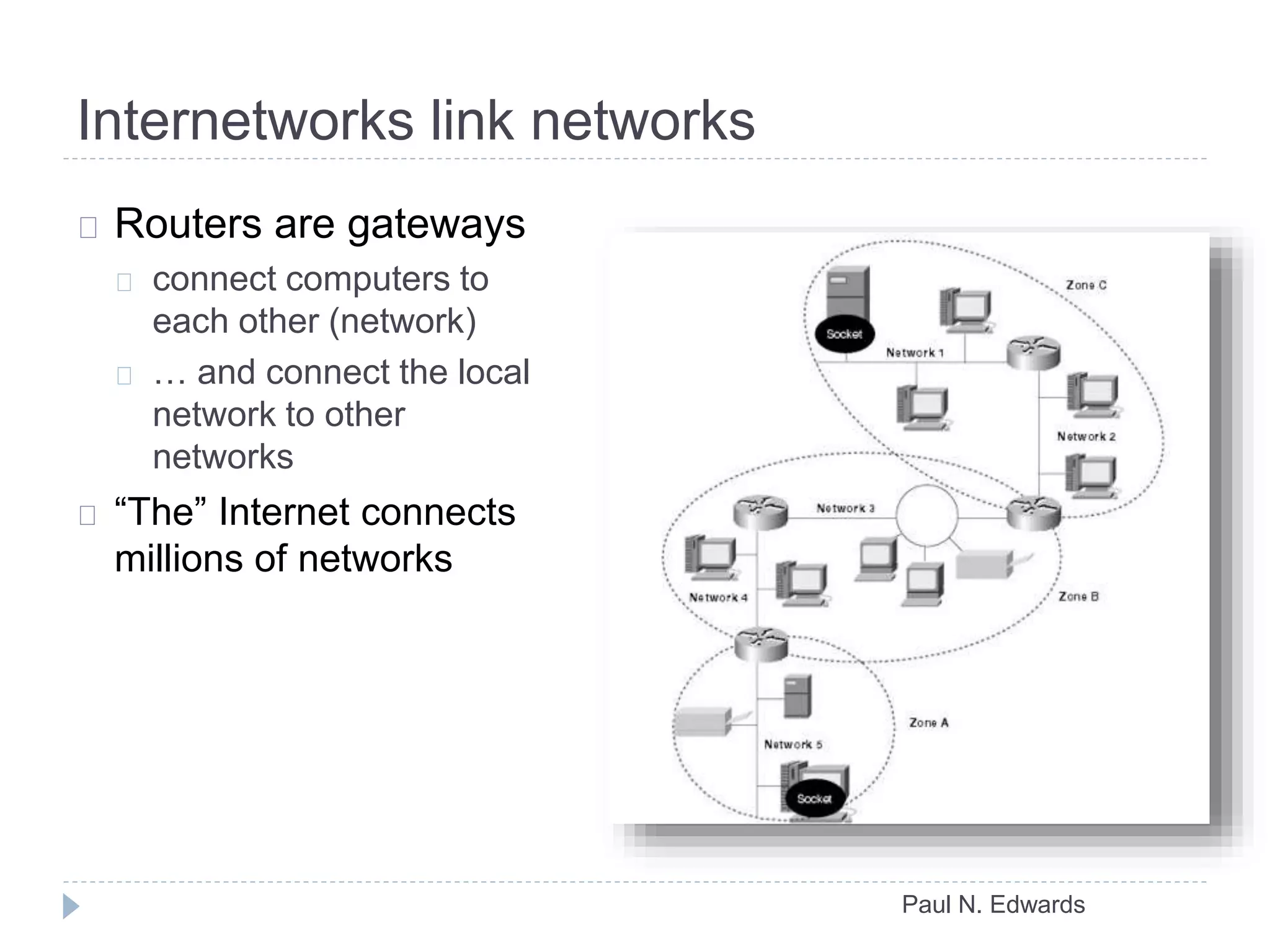
Internetworks link networks
Paul N. Edwards
Routers are gateways
connect computers to
each other (network)
… and connect the local
network to other
networks
“The” Internet connects
millions of networks
This morning
A little history of infrastructure
… and of governance in meteorology
What is governance?
Governance and software in Earth system science
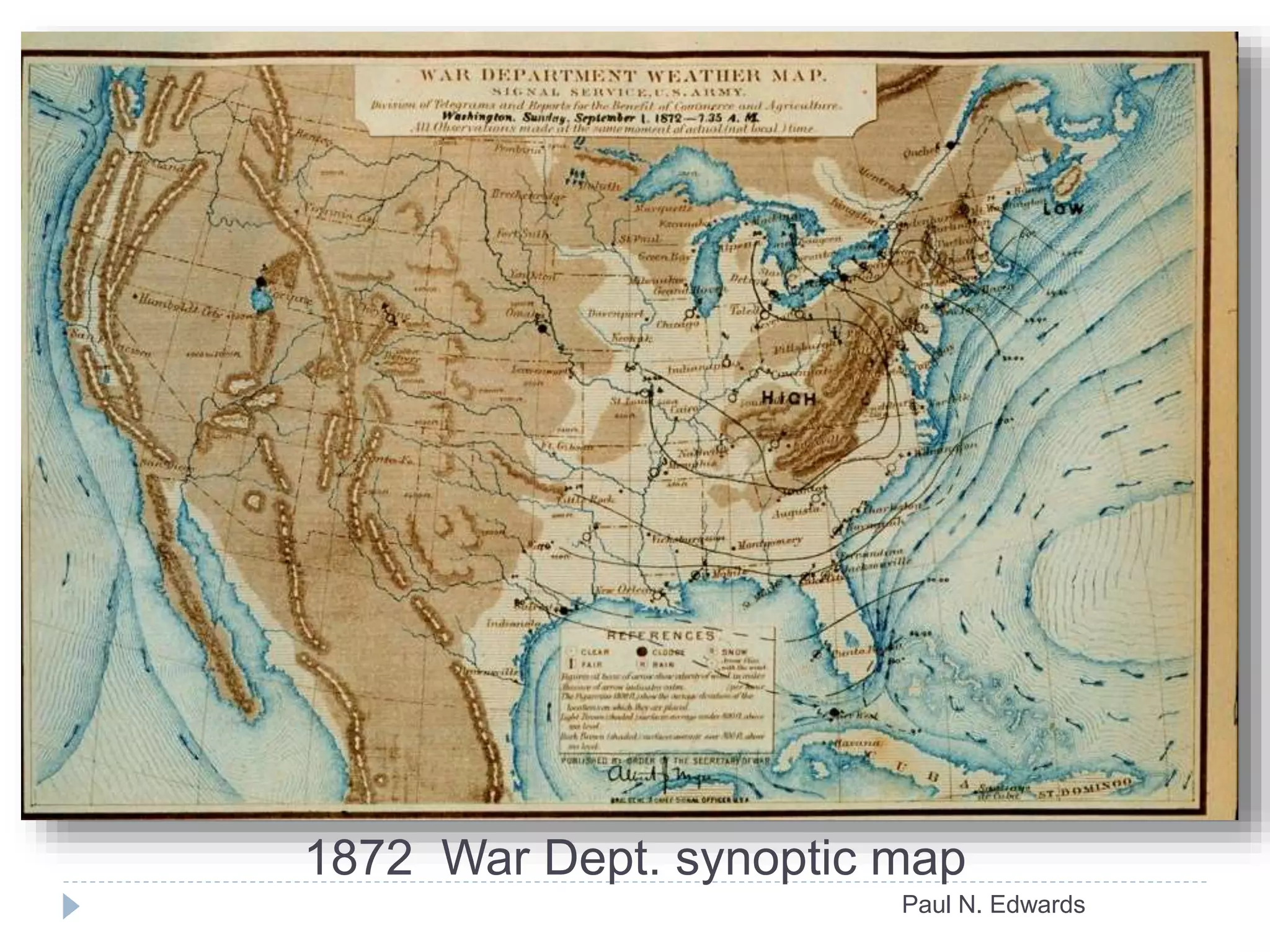
1872 War Dept. synoptic map
Paul N. Edwards
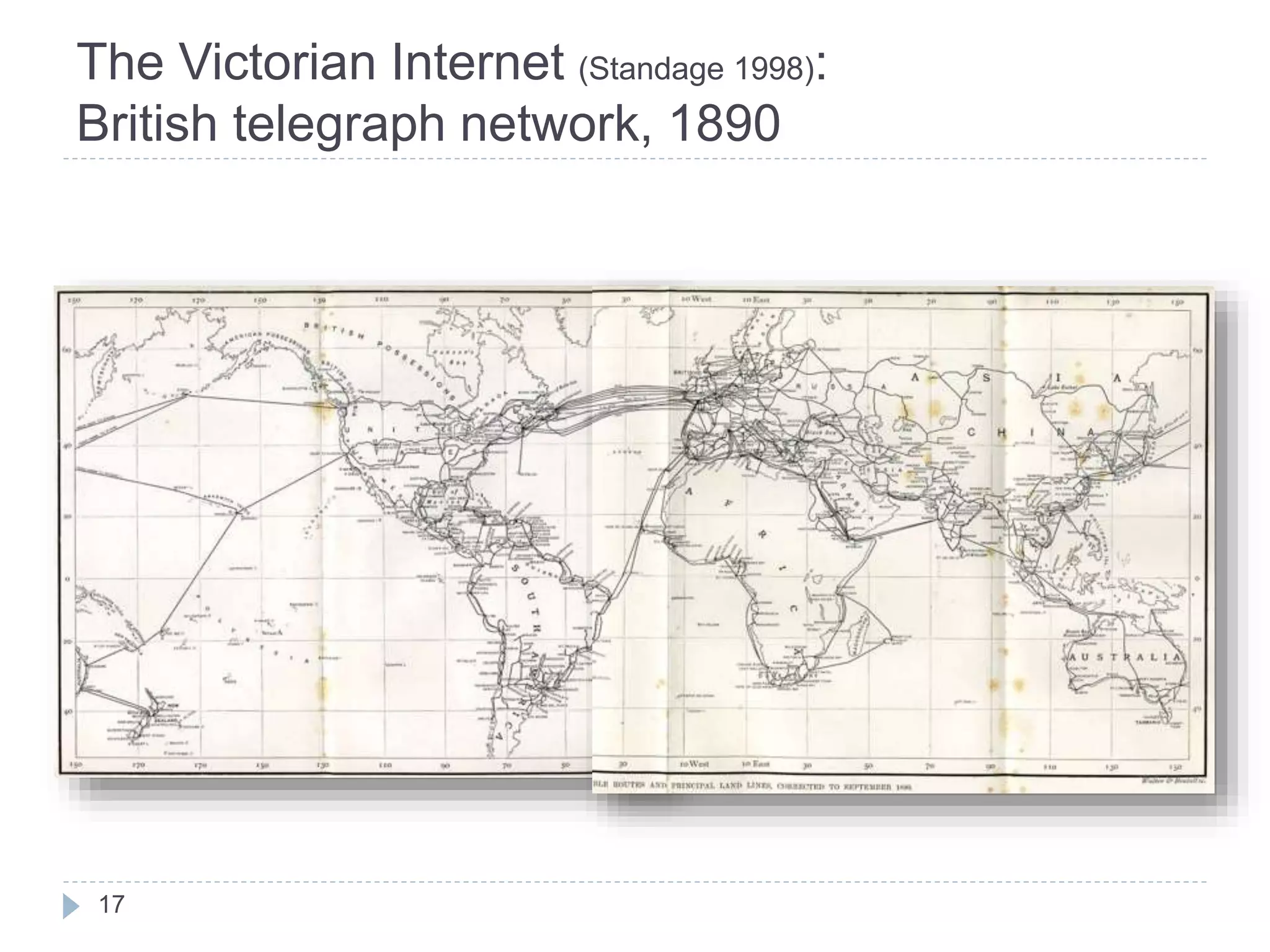
The Victorian Internet (Standage 1998):
British telegraph network, 1890
17
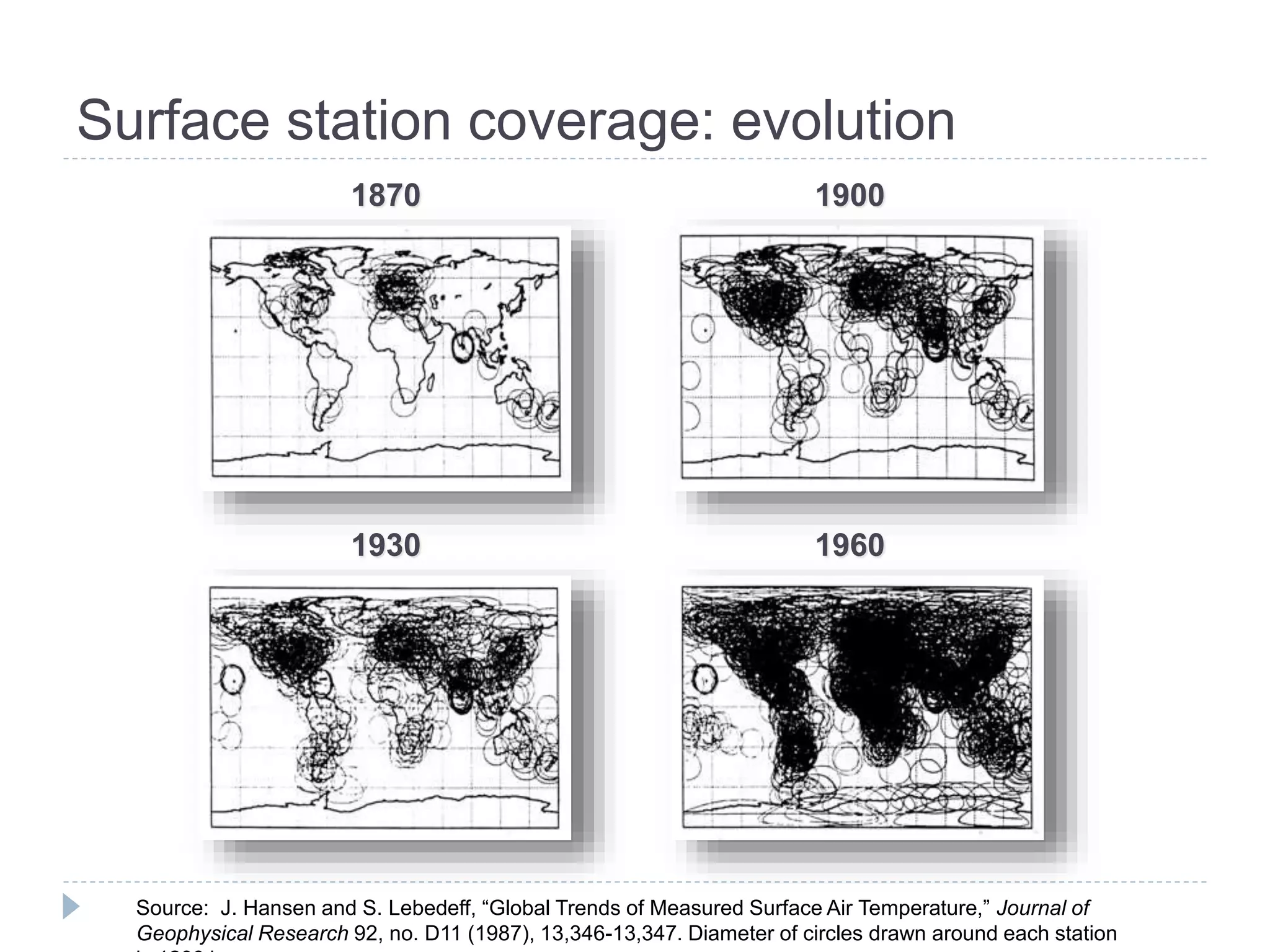
1870 1900
1930 1960
Surface station coverage: evolution
Source: J. Hansen and S. Lebedeff, “Global Trends of Measured Surface Air Temperature,” Journal of
Geophysical Research 92, no. D11 (1987), 13,346-13,347. Diameter of circles drawn around each station
Stages in the history of weather forecasting
20
Systems: national
weather services
Set own standards
Networks: national and
international
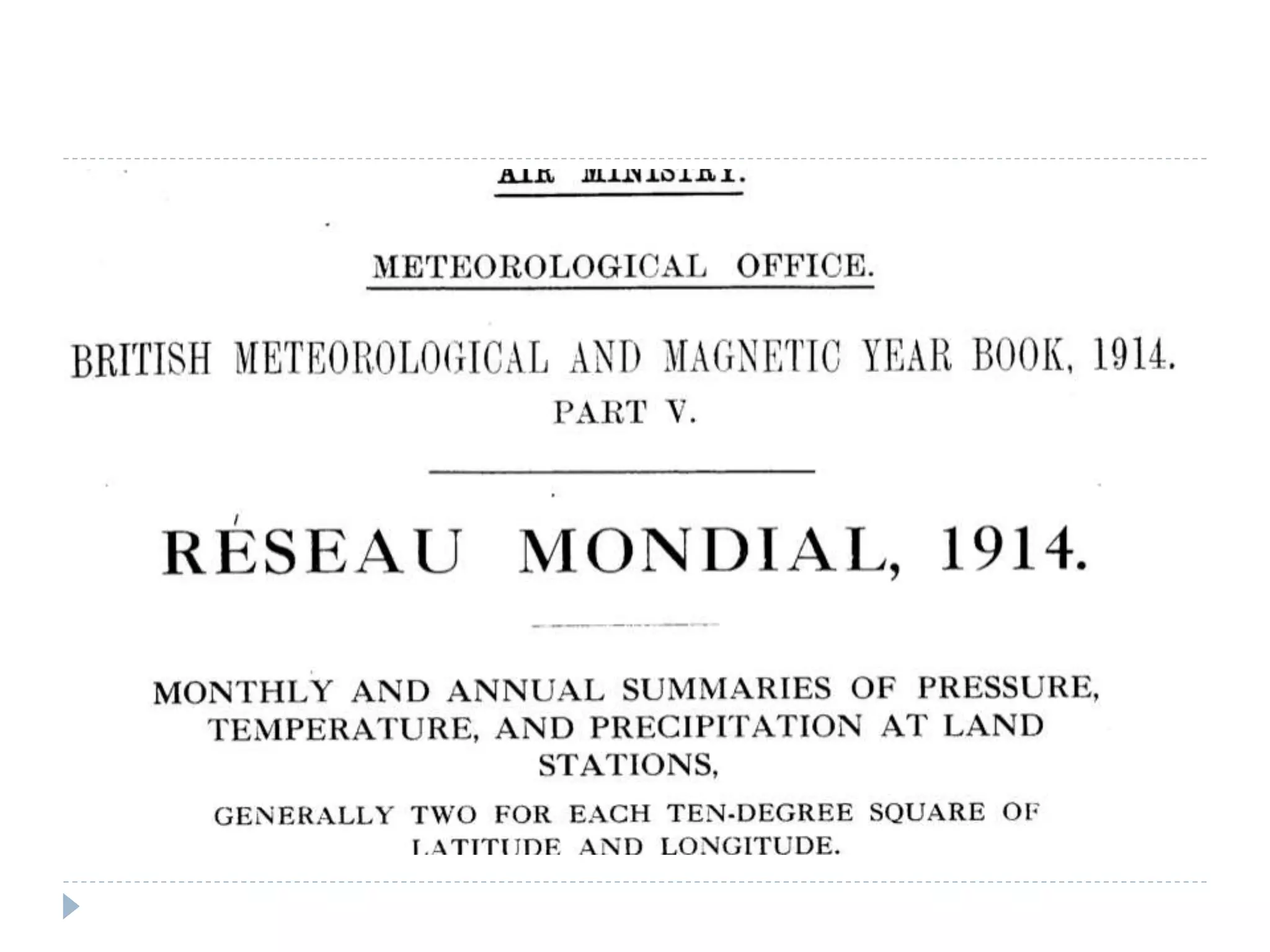
The Réseau Mondial
Internetworks
Integrating
heterogeneous data
sources
Surface stations
Air bases and airports
Marine data
Satellites
Governance
International Meteorological
Organization (1873-1949)
World Meteorological
Organization (WMO, founded
1950)
Set standards, assisted
coordination — but
lightweight relative to
national services
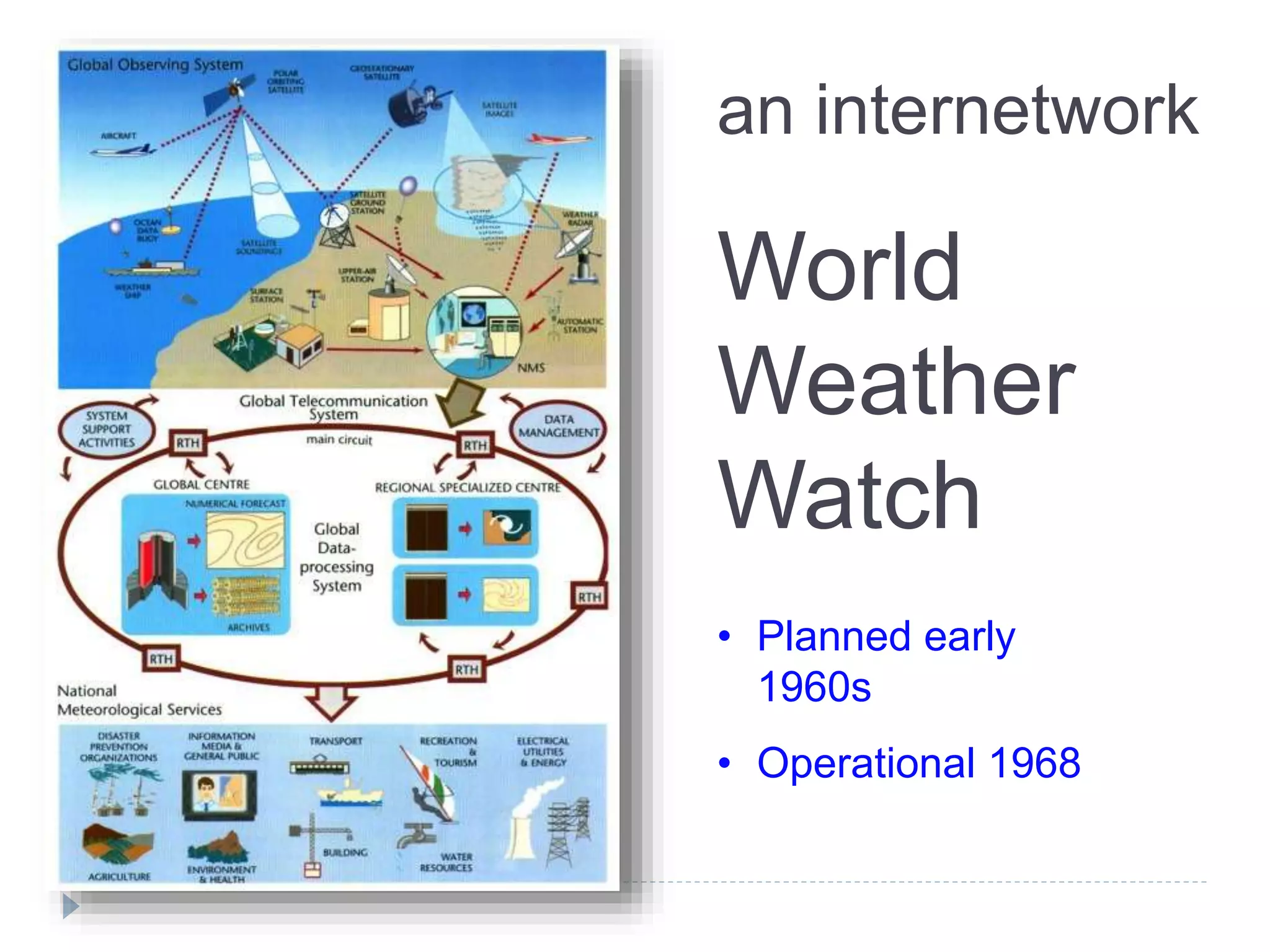
an internetwork
World
Weather
Watch
• Planned early
1960s
• Operational 1968
This morning
A little history of infrastructure
… and of governance in meteorology
What is governance?
Governance and software in Earth system science
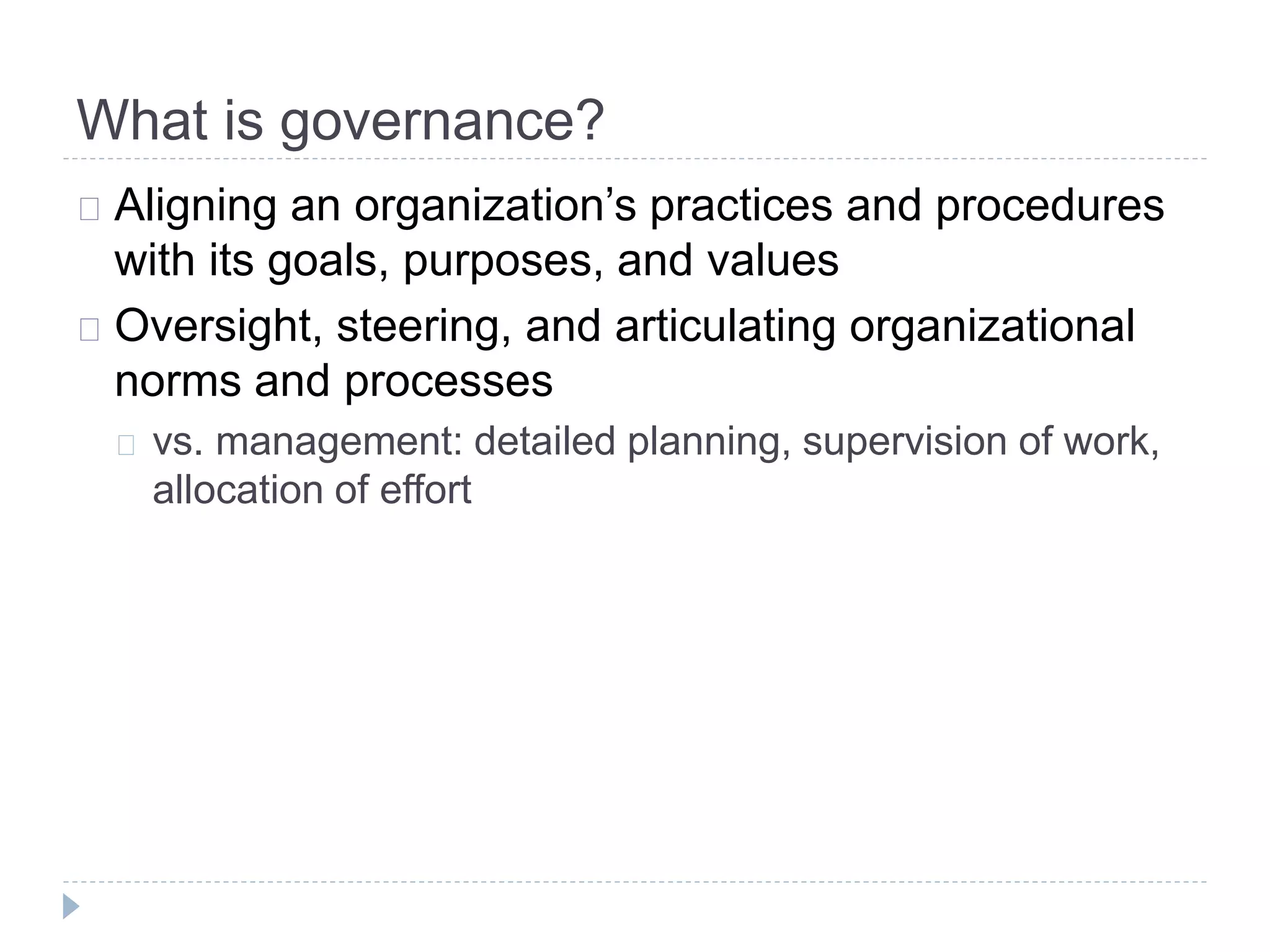
What is governance?
Aligning an organization’s practices and procedures
with its goals, purposes, and values
Oversight, steering, and articulating organizational
norms and processes
vs. management: detailed planning, supervision of work,
allocation of effort
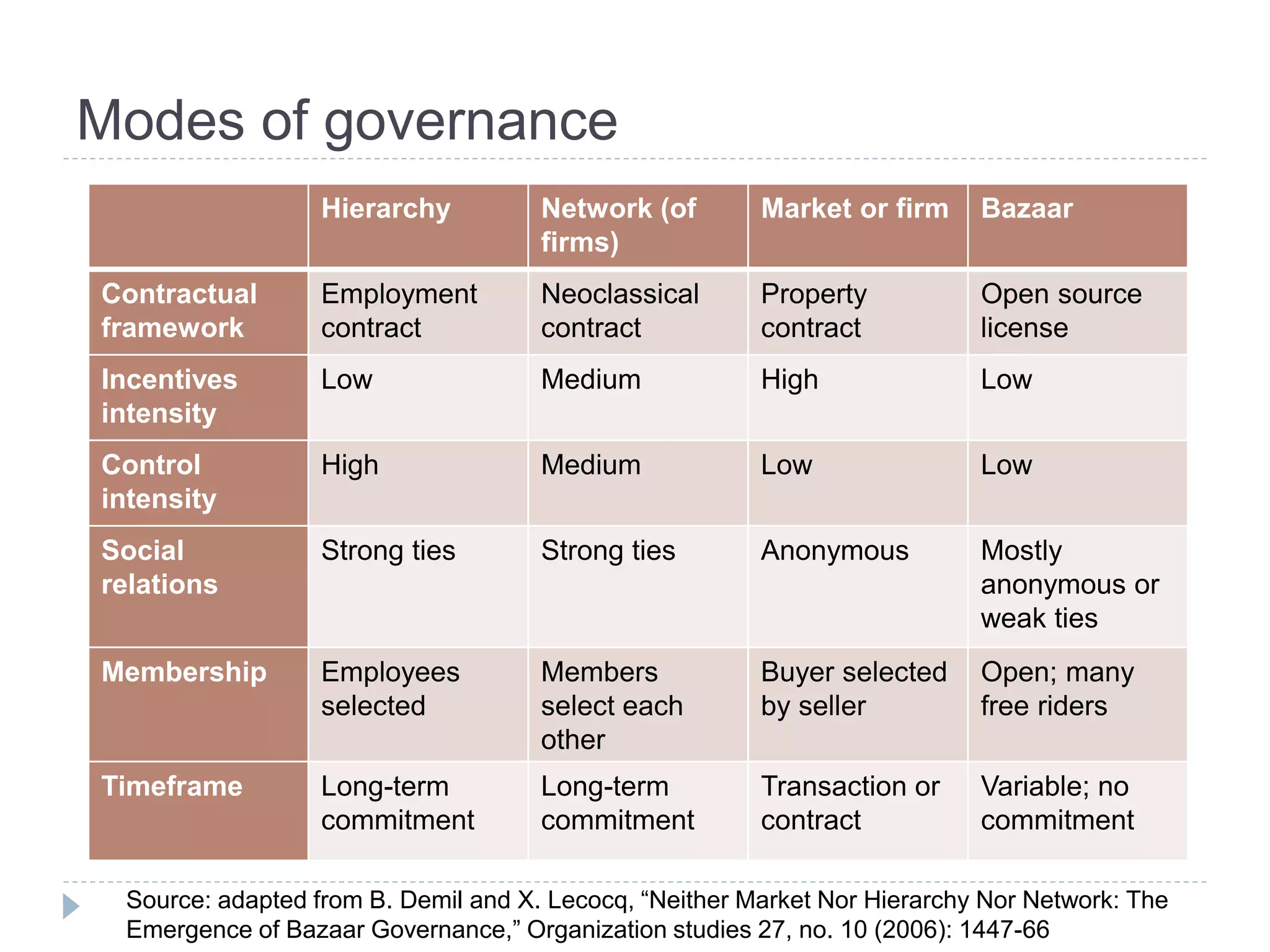
Modes of governance
Hierarchy Network (of
firms)
Market or firm Bazaar
Contractual
framework
Employment
contract
Neoclassical
contract
Property
contract
Open source
license
Incentives
intensity
Low Medium High Low
Control
intensity
High Medium Low Low
Social
relations
Strong ties Strong ties Anonymous Mostly
anonymous or
weak ties
Membership Employees
selected
Members
select each
other
Buyer selected
by seller
Open; many
free riders
Timeframe Long-term
commitment
Long-term
commitment
Transaction or
contract
Variable; no
commitment
Source: adapted from B. Demil and X. Lecocq, “Neither Market Nor Hierarchy Nor Network: The
Emergence of Bazaar Governance,” Organization studies 27, no. 10 (2006): 1447-66
Open source culture: bazaar governance
E. Raymond, “The Cathedral and the Bazaar”
Linux is ‘a great babbling bazaar of differing agendas and
approaches’
Characteristic: chaotic market, huge variations in quality
“Low levels of control and weak incentives intensity
are distinctive features of bazaar [governance],
lending a high uncertainty to governed transactions.”
Source: B. Demil and X. Lecocq, “Neither Market Nor Hierarchy Nor Network: The Emergence of Bazaar
Governance,” Organization Studies 27, no. 10 (2006): 1447-1466.
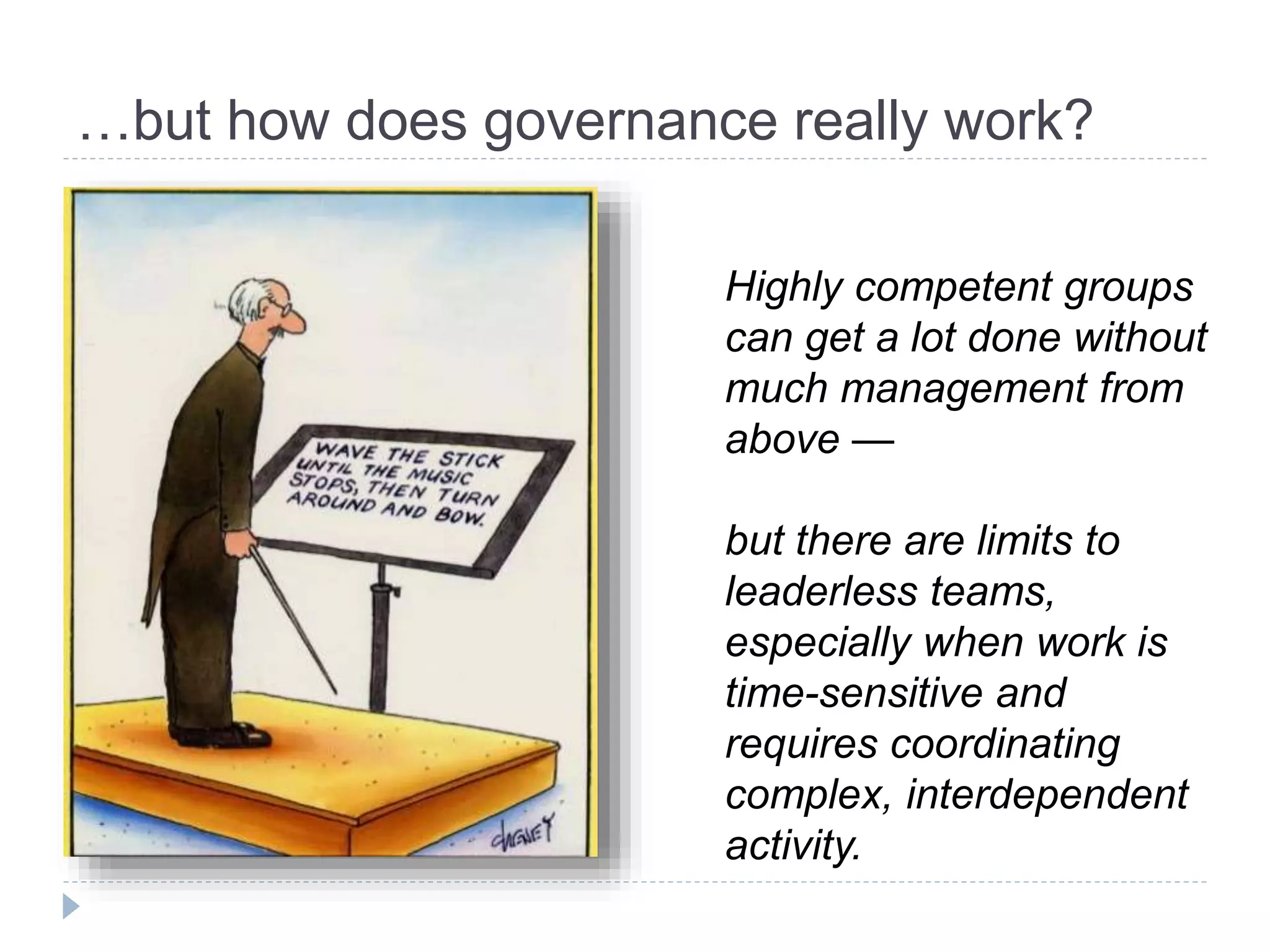
…but how does governance really work?
Highly competent groups
can get a lot done without
much management from
above —
but there are limits to
leaderless teams,
especially when work is
time-sensitive and
requires coordinating
complex, interdependent
activity.
This morning
A little history of infrastructure
… and of governance in meteorology
What is governance?
Governance and software in Earth system science
Organizations in science…
Organizations provide space, equipment, money, and
support
Stable, long-lasting (decades)
Well-defined roles and routines
Have boundaries, hierarchies, and entrenched cultures
Research (NCAR, GFDL, universities) vs. operational (NOAA,
NASA, DOE)
National laboratories and military research
Funding agencies (NSF, NIH) and foundations
They strongly structure work incentives and disincentives
… vs. projects
...but most scientific work takes place in projects,
teams, and working groups
Varying sizes
Lifespans vary, but mostly short (1-5 years)
Depend heavily on funding cycles
Often cross organizational boundaries
Many scientists are involved in several projects at
once
Overlapping membership
Funding is an ongoing concern
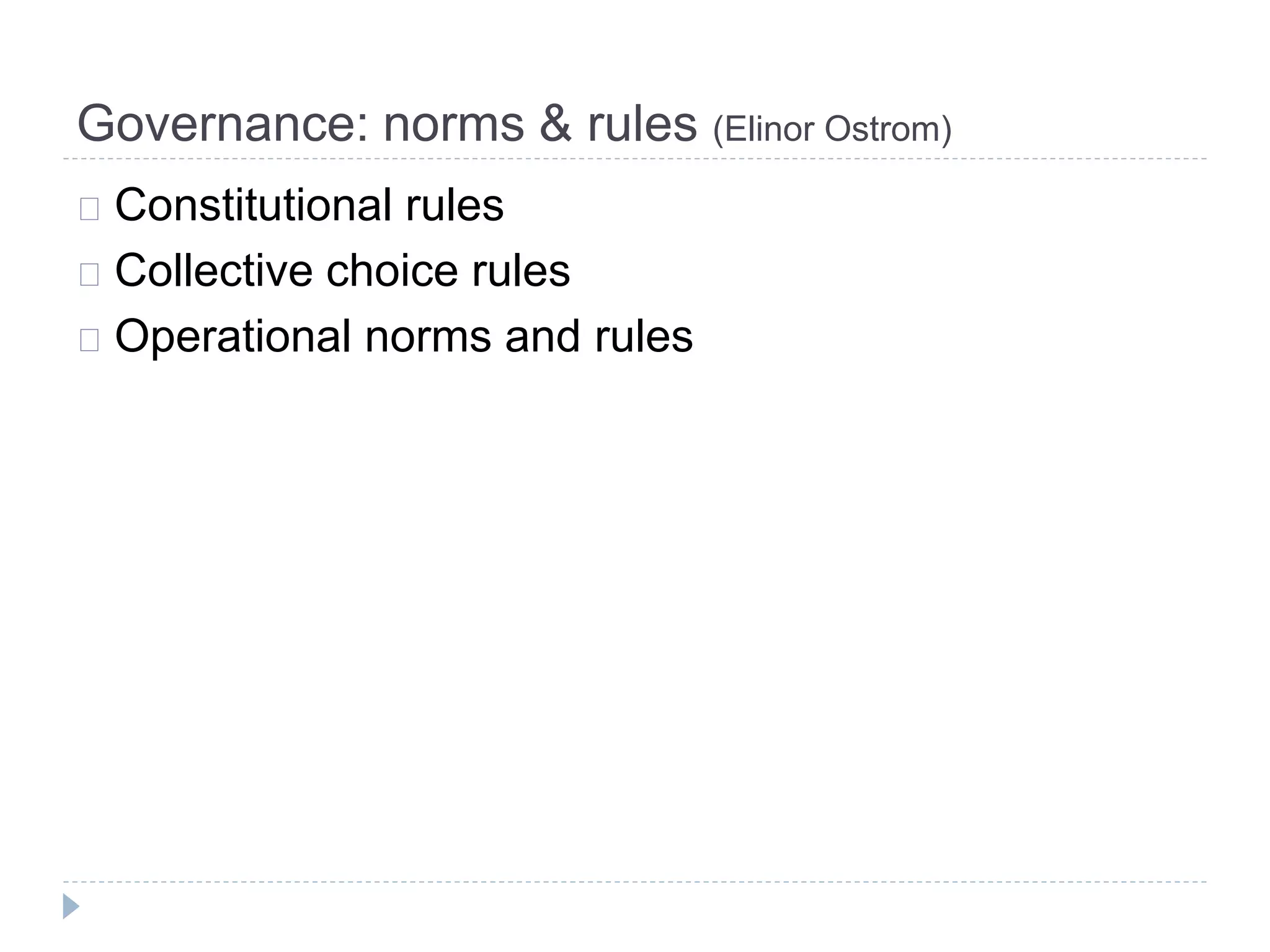
Governance: norms & rules (Elinor Ostrom)
Constitutional rules
Collective choice rules
Operational norms and rules
Expectations that govern everyday interaction
among project members
Largely informal and tacit (unarticulated)
May be embedded in organizational routines or tools
Usually surface only during crisis or conflict
Difficult to change without a forcing factor
Tools can embody operational norms — but usually can’t
force changes
Cyberinfrastructure pitfalls
35
Software makes it seem easy to build gateways
between systems and networks…
“You just…”
… but social, institutional, and security gateways are
even more important
Multiple institutional cultures
Complex projects with many working groups
Multiple security and legal standards can block
interchange
Conclusions: some lessons from history
36
Centralized design and control is not the primary
path to working infrastructure
Instead, build gateways (couplers)
Standards technologies, institutions
Must be lightweight, readily understood, easily transferred
across regions and cultures (including disciplinary
cultures)
International governance of data standardization and
exchange in meteorology was achieved by the
1960s
in the face of enormous technical obstacles
(communication channels) and social obstacles (Cold
War, decolonization)
EarthCube goal
“…to design, build, and maintain an easy-to-use
system based on existing resources that embraces
open-source culture and methods to align
technology development with scientific needs.”
Richard et al. “Community‐developed Geoscience Cyberinfrastructure.” Eos 95, no. 20 (2014):
165-166
Conclusions: some lessons from history
The tensions between hierarchy, network, and
bazaar modes of governance will be difficult to
resolve
Cyberinfrastructure can help, but it can also hinder
Social and organizational issues must be addressed
along with technology
The EarthCube experiment is enormously important,
and worth doing!
25 July 2014Paul N. Edwards , University of Michigan
School of Information
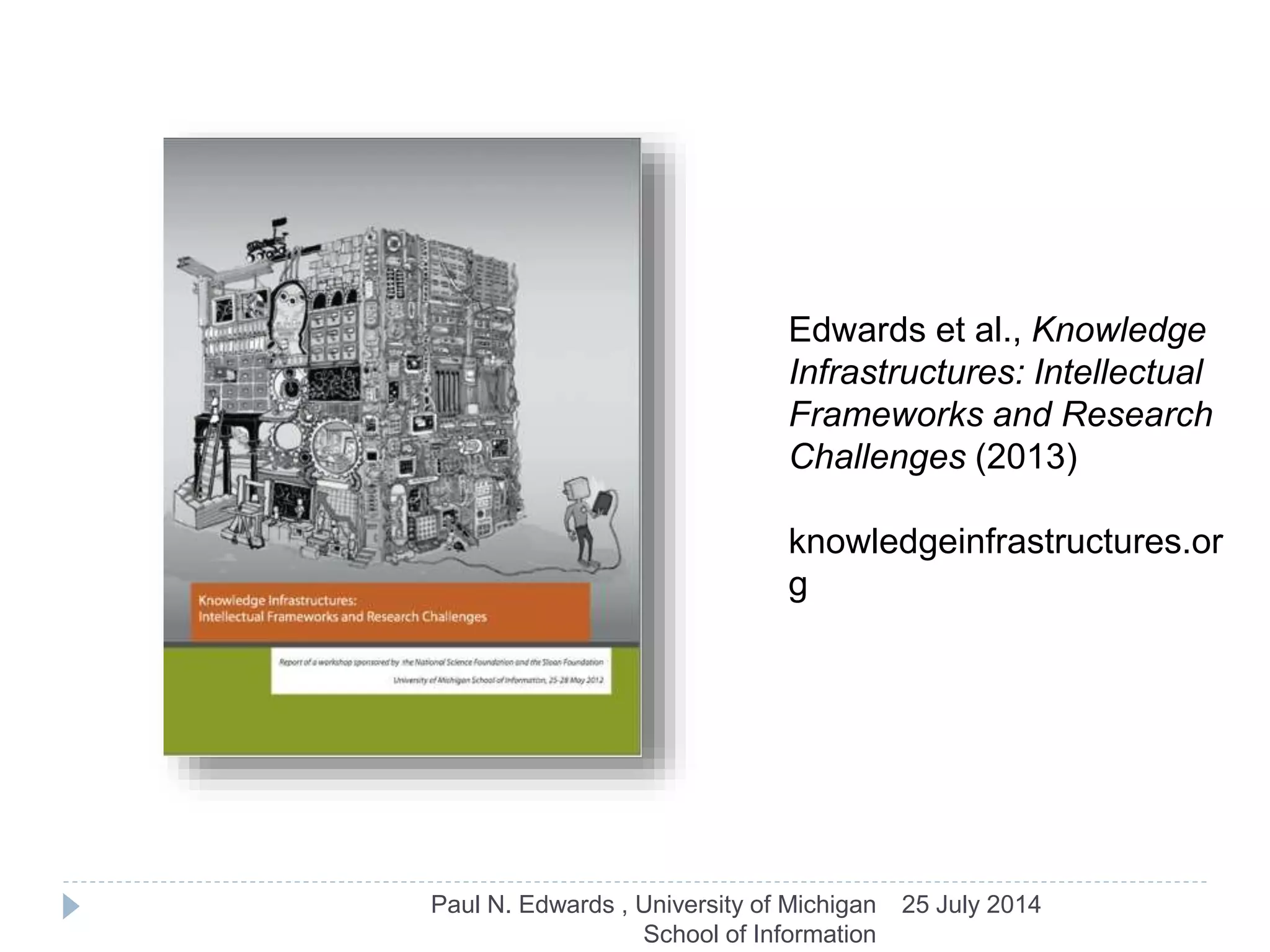
Edwards et al., Knowledge
Infrastructures: Intellectual
Frameworks and Research
Challenges (2013)
knowledgeinfrastructures.or
g

AHM 2014: Governance and Cyberinfrastructure in the Earth System Sciences

  • 1.
    Governance and cyberinfrastructure inthe Earth system sciences Paul N. Edwards School of Information and Dept. of History, University of Michigan
  • 2.
    EarthCube goal “…to design,build, and maintain an easy-to-use system based on existing resources that embraces open-source culture and methods to align technology development with scientific needs.” Richard et al. “Community‐developed Geoscience Cyberinfrastructure.” Eos 95, no. 20 (2014): 165-166
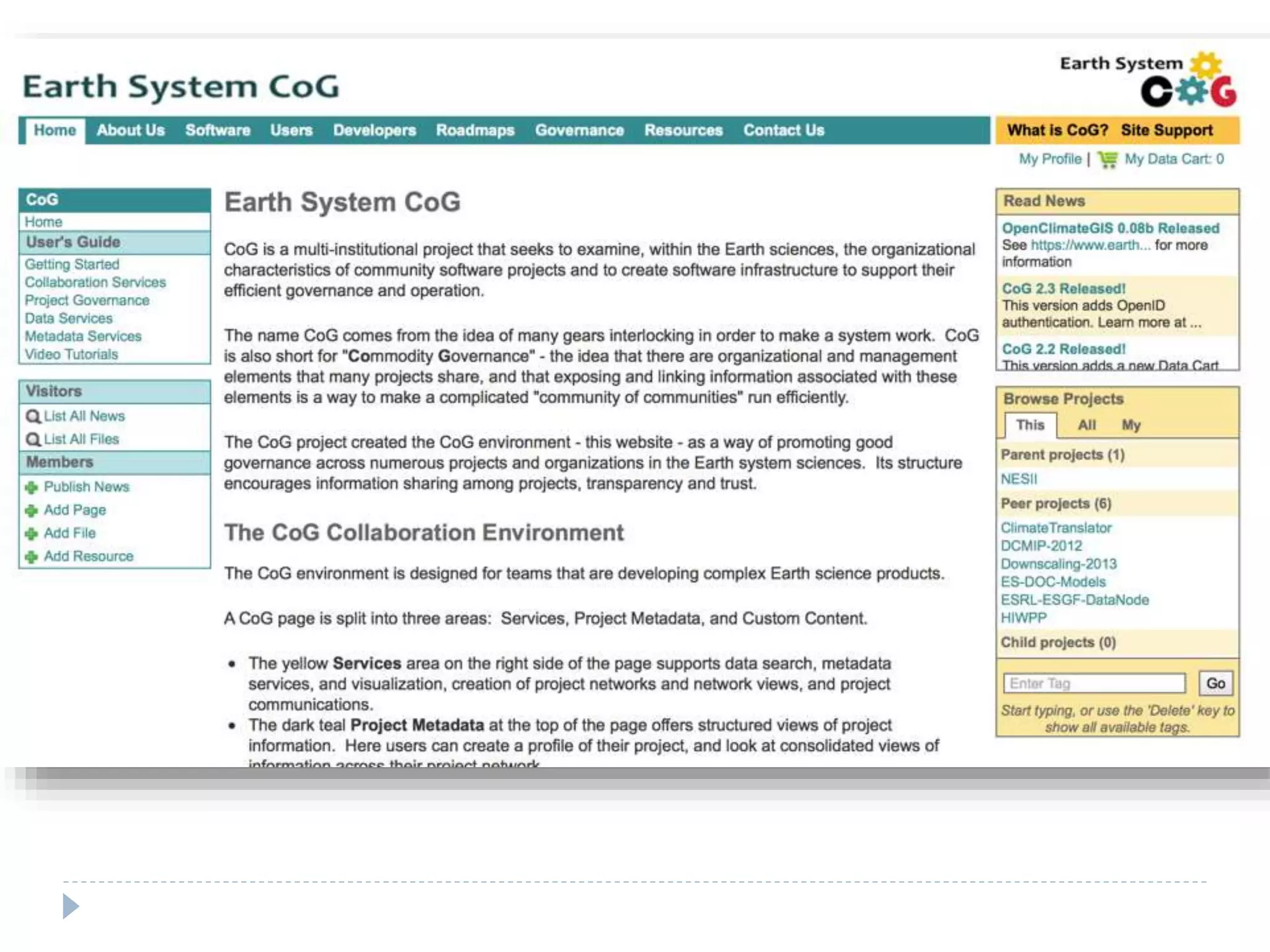
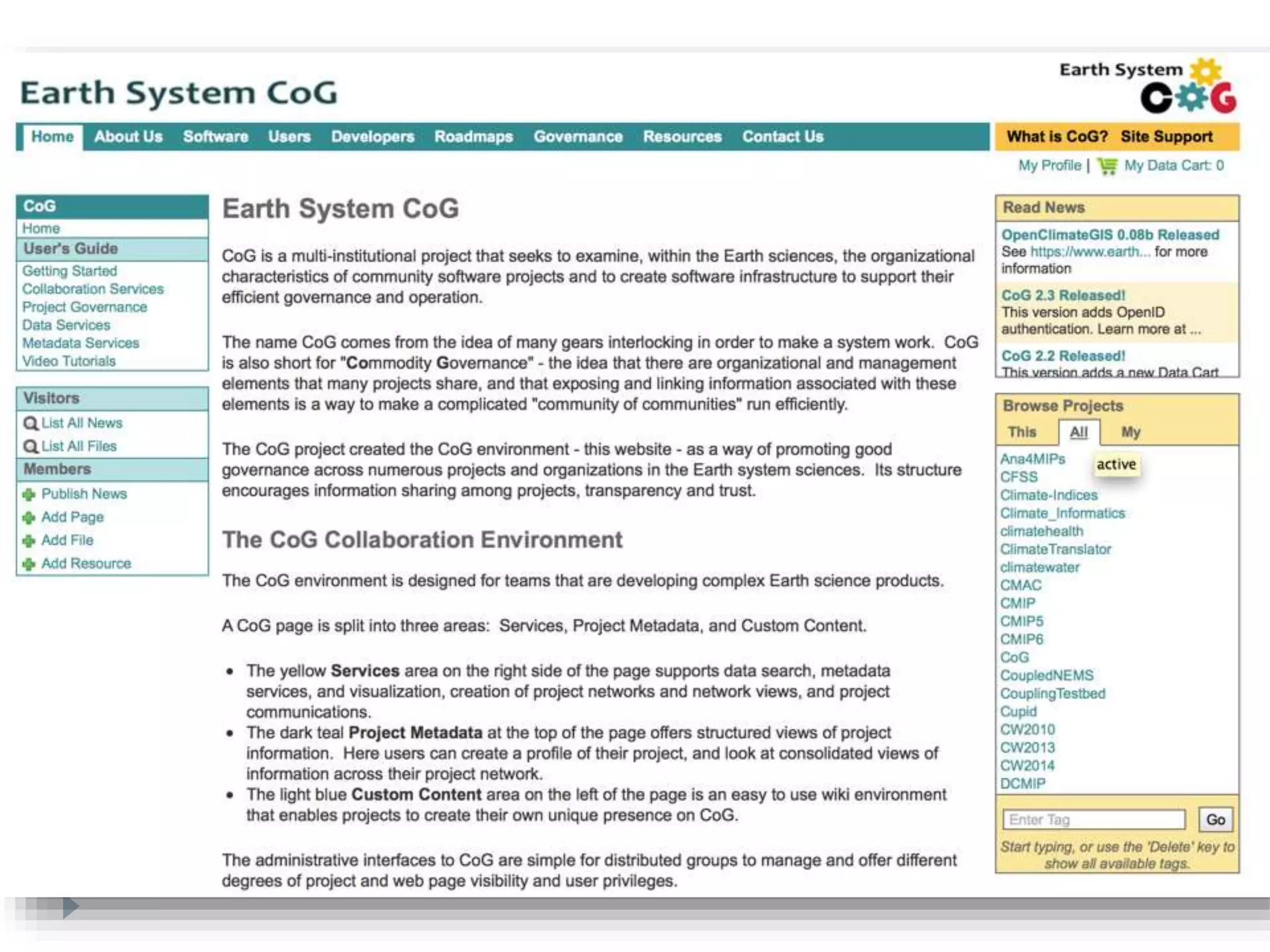
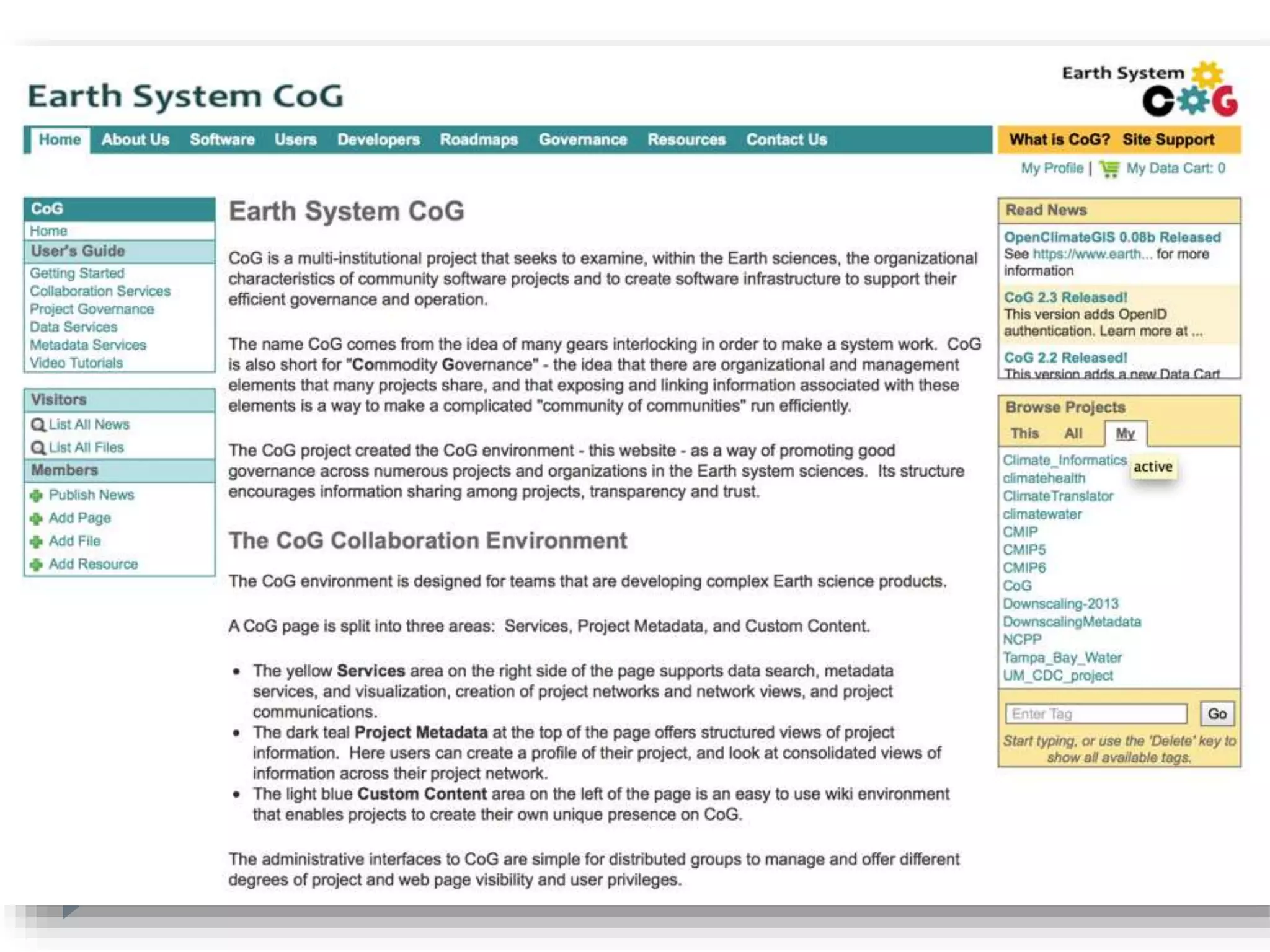
  • 3.
  • 4.
    The Tower ofBabel… Heritage of multiple disciplines, sensors, data analysis methods Cacophony of formats, metadata, software Earthcube survey of ~175 scientists (2011): need… Common data formats Better metadata and metadata standards Better ways to find data Coupled web-based services, such as visualization tools
  • 5.
    Cyberinfrastructure and climate changeinformatics (Rood & Edwards 2014) R. B. Rood & P. N. Edwards, “Climate Informatics: Human Experts and the End-to-End System,” Earthzine, May 2014
  • 6.
    The loading dockmodel of cyberinfrastructure Data Models Services Loading Dock Model
  • 7.
    Access is notthe main problem Beyond the loading dock model Need for translational information for (many) particular users and uses Human communication — often informal — remains the most basic process for effective data sharing Metadata as product vs. metadata as process Always provide for communication with data creators
  • 8.
    This morning A littlehistory of infrastructure … and of governance in meteorology What is governance? Governance and software in Earth system science
  • 9.
    This morning A littlehistory of infrastructure … and of governance in meteorology What is governance? Governance and software in Earth system science
  • 10.
    Infrastructure: a historicalmodel Paul N. Edwards System building: designed, coherent, centrally organized Proliferation of systems; variation Networks: dedicated gateways link heterogeneous systems Internetworks: generic gateways link heterogeneous networks Decentralization, fragmentation Abandonment, substitution time Edwards et al. 2007
  • 11.
    Dedicated or improvisedgateways (Egyedi 2001) Paul N. Edwards Whose responsibility? Who sets standards? Who pays?
  • 12.
    Computer networks linkcomputers Paul N. Edwards
  • 13.
    Generic gateways the ISOstandard container Paul N. Edwards
  • 14.
    Internetworks link networks PaulN. Edwards Routers are gateways connect computers to each other (network) … and connect the local network to other networks “The” Internet connects millions of networks
  • 15.
    This morning A littlehistory of infrastructure … and of governance in meteorology What is governance? Governance and software in Earth system science
  • 16.
    1872 War Dept.synoptic map Paul N. Edwards
  • 17.
    The Victorian Internet(Standage 1998): British telegraph network, 1890 17
  • 18.
    1870 1900 1930 1960 Surfacestation coverage: evolution Source: J. Hansen and S. Lebedeff, “Global Trends of Measured Surface Air Temperature,” Journal of Geophysical Research 92, no. D11 (1987), 13,346-13,347. Diameter of circles drawn around each station
  • 20.
    Stages in thehistory of weather forecasting 20 Systems: national weather services Set own standards Networks: national and international The Réseau Mondial Internetworks Integrating heterogeneous data sources Surface stations Air bases and airports Marine data Satellites Governance International Meteorological Organization (1873-1949) World Meteorological Organization (WMO, founded 1950) Set standards, assisted coordination — but lightweight relative to national services
  • 21.
    an internetwork World Weather Watch • Plannedearly 1960s • Operational 1968
  • 22.
    This morning A littlehistory of infrastructure … and of governance in meteorology What is governance? Governance and software in Earth system science
  • 23.
    What is governance? Aligningan organization’s practices and procedures with its goals, purposes, and values Oversight, steering, and articulating organizational norms and processes vs. management: detailed planning, supervision of work, allocation of effort
  • 24.
    Modes of governance HierarchyNetwork (of firms) Market or firm Bazaar Contractual framework Employment contract Neoclassical contract Property contract Open source license Incentives intensity Low Medium High Low Control intensity High Medium Low Low Social relations Strong ties Strong ties Anonymous Mostly anonymous or weak ties Membership Employees selected Members select each other Buyer selected by seller Open; many free riders Timeframe Long-term commitment Long-term commitment Transaction or contract Variable; no commitment Source: adapted from B. Demil and X. Lecocq, “Neither Market Nor Hierarchy Nor Network: The Emergence of Bazaar Governance,” Organization studies 27, no. 10 (2006): 1447-66
  • 25.
    Open source culture:bazaar governance E. Raymond, “The Cathedral and the Bazaar” Linux is ‘a great babbling bazaar of differing agendas and approaches’ Characteristic: chaotic market, huge variations in quality “Low levels of control and weak incentives intensity are distinctive features of bazaar [governance], lending a high uncertainty to governed transactions.” Source: B. Demil and X. Lecocq, “Neither Market Nor Hierarchy Nor Network: The Emergence of Bazaar Governance,” Organization Studies 27, no. 10 (2006): 1447-1466.
  • 26.
    …but how doesgovernance really work? Highly competent groups can get a lot done without much management from above — but there are limits to leaderless teams, especially when work is time-sensitive and requires coordinating complex, interdependent activity.
  • 27.
    This morning A littlehistory of infrastructure … and of governance in meteorology What is governance? Governance and software in Earth system science
  • 28.
    Organizations in science… Organizationsprovide space, equipment, money, and support Stable, long-lasting (decades) Well-defined roles and routines Have boundaries, hierarchies, and entrenched cultures Research (NCAR, GFDL, universities) vs. operational (NOAA, NASA, DOE) National laboratories and military research Funding agencies (NSF, NIH) and foundations They strongly structure work incentives and disincentives
  • 29.
    … vs. projects ...butmost scientific work takes place in projects, teams, and working groups Varying sizes Lifespans vary, but mostly short (1-5 years) Depend heavily on funding cycles Often cross organizational boundaries Many scientists are involved in several projects at once Overlapping membership Funding is an ongoing concern
  • 33.
    Governance: norms &rules (Elinor Ostrom) Constitutional rules Collective choice rules Operational norms and rules
  • 34.
    Operational norms andrules Expectations that govern everyday interaction among project members Largely informal and tacit (unarticulated) May be embedded in organizational routines or tools Usually surface only during crisis or conflict Difficult to change without a forcing factor Tools can embody operational norms — but usually can’t force changes
  • 35.
    Cyberinfrastructure pitfalls 35 Software makesit seem easy to build gateways between systems and networks… “You just…” … but social, institutional, and security gateways are even more important Multiple institutional cultures Complex projects with many working groups Multiple security and legal standards can block interchange
  • 36.
    Conclusions: some lessonsfrom history 36 Centralized design and control is not the primary path to working infrastructure Instead, build gateways (couplers) Standards technologies, institutions Must be lightweight, readily understood, easily transferred across regions and cultures (including disciplinary cultures) International governance of data standardization and exchange in meteorology was achieved by the 1960s in the face of enormous technical obstacles (communication channels) and social obstacles (Cold War, decolonization)
  • 37.
    EarthCube goal “…to design,build, and maintain an easy-to-use system based on existing resources that embraces open-source culture and methods to align technology development with scientific needs.” Richard et al. “Community‐developed Geoscience Cyberinfrastructure.” Eos 95, no. 20 (2014): 165-166
  • 38.
    Conclusions: some lessonsfrom history The tensions between hierarchy, network, and bazaar modes of governance will be difficult to resolve Cyberinfrastructure can help, but it can also hinder Social and organizational issues must be addressed along with technology The EarthCube experiment is enormously important, and worth doing!
  • 39.
    25 July 2014PaulN. Edwards , University of Michigan School of Information Edwards et al., Knowledge Infrastructures: Intellectual Frameworks and Research Challenges (2013) knowledgeinfrastructures.or g