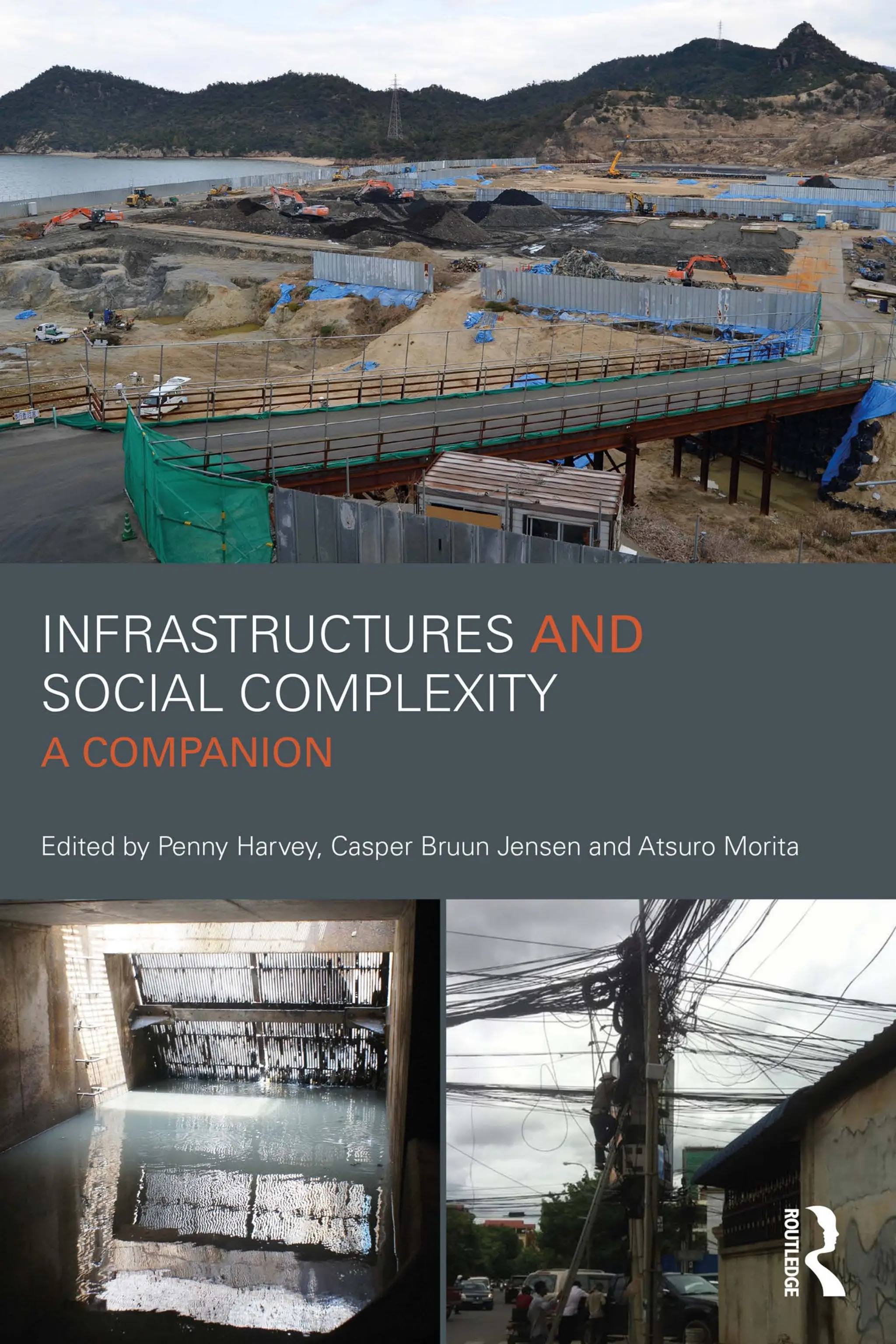
Infrastructures and Social Complexity A Companion 1°
Edition Penelope Harvey (Editor) - PDF Download
(2025)
https://ebookultra.com/download/infrastructures-and-social-
complexity-a-companion-1-edition-penelope-harvey-editor/
Visit ebookultra.com today to download the complete set of
ebooks or textbooks
We have selected some products that you may be interested in
Click the link to download now or visit ebookultra.com
for more options!.
Social Complexity and Complex Systems in Archaeology 1st
Edition Dries Daems
https://ebookultra.com/download/social-complexity-and-complex-systems-
in-archaeology-1st-edition-dries-daems/
Family Violence Legal Medical and Social Perspectives 9th
Edition Harvey Wallace
https://ebookultra.com/download/family-violence-legal-medical-and-
social-perspectives-9th-edition-harvey-wallace/
A companion to Jean Renoir 1. publ Edition Renoir
https://ebookultra.com/download/a-companion-to-jean-renoir-1-publ-
edition-renoir/
Psychological Therapy in Prisons and Other Settings 1
Edition Joel Harvey
https://ebookultra.com/download/psychological-therapy-in-prisons-and-
other-settings-1-edition-joel-harvey/
Visual C 2010 How to Program 4th Edition 1 29 pdf Paul
Deitel
https://ebookultra.com/download/visual-c-2010-how-to-program-4th-
edition-1-29-pdf-paul-deitel/
Encyclopedia of Social Media and Politics 3 volume set 1st
Edition Kerric Harvey
https://ebookultra.com/download/encyclopedia-of-social-media-and-
politics-3-volume-set-1st-edition-kerric-harvey/
Companion to Social Archaeology Lynn Meskell
https://ebookultra.com/download/companion-to-social-archaeology-lynn-
meskell/
Language Complexity Typology contact change Studies in
Language Companion Series 94th Edition Matti Miestamo
https://ebookultra.com/download/language-complexity-typology-contact-
change-studies-in-language-companion-series-94th-edition-matti-
miestamo/
Starting Out The c3 Sicilian 1st Edition John Emms
https://ebookultra.com/download/starting-out-the-c3-sicilian-1st-
edition-john-emms/
Infrastructures and Social Complexity A Companion 1°
Edition Penelope Harvey (Editor) Digital Instant

Download
Author(s): Penelope Harvey (editor), Casper Bruun Jensen (editor), Atsuro
Morita (editor)
ISBN(s): 9781138654945, 1138654949
Edition: 1°
File Details: PDF, 29.91 MB
Year: 2016
Language: english
Infrastructures and Social Complexity
Contemporary forms of infrastructural development herald alternative futures
through their incorporation of digital technologies, mobile capital, international
politics, and the promises and fears of enhanced connectivity. In tandem with
increasing concerns about climate change and the anthropocene, there is fur-
ther an urgency around contemporary infrastructural provision: a concern
about its fragility and an awareness that these connective, relational systems
significantly shape both local and planetary futures in ways that we need to
understand more clearly. Offering a rich set of empirically detailed and con-
ceptually sophisticated studies of infrastructural systems and experiments,
present and past, contributors to this volume address both the transformative
potential of infrastructural systems and their stasis. Covering infrastructural
figures – their ontologies, epistemologies, classifications and politics – and
spanning development, urban, energy, environmental and information
infrastructures, the chapters explore both the promises and failures of infra-
structure. Tracing the experimental histories of a wide range of infrastructures
and documenting their variable outcomes, the volume offers a unique set of
analytical perspectives on contemporary infrastructural complications. These
studies bring a systematic empirical and analytical attention to human worlds as
they intersect with more-than-human worlds, whether technological or
biological.
Penny Harvey is Professor of Social Anthropology at the University of
Manchester, UK.
Casper Bruun Jensen is Associate Professor/Senior Researcher at Osaka
University, Japan.
Atsuro Morita is Associate Professor in the Department of Anthropology,
School of Human Sciences, Osaka University, Japan.
Culture, Economy and the Social
A new series from CRESC – the ESRC Centre for Research on Socio-Cultural Change
Professor Tony Bennett, Social and Cultural Theory, University of Western
Sydney; Professor Penny Harvey, Anthropology, Manchester University;
Professor Kevin Hetherington, Geography, Open University
The Culture, Economy and the Social series is committed to innovative
contemporary, comparative and historical work on the relations between social,
cultural and economic change. It publishes empirically based research that is the-
oretically informed, that critically examines the ways in which social, cultural and
economic change is framed and made visible, and that is attentive to perspectives
that tend to be ignored or side ined by grand theorizing or epochal accounts
of social change. The series addresses the diverse manifestations of con-
temporary capitalism, and considers the various ways in which the ‘social’,
‘the cultural’ and ‘the economic’ are apprehended as tangible sites of value
and practice. It is explicitly comparative, publishing books that work across
disciplinary perspectives, cross-culturally, or across different historical periods.
For more info please see: www.routledge.com/CRESC/book-series/CRESC
Recent series titles include:
Cultural Pedagogies and Human Conduct
Edited by Megan Watkins, Greg Noble and Catherine Driscoll
Culture as a Vocation
Sociology of career choices in cultural management
By Vincent Dubois
Topologies of power
By John Allen
Distinctions of the Flesh
Social class and the embodiment of inequality
By Dieter Vandebroeck
Infrastructures and Social Complexity
A companion
Edited by Penny Harvey, Casper Bruun Jensen and Atsuro Morita
Film Criticism as a Cultural Institution
Crisis and continuity from the 20th to the 21st century
By Huw Walmsley-Evans
Infrastructures and Social
Complexity
A companion
Edited by
Penny Harvey, Casper Bruun Jensen and
Atsuro Morita
Routledge
Taylor & Francis Group
LONDON AND NEW YORK
E·S·R·C
ECONOMIC
& SOCIAL
RESEARCH Centre for Research on
C 0 UN C I L Socia-Cultural Change
Centre
Centre
First published 2017
by Routledge
2 Park Square, Milton Park, Abingdon, Oxon OX14 4RN
and by Routledge
711 Third Avenue, New York, NY 10017
Routledge is an imprint of the Taylor & Francis Group, an informa business
© 2017 Penny Harvey, Casper Bruun Jensen, Atsuro Morita
The right of the editors to be identified as the authors of the editorial
material, and of the authors for their individual chapters, has been asserted
in accordance with sections 77 and 78 of the Copyright, Designs and
Patents Act 1988.
All rights reserved. No part of this book may be reprinted or reproduced or
utilised in any form or by any electronic, mechanical, or other means, now
known or hereafter invented, including photocopying and recording, or in
any information storage or retrieval system, without permission in writing
from the publishers.
Trademark notice: Product or corporate names may be trademarks or
registered trademarks, and are used only for identification and explanation
without intent to infringe.
British Library Cataloguing in Publication Data
A catalogue record for this book is available from the British Library
Library of Congress Cataloging in Publication Data
Names: Harvey, Penelope, 1956- editor. | Jensen, Casper Bruun, editor. |
Morita, Atsuro, editor.
Title: Infrastructures and social complexity : a companion / edited by Penny
Harvey, Casper Bruun Jensen, Atsuro Morita.
Description: Abingdon, Oxon ; New York, NY : Routledge, 2016.
Identifiers: LCCN 2016013854| ISBN 9781138654945 (hardback) | ISBN
9781315622880 (ebook)
Subjects: LCSH: Infrastructure (Economics)–Social aspects. | Economic
development–Social aspects. | Technological complexity–Social aspects. |
Social systems.
Classification: LCC HC79.C3 I5247 2016 | DDC 306.3–dc23
LC record available at https://lccn.loc.gov/2016013854
ISBN: 978-1-138-65494-5 (hbk)
ISBN: 978-1-315-62288-0 (ebk)
Typeset in Times New Roman
by Taylor & Francis Books
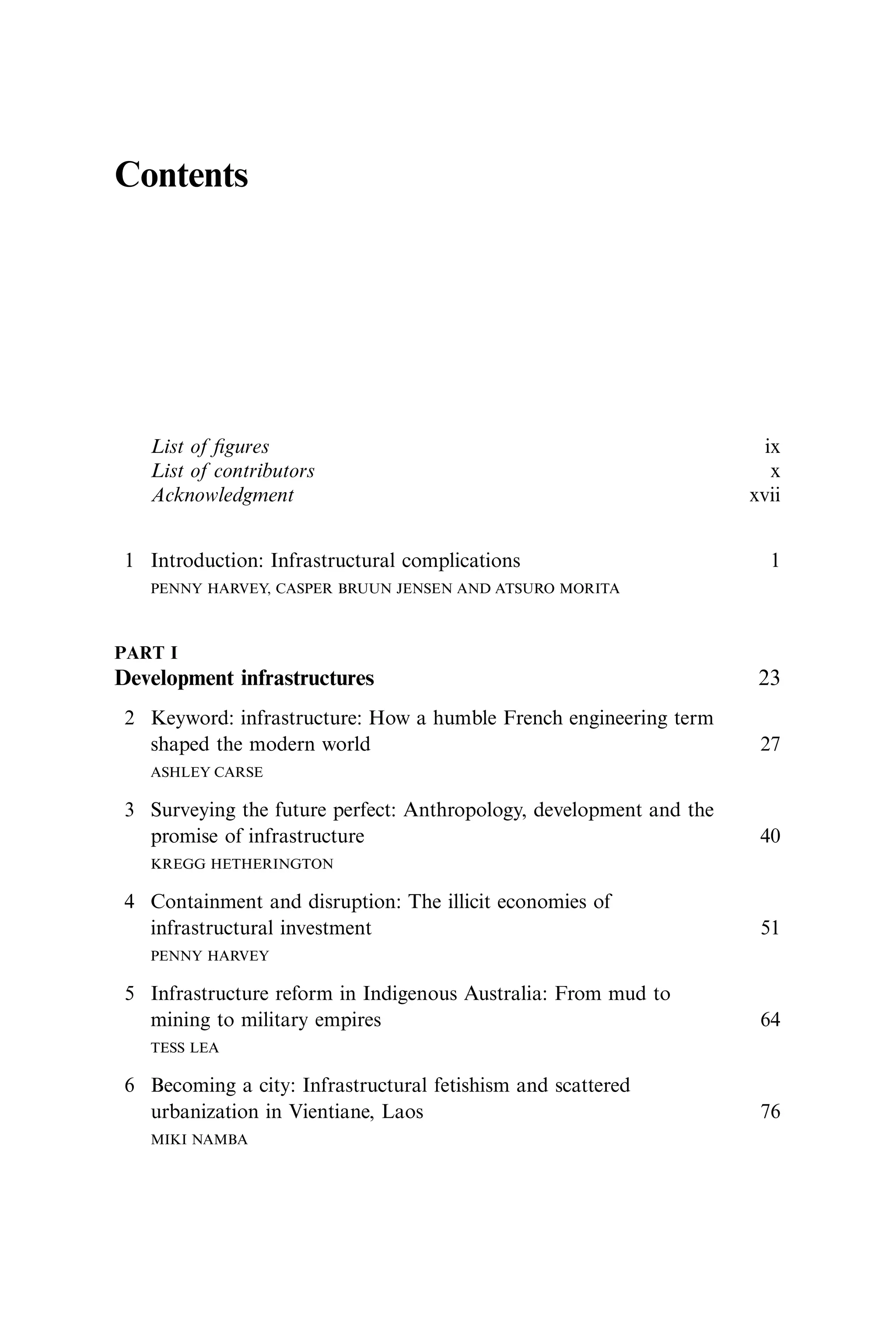
Contents
List of figures ix
List of contributors x
Acknowledgment xvii
1 Introduction: Infrastructural complications 1
PENNY HARVEY, CASPER BRUUN JENSEN AND ATSURO MORITA
PART I
Development infrastructures 23
2 Keyword: infrastructure: How a humble French engineering term
shaped the modern world 27
ASHLEY CARSE
3 Surveying the future perfect: Anthropology, development and the
promise of infrastructure 40
KREGG HETHERINGTON
4 Containment and disruption: The illicit economies of
infrastructural investment 51
PENNY HARVEY
5 Infrastructure reform in Indigenous Australia: From mud to
mining to military empires 64
TESS LEA
6 Becoming a city: Infrastructural fetishism and scattered
urbanization in Vientiane, Laos 76
MIKI NAMBA
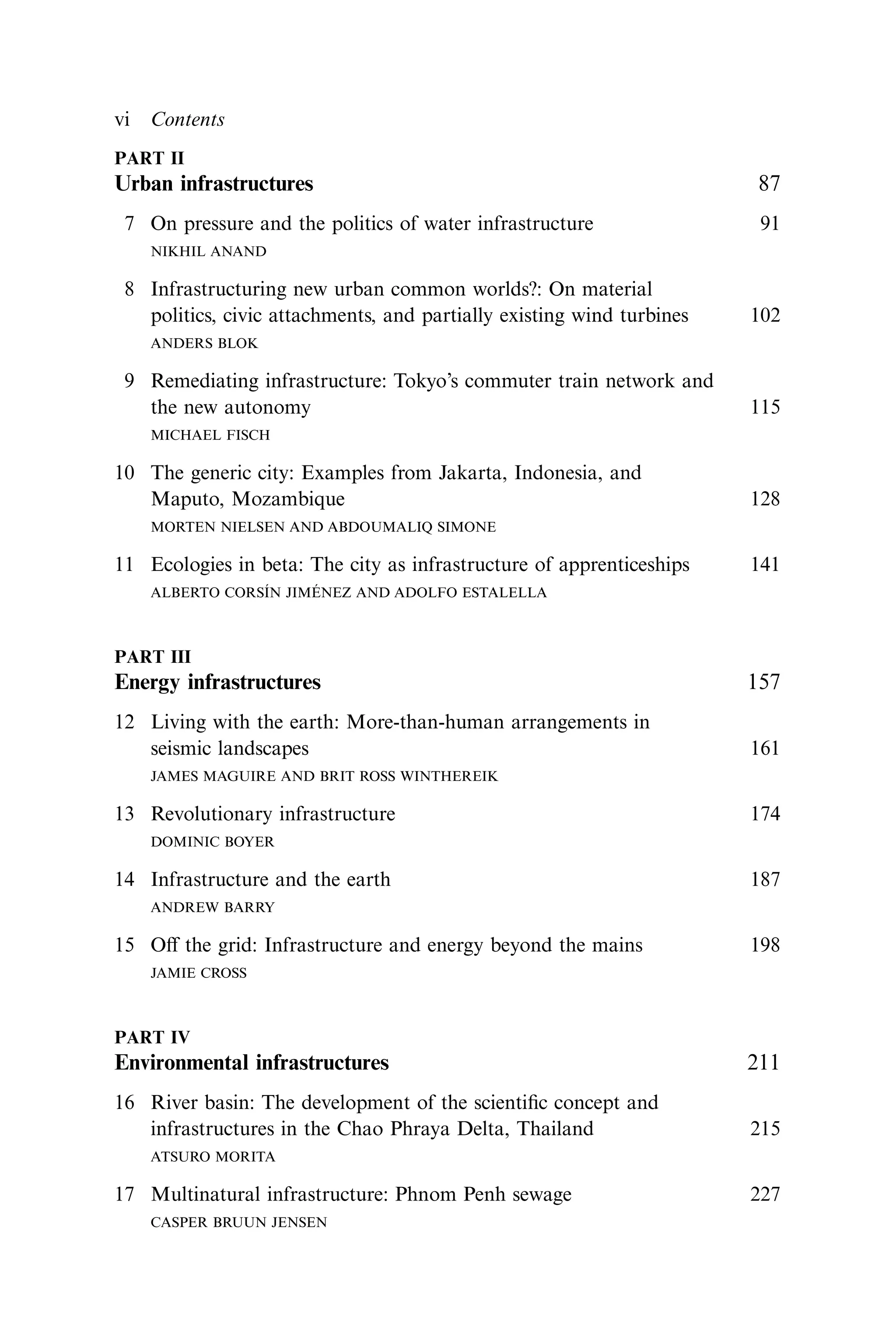
PART II
Urban infrastructures 87
7 On pressure and the politics of water infrastructure 91
NIKHIL ANAND
8 Infrastructuring new urban common worlds?: On material
politics, civic attachments, and partially existing wind turbines 102
ANDERS BLOK
9 Remediating infrastructure: Tokyo’s commuter train network and
the new autonomy 115
MICHAEL FISCH
10 The generic city: Examples from Jakarta, Indonesia, and
Maputo, Mozambique 128
MORTEN NIELSEN AND ABDOUMALIQ SIMONE
11 Ecologies in beta: The city as infrastructure of apprenticeships 141
ALBERTO CORSÍN JIMÉNEZ AND ADOLFO ESTALELLA
PART III
Energy infrastructures 157
12 Living with the earth: More-than-human arrangements in
seismic landscapes 161
JAMES MAGUIRE AND BRIT ROSS WINTHEREIK
13 Revolutionary infrastructure 174
DOMINIC BOYER
14 Infrastructure and the earth 187
ANDREW BARRY
15 Off the grid: Infrastructure and energy beyond the mains 198
JAMIE CROSS
PART IV
Environmental infrastructures 211
16 River basin: The development of the scientific concept and
infrastructures in the Chao Phraya Delta, Thailand 215
ATSURO MORITA
17 Multinatural infrastructure: Phnom Penh sewage 227
CASPER BRUUN JENSEN
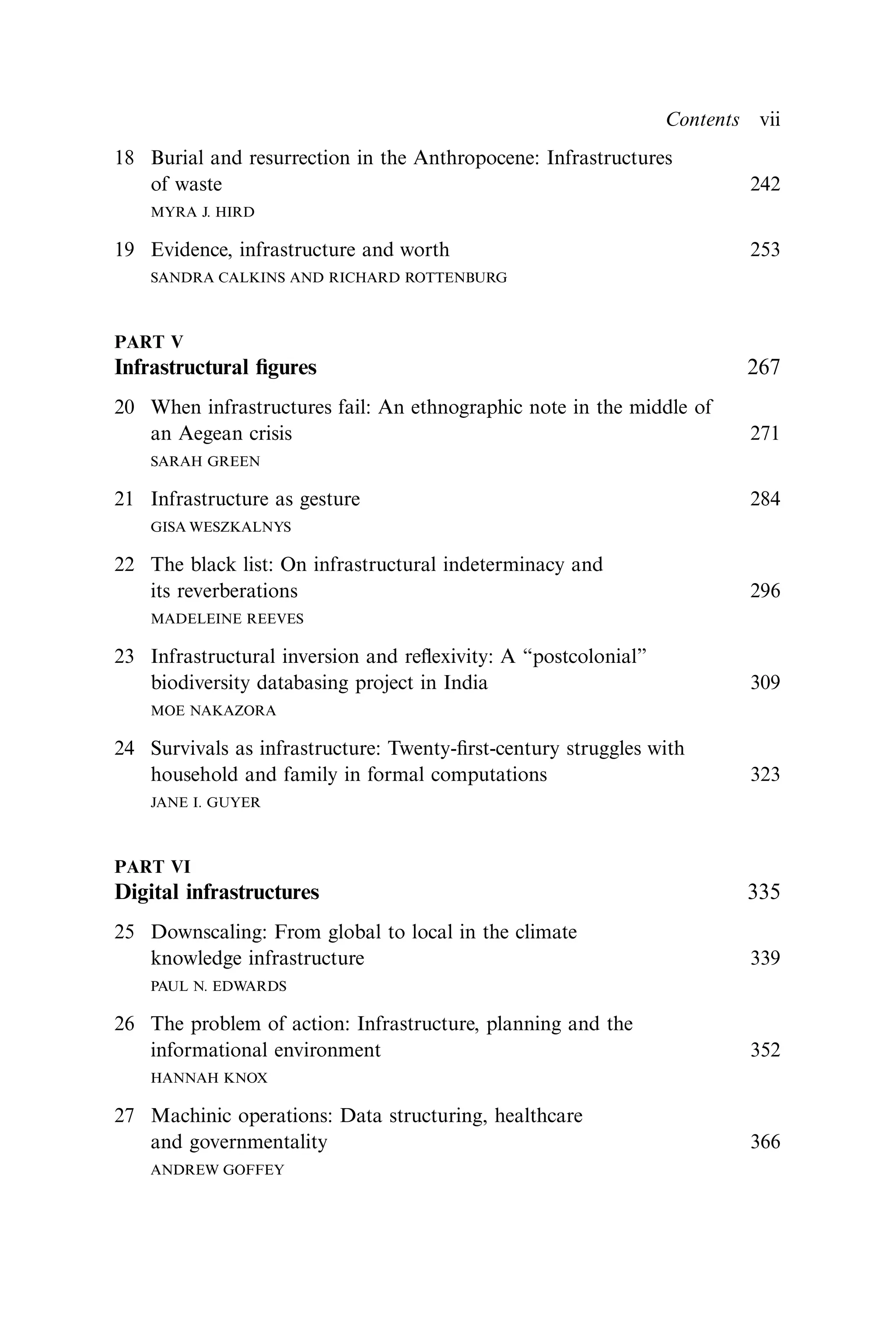
vi Contents
18 Burial and resurrection in the Anthropocene: Infrastructures
of waste 242
MYRA J. HIRD
19 Evidence, infrastructure and worth 253
SANDRA CALKINS AND RICHARD ROTTENBURG
PART V
Infrastructural figures 267
20 When infrastructures fail: An ethnographic note in the middle of
an Aegean crisis 271
SARAH GREEN
21 Infrastructure as gesture 284
GISA WESZKALNYS
22 The black list: On infrastructural indeterminacy and
its reverberations 296
MADELEINE REEVES
23 Infrastructural inversion and reflexivity: A “postcolonial”
biodiversity databasing project in India 309
MOE NAKAZORA
24 Survivals as infrastructure: Twenty-first-century struggles with
household and family in formal computations 323
JANE I. GUYER
PART VI
Digital infrastructures 335
25 Downscaling: From global to local in the climate
knowledge infrastructure 339
PAUL N. EDWARDS
26 The problem of action: Infrastructure, planning and the
informational environment 352
HANNAH KNOX
27 Machinic operations: Data structuring, healthcare
and governmentality 366
ANDREW GOFFEY
Contents vii
28 Infrastructures in name only?: Identifying effects of depth
and scale 379
ADRIAN MACKENZIE
29 How knowledge infrastructures learn 391
GEOFFREY C. BOWKER
Index 404
viii Contents
List of figures
8.1 Kids decorating the blade of a wind turbine in Copenhagen’s
town hall square 103
8.2 Counter-visualization of wind turbines from concerned
public group 108
9.1 A section from a daiya representing two hours of train traffic on
one train line 118
9.2 Diagram comparing the former centralized system with the
contemporary decentralized system 121
11.1 Congealed affects 142
11.2 (a) and (b) Two views of The Urban Parliament by Zuloark 143
11.3 Atlas table map 144
11.4 Pictogramas by Iconoclasistas, a portfolio of creative commons
licenced ideograms used to facilitate community storytelling
and cartographies 148
11.5 Inteligencia colectiva, a public domain self-archival project on
do-it-yourself, grassroots, retrofitted architectural designs 150
12.1 Wellhead and geologist on the day of the awakening 161
13.1 Map of major natural gas and oil pipelines in the United States 179
17.1 Entering the Phnom Penh sewer system 229
17.2 Inside the sewage pipe 230
17.3 Rebuilding a sedimentation chamber 231
17.4 Entering the pumping channel 238
17.5 Underneath the pumping station at Phnom Penh riverside 239
17.6 Cockroach colony living inside flooding infrastructure 239
20.1 Aylan Kurdi’s body being carried by Mehmet Ciplak, the
Turkish police officer 273
20.2 Antonis Deligiorgis saving Wegasi Nebiat on 20 April 2015 273
26.1 Screen shot of image from Covenant of Mayors website 353
26.2 Aims and objectives of the Green Digital Project 357
26.3 Overview of action fields for Green Digital Charter (GDC)
implementation 361
28.1 The most popular repositories on Github in 2014 383
29.1 Diagram of infrastructural dimensions 392
Contributors
Nikhil Anand is Assistant Professor of Anthropology at the University of
Pennsylvania. His research focuses on the political ecology of urban infra-
structures and the social and material relations that they entail. Through
ethnographic research, he examines how natures, technologies, and specific
gatherings of experts and publics are mobilized to effect environmental
projects and relations of difference in postcolonial cities. His first book,
Hydraulic City (Duke University Press, 2017), explores how cities and
citizens are made through the everyday maintenance of water infra-
structures in Mumbai. His work has been published in Public Culture,
Cultural Anthropology, Antipode, and Ethnography.
Andrew Barry is Chair of Human Geography at University College London.
His most recent books are Material Politics: Disputes along the Pipeline
(2013) and Interdisciplinarity: Reconfigurations of the Social and Natural
Sciences (2013). He is currently interested in the geography of chemicals.
Anders Blok is Associate Professor in Sociology at the University of Copen-
hagen, Denmark. His current research inquires into the knowledge politics
of urban environmental change in Europe and East Asia. He has published
widely within science and technology studies (STS), urban studies, envir-
onmental sociology and social theory, and he is co-author (with Torben E.
Jensen) of Bruno Latour: Hybrid Thoughts in a Hybrid World (Routledge,
2011).
Geoffrey C. Bowker is Professor at the School of Information and Computer
Science, University of California at Irvine, where he directs the Evoke
Laboratory, which explores new forms of knowledge expression. Together
with Susan Leigh Star he wrote Sorting Things Out: Classification and its
Consequences; his most recent books are Memory Practices in the Sciences
and (with Stefan Timmermans, Adele Clarke, and Ellen Balka) the edited
collection: Boundary Objects and Beyond: Working with Leigh Star. He is
currently working on big data policy and on scientific cyberinfrastructure;
as well as completing a book on social readings of data and databases. He
is a founding member of the Council for Big Data, Ethics and Society.
Dominic Boyer is Professor of Anthropology at Rice University and Founding
Director of the Center for Energy and Environmental Research in the
Human Sciences (CENHS, culturesofenergy.org). He is part of the editorial
collective of the journal Cultural Anthropology (2015–2018) and edits the
Expertise: Cultures and Technologies of Knowledge book series for Cornell
University Press. His most recent monograph is The Life Informatic:
Newsmaking in the Digital Era (Cornell University Press, 2013). With James
Faubion and George Marcus, he has recently edited Theory can be more than
it used to be (Cornell University Press, 2015) and with Imre Szeman has
developed The Energy Humanities Reader for Johns Hopkins University
Press. His next book, Energopolitics, with Cymene Howe, will explore the
complexities of wind power development in southern Mexico.
Sandra Calkins holds a PhD in Anthropology from the University of Leipzig.
She is a research fellow at the Max Planck Institute for Social Anthropology
and a member of the Law, Organization, Science and Technology Group at
the University of Halle. Her previous research explored connections
between indeterminacy, reflexivity, and ordering (Who Knows Tomorrow?
Uncertainty in Northeastern Sudan, Berghahn, 2016). Her current project
examines modalities of evidence production about biofortification, an
agricultural public health strategy to ameliorate micronutrient deficiencies.
Ashley Carse, an anthropologist, is Assistant Professor of Human and Orga-
nizational Development at Vanderbilt University. He is the author of
Beyond the Big Ditch: Politics, Ecology, and Infrastructure at the Panama
Canal (MIT Press, 2014).
Alberto Corsín Jiménez is Reader in Social Anthropology in the Department
of the History of Science at the Spanish National Research Council in
Madrid. He has an interest in the organization of ethnography and
anthropological knowledge as descriptive and theoretical forms. He
recently finished a book, A Trompe L'oeil Anthropology for a Common
World (Berghahn, 2013). He is the editor of Prototyping Cultures: Art,
Science and Politics in Beta (Routledge, 2016), Culture and Well-Being:
Anthropological Approaches to Freedom and Political Ethics (Pluto, 2008),
and The Anthropology of Organisations (Ashgate, 2007). His current work
examines the rise of an urban commons movement and the development of
open-source urban hardware projects by architects, artists, and engineers.
Jamie Cross is Senior Lecturer in Social Anthropology and Director of the
Global Development Academy at the University of Edinburgh. He is the
author of Dream Zones: Anticipating Capitalism and Development in India
(2014, Pluto Press).
Paul N. Edwards is Professor of Information and History at the University of
Michigan. He writes and teaches on the history and politics of knowledge
and information infrastructures. Edwards is the author of A Vast Machine:
List of contributors xi
Computer Models, Climate Data, and the Politics of Global Warming (MIT
Press, 2010) and The Closed World: Computers and the Politics of Dis-
course in Cold War America (MIT Press, 1996), and co-editor of Changing
the Atmosphere: Expert Knowledge and Environmental Governance (MIT
Press, 2001), as well as numerous articles.
Adolfo Estalella is an anthropologist and postdoctoral researcher at the
Spanish National Research Council (CSIC). His research dialogues with
the Anthropology of knowledge and Science and Technology Studies (STS).
Grassroots urbanism and digital cultures are the two main topics of
inquiry he have carried out in the last years by investigating the Indignados/
15M movement (the Spanish Occupy movement) and a diversity of civic
projects of urban intervention in Madrid (Spain).
Michael Fisch is an Assistant Professor in the Department of Anthropology at
the University of Chicago. His work is situated at the intersection of
sociocultural anthropology and science and technology studies and looks
at the dynamic between changing conceptualizations of nature, culture,
and technological innovation. He is currently finishing an ethnography of
Tokyo’s train infrastructure entitled An Anthropology of the Machine: Tokyo’s
Commuter Train Network. In addition, he is conducting new research
around the development of and opposition to disaster infrastructure in
northeast Japan.
Andrew Goffey is an Associate Professor and Director of the Centre for Cri-
tical Theory at the University of Nottingham. He is the author (with
Matthew Fuller) of Evil Media, the editor (with Eric Alliez) of The Guat-
tari Effect and (with Roland Faber) of The Allure of Things. He is currently
writing books on the politics of software and the work of Félix Guattari
and is doing research on institutional analysis and the materiality of
information. He is also the translator of numerous works in the fields of
philosophy and critical theory, including In Catastrophic Times and Capi-
talist Sorcery (by Isabelle Stengers) and Schizoanalytic Cartographies and
Lines of Flight by Félix Guattari.
Sarah Green is Professor of Social and Cultural Anthropology at the Uni-
versity of Helsinki. She is interested in the dynamics of location, particu-
larly questions of establishing where people are as opposed to who they
are. In earlier years this focused around questions of the politics of gender
and sexuality; later, on the introduction of digital technologies to people’s
spatial lives. For many years since then she has been studying the logic of
borders in the Balkan and European regions more widely and the relative
locations involved (Notes from the Balkans, 2005). More recently, she has
shifted her attention to the Aegean and is studying how locations overlap
and the relations and separations between locations.
xii List of contributors
Jane I. Guyer retired in 2015 from her position as George Armstrong Kelly
Professor in the Department of Anthropology, Johns Hopkins University,
and moved to membership in the Academy at Hopkins. Trained at under-
graduate level at the London School of Economics, and at graduate level
at the University of Rochester, her full-time academic career moved from
Harvard, to Boston University, to the Directorship of the Program of
African Studies at Northwestern University, and finally to Johns Hopkins
University. Her research and publications have focused on livelihoods and
money, from an empirical focus on West and Central Africa (Nigeria and
Cameroon). She was elected to the National Academy of Sciences in 2008.
Penny Harvey is Professor of Social Anthropology at the University of Man-
chester. She co-directed the ESRC Centre for Research on Socio-Cultural
Change. She has done ethnographic fieldwork in Peru, Spain, and the UK
and published widely on language and communication, technology, engi-
neering practice, and material politics. Recent publications include Roads:
An Anthropology of Infrastructure and Expertise (with Hannah Knox),
(Cornell University Press, 2015); Objects and Materials: A Routledge Com-
panion (edited with Hannah Knox and CRESC colleagues) (Routledge,
2013); Roads and Anthropology: Ethnography, Infrastructures, (Im)mobility
(edited with Dimitris Dalakoglou) (Routledge, 2014). She is co-writing a
book with Deborah Poole on decentralization in Peru entitled Experimental
States.
Kregg Hetherington is Professor of Anthropology at Concordia University in
Montreal. His research focuses on environment, infrastructure, bureau-
cracy, and rural social movements. His most recent book is Guerrilla
Auditors: The Politics of Transparency in Neoliberal Paraguay and he has
recent articles in American Ethnologist, Cultural Anthropology, Economy
and Society, among others. He is currently editing a book on Infrastructure,
Environment and Life in the Anthropocene and is leading new research on
energy transitions and sovereignty in Quebec.
Myra J. Hird is Professor, Queen’s National Scholar and FRSC in the School
of Environmental Studies, Queen’s University, Canada (www.myrahird.
com). She is Director of Canada’s Waste Flow, an interdisciplinary
research project focused on waste as a global scientific-technical and socio-
ethical issue (www.wasteflow.ca), and Director of the genera Research
Group (gRG), an interdisciplinary research network of collaborating nat-
ural, social, and humanities scholars focused on the topic of waste. Hird
has published eight books and over sixty articles and book chapters on a
diversity of topics relating to science studies.
Casper Bruun Jensen is Senior Researcher at Osaka University and Honorary
Lecturer at Leicester University. He is the author of Ontologies for Devel-
oping Things (Sense, 2010) and Monitoring Movements in Development Aid
(with Brit Ross Winthereik) (MIT, 2013) and the editor of Deleuzian
List of contributors xiii
Intersections: Science, Technology, Anthropology with Kjetil Rödje (Berghahn,
2009). His present work focuses on delta ontologies and environmental
infrastructures in Southeast Asia.
Hannah Knox is a Lecturer in Anthropology at University College London.
Her research looks at the interplay between technology, materiality, and
social change and she has conducted fieldwork in the UK and Peru. Her
publications include two books: Objects and Materials: A Routledge Com-
panion and Roads: An Anthropology of Infrastructure and Expertise. Her
current work is exploring the cultural politics of climate change mitigation.
Tess Lea is an anthropologist at the University of Sydney, specializing in the
anthropology of policy and the ethnography of infrastructure. She is the
author of Bureaucrats and Bleeding Hearts (UNSW, 2008) and Darwin (New
South, 2014). Her fundamental interest is with issues of (dys)function: how
it occurs and to what, whom, and how it is ascribed. Looking at social
housing, infrastructure, schools, and efforts to create culturally congruent
forms of employment, home indebtedness, and enterprise from the respec-
tive points of view of policy formulators, service delivery organizations,
contractors, and Indigenous families, her work asks why the path to realizing
seemingly shared ambitions is so densely obstacled.
Adrian Mackenzie (Professor in Technological Cultures, Department of
Sociology, Lancaster University) has published work on technology:
Transductions: Bodies and Machines at Speed, (2002/6); Cutting Code:
Software and Sociality (2006); and Wirelessness: Radical Empiricism in
Network Cultures (2010). He is currently working on an archaeology of
machine learning and its associated transformations. He co-directs the
Centre for Science Studies, Lancaster University, UK.
James Maguire is a PhD Fellow at the IT University of Copenhagen, where
he is part of a broader research collective called Alien Energy. James is
currently writing up his PhD dissertation after conducting ten months of
fieldwork in a volcanic zone in the south-west of Iceland. His work mainly
focuses on geothermal energy as a specific configuration of human–earth
relations in the anthropocene.
Atsuro Morita teaches anthropology at Osaka University. He has done eth-
nographic research on technology development in Thailand, focusing on
how ideas, artifacts, and people travel in and out of Thailand. He is
recently co-convening a Japan–Denmark collaborative project titled
Environmental Infrastructures funded by the Japan Society for Promotion
of Science. In this project he studies the co-existence of heterogeneous
components – including cosmological scientific and multispecies ones – of
the water management infrastructure in the Chao Phraya Delta.
Moe Nakazora is currently a postdoctoral research fellow of the Japan
Society for Promotion of Science (JSPS) and an affiliate of the Institute for
xiv List of contributors
Research in the Humanities at Kyoto University. Her main fields of interest
are the anthropology of science, technology, and medicine; critical legal
studies; and South Asian area studies. Her research contributes to the
understanding of ‘biodiversity’ as a site of encounter between modern sci-
ence and indigenous knowledge as well as postcolonial engagements with
intellectual property. In two years of field research in India she has pursued
these themes by examining Indian state actors’ attempts to database
traditional medical knowledge related to biodiversity.
Miki Namba is a doctoral candidate in anthropology at Hitotsubashi Uni-
versity and a research fellow of the Japan Society for the Promotion of
Science (JSPS). Her research focuses on complex relation between infra-
structural development, urban formation, and modernity in Laos. Her
work is forthcoming in Transnational Frontiers of Asia and Latin America
from 1800, eds J. Moneiro Tejada and B. Tatar (Routledge).
Morten Nielsen is an Associate Professor in the Department of Anthropology
at Aarhus University and coordinator of the interdisciplinary research
network Urban Orders (URO). Based on his fieldwork in Brazil, Mozam-
bique, and, most recently, Scotland, he has published on issues such as
urban citizenship, time and temporality, urban aesthetics, materiality,
infrastructure, and political cosmologies. Recent publications include arti-
cles in the Journal of the Royal Anthropological Institute, HAU: Journal of
Ethnographic Theory, Social Analysis, and Social Anthropology.
Madeleine Reeves is Senior Lecturer in Social Anthropology at the University
of Manchester and a member of the ESRC Centre for Research on Socio-
Cultural Change. Her interests lie in the anthropology of politics, space,
and (im)mobility. She is the author of Border Work: Spatial Lives of the
State in Rural Central Asia (Cornell, 2014), and the co-editor, most
recently, of Affective States: Entanglements, Suspensions, Suspicions (Social
Analysis, 2015), with Mateusz Laszczkowski.
Richard Rottenburg holds a chair in anthropology at the University of Halle,
where he directs a research group focusing on the anthropology of ‘Law,
Organization, Science and Technology’ (LOST). Inspired by STS and renditions
of pragmatist social theory, the emergence of material-semiotic orderings
and their institutionalizations are at the heart of his current work. These
inquiries center stage evidentiary practices (experiments, tests, measurements)
and multilayered infrastructures, which solidify and circulate evidence, and
ask how it is mobilized to design and critique specific futures.
AbdouMaliq Simone is an urbanist and currently Research Professor at the
Max Planck Institute for the Study of Religious and Ethnic Diversity and a
Visiting Professor at Goldsmiths College and the African Centre for Cities,
University of Cape Town. His work concerns the relationship between
emerging forms of urban collective life and political institutions.
List of contributors xv
Gisa Weszkalnys is Assistant Professor in anthropology at the London School
of Economics. She is author of Berlin, Alexanderplatz: Transforming Place
in a Unified Germany (2010) and co-editor of Elusive Promises: Planning in
the Contemporary World (2013). Her current research deals with specula-
tion, potentiality, and absence in the context of an emerging West African
oil economy.
Brit Ross Winthereik is Associate Professor at the IT University of Copen-
hagen in the Technologies in Practice faculty group and the author of
Monitoring Movements in Development Aid with Casper Bruun Jensen
(MIT, 2013). She is lead investigator of Marine Renewable Energy as
Alien: Social Studies of an Emerging Industry with Laura Watts and Head
of the ETHOS Lab – an experimental space for ethnography of/through
the digital. She has published on ethnographic methods, accountability,
information infrastructures, ontology, and critique.
xvi List of contributors
Acknowledgment
Our collaboration began with a visit by Casper Bruun Jensen and Atsuro
Morita to the University of Manchester to participate in a workshop that
Penny Harvey was running on ‘Infrastructures of Social Change.’ That
meeting and our subsequent discussions on putting together a joint publica-
tion were possible thanks to the networks of funding and of collaboration
that had supported our individual research trajectories. Our key sources of
funding have been the UK Economic and Social Research Council (CRESC),
which funded the ESRC Centre for Research on Socio-Cultural Change, and
the Japan Society for Promotion of Science (JSPS), which funded the Envir-
onmental Infrastructures project (KAKENHI-24251017). We are also grateful
to the Institute for Research in Humanities, Kyoto University, whose funding
enabled us to work intensively together in Japan on the collection in the
summer of 2015.
Beyond these general funding possibilities we have, as ever, many intellec-
tual debts. Penny Harvey would like in particular to thank her colleagues
from CRESC. Here our research group, which went by the name of Theme 4,
was formally configured to study “Politics of Cultural Change”, then
“Topologies of Cultural Change” and most recently “Infrastructures of Social
Change”. Theme 4 continues to be a wonderful space for dialogue and
exploration. Some of the key figures from that group are in this publication:
Hannah Knox, Madeleine Reeves, Adolfo Estalella, and Sarah Green. Others
whose influence is strong and much appreciated are Eleanor Casella, Damian
O’Doherty, Gillian Evans, Christine McLean, Elizabeth Silva, Nick Thoburn,
and Kath Woodward. We are already taking our infrastructural work forward
into new conversations on mega-projects.
CRESC also had a research group known as SLOM or the Social Life of
Methods. Evelyn Ruppert was a key member of that group and in collabora-
tion with Hannah Knox she initiated a project on ‘Socializing Big Data’ that
experimented with new methods of collaborative research, staging conversa-
tions with genomic scientists, national statisticians, and waste management
practitioners, opening new horizons for thinking about digital infrastructures.
Key collaborators on that project were Adrian Mackenzie, Ruth McNally,
Celia Lury, Stephanie Barker, Camilla Lewis, and Yannis Kallianos.
As infrastructures began to take off as a topic of anthropological interest,
Penny has also had the chance to work closely with other colleagues who have
opened the field up in wonderful ways. Nikhil Anand, Hannah Appel, and
Akhil Gupta convened a SAR seminar on the ‘Promise of Infrastructure’ that
allowed us a generous five days to live, think, and talk infrastructure in the
company of Brian Larkin, Antina von Schnitzler, Christina Schwenkel, Cassie
Fennell, Geof Bowker, and Dominic Boyer. The support for these seminars
from the School for Advanced Research is invaluable, and shows that you can
learn a great deal while having fun!
Atsuro Morita and Casper Bruun Jensen would like in particular to thank
the colleagues in the ‘Environmental Infrastructures’ project, Brit Ross Win-
thereik, Anders Blok, Keiichi Omura, Miho Ishii, Shuhei Kimura, Osamu
Nakagawa, Keiichiro Matsumura, and Moe Nakazora. Some of these names
are found in this publication. Our view of infrastructure has dramatically
expanded through discussions with many stimulating scholars who joined the
project’s workshops. Among them, Atsuro and Casper particularly thank
Eduardo Viveiros de Castro, Natasha Myers, Mei Zhan, Marilyn Strathern,
Geof Bowker, Andrew Pickering, Hugh Raffles, Marisol de la Cadena, Kregg
Hetherington, Shiho Satsuka, Rebecca Empson, Jakkrit Sangkhamanee,
Arjen Zegwaard, Mohacsi Gergely, Wakana Suzuki, Liv Nyland Krause,
Miki Namba, and Fukachi Furukawa. Atsuro and Casper’s thanks also go to
the professors and the secretaries of the Department of Anthropology and
administrators of the School of Human Sciences, Osaka University, whose
generous support made all these international workshops and the collaboration
for this publication possible.
Last but not least we are grateful to Gerhard Boomgaarden for his ongoing
support of the CRESC series at Routledge, to Tony Bennett for his collegial
support, and to Alyson Claffey for her wonderful attention to detail.
xviii Acknowledgment
1 Introduction
Infrastructural complications
Penny Harvey, Casper Bruun Jensen and
Atsuro Morita
Over the past decade, infrastructures have emerged as compelling sites for
qualitative social research. This occurs in a general situation where the race
for infrastructural investment has become quite frenzied as world superpowers
compete for the most effective means to circulate energy, goods, and money.
At the same time, millions of people disenfranchised by trade corridors,
securitized production sites, and privatized service provision seek to establish
their own possibilities that intersect, disrupt, or otherwise engage the high-
level investments that now routinely reconfigure their worlds. The projects of
the powerful and the engagements of the poor are thus thoroughly entangled
in this contemporary drive to “leverage the future.”1
The study of infrastructure can lead researchers in multiple directions. Some
take an interest in embedded power relations or their symbolic or spectacular
dimensions. Others focus on the effects of categorization and standardizations
and the modes of support and connectivity enabled by infrastructural sys-
tems, including the reconfigurations of the lives and subjectivities of those
who live in and around them. Yet others emphasize their scale-making capa-
cities, their recursive, or loopy, relations with social formations, and their role
in the emergence of new ontologies. This volume offers a compendium of
approaches to this increasingly populated field of social research.
For obvious reasons, the selection is far from comprehensive. This intro-
ductory essay discusses a range of issues that we have been particularly
interested in, and engaged by. At the end, we set out the principles that have
guided the selection of contributions, some of which are written by estab-
lished figures, many others by new voices. Our hope is that others will find
inspiration and their own sense of possibility for engaging what can appear as vast,
uncontainable networks that may be resistant to established social methods. The
aim is to exhibit a range of ways to examine the textures, social complexities,
and complications of infrastructure.
The volume grew out of overlaps that appeared between two research
groups, one affiliated with the Centre for Research on Socio-Cultural Change
(CRESC) based at the University of Manchester and the Open University in
the UK and one centered at Osaka University in Japan, in collaboration with
Danish researchers at the IT University of Copenhagen and the University of
Other documents randomly have
different content
with active links or immediate access to the full terms of the Project
Gutenberg™ License.
1.E.6. You may convert to and distribute this work in any binary,
compressed, marked up, nonproprietary or proprietary form,
including any word processing or hypertext form. However, if you
provide access to or distribute copies of a Project Gutenberg™ work
in a format other than “Plain Vanilla ASCII” or other format used in
the official version posted on the official Project Gutenberg™ website
(www.gutenberg.org), you must, at no additional cost, fee or
expense to the user, provide a copy, a means of exporting a copy, or
a means of obtaining a copy upon request, of the work in its original
“Plain Vanilla ASCII” or other form. Any alternate format must
include the full Project Gutenberg™ License as specified in
paragraph 1.E.1.
1.E.7. Do not charge a fee for access to, viewing, displaying,
performing, copying or distributing any Project Gutenberg™ works
unless you comply with paragraph 1.E.8 or 1.E.9.
1.E.8. You may charge a reasonable fee for copies of or providing
access to or distributing Project Gutenberg™ electronic works
provided that:
• You pay a royalty fee of 20% of the gross profits you derive
from the use of Project Gutenberg™ works calculated using the
method you already use to calculate your applicable taxes. The
fee is owed to the owner of the Project Gutenberg™ trademark,
but he has agreed to donate royalties under this paragraph to
the Project Gutenberg Literary Archive Foundation. Royalty
payments must be paid within 60 days following each date on
which you prepare (or are legally required to prepare) your
periodic tax returns. Royalty payments should be clearly marked
as such and sent to the Project Gutenberg Literary Archive
Foundation at the address specified in Section 4, “Information
about donations to the Project Gutenberg Literary Archive
Foundation.”
• You provide a full refund of any money paid by a user who
notifies you in writing (or by e-mail) within 30 days of receipt
that s/he does not agree to the terms of the full Project
Gutenberg™ License. You must require such a user to return or
destroy all copies of the works possessed in a physical medium
and discontinue all use of and all access to other copies of
Project Gutenberg™ works.
• You provide, in accordance with paragraph 1.F.3, a full refund of
any money paid for a work or a replacement copy, if a defect in
the electronic work is discovered and reported to you within 90
days of receipt of the work.
• You comply with all other terms of this agreement for free
distribution of Project Gutenberg™ works.
1.E.9. If you wish to charge a fee or distribute a Project Gutenberg™
electronic work or group of works on different terms than are set
forth in this agreement, you must obtain permission in writing from
the Project Gutenberg Literary Archive Foundation, the manager of
the Project Gutenberg™ trademark. Contact the Foundation as set
forth in Section 3 below.
1.F.
1.F.1. Project Gutenberg volunteers and employees expend
considerable effort to identify, do copyright research on, transcribe
and proofread works not protected by U.S. copyright law in creating
the Project Gutenberg™ collection. Despite these efforts, Project
Gutenberg™ electronic works, and the medium on which they may
be stored, may contain “Defects,” such as, but not limited to,
incomplete, inaccurate or corrupt data, transcription errors, a
copyright or other intellectual property infringement, a defective or
damaged disk or other medium, a computer virus, or computer
codes that damage or cannot be read by your equipment.
1.F.2. LIMITED WARRANTY, DISCLAIMER OF DAMAGES - Except for
the “Right of Replacement or Refund” described in paragraph 1.F.3,
the Project Gutenberg Literary Archive Foundation, the owner of the
Project Gutenberg™ trademark, and any other party distributing a
Project Gutenberg™ electronic work under this agreement, disclaim
all liability to you for damages, costs and expenses, including legal
fees. YOU AGREE THAT YOU HAVE NO REMEDIES FOR
NEGLIGENCE, STRICT LIABILITY, BREACH OF WARRANTY OR
BREACH OF CONTRACT EXCEPT THOSE PROVIDED IN PARAGRAPH
1.F.3. YOU AGREE THAT THE FOUNDATION, THE TRADEMARK
OWNER, AND ANY DISTRIBUTOR UNDER THIS AGREEMENT WILL
NOT BE LIABLE TO YOU FOR ACTUAL, DIRECT, INDIRECT,
CONSEQUENTIAL, PUNITIVE OR INCIDENTAL DAMAGES EVEN IF
YOU GIVE NOTICE OF THE POSSIBILITY OF SUCH DAMAGE.
1.F.3. LIMITED RIGHT OF REPLACEMENT OR REFUND - If you
discover a defect in this electronic work within 90 days of receiving
it, you can receive a refund of the money (if any) you paid for it by
sending a written explanation to the person you received the work
from. If you received the work on a physical medium, you must
return the medium with your written explanation. The person or
entity that provided you with the defective work may elect to provide
a replacement copy in lieu of a refund. If you received the work
electronically, the person or entity providing it to you may choose to
give you a second opportunity to receive the work electronically in
lieu of a refund. If the second copy is also defective, you may
demand a refund in writing without further opportunities to fix the
problem.
1.F.4. Except for the limited right of replacement or refund set forth
in paragraph 1.F.3, this work is provided to you ‘AS-IS’, WITH NO
OTHER WARRANTIES OF ANY KIND, EXPRESS OR IMPLIED,
INCLUDING BUT NOT LIMITED TO WARRANTIES OF
MERCHANTABILITY OR FITNESS FOR ANY PURPOSE.
1.F.5. Some states do not allow disclaimers of certain implied
warranties or the exclusion or limitation of certain types of damages.
If any disclaimer or limitation set forth in this agreement violates the
law of the state applicable to this agreement, the agreement shall be
interpreted to make the maximum disclaimer or limitation permitted
by the applicable state law. The invalidity or unenforceability of any
provision of this agreement shall not void the remaining provisions.
1.F.6. INDEMNITY - You agree to indemnify and hold the Foundation,
the trademark owner, any agent or employee of the Foundation,
anyone providing copies of Project Gutenberg™ electronic works in
accordance with this agreement, and any volunteers associated with
the production, promotion and distribution of Project Gutenberg™
electronic works, harmless from all liability, costs and expenses,
including legal fees, that arise directly or indirectly from any of the
following which you do or cause to occur: (a) distribution of this or
any Project Gutenberg™ work, (b) alteration, modification, or
additions or deletions to any Project Gutenberg™ work, and (c) any
Defect you cause.
Section 2. Information about the Mission
of Project Gutenberg™
Project Gutenberg™ is synonymous with the free distribution of
electronic works in formats readable by the widest variety of
computers including obsolete, old, middle-aged and new computers.
It exists because of the efforts of hundreds of volunteers and
donations from people in all walks of life.
Volunteers and financial support to provide volunteers with the
assistance they need are critical to reaching Project Gutenberg™’s
goals and ensuring that the Project Gutenberg™ collection will
remain freely available for generations to come. In 2001, the Project
Gutenberg Literary Archive Foundation was created to provide a
secure and permanent future for Project Gutenberg™ and future
generations. To learn more about the Project Gutenberg Literary
Archive Foundation and how your efforts and donations can help,
see Sections 3 and 4 and the Foundation information page at
www.gutenberg.org.
Section 3. Information about the Project
Gutenberg Literary Archive Foundation
The Project Gutenberg Literary Archive Foundation is a non-profit
501(c)(3) educational corporation organized under the laws of the
state of Mississippi and granted tax exempt status by the Internal
Revenue Service. The Foundation’s EIN or federal tax identification
number is 64-6221541. Contributions to the Project Gutenberg
Literary Archive Foundation are tax deductible to the full extent
permitted by U.S. federal laws and your state’s laws.
The Foundation’s business office is located at 809 North 1500 West,
Salt Lake City, UT 84116, (801) 596-1887. Email contact links and up
to date contact information can be found at the Foundation’s website
and official page at www.gutenberg.org/contact
Section 4. Information about Donations to
the Project Gutenberg Literary Archive
Foundation
Project Gutenberg™ depends upon and cannot survive without
widespread public support and donations to carry out its mission of
increasing the number of public domain and licensed works that can
be freely distributed in machine-readable form accessible by the
widest array of equipment including outdated equipment. Many
small donations ($1 to $5,000) are particularly important to
maintaining tax exempt status with the IRS.
The Foundation is committed to complying with the laws regulating
charities and charitable donations in all 50 states of the United
States. Compliance requirements are not uniform and it takes a
considerable effort, much paperwork and many fees to meet and
keep up with these requirements. We do not solicit donations in
locations where we have not received written confirmation of
compliance. To SEND DONATIONS or determine the status of
compliance for any particular state visit www.gutenberg.org/donate.
While we cannot and do not solicit contributions from states where
we have not met the solicitation requirements, we know of no
prohibition against accepting unsolicited donations from donors in
such states who approach us with offers to donate.
International donations are gratefully accepted, but we cannot make
any statements concerning tax treatment of donations received from
outside the United States. U.S. laws alone swamp our small staff.
Please check the Project Gutenberg web pages for current donation
methods and addresses. Donations are accepted in a number of
other ways including checks, online payments and credit card
donations. To donate, please visit: www.gutenberg.org/donate.
Section 5. General Information About
Project Gutenberg™ electronic works
Professor Michael S. Hart was the originator of the Project
Gutenberg™ concept of a library of electronic works that could be
freely shared with anyone. For forty years, he produced and
distributed Project Gutenberg™ eBooks with only a loose network of
volunteer support.
Project Gutenberg™ eBooks are often created from several printed
editions, all of which are confirmed as not protected by copyright in
the U.S. unless a copyright notice is included. Thus, we do not
necessarily keep eBooks in compliance with any particular paper
edition.
Most people start at our website which has the main PG search
facility: www.gutenberg.org.
This website includes information about Project Gutenberg™,
including how to make donations to the Project Gutenberg Literary
Archive Foundation, how to help produce our new eBooks, and how
to subscribe to our email newsletter to hear about new eBooks.
Welcome to our website – the ideal destination for book lovers and
knowledge seekers. With a mission to inspire endlessly, we offer a
vast collection of books, ranging from classic literary works to
specialized publications, self-development books, and children's
literature. Each book is a new journey of discovery, expanding
knowledge and enriching the soul of the reade
Our website is not just a platform for buying books, but a bridge
connecting readers to the timeless values of culture and wisdom. With
an elegant, user-friendly interface and an intelligent search system,
we are committed to providing a quick and convenient shopping
experience. Additionally, our special promotions and home delivery
services ensure that you save time and fully enjoy the joy of reading.
Let us accompany you on the journey of exploring knowledge and
personal growth!
ebookultra.com

Infrastructures and Social Complexity A Companion 1° Edition Penelope Harvey (Editor)
  • 1.
    Infrastructures and SocialComplexity A Companion 1° Edition Penelope Harvey (Editor) - PDF Download (2025) https://ebookultra.com/download/infrastructures-and-social- complexity-a-companion-1-edition-penelope-harvey-editor/ Visit ebookultra.com today to download the complete set of ebooks or textbooks

  • 2.
    We have selectedsome products that you may be interested in Click the link to download now or visit ebookultra.com for more options!. Social Complexity and Complex Systems in Archaeology 1st Edition Dries Daems https://ebookultra.com/download/social-complexity-and-complex-systems- in-archaeology-1st-edition-dries-daems/ Family Violence Legal Medical and Social Perspectives 9th Edition Harvey Wallace https://ebookultra.com/download/family-violence-legal-medical-and- social-perspectives-9th-edition-harvey-wallace/ A companion to Jean Renoir 1. publ Edition Renoir https://ebookultra.com/download/a-companion-to-jean-renoir-1-publ- edition-renoir/ Psychological Therapy in Prisons and Other Settings 1 Edition Joel Harvey https://ebookultra.com/download/psychological-therapy-in-prisons-and- other-settings-1-edition-joel-harvey/
  • 3.
    Visual C 2010How to Program 4th Edition 1 29 pdf Paul Deitel https://ebookultra.com/download/visual-c-2010-how-to-program-4th- edition-1-29-pdf-paul-deitel/ Encyclopedia of Social Media and Politics 3 volume set 1st Edition Kerric Harvey https://ebookultra.com/download/encyclopedia-of-social-media-and- politics-3-volume-set-1st-edition-kerric-harvey/ Companion to Social Archaeology Lynn Meskell https://ebookultra.com/download/companion-to-social-archaeology-lynn- meskell/ Language Complexity Typology contact change Studies in Language Companion Series 94th Edition Matti Miestamo https://ebookultra.com/download/language-complexity-typology-contact- change-studies-in-language-companion-series-94th-edition-matti- miestamo/ Starting Out The c3 Sicilian 1st Edition John Emms https://ebookultra.com/download/starting-out-the-c3-sicilian-1st- edition-john-emms/
  • 5.
    Infrastructures and SocialComplexity A Companion 1° Edition Penelope Harvey (Editor) Digital Instant Download Author(s): Penelope Harvey (editor), Casper Bruun Jensen (editor), Atsuro Morita (editor) ISBN(s): 9781138654945, 1138654949 Edition: 1° File Details: PDF, 29.91 MB Year: 2016 Language: english

  • 7.
    Infrastructures and SocialComplexity Contemporary forms of infrastructural development herald alternative futures through their incorporation of digital technologies, mobile capital, international politics, and the promises and fears of enhanced connectivity. In tandem with increasing concerns about climate change and the anthropocene, there is fur- ther an urgency around contemporary infrastructural provision: a concern about its fragility and an awareness that these connective, relational systems significantly shape both local and planetary futures in ways that we need to understand more clearly. Offering a rich set of empirically detailed and con- ceptually sophisticated studies of infrastructural systems and experiments, present and past, contributors to this volume address both the transformative potential of infrastructural systems and their stasis. Covering infrastructural figures – their ontologies, epistemologies, classifications and politics – and spanning development, urban, energy, environmental and information infrastructures, the chapters explore both the promises and failures of infra- structure. Tracing the experimental histories of a wide range of infrastructures and documenting their variable outcomes, the volume offers a unique set of analytical perspectives on contemporary infrastructural complications. These studies bring a systematic empirical and analytical attention to human worlds as they intersect with more-than-human worlds, whether technological or biological. Penny Harvey is Professor of Social Anthropology at the University of Manchester, UK. Casper Bruun Jensen is Associate Professor/Senior Researcher at Osaka University, Japan. Atsuro Morita is Associate Professor in the Department of Anthropology, School of Human Sciences, Osaka University, Japan.
  • 8.
    Culture, Economy andthe Social A new series from CRESC – the ESRC Centre for Research on Socio-Cultural Change Professor Tony Bennett, Social and Cultural Theory, University of Western Sydney; Professor Penny Harvey, Anthropology, Manchester University; Professor Kevin Hetherington, Geography, Open University The Culture, Economy and the Social series is committed to innovative contemporary, comparative and historical work on the relations between social, cultural and economic change. It publishes empirically based research that is the- oretically informed, that critically examines the ways in which social, cultural and economic change is framed and made visible, and that is attentive to perspectives that tend to be ignored or side ined by grand theorizing or epochal accounts of social change. The series addresses the diverse manifestations of con- temporary capitalism, and considers the various ways in which the ‘social’, ‘the cultural’ and ‘the economic’ are apprehended as tangible sites of value and practice. It is explicitly comparative, publishing books that work across disciplinary perspectives, cross-culturally, or across different historical periods. For more info please see: www.routledge.com/CRESC/book-series/CRESC Recent series titles include: Cultural Pedagogies and Human Conduct Edited by Megan Watkins, Greg Noble and Catherine Driscoll Culture as a Vocation Sociology of career choices in cultural management By Vincent Dubois Topologies of power By John Allen Distinctions of the Flesh Social class and the embodiment of inequality By Dieter Vandebroeck Infrastructures and Social Complexity A companion Edited by Penny Harvey, Casper Bruun Jensen and Atsuro Morita Film Criticism as a Cultural Institution Crisis and continuity from the 20th to the 21st century By Huw Walmsley-Evans
  • 9.
    Infrastructures and Social Complexity Acompanion Edited by Penny Harvey, Casper Bruun Jensen and Atsuro Morita Routledge Taylor & Francis Group LONDON AND NEW YORK E·S·R·C ECONOMIC & SOCIAL RESEARCH Centre for Research on C 0 UN C I L Socia-Cultural Change Centre Centre
  • 10.
    First published 2017 byRoutledge 2 Park Square, Milton Park, Abingdon, Oxon OX14 4RN and by Routledge 711 Third Avenue, New York, NY 10017 Routledge is an imprint of the Taylor & Francis Group, an informa business © 2017 Penny Harvey, Casper Bruun Jensen, Atsuro Morita The right of the editors to be identified as the authors of the editorial material, and of the authors for their individual chapters, has been asserted in accordance with sections 77 and 78 of the Copyright, Designs and Patents Act 1988. All rights reserved. No part of this book may be reprinted or reproduced or utilised in any form or by any electronic, mechanical, or other means, now known or hereafter invented, including photocopying and recording, or in any information storage or retrieval system, without permission in writing from the publishers. Trademark notice: Product or corporate names may be trademarks or registered trademarks, and are used only for identification and explanation without intent to infringe. British Library Cataloguing in Publication Data A catalogue record for this book is available from the British Library Library of Congress Cataloging in Publication Data Names: Harvey, Penelope, 1956- editor. | Jensen, Casper Bruun, editor. | Morita, Atsuro, editor. Title: Infrastructures and social complexity : a companion / edited by Penny Harvey, Casper Bruun Jensen, Atsuro Morita. Description: Abingdon, Oxon ; New York, NY : Routledge, 2016. Identifiers: LCCN 2016013854| ISBN 9781138654945 (hardback) | ISBN 9781315622880 (ebook) Subjects: LCSH: Infrastructure (Economics)–Social aspects. | Economic development–Social aspects. | Technological complexity–Social aspects. | Social systems. Classification: LCC HC79.C3 I5247 2016 | DDC 306.3–dc23 LC record available at https://lccn.loc.gov/2016013854 ISBN: 978-1-138-65494-5 (hbk) ISBN: 978-1-315-62288-0 (ebk) Typeset in Times New Roman by Taylor & Francis Books
  • 11.
    Contents List of figuresix List of contributors x Acknowledgment xvii 1 Introduction: Infrastructural complications 1 PENNY HARVEY, CASPER BRUUN JENSEN AND ATSURO MORITA PART I Development infrastructures 23 2 Keyword: infrastructure: How a humble French engineering term shaped the modern world 27 ASHLEY CARSE 3 Surveying the future perfect: Anthropology, development and the promise of infrastructure 40 KREGG HETHERINGTON 4 Containment and disruption: The illicit economies of infrastructural investment 51 PENNY HARVEY 5 Infrastructure reform in Indigenous Australia: From mud to mining to military empires 64 TESS LEA 6 Becoming a city: Infrastructural fetishism and scattered urbanization in Vientiane, Laos 76 MIKI NAMBA
  • 12.
    PART II Urban infrastructures87 7 On pressure and the politics of water infrastructure 91 NIKHIL ANAND 8 Infrastructuring new urban common worlds?: On material politics, civic attachments, and partially existing wind turbines 102 ANDERS BLOK 9 Remediating infrastructure: Tokyo’s commuter train network and the new autonomy 115 MICHAEL FISCH 10 The generic city: Examples from Jakarta, Indonesia, and Maputo, Mozambique 128 MORTEN NIELSEN AND ABDOUMALIQ SIMONE 11 Ecologies in beta: The city as infrastructure of apprenticeships 141 ALBERTO CORSÍN JIMÉNEZ AND ADOLFO ESTALELLA PART III Energy infrastructures 157 12 Living with the earth: More-than-human arrangements in seismic landscapes 161 JAMES MAGUIRE AND BRIT ROSS WINTHEREIK 13 Revolutionary infrastructure 174 DOMINIC BOYER 14 Infrastructure and the earth 187 ANDREW BARRY 15 Off the grid: Infrastructure and energy beyond the mains 198 JAMIE CROSS PART IV Environmental infrastructures 211 16 River basin: The development of the scientific concept and infrastructures in the Chao Phraya Delta, Thailand 215 ATSURO MORITA 17 Multinatural infrastructure: Phnom Penh sewage 227 CASPER BRUUN JENSEN vi Contents
  • 13.
    18 Burial andresurrection in the Anthropocene: Infrastructures of waste 242 MYRA J. HIRD 19 Evidence, infrastructure and worth 253 SANDRA CALKINS AND RICHARD ROTTENBURG PART V Infrastructural figures 267 20 When infrastructures fail: An ethnographic note in the middle of an Aegean crisis 271 SARAH GREEN 21 Infrastructure as gesture 284 GISA WESZKALNYS 22 The black list: On infrastructural indeterminacy and its reverberations 296 MADELEINE REEVES 23 Infrastructural inversion and reflexivity: A “postcolonial” biodiversity databasing project in India 309 MOE NAKAZORA 24 Survivals as infrastructure: Twenty-first-century struggles with household and family in formal computations 323 JANE I. GUYER PART VI Digital infrastructures 335 25 Downscaling: From global to local in the climate knowledge infrastructure 339 PAUL N. EDWARDS 26 The problem of action: Infrastructure, planning and the informational environment 352 HANNAH KNOX 27 Machinic operations: Data structuring, healthcare and governmentality 366 ANDREW GOFFEY Contents vii
  • 14.
    28 Infrastructures inname only?: Identifying effects of depth and scale 379 ADRIAN MACKENZIE 29 How knowledge infrastructures learn 391 GEOFFREY C. BOWKER Index 404 viii Contents
  • 15.
    List of figures 8.1Kids decorating the blade of a wind turbine in Copenhagen’s town hall square 103 8.2 Counter-visualization of wind turbines from concerned public group 108 9.1 A section from a daiya representing two hours of train traffic on one train line 118 9.2 Diagram comparing the former centralized system with the contemporary decentralized system 121 11.1 Congealed affects 142 11.2 (a) and (b) Two views of The Urban Parliament by Zuloark 143 11.3 Atlas table map 144 11.4 Pictogramas by Iconoclasistas, a portfolio of creative commons licenced ideograms used to facilitate community storytelling and cartographies 148 11.5 Inteligencia colectiva, a public domain self-archival project on do-it-yourself, grassroots, retrofitted architectural designs 150 12.1 Wellhead and geologist on the day of the awakening 161 13.1 Map of major natural gas and oil pipelines in the United States 179 17.1 Entering the Phnom Penh sewer system 229 17.2 Inside the sewage pipe 230 17.3 Rebuilding a sedimentation chamber 231 17.4 Entering the pumping channel 238 17.5 Underneath the pumping station at Phnom Penh riverside 239 17.6 Cockroach colony living inside flooding infrastructure 239 20.1 Aylan Kurdi’s body being carried by Mehmet Ciplak, the Turkish police officer 273 20.2 Antonis Deligiorgis saving Wegasi Nebiat on 20 April 2015 273 26.1 Screen shot of image from Covenant of Mayors website 353 26.2 Aims and objectives of the Green Digital Project 357 26.3 Overview of action fields for Green Digital Charter (GDC) implementation 361 28.1 The most popular repositories on Github in 2014 383 29.1 Diagram of infrastructural dimensions 392
  • 16.
    Contributors Nikhil Anand isAssistant Professor of Anthropology at the University of Pennsylvania. His research focuses on the political ecology of urban infra- structures and the social and material relations that they entail. Through ethnographic research, he examines how natures, technologies, and specific gatherings of experts and publics are mobilized to effect environmental projects and relations of difference in postcolonial cities. His first book, Hydraulic City (Duke University Press, 2017), explores how cities and citizens are made through the everyday maintenance of water infra- structures in Mumbai. His work has been published in Public Culture, Cultural Anthropology, Antipode, and Ethnography. Andrew Barry is Chair of Human Geography at University College London. His most recent books are Material Politics: Disputes along the Pipeline (2013) and Interdisciplinarity: Reconfigurations of the Social and Natural Sciences (2013). He is currently interested in the geography of chemicals. Anders Blok is Associate Professor in Sociology at the University of Copen- hagen, Denmark. His current research inquires into the knowledge politics of urban environmental change in Europe and East Asia. He has published widely within science and technology studies (STS), urban studies, envir- onmental sociology and social theory, and he is co-author (with Torben E. Jensen) of Bruno Latour: Hybrid Thoughts in a Hybrid World (Routledge, 2011). Geoffrey C. Bowker is Professor at the School of Information and Computer Science, University of California at Irvine, where he directs the Evoke Laboratory, which explores new forms of knowledge expression. Together with Susan Leigh Star he wrote Sorting Things Out: Classification and its Consequences; his most recent books are Memory Practices in the Sciences and (with Stefan Timmermans, Adele Clarke, and Ellen Balka) the edited collection: Boundary Objects and Beyond: Working with Leigh Star. He is currently working on big data policy and on scientific cyberinfrastructure; as well as completing a book on social readings of data and databases. He is a founding member of the Council for Big Data, Ethics and Society.
  • 17.
    Dominic Boyer isProfessor of Anthropology at Rice University and Founding Director of the Center for Energy and Environmental Research in the Human Sciences (CENHS, culturesofenergy.org). He is part of the editorial collective of the journal Cultural Anthropology (2015–2018) and edits the Expertise: Cultures and Technologies of Knowledge book series for Cornell University Press. His most recent monograph is The Life Informatic: Newsmaking in the Digital Era (Cornell University Press, 2013). With James Faubion and George Marcus, he has recently edited Theory can be more than it used to be (Cornell University Press, 2015) and with Imre Szeman has developed The Energy Humanities Reader for Johns Hopkins University Press. His next book, Energopolitics, with Cymene Howe, will explore the complexities of wind power development in southern Mexico. Sandra Calkins holds a PhD in Anthropology from the University of Leipzig. She is a research fellow at the Max Planck Institute for Social Anthropology and a member of the Law, Organization, Science and Technology Group at the University of Halle. Her previous research explored connections between indeterminacy, reflexivity, and ordering (Who Knows Tomorrow? Uncertainty in Northeastern Sudan, Berghahn, 2016). Her current project examines modalities of evidence production about biofortification, an agricultural public health strategy to ameliorate micronutrient deficiencies. Ashley Carse, an anthropologist, is Assistant Professor of Human and Orga- nizational Development at Vanderbilt University. He is the author of Beyond the Big Ditch: Politics, Ecology, and Infrastructure at the Panama Canal (MIT Press, 2014). Alberto Corsín Jiménez is Reader in Social Anthropology in the Department of the History of Science at the Spanish National Research Council in Madrid. He has an interest in the organization of ethnography and anthropological knowledge as descriptive and theoretical forms. He recently finished a book, A Trompe L'oeil Anthropology for a Common World (Berghahn, 2013). He is the editor of Prototyping Cultures: Art, Science and Politics in Beta (Routledge, 2016), Culture and Well-Being: Anthropological Approaches to Freedom and Political Ethics (Pluto, 2008), and The Anthropology of Organisations (Ashgate, 2007). His current work examines the rise of an urban commons movement and the development of open-source urban hardware projects by architects, artists, and engineers. Jamie Cross is Senior Lecturer in Social Anthropology and Director of the Global Development Academy at the University of Edinburgh. He is the author of Dream Zones: Anticipating Capitalism and Development in India (2014, Pluto Press). Paul N. Edwards is Professor of Information and History at the University of Michigan. He writes and teaches on the history and politics of knowledge and information infrastructures. Edwards is the author of A Vast Machine: List of contributors xi
  • 18.
    Computer Models, ClimateData, and the Politics of Global Warming (MIT Press, 2010) and The Closed World: Computers and the Politics of Dis- course in Cold War America (MIT Press, 1996), and co-editor of Changing the Atmosphere: Expert Knowledge and Environmental Governance (MIT Press, 2001), as well as numerous articles. Adolfo Estalella is an anthropologist and postdoctoral researcher at the Spanish National Research Council (CSIC). His research dialogues with the Anthropology of knowledge and Science and Technology Studies (STS). Grassroots urbanism and digital cultures are the two main topics of inquiry he have carried out in the last years by investigating the Indignados/ 15M movement (the Spanish Occupy movement) and a diversity of civic projects of urban intervention in Madrid (Spain). Michael Fisch is an Assistant Professor in the Department of Anthropology at the University of Chicago. His work is situated at the intersection of sociocultural anthropology and science and technology studies and looks at the dynamic between changing conceptualizations of nature, culture, and technological innovation. He is currently finishing an ethnography of Tokyo’s train infrastructure entitled An Anthropology of the Machine: Tokyo’s Commuter Train Network. In addition, he is conducting new research around the development of and opposition to disaster infrastructure in northeast Japan. Andrew Goffey is an Associate Professor and Director of the Centre for Cri- tical Theory at the University of Nottingham. He is the author (with Matthew Fuller) of Evil Media, the editor (with Eric Alliez) of The Guat- tari Effect and (with Roland Faber) of The Allure of Things. He is currently writing books on the politics of software and the work of Félix Guattari and is doing research on institutional analysis and the materiality of information. He is also the translator of numerous works in the fields of philosophy and critical theory, including In Catastrophic Times and Capi- talist Sorcery (by Isabelle Stengers) and Schizoanalytic Cartographies and Lines of Flight by Félix Guattari. Sarah Green is Professor of Social and Cultural Anthropology at the Uni- versity of Helsinki. She is interested in the dynamics of location, particu- larly questions of establishing where people are as opposed to who they are. In earlier years this focused around questions of the politics of gender and sexuality; later, on the introduction of digital technologies to people’s spatial lives. For many years since then she has been studying the logic of borders in the Balkan and European regions more widely and the relative locations involved (Notes from the Balkans, 2005). More recently, she has shifted her attention to the Aegean and is studying how locations overlap and the relations and separations between locations. xii List of contributors
  • 19.
    Jane I. Guyerretired in 2015 from her position as George Armstrong Kelly Professor in the Department of Anthropology, Johns Hopkins University, and moved to membership in the Academy at Hopkins. Trained at under- graduate level at the London School of Economics, and at graduate level at the University of Rochester, her full-time academic career moved from Harvard, to Boston University, to the Directorship of the Program of African Studies at Northwestern University, and finally to Johns Hopkins University. Her research and publications have focused on livelihoods and money, from an empirical focus on West and Central Africa (Nigeria and Cameroon). She was elected to the National Academy of Sciences in 2008. Penny Harvey is Professor of Social Anthropology at the University of Man- chester. She co-directed the ESRC Centre for Research on Socio-Cultural Change. She has done ethnographic fieldwork in Peru, Spain, and the UK and published widely on language and communication, technology, engi- neering practice, and material politics. Recent publications include Roads: An Anthropology of Infrastructure and Expertise (with Hannah Knox), (Cornell University Press, 2015); Objects and Materials: A Routledge Com- panion (edited with Hannah Knox and CRESC colleagues) (Routledge, 2013); Roads and Anthropology: Ethnography, Infrastructures, (Im)mobility (edited with Dimitris Dalakoglou) (Routledge, 2014). She is co-writing a book with Deborah Poole on decentralization in Peru entitled Experimental States. Kregg Hetherington is Professor of Anthropology at Concordia University in Montreal. His research focuses on environment, infrastructure, bureau- cracy, and rural social movements. His most recent book is Guerrilla Auditors: The Politics of Transparency in Neoliberal Paraguay and he has recent articles in American Ethnologist, Cultural Anthropology, Economy and Society, among others. He is currently editing a book on Infrastructure, Environment and Life in the Anthropocene and is leading new research on energy transitions and sovereignty in Quebec. Myra J. Hird is Professor, Queen’s National Scholar and FRSC in the School of Environmental Studies, Queen’s University, Canada (www.myrahird. com). She is Director of Canada’s Waste Flow, an interdisciplinary research project focused on waste as a global scientific-technical and socio- ethical issue (www.wasteflow.ca), and Director of the genera Research Group (gRG), an interdisciplinary research network of collaborating nat- ural, social, and humanities scholars focused on the topic of waste. Hird has published eight books and over sixty articles and book chapters on a diversity of topics relating to science studies. Casper Bruun Jensen is Senior Researcher at Osaka University and Honorary Lecturer at Leicester University. He is the author of Ontologies for Devel- oping Things (Sense, 2010) and Monitoring Movements in Development Aid (with Brit Ross Winthereik) (MIT, 2013) and the editor of Deleuzian List of contributors xiii
  • 20.
    Intersections: Science, Technology,Anthropology with Kjetil Rödje (Berghahn, 2009). His present work focuses on delta ontologies and environmental infrastructures in Southeast Asia. Hannah Knox is a Lecturer in Anthropology at University College London. Her research looks at the interplay between technology, materiality, and social change and she has conducted fieldwork in the UK and Peru. Her publications include two books: Objects and Materials: A Routledge Com- panion and Roads: An Anthropology of Infrastructure and Expertise. Her current work is exploring the cultural politics of climate change mitigation. Tess Lea is an anthropologist at the University of Sydney, specializing in the anthropology of policy and the ethnography of infrastructure. She is the author of Bureaucrats and Bleeding Hearts (UNSW, 2008) and Darwin (New South, 2014). Her fundamental interest is with issues of (dys)function: how it occurs and to what, whom, and how it is ascribed. Looking at social housing, infrastructure, schools, and efforts to create culturally congruent forms of employment, home indebtedness, and enterprise from the respec- tive points of view of policy formulators, service delivery organizations, contractors, and Indigenous families, her work asks why the path to realizing seemingly shared ambitions is so densely obstacled. Adrian Mackenzie (Professor in Technological Cultures, Department of Sociology, Lancaster University) has published work on technology: Transductions: Bodies and Machines at Speed, (2002/6); Cutting Code: Software and Sociality (2006); and Wirelessness: Radical Empiricism in Network Cultures (2010). He is currently working on an archaeology of machine learning and its associated transformations. He co-directs the Centre for Science Studies, Lancaster University, UK. James Maguire is a PhD Fellow at the IT University of Copenhagen, where he is part of a broader research collective called Alien Energy. James is currently writing up his PhD dissertation after conducting ten months of fieldwork in a volcanic zone in the south-west of Iceland. His work mainly focuses on geothermal energy as a specific configuration of human–earth relations in the anthropocene. Atsuro Morita teaches anthropology at Osaka University. He has done eth- nographic research on technology development in Thailand, focusing on how ideas, artifacts, and people travel in and out of Thailand. He is recently co-convening a Japan–Denmark collaborative project titled Environmental Infrastructures funded by the Japan Society for Promotion of Science. In this project he studies the co-existence of heterogeneous components – including cosmological scientific and multispecies ones – of the water management infrastructure in the Chao Phraya Delta. Moe Nakazora is currently a postdoctoral research fellow of the Japan Society for Promotion of Science (JSPS) and an affiliate of the Institute for xiv List of contributors
  • 21.
    Research in theHumanities at Kyoto University. Her main fields of interest are the anthropology of science, technology, and medicine; critical legal studies; and South Asian area studies. Her research contributes to the understanding of ‘biodiversity’ as a site of encounter between modern sci- ence and indigenous knowledge as well as postcolonial engagements with intellectual property. In two years of field research in India she has pursued these themes by examining Indian state actors’ attempts to database traditional medical knowledge related to biodiversity. Miki Namba is a doctoral candidate in anthropology at Hitotsubashi Uni- versity and a research fellow of the Japan Society for the Promotion of Science (JSPS). Her research focuses on complex relation between infra- structural development, urban formation, and modernity in Laos. Her work is forthcoming in Transnational Frontiers of Asia and Latin America from 1800, eds J. Moneiro Tejada and B. Tatar (Routledge). Morten Nielsen is an Associate Professor in the Department of Anthropology at Aarhus University and coordinator of the interdisciplinary research network Urban Orders (URO). Based on his fieldwork in Brazil, Mozam- bique, and, most recently, Scotland, he has published on issues such as urban citizenship, time and temporality, urban aesthetics, materiality, infrastructure, and political cosmologies. Recent publications include arti- cles in the Journal of the Royal Anthropological Institute, HAU: Journal of Ethnographic Theory, Social Analysis, and Social Anthropology. Madeleine Reeves is Senior Lecturer in Social Anthropology at the University of Manchester and a member of the ESRC Centre for Research on Socio- Cultural Change. Her interests lie in the anthropology of politics, space, and (im)mobility. She is the author of Border Work: Spatial Lives of the State in Rural Central Asia (Cornell, 2014), and the co-editor, most recently, of Affective States: Entanglements, Suspensions, Suspicions (Social Analysis, 2015), with Mateusz Laszczkowski. Richard Rottenburg holds a chair in anthropology at the University of Halle, where he directs a research group focusing on the anthropology of ‘Law, Organization, Science and Technology’ (LOST). Inspired by STS and renditions of pragmatist social theory, the emergence of material-semiotic orderings and their institutionalizations are at the heart of his current work. These inquiries center stage evidentiary practices (experiments, tests, measurements) and multilayered infrastructures, which solidify and circulate evidence, and ask how it is mobilized to design and critique specific futures. AbdouMaliq Simone is an urbanist and currently Research Professor at the Max Planck Institute for the Study of Religious and Ethnic Diversity and a Visiting Professor at Goldsmiths College and the African Centre for Cities, University of Cape Town. His work concerns the relationship between emerging forms of urban collective life and political institutions. List of contributors xv
  • 22.
    Gisa Weszkalnys isAssistant Professor in anthropology at the London School of Economics. She is author of Berlin, Alexanderplatz: Transforming Place in a Unified Germany (2010) and co-editor of Elusive Promises: Planning in the Contemporary World (2013). Her current research deals with specula- tion, potentiality, and absence in the context of an emerging West African oil economy. Brit Ross Winthereik is Associate Professor at the IT University of Copen- hagen in the Technologies in Practice faculty group and the author of Monitoring Movements in Development Aid with Casper Bruun Jensen (MIT, 2013). She is lead investigator of Marine Renewable Energy as Alien: Social Studies of an Emerging Industry with Laura Watts and Head of the ETHOS Lab – an experimental space for ethnography of/through the digital. She has published on ethnographic methods, accountability, information infrastructures, ontology, and critique. xvi List of contributors
  • 23.
    Acknowledgment Our collaboration beganwith a visit by Casper Bruun Jensen and Atsuro Morita to the University of Manchester to participate in a workshop that Penny Harvey was running on ‘Infrastructures of Social Change.’ That meeting and our subsequent discussions on putting together a joint publica- tion were possible thanks to the networks of funding and of collaboration that had supported our individual research trajectories. Our key sources of funding have been the UK Economic and Social Research Council (CRESC), which funded the ESRC Centre for Research on Socio-Cultural Change, and the Japan Society for Promotion of Science (JSPS), which funded the Envir- onmental Infrastructures project (KAKENHI-24251017). We are also grateful to the Institute for Research in Humanities, Kyoto University, whose funding enabled us to work intensively together in Japan on the collection in the summer of 2015. Beyond these general funding possibilities we have, as ever, many intellec- tual debts. Penny Harvey would like in particular to thank her colleagues from CRESC. Here our research group, which went by the name of Theme 4, was formally configured to study “Politics of Cultural Change”, then “Topologies of Cultural Change” and most recently “Infrastructures of Social Change”. Theme 4 continues to be a wonderful space for dialogue and exploration. Some of the key figures from that group are in this publication: Hannah Knox, Madeleine Reeves, Adolfo Estalella, and Sarah Green. Others whose influence is strong and much appreciated are Eleanor Casella, Damian O’Doherty, Gillian Evans, Christine McLean, Elizabeth Silva, Nick Thoburn, and Kath Woodward. We are already taking our infrastructural work forward into new conversations on mega-projects. CRESC also had a research group known as SLOM or the Social Life of Methods. Evelyn Ruppert was a key member of that group and in collabora- tion with Hannah Knox she initiated a project on ‘Socializing Big Data’ that experimented with new methods of collaborative research, staging conversa- tions with genomic scientists, national statisticians, and waste management practitioners, opening new horizons for thinking about digital infrastructures. Key collaborators on that project were Adrian Mackenzie, Ruth McNally, Celia Lury, Stephanie Barker, Camilla Lewis, and Yannis Kallianos.
  • 24.
    As infrastructures beganto take off as a topic of anthropological interest, Penny has also had the chance to work closely with other colleagues who have opened the field up in wonderful ways. Nikhil Anand, Hannah Appel, and Akhil Gupta convened a SAR seminar on the ‘Promise of Infrastructure’ that allowed us a generous five days to live, think, and talk infrastructure in the company of Brian Larkin, Antina von Schnitzler, Christina Schwenkel, Cassie Fennell, Geof Bowker, and Dominic Boyer. The support for these seminars from the School for Advanced Research is invaluable, and shows that you can learn a great deal while having fun! Atsuro Morita and Casper Bruun Jensen would like in particular to thank the colleagues in the ‘Environmental Infrastructures’ project, Brit Ross Win- thereik, Anders Blok, Keiichi Omura, Miho Ishii, Shuhei Kimura, Osamu Nakagawa, Keiichiro Matsumura, and Moe Nakazora. Some of these names are found in this publication. Our view of infrastructure has dramatically expanded through discussions with many stimulating scholars who joined the project’s workshops. Among them, Atsuro and Casper particularly thank Eduardo Viveiros de Castro, Natasha Myers, Mei Zhan, Marilyn Strathern, Geof Bowker, Andrew Pickering, Hugh Raffles, Marisol de la Cadena, Kregg Hetherington, Shiho Satsuka, Rebecca Empson, Jakkrit Sangkhamanee, Arjen Zegwaard, Mohacsi Gergely, Wakana Suzuki, Liv Nyland Krause, Miki Namba, and Fukachi Furukawa. Atsuro and Casper’s thanks also go to the professors and the secretaries of the Department of Anthropology and administrators of the School of Human Sciences, Osaka University, whose generous support made all these international workshops and the collaboration for this publication possible. Last but not least we are grateful to Gerhard Boomgaarden for his ongoing support of the CRESC series at Routledge, to Tony Bennett for his collegial support, and to Alyson Claffey for her wonderful attention to detail. xviii Acknowledgment
  • 25.
    1 Introduction Infrastructural complications PennyHarvey, Casper Bruun Jensen and Atsuro Morita Over the past decade, infrastructures have emerged as compelling sites for qualitative social research. This occurs in a general situation where the race for infrastructural investment has become quite frenzied as world superpowers compete for the most effective means to circulate energy, goods, and money. At the same time, millions of people disenfranchised by trade corridors, securitized production sites, and privatized service provision seek to establish their own possibilities that intersect, disrupt, or otherwise engage the high- level investments that now routinely reconfigure their worlds. The projects of the powerful and the engagements of the poor are thus thoroughly entangled in this contemporary drive to “leverage the future.”1 The study of infrastructure can lead researchers in multiple directions. Some take an interest in embedded power relations or their symbolic or spectacular dimensions. Others focus on the effects of categorization and standardizations and the modes of support and connectivity enabled by infrastructural sys- tems, including the reconfigurations of the lives and subjectivities of those who live in and around them. Yet others emphasize their scale-making capa- cities, their recursive, or loopy, relations with social formations, and their role in the emergence of new ontologies. This volume offers a compendium of approaches to this increasingly populated field of social research. For obvious reasons, the selection is far from comprehensive. This intro- ductory essay discusses a range of issues that we have been particularly interested in, and engaged by. At the end, we set out the principles that have guided the selection of contributions, some of which are written by estab- lished figures, many others by new voices. Our hope is that others will find inspiration and their own sense of possibility for engaging what can appear as vast, uncontainable networks that may be resistant to established social methods. The aim is to exhibit a range of ways to examine the textures, social complexities, and complications of infrastructure. The volume grew out of overlaps that appeared between two research groups, one affiliated with the Centre for Research on Socio-Cultural Change (CRESC) based at the University of Manchester and the Open University in the UK and one centered at Osaka University in Japan, in collaboration with Danish researchers at the IT University of Copenhagen and the University of
  • 26.
    Other documents randomlyhave different content
  • 27.
    with active linksor immediate access to the full terms of the Project Gutenberg™ License. 1.E.6. You may convert to and distribute this work in any binary, compressed, marked up, nonproprietary or proprietary form, including any word processing or hypertext form. However, if you provide access to or distribute copies of a Project Gutenberg™ work in a format other than “Plain Vanilla ASCII” or other format used in the official version posted on the official Project Gutenberg™ website (www.gutenberg.org), you must, at no additional cost, fee or expense to the user, provide a copy, a means of exporting a copy, or a means of obtaining a copy upon request, of the work in its original “Plain Vanilla ASCII” or other form. Any alternate format must include the full Project Gutenberg™ License as specified in paragraph 1.E.1. 1.E.7. Do not charge a fee for access to, viewing, displaying, performing, copying or distributing any Project Gutenberg™ works unless you comply with paragraph 1.E.8 or 1.E.9. 1.E.8. You may charge a reasonable fee for copies of or providing access to or distributing Project Gutenberg™ electronic works provided that: • You pay a royalty fee of 20% of the gross profits you derive from the use of Project Gutenberg™ works calculated using the method you already use to calculate your applicable taxes. The fee is owed to the owner of the Project Gutenberg™ trademark, but he has agreed to donate royalties under this paragraph to the Project Gutenberg Literary Archive Foundation. Royalty payments must be paid within 60 days following each date on which you prepare (or are legally required to prepare) your periodic tax returns. Royalty payments should be clearly marked as such and sent to the Project Gutenberg Literary Archive Foundation at the address specified in Section 4, “Information
  • 28.
    about donations tothe Project Gutenberg Literary Archive Foundation.” • You provide a full refund of any money paid by a user who notifies you in writing (or by e-mail) within 30 days of receipt that s/he does not agree to the terms of the full Project Gutenberg™ License. You must require such a user to return or destroy all copies of the works possessed in a physical medium and discontinue all use of and all access to other copies of Project Gutenberg™ works. • You provide, in accordance with paragraph 1.F.3, a full refund of any money paid for a work or a replacement copy, if a defect in the electronic work is discovered and reported to you within 90 days of receipt of the work. • You comply with all other terms of this agreement for free distribution of Project Gutenberg™ works. 1.E.9. If you wish to charge a fee or distribute a Project Gutenberg™ electronic work or group of works on different terms than are set forth in this agreement, you must obtain permission in writing from the Project Gutenberg Literary Archive Foundation, the manager of the Project Gutenberg™ trademark. Contact the Foundation as set forth in Section 3 below. 1.F. 1.F.1. Project Gutenberg volunteers and employees expend considerable effort to identify, do copyright research on, transcribe and proofread works not protected by U.S. copyright law in creating the Project Gutenberg™ collection. Despite these efforts, Project Gutenberg™ electronic works, and the medium on which they may be stored, may contain “Defects,” such as, but not limited to, incomplete, inaccurate or corrupt data, transcription errors, a copyright or other intellectual property infringement, a defective or
  • 29.
    damaged disk orother medium, a computer virus, or computer codes that damage or cannot be read by your equipment. 1.F.2. LIMITED WARRANTY, DISCLAIMER OF DAMAGES - Except for the “Right of Replacement or Refund” described in paragraph 1.F.3, the Project Gutenberg Literary Archive Foundation, the owner of the Project Gutenberg™ trademark, and any other party distributing a Project Gutenberg™ electronic work under this agreement, disclaim all liability to you for damages, costs and expenses, including legal fees. YOU AGREE THAT YOU HAVE NO REMEDIES FOR NEGLIGENCE, STRICT LIABILITY, BREACH OF WARRANTY OR BREACH OF CONTRACT EXCEPT THOSE PROVIDED IN PARAGRAPH 1.F.3. YOU AGREE THAT THE FOUNDATION, THE TRADEMARK OWNER, AND ANY DISTRIBUTOR UNDER THIS AGREEMENT WILL NOT BE LIABLE TO YOU FOR ACTUAL, DIRECT, INDIRECT, CONSEQUENTIAL, PUNITIVE OR INCIDENTAL DAMAGES EVEN IF YOU GIVE NOTICE OF THE POSSIBILITY OF SUCH DAMAGE. 1.F.3. LIMITED RIGHT OF REPLACEMENT OR REFUND - If you discover a defect in this electronic work within 90 days of receiving it, you can receive a refund of the money (if any) you paid for it by sending a written explanation to the person you received the work from. If you received the work on a physical medium, you must return the medium with your written explanation. The person or entity that provided you with the defective work may elect to provide a replacement copy in lieu of a refund. If you received the work electronically, the person or entity providing it to you may choose to give you a second opportunity to receive the work electronically in lieu of a refund. If the second copy is also defective, you may demand a refund in writing without further opportunities to fix the problem. 1.F.4. Except for the limited right of replacement or refund set forth in paragraph 1.F.3, this work is provided to you ‘AS-IS’, WITH NO OTHER WARRANTIES OF ANY KIND, EXPRESS OR IMPLIED,
  • 30.
    INCLUDING BUT NOTLIMITED TO WARRANTIES OF MERCHANTABILITY OR FITNESS FOR ANY PURPOSE. 1.F.5. Some states do not allow disclaimers of certain implied warranties or the exclusion or limitation of certain types of damages. If any disclaimer or limitation set forth in this agreement violates the law of the state applicable to this agreement, the agreement shall be interpreted to make the maximum disclaimer or limitation permitted by the applicable state law. The invalidity or unenforceability of any provision of this agreement shall not void the remaining provisions. 1.F.6. INDEMNITY - You agree to indemnify and hold the Foundation, the trademark owner, any agent or employee of the Foundation, anyone providing copies of Project Gutenberg™ electronic works in accordance with this agreement, and any volunteers associated with the production, promotion and distribution of Project Gutenberg™ electronic works, harmless from all liability, costs and expenses, including legal fees, that arise directly or indirectly from any of the following which you do or cause to occur: (a) distribution of this or any Project Gutenberg™ work, (b) alteration, modification, or additions or deletions to any Project Gutenberg™ work, and (c) any Defect you cause. Section 2. Information about the Mission of Project Gutenberg™ Project Gutenberg™ is synonymous with the free distribution of electronic works in formats readable by the widest variety of computers including obsolete, old, middle-aged and new computers. It exists because of the efforts of hundreds of volunteers and donations from people in all walks of life. Volunteers and financial support to provide volunteers with the assistance they need are critical to reaching Project Gutenberg™’s goals and ensuring that the Project Gutenberg™ collection will
  • 31.
    remain freely availablefor generations to come. In 2001, the Project Gutenberg Literary Archive Foundation was created to provide a secure and permanent future for Project Gutenberg™ and future generations. To learn more about the Project Gutenberg Literary Archive Foundation and how your efforts and donations can help, see Sections 3 and 4 and the Foundation information page at www.gutenberg.org. Section 3. Information about the Project Gutenberg Literary Archive Foundation The Project Gutenberg Literary Archive Foundation is a non-profit 501(c)(3) educational corporation organized under the laws of the state of Mississippi and granted tax exempt status by the Internal Revenue Service. The Foundation’s EIN or federal tax identification number is 64-6221541. Contributions to the Project Gutenberg Literary Archive Foundation are tax deductible to the full extent permitted by U.S. federal laws and your state’s laws. The Foundation’s business office is located at 809 North 1500 West, Salt Lake City, UT 84116, (801) 596-1887. Email contact links and up to date contact information can be found at the Foundation’s website and official page at www.gutenberg.org/contact Section 4. Information about Donations to the Project Gutenberg Literary Archive Foundation Project Gutenberg™ depends upon and cannot survive without widespread public support and donations to carry out its mission of increasing the number of public domain and licensed works that can be freely distributed in machine-readable form accessible by the widest array of equipment including outdated equipment. Many
  • 32.
    small donations ($1to $5,000) are particularly important to maintaining tax exempt status with the IRS. The Foundation is committed to complying with the laws regulating charities and charitable donations in all 50 states of the United States. Compliance requirements are not uniform and it takes a considerable effort, much paperwork and many fees to meet and keep up with these requirements. We do not solicit donations in locations where we have not received written confirmation of compliance. To SEND DONATIONS or determine the status of compliance for any particular state visit www.gutenberg.org/donate. While we cannot and do not solicit contributions from states where we have not met the solicitation requirements, we know of no prohibition against accepting unsolicited donations from donors in such states who approach us with offers to donate. International donations are gratefully accepted, but we cannot make any statements concerning tax treatment of donations received from outside the United States. U.S. laws alone swamp our small staff. Please check the Project Gutenberg web pages for current donation methods and addresses. Donations are accepted in a number of other ways including checks, online payments and credit card donations. To donate, please visit: www.gutenberg.org/donate. Section 5. General Information About Project Gutenberg™ electronic works Professor Michael S. Hart was the originator of the Project Gutenberg™ concept of a library of electronic works that could be freely shared with anyone. For forty years, he produced and distributed Project Gutenberg™ eBooks with only a loose network of volunteer support.
  • 33.
    Project Gutenberg™ eBooksare often created from several printed editions, all of which are confirmed as not protected by copyright in the U.S. unless a copyright notice is included. Thus, we do not necessarily keep eBooks in compliance with any particular paper edition. Most people start at our website which has the main PG search facility: www.gutenberg.org. This website includes information about Project Gutenberg™, including how to make donations to the Project Gutenberg Literary Archive Foundation, how to help produce our new eBooks, and how to subscribe to our email newsletter to hear about new eBooks.
  • 34.
    Welcome to ourwebsite – the ideal destination for book lovers and knowledge seekers. With a mission to inspire endlessly, we offer a vast collection of books, ranging from classic literary works to specialized publications, self-development books, and children's literature. Each book is a new journey of discovery, expanding knowledge and enriching the soul of the reade Our website is not just a platform for buying books, but a bridge connecting readers to the timeless values of culture and wisdom. With an elegant, user-friendly interface and an intelligent search system, we are committed to providing a quick and convenient shopping experience. Additionally, our special promotions and home delivery services ensure that you save time and fully enjoy the joy of reading. Let us accompany you on the journey of exploring knowledge and personal growth! ebookultra.com