Game based learning
Excerpts from experts
Documentation developed for EDU-K project
with MCDEM La Salle,
Master On Multimedia Design
edukgame.wordpress.com
Alba Monedero, 2014
1
Game based learning
edu-k project - game design
“They observe that game player’s regularly exhibit persistence, risk-
taking, attention to detail and problem solving skills, all behaviors
that ideally would be regularly demonstrated in school. They also
understand that game environments enable players to construct un-
derstanding actively, and at individual paces, and that well-designed
games enable players to advance on different paths at different rates
in response to each player’s interests and abilities, while also foster-
ing collaboration and just-in-time learning.” moving learning games
forward
“In exploring the reasons for game-based learning having an impact
on student motivation, Ya-Ting (2012) suggests that by immediately
providing students with praise, encouragement and reinforcement,
gaming software helps students develop confidence and motivation
Moving learning games forward,
Eric Klopfer, Scot Osterweil, and
Katie Salen, The Education Ar-
cade, MIT 2009, p.1
Game-based learning: lat-
est evidence and future direc-
tions, Carlo Perrotta, Gill Feath-
erstone, Helen Aston, Emily
Houghton, NFER Research Pro-
gramme: Innovation in Educa-
tion 2013, p. 16
2
edu-k project - game design
to continue with the task.” Game-based learning: latest evidence
and future directions
“Games provide a platform for active learning, that is, they are
learning by doing rather than listening or reading, they can be cus-
tomised to the learner, they provide immediate feedback, allow ac-
tive discovery and develop new kinds of comprehension. There is
also evidence of a higher level of retention of material.*
* Magennis and Farrell (2005) reported that
students who learn by doing have an
average retention rate of 75% compared to
an average retention rate of 5% for those
who learn from lectures. while Joyce
(2005) found a retention rate of 90% from
simultaneously seeing, hearing, and doing,
80% from doing, 40% from seeing, and
20% from hearing (cited by binSubaih et al.
2009, p.9).” Games in Education: Serious Games
Game-based learning: lat-
est evidence and future direc-
tions, Carlo Perrotta, Gill Feath-
erstone, Helen Aston, Emily
Houghton, NFER Research Pro-
gramme: Innovation in Educa-
tion 2013, p. 16
Games in Education: Serious
Games, Mary Ulicsak, Martha
Wright, Futurelab 2010, p.14
3
edu-k project - game design
“…game environments enable players to construct understand-
ing actively, and at individual paces, and that well-designed games
enable players to advance on different paths at different rates in
response to each player’s interests and abilities, while also foster-
ing collaboration and just-in-time learning.” The impact of console
games in the classroom: Evidence from schools in Scotland
The impact of console games in
the classroom: Evidence from
schools in Scotland, Jen Groff,
Cathrin Howells, Sue Cranmer,
Futurelab 2010, p. 21
4
edu-k project - game design
“The interviews with students found that:
1. Students perceived a range of educational benefits as a result
of participating in the game-based learning approaches, including
increased collaboration, creativity and communication.
2. Students’ responses in general showed how positively they
viewed console games and the projects built around them in school.
3. Some students found aspects of the projects repetitive, oth-
ers believed that game-based learning should be included in the
curriculum as part of a balance between new and more traditional
learning experiences.
4. In some classrooms, students found other students playing
games whilst they were trying to work distracting.”
The impact of console games in
the classroom: Evidence from
schools in Scotland, Jen Groff,
Cathrin Howells, Sue Cranmer,
Futurelab 2010, p.6
Voices & evidence
5
edu-k project - game design
“There has been much interest in the potential of console games
for learning and teaching in recent years. They are popular with
young people - a recent survey carried out for Futurelab showed
that 79% of 737 children aged five to 15 played computer games
at home alone ‘at least a few times a week’ (Ulicsak and Cranmer,
2010).”
“Teachers using games in the classroom have also noted improve-
ment in several key skills areas (Joyce, Gerhard & Debry, 2009,
p. 85):
1. Personal skills (such as initiative and persistence);
2. Spatial and motor skills (such as coordination and speed of re-
flexes);
3. Social (such as teamwork and communication);
4. Intellectual (such as problem-solving)”
“Many argue that these skills are able to be accessed because
many games provide such rich learning environments that sur-
round learners: “Games allow players to enter environments that
The impact of console games in
the classroom: Evidence from
schools in Scotland, Jen Groff,
Cathrin Howells, Sue Cranmer,
Futurelab 2010, p. 9, 15
edu-k project - game design
would be impossible to access in any other way, eg. going back
in history, understanding the complexity of running a major city,
managing entire civilisations or nurturing families. They require en-
gagement with complex decisions – exploring the effects of differ-
ent choices and a multiplicity of variables. They offer ongoing and
responsive feedback on choices – calibrating closely to the ability
level of the individual and then encouraging them to discover new
limits to those abilities. They stimulate conversation and discus-
sion; players share ideas, hints and tips in what increasingly tend
to be lively and supportive learning communities.””
“The affordability and low-technical barriers to console games, as
well as the portability of handheld consoles, have put video gaming
in many of the homes of today’s learners. This ease-of-use has
also led to lower barriers to implementation in the classroom
(Faux, McFarlane, Roche & Facer, 2006).”
“Harnessing the children’s current culture most of the school lead-
ers involved felt that gaming is an important part of pupil culture
which should be recognised by the educational system and har-
nessed to engage pupils in learning.”
The impact of console games in
the classroom: Evidence from
schools in Scotland, Jen Groff,
Cathrin Howells, Sue Cranmer,
Futurelab 2010, p. 15, 16, 27, 30
6
edu-k project - game design
“The majority of school leaders viewed these projects as highly
successful and are enthusiastic about their impact: “I’ve never
been so convinced about the way forward with things. My absolute
dream is to have a games console in every class permanently.“
Success with game-based learning is repeatedly linked by senior
leaders to the pedagogical skill of the teacher involved. The game
is often described as the hook or the stimulus and is never an end
in itself. […] Impact on the pupils: One primary headteacher re-
flected the views of many of the school leaders when he said, “As
a motivational tool it has been unsurpassed....these kids are
learning without realising.””
“The stories of enthused, engaged and highly motivated pupils are
manifold: pupils who had been reluctant to come school turning up
at 8.30 am to rehearse; pupils who rarely wrote more than a para-
graph writing at length; pupils who never did their homework bring-
ing in the fruits of their research unprompted; pupils who found
group work impossible blending in to group tasks and even sup-
porting others; pupils with behaviour problems settling down; sum-
mer term P7 pupils on task and inspired. […] There were accounts
of hierarchies being flattened, as less academic and confident chil-
dren increasingly demonstrated their game skills, confidence and
self-esteem being built through natural peer-tutoring opportunities
afforded by the game.”
The impact of console games in
the classroom: Evidence from
schools in Scotland, Jen Groff,
Cathrin Howells, Sue Cranmer,
Futurelab 2010, p. 30, 31, 49
7
edu-k project - game design
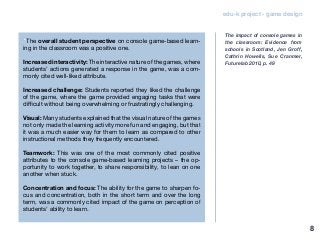
“The overall student perspective on console game-based learn-
ing in the classroom was a positive one.
Increased interactivity: The interactive nature of the games, where
students’ actions generated a response in the game, was a com-
monly cited well-liked attribute.
Increased challenge: Students reported they liked the challenge
of the game, where the game provided engaging tasks that were
difficult without being overwhelming or frustratingly challenging.
Visual: Many students explained that the visual nature of the games
not only made the learning activity more fun and engaging, but that
it was a much easier way for them to learn as compared to other
instructional methods they frequently encountered.
Teamwork: This was one of the most commonly cited positive
attributes to the console game-based learning projects – the op-
portunity to work together, to share responsibility, to lean on one
another when stuck.
Concentration and focus: The ability for the game to sharpen fo-
cus and concentration, both in the short term and over the long
term, was a commonly cited impact of the game on perception of
students’ ability to learn.
The impact of console games in
the classroom: Evidence from
schools in Scotland, Jen Groff,
Cathrin Howells, Sue Cranmer,
Futurelab 2010, p. 49
8
edu-k project - game design
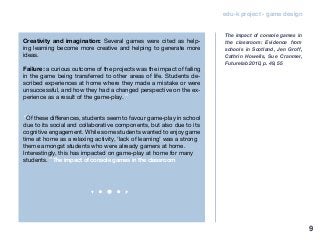
Creativity and imagination: Several games were cited as help-
ing learning become more creative and helping to generate more
ideas.
Failure: a curious outcome of the projects was the impact of failing
in the game being transferred to other areas of life. Students de-
scribed experiences at home where they made a mistake or were
unsuccessful, and how they had a changed perspective on the ex-
perience as a result of the game-play.”
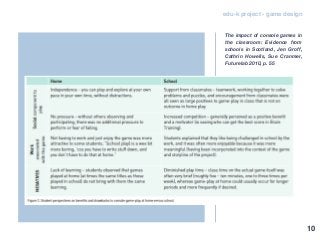
“Of these differences, students seem to favour game-play in school
due to its social and collaborative components, but also due to its
cognitive engagement. While some students wanted to enjoy game
time at home as a relaxing activity, ‘lack of learning’ was a strong
theme amongst students who were already gamers at home.
Interestingly, this has impacted on game-play at home for many
students.” The impact of console games in the classroom
The impact of console games in
the classroom: Evidence from
schools in Scotland, Jen Groff,
Cathrin Howells, Sue Cranmer,
Futurelab 2010, p. 49, 55
9
edu-k project - game design
The impact of console games in
the classroom: Evidence from
schools in Scotland, Jen Groff,
Cathrin Howells, Sue Cranmer,
Futurelab 2010, p. 55
10
edu-k project - game design
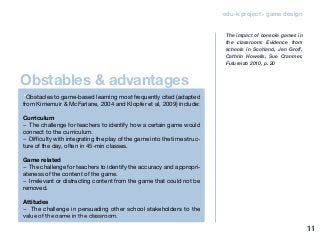
“Obstacles to game-based learning most frequently cited (adapted
from Kirriemuir & McFarlane, 2004 and Klopfer et al, 2009) include:
Curriculum
− The challenge for teachers to identify how a certain game would
connect to the curriculum.
− Difficulty with integrating the play of the game into the time struc-
ture of the day, often in 45-min classes.
Game related
− The challenge for teachers to identify the accuracy and appropri-
ateness of the content of the game.
− Irrelevant or distracting content from the game that could not be
removed.
Attitudes
− The challenge in persuading other school stakeholders to the
value of the game in the classroom.
The impact of console games in
the classroom: Evidence from
schools in Scotland, Jen Groff,
Cathrin Howells, Sue Cranmer,
Futurelab 2010, p. 20
Obstables & advantages
11
edu-k project - game design
Teacher support
− Lack of available time for teachers to learn the game and gener-
ate best practices with it.
− Lack of specific training and support on the effective use of
games in the classroom.
Assessment
−Traditional assessments do not often align with game-based
learning, so new models and approaches must be considered.”
The impact of console games in
the classroom: Evidence from
schools in Scotland, Jen Groff,
Cathrin Howells, Sue Cranmer,
Futurelab 2010, p. 20
12
edu-k project - game design
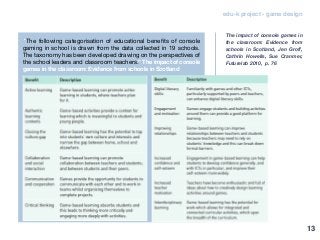
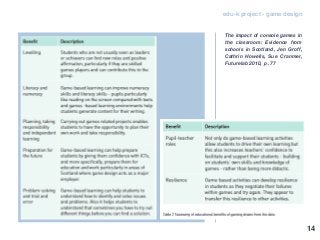
“The following categorisation of educational benefits of console
gaming in school is drawn from the data collected in 19 schools.
The taxonomy has been developed drawing on the perspectives of
the school leaders and classroom teachers.” The impact of console
games in the classroom: Evidence from schools in Scotland
The impact of console games in
the classroom: Evidence from
schools in Scotland, Jen Groff,
Cathrin Howells, Sue Cranmer,
Futurelab 2010, p. 76
13
edu-k project - game design
The impact of console games in
the classroom: Evidence from
schools in Scotland, Jen Groff,
Cathrin Howells, Sue Cranmer,
Futurelab 2010, p. 77
14
Gamification: definition
edu-k project - game design
“‘Game-based learning’ broadly refers to the use of video games
to support teaching and learning.
‘Gamification’ is a much newer concept than game-based learn-
ing. It is about using ‘elements’ derived from video-game design,
which are then deployed in a variety of contexts.
‘Gameplay’ is the treatment of topics and ideas as rules, actions,
decisions and consequences, rather than as content to be com-
municated or assimilated.”
“As the word suggests, gamification is more concerned with how
certain situations or processes (including learning) can be turned
into playful experiences that, indeed, resemble video games.”
Game-based learning: latest evidence and future directions
Game-based learning: latest
evidence and future directions,
Carlo Perrotta, Gill Featherstone,
Helen Aston, Emily Houghton,
NFER Research Programme: In-
novation in Education 2013, p.
6-7, 13
15
edu-k project - game design
“We suggest including all these levels in the definition of gamifica-
tion. Ordered from concrete to abstract, one may distinguish five
levels:
Interface design patterns: such as badges, levels, or leader-
boards.
Game design patterns: or game mechanics.
Design principles or heuristics: guidelines for approaching a de-
sign problem or evaluating a design solution.
Conceptual models of game design units: such as the MDA
framework, Malone’s challenge, fantasy, and curiosity, or the game
design atoms described in Braithwaite and Schreiber.
Game design methods: including game design specific practices
such as playtesting and design processes like playcentric design
or value conscious game design.” Gamification: Toward a Definition
Gamification: Toward a Defini-
tion, Sebastian Deterding, Rilla
Khaled, Lennart E. Nack, Dan
Dixon 2011, p. 3-4
16
edu-k project - game design
“An activity is said to be intrinsically motivated if people engage in
it “for its own sake,” if they do not engage in the activity in order to
receive some external reward such as money or status.” Toward a
Theory of Intrinsically Instruction
“Self-Determination Theory by Deci and Ryan (2004). They found
there were three things that were connected with intrinsic motiva-
tion and a healthy mental attitude toward a task: mastery, auton-
omy, and relatedness.”
“The term “meaningful” is based out of Mezirow’s model of trans-
formative learning, where learners connect an experience to previ-
Toward a Theory of Intrinsically
Instruction, Thomas W. Malone,
Xerox Palo AIto Research Cent-
er 1981, p. 3
The recipe for Meaningful Gami-
fication, Scott Nicholson, Wood,
L & Reiners 2012, p. 3, 4
Intrinsic motivation and
meaninful learning
17
edu-k project - game design
ously-held beliefs, which can allow transformation of those beliefs
and long-term change (Mezirow, 1991).”
“Self-Determination Theory, explores how rewards enhance per-
formance when they are used for tasks that are algorithmic, which
require little original thought and are about following a set of rules,
but diminish performance when the tasks are heuristic, which re-
quire creativity and the creation of new solutions (2011).”
“A key finding by Deci and Ryan in their studies of motivation is
that extrinsic rewards replace intrinsic motivation (2004).” The rec-
ipe for Meaningful Gamification
“A rudimentary theory of intrinsically motivating instruction is de-
veloped, based on three categories: challenge, fantasy, and curi-
osity. Challenge is hypothesized to depend on goals with uncertain
outcomes. Fantasy is claimed to have both cognitive and emotion-
al advantages in designing instructional environments. Curiosity is
separated into sensory and cognitive components.”
The recipe for Meaningful Gami-
fication, Scott Nicholson, Wood,
L & Reiners 2012, p. 14, 3
Toward a Theory of Intrinsically
Instruction, Thomas W. Malone,
Xerox Palo AIto Research Cent-
er 1981, p. 333, 356
18
edu-k project - game design
“To greatly oversimplify his theory for the purpose of comparison,
he claims that people are driven by a will to mastery (challenge) to
seek optimally informative environments (curiosity) which they as-
similate, in part, using schemas from other contexts (fantasy).”
“Piaget (1951) explains fantasy in children’s play primarily as an
attempt to “assimilate” experience into existing structures in the
child’s mind with minimal needs to “accommodate” to the de-
mands of external reality. [...] I define a fantasy-inducing environ-
ment as one that evokes “mental images of things not present to the
senses or within the actual experience of the person involved”. [...]
It seems fair to say, however, that computer games that embody
emotionally-involving fantasies like war, destruction, and competi-
tion are likely to be more popular than those with less emotional
fantasies.”
“Curiosity. One of the most important features of intrinsically mo-
tivating environments is the degree to which they can continue to
arouse and then satisfy our curiosity. [...] it involves surprisingness
with respect to the knowledge. [...] Berlyne (1965) goes further and
claims that the principal factor producing curiosity is what he calls
conceptual conflict. By this he means conflict between incompat-
ible attitudes or ideas evoked by a stimulus situation.”
Toward a Theory of Intrinsically
Instruction, Thomas W. Malone,
Xerox Palo AIto Research Cent-
er 1981, p. 356, 337 - 338
19
edu-k project - game design
“Choice. As Zimbardo (1969) and others have shown, giving peo-
ple a choice, or even just the illusion of choice, often increases their
motivation to do a task.”
“In a sense, a good game is intentionally made difficult to play to
increase its challenge, but a tool should be made as easy as pos-
sible to use.”
“In order to be motivating, environments like this should be struc-
tured so that users can easily generate goals of appropriate dif-
ficulty.”
“Challenge is captivating because it engages a person’s self-
esteem. Success in an instructional environment, like success in
any challenging activity, can make people feel better about them-
selves.”
“In other words, the environments should be neither too complicat-
ed nor too simple with respect to the learner’s existing knowledge.
They should be novel and surprising, but not completely incompre-
hensible. In general, an optimally complex environment will be one
Toward a Theory of Intrinsically
Instruction, Thomas W. Malone,
Xerox Palo AIto Research Cent-
er 1981, p. 338, 358, 359, 360, 362
20
edu-k project - game design
where the learner knows enough to have expectations about what
will happen, but where these expectations are sometimes unmet.”
Toward a Theory of Intrinsically Instruction
“Klopfer et al explain that play creates a learning space along five
distinct axes (2009):
− freedom to fail
− freedom to experiment
− freedom to fashion identities
− freedom of effort and
− freedom of interpretation.
These dimensions create a learning space where new ideas and
problem-solutions can be tested and retested because failure is
not only accepted but expected.” The impact of console games
in the classroom: Evidence from schools in Scotland
The impact of console games in
the classroom: Evidence from
schools in Scotland, Jen Groff,
Cathrin Howells, Sue Cranmer
Futurelab 2010, p. 14
Toward a Theory of Intrinsically
Instruction, Thomas W. Malone,
Xerox Palo AIto Research Cent-
er 1981, p. 336
21
edu-k project - game design
“Csikszentmihalyi describes intrinsically motivating activities as
follows:
The activity should be structured so that the actor can increase or
decrease the level of challenges he is facing, in order to match
exactly his skills with the requirements for action.
It should be easy to isolate the activity, at least at the perceptual
level, from other stimuli, external or internal, which might interfere
with involvement in it.
There should be clear criteria for performance; one should be
able to evaluate how well or how poorly one is doing at any time.
The activity should provide concrete feedback to the actor, so
that he can tell how well he is meeting the criteria of performance.
The activity ought to have a broad range of challenges, and pos-
sibly several qualitatively different ranges of challenge, so that the
actor may obtain increasingly complex information about differ-
ent aspects of himself.” Toward a Theory of Intrinsically Instruction
Toward a Theory of Intrinsically
Instruction, Thomas W. Malone,
Xerox Palo AIto Research Cent-
er 1981, p. 336
Games-based experiences for
learning, Dr Magdalena Bober,
Futurelab 2010, p. 8
22
edu-k project - game design
CONCEPT OF FLOW
“Paras and Bizzocchi (2005) express the potential for learning from
‘well-designed educational games’ in the following diagram:
Games > Play > Flow > Motivation > Learning
Games foster play, which produces a state of flow, which increases
motivation, which supports the learning process. They add that
“well-designed game mechanics can result in learning experiences
which are intrinsically motivating.”” Games-based experiences for
learning
SEMIOTIC LITERACY
“According to Gee, to learn or to be literate is to master what he
terms a semiotic domain. A semiotic domain consists of ways of
acting, talking and using signs and tools within a particular so-
cial practice. Exactly what it is which constitutes a certain social
practice cannot easily be pinned down analytically, because this is
Games-based experiences for
learning, Dr Magdalena Bober,
Futurelab 2010, p. 8
Learning to Play or Playing to
Learn A Critical Account of the
Models of Communication In-
forming Educational Research
on Computer Gameplay, Hans
Christian Arnseth, http://games-
tudies.org, 2006
23
edu-k project - game design
an important issue at stake for participants themselves. Instead,
the concept is used in order to focus our attention on the patterns
people usually follow in order to accomplish what they do.”
“According to Gee, the principles and patterns through which
members can recognize something as meaningful is continu-
ously produced and reproduced in social interaction.”
“That is to say, literacy is conceived as the ability to use various
sign systems as part of social practices and to be able to use them
in a way that communicates to other participants in the practice so
that you and others can negotiate meanings and perform tasks that
are considered appropriate and relevant in the practice in ques-
tion.”
“However, children often encounter problems when they are ex-
posed to more formal ways of reasoning which are typical of the
knowledge and skills taught in schools. Thus, the various semi-
otic domains taught in school appear unfamiliar because chil-
dren are not able to situate the meanings in any meaningful
context.” Learning to Play or Playing to Learn
Learning to Play or Playing to
Learn A Critical Account of the
Models of Communication In-
forming Educational Research
on Computer Gameplay, Hans
Christian Arnseth, http://games-
tudies.org, 2006
Learning and Games, James
Paul Gee, The MIT Press, 2008,
p. 21
24
edu-k project - game design
EXPERIENCE LEARNING
“On this view, humans think and learn by manipulating abstract
symbols via logic like rules. Newer work, however, argues that peo-
ple primarily think and learn through experiences they have
had, not through abstract calculations and generalizations.
People store these experiences in memory—and human long-term
memory is now viewed as nearly limitless—and use them to run
simulations in their minds to prepare for problem solving in new
situations. These simulations help them to form hypotheses about
how to proceed in the new situation based on past experiences.”
Learning and Games
“He stresses that games are first and foremost representations that
simulate certain behaviours and experiences, and use rule sets,
role playing and reward mechanisms to motivate and engage. They
offer learners a way to more fully engage with topics or ideas than
they might be able to in the ‘real’ world. They can exercise choice
and control over (virtual) reality, without incurring any real conse-
quences. This means that a video game allows, at least in theory,
learners to experience a certain school subject through inter-
action and simulation, rather than through the conventional ma-
Learning and Games, James
Paul Gee, The MIT Press, 2008,
p. 21
Game-based learning: latest
evidence and future directions,
Carlo Perrotta, Gill Featherstone,
Helen Aston, Emily Houghton,
NFER Research Programme: In-
novation in Education 2013, p. 6,
7
25
edu-k project - game design
terials and formats of schooling: textbooks, lessons, assignments
and so forth. Bogost contends that video games treat topics and
ideas not as content to be communicated or assimilated, but as
rules, actions, decisions and consequences – that is, gameplay.”
“Talking into account all of the reviewed literature, we could further
describe game-based learning as a form of experiential engage-
ment in which people learn by trial and error, by role-playing and
by treating a certain topic not as ‘content’ but as a set of rules, or a
system of choices and consequences.” Game-based learning: lat-
est evidence and future directions
“There are conditions experiences need to meet in order to be
truly useful for learning:
First, experiences are most useful for future problem solving if the
experience is structured by specific goals. Humans store their
experiences best in terms of goals, and how these goals did or did
not work out.
Learning and Games, James
Paul Gee, The MIT Press, 2008,
p. 21
26
edu-k project - game design
Second, for experiences to be useful for future problem solving,
they have to be interpreted. Interpreting experience means think-
ing—in action and after action—about how our goals relate to
our reasoning in the situation. It means, as well, extracting les-
sons learned and anticipating when and where those lessons might
be useful.
Third, people learn best from their experiences when they get im-
mediate feedback during those experiences so that they can
recognize and assess their errors and see where their expecta-
tions have failed. It is important too that they are encouraged to
explain their errors and why their expectations failed, along with
what they could have done differently.
Fourth, learners need ample opportunities to apply their previ-
ous experiences—as interpreted— to similar new situations, so
they can “debug” and improve their interpretations of these experi-
ences, gradually generalizing them beyond specific contexts.
Fifth, learners need to learn from the interpreted experiences and
explanations of other people, including both peers and more expert
people. Social interaction, discussion, and sharing with peers,
as well as mentoring from others who are more advanced, are im-
portant.” Learning and Games
Learning and Games, James
Paul Gee, The MIT Press, 2008,
p. 21
Learning to Play or Playing to
Learn A Critical Account of the
Models of Communication In-
forming Educational Research
on Computer Gameplay, Hans
Christian Arnseth, http://games-
tudies.org, 2006
27
edu-k project - game design
“Learning to play on the other hand is a category that makes it
easier to include the social, material and cultural contexts for learn-
ing. That is to say, the ordering of words directs our attention to the
activity of gameplay. Consequently, we as educational researchers
need to employ theories that are more sensitive to the impor-
tance of context (see, Lave & Wenger, 1991; Mercer, 2000, Kirsch-
ner & Whitson, 1997).” Learning to Play or Playing to Learn
SOCIAL LEARNING
“Also in this second generation were games based on constructiv-
ism, that is, learning by making. The player is immersed in a world
that enables them to include feelings and emotions with the social,
the player can interact with fellow participants in the virtual environ-
ment as well as acquiring and using knowledge gained.” Games in
Education: Serious Games
Games in Education: Serious
Games, Mary Ulicsak, Martha
Wright, Futurelab 2010, p. 29
Learning and Games, James
Paul Gee, The MIT Press, 2008,
p. 23
28
edu-k project - game design
“Social groups exist to induct newcomers into distinctive experi-
ences, and ways of interpreting and using those experiences, for
achieving goals and solving problems. [...] Gamers often organize
themselves into communities of practice that create social identi-
ties with distinctive ways of talking, interacting, interpreting experi-
ences, and applying values, knowledge, and skill to achieve goals
and solve problems. This is a crucial point for those who wish to
make so-called serious games: to gain these sorts of desired learn-
ing effects will often require as much care about the social system
(the learning system) in which the game is placed as the in-game
design itself.” Learning and Games
“In terms of the social dynamics of game-based learning, a com-
mon theme is that through video games young people cultivate
interests and join ‘affinity groups’ that operate across contexts, as
part of their projects of personal development. In these groups,
players engage in sophisticated forms of learning fuelled by the
shared passion for gaming. […] A similar, and equally popular,
theme is that video games provide virtual worlds which are effec-
tive contexts for learning, because acting in such worlds allows
learners to develop social practices and take on the identities of
actual professional communities.”
Game-based learning: latest
evidence and future directions,
Carlo Perrotta, Gill Featherstone,
Helen Aston, Emily Houghton,
NFER Research Programme: In-
novation in Education 2013, p. 6,
17
29
edu-k project - game design
“Further, Fengfeng (2008b) also found that a cooperative struc-
ture (where learners worked together in the gamespace) was better
than an individualistic or competitive structure at facilitating atti-
tudes towards mathematics learning.” Game-based learning: latest
evidence and future directions
PEDAGOGIC PROCESS
“The best way of integrating gaming into teaching is by using it
within a clear pedagogic process. In particular, place learning ac-
tivities and academic content within the video game’s fictional and
entertainment context, maintaining a balance between fun and
learning.
Make the academic content integral to the game rather than an
add-on. Content-specific tasks work better when embedded in
the fictional context and rules (‘mechanics’) of the game.
Carefully plan the roles that you and your learners will take on in the
game. Teachers should play roles that allow them to mediate
the experience for learners: providing guidance when needed;
Game-based learning: lat-
est evidence and future direc-
tions, Carlo Perrotta, Gill Feath-
erstone, Helen Aston, Emily
Houghton, NFER Research Pro-
gramme: Innovation in Educa-
tion 2013, p. 17
30
edu-k project - game design
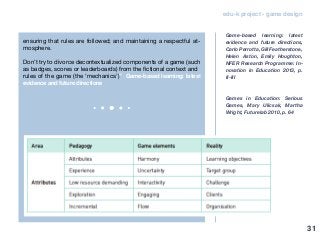
ensuring that rules are followed; and maintaining a respectful at-
mosphere.
Don’t try to divorce decontextualized components of a game (such
as badges, scores or leaderboards) from the fictional context and
rules of the game (the ‘mechanics’)” Game-based learning: latest
evidence and future directions
Game-based learning: latest
evidence and future directions,
Carlo Perrotta, Gill Featherstone,
Helen Aston, Emily Houghton,
NFER Research Programme: In-
novation in Education 2013, p.
II-III
Games in Education: Serious
Games, Mary Ulicsak, Martha
Wright, Futurelab 2010, p. 64
31
Gamers
edu-k project - game design
“Parks Associates study of Americans who play games, they de-
fined a number of types of gamers based on their playing habits.
Power gamers who are the prototypical gamers mentioned above.
Social gamers who enjoy gaming as a way to interact with friends.
Leisure gamers mainly play casual titles. Nevertheless they prefer
challenging titles and show high interest in new gaming services.
Dormant gamers love gaming but spend little time because of
family, work, or school. They like to play with friends and family and
prefer complex and challenging games.
Incidental gamers lack motivation and play games mainly out of
boredom.
Occasional gamers play puzzle, word, and board games almost
Moving learning games forward,
Eric Klopfer, Scot Osterweil, and
Katie Salen, The Education Ar-
cade, MIT 2009, p. 7
32
edu-k project - game design
exclusively.” moving learning games forward
“Designing deep game experiences for each Key offers a differ-
ent avenue to enhance the Player Experience as a whole and by
refining them through play testing provides more opportunities for
emotion in games.
Hard Fun: Emotions from Meaningful Challenges, Strategies, and
Puzzles. For many players overcoming obstacles is why they play.
Hard Fun creates emotion by structuring experience towards the
pursuit of a goal. The challenge focuses attention and rewards pro-
gress to create emotions such as Frustration and Fiero (an Italian
word for personal triumph). It inspires creativity in the development
and application of strategies. It rewards the player with feedback
on progress and success. Players using this Key play to test their
skills, and feel accomplishment.
Easy Fun: Grab Attention with Ambiguity, Incompleteness, and De-
tail. Other players focus on the sheer enjoyment of experiencing
the game activities. Easy Fun maintains focus with player attention
rather than a winning condition. The Immersion Key awakens in the
player a sense of curiosity. It entices the player to consider options
Moving learning games forward,
Eric Klopfer, Scot Osterweil, and
Katie Salen, The Education Ar-
cade, MIT 2009, p. 7
Why we play games: four keys
to more emotion without story,
Nicole Lazzaro, XEODesign,
2004, p. 3-5
33
edu-k project - game design
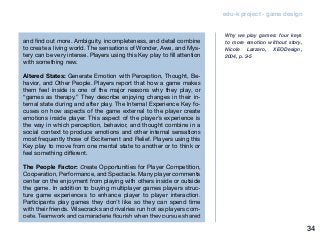
and find out more. Ambiguity, incompleteness, and detail combine
to create a living world. The sensations of Wonder, Awe, and Mys-
tery can be very intense. Players using this Key play to fill attention
with something new.
Altered States: Generate Emotion with Perception, Thought, Be-
havior, and Other People. Players report that how a game makes
them feel inside is one of the major reasons why they play, or
“games as therapy.” They describe enjoying changes in their in-
ternal state during and after play. The Internal Experience Key fo-
cuses on how aspects of the game external to the player create
emotions inside player. This aspect of the player’s experience is
the way in which perception, behavior, and thought combine in a
social context to produce emotions and other internal sensations
most frequently those of Excitement and Relief. Players using this
Key play to move from one mental state to another or to think or
feel something different.
The People Factor: Create Opportunities for Player Competition,
Cooperation, Performance, and Spectacle. Many player comments
center on the enjoyment from playing with others inside or outside
the game. In addition to buying multiplayer games players struc-
ture game experiences to enhance player to player interaction.
Participants play games they don’t like so they can spend time
with their friends. Wisecracks and rivalries run hot as players com-
pete. Teamwork and camaraderie flourish when they pursue shared
Why we play games: four keys
to more emotion without story,
Nicole Lazzaro, XEODesign,
2004, p. 3-5
34
edu-k project - game design
goals. Dominant emotions include Amusement, Schadenfreude,
and Naches. Players using this Key see games as mechanisms for
social interaction. ” Why we play games: four keys to more emotion
without story
Why we play games: four keys
to more emotion without story,
Nicole Lazzaro, XEODesign,
2004, p. 3-5, 7
35
edu-k project - game design
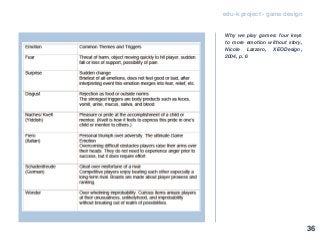
Why we play games: four keys
to more emotion without story,
Nicole Lazzaro, XEODesign,
2004, p. 6
36
edu-k project - game design
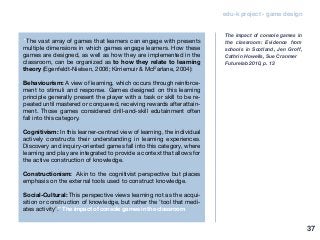
“The vast array of games that learners can engage with presents
multiple dimensions in which games engage learners. How these
games are designed, as well as how they are implemented in the
classroom, can be organized as to how they relate to learning
theory (Egenfeldt-Nielsen, 2006; Kirriemuir & McFarlane, 2004):
Behaviourism: A view of learning, which occurs through reinforce-
ment to stimuli and response. Games designed on this learning
principle generally present the player with a task or skill to be re-
peated until mastered or conquered, receiving rewards after attain-
ment. Those games considered drill-and-skill edutainment often
fall into this category.
Cognitivism: In this learner-centred view of learning, the individual
actively constructs their understanding in learning experiences.
Discovery and inquiry-oriented games fall into this category, where
learning and play are integrated to provide a context that allows for
the active construction of knowledge.
Constructionism: Akin to the cognitivist perspective but places
emphasis on the external tools used to construct knowledge.
Social-Cultural: This perspective views learning not as the acqui-
sition or construction of knowledge, but rather the ’tool that medi-
ates activity’.” The impact of console games in the classroom
The impact of console games in
the classroom: Evidence from
schools in Scotland, Jen Groff,
Cathrin Howells, Sue Cranmer
Futurelab 2010, p. 13
37
Game mechanics
edu-k project - game design
“The first concerns the design of learning environments where
game like features are included as part of the design in order to
anchor activities in something students find meaningful, interesting
and motivating.” Learning to Play or Playing to Learn
“A careful analysis of the computer games studied above shows
that there are at least four general ways that the attainment of a
goal can be made uncertain for a wide range of people, or for the
same person at different times: variable difficulty level, multiple lev-
el goals, hidden information, and randomness.
Variable Difficulty Level. Most good computer games are playable
at different difficulty levels. In computer games, as well as in other
educational activities, the choice of difficulty level can be either: (a)
Learning to Play or Playing to
Learn A Critical Account of the
Models of Communication In-
forming Educational Research
on Computer Gameplay, Hans
Christian Arnseth, http://games-
tudies.org, 2006
Toward a Theory of Intrinsically
Instruction, Thomas W. Malone,
Xerox Palo AIto Research Cent-
er 1981, p. 358-359
38
edu-k project - game design
determined automatically according to how well the player does,
(b) chosen by the learner, or (c) determined by the opponent’s skill.
Multiple Level Goals. The implication here is that well-designed
instructional environments, by providing high-level goals, can take
advantage of a “natural” cognitive motivation to optimize existing
mental procedures. Environments that include scorekeeping or
speeded responses often emphasize this sort of high level goal,
and therefore these features seem especially appropriate for in-
structional situations (like drill-and-practice) where the purpose is
to optimize previously learned procedures.
Hidden Information. Many games, especially guessing games,
make the outcome of a game uncertainty by hiding information
from the player or players and selectively revealing it. This feature
seems to provoke curiosity, as well as contributing to the challenge
of an activity.
Randomness. A final way of making the outcome of a game un-
certain is to introduce randomness. Many gambling games seem to
succeed almost entirely on the basis of this principle, and random-
ness can be used to heighten interest in many other kinds of games
or activities.”
“One way of making environments interestingly complex is to make
Toward a Theory of Intrinsically
Instruction, Thomas W. Malone,
Xerox Palo AIto Research Cent-
er 1981, p. 358-359, 364
39
edu-k project - game design
them responsive (see Moore & Anderson, 1976). In particular:
(a) To engage a learner’s curiosity, feedback should be surprising.
The “easy” way to do this is by using randomness. A deeper way
to do this is to have environments whose underlying consistency is
revealed by things that seem surprising at first.
(b) To be educational, feedback should be constructive. In other
words, the feedback should not just reveal to learners that their
knowledge is incomplete, inconsistent, or unparsimonious, but
should help them see how to change their knowledge to become
more complete, consistent, or parsimonious.”
“Sensory Curiosity. Sensory curiosity involves the attention-at-
tracting value of changes in the light, sound, or other sensory stim-
uli of an environment. There is no reason why educational environ-
ments have to be impoverished sensory environments. Computers
provide even more possibilities for graphics, animation, music, and
other captivating audio and visual effects. These effects can be
used: (1) as decoration, (2) to enhance fantasy, (3) as a reward, and
perhaps most importantly, (4) as a representation system that may
be more effective than words or numbers.
Cognitive Curiosity. I claim that people are motivated to bring to all
their cognitive structures three of the characteristics of well-formed
Toward a Theory of Intrinsically
Instruction, Thomas W. Malone,
Xerox Palo AIto Research Cent-
er 1981, p. 363
40
edu-k project - game design
scientific theories: completeness, consistency, and parsimony.
[...] According to this theory, the way to engage learners’ curiosity
is to present just enough information to make their existing knowl-
edge seem incomplete, inconsistent, or unparsimonious. The learn-
ers are then motivated to learn more, in order to make their cogni-
tive structures better-formed. [...] The “Socratic method” and the
tutorial strategies of master teachers (Collins & Stevens, 1981) can
be seen as ways of systematically exposing incompletenesses, in-
consistencies, and unparsimoniousness in the learner’s knowledge
structures.” Toward a Theory of Intrinsically Instruction
“The RECIPE for Meaningful Gamification:
Play – facilitating the freedom to explore and fail within boundaries.
Exposition – creating stories for participants that are integrated
with the real-world setting and allowing them to create their own.
Choice – developing systems that put the power in the hands of
the participants.
Toward a Theory of Intrinsically
Instruction, Thomas W. Malone,
Xerox Palo AIto Research Cent-
er 1981, p. 363
The recipe for Meaningful Gami-
fication, Scott Nicholson, Wood,
L & Reiners 2012., p. 4
41
edu-k project - game design
Information – using game design and game display concepts to
allow participants to learn more about the real-world context.
Engagement – encouraging participants to discover and learn
from others interested in the real world setting.
Reflection – assisting participants in finding other interests and
past experiences that can deepen engagement and learning.” The
recipe for Meaningful Gamification
“Importantly, there are a key set of design principles that occur
again and again in multiplayer games with social dimensions, (Ito,
2006; Salen, 2007)
Layering of access to work (friendlocking profiles and access to
other forms of shared content);
Specialization (in contrast to standardization): multiple forms of
expertise exist across the network;
Mastery is specialized and not standardized; connected to spe-
The recipe for Meaningful Gami-
fication, Scott Nicholson, Wood,
L & Reiners 2012, p. 4
Moving learning games forward,
Eric Klopfer, Scot Osterweil, and
Katie Salen, The Education Ar-
cade, MIT 2009, 33-34
42
edu-k project - game design
cialization is the need to create conditions for moments not just of
mastery but also of virtuosity;
Competition and status;
Sharing and recommendations;
Reviewing and sharing feedback as a form of assessment
Appreciation and validation (there is a celebration of what one
knows and does);
Collective, external artifacts produced;
Distribution of expertise and knowledge across the community
of practice.” moving learning games forward
“On basis of the research in LAB, other learning games and inter-
views with children on use of different computer games and dif-
ferent social software, focus has been on the children’s satisfac-
tion and experiences. This focus has led to the generation of a
set of concepts which seem central in the development of learning
Moving learning games forward,
Eric Klopfer, Scot Osterweil, and
Katie Salen, The Education Ar-
cade, MIT 2009, 33-34
Serious Games in language
learning and teaching – a the-
oretical perspective, Birgitte
Holm Sørensen, Bente Meyer,
Digital Games Research Asso-
ciation (DiGRA) 2007, p. 563
43
edu-k project - game design
games (Sørensen 2002):
Challenges – to be confronted with a problem you have to solve
Reification – to create, produce and make experiments
Socialities – to communicate and take part in communities and
social networks
Achievements – to get acknowledgment and enjoy respect
Pleasure – to interact in sensitive and pleasurable situations
Exploration – to explore and act on basis of curiosity
Self interpretation – to search and experiment identities” Serious
Games in language learning and teaching.” Serious Games in lan-
guage learning and teaching
“Digital games based learning experiences should:
Use fantasy and narrative to create an engaging context for the
learning experience.
Serious Games in language
learning and teaching – a the-
oretical perspective, Birgitte
Holm Sørensen, Bente Meyer,
Digital Games Research Asso-
ciation (DiGRA) 2007, p. 563
Games-based experiences for
learning, Dr Magdalena Bober,
Futurelab 2010, p. 43
44
edu-k project - game design
Relate to prior interests of the learner.
Be visually stimulating, eg through the use of multimedia features.
Be challenging with adaptable and increasing levels of difficulty.
Have clear and meaningful goals
Provide immediate feedback to give the learner a sense of con-
trol.
Provide opportunities for learners to make decisions that influ-
ence the learning experience.
Encourage social interaction between learners by providing op-
portunities for collaboration and discussion – as part of the game,
in the classroom and/or online.
Focus on progression and self-improvement rather than com-
petition between learners.” Games-based experiences for learning
Games-based experiences for
learning, Dr Magdalena Bober,
Futurelab 2010, p. 43
Game-based learning: latest
evidence and future directions,
Carlo Perrotta, Gill Featherstone,
Helen Aston, Emily Houghton,
NFER Research Programme: In-
novation in Education 2013, p. 9
45
edu-k project - game design
“The principles and mechanisms of game-based learning:
Principles
Intrinsic motivation. Gaming is intrinsically motivating because by
and large it’s a voluntary activity. Therefore, gaming for learning
works best in the context of invitation and persuasion, rather than
compulsion.
Learning through intense enjoyment and “fun”. Several authors
suggest that games can be a vehicle for engaging students in a
“flow”. Flow is a state of consciousness during which an individual
is in control of his actions and completely absorbed in the task at
hand.
Authenticity. Authenticity means a concern for the real nature of
learning, which is supposedly different from the “artificial” or de-
contextualised forms of learning that take place in schools. In the
name of authenticity, contextual skills are prioritised over the ab-
stract notions and facts valued in traditional instruction. Therefore,
“good” gaming reflects actual learning processes, which are always
grounded in specific settings and practices. These can be actual
professions, but also extravagant, fantastic roles and endeavours.
Self-reliance and autonomy. Gaming encourages independent in-
Game-based learning: latest
evidence and future directions,
Carlo Perrotta, Gill Featherstone,
Helen Aston, Emily Houghton,
NFER Research Programme: In-
novation in Education 2013, p. 9
46
edu-k project - game design
quiry and exploration; interests and passions can branch off from
the individual game, towards aspects of the “ecosystem” that sur-
rounds it. These aspects include technical and artistic skills like
programming, writing, drawing, making music; but also the desire
to find out more about certain topics, e.g. about science, history or
mythology.
Experiential learning. The notion of experiential learning is a very
old and influential one in education, dating back to the seminal
work of John Dewey. Many claim that gaming provides a cost ef-
fective alternative to learning by doing in real settings.
Mechanisms
Rules. At their most basic level, video games are sets of rules.
These rules can be more or less complex depending on the choic-
es they elicit and the related consequences. For instance, rules can
be simple and binary (if/then); or multifaceted and accommodating
a broad range of decision making processes.
Clear but challenging goals. The presence of clearly defined, de-
manding activities which, although might appear arbitrary and un-
necessary, allow people to see the direct impact of their efforts.
Game-based learning: latest
evidence and future directions,
Carlo Perrotta, Gill Featherstone,
Helen Aston, Emily Houghton,
NFER Research Programme: In-
novation in Education 2013, p. 9
47
edu-k project - game design
A fictional setting or “fantasy” that provides a compelling
background. This is an essential but easily misunderstood aspect
of gaming. Notwithstanding the tendency to indulge in escapism
and compensatory fantasies, classic studies on playing suggest
that pretence can also be a deliberate and conscious strategy that
assists learning. A consensual and transparent adherence to a fic-
tional setting or role allows players to experiment with skills and
identities without suffering the consequences of failure in real life.
Progressive difficulty levels, underpinned by understandable
criteria for progression. Over the years game developers have
devised mechanisms for progression and “levelling up” to a con-
siderable degree of refinement. Not all of these mechanisms may
be appropriate in an educational context, but they raise interesting
questions for educators - not least the fact that players are allowed
to tackle challenges and tests (like exams) as many times as nec-
essary - and with no lasting consequences - in order to progress
from one level to another.
Interaction and high degree of student control. This mechanism
is strongly related to the notion of “agency”: the feeling of being in
control of one’s destiny through actions and choices. Most impor-
tantly, it concerns the certainty that effort and dedication will be
acknowledged and rewarded.
Game-based learning: latest
evidence and future directions,
Carlo Perrotta, Gill Featherstone,
Helen Aston, Emily Houghton,
NFER Research Programme: In-
novation in Education 2013, p. 9
48
edu-k project - game design
A degree of uncertainty and unpredictability. As long as it does
not contradict point 5, a measured injection of uncertainty into
tasks is consistent with many game developments tenets. For ex-
ample, in the Quest schools students are not given assignments
as such, but asked to choose between number of possible “mis-
sions”. The scope and purpose of the missions become clear only
when certain clues have been gathered and deciphered.
Immediate and constructive feedback. One of the most power-
ful mechanisms of video games is the ability to provide feedback
in real time, not only as evaluation, but more often as guidance to
facilitate and correct performance. This is largely in line with the
idea of formative assessment in education.
A social element that allows people to share experiences and
build bonds. As mentioned several times in this chapter, a game
is not simply a product or tool which may or may not have a re-
lationship with learning. The ecosystem surrounding the game is
just as important. In fact, it is probably even more relevant from an
education perspective, because it provides players with a range of
opportunities to share, interact and pursue interests and passions.”
Game-based learning: latest evidence and future directions
Game-based learning: latest
evidence and future directions,
Carlo Perrotta, Gill Featherstone,
Helen Aston, Emily Houghton,
NFER Research Programme: In-
novation in Education 2013, p. 9
Games-based experiences for
learning, Dr Magdalena Bober,
Futurelab 2010, p. 3-4
49
edu-k project - game design
“The following learning elements of digital games have been
identified in the literature reviewed and in the expert interviews:
Challenge: A test of the learner’s skills, set at a level to stretch his/
her abilities.
Fantasy/ Narrative: Imaginary environment, characters or story
which can stand as a metaphor for the real world.
Feedback: Response to the learner’s actions or progress within
the game.
Goals: Clear aims that are meaningful and achievable but stretch
the learner’s abilities.
Sensori stimuli: Engaging visual and sound effects.
Social aspects / community: Playing with or against other people
and social interaction inside and outside the game.
Active learning: Learning ‘by doing’, ie actively engaging in the
game-related task.
Adaptivity / Individualisation: The difficulty of the game or task
adjusts itself to suit the learner’s ability level.
Games-based experiences for
learning, Dr Magdalena Bober,
Futurelab 2010, p. 3-4
50
edu-k project - game design
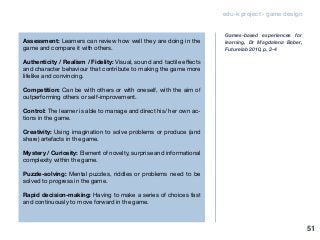
Assessment: Learners can review how well they are doing in the
game and compare it with others.
Authenticity / Realism / Fidelity: Visual, sound and tactile effects
and character behaviour that contribute to making the game more
lifelike and convincing.
Competition: Can be with others or with oneself, with the aim of
outperforming others or self-improvement.
Control: The learner is able to manage and direct his/ her own ac-
tions in the game.
Creativity: Using imagination to solve problems or produce (and
share) artefacts in the game.
Mystery / Curiosity: Element of novelty, surprise and informational
complexity within the game.
Puzzle-solving: Mental puzzles, riddles or problems need to be
solved to progress in the game.
Rapid decision-making: Having to make a series of choices fast
and continuously to move forward in the game.
Games-based experiences for
learning, Dr Magdalena Bober,
Futurelab 2010, p. 3-4
51
edu-k project - game design
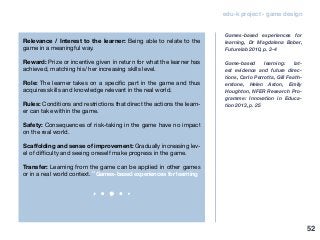
Relevance / Interest to the learner: Being able to relate to the
game in a meaningful way.
Reward: Prize or incentive given in return for what the learner has
achieved, matching his/ her increasing skills level.
Role: The learner takes on a specific part in the game and thus
acquires skills and knowledge relevant in the real world.
Rules: Conditions and restrictions that direct the actions the learn-
er can take within the game.
Safety: Consequences of risk-taking in the game have no impact
on the real world.
Scaffolding and sense of improvement: Gradually increasing lev-
el of difficulty and seeing oneself make progress in the game.
Transfer: Learning from the game can be applied in other games
or in a real world context.” Games-based experiences for learning
Games-based experiences for
learning, Dr Magdalena Bober,
Futurelab 2010, p. 3-4
Game-based learning: lat-
est evidence and future direc-
tions, Carlo Perrotta, Gill Feath-
erstone, Helen Aston, Emily
Houghton, NFER Research Pro-
gramme: Innovation in Educa-
tion 2013, p. 25
52
edu-k project - game design
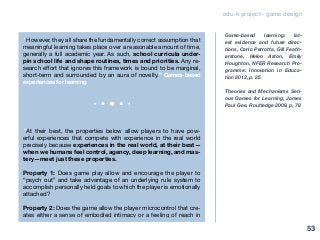
“However, they all share the fundamentally correct assumption that
meaningful learning takes place over a reasonable amount of time,
generally a full academic year. As such, school curricula under-
pin school life and shape routines, times and priorities. Any re-
search effort that ignores this framework is bound to be marginal,
short-term and surrounded by an aura of novelty.” Games-based
experiences for learning
“At their best, the properties below allow players to have pow-
erful experiences that compete with experience in the real world
precisely because experiences in the real world, at their best—
when we humans feel control, agency, deep learning, and mas-
tery—meet just these properties.
Property 1: Does game play allow and encourage the player to
“psych out” and take advantage of an underlying rule system to
accomplish personally held goals to which the player is emotionally
attached?
Property 2: Does the game allow the player microcontrol that cre-
ates either a sense of embodied intimacy or a feeling of reach in
Game-based learning: lat-
est evidence and future direc-
tions, Carlo Perrotta, Gill Feath-
erstone, Helen Aston, Emily
Houghton, NFER Research Pro-
gramme: Innovation in Educa-
tion 2013, p. 25
Theories and Mechanisms Seri-
ous Games for Learning, James
Paul Gee, Routledge 2009, p. 78
53
edu-k project - game design
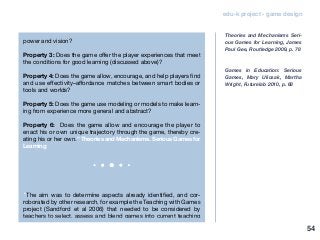
power and vision?
Property 3: Does the game offer the player experiences that meet
the conditions for good learning (discussed above)?
Property 4: Does the game allow, encourage, and help players find
and use effectivity–affordance matches between smart bodies or
tools and worlds?
Property 5: Does the game use modeling or models to make learn-
ing from experience more general and abstract?
Property 6: Does the game allow and encourage the player to
enact his or own unique trajectory through the game, thereby cre-
ating his or her own.” Theories and Mechanisms. Serious Games for
Learning
“The aim was to determine aspects already identified, and cor-
roborated by other research, for example the Teaching with Games
project (Sandford et al 2006) that needed to be considered by
teachers to select, assess and blend games into current teaching
Theories and Mechanisms Seri-
ous Games for Learning, James
Paul Gee, Routledge 2009, p. 78
Games in Education: Serious
Games, Mary Ulicsak, Martha
Wright, Futurelab 2010, p. 68
54
edu-k project - game design
practice. The areas for consideration identified for any game out-
side the physical constraints (available machines, licenses etc) are:
What is the background of the player(s) (age, language, experi-
ence, prior knowledge, preferred learning styles, etc)?
What are the learning goals?
How does the game content, that is, the factual knowledge con-
tained, experiences, mechanics and activities, relate to the learning
goals?
How integral is the content to the game mechanics, processes,
experience of playing as well as the art assets or copy, and is its
acquisition required in order to progress?
Will the game engage the learners – is it immersive?
Does the game have a learning curve (ie do the players improve
through repeated play), appropriate feedback, clear progression
etc?
What level of fidelity is appropriate?
Does the game have a learning curve (ie do the players improve
through repeated play), appropriate feedback, clear progression
etc?
Games in Education: Serious
Games, Mary Ulicsak, Martha
Wright, Futurelab 2010, p. 68
55
edu-k project - game design
What level of fidelity is appropriate?
How will learning be transferred beyond the game context?
How can the game be embedded and assessed?
What other practices will support learning, either in the game
such as reflection, or externally such as discussion?
What retention rate, ie how long will the players remember the
learning, will the game have?” Games in Education: Serious Games
Games in Education: Serious
Games, Mary Ulicsak, Martha
Wright, Futurelab 2010, p. 68
56

Eduk quotes-report

  • 1.
  • 2.
    Documentation developed forEDU-K project with MCDEM La Salle, Master On Multimedia Design edukgame.wordpress.com Alba Monedero, 2014
  • 3.
    1 Game based learning edu-kproject - game design “They observe that game player’s regularly exhibit persistence, risk- taking, attention to detail and problem solving skills, all behaviors that ideally would be regularly demonstrated in school. They also understand that game environments enable players to construct un- derstanding actively, and at individual paces, and that well-designed games enable players to advance on different paths at different rates in response to each player’s interests and abilities, while also foster- ing collaboration and just-in-time learning.” moving learning games forward “In exploring the reasons for game-based learning having an impact on student motivation, Ya-Ting (2012) suggests that by immediately providing students with praise, encouragement and reinforcement, gaming software helps students develop confidence and motivation Moving learning games forward, Eric Klopfer, Scot Osterweil, and Katie Salen, The Education Ar- cade, MIT 2009, p.1 Game-based learning: lat- est evidence and future direc- tions, Carlo Perrotta, Gill Feath- erstone, Helen Aston, Emily Houghton, NFER Research Pro- gramme: Innovation in Educa- tion 2013, p. 16
  • 4.
    2 edu-k project -game design to continue with the task.” Game-based learning: latest evidence and future directions “Games provide a platform for active learning, that is, they are learning by doing rather than listening or reading, they can be cus- tomised to the learner, they provide immediate feedback, allow ac- tive discovery and develop new kinds of comprehension. There is also evidence of a higher level of retention of material.* * Magennis and Farrell (2005) reported that students who learn by doing have an average retention rate of 75% compared to an average retention rate of 5% for those who learn from lectures. while Joyce (2005) found a retention rate of 90% from simultaneously seeing, hearing, and doing, 80% from doing, 40% from seeing, and 20% from hearing (cited by binSubaih et al. 2009, p.9).” Games in Education: Serious Games Game-based learning: lat- est evidence and future direc- tions, Carlo Perrotta, Gill Feath- erstone, Helen Aston, Emily Houghton, NFER Research Pro- gramme: Innovation in Educa- tion 2013, p. 16 Games in Education: Serious Games, Mary Ulicsak, Martha Wright, Futurelab 2010, p.14
  • 5.
    3 edu-k project -game design “…game environments enable players to construct understand- ing actively, and at individual paces, and that well-designed games enable players to advance on different paths at different rates in response to each player’s interests and abilities, while also foster- ing collaboration and just-in-time learning.” The impact of console games in the classroom: Evidence from schools in Scotland The impact of console games in the classroom: Evidence from schools in Scotland, Jen Groff, Cathrin Howells, Sue Cranmer, Futurelab 2010, p. 21
  • 6.
    4 edu-k project -game design “The interviews with students found that: 1. Students perceived a range of educational benefits as a result of participating in the game-based learning approaches, including increased collaboration, creativity and communication. 2. Students’ responses in general showed how positively they viewed console games and the projects built around them in school. 3. Some students found aspects of the projects repetitive, oth- ers believed that game-based learning should be included in the curriculum as part of a balance between new and more traditional learning experiences. 4. In some classrooms, students found other students playing games whilst they were trying to work distracting.” The impact of console games in the classroom: Evidence from schools in Scotland, Jen Groff, Cathrin Howells, Sue Cranmer, Futurelab 2010, p.6 Voices & evidence
  • 7.
    5 edu-k project -game design “There has been much interest in the potential of console games for learning and teaching in recent years. They are popular with young people - a recent survey carried out for Futurelab showed that 79% of 737 children aged five to 15 played computer games at home alone ‘at least a few times a week’ (Ulicsak and Cranmer, 2010).” “Teachers using games in the classroom have also noted improve- ment in several key skills areas (Joyce, Gerhard & Debry, 2009, p. 85): 1. Personal skills (such as initiative and persistence); 2. Spatial and motor skills (such as coordination and speed of re- flexes); 3. Social (such as teamwork and communication); 4. Intellectual (such as problem-solving)” “Many argue that these skills are able to be accessed because many games provide such rich learning environments that sur- round learners: “Games allow players to enter environments that The impact of console games in the classroom: Evidence from schools in Scotland, Jen Groff, Cathrin Howells, Sue Cranmer, Futurelab 2010, p. 9, 15
  • 8.
    edu-k project -game design would be impossible to access in any other way, eg. going back in history, understanding the complexity of running a major city, managing entire civilisations or nurturing families. They require en- gagement with complex decisions – exploring the effects of differ- ent choices and a multiplicity of variables. They offer ongoing and responsive feedback on choices – calibrating closely to the ability level of the individual and then encouraging them to discover new limits to those abilities. They stimulate conversation and discus- sion; players share ideas, hints and tips in what increasingly tend to be lively and supportive learning communities.”” “The affordability and low-technical barriers to console games, as well as the portability of handheld consoles, have put video gaming in many of the homes of today’s learners. This ease-of-use has also led to lower barriers to implementation in the classroom (Faux, McFarlane, Roche & Facer, 2006).” “Harnessing the children’s current culture most of the school lead- ers involved felt that gaming is an important part of pupil culture which should be recognised by the educational system and har- nessed to engage pupils in learning.” The impact of console games in the classroom: Evidence from schools in Scotland, Jen Groff, Cathrin Howells, Sue Cranmer, Futurelab 2010, p. 15, 16, 27, 30 6
  • 9.
    edu-k project -game design “The majority of school leaders viewed these projects as highly successful and are enthusiastic about their impact: “I’ve never been so convinced about the way forward with things. My absolute dream is to have a games console in every class permanently.“ Success with game-based learning is repeatedly linked by senior leaders to the pedagogical skill of the teacher involved. The game is often described as the hook or the stimulus and is never an end in itself. […] Impact on the pupils: One primary headteacher re- flected the views of many of the school leaders when he said, “As a motivational tool it has been unsurpassed....these kids are learning without realising.”” “The stories of enthused, engaged and highly motivated pupils are manifold: pupils who had been reluctant to come school turning up at 8.30 am to rehearse; pupils who rarely wrote more than a para- graph writing at length; pupils who never did their homework bring- ing in the fruits of their research unprompted; pupils who found group work impossible blending in to group tasks and even sup- porting others; pupils with behaviour problems settling down; sum- mer term P7 pupils on task and inspired. […] There were accounts of hierarchies being flattened, as less academic and confident chil- dren increasingly demonstrated their game skills, confidence and self-esteem being built through natural peer-tutoring opportunities afforded by the game.” The impact of console games in the classroom: Evidence from schools in Scotland, Jen Groff, Cathrin Howells, Sue Cranmer, Futurelab 2010, p. 30, 31, 49 7
  • 10.
    edu-k project -game design “The overall student perspective on console game-based learn- ing in the classroom was a positive one. Increased interactivity: The interactive nature of the games, where students’ actions generated a response in the game, was a com- monly cited well-liked attribute. Increased challenge: Students reported they liked the challenge of the game, where the game provided engaging tasks that were difficult without being overwhelming or frustratingly challenging. Visual: Many students explained that the visual nature of the games not only made the learning activity more fun and engaging, but that it was a much easier way for them to learn as compared to other instructional methods they frequently encountered. Teamwork: This was one of the most commonly cited positive attributes to the console game-based learning projects – the op- portunity to work together, to share responsibility, to lean on one another when stuck. Concentration and focus: The ability for the game to sharpen fo- cus and concentration, both in the short term and over the long term, was a commonly cited impact of the game on perception of students’ ability to learn. The impact of console games in the classroom: Evidence from schools in Scotland, Jen Groff, Cathrin Howells, Sue Cranmer, Futurelab 2010, p. 49 8
  • 11.
    edu-k project -game design Creativity and imagination: Several games were cited as help- ing learning become more creative and helping to generate more ideas. Failure: a curious outcome of the projects was the impact of failing in the game being transferred to other areas of life. Students de- scribed experiences at home where they made a mistake or were unsuccessful, and how they had a changed perspective on the ex- perience as a result of the game-play.” “Of these differences, students seem to favour game-play in school due to its social and collaborative components, but also due to its cognitive engagement. While some students wanted to enjoy game time at home as a relaxing activity, ‘lack of learning’ was a strong theme amongst students who were already gamers at home. Interestingly, this has impacted on game-play at home for many students.” The impact of console games in the classroom The impact of console games in the classroom: Evidence from schools in Scotland, Jen Groff, Cathrin Howells, Sue Cranmer, Futurelab 2010, p. 49, 55 9
  • 12.
    edu-k project -game design The impact of console games in the classroom: Evidence from schools in Scotland, Jen Groff, Cathrin Howells, Sue Cranmer, Futurelab 2010, p. 55 10
  • 13.
    edu-k project -game design “Obstacles to game-based learning most frequently cited (adapted from Kirriemuir & McFarlane, 2004 and Klopfer et al, 2009) include: Curriculum − The challenge for teachers to identify how a certain game would connect to the curriculum. − Difficulty with integrating the play of the game into the time struc- ture of the day, often in 45-min classes. Game related − The challenge for teachers to identify the accuracy and appropri- ateness of the content of the game. − Irrelevant or distracting content from the game that could not be removed. Attitudes − The challenge in persuading other school stakeholders to the value of the game in the classroom. The impact of console games in the classroom: Evidence from schools in Scotland, Jen Groff, Cathrin Howells, Sue Cranmer, Futurelab 2010, p. 20 Obstables & advantages 11
  • 14.
    edu-k project -game design Teacher support − Lack of available time for teachers to learn the game and gener- ate best practices with it. − Lack of specific training and support on the effective use of games in the classroom. Assessment −Traditional assessments do not often align with game-based learning, so new models and approaches must be considered.” The impact of console games in the classroom: Evidence from schools in Scotland, Jen Groff, Cathrin Howells, Sue Cranmer, Futurelab 2010, p. 20 12
  • 15.
    edu-k project -game design “The following categorisation of educational benefits of console gaming in school is drawn from the data collected in 19 schools. The taxonomy has been developed drawing on the perspectives of the school leaders and classroom teachers.” The impact of console games in the classroom: Evidence from schools in Scotland The impact of console games in the classroom: Evidence from schools in Scotland, Jen Groff, Cathrin Howells, Sue Cranmer, Futurelab 2010, p. 76 13
  • 16.
    edu-k project -game design The impact of console games in the classroom: Evidence from schools in Scotland, Jen Groff, Cathrin Howells, Sue Cranmer, Futurelab 2010, p. 77 14
  • 17.
    Gamification: definition edu-k project- game design “‘Game-based learning’ broadly refers to the use of video games to support teaching and learning. ‘Gamification’ is a much newer concept than game-based learn- ing. It is about using ‘elements’ derived from video-game design, which are then deployed in a variety of contexts. ‘Gameplay’ is the treatment of topics and ideas as rules, actions, decisions and consequences, rather than as content to be com- municated or assimilated.” “As the word suggests, gamification is more concerned with how certain situations or processes (including learning) can be turned into playful experiences that, indeed, resemble video games.” Game-based learning: latest evidence and future directions Game-based learning: latest evidence and future directions, Carlo Perrotta, Gill Featherstone, Helen Aston, Emily Houghton, NFER Research Programme: In- novation in Education 2013, p. 6-7, 13 15
  • 18.
    edu-k project -game design “We suggest including all these levels in the definition of gamifica- tion. Ordered from concrete to abstract, one may distinguish five levels: Interface design patterns: such as badges, levels, or leader- boards. Game design patterns: or game mechanics. Design principles or heuristics: guidelines for approaching a de- sign problem or evaluating a design solution. Conceptual models of game design units: such as the MDA framework, Malone’s challenge, fantasy, and curiosity, or the game design atoms described in Braithwaite and Schreiber. Game design methods: including game design specific practices such as playtesting and design processes like playcentric design or value conscious game design.” Gamification: Toward a Definition Gamification: Toward a Defini- tion, Sebastian Deterding, Rilla Khaled, Lennart E. Nack, Dan Dixon 2011, p. 3-4 16
  • 19.
    edu-k project -game design “An activity is said to be intrinsically motivated if people engage in it “for its own sake,” if they do not engage in the activity in order to receive some external reward such as money or status.” Toward a Theory of Intrinsically Instruction “Self-Determination Theory by Deci and Ryan (2004). They found there were three things that were connected with intrinsic motiva- tion and a healthy mental attitude toward a task: mastery, auton- omy, and relatedness.” “The term “meaningful” is based out of Mezirow’s model of trans- formative learning, where learners connect an experience to previ- Toward a Theory of Intrinsically Instruction, Thomas W. Malone, Xerox Palo AIto Research Cent- er 1981, p. 3 The recipe for Meaningful Gami- fication, Scott Nicholson, Wood, L & Reiners 2012, p. 3, 4 Intrinsic motivation and meaninful learning 17
  • 20.
    edu-k project -game design ously-held beliefs, which can allow transformation of those beliefs and long-term change (Mezirow, 1991).” “Self-Determination Theory, explores how rewards enhance per- formance when they are used for tasks that are algorithmic, which require little original thought and are about following a set of rules, but diminish performance when the tasks are heuristic, which re- quire creativity and the creation of new solutions (2011).” “A key finding by Deci and Ryan in their studies of motivation is that extrinsic rewards replace intrinsic motivation (2004).” The rec- ipe for Meaningful Gamification “A rudimentary theory of intrinsically motivating instruction is de- veloped, based on three categories: challenge, fantasy, and curi- osity. Challenge is hypothesized to depend on goals with uncertain outcomes. Fantasy is claimed to have both cognitive and emotion- al advantages in designing instructional environments. Curiosity is separated into sensory and cognitive components.” The recipe for Meaningful Gami- fication, Scott Nicholson, Wood, L & Reiners 2012, p. 14, 3 Toward a Theory of Intrinsically Instruction, Thomas W. Malone, Xerox Palo AIto Research Cent- er 1981, p. 333, 356 18
  • 21.
    edu-k project -game design “To greatly oversimplify his theory for the purpose of comparison, he claims that people are driven by a will to mastery (challenge) to seek optimally informative environments (curiosity) which they as- similate, in part, using schemas from other contexts (fantasy).” “Piaget (1951) explains fantasy in children’s play primarily as an attempt to “assimilate” experience into existing structures in the child’s mind with minimal needs to “accommodate” to the de- mands of external reality. [...] I define a fantasy-inducing environ- ment as one that evokes “mental images of things not present to the senses or within the actual experience of the person involved”. [...] It seems fair to say, however, that computer games that embody emotionally-involving fantasies like war, destruction, and competi- tion are likely to be more popular than those with less emotional fantasies.” “Curiosity. One of the most important features of intrinsically mo- tivating environments is the degree to which they can continue to arouse and then satisfy our curiosity. [...] it involves surprisingness with respect to the knowledge. [...] Berlyne (1965) goes further and claims that the principal factor producing curiosity is what he calls conceptual conflict. By this he means conflict between incompat- ible attitudes or ideas evoked by a stimulus situation.” Toward a Theory of Intrinsically Instruction, Thomas W. Malone, Xerox Palo AIto Research Cent- er 1981, p. 356, 337 - 338 19
  • 22.
    edu-k project -game design “Choice. As Zimbardo (1969) and others have shown, giving peo- ple a choice, or even just the illusion of choice, often increases their motivation to do a task.” “In a sense, a good game is intentionally made difficult to play to increase its challenge, but a tool should be made as easy as pos- sible to use.” “In order to be motivating, environments like this should be struc- tured so that users can easily generate goals of appropriate dif- ficulty.” “Challenge is captivating because it engages a person’s self- esteem. Success in an instructional environment, like success in any challenging activity, can make people feel better about them- selves.” “In other words, the environments should be neither too complicat- ed nor too simple with respect to the learner’s existing knowledge. They should be novel and surprising, but not completely incompre- hensible. In general, an optimally complex environment will be one Toward a Theory of Intrinsically Instruction, Thomas W. Malone, Xerox Palo AIto Research Cent- er 1981, p. 338, 358, 359, 360, 362 20
  • 23.
    edu-k project -game design where the learner knows enough to have expectations about what will happen, but where these expectations are sometimes unmet.” Toward a Theory of Intrinsically Instruction “Klopfer et al explain that play creates a learning space along five distinct axes (2009): − freedom to fail − freedom to experiment − freedom to fashion identities − freedom of effort and − freedom of interpretation. These dimensions create a learning space where new ideas and problem-solutions can be tested and retested because failure is not only accepted but expected.” The impact of console games in the classroom: Evidence from schools in Scotland The impact of console games in the classroom: Evidence from schools in Scotland, Jen Groff, Cathrin Howells, Sue Cranmer Futurelab 2010, p. 14 Toward a Theory of Intrinsically Instruction, Thomas W. Malone, Xerox Palo AIto Research Cent- er 1981, p. 336 21
  • 24.
    edu-k project -game design “Csikszentmihalyi describes intrinsically motivating activities as follows: The activity should be structured so that the actor can increase or decrease the level of challenges he is facing, in order to match exactly his skills with the requirements for action. It should be easy to isolate the activity, at least at the perceptual level, from other stimuli, external or internal, which might interfere with involvement in it. There should be clear criteria for performance; one should be able to evaluate how well or how poorly one is doing at any time. The activity should provide concrete feedback to the actor, so that he can tell how well he is meeting the criteria of performance. The activity ought to have a broad range of challenges, and pos- sibly several qualitatively different ranges of challenge, so that the actor may obtain increasingly complex information about differ- ent aspects of himself.” Toward a Theory of Intrinsically Instruction Toward a Theory of Intrinsically Instruction, Thomas W. Malone, Xerox Palo AIto Research Cent- er 1981, p. 336 Games-based experiences for learning, Dr Magdalena Bober, Futurelab 2010, p. 8 22
  • 25.
    edu-k project -game design CONCEPT OF FLOW “Paras and Bizzocchi (2005) express the potential for learning from ‘well-designed educational games’ in the following diagram: Games > Play > Flow > Motivation > Learning Games foster play, which produces a state of flow, which increases motivation, which supports the learning process. They add that “well-designed game mechanics can result in learning experiences which are intrinsically motivating.”” Games-based experiences for learning SEMIOTIC LITERACY “According to Gee, to learn or to be literate is to master what he terms a semiotic domain. A semiotic domain consists of ways of acting, talking and using signs and tools within a particular so- cial practice. Exactly what it is which constitutes a certain social practice cannot easily be pinned down analytically, because this is Games-based experiences for learning, Dr Magdalena Bober, Futurelab 2010, p. 8 Learning to Play or Playing to Learn A Critical Account of the Models of Communication In- forming Educational Research on Computer Gameplay, Hans Christian Arnseth, http://games- tudies.org, 2006 23
  • 26.
    edu-k project -game design an important issue at stake for participants themselves. Instead, the concept is used in order to focus our attention on the patterns people usually follow in order to accomplish what they do.” “According to Gee, the principles and patterns through which members can recognize something as meaningful is continu- ously produced and reproduced in social interaction.” “That is to say, literacy is conceived as the ability to use various sign systems as part of social practices and to be able to use them in a way that communicates to other participants in the practice so that you and others can negotiate meanings and perform tasks that are considered appropriate and relevant in the practice in ques- tion.” “However, children often encounter problems when they are ex- posed to more formal ways of reasoning which are typical of the knowledge and skills taught in schools. Thus, the various semi- otic domains taught in school appear unfamiliar because chil- dren are not able to situate the meanings in any meaningful context.” Learning to Play or Playing to Learn Learning to Play or Playing to Learn A Critical Account of the Models of Communication In- forming Educational Research on Computer Gameplay, Hans Christian Arnseth, http://games- tudies.org, 2006 Learning and Games, James Paul Gee, The MIT Press, 2008, p. 21 24
  • 27.
    edu-k project -game design EXPERIENCE LEARNING “On this view, humans think and learn by manipulating abstract symbols via logic like rules. Newer work, however, argues that peo- ple primarily think and learn through experiences they have had, not through abstract calculations and generalizations. People store these experiences in memory—and human long-term memory is now viewed as nearly limitless—and use them to run simulations in their minds to prepare for problem solving in new situations. These simulations help them to form hypotheses about how to proceed in the new situation based on past experiences.” Learning and Games “He stresses that games are first and foremost representations that simulate certain behaviours and experiences, and use rule sets, role playing and reward mechanisms to motivate and engage. They offer learners a way to more fully engage with topics or ideas than they might be able to in the ‘real’ world. They can exercise choice and control over (virtual) reality, without incurring any real conse- quences. This means that a video game allows, at least in theory, learners to experience a certain school subject through inter- action and simulation, rather than through the conventional ma- Learning and Games, James Paul Gee, The MIT Press, 2008, p. 21 Game-based learning: latest evidence and future directions, Carlo Perrotta, Gill Featherstone, Helen Aston, Emily Houghton, NFER Research Programme: In- novation in Education 2013, p. 6, 7 25
  • 28.
    edu-k project -game design terials and formats of schooling: textbooks, lessons, assignments and so forth. Bogost contends that video games treat topics and ideas not as content to be communicated or assimilated, but as rules, actions, decisions and consequences – that is, gameplay.” “Talking into account all of the reviewed literature, we could further describe game-based learning as a form of experiential engage- ment in which people learn by trial and error, by role-playing and by treating a certain topic not as ‘content’ but as a set of rules, or a system of choices and consequences.” Game-based learning: lat- est evidence and future directions “There are conditions experiences need to meet in order to be truly useful for learning: First, experiences are most useful for future problem solving if the experience is structured by specific goals. Humans store their experiences best in terms of goals, and how these goals did or did not work out. Learning and Games, James Paul Gee, The MIT Press, 2008, p. 21 26
  • 29.
    edu-k project -game design Second, for experiences to be useful for future problem solving, they have to be interpreted. Interpreting experience means think- ing—in action and after action—about how our goals relate to our reasoning in the situation. It means, as well, extracting les- sons learned and anticipating when and where those lessons might be useful. Third, people learn best from their experiences when they get im- mediate feedback during those experiences so that they can recognize and assess their errors and see where their expecta- tions have failed. It is important too that they are encouraged to explain their errors and why their expectations failed, along with what they could have done differently. Fourth, learners need ample opportunities to apply their previ- ous experiences—as interpreted— to similar new situations, so they can “debug” and improve their interpretations of these experi- ences, gradually generalizing them beyond specific contexts. Fifth, learners need to learn from the interpreted experiences and explanations of other people, including both peers and more expert people. Social interaction, discussion, and sharing with peers, as well as mentoring from others who are more advanced, are im- portant.” Learning and Games Learning and Games, James Paul Gee, The MIT Press, 2008, p. 21 Learning to Play or Playing to Learn A Critical Account of the Models of Communication In- forming Educational Research on Computer Gameplay, Hans Christian Arnseth, http://games- tudies.org, 2006 27
  • 30.
    edu-k project -game design “Learning to play on the other hand is a category that makes it easier to include the social, material and cultural contexts for learn- ing. That is to say, the ordering of words directs our attention to the activity of gameplay. Consequently, we as educational researchers need to employ theories that are more sensitive to the impor- tance of context (see, Lave & Wenger, 1991; Mercer, 2000, Kirsch- ner & Whitson, 1997).” Learning to Play or Playing to Learn SOCIAL LEARNING “Also in this second generation were games based on constructiv- ism, that is, learning by making. The player is immersed in a world that enables them to include feelings and emotions with the social, the player can interact with fellow participants in the virtual environ- ment as well as acquiring and using knowledge gained.” Games in Education: Serious Games Games in Education: Serious Games, Mary Ulicsak, Martha Wright, Futurelab 2010, p. 29 Learning and Games, James Paul Gee, The MIT Press, 2008, p. 23 28
  • 31.
    edu-k project -game design “Social groups exist to induct newcomers into distinctive experi- ences, and ways of interpreting and using those experiences, for achieving goals and solving problems. [...] Gamers often organize themselves into communities of practice that create social identi- ties with distinctive ways of talking, interacting, interpreting experi- ences, and applying values, knowledge, and skill to achieve goals and solve problems. This is a crucial point for those who wish to make so-called serious games: to gain these sorts of desired learn- ing effects will often require as much care about the social system (the learning system) in which the game is placed as the in-game design itself.” Learning and Games “In terms of the social dynamics of game-based learning, a com- mon theme is that through video games young people cultivate interests and join ‘affinity groups’ that operate across contexts, as part of their projects of personal development. In these groups, players engage in sophisticated forms of learning fuelled by the shared passion for gaming. […] A similar, and equally popular, theme is that video games provide virtual worlds which are effec- tive contexts for learning, because acting in such worlds allows learners to develop social practices and take on the identities of actual professional communities.” Game-based learning: latest evidence and future directions, Carlo Perrotta, Gill Featherstone, Helen Aston, Emily Houghton, NFER Research Programme: In- novation in Education 2013, p. 6, 17 29
  • 32.
    edu-k project -game design “Further, Fengfeng (2008b) also found that a cooperative struc- ture (where learners worked together in the gamespace) was better than an individualistic or competitive structure at facilitating atti- tudes towards mathematics learning.” Game-based learning: latest evidence and future directions PEDAGOGIC PROCESS “The best way of integrating gaming into teaching is by using it within a clear pedagogic process. In particular, place learning ac- tivities and academic content within the video game’s fictional and entertainment context, maintaining a balance between fun and learning. Make the academic content integral to the game rather than an add-on. Content-specific tasks work better when embedded in the fictional context and rules (‘mechanics’) of the game. Carefully plan the roles that you and your learners will take on in the game. Teachers should play roles that allow them to mediate the experience for learners: providing guidance when needed; Game-based learning: lat- est evidence and future direc- tions, Carlo Perrotta, Gill Feath- erstone, Helen Aston, Emily Houghton, NFER Research Pro- gramme: Innovation in Educa- tion 2013, p. 17 30
  • 33.
    edu-k project -game design ensuring that rules are followed; and maintaining a respectful at- mosphere. Don’t try to divorce decontextualized components of a game (such as badges, scores or leaderboards) from the fictional context and rules of the game (the ‘mechanics’)” Game-based learning: latest evidence and future directions Game-based learning: latest evidence and future directions, Carlo Perrotta, Gill Featherstone, Helen Aston, Emily Houghton, NFER Research Programme: In- novation in Education 2013, p. II-III Games in Education: Serious Games, Mary Ulicsak, Martha Wright, Futurelab 2010, p. 64 31
  • 34.
    Gamers edu-k project -game design “Parks Associates study of Americans who play games, they de- fined a number of types of gamers based on their playing habits. Power gamers who are the prototypical gamers mentioned above. Social gamers who enjoy gaming as a way to interact with friends. Leisure gamers mainly play casual titles. Nevertheless they prefer challenging titles and show high interest in new gaming services. Dormant gamers love gaming but spend little time because of family, work, or school. They like to play with friends and family and prefer complex and challenging games. Incidental gamers lack motivation and play games mainly out of boredom. Occasional gamers play puzzle, word, and board games almost Moving learning games forward, Eric Klopfer, Scot Osterweil, and Katie Salen, The Education Ar- cade, MIT 2009, p. 7 32
  • 35.
    edu-k project -game design exclusively.” moving learning games forward “Designing deep game experiences for each Key offers a differ- ent avenue to enhance the Player Experience as a whole and by refining them through play testing provides more opportunities for emotion in games. Hard Fun: Emotions from Meaningful Challenges, Strategies, and Puzzles. For many players overcoming obstacles is why they play. Hard Fun creates emotion by structuring experience towards the pursuit of a goal. The challenge focuses attention and rewards pro- gress to create emotions such as Frustration and Fiero (an Italian word for personal triumph). It inspires creativity in the development and application of strategies. It rewards the player with feedback on progress and success. Players using this Key play to test their skills, and feel accomplishment. Easy Fun: Grab Attention with Ambiguity, Incompleteness, and De- tail. Other players focus on the sheer enjoyment of experiencing the game activities. Easy Fun maintains focus with player attention rather than a winning condition. The Immersion Key awakens in the player a sense of curiosity. It entices the player to consider options Moving learning games forward, Eric Klopfer, Scot Osterweil, and Katie Salen, The Education Ar- cade, MIT 2009, p. 7 Why we play games: four keys to more emotion without story, Nicole Lazzaro, XEODesign, 2004, p. 3-5 33
  • 36.
    edu-k project -game design and find out more. Ambiguity, incompleteness, and detail combine to create a living world. The sensations of Wonder, Awe, and Mys- tery can be very intense. Players using this Key play to fill attention with something new. Altered States: Generate Emotion with Perception, Thought, Be- havior, and Other People. Players report that how a game makes them feel inside is one of the major reasons why they play, or “games as therapy.” They describe enjoying changes in their in- ternal state during and after play. The Internal Experience Key fo- cuses on how aspects of the game external to the player create emotions inside player. This aspect of the player’s experience is the way in which perception, behavior, and thought combine in a social context to produce emotions and other internal sensations most frequently those of Excitement and Relief. Players using this Key play to move from one mental state to another or to think or feel something different. The People Factor: Create Opportunities for Player Competition, Cooperation, Performance, and Spectacle. Many player comments center on the enjoyment from playing with others inside or outside the game. In addition to buying multiplayer games players struc- ture game experiences to enhance player to player interaction. Participants play games they don’t like so they can spend time with their friends. Wisecracks and rivalries run hot as players com- pete. Teamwork and camaraderie flourish when they pursue shared Why we play games: four keys to more emotion without story, Nicole Lazzaro, XEODesign, 2004, p. 3-5 34
  • 37.
    edu-k project -game design goals. Dominant emotions include Amusement, Schadenfreude, and Naches. Players using this Key see games as mechanisms for social interaction. ” Why we play games: four keys to more emotion without story Why we play games: four keys to more emotion without story, Nicole Lazzaro, XEODesign, 2004, p. 3-5, 7 35
  • 38.
    edu-k project -game design Why we play games: four keys to more emotion without story, Nicole Lazzaro, XEODesign, 2004, p. 6 36
  • 39.
    edu-k project -game design “The vast array of games that learners can engage with presents multiple dimensions in which games engage learners. How these games are designed, as well as how they are implemented in the classroom, can be organized as to how they relate to learning theory (Egenfeldt-Nielsen, 2006; Kirriemuir & McFarlane, 2004): Behaviourism: A view of learning, which occurs through reinforce- ment to stimuli and response. Games designed on this learning principle generally present the player with a task or skill to be re- peated until mastered or conquered, receiving rewards after attain- ment. Those games considered drill-and-skill edutainment often fall into this category. Cognitivism: In this learner-centred view of learning, the individual actively constructs their understanding in learning experiences. Discovery and inquiry-oriented games fall into this category, where learning and play are integrated to provide a context that allows for the active construction of knowledge. Constructionism: Akin to the cognitivist perspective but places emphasis on the external tools used to construct knowledge. Social-Cultural: This perspective views learning not as the acqui- sition or construction of knowledge, but rather the ’tool that medi- ates activity’.” The impact of console games in the classroom The impact of console games in the classroom: Evidence from schools in Scotland, Jen Groff, Cathrin Howells, Sue Cranmer Futurelab 2010, p. 13 37
  • 40.
    Game mechanics edu-k project- game design “The first concerns the design of learning environments where game like features are included as part of the design in order to anchor activities in something students find meaningful, interesting and motivating.” Learning to Play or Playing to Learn “A careful analysis of the computer games studied above shows that there are at least four general ways that the attainment of a goal can be made uncertain for a wide range of people, or for the same person at different times: variable difficulty level, multiple lev- el goals, hidden information, and randomness. Variable Difficulty Level. Most good computer games are playable at different difficulty levels. In computer games, as well as in other educational activities, the choice of difficulty level can be either: (a) Learning to Play or Playing to Learn A Critical Account of the Models of Communication In- forming Educational Research on Computer Gameplay, Hans Christian Arnseth, http://games- tudies.org, 2006 Toward a Theory of Intrinsically Instruction, Thomas W. Malone, Xerox Palo AIto Research Cent- er 1981, p. 358-359 38
  • 41.
    edu-k project -game design determined automatically according to how well the player does, (b) chosen by the learner, or (c) determined by the opponent’s skill. Multiple Level Goals. The implication here is that well-designed instructional environments, by providing high-level goals, can take advantage of a “natural” cognitive motivation to optimize existing mental procedures. Environments that include scorekeeping or speeded responses often emphasize this sort of high level goal, and therefore these features seem especially appropriate for in- structional situations (like drill-and-practice) where the purpose is to optimize previously learned procedures. Hidden Information. Many games, especially guessing games, make the outcome of a game uncertainty by hiding information from the player or players and selectively revealing it. This feature seems to provoke curiosity, as well as contributing to the challenge of an activity. Randomness. A final way of making the outcome of a game un- certain is to introduce randomness. Many gambling games seem to succeed almost entirely on the basis of this principle, and random- ness can be used to heighten interest in many other kinds of games or activities.” “One way of making environments interestingly complex is to make Toward a Theory of Intrinsically Instruction, Thomas W. Malone, Xerox Palo AIto Research Cent- er 1981, p. 358-359, 364 39
  • 42.
    edu-k project -game design them responsive (see Moore & Anderson, 1976). In particular: (a) To engage a learner’s curiosity, feedback should be surprising. The “easy” way to do this is by using randomness. A deeper way to do this is to have environments whose underlying consistency is revealed by things that seem surprising at first. (b) To be educational, feedback should be constructive. In other words, the feedback should not just reveal to learners that their knowledge is incomplete, inconsistent, or unparsimonious, but should help them see how to change their knowledge to become more complete, consistent, or parsimonious.” “Sensory Curiosity. Sensory curiosity involves the attention-at- tracting value of changes in the light, sound, or other sensory stim- uli of an environment. There is no reason why educational environ- ments have to be impoverished sensory environments. Computers provide even more possibilities for graphics, animation, music, and other captivating audio and visual effects. These effects can be used: (1) as decoration, (2) to enhance fantasy, (3) as a reward, and perhaps most importantly, (4) as a representation system that may be more effective than words or numbers. Cognitive Curiosity. I claim that people are motivated to bring to all their cognitive structures three of the characteristics of well-formed Toward a Theory of Intrinsically Instruction, Thomas W. Malone, Xerox Palo AIto Research Cent- er 1981, p. 363 40
  • 43.
    edu-k project -game design scientific theories: completeness, consistency, and parsimony. [...] According to this theory, the way to engage learners’ curiosity is to present just enough information to make their existing knowl- edge seem incomplete, inconsistent, or unparsimonious. The learn- ers are then motivated to learn more, in order to make their cogni- tive structures better-formed. [...] The “Socratic method” and the tutorial strategies of master teachers (Collins & Stevens, 1981) can be seen as ways of systematically exposing incompletenesses, in- consistencies, and unparsimoniousness in the learner’s knowledge structures.” Toward a Theory of Intrinsically Instruction “The RECIPE for Meaningful Gamification: Play – facilitating the freedom to explore and fail within boundaries. Exposition – creating stories for participants that are integrated with the real-world setting and allowing them to create their own. Choice – developing systems that put the power in the hands of the participants. Toward a Theory of Intrinsically Instruction, Thomas W. Malone, Xerox Palo AIto Research Cent- er 1981, p. 363 The recipe for Meaningful Gami- fication, Scott Nicholson, Wood, L & Reiners 2012., p. 4 41
  • 44.
    edu-k project -game design Information – using game design and game display concepts to allow participants to learn more about the real-world context. Engagement – encouraging participants to discover and learn from others interested in the real world setting. Reflection – assisting participants in finding other interests and past experiences that can deepen engagement and learning.” The recipe for Meaningful Gamification “Importantly, there are a key set of design principles that occur again and again in multiplayer games with social dimensions, (Ito, 2006; Salen, 2007) Layering of access to work (friendlocking profiles and access to other forms of shared content); Specialization (in contrast to standardization): multiple forms of expertise exist across the network; Mastery is specialized and not standardized; connected to spe- The recipe for Meaningful Gami- fication, Scott Nicholson, Wood, L & Reiners 2012, p. 4 Moving learning games forward, Eric Klopfer, Scot Osterweil, and Katie Salen, The Education Ar- cade, MIT 2009, 33-34 42
  • 45.
    edu-k project -game design cialization is the need to create conditions for moments not just of mastery but also of virtuosity; Competition and status; Sharing and recommendations; Reviewing and sharing feedback as a form of assessment Appreciation and validation (there is a celebration of what one knows and does); Collective, external artifacts produced; Distribution of expertise and knowledge across the community of practice.” moving learning games forward “On basis of the research in LAB, other learning games and inter- views with children on use of different computer games and dif- ferent social software, focus has been on the children’s satisfac- tion and experiences. This focus has led to the generation of a set of concepts which seem central in the development of learning Moving learning games forward, Eric Klopfer, Scot Osterweil, and Katie Salen, The Education Ar- cade, MIT 2009, 33-34 Serious Games in language learning and teaching – a the- oretical perspective, Birgitte Holm Sørensen, Bente Meyer, Digital Games Research Asso- ciation (DiGRA) 2007, p. 563 43
  • 46.
    edu-k project -game design games (Sørensen 2002): Challenges – to be confronted with a problem you have to solve Reification – to create, produce and make experiments Socialities – to communicate and take part in communities and social networks Achievements – to get acknowledgment and enjoy respect Pleasure – to interact in sensitive and pleasurable situations Exploration – to explore and act on basis of curiosity Self interpretation – to search and experiment identities” Serious Games in language learning and teaching.” Serious Games in lan- guage learning and teaching “Digital games based learning experiences should: Use fantasy and narrative to create an engaging context for the learning experience. Serious Games in language learning and teaching – a the- oretical perspective, Birgitte Holm Sørensen, Bente Meyer, Digital Games Research Asso- ciation (DiGRA) 2007, p. 563 Games-based experiences for learning, Dr Magdalena Bober, Futurelab 2010, p. 43 44
  • 47.
    edu-k project -game design Relate to prior interests of the learner. Be visually stimulating, eg through the use of multimedia features. Be challenging with adaptable and increasing levels of difficulty. Have clear and meaningful goals Provide immediate feedback to give the learner a sense of con- trol. Provide opportunities for learners to make decisions that influ- ence the learning experience. Encourage social interaction between learners by providing op- portunities for collaboration and discussion – as part of the game, in the classroom and/or online. Focus on progression and self-improvement rather than com- petition between learners.” Games-based experiences for learning Games-based experiences for learning, Dr Magdalena Bober, Futurelab 2010, p. 43 Game-based learning: latest evidence and future directions, Carlo Perrotta, Gill Featherstone, Helen Aston, Emily Houghton, NFER Research Programme: In- novation in Education 2013, p. 9 45
  • 48.
    edu-k project -game design “The principles and mechanisms of game-based learning: Principles Intrinsic motivation. Gaming is intrinsically motivating because by and large it’s a voluntary activity. Therefore, gaming for learning works best in the context of invitation and persuasion, rather than compulsion. Learning through intense enjoyment and “fun”. Several authors suggest that games can be a vehicle for engaging students in a “flow”. Flow is a state of consciousness during which an individual is in control of his actions and completely absorbed in the task at hand. Authenticity. Authenticity means a concern for the real nature of learning, which is supposedly different from the “artificial” or de- contextualised forms of learning that take place in schools. In the name of authenticity, contextual skills are prioritised over the ab- stract notions and facts valued in traditional instruction. Therefore, “good” gaming reflects actual learning processes, which are always grounded in specific settings and practices. These can be actual professions, but also extravagant, fantastic roles and endeavours. Self-reliance and autonomy. Gaming encourages independent in- Game-based learning: latest evidence and future directions, Carlo Perrotta, Gill Featherstone, Helen Aston, Emily Houghton, NFER Research Programme: In- novation in Education 2013, p. 9 46
  • 49.
    edu-k project -game design quiry and exploration; interests and passions can branch off from the individual game, towards aspects of the “ecosystem” that sur- rounds it. These aspects include technical and artistic skills like programming, writing, drawing, making music; but also the desire to find out more about certain topics, e.g. about science, history or mythology. Experiential learning. The notion of experiential learning is a very old and influential one in education, dating back to the seminal work of John Dewey. Many claim that gaming provides a cost ef- fective alternative to learning by doing in real settings. Mechanisms Rules. At their most basic level, video games are sets of rules. These rules can be more or less complex depending on the choic- es they elicit and the related consequences. For instance, rules can be simple and binary (if/then); or multifaceted and accommodating a broad range of decision making processes. Clear but challenging goals. The presence of clearly defined, de- manding activities which, although might appear arbitrary and un- necessary, allow people to see the direct impact of their efforts. Game-based learning: latest evidence and future directions, Carlo Perrotta, Gill Featherstone, Helen Aston, Emily Houghton, NFER Research Programme: In- novation in Education 2013, p. 9 47
  • 50.
    edu-k project -game design A fictional setting or “fantasy” that provides a compelling background. This is an essential but easily misunderstood aspect of gaming. Notwithstanding the tendency to indulge in escapism and compensatory fantasies, classic studies on playing suggest that pretence can also be a deliberate and conscious strategy that assists learning. A consensual and transparent adherence to a fic- tional setting or role allows players to experiment with skills and identities without suffering the consequences of failure in real life. Progressive difficulty levels, underpinned by understandable criteria for progression. Over the years game developers have devised mechanisms for progression and “levelling up” to a con- siderable degree of refinement. Not all of these mechanisms may be appropriate in an educational context, but they raise interesting questions for educators - not least the fact that players are allowed to tackle challenges and tests (like exams) as many times as nec- essary - and with no lasting consequences - in order to progress from one level to another. Interaction and high degree of student control. This mechanism is strongly related to the notion of “agency”: the feeling of being in control of one’s destiny through actions and choices. Most impor- tantly, it concerns the certainty that effort and dedication will be acknowledged and rewarded. Game-based learning: latest evidence and future directions, Carlo Perrotta, Gill Featherstone, Helen Aston, Emily Houghton, NFER Research Programme: In- novation in Education 2013, p. 9 48
  • 51.
    edu-k project -game design A degree of uncertainty and unpredictability. As long as it does not contradict point 5, a measured injection of uncertainty into tasks is consistent with many game developments tenets. For ex- ample, in the Quest schools students are not given assignments as such, but asked to choose between number of possible “mis- sions”. The scope and purpose of the missions become clear only when certain clues have been gathered and deciphered. Immediate and constructive feedback. One of the most power- ful mechanisms of video games is the ability to provide feedback in real time, not only as evaluation, but more often as guidance to facilitate and correct performance. This is largely in line with the idea of formative assessment in education. A social element that allows people to share experiences and build bonds. As mentioned several times in this chapter, a game is not simply a product or tool which may or may not have a re- lationship with learning. The ecosystem surrounding the game is just as important. In fact, it is probably even more relevant from an education perspective, because it provides players with a range of opportunities to share, interact and pursue interests and passions.” Game-based learning: latest evidence and future directions Game-based learning: latest evidence and future directions, Carlo Perrotta, Gill Featherstone, Helen Aston, Emily Houghton, NFER Research Programme: In- novation in Education 2013, p. 9 Games-based experiences for learning, Dr Magdalena Bober, Futurelab 2010, p. 3-4 49
  • 52.
    edu-k project -game design “The following learning elements of digital games have been identified in the literature reviewed and in the expert interviews: Challenge: A test of the learner’s skills, set at a level to stretch his/ her abilities. Fantasy/ Narrative: Imaginary environment, characters or story which can stand as a metaphor for the real world. Feedback: Response to the learner’s actions or progress within the game. Goals: Clear aims that are meaningful and achievable but stretch the learner’s abilities. Sensori stimuli: Engaging visual and sound effects. Social aspects / community: Playing with or against other people and social interaction inside and outside the game. Active learning: Learning ‘by doing’, ie actively engaging in the game-related task. Adaptivity / Individualisation: The difficulty of the game or task adjusts itself to suit the learner’s ability level. Games-based experiences for learning, Dr Magdalena Bober, Futurelab 2010, p. 3-4 50
  • 53.
    edu-k project -game design Assessment: Learners can review how well they are doing in the game and compare it with others. Authenticity / Realism / Fidelity: Visual, sound and tactile effects and character behaviour that contribute to making the game more lifelike and convincing. Competition: Can be with others or with oneself, with the aim of outperforming others or self-improvement. Control: The learner is able to manage and direct his/ her own ac- tions in the game. Creativity: Using imagination to solve problems or produce (and share) artefacts in the game. Mystery / Curiosity: Element of novelty, surprise and informational complexity within the game. Puzzle-solving: Mental puzzles, riddles or problems need to be solved to progress in the game. Rapid decision-making: Having to make a series of choices fast and continuously to move forward in the game. Games-based experiences for learning, Dr Magdalena Bober, Futurelab 2010, p. 3-4 51
  • 54.
    edu-k project -game design Relevance / Interest to the learner: Being able to relate to the game in a meaningful way. Reward: Prize or incentive given in return for what the learner has achieved, matching his/ her increasing skills level. Role: The learner takes on a specific part in the game and thus acquires skills and knowledge relevant in the real world. Rules: Conditions and restrictions that direct the actions the learn- er can take within the game. Safety: Consequences of risk-taking in the game have no impact on the real world. Scaffolding and sense of improvement: Gradually increasing lev- el of difficulty and seeing oneself make progress in the game. Transfer: Learning from the game can be applied in other games or in a real world context.” Games-based experiences for learning Games-based experiences for learning, Dr Magdalena Bober, Futurelab 2010, p. 3-4 Game-based learning: lat- est evidence and future direc- tions, Carlo Perrotta, Gill Feath- erstone, Helen Aston, Emily Houghton, NFER Research Pro- gramme: Innovation in Educa- tion 2013, p. 25 52
  • 55.
    edu-k project -game design “However, they all share the fundamentally correct assumption that meaningful learning takes place over a reasonable amount of time, generally a full academic year. As such, school curricula under- pin school life and shape routines, times and priorities. Any re- search effort that ignores this framework is bound to be marginal, short-term and surrounded by an aura of novelty.” Games-based experiences for learning “At their best, the properties below allow players to have pow- erful experiences that compete with experience in the real world precisely because experiences in the real world, at their best— when we humans feel control, agency, deep learning, and mas- tery—meet just these properties. Property 1: Does game play allow and encourage the player to “psych out” and take advantage of an underlying rule system to accomplish personally held goals to which the player is emotionally attached? Property 2: Does the game allow the player microcontrol that cre- ates either a sense of embodied intimacy or a feeling of reach in Game-based learning: lat- est evidence and future direc- tions, Carlo Perrotta, Gill Feath- erstone, Helen Aston, Emily Houghton, NFER Research Pro- gramme: Innovation in Educa- tion 2013, p. 25 Theories and Mechanisms Seri- ous Games for Learning, James Paul Gee, Routledge 2009, p. 78 53
  • 56.
    edu-k project -game design power and vision? Property 3: Does the game offer the player experiences that meet the conditions for good learning (discussed above)? Property 4: Does the game allow, encourage, and help players find and use effectivity–affordance matches between smart bodies or tools and worlds? Property 5: Does the game use modeling or models to make learn- ing from experience more general and abstract? Property 6: Does the game allow and encourage the player to enact his or own unique trajectory through the game, thereby cre- ating his or her own.” Theories and Mechanisms. Serious Games for Learning “The aim was to determine aspects already identified, and cor- roborated by other research, for example the Teaching with Games project (Sandford et al 2006) that needed to be considered by teachers to select, assess and blend games into current teaching Theories and Mechanisms Seri- ous Games for Learning, James Paul Gee, Routledge 2009, p. 78 Games in Education: Serious Games, Mary Ulicsak, Martha Wright, Futurelab 2010, p. 68 54
  • 57.
    edu-k project -game design practice. The areas for consideration identified for any game out- side the physical constraints (available machines, licenses etc) are: What is the background of the player(s) (age, language, experi- ence, prior knowledge, preferred learning styles, etc)? What are the learning goals? How does the game content, that is, the factual knowledge con- tained, experiences, mechanics and activities, relate to the learning goals? How integral is the content to the game mechanics, processes, experience of playing as well as the art assets or copy, and is its acquisition required in order to progress? Will the game engage the learners – is it immersive? Does the game have a learning curve (ie do the players improve through repeated play), appropriate feedback, clear progression etc? What level of fidelity is appropriate? Does the game have a learning curve (ie do the players improve through repeated play), appropriate feedback, clear progression etc? Games in Education: Serious Games, Mary Ulicsak, Martha Wright, Futurelab 2010, p. 68 55
  • 58.
    edu-k project -game design What level of fidelity is appropriate? How will learning be transferred beyond the game context? How can the game be embedded and assessed? What other practices will support learning, either in the game such as reflection, or externally such as discussion? What retention rate, ie how long will the players remember the learning, will the game have?” Games in Education: Serious Games Games in Education: Serious Games, Mary Ulicsak, Martha Wright, Futurelab 2010, p. 68 56