RUNNING HEAD: 21st Century Classrooms
Creating Highly Effective 21st Century Classrooms
James B. Leach V
Western Oregon University
21st Century Classrooms 2
Creating Highly Effective 21st Century Classrooms
We live in a world that is engulfed by digital tools, and engineers are constantly looking
for the next advancement in technology. Digital innovation is one big race. Daily there are
people texting, blogging, liking, commenting, and participating in a digital world that can seem
more in-depth than actual human life. Whether it is in a restaurant, office, library, playground,
car, or walking down the street, people today will often have some form of technology readily
available, and if they do not, many may want to get back to their phone or tablet. In today’s
classrooms there are several restrictions on technology usage, and often classrooms restrict the
use of any technology at all, a stark contrast to what we see in the communities around us.
Computers will be pushed to the back of the classroom, and students are sitting at a desk with a
generic assignment in front of them that the teacher handed out. For some classes this is best, for
others incorporating technology can add to a unique overall educational experience. Classrooms
in the 21st century need to do a better job reflecting the world that students are growing up in.
According to Lambert and Cuper (2008) the current generation of digital students are motivated
to use multimedia tools. Teachers need to use their power as teachers to provide learning
opportunities for the next generation of classroom teachers and modern day workers. Teachers
need to push for collaboration, creativity and team building efforts using technology, web 2.0
tools and mass media. With all the benefits that come with the use of technology in the world of
education, instructors need to be knowledgeable in ways to incorporate technology into their
curriculum. The purpose of this paper is to convince people that teachers need to be using
technology to create a highly effective classroom environment that can meet 21st century skills
and demands.
21st Century Classrooms 3
Many articles have been written on the debate discussing the use of various technologies
within classrooms and online learning. Gibson, Yaulk, and Seo (2017) and Kemp, Preston, Page,
Harper, Dillard, Flynn and Yamaguchi (2014) argue that technology does not provide the same
values as face-to-face instruction and learning; rather it makes us emotionless and not
opinionated. On the other hand, Groff and Mouza (2008), Shirky (2010), and Driscoll (2019) are
adamant that classrooms should be implementing the use of technology because it is the way of
the world and the future. Although researchers describe many benefits to technology use in
classrooms, some argue that too much use can be damaging to students and individuals.
Sharkins, Newton, Albaiz and Ernst (2016) shared that studies have shown a decrease in a child's
ability to stay on task, in academic performance, creativity, and social interactions from
excessive amounts of screen time.
Teachers need to be able and willing to meet all demands of students in the classroom.
Too often it is debated whether technology should be a fundamental building block for modern
day classrooms. Educators cannot assume students learn the same way they always have and that
the same methods we used years ago will work today (Lambert & Cuper, 2008). In addition to
the ongoing debate of whether technology has a beneficial place in modern day classrooms, there
is also the issue of teachers not wanting to deal with the hassle of implementing technology into
their curriculums because of the challenge of learning new skills to properly use new technology.
When using technology and new programs, teachers must have the time to learn new skills. If
teachers are not given the time or do not have adequate time to learn new skills or programs, then
the technology will not be useful to the students or teacher (Parette, Hourcade & Blum, 2011).
Teachers often do not want to have a large change with their current curriculum. Students today
21st Century Classrooms 4
are, on occasion, more familiar with current technology than teachers and there is a lack of
knowledge on how to develop a quality technology-based educational experience for students.
Students in today's classrooms are growing up with the internet and technology in hand.
Today’s generation of students has never known life without the internet and technology.
Driscoll (2019) points out Generation Alpha (born since 2010) are younger than smartphones,
Instagram, 3D television, and the iPad. A 21st century student is a new kind of student, one that
needs to be taught in a unique way. Creativity and collaboration are at an all-time high for
modern day students. Generation Alpha is a brand of student who thrives off the use of
technology and using it is often not a new concept. Rather than restricting the use of technology,
educators need to be looking at how curriculum can be modernized to meet the demands of the
21st century student.
According to Alismail and Mcguire (2015), 21st century curriculum should blend
knowledge, thinking, innovation skills, media, Information and Communication Technology
(ICT) literacy, and real life experience in the context of core academic subjects. It is important to
allow students the creativity and use of technology to drive learning in a unique style. By
allowing creative thinking and gauging understanding of content standards through a portfolio
based system, students can display their concept retention while producing tangible and valuable
outcomes (Alismail & Mcguire, 2017). For example, students could work throughout the school
year to create a culminating portfolio to show their retention of concepts covered. Educators
need to take a deeper look into the use of technology in classrooms. If people are seriously
looking at how teachers can best prepare and educate youth for life after the classroom, then
teachers should be implementing technology into their classrooms and giving students all the
tools possible to succeed in a world filled with and run on technology.
21st Century Classrooms 5
Educators and society are still not sure that pushing the use of technology in classrooms
is the way to go. According to Gibson, Yaulk and Seo (2017), technology should be introduced
into a classroom with an intention in mind. Most teachers using technology do not monitor the
use of computers with students and do not record any data to support a positive or negative
impact (Gibson et al., 2017). Educators are asked to record scores and grades, and collect data,
because it gives validity to current curriculum and teaching practices. This same data collection
should be taken into consideration when it comes to introducing technology into a new
curriculum plan. By recording data, teachers, students, and administrators will be given the
capabilities to see if technology is having a positive impact on the educational experience within
a school setting.
Bitner and Bitner (2002) believe there are eight considerations that can be taken to
successfully integrate technology into the classroom: fear of change, training in basics, personal
use, teaching models, learning based, climate, motivation, and support. Each of these
considerations is still relevant in the 21st century classroom. These considerations are not new to
teaching, but rather need to be adapted to help with the implementation of technology into lesson
plans (Bitner & Bitner, 2002). With these considerations in mind, teachers need to look at
various ways to integrate technology into curriculum to culminate with a well-rounded,
collaborative learning experience for our students. For example, a teacher trying to bring in a
new web 2.0 tool needs to look at how this will impact classroom collaboration, creativity, and
develop 21st century skills. With that may come the fear of not knowing the basic usage
guidelines of the new technology, leading to not being able to problem solve when something
arises to best help students. All eight of Bitner and Bitner’s (2002) considerations are linked: if
the teacher is fearful then there will be no motivation to teach, if the teacher is not comfortable
21st Century Classrooms 6
using technology then there will be anxiety and fear. A proper training program will help to
eliminate these roadblocks and lead to a quality learning climate in the classroom.
Kemp et al. (2014) asserted that technology is not a means for education or a replacement
of the person. Rather the authors’ maintained schools should use technology as a personal tool
for expanding curriculum within a classroom. Simply put, it is another tool to educate just as a
textbook is used. A lot of the debate between Kemp and colleagues was targeted at virtual
classrooms versus “brick and mortar” and the downfalls or struggles that come along with
teacher-student relationships while strictly instructing online (Kemp, et al., 2014). According to
Flynn (2014), while teaching online courses the instructor loses control over the class in the
scope of sequencing of the syllabus, texts chosen, and the pacing of the material. Gone are the
impromptu class discussions, spur of the moment interactions, and challenging real life
conversations that happen when a teacher and student are face-to-face (Kemp et al., 2014). One
of the purposes of technology is to create a sense of community through keeping people digitally
connected while not together. According to Flynn, this is something that is lost when working
and teaching online with students. This is something that can be resolved through proper set up
of online classrooms through the extension of learning via videos, images, interactive web 2.0
tools, and podcasts.
Often, people will immediately reach for a phone or computer when a chime indicates an
incoming email or text message. One of the positives to the availability of technology is
connecting teachers and students while not in the classroom. Teachers can help to answer
questions and problem solve with students about assignments while outside of the school setting.
Being able to access this tool at our fingertips at any time is a great resource for enhancing the
overall learning experience among students. Along with availability to respond to students in a
21st Century Classrooms 7
timely manner comes the availability of material for online students. Students do not have to wait
for class the next day to get access to class material or to ask questions. They can simply go
online, submit a question in a class discussion thread and either their professor or other students
will be able to help guide them in the appropriate direction.
Another major advantage to teachers using technology in the classroom is that is allows
students to have in-classroom material and assignments available and accessible while outside of
the physical classroom. Some students may need to look back over the rubric for an assignment,
and posting material online gives students the ability to have access to whatever they need,
whenever they want it. Often students will have questions about an assignment while they are
outside of the classroom; creating an online thread for discussion can help to solve this issue. All
of this creates a learning environment that extends well beyond the walls of the classroom to give
students a fully immersed learning experience and create a solid community. Giving students the
ability to go online and review, discuss, and problem solve while outside of the classroom is a
great way for teachers to develop a quality technology-based educational experience for their
students.
A downfall that Kemp et al. (2014) pointed out with putting classroom material online
and asking students to go online is that access to technology outside of the classroom is not
something that is feasible for everyone. Technology is expensive and may not be something
every student has access to while outside of school. Individuals that come from lower class
families and often students of minority can have a harder time accessing technology that allows
them to become a member of the online community unless they are in school, which creates a
great barrier to staying connected while outside of the classroom (Kemp et al., 2014). Teachers
need to reach all their students and design curriculum with the whole class in mind. This is a
21st Century Classrooms 8
large reason why knowing the surrounding community is important. Communicating with
parents and creating an all-inclusive learning environment will in turn foster a quality
educational experience for students.
Although there are many criticisms of technology, there are several benefits to the use of
technology as well. Technology is currently the driving force behind many aspects of the modern
day world. As mentioned above, youth today are growing up with technology readily available to
them. Educators need to look at merging technology and education to better prepare students for
their futures and to create creative thinkers. According to Driscoll (2019), a 21st century
education needs to be about providing students with the knowledge they need to succeed in this
new world of technology. Considering how much information is readily available, there needs to
be more of a focus on making sense of that information and how to share it and use it (Driscoll,
2019). A large part of using technology and being able to have access to the internet is helping
students decipher what is reliable information versus what should be avoided.
Clay Shirky, whose 2010 book Cognitive Surplus shared ideas about collaboration and
information building while using technology, argues that prior to the internet, people were
primarily consumers of information with their free time. The internet, however, has presented
people with a whole new medium for using free time. They are now constantly collaborating and
sharing during their free time. Web 2.0 tools and social media outlets have turned everyone into
collaborators and creative thinkers (Shirky, 2010). As an educator, it is important to think about
where and what students will be doing in their future careers and lives. Educators need to be
setting students up with the tools to be leaders and creative thinkers. Educators need to be
integrating Web 2.0 tools and social media platforms into lesson plans in a way that builds
critical thinking, collaboration, and creativity with a purpose.
21st Century Classrooms 9
I make the argument that students in today's educational system who are growing up with
technology and access to the internet, often have not experienced life without the internet. Shirky
(2010) and Driscoll (2019) discussed how educators need to serve students more as mentors,
rather than all-knowing information providers. Driscoll states that serving students in this way
will be beneficial because when it comes to technology, students invariably are going to know
more than the teacher on different topics. Shirky (2010) mentions that free time for people is
spent differently now. Individuals can contribute to large group conversation on topics they are
passionate about, giving them the ability to access and learn a wide array of topics and mediums
that draw their interests. Educators are going to have a difficult time stopping students from
going online and learning about whatever passed through their head in that moment. Students are
going to be technology and internet savvy the moment that they step into their classrooms. They
are living in a world that is controlled by the internet, and where individuals’ free time outlet is
no longer going outside and playing but rather going online and surfing the web. Students are
going to be craving the release of the internet while in class, so why not allow them to have
access to it through incorporating it into lesson plans and curriculum?
Teachers are the driving force behind any classroom, educational system, quality lesson
plan, and changes that are made within a classroom. A teacher needs to be well prepared to
provide students with a well-rounded quality educational experience. Groff and Mouza (2008)
discuss a framework that helps to address and handle challenges that come with integrating
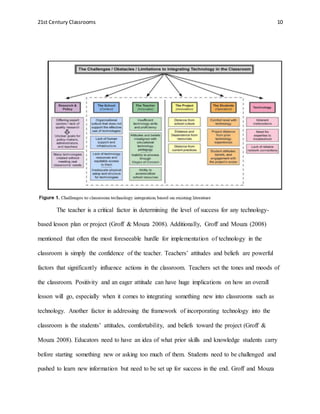
technology into the classrooms. Below is a chart that Groff and Mouza came up with to show the
various challenges, obstacles, and limitations to integrating technology in the classroom.
21st Century Classrooms 10
The teacher is a critical factor in determining the level of success for any technology-
based lesson plan or project (Groff & Mouza 2008). Additionally, Groff and Mouza (2008)
mentioned that often the most foreseeable hurdle for implementation of technology in the
classroom is simply the confidence of the teacher. Teachers’ attitudes and beliefs are powerful
factors that significantly influence actions in the classroom. Teachers set the tones and moods of
the classroom. Positivity and an eager attitude can have huge implications on how an overall
lesson will go, especially when it comes to integrating something new into classrooms such as
technology. Another factor in addressing the framework of incorporating technology into the
classroom is the students’ attitudes, comfortability, and beliefs toward the project (Groff &
Mouza 2008). Educators need to have an idea of what prior skills and knowledge students carry
before starting something new or asking too much of them. Students need to be challenged and
pushed to learn new information but need to be set up for success in the end. Groff and Mouza
21st Century Classrooms 11
(2008) mentioned that one of the largest factors in whether integrating something new into the
classroom will work is knowing a student's prior experiences, skills, and attitudes. Knowing how
students respond to technology in a classroom and what needs to be modified for a successful
learning experience is part of providing an all-inclusive and well-rounded technology-based
curriculum.
Overall the integration of technology into the classrooms is something that is inevitable.
This paper shows that teachers need to be using technology to create a highly effective classroom
environment that can meet 21st century skills and demands. Humans are living in a world that is
controlled by technology and their daily lives are engulfed by electronics, social media, and the
internet. Students are entering classrooms with more knowledge about technology and the
internet than most educators. For 21st century students, there has never been a world without a
smartphone or the ability to get online and Google search any answer. Educators need to do their
very best to prepare students to live in the 21st century and beyond. Educators need to prepare
their students for success, teaching them to be creative thinkers, encouraging them to collaborate
with others, and developing a never ending hunger for knowledge. For all teachers, an overall
goal should be to create a highly effective classroom environment that can meet 21st century
skills and demands.
21st Century Classrooms 12
References:
Alismail, H. A., & McGuire, P. (2015). 21st century standards and curriculum: Current research
and practice. Journal of Education and Practice, 6(6), 150-154.
Bitner N. & Bitner J. (2002). Integrating technology into the classroom: Eight keys to success.
Technology and Teaching, 10(1), 95-100.
Driscoll, M. (2019, August 3). Education in the 21st Century. Retrieved from
https://thinkstrategicforschools.com/education-21st-century/.
Gibbons, S., Yauk, M., & Seo, K. K. (2017, June). Investigating the interplay between new
technology and continuing professional education. In EdMedia+ Innovate Learning (pp.
1292-1295). Association for the Advancement of Computing in Education (AACE).
Groff, J., & Mouza, C. (2008). A framework for addressing challenges to classroom technology
use. AACE Journal, 16(1), 21-46.
Kemp, A. T., Preston, J., Page, C. S., Harper, R., Dillard, B., Flynn, J., & Yamaguchi, M. (2014).
Technology and Teaching: A Conversation among Faculty Regarding the Pros and Cons
of Technology. The Qualitative Report, 19(3), 1-23. Retrieved from
https://nsuworks.nova.edu/tqr/vol19/iss3/2
Lambert, J. & Cuper, P. (2008). Multimedia technologies and familiar spaces: 21st-century
teaching for 21st-century learners. Contemporary Issues in Technology and Teacher
Education, 8(3), 264276.
21st Century Classrooms 13
Parette, H. P., Hourcade, J., & Blum, C. (2011). Using animation in Microsoft PowerPoint to
enhance engagement and learning in young learners with development delay. Teaching
Exceptional Children, 43(4), 58-67. Doi: 10.1177/004005991104300406
Sharkins, K. A., Newton, A. B., Albaiz, N. E., & Ernest, J. M. (2016). Preschool children’s
exposure to media, technology, and screen time: Perspectives of caregivers from three
early childcare settings. Early Childhood Education Journal, 44(5), 437-444. Doi:
10.1007/s10643-015-0732-3
Shirky, C. (2010). Cognitive surplus: how technology makes consumers into
collaborators. New York, NY: Penguin Paperbacks. Kindle Edition.

3rd essay

  • 1.
    RUNNING HEAD: 21stCentury Classrooms Creating Highly Effective 21st Century Classrooms James B. Leach V Western Oregon University
  • 2.
    21st Century Classrooms2 Creating Highly Effective 21st Century Classrooms We live in a world that is engulfed by digital tools, and engineers are constantly looking for the next advancement in technology. Digital innovation is one big race. Daily there are people texting, blogging, liking, commenting, and participating in a digital world that can seem more in-depth than actual human life. Whether it is in a restaurant, office, library, playground, car, or walking down the street, people today will often have some form of technology readily available, and if they do not, many may want to get back to their phone or tablet. In today’s classrooms there are several restrictions on technology usage, and often classrooms restrict the use of any technology at all, a stark contrast to what we see in the communities around us. Computers will be pushed to the back of the classroom, and students are sitting at a desk with a generic assignment in front of them that the teacher handed out. For some classes this is best, for others incorporating technology can add to a unique overall educational experience. Classrooms in the 21st century need to do a better job reflecting the world that students are growing up in. According to Lambert and Cuper (2008) the current generation of digital students are motivated to use multimedia tools. Teachers need to use their power as teachers to provide learning opportunities for the next generation of classroom teachers and modern day workers. Teachers need to push for collaboration, creativity and team building efforts using technology, web 2.0 tools and mass media. With all the benefits that come with the use of technology in the world of education, instructors need to be knowledgeable in ways to incorporate technology into their curriculum. The purpose of this paper is to convince people that teachers need to be using technology to create a highly effective classroom environment that can meet 21st century skills and demands.
  • 3.
    21st Century Classrooms3 Many articles have been written on the debate discussing the use of various technologies within classrooms and online learning. Gibson, Yaulk, and Seo (2017) and Kemp, Preston, Page, Harper, Dillard, Flynn and Yamaguchi (2014) argue that technology does not provide the same values as face-to-face instruction and learning; rather it makes us emotionless and not opinionated. On the other hand, Groff and Mouza (2008), Shirky (2010), and Driscoll (2019) are adamant that classrooms should be implementing the use of technology because it is the way of the world and the future. Although researchers describe many benefits to technology use in classrooms, some argue that too much use can be damaging to students and individuals. Sharkins, Newton, Albaiz and Ernst (2016) shared that studies have shown a decrease in a child's ability to stay on task, in academic performance, creativity, and social interactions from excessive amounts of screen time. Teachers need to be able and willing to meet all demands of students in the classroom. Too often it is debated whether technology should be a fundamental building block for modern day classrooms. Educators cannot assume students learn the same way they always have and that the same methods we used years ago will work today (Lambert & Cuper, 2008). In addition to the ongoing debate of whether technology has a beneficial place in modern day classrooms, there is also the issue of teachers not wanting to deal with the hassle of implementing technology into their curriculums because of the challenge of learning new skills to properly use new technology. When using technology and new programs, teachers must have the time to learn new skills. If teachers are not given the time or do not have adequate time to learn new skills or programs, then the technology will not be useful to the students or teacher (Parette, Hourcade & Blum, 2011). Teachers often do not want to have a large change with their current curriculum. Students today
  • 4.
    21st Century Classrooms4 are, on occasion, more familiar with current technology than teachers and there is a lack of knowledge on how to develop a quality technology-based educational experience for students. Students in today's classrooms are growing up with the internet and technology in hand. Today’s generation of students has never known life without the internet and technology. Driscoll (2019) points out Generation Alpha (born since 2010) are younger than smartphones, Instagram, 3D television, and the iPad. A 21st century student is a new kind of student, one that needs to be taught in a unique way. Creativity and collaboration are at an all-time high for modern day students. Generation Alpha is a brand of student who thrives off the use of technology and using it is often not a new concept. Rather than restricting the use of technology, educators need to be looking at how curriculum can be modernized to meet the demands of the 21st century student. According to Alismail and Mcguire (2015), 21st century curriculum should blend knowledge, thinking, innovation skills, media, Information and Communication Technology (ICT) literacy, and real life experience in the context of core academic subjects. It is important to allow students the creativity and use of technology to drive learning in a unique style. By allowing creative thinking and gauging understanding of content standards through a portfolio based system, students can display their concept retention while producing tangible and valuable outcomes (Alismail & Mcguire, 2017). For example, students could work throughout the school year to create a culminating portfolio to show their retention of concepts covered. Educators need to take a deeper look into the use of technology in classrooms. If people are seriously looking at how teachers can best prepare and educate youth for life after the classroom, then teachers should be implementing technology into their classrooms and giving students all the tools possible to succeed in a world filled with and run on technology.
  • 5.
    21st Century Classrooms5 Educators and society are still not sure that pushing the use of technology in classrooms is the way to go. According to Gibson, Yaulk and Seo (2017), technology should be introduced into a classroom with an intention in mind. Most teachers using technology do not monitor the use of computers with students and do not record any data to support a positive or negative impact (Gibson et al., 2017). Educators are asked to record scores and grades, and collect data, because it gives validity to current curriculum and teaching practices. This same data collection should be taken into consideration when it comes to introducing technology into a new curriculum plan. By recording data, teachers, students, and administrators will be given the capabilities to see if technology is having a positive impact on the educational experience within a school setting. Bitner and Bitner (2002) believe there are eight considerations that can be taken to successfully integrate technology into the classroom: fear of change, training in basics, personal use, teaching models, learning based, climate, motivation, and support. Each of these considerations is still relevant in the 21st century classroom. These considerations are not new to teaching, but rather need to be adapted to help with the implementation of technology into lesson plans (Bitner & Bitner, 2002). With these considerations in mind, teachers need to look at various ways to integrate technology into curriculum to culminate with a well-rounded, collaborative learning experience for our students. For example, a teacher trying to bring in a new web 2.0 tool needs to look at how this will impact classroom collaboration, creativity, and develop 21st century skills. With that may come the fear of not knowing the basic usage guidelines of the new technology, leading to not being able to problem solve when something arises to best help students. All eight of Bitner and Bitner’s (2002) considerations are linked: if the teacher is fearful then there will be no motivation to teach, if the teacher is not comfortable
  • 6.
    21st Century Classrooms6 using technology then there will be anxiety and fear. A proper training program will help to eliminate these roadblocks and lead to a quality learning climate in the classroom. Kemp et al. (2014) asserted that technology is not a means for education or a replacement of the person. Rather the authors’ maintained schools should use technology as a personal tool for expanding curriculum within a classroom. Simply put, it is another tool to educate just as a textbook is used. A lot of the debate between Kemp and colleagues was targeted at virtual classrooms versus “brick and mortar” and the downfalls or struggles that come along with teacher-student relationships while strictly instructing online (Kemp, et al., 2014). According to Flynn (2014), while teaching online courses the instructor loses control over the class in the scope of sequencing of the syllabus, texts chosen, and the pacing of the material. Gone are the impromptu class discussions, spur of the moment interactions, and challenging real life conversations that happen when a teacher and student are face-to-face (Kemp et al., 2014). One of the purposes of technology is to create a sense of community through keeping people digitally connected while not together. According to Flynn, this is something that is lost when working and teaching online with students. This is something that can be resolved through proper set up of online classrooms through the extension of learning via videos, images, interactive web 2.0 tools, and podcasts. Often, people will immediately reach for a phone or computer when a chime indicates an incoming email or text message. One of the positives to the availability of technology is connecting teachers and students while not in the classroom. Teachers can help to answer questions and problem solve with students about assignments while outside of the school setting. Being able to access this tool at our fingertips at any time is a great resource for enhancing the overall learning experience among students. Along with availability to respond to students in a
  • 7.
    21st Century Classrooms7 timely manner comes the availability of material for online students. Students do not have to wait for class the next day to get access to class material or to ask questions. They can simply go online, submit a question in a class discussion thread and either their professor or other students will be able to help guide them in the appropriate direction. Another major advantage to teachers using technology in the classroom is that is allows students to have in-classroom material and assignments available and accessible while outside of the physical classroom. Some students may need to look back over the rubric for an assignment, and posting material online gives students the ability to have access to whatever they need, whenever they want it. Often students will have questions about an assignment while they are outside of the classroom; creating an online thread for discussion can help to solve this issue. All of this creates a learning environment that extends well beyond the walls of the classroom to give students a fully immersed learning experience and create a solid community. Giving students the ability to go online and review, discuss, and problem solve while outside of the classroom is a great way for teachers to develop a quality technology-based educational experience for their students. A downfall that Kemp et al. (2014) pointed out with putting classroom material online and asking students to go online is that access to technology outside of the classroom is not something that is feasible for everyone. Technology is expensive and may not be something every student has access to while outside of school. Individuals that come from lower class families and often students of minority can have a harder time accessing technology that allows them to become a member of the online community unless they are in school, which creates a great barrier to staying connected while outside of the classroom (Kemp et al., 2014). Teachers need to reach all their students and design curriculum with the whole class in mind. This is a
  • 8.
    21st Century Classrooms8 large reason why knowing the surrounding community is important. Communicating with parents and creating an all-inclusive learning environment will in turn foster a quality educational experience for students. Although there are many criticisms of technology, there are several benefits to the use of technology as well. Technology is currently the driving force behind many aspects of the modern day world. As mentioned above, youth today are growing up with technology readily available to them. Educators need to look at merging technology and education to better prepare students for their futures and to create creative thinkers. According to Driscoll (2019), a 21st century education needs to be about providing students with the knowledge they need to succeed in this new world of technology. Considering how much information is readily available, there needs to be more of a focus on making sense of that information and how to share it and use it (Driscoll, 2019). A large part of using technology and being able to have access to the internet is helping students decipher what is reliable information versus what should be avoided. Clay Shirky, whose 2010 book Cognitive Surplus shared ideas about collaboration and information building while using technology, argues that prior to the internet, people were primarily consumers of information with their free time. The internet, however, has presented people with a whole new medium for using free time. They are now constantly collaborating and sharing during their free time. Web 2.0 tools and social media outlets have turned everyone into collaborators and creative thinkers (Shirky, 2010). As an educator, it is important to think about where and what students will be doing in their future careers and lives. Educators need to be setting students up with the tools to be leaders and creative thinkers. Educators need to be integrating Web 2.0 tools and social media platforms into lesson plans in a way that builds critical thinking, collaboration, and creativity with a purpose.
  • 9.
    21st Century Classrooms9 I make the argument that students in today's educational system who are growing up with technology and access to the internet, often have not experienced life without the internet. Shirky (2010) and Driscoll (2019) discussed how educators need to serve students more as mentors, rather than all-knowing information providers. Driscoll states that serving students in this way will be beneficial because when it comes to technology, students invariably are going to know more than the teacher on different topics. Shirky (2010) mentions that free time for people is spent differently now. Individuals can contribute to large group conversation on topics they are passionate about, giving them the ability to access and learn a wide array of topics and mediums that draw their interests. Educators are going to have a difficult time stopping students from going online and learning about whatever passed through their head in that moment. Students are going to be technology and internet savvy the moment that they step into their classrooms. They are living in a world that is controlled by the internet, and where individuals’ free time outlet is no longer going outside and playing but rather going online and surfing the web. Students are going to be craving the release of the internet while in class, so why not allow them to have access to it through incorporating it into lesson plans and curriculum? Teachers are the driving force behind any classroom, educational system, quality lesson plan, and changes that are made within a classroom. A teacher needs to be well prepared to provide students with a well-rounded quality educational experience. Groff and Mouza (2008) discuss a framework that helps to address and handle challenges that come with integrating technology into the classrooms. Below is a chart that Groff and Mouza came up with to show the various challenges, obstacles, and limitations to integrating technology in the classroom.
  • 10.
    21st Century Classrooms10 The teacher is a critical factor in determining the level of success for any technology- based lesson plan or project (Groff & Mouza 2008). Additionally, Groff and Mouza (2008) mentioned that often the most foreseeable hurdle for implementation of technology in the classroom is simply the confidence of the teacher. Teachers’ attitudes and beliefs are powerful factors that significantly influence actions in the classroom. Teachers set the tones and moods of the classroom. Positivity and an eager attitude can have huge implications on how an overall lesson will go, especially when it comes to integrating something new into classrooms such as technology. Another factor in addressing the framework of incorporating technology into the classroom is the students’ attitudes, comfortability, and beliefs toward the project (Groff & Mouza 2008). Educators need to have an idea of what prior skills and knowledge students carry before starting something new or asking too much of them. Students need to be challenged and pushed to learn new information but need to be set up for success in the end. Groff and Mouza
  • 11.
    21st Century Classrooms11 (2008) mentioned that one of the largest factors in whether integrating something new into the classroom will work is knowing a student's prior experiences, skills, and attitudes. Knowing how students respond to technology in a classroom and what needs to be modified for a successful learning experience is part of providing an all-inclusive and well-rounded technology-based curriculum. Overall the integration of technology into the classrooms is something that is inevitable. This paper shows that teachers need to be using technology to create a highly effective classroom environment that can meet 21st century skills and demands. Humans are living in a world that is controlled by technology and their daily lives are engulfed by electronics, social media, and the internet. Students are entering classrooms with more knowledge about technology and the internet than most educators. For 21st century students, there has never been a world without a smartphone or the ability to get online and Google search any answer. Educators need to do their very best to prepare students to live in the 21st century and beyond. Educators need to prepare their students for success, teaching them to be creative thinkers, encouraging them to collaborate with others, and developing a never ending hunger for knowledge. For all teachers, an overall goal should be to create a highly effective classroom environment that can meet 21st century skills and demands.
  • 12.
    21st Century Classrooms12 References: Alismail, H. A., & McGuire, P. (2015). 21st century standards and curriculum: Current research and practice. Journal of Education and Practice, 6(6), 150-154. Bitner N. & Bitner J. (2002). Integrating technology into the classroom: Eight keys to success. Technology and Teaching, 10(1), 95-100. Driscoll, M. (2019, August 3). Education in the 21st Century. Retrieved from https://thinkstrategicforschools.com/education-21st-century/. Gibbons, S., Yauk, M., & Seo, K. K. (2017, June). Investigating the interplay between new technology and continuing professional education. In EdMedia+ Innovate Learning (pp. 1292-1295). Association for the Advancement of Computing in Education (AACE). Groff, J., & Mouza, C. (2008). A framework for addressing challenges to classroom technology use. AACE Journal, 16(1), 21-46. Kemp, A. T., Preston, J., Page, C. S., Harper, R., Dillard, B., Flynn, J., & Yamaguchi, M. (2014). Technology and Teaching: A Conversation among Faculty Regarding the Pros and Cons of Technology. The Qualitative Report, 19(3), 1-23. Retrieved from https://nsuworks.nova.edu/tqr/vol19/iss3/2 Lambert, J. & Cuper, P. (2008). Multimedia technologies and familiar spaces: 21st-century teaching for 21st-century learners. Contemporary Issues in Technology and Teacher Education, 8(3), 264276.
  • 13.
    21st Century Classrooms13 Parette, H. P., Hourcade, J., & Blum, C. (2011). Using animation in Microsoft PowerPoint to enhance engagement and learning in young learners with development delay. Teaching Exceptional Children, 43(4), 58-67. Doi: 10.1177/004005991104300406 Sharkins, K. A., Newton, A. B., Albaiz, N. E., & Ernest, J. M. (2016). Preschool children’s exposure to media, technology, and screen time: Perspectives of caregivers from three early childcare settings. Early Childhood Education Journal, 44(5), 437-444. Doi: 10.1007/s10643-015-0732-3 Shirky, C. (2010). Cognitive surplus: how technology makes consumers into collaborators. New York, NY: Penguin Paperbacks. Kindle Edition.