CHAPTER IV
BASIC CONTENT OF THE
CHURCH’S CATECHESIS
ALVIN HANAPIN JIMENA
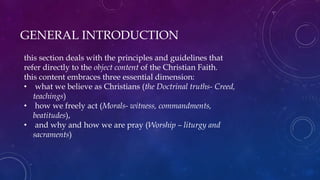
GENERAL INTRODUCTION
this section deals with the principles and guidelines that
refer directly to the object content of the Christian Faith.
this content embraces three essential dimension:
• what we believe as Christians (the Doctrinal truths- Creed,
teachings)
• how we freely act (Morals- witness, commandments,
beatitudes),
• and why and how we are pray (Worship – liturgy and
sacraments)
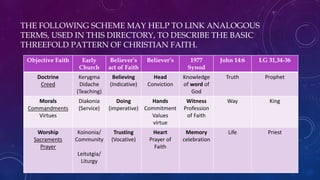
THE FOLLOWING SCHEME MAY HELP TO LINK ANALOGOUS
TERMS, USED IN THIS DIRECTORY, TO DESCRIBE THE BASIC
THREEFOLD PATTERN OF CHRISTIAN FAITH.
Objective Faith Early
Church
Believer’s
act of Faith
Believer’s 1977
Synod
John 14:6 LG 31,34-36
Doctrine
Creed
Kerygma
Didache
(Teaching)
Believing
(Indicative)
Head
Conviction
Knowledge
of word of
God
Truth Prophet
Morals
Commandments
Virtues
Diakonia
(Service)
Doing
(imperative)
Hands
Commitment
Values
virtue
Witness
Profession
of Faith
Way King
Worship
Sacraments
Prayer
Koinonia/
Community
Leitutgia/
Liturgy
Trusting
(Vocative)
Heart
Prayer of
Faith
Memory
celebration
Life Priest
• the sequence of this three dimension is not rigid. On can begin with any
of this three – doctrine, morals, or worship – and proceed from the other
two.
• the direct connection between Catholic doctrine and prayer has always
been recognize according to the ancient axiom: “lex orandi-lex credendi”
(the law of Prayer is the law of belief).
• the intrinsic link between authentic prayer/worship and moral witness
stressed traditionally by focusing on the first three commandments.
• more recent teaching emphasizes loving service of one’s neighbor as one
norm for authentic worship: it corrects the false individualistic “Saving-
one’s-soul” dimension of the Eucharist: “go in peace to love and serve the
Lord.”
• different sequences may and should be used, depending on the
particular catechetical situation.
• What is of prime importance is an integrated catechesis - one that
incorporates all three dimensions into a unified presentation of the
“Good news” towards maturity in Christ.
• this does not mean the catechesis must consist of three equal parts, nor
does it forbid focusing primarily on one dimension. Rather it means that
while focusing, for example on a creedal doctrine, the moral and
worship dimensions play a secondary role of exemplifying the
experiential aspect of the doctrine: how it influences actual moral
behavior and praying as a Christians
NORMS FOR PRESENTING THE GOSPEL MESSAGE
• Christocentric: centered on the person of Jesus Christ, who not only
communicates “the word of the Lord” but is the incarnate Word of God.
 the task of all catechesis is to promote a personal relationship to “the Person
of Jesus of Nazareth, the only Son of the Father” who is the “heart “ of the
Christian Faith.
 Christ is the center of Salvation history and ultimate meaning of all Human
History
 The Gospel is the living word of God, not merely a human message, and must
be handed on as such in catechesis
 Central to Catechesis are the Four Gospels, which have a “catechetical structure
of their own since they rose from the oral tradition which passed on Christ’s Life,
teaching and saving actions to the first Christian Communities”
NORMS FOR PRESENTING THE GOSPEL MESSAGE
• Trinitarian Christo-centricity: Only by confessing faith in God, Father , Son
And Holy Spirit, can Jesus be the center of Catechesis preciselyas the incarnate
word and Beloved Son of the Father, presented to us in His Spirit. Thus
Christians are configured to Christ at Baptism, becoming sons and daughters of
the Father in the Son by the Holy Spirit
 the internal structure of Catechetical presentation must always be
through Christ to the Father in the Holy Spirit
 Catechesis instructs in the intimate life of God by following Jesus’ own
pedagogy in revealing the father as acting Son, and the spirit by His
salvific works.
NORMS FOR PRESENTING THE GOSPEL MESSAGE
• A Message Proclaiming Salvation. The “Good News of Salvation” is a saving
message. In Jesus’ Preaching of the kingdom of God Catechesis Stresses:
 God is revealed not as remote power without a name but as a Father
who is present among His Creatures and whose power is His Love
 with the coming of His Kingdom, God Offers the gift of integral salvation-
freedom from sin, communion with the Father, conquering death with
promise of eternal life.
 proclaiming the justice of God, involving the call to conversion and
formation of authentic Christian Conscience
 the kingdom is inaugurated in the person of Jesus himself, with its seed
and beginning in the community of his disciples, the Church in
pilgrimage towards the Father’s House.
NORMS FOR PRESENTING THE GOSPEL MESSAGE
• Message of Liberation. The Good News of Salvation includes a message of
Liberation, exemplified in the way of Beatitudes address those suffering poverty,
pain, hunger, and injustices, thus catechesis must be attentive to:
 the specific religious dimension of this liberation, not reducing this
liberation simply to the temporal, material dimension of human well-
being, while ignoring spiritual and religious values; rather it must aim at
integral human development
 the importance of Christian Social Morality in Moral Education, with its
”preferential option for the poor.”
NORMS FOR PRESENTING THE GOSPEL MESSAGE
• Ecclesial Nature of the Gospel. Catechesis, originating in the Church’s ministry of the
word, “is nothing other than the process of transmitting the Gospel, as the Christian
Community has received it, understand it, celebrates it, lives it, and commemorates
it in many ways”
• The Historical Character of the Mystery of Salvation. Proclaiming the faith has always
an historical character for it is always within the context of the History of Salvation,
and is based on the Biblical narrative of the wonderful deeds of God (Magnalia Dei)
 presenting “the deeds and words” of God throughout the great stages of
Salvation History;
 explaining the Creed and Catholic Morality by the Gospel by the Gospel
message’s power to illumine the human life in ou age, interpreting the signs
of the times today;
 Situating the sacraments within the History of Salvation by showing how
the sacraments bring the great events of Salvation into the “today” of the
Liturgy;
 uncovering the mystery of God’s presence in His “deeds and words” in
Scriptures, in signs of the times, and in the Knowledge through signs which
is typical of Faith.
NORMS FOR PRESENTING THE GOSPEL MESSAGE
• Inculturation of the Gospel Message. Christ’s incarnation is the Original
“inculturation” and model of all the Church’s catechesis which “ is called to bring
the power of the Gospel into the very heart of culture and cultures.” inculturation of
the faith cannot be reduced to simply external adaptation, but rather signifies how
the Gospel penetrates into the depths of persons and whole peoples, touching them
deeply and “going to the very roots” of their culture. The work of inculturation
demands discernment concerning which cultural riches to take up and which must
be purified and transformed. Two principles govern this discernment: compatibility
with the Gospel and Communion with the Universal Church.
• A Message Meaningful for the Human Person. Catechesis , then, working from this
identity of human experience between Jesus and His disciples, aims at leading
Christians “to follow Christ, learn more and more within the church to think like
him, to judge like him, to act in conformity with his commandments, and to hope as
he invites is to.”
 doctrinal themes illumine the basic experiences and values of all human persons
 Moral Catechesis presents the authentic “good life” in promoting the Beatitudes as
the spirit permeating the Commandments,
 Liturgical catechesis refers the signs and symbols of the Liturgy to the great human
experiences of birth, love, vocation, sacrifice, death.
RELATION OF CFC TO CCC
• the New GDC speaks of a “symphony of faith” in describing the relationship
between the Catechism of the Catholic Church and National Catechism such as our
CFC
• both take their inspiration from Christ, ”the Way, the Truth, the Life.”
• the CCC is a “sure norm for teaching the Faith,” “a sure and authentic reference text for
teaching Catholic Doctrine and preparing for local catechisms
• The CCC is not intended to replace the local catechism but to encourage and assist
in the writing of new cultures
• the CFC, for its part, is characterized by:
 Its official character as created by the CBCP with official approbation of
the Apostolic See.
 its organic presentation of the synthesis of the Faith;
 its roles as a proximate point of reference for catechesis in the Philippines.
RELATION OF CFC TO CCC
• the CCC and CFC together manifest:
 the Catholicity of the Church, with the cultural riches of the Filipino people
incorporated into the expression of the one Church.
 the ecclesial communion of which of which the expression of the one faith is
one of the visible links.
 The reality of Episcopal collegiality
 called to be a renewing leaven of catechesis in the Church
NATURE AND OVERALL STRUCTURE OF THE CFC
• The CFC is based on the “four pillars” of catechesis:
 the profession of Faith (the Creed)
 the celebration of the Faith (The Sacraments)
 The profession of Faith in daily life (the Commandments/virtues)
 and Faith as prayed in the Lord’s Prayer.
• it begins with a Preface, then foundations (Revelation and Faith), followed by
the three essential dimensions of the Catholic Faith (Doctrine, Morals,
Worship) but structured in a way that all three dimensions are integrated in a
diamond shape inter-related sequence which concludes with an epilogue
summarizing the whole work on the basis of the Lord’s Prayer.

Catechetical Program Basic content Chapter V NCDP

  • 1.
    CHAPTER IV BASIC CONTENTOF THE CHURCH’S CATECHESIS ALVIN HANAPIN JIMENA
  • 2.
    GENERAL INTRODUCTION this sectiondeals with the principles and guidelines that refer directly to the object content of the Christian Faith. this content embraces three essential dimension: • what we believe as Christians (the Doctrinal truths- Creed, teachings) • how we freely act (Morals- witness, commandments, beatitudes), • and why and how we are pray (Worship – liturgy and sacraments)
  • 3.
    THE FOLLOWING SCHEMEMAY HELP TO LINK ANALOGOUS TERMS, USED IN THIS DIRECTORY, TO DESCRIBE THE BASIC THREEFOLD PATTERN OF CHRISTIAN FAITH. Objective Faith Early Church Believer’s act of Faith Believer’s 1977 Synod John 14:6 LG 31,34-36 Doctrine Creed Kerygma Didache (Teaching) Believing (Indicative) Head Conviction Knowledge of word of God Truth Prophet Morals Commandments Virtues Diakonia (Service) Doing (imperative) Hands Commitment Values virtue Witness Profession of Faith Way King Worship Sacraments Prayer Koinonia/ Community Leitutgia/ Liturgy Trusting (Vocative) Heart Prayer of Faith Memory celebration Life Priest
  • 4.
    • the sequenceof this three dimension is not rigid. On can begin with any of this three – doctrine, morals, or worship – and proceed from the other two. • the direct connection between Catholic doctrine and prayer has always been recognize according to the ancient axiom: “lex orandi-lex credendi” (the law of Prayer is the law of belief). • the intrinsic link between authentic prayer/worship and moral witness stressed traditionally by focusing on the first three commandments. • more recent teaching emphasizes loving service of one’s neighbor as one norm for authentic worship: it corrects the false individualistic “Saving- one’s-soul” dimension of the Eucharist: “go in peace to love and serve the Lord.”
  • 5.
    • different sequencesmay and should be used, depending on the particular catechetical situation. • What is of prime importance is an integrated catechesis - one that incorporates all three dimensions into a unified presentation of the “Good news” towards maturity in Christ. • this does not mean the catechesis must consist of three equal parts, nor does it forbid focusing primarily on one dimension. Rather it means that while focusing, for example on a creedal doctrine, the moral and worship dimensions play a secondary role of exemplifying the experiential aspect of the doctrine: how it influences actual moral behavior and praying as a Christians
  • 6.
    NORMS FOR PRESENTINGTHE GOSPEL MESSAGE • Christocentric: centered on the person of Jesus Christ, who not only communicates “the word of the Lord” but is the incarnate Word of God.  the task of all catechesis is to promote a personal relationship to “the Person of Jesus of Nazareth, the only Son of the Father” who is the “heart “ of the Christian Faith.  Christ is the center of Salvation history and ultimate meaning of all Human History  The Gospel is the living word of God, not merely a human message, and must be handed on as such in catechesis  Central to Catechesis are the Four Gospels, which have a “catechetical structure of their own since they rose from the oral tradition which passed on Christ’s Life, teaching and saving actions to the first Christian Communities”
  • 7.
    NORMS FOR PRESENTINGTHE GOSPEL MESSAGE • Trinitarian Christo-centricity: Only by confessing faith in God, Father , Son And Holy Spirit, can Jesus be the center of Catechesis preciselyas the incarnate word and Beloved Son of the Father, presented to us in His Spirit. Thus Christians are configured to Christ at Baptism, becoming sons and daughters of the Father in the Son by the Holy Spirit  the internal structure of Catechetical presentation must always be through Christ to the Father in the Holy Spirit  Catechesis instructs in the intimate life of God by following Jesus’ own pedagogy in revealing the father as acting Son, and the spirit by His salvific works.
  • 8.
    NORMS FOR PRESENTINGTHE GOSPEL MESSAGE • A Message Proclaiming Salvation. The “Good News of Salvation” is a saving message. In Jesus’ Preaching of the kingdom of God Catechesis Stresses:  God is revealed not as remote power without a name but as a Father who is present among His Creatures and whose power is His Love  with the coming of His Kingdom, God Offers the gift of integral salvation- freedom from sin, communion with the Father, conquering death with promise of eternal life.  proclaiming the justice of God, involving the call to conversion and formation of authentic Christian Conscience  the kingdom is inaugurated in the person of Jesus himself, with its seed and beginning in the community of his disciples, the Church in pilgrimage towards the Father’s House.
  • 9.
    NORMS FOR PRESENTINGTHE GOSPEL MESSAGE • Message of Liberation. The Good News of Salvation includes a message of Liberation, exemplified in the way of Beatitudes address those suffering poverty, pain, hunger, and injustices, thus catechesis must be attentive to:  the specific religious dimension of this liberation, not reducing this liberation simply to the temporal, material dimension of human well- being, while ignoring spiritual and religious values; rather it must aim at integral human development  the importance of Christian Social Morality in Moral Education, with its ”preferential option for the poor.”
  • 10.
    NORMS FOR PRESENTINGTHE GOSPEL MESSAGE • Ecclesial Nature of the Gospel. Catechesis, originating in the Church’s ministry of the word, “is nothing other than the process of transmitting the Gospel, as the Christian Community has received it, understand it, celebrates it, lives it, and commemorates it in many ways” • The Historical Character of the Mystery of Salvation. Proclaiming the faith has always an historical character for it is always within the context of the History of Salvation, and is based on the Biblical narrative of the wonderful deeds of God (Magnalia Dei)  presenting “the deeds and words” of God throughout the great stages of Salvation History;  explaining the Creed and Catholic Morality by the Gospel by the Gospel message’s power to illumine the human life in ou age, interpreting the signs of the times today;  Situating the sacraments within the History of Salvation by showing how the sacraments bring the great events of Salvation into the “today” of the Liturgy;  uncovering the mystery of God’s presence in His “deeds and words” in Scriptures, in signs of the times, and in the Knowledge through signs which is typical of Faith.
  • 11.
    NORMS FOR PRESENTINGTHE GOSPEL MESSAGE • Inculturation of the Gospel Message. Christ’s incarnation is the Original “inculturation” and model of all the Church’s catechesis which “ is called to bring the power of the Gospel into the very heart of culture and cultures.” inculturation of the faith cannot be reduced to simply external adaptation, but rather signifies how the Gospel penetrates into the depths of persons and whole peoples, touching them deeply and “going to the very roots” of their culture. The work of inculturation demands discernment concerning which cultural riches to take up and which must be purified and transformed. Two principles govern this discernment: compatibility with the Gospel and Communion with the Universal Church. • A Message Meaningful for the Human Person. Catechesis , then, working from this identity of human experience between Jesus and His disciples, aims at leading Christians “to follow Christ, learn more and more within the church to think like him, to judge like him, to act in conformity with his commandments, and to hope as he invites is to.”  doctrinal themes illumine the basic experiences and values of all human persons  Moral Catechesis presents the authentic “good life” in promoting the Beatitudes as the spirit permeating the Commandments,  Liturgical catechesis refers the signs and symbols of the Liturgy to the great human experiences of birth, love, vocation, sacrifice, death.
  • 12.
    RELATION OF CFCTO CCC • the New GDC speaks of a “symphony of faith” in describing the relationship between the Catechism of the Catholic Church and National Catechism such as our CFC • both take their inspiration from Christ, ”the Way, the Truth, the Life.” • the CCC is a “sure norm for teaching the Faith,” “a sure and authentic reference text for teaching Catholic Doctrine and preparing for local catechisms • The CCC is not intended to replace the local catechism but to encourage and assist in the writing of new cultures • the CFC, for its part, is characterized by:  Its official character as created by the CBCP with official approbation of the Apostolic See.  its organic presentation of the synthesis of the Faith;  its roles as a proximate point of reference for catechesis in the Philippines.
  • 13.
    RELATION OF CFCTO CCC • the CCC and CFC together manifest:  the Catholicity of the Church, with the cultural riches of the Filipino people incorporated into the expression of the one Church.  the ecclesial communion of which of which the expression of the one faith is one of the visible links.  The reality of Episcopal collegiality  called to be a renewing leaven of catechesis in the Church
  • 14.
    NATURE AND OVERALLSTRUCTURE OF THE CFC • The CFC is based on the “four pillars” of catechesis:  the profession of Faith (the Creed)  the celebration of the Faith (The Sacraments)  The profession of Faith in daily life (the Commandments/virtues)  and Faith as prayed in the Lord’s Prayer. • it begins with a Preface, then foundations (Revelation and Faith), followed by the three essential dimensions of the Catholic Faith (Doctrine, Morals, Worship) but structured in a way that all three dimensions are integrated in a diamond shape inter-related sequence which concludes with an epilogue summarizing the whole work on the basis of the Lord’s Prayer.