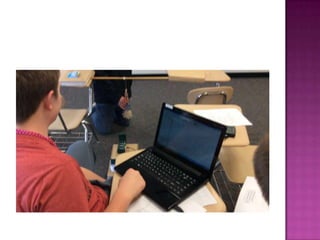
By: Laura Condon
OSU Capstone Project
 Teachers need to develop skills of using
technology as well as skills of integrating
technology to grant students a richer
learning environment (Sevinc and Karaca,
2010).
 Research discoveries and reflection on
practice have led to new knowledge and
beliefs that are transforming the way
educators think about teaching and learning
(Loucks-Horsley, Stiles, Mundry, Love, &
Hewson, 2010).
 Technology is the application of scientific
knowledge and the tools developed from such
knowledge. Humans are capable of developing
technology as well as using technology to further
develop civilization (AAAS, 1990).
 In the more modern, digital world, the Internet,
search engines, and websites were all created to
make the gathering of information easier.
 Technology has to continue to make
advancements to meet these connection needs
of the society. Because of the need for
technological advancements, the way students
learn in the 21st century is changing.
 Many teachers do not know how to teach
students of the 21st century (Birman,
Desimone, Porter, & Garet, 2000), and
professional development must focus on
teaching teachers these skills.
 Schools can only be as good as the teachers
and administrators within them (Guskey,
2002).
 Professional development is the most
effective way to help teachers become more
prepared to teach and evaluate students of
the 21st century (Lieberman & Mace, 2011).
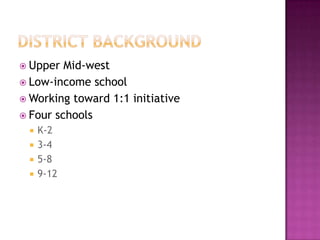
 Upper Mid-west
 Low-income school
 Working toward 1:1 initiative
 Four schools
 K-2
 3-4
 5-8
 9-12
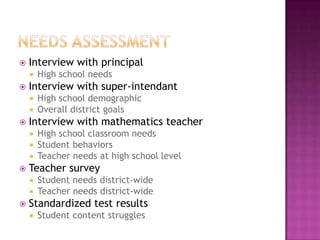
 Interview with principal
 High school needs
 Interview with super-intendant
 High school demographic
 Overall district goals
 Interview with mathematics teacher
 High school classroom needs
 Student behaviors
 Teacher needs at high school level
 Teacher survey
 Student needs district-wide
 Teacher needs district-wide
 Standardized test results
 Student content struggles
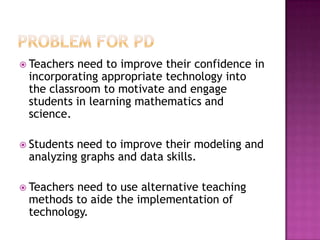
 Teachers need to improve their confidence in
incorporating appropriate technology into
the classroom to motivate and engage
students in learning mathematics and
science.
 Students need to improve their modeling and
analyzing graphs and data skills.
 Teachers need to use alternative teaching
methods to aide the implementation of
technology.
My professional development
focused on the use of data
collection technology with
new instructional strategies as
a motivational tool to help
students understand different
modeling and analyzing
techniques using real-world
data.
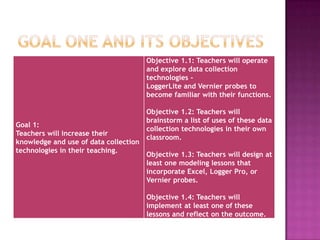
Goal 1:
Teachers will increase their
knowledge and use of data collection
technologies in their teaching.
Objective 1.1: Teachers will operate
and explore data collection
technologies -
LoggerLite and Vernier probes to
become familiar with their functions.
Objective 1.2: Teachers will
brainstorm a list of uses of these data
collection technologies in their own
classroom.
Objective 1.3: Teachers will design at
least one modeling lessons that
incorporate Excel, Logger Pro, or
Vernier probes.
Objective 1.4: Teachers will
implement at least one of these
lessons and reflect on the outcome.
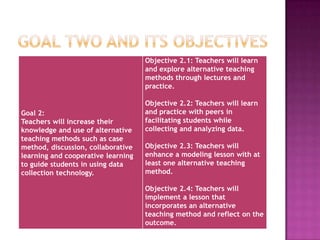
Goal 2:
Teachers will increase their
knowledge and use of alternative
teaching methods such as case
method, discussion, collaborative
learning and cooperative learning
to guide students in using data
collection technology.
Objective 2.1: Teachers will learn
and explore alternative teaching
methods through lectures and
practice.
Objective 2.2: Teachers will learn
and practice with peers in
facilitating students while
collecting and analyzing data.
Objective 2.3: Teachers will
enhance a modeling lesson with at
least one alternative teaching
method.
Objective 2.4: Teachers will
implement a lesson that
incorporates an alternative
teaching method and reflect on the
outcome.
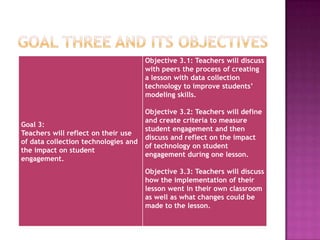
Goal 3:
Teachers will reflect on their use
of data collection technologies and
the impact on student
engagement.
Objective 3.1: Teachers will discuss
with peers the process of creating
a lesson with data collection
technology to improve students’
modeling skills.
Objective 3.2: Teachers will define
and create criteria to measure
student engagement and then
discuss and reflect on the impact
of technology on student
engagement during one lesson.
Objective 3.3: Teachers will discuss
how the implementation of their
lesson went in their own classroom
as well as what changes could be
made to the lesson.
 All middle school and high school
mathematics and science teachers were
invited
 Two high school mathematics and three
science teachers attended
 All veteran teachers willing to meet the
needs of our district
 Minimum teaching experience is 10 years.
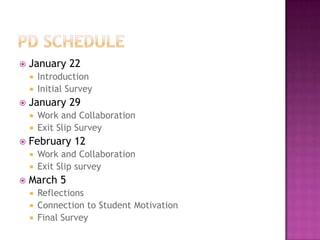
 January 22
 Introduction
 Initial Survey
 January 29
 Work and Collaboration
 Exit Slip Survey
 February 12
 Work and Collaboration
 Exit Slip survey
 March 5
 Reflections
 Connection to Student Motivation
 Final Survey
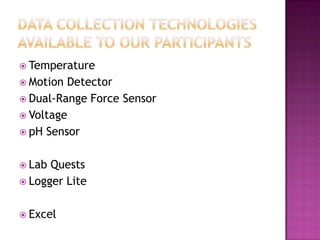
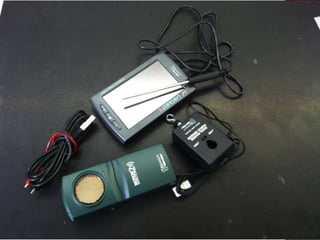
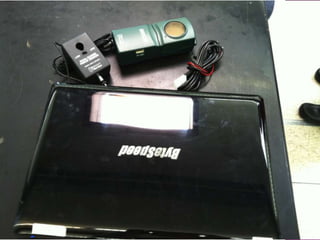
 Temperature
 Motion Detector
 Dual-Range Force Sensor
 Voltage
 pH Sensor
 Lab Quests
 Logger Lite
 Excel
 Initial survey
 Sign consent form
 Demonstrate Vernier probes
 Outline the schedule and plan of events
 Go over any questions
 Collaboration
 Work time
 Explore and Research
 Develop Lessons
 Play with the probes
 Collaboration
 Work time
 Explore and Research
 Develop Lessons
 Play with the probes
 Characteristics of a motivated student
 Reflection of lessons implemented
 Alternative teaching strategies overview
 Questions and answers
 Final reflection
 Final survey
“A motivated student shows up, is engaged,
asks questions, and submits quality work.
They do not complain that they do not know,
but instead use their confusion as a time to
learn more and ask questions. Motivated
students use their resources to help them learn
instead of cheat. Their scores are consistent
on homework and tests. Motivated students
are active in their learning.”
~Professional Development Participants
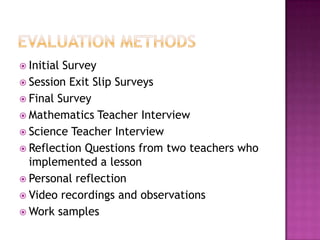
 Initial Survey
 Session Exit Slip Surveys
 Final Survey
 Mathematics Teacher Interview
 Science Teacher Interview
 Reflection Questions from two teachers who
implemented a lesson
 Personal reflection
 Video recordings and observations
 Work samples
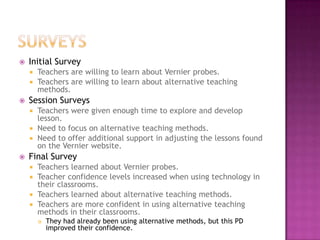
 Initial Survey
 Teachers are willing to learn about Vernier probes.
 Teachers are willing to learn about alternative teaching
methods.
 Session Surveys
 Teachers were given enough time to explore and develop
lesson.
 Need to focus on alternative teaching methods.
 Need to offer additional support in adjusting the lessons found
on the Vernier website.
 Final Survey
 Teachers learned about Vernier probes.
 Teacher confidence levels increased when using technology in
their classrooms.
 Teachers learned about alternative teaching methods.
 Teachers are more confident in using alternative teaching
methods in their classrooms.
 They had already been using alternative methods, but this PD
improved their confidence.
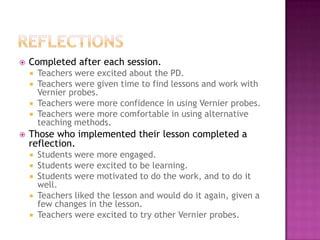
 Completed after each session.
 Teachers were excited about the PD.
 Teachers were given time to find lessons and work with
Vernier probes.
 Teachers were more confidence in using Vernier probes.
 Teachers were more comfortable in using alternative
teaching methods.
 Those who implemented their lesson completed a
reflection.
 Students were more engaged.
 Students were excited to be learning.
 Students were motivated to do the work, and to do it
well.
 Teachers liked the lesson and would do it again, given a
few changes in the lesson.
 Teachers were excited to try other Vernier probes.
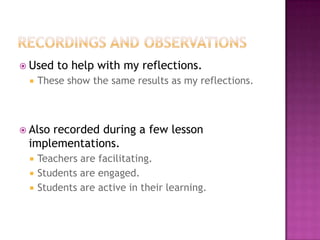
 Used to help with my reflections.
 These show the same results as my reflections.
 Also recorded during a few lesson
implementations.
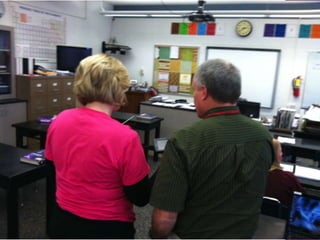
 Teachers are facilitating.
 Students are engaged.
 Students are active in their learning.
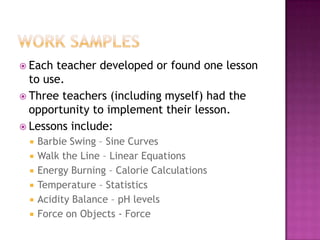
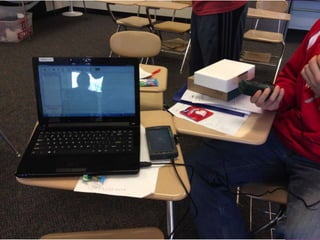
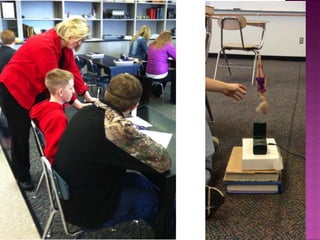
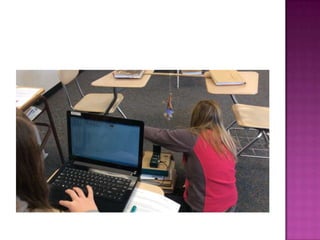
 Each teacher developed or found one lesson
to use.
 Three teachers (including myself) had the
opportunity to implement their lesson.
 Lessons include:
 Barbie Swing – Sine Curves
 Walk the Line – Linear Equations
 Energy Burning – Calorie Calculations
 Temperature – Statistics
 Acidity Balance – pH levels
 Force on Objects - Force
 The high school mathematics and science
teachers increased their confidence in using
technology in their classrooms.
 Teachers increased their knowledge of
Vernier probes.
 Teachers increased their knowledge of
alternative teaching methods.
 Teachers were able to reflect on their
lessons, the success of the implementation,
and the process as a whole.
 With time, support, and practice teachers can
increase their confidence in technology use in
the classroom.
 With time, support, and practice teachers can
increase their confidence in using alternative
teaching methods.
 The high school teachers at my school still need
administrator support and witness to these new
technologies and teaching methods.
 The high school teachers are willing to continue
to learn about Vernier probes and the technology
we have available at the high school.
 These teachers are committed to the success
and motivation of our students.
 I was very excited about the results of the
PD.
 I wish some middle school teachers had
attended.
 I will have to focus on providing them with
support in the coming year.
 Overall, I feel the PD was a success and all
goals were met.
 I am thrilled about being able to continue to
lead and support these teachers in
implementing technology into our
classrooms.
 Present to the school board
 Have superintendent post my PowerPoint on
the school Facebook page
 Offer help to other teachers during our in-
service times on Wednesdays
 Work with our technology integrationalist for
more ideas and to reach out to other grade
levels

Condon Capstone PowerPoint

  • 1.
    By: Laura Condon OSUCapstone Project
  • 2.
     Teachers needto develop skills of using technology as well as skills of integrating technology to grant students a richer learning environment (Sevinc and Karaca, 2010).  Research discoveries and reflection on practice have led to new knowledge and beliefs that are transforming the way educators think about teaching and learning (Loucks-Horsley, Stiles, Mundry, Love, & Hewson, 2010).
  • 3.
     Technology isthe application of scientific knowledge and the tools developed from such knowledge. Humans are capable of developing technology as well as using technology to further develop civilization (AAAS, 1990).  In the more modern, digital world, the Internet, search engines, and websites were all created to make the gathering of information easier.  Technology has to continue to make advancements to meet these connection needs of the society. Because of the need for technological advancements, the way students learn in the 21st century is changing.
  • 4.
     Many teachersdo not know how to teach students of the 21st century (Birman, Desimone, Porter, & Garet, 2000), and professional development must focus on teaching teachers these skills.  Schools can only be as good as the teachers and administrators within them (Guskey, 2002).  Professional development is the most effective way to help teachers become more prepared to teach and evaluate students of the 21st century (Lieberman & Mace, 2011).
  • 5.
     Upper Mid-west Low-income school  Working toward 1:1 initiative  Four schools  K-2  3-4  5-8  9-12
  • 6.
     Interview withprincipal  High school needs  Interview with super-intendant  High school demographic  Overall district goals  Interview with mathematics teacher  High school classroom needs  Student behaviors  Teacher needs at high school level  Teacher survey  Student needs district-wide  Teacher needs district-wide  Standardized test results  Student content struggles
  • 7.
     Teachers needto improve their confidence in incorporating appropriate technology into the classroom to motivate and engage students in learning mathematics and science.  Students need to improve their modeling and analyzing graphs and data skills.  Teachers need to use alternative teaching methods to aide the implementation of technology.
  • 8.
    My professional development focusedon the use of data collection technology with new instructional strategies as a motivational tool to help students understand different modeling and analyzing techniques using real-world data.
  • 9.
    Goal 1: Teachers willincrease their knowledge and use of data collection technologies in their teaching. Objective 1.1: Teachers will operate and explore data collection technologies - LoggerLite and Vernier probes to become familiar with their functions. Objective 1.2: Teachers will brainstorm a list of uses of these data collection technologies in their own classroom. Objective 1.3: Teachers will design at least one modeling lessons that incorporate Excel, Logger Pro, or Vernier probes. Objective 1.4: Teachers will implement at least one of these lessons and reflect on the outcome.
  • 10.
    Goal 2: Teachers willincrease their knowledge and use of alternative teaching methods such as case method, discussion, collaborative learning and cooperative learning to guide students in using data collection technology. Objective 2.1: Teachers will learn and explore alternative teaching methods through lectures and practice. Objective 2.2: Teachers will learn and practice with peers in facilitating students while collecting and analyzing data. Objective 2.3: Teachers will enhance a modeling lesson with at least one alternative teaching method. Objective 2.4: Teachers will implement a lesson that incorporates an alternative teaching method and reflect on the outcome.
  • 11.
    Goal 3: Teachers willreflect on their use of data collection technologies and the impact on student engagement. Objective 3.1: Teachers will discuss with peers the process of creating a lesson with data collection technology to improve students’ modeling skills. Objective 3.2: Teachers will define and create criteria to measure student engagement and then discuss and reflect on the impact of technology on student engagement during one lesson. Objective 3.3: Teachers will discuss how the implementation of their lesson went in their own classroom as well as what changes could be made to the lesson.
  • 12.
     All middleschool and high school mathematics and science teachers were invited  Two high school mathematics and three science teachers attended  All veteran teachers willing to meet the needs of our district  Minimum teaching experience is 10 years.
  • 13.
     January 22 Introduction  Initial Survey  January 29  Work and Collaboration  Exit Slip Survey  February 12  Work and Collaboration  Exit Slip survey  March 5  Reflections  Connection to Student Motivation  Final Survey
  • 14.
     Temperature  MotionDetector  Dual-Range Force Sensor  Voltage  pH Sensor  Lab Quests  Logger Lite  Excel
  • 17.
     Initial survey Sign consent form  Demonstrate Vernier probes  Outline the schedule and plan of events  Go over any questions
  • 18.
     Collaboration  Worktime  Explore and Research  Develop Lessons  Play with the probes
  • 19.
     Collaboration  Worktime  Explore and Research  Develop Lessons  Play with the probes
  • 23.
     Characteristics ofa motivated student  Reflection of lessons implemented  Alternative teaching strategies overview  Questions and answers  Final reflection  Final survey
  • 24.
    “A motivated studentshows up, is engaged, asks questions, and submits quality work. They do not complain that they do not know, but instead use their confusion as a time to learn more and ask questions. Motivated students use their resources to help them learn instead of cheat. Their scores are consistent on homework and tests. Motivated students are active in their learning.” ~Professional Development Participants
  • 25.
     Initial Survey Session Exit Slip Surveys  Final Survey  Mathematics Teacher Interview  Science Teacher Interview  Reflection Questions from two teachers who implemented a lesson  Personal reflection  Video recordings and observations  Work samples
  • 26.
     Initial Survey Teachers are willing to learn about Vernier probes.  Teachers are willing to learn about alternative teaching methods.  Session Surveys  Teachers were given enough time to explore and develop lesson.  Need to focus on alternative teaching methods.  Need to offer additional support in adjusting the lessons found on the Vernier website.  Final Survey  Teachers learned about Vernier probes.  Teacher confidence levels increased when using technology in their classrooms.  Teachers learned about alternative teaching methods.  Teachers are more confident in using alternative teaching methods in their classrooms.  They had already been using alternative methods, but this PD improved their confidence.
  • 28.
     Completed aftereach session.  Teachers were excited about the PD.  Teachers were given time to find lessons and work with Vernier probes.  Teachers were more confidence in using Vernier probes.  Teachers were more comfortable in using alternative teaching methods.  Those who implemented their lesson completed a reflection.  Students were more engaged.  Students were excited to be learning.  Students were motivated to do the work, and to do it well.  Teachers liked the lesson and would do it again, given a few changes in the lesson.  Teachers were excited to try other Vernier probes.
  • 29.
     Used tohelp with my reflections.  These show the same results as my reflections.  Also recorded during a few lesson implementations.  Teachers are facilitating.  Students are engaged.  Students are active in their learning.
  • 30.
     Each teacherdeveloped or found one lesson to use.  Three teachers (including myself) had the opportunity to implement their lesson.  Lessons include:  Barbie Swing – Sine Curves  Walk the Line – Linear Equations  Energy Burning – Calorie Calculations  Temperature – Statistics  Acidity Balance – pH levels  Force on Objects - Force
  • 35.
     The highschool mathematics and science teachers increased their confidence in using technology in their classrooms.  Teachers increased their knowledge of Vernier probes.  Teachers increased their knowledge of alternative teaching methods.  Teachers were able to reflect on their lessons, the success of the implementation, and the process as a whole.
  • 36.
     With time,support, and practice teachers can increase their confidence in technology use in the classroom.  With time, support, and practice teachers can increase their confidence in using alternative teaching methods.  The high school teachers at my school still need administrator support and witness to these new technologies and teaching methods.  The high school teachers are willing to continue to learn about Vernier probes and the technology we have available at the high school.  These teachers are committed to the success and motivation of our students.
  • 37.
     I wasvery excited about the results of the PD.  I wish some middle school teachers had attended.  I will have to focus on providing them with support in the coming year.  Overall, I feel the PD was a success and all goals were met.  I am thrilled about being able to continue to lead and support these teachers in implementing technology into our classrooms.
  • 38.
     Present tothe school board  Have superintendent post my PowerPoint on the school Facebook page  Offer help to other teachers during our in- service times on Wednesdays  Work with our technology integrationalist for more ideas and to reach out to other grade levels