
*
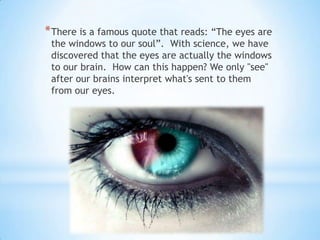
* There is a famous quote that reads: “The eyes are
 the windows to our soul”. With science, we have
 discovered that the eyes are actually the windows
 to our brain. How can this happen? We only "see"
 after our brains interpret what's sent to them
 from our eyes.
* Watch this video so you can understand more
    about the process:
*


Bill Nye The Science Guy on The Eyeball
* Luckily, for most of us our eye catches all the colors around
    us. Our world is full of color thanks to these windows; our
    eyes.
*
* Have you asked yourself, how would it be like to wake up one
    day, and all of a sudden you realize there is something wrong
    with your eyesight. Your world has been dimmed to a
    monochromatic, pale, and grayish or dull world! There are
    many colors missing everywhere; the shirt that used to be
    purple is now pale blue! Your bright green pants are now light
    brown! How can this happen?
*
* Of course this can’t really happen from one day to
    another. But, did you know there are people who were born
    like that? They are born with a condition that is called Color-
    Blindness.
*
*
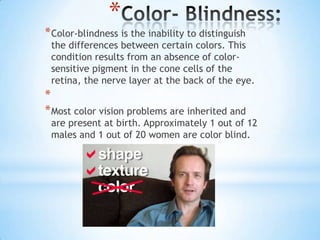
* Color-blindness is the inability to distinguish
 the differences between certain colors. This
 condition results from an absence of color-
 sensitive pigment in the cone cells of the
 retina, the nerve layer at the back of the eye.
*
* Most color vision problems are inherited and
 are present at birth. Approximately 1 out of 12
 males and 1 out of 20 women are color blind.
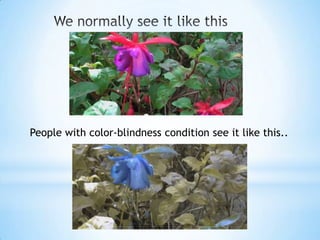
People with color-blindness condition see it like this..
*

*what is it like to be colorblind?

*Colour Blind (BBC - Do you see
 what I see?)
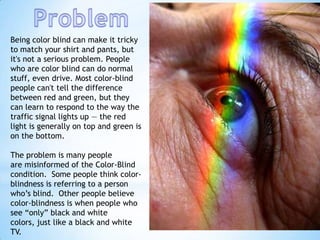
Being color blind can make it tricky
to match your shirt and pants, but
it's not a serious problem. People
who are color blind can do normal
stuff, even drive. Most color-blind
people can't tell the difference
between red and green, but they
can learn to respond to the way the
traffic signal lights up — the red
light is generally on top and green is
on the bottom.

The problem is many people
are misinformed of the Color-Blind
condition. Some people think color-
blindness is referring to a person
who’s blind. Other people believe
color-blindness is when people who
see “only” black and white
colors, just like a black and white
TV.
*
* For this assignment you will be working in teams of two.   Your team will
 have access to a laptop with internet access.
*
* Your task is to investigate, search more about this condition.
* For example,
*·       What is color-blindness?
*·       How many different color-blindness conditions are out there?
*·       Can it get prevented?
*·       How can this affect a person’s life?
*·       Can we find a solution to color-blindness?
*·       How can people help other people with color-blindness?
*·       How are color-blind people different from us?
*·       How does the eye work differently than our eyes?
*·       What is the eye anatomy?
*·       How does the eye transmit color to the brain?
*        How can we take care of our eyes?

* And so on…
*
*
*After you have found essential
    information, illustrations, visual aids, videos, etc. You
    will gather all of it together and create a five-slide
    Presentation with VoiceThread.
*
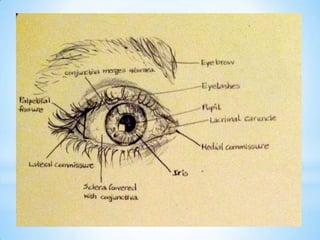
*Your team will also create an Eye Anatomy poster by
    drawing a human eye on white tag board. These
    drawing posters will be posted on the “Science Hall”.
*In this Color-Blindness and Eye Anatomy
     Search Engine you can find everything you
     need to know about the eye anatomy, the
     color-blindness conditions, possible
     solutions, informative videos, tutorial
     videos on how to draw the human eye and
     information on how to take care of our
     eyes.


*        HERE            HERE
*
* http://cepedadeportfolio.pbworks.com/w/page/55852567/PBL%2
 04
* Sources: http://www.kenrockwell.com/tech/how-we-see.htm
* http://www.colormatters.com/color-and-vision/what-is-color-
 blindness


* Sources: http://www.kenrockwell.com/tech/how-we-see.htm
* http://www.colormatters.com/color-and-vision/what-is-color-
 blindness

Color blind nocolor-eye anatomy

  • 1.
  • 2.
    * There isa famous quote that reads: “The eyes are the windows to our soul”. With science, we have discovered that the eyes are actually the windows to our brain. How can this happen? We only "see" after our brains interpret what's sent to them from our eyes.
  • 3.
    * Watch thisvideo so you can understand more about the process: * Bill Nye The Science Guy on The Eyeball
  • 4.
    * Luckily, formost of us our eye catches all the colors around us. Our world is full of color thanks to these windows; our eyes. * * Have you asked yourself, how would it be like to wake up one day, and all of a sudden you realize there is something wrong with your eyesight. Your world has been dimmed to a monochromatic, pale, and grayish or dull world! There are many colors missing everywhere; the shirt that used to be purple is now pale blue! Your bright green pants are now light brown! How can this happen? * * Of course this can’t really happen from one day to another. But, did you know there are people who were born like that? They are born with a condition that is called Color- Blindness. *
  • 5.
    * * Color-blindness isthe inability to distinguish the differences between certain colors. This condition results from an absence of color- sensitive pigment in the cone cells of the retina, the nerve layer at the back of the eye. * * Most color vision problems are inherited and are present at birth. Approximately 1 out of 12 males and 1 out of 20 women are color blind.
  • 6.
    People with color-blindnesscondition see it like this..
  • 7.
    * *what is itlike to be colorblind? *Colour Blind (BBC - Do you see what I see?)
  • 8.
    Being color blindcan make it tricky to match your shirt and pants, but it's not a serious problem. People who are color blind can do normal stuff, even drive. Most color-blind people can't tell the difference between red and green, but they can learn to respond to the way the traffic signal lights up — the red light is generally on top and green is on the bottom. The problem is many people are misinformed of the Color-Blind condition. Some people think color- blindness is referring to a person who’s blind. Other people believe color-blindness is when people who see “only” black and white colors, just like a black and white TV.
  • 9.
    * * For thisassignment you will be working in teams of two. Your team will have access to a laptop with internet access. * * Your task is to investigate, search more about this condition. * For example, *· What is color-blindness? *· How many different color-blindness conditions are out there? *· Can it get prevented? *· How can this affect a person’s life? *· Can we find a solution to color-blindness? *· How can people help other people with color-blindness? *· How are color-blind people different from us? *· How does the eye work differently than our eyes? *· What is the eye anatomy? *· How does the eye transmit color to the brain? * How can we take care of our eyes? * And so on…
  • 10.
    * * *After you havefound essential information, illustrations, visual aids, videos, etc. You will gather all of it together and create a five-slide Presentation with VoiceThread. * *Your team will also create an Eye Anatomy poster by drawing a human eye on white tag board. These drawing posters will be posted on the “Science Hall”.
  • 12.
    *In this Color-Blindnessand Eye Anatomy Search Engine you can find everything you need to know about the eye anatomy, the color-blindness conditions, possible solutions, informative videos, tutorial videos on how to draw the human eye and information on how to take care of our eyes. * HERE HERE
  • 13.
    * * http://cepedadeportfolio.pbworks.com/w/page/55852567/PBL%2 04 *Sources: http://www.kenrockwell.com/tech/how-we-see.htm * http://www.colormatters.com/color-and-vision/what-is-color- blindness * Sources: http://www.kenrockwell.com/tech/how-we-see.htm * http://www.colormatters.com/color-and-vision/what-is-color- blindness