Editing Correspondence
The in TEI
Historical Documents, Digital Approaches
Ghent, 5 Sept. 2013
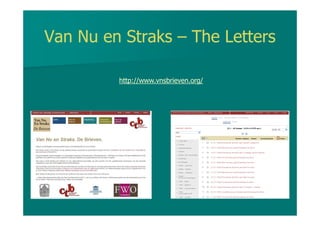
Van Nu en Straks – The Letters
http://www.vnsbrieven.org/
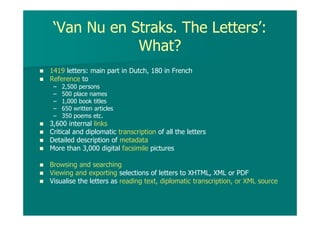
‘Van Nu en Straks. The Letters’:
What?
1419 letters: main part in Dutch, 180 in French
Reference to
– 2,500 persons
– 500 place names
– 1,000 book titles
– 650 written articles
– 350 poems etc.
3,600 internal links
Critical and diplomatic transcription of all the letters
Detailed description of metadata
More than 3,000 digital facsimile pictures
Browsing and searching
Viewing and exporting selections of letters to XHTML, XML or PDF
Visualise the letters as reading text, diplomatic transcription, or XML source
‘Van Nu en Straks. The Letters’:
How?
Each letter = TEI file
Description of metadata in <teiHeader>
eXist-driven web interface
Why does it do what it does?
Because
wanted it to do so.
Therefore
this is the story of
the in TEI
(1) TEI: what?
“A consortium which collectively develops and maintains a
standard for the representation of texts in digital form.”
“Its chief deliverable is a set of Guidelines which specify
encoding methods for machine-readable texts, chiefly in the
humanities, social sciences and linguistics.”
“Since 1994, the TEI Guidelines have been widely used by
libraries, museums, publishers, and individual scholars to
present texts for online research, teaching, and preservation.”
http://www.tei-c.org/index.xml
What hear
Standard
Guidelines
Widely used
What hear
Standard
Guidelines
Widely used
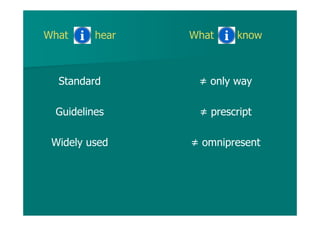
What know
≠ only way
≠ prescript
≠ omnipresent
editing with TEI:
too many downsides?
individual steep learning curve
institutional in-house skills, funding
technical no subset for correspondence
only a few projects in Flanders
these projects take years (trial and error)
Resolution #1
The in TEI <
and rightfully so
Because yes,
It is quite an enterprise
There are other (faster and more simple) ways
but
It offers the best guarantee that your data will be
– safe
– freely accessible
– readable for man and machine
Initiative worth taking
(2) TEI Guidelines: what?
“The TEI Guidelines are designed to be
customized, and specific projects and
disciplinary groups often create
customized versions reflecting particular
needs and practices.”
http://www.tei-c.org/Guidelines/
What hear
designed to be
customized
for
particular needs
and practices
What hear
designed to be
customized
for
particular needs
and practices
What know
customization can be quite
an undertaking
and
some needs are
more particular than others
Editing letters with TEI:
too many downsides?
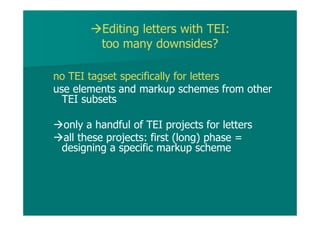
no TEI tagset specifically for letters
use elements and markup schemes from other
TEI subsets
only a handful of TEI projects for letters
all these projects: first (long) phase =
designing a specific markup scheme
e.g. Van Nu en Straks Letters
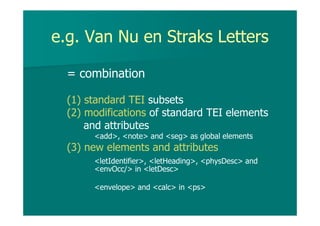
= combination
(1) standard TEI subsets
(2) modifications of standard TEI elements
and attributes
<add>, <note> and <seg> as global elements
(3) new elements and attributes
<letIdentifier>, <letHeading>, <physDesc> and
<envOcc/> in <letDesc>
<envelope> and <calc> in <ps>
Resolution #2
The in TEI <
No other part of your
edition will reflect more
of your personal view
on what text really is,
how the text that you’re
editing is structured etc.
So: this is the awesome part
of your edition, your core
business
(no matter what they’ll tell you)
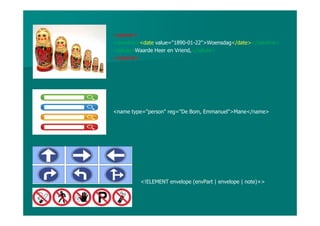
<opener>
<dateline><date value="1890-01-22">Woensdag</date></dateline>
<salute>Waarde Heer en Vriend,</salute>
</opener>
<name type="person" reg="De Bom, Emmanuel">Mane</name>
<!ELEMENT envelope (envPart | envelope | note)+>
(3) Scholarly editions: where?
“[T]he Consortium provides a variety of
resources and training events for learning
TEI, information on projects using the TEI, a
bibliography of TEI-related publications, and
software developed for or adapted to the
TEI.”
http://www.tei-c.org/index.xml
What hear
information
on projects
using the TEI
What hear
information
on projects
using the TEI
What know
this information is very rare,
and only a few projects
provide their own
source files
Publishing TEI/XML-based scholarly editions:
too many downsides?
matter of credibility and visibility
- You need a nest that is both safe and big enough to
publish your work
(university, centre for digital humanities)
- Open access = source files available
- You should at least make a minimal effort to present your
data in a more or less esthetically acceptable way
Resolution #3
The in TEI <
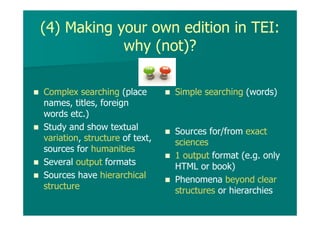
(4) Making your own edition in TEI:
why (not)?
Complex searching (place
names, titles, foreign
words etc.)
Study and show textual
variation, structure of text,
sources for humanities
Several output formats
Sources have hierarchical
structure
Simple searching (words)
Sources for/from exact
sciences
1 output format (e.g. only
HTML or book)
Phenomena beyond clear
structures or hierarchies
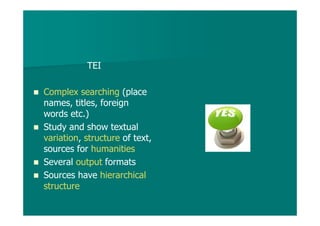
TEI
Complex searching (place
names, titles, foreign
words etc.)
Study and show textual
variation, structure of text,
sources for humanities
Several output formats
Sources have hierarchical
structure
But
You need that big and safe nest
not only for publishing
but also for making your edition
it takes a village
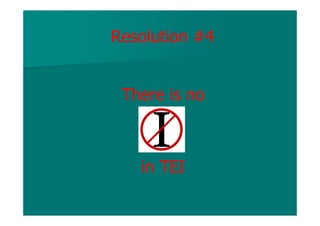
Resolution #4
There is no
in TEI
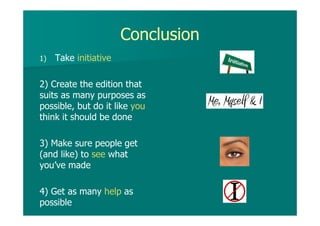
Conclusion
1) Take initiative
2) Create the edition that
suits as many purposes as
possible, but do it like you
think it should be done
3) Make sure people get
(and like) to see what
you’ve made
4) Get as many help as
possible
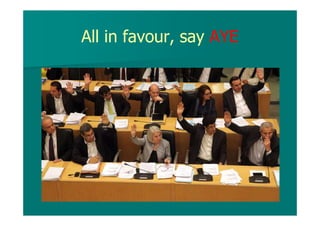
All in favour, say AYE
bert.vanraemdonck@ugent.be

Editing Correspondence. The I in TEI.

  • 1.
    Editing Correspondence The inTEI Historical Documents, Digital Approaches Ghent, 5 Sept. 2013
  • 3.
    Van Nu enStraks – The Letters http://www.vnsbrieven.org/
  • 4.
    ‘Van Nu enStraks. The Letters’: What? 1419 letters: main part in Dutch, 180 in French Reference to – 2,500 persons – 500 place names – 1,000 book titles – 650 written articles – 350 poems etc. 3,600 internal links Critical and diplomatic transcription of all the letters Detailed description of metadata More than 3,000 digital facsimile pictures Browsing and searching Viewing and exporting selections of letters to XHTML, XML or PDF Visualise the letters as reading text, diplomatic transcription, or XML source
  • 5.
    ‘Van Nu enStraks. The Letters’: How? Each letter = TEI file Description of metadata in <teiHeader> eXist-driven web interface
  • 6.
    Why does itdo what it does? Because wanted it to do so.
  • 7.
  • 8.
  • 9.
    (1) TEI: what? “Aconsortium which collectively develops and maintains a standard for the representation of texts in digital form.” “Its chief deliverable is a set of Guidelines which specify encoding methods for machine-readable texts, chiefly in the humanities, social sciences and linguistics.” “Since 1994, the TEI Guidelines have been widely used by libraries, museums, publishers, and individual scholars to present texts for online research, teaching, and preservation.” http://www.tei-c.org/index.xml
  • 10.
  • 11.
    What hear Standard Guidelines Widely used Whatknow ≠ only way ≠ prescript ≠ omnipresent
  • 12.
    editing with TEI: toomany downsides? individual steep learning curve institutional in-house skills, funding technical no subset for correspondence only a few projects in Flanders these projects take years (trial and error)
  • 13.
    Resolution #1 The inTEI < and rightfully so
  • 14.
    Because yes, It isquite an enterprise There are other (faster and more simple) ways but It offers the best guarantee that your data will be – safe – freely accessible – readable for man and machine Initiative worth taking
  • 15.
    (2) TEI Guidelines:what? “The TEI Guidelines are designed to be customized, and specific projects and disciplinary groups often create customized versions reflecting particular needs and practices.” http://www.tei-c.org/Guidelines/
  • 16.
    What hear designed tobe customized for particular needs and practices
  • 17.
    What hear designed tobe customized for particular needs and practices What know customization can be quite an undertaking and some needs are more particular than others
  • 18.
    Editing letters withTEI: too many downsides? no TEI tagset specifically for letters use elements and markup schemes from other TEI subsets only a handful of TEI projects for letters all these projects: first (long) phase = designing a specific markup scheme
  • 19.
    e.g. Van Nuen Straks Letters = combination (1) standard TEI subsets (2) modifications of standard TEI elements and attributes <add>, <note> and <seg> as global elements (3) new elements and attributes <letIdentifier>, <letHeading>, <physDesc> and <envOcc/> in <letDesc> <envelope> and <calc> in <ps>
  • 20.
  • 21.
    No other partof your edition will reflect more of your personal view on what text really is, how the text that you’re editing is structured etc. So: this is the awesome part of your edition, your core business (no matter what they’ll tell you)
  • 22.
    <opener> <dateline><date value="1890-01-22">Woensdag</date></dateline> <salute>Waarde Heeren Vriend,</salute> </opener> <name type="person" reg="De Bom, Emmanuel">Mane</name> <!ELEMENT envelope (envPart | envelope | note)+>
  • 23.
    (3) Scholarly editions:where? “[T]he Consortium provides a variety of resources and training events for learning TEI, information on projects using the TEI, a bibliography of TEI-related publications, and software developed for or adapted to the TEI.” http://www.tei-c.org/index.xml
  • 24.
  • 25.
    What hear information on projects usingthe TEI What know this information is very rare, and only a few projects provide their own source files
  • 26.
    Publishing TEI/XML-based scholarlyeditions: too many downsides? matter of credibility and visibility - You need a nest that is both safe and big enough to publish your work (university, centre for digital humanities) - Open access = source files available - You should at least make a minimal effort to present your data in a more or less esthetically acceptable way
  • 27.
  • 31.
    (4) Making yourown edition in TEI: why (not)? Complex searching (place names, titles, foreign words etc.) Study and show textual variation, structure of text, sources for humanities Several output formats Sources have hierarchical structure Simple searching (words) Sources for/from exact sciences 1 output format (e.g. only HTML or book) Phenomena beyond clear structures or hierarchies
  • 32.
    TEI Complex searching (place names,titles, foreign words etc.) Study and show textual variation, structure of text, sources for humanities Several output formats Sources have hierarchical structure
  • 33.
    But You need thatbig and safe nest not only for publishing but also for making your edition it takes a village
  • 34.
  • 35.
    Conclusion 1) Take initiative 2)Create the edition that suits as many purposes as possible, but do it like you think it should be done 3) Make sure people get (and like) to see what you’ve made 4) Get as many help as possible
  • 36.
  • 37.