editing
What is it? Editing forms the  post-production  part of any production process.  It is necessary in assembling shots together to create a coherent whole production. It is the process where  sound  and  images  are cut together to create a narrative.
Creating the narrative Shots are assembled together by  transitions  which are carefully selected in order to maximise  continuity  and aid audience understanding. Shots vary in  length  (duration) and when edited together have a  rhythm  which can manipulate  audience  emotions and reading of a situation.
So what is continuity, Rhythm and a Transition? You tell me……… Use the  links  and  media studies reference books  to complete the table provided. You only have 30 minutes to do this. we will then feed it back as a class before viewing an extract of a TV drama where you will identify a variety of different transitions and discuss what you think their effect is. http://www.waikato.ac.nz/film/handbook/glossary.html#editing http://www.springhurst.org/cinemagic/glossary_terms.htm#Match%20cut http://195.12.22.187/sfeu_dotnet/uploads/documents/Higher%20Media%20Studies%20Glossary.pdf
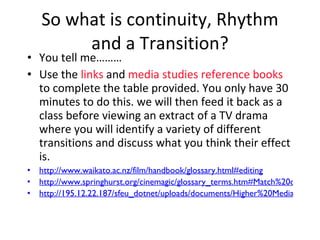
Continuity editing
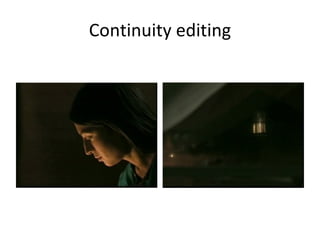
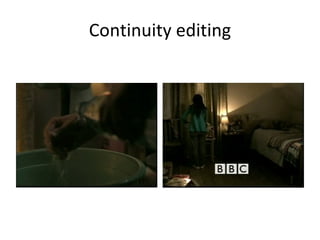
Continuity editing
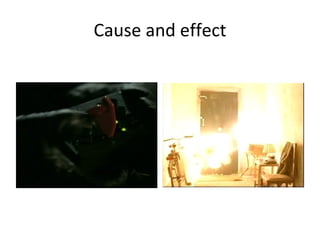
Cause and effect
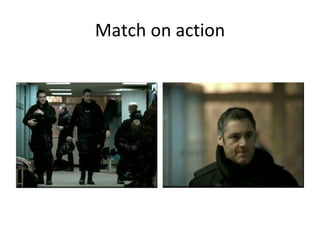
Match on action
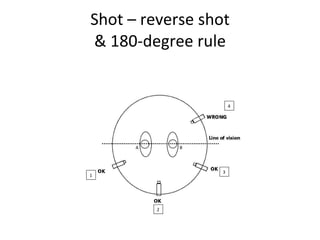
Shot – reverse shot & 180-degree rule A B 2 3 1 4
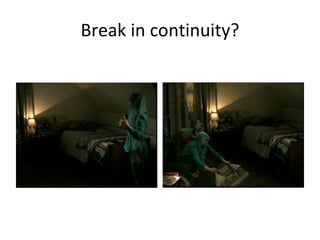
Break in continuity?
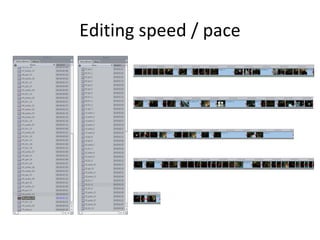
Editing speed / pace
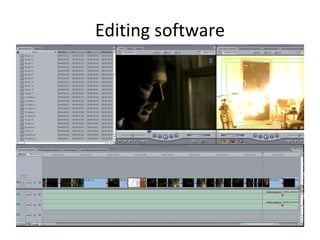
Editing software

Editing 10 11

  • 1.
  • 2.
    What is it?Editing forms the post-production part of any production process. It is necessary in assembling shots together to create a coherent whole production. It is the process where sound and images are cut together to create a narrative.
  • 3.
    Creating the narrativeShots are assembled together by transitions which are carefully selected in order to maximise continuity and aid audience understanding. Shots vary in length (duration) and when edited together have a rhythm which can manipulate audience emotions and reading of a situation.
  • 4.
    So what iscontinuity, Rhythm and a Transition? You tell me……… Use the links and media studies reference books to complete the table provided. You only have 30 minutes to do this. we will then feed it back as a class before viewing an extract of a TV drama where you will identify a variety of different transitions and discuss what you think their effect is. http://www.waikato.ac.nz/film/handbook/glossary.html#editing http://www.springhurst.org/cinemagic/glossary_terms.htm#Match%20cut http://195.12.22.187/sfeu_dotnet/uploads/documents/Higher%20Media%20Studies%20Glossary.pdf
  • 5.
  • 6.
  • 7.
  • 8.
  • 9.
    Shot – reverseshot & 180-degree rule A B 2 3 1 4
  • 10.
  • 11.
  • 12.

Editor's Notes

  • #13 I:\\Students\\Media Studies\\AS & A2 Course Materials\\AS 2008 Spec\\Textual Analysis of TV Drama\\Textual Analysis - Codes\\Editing\\Editing09-10.pptx