L I G H T I N G U P N E W M A R K E T S
4 Introduction
Plácido Domingo, Chairman, IFPI
Frances Moore, Chief Executive, IFPI
6 Facts, Figures and Trends
Streaming and subscriptions surge
A diverse global market
A mixed economy of revenue streams
Revival in Scandinavia
US stabilises as Europe grows
Lighting up developing markets
Attracting consumers to licensed services
12 Most Popular Artists of 2013
Top selling global albums
IFPI Global Recording Artist Chart
Top global singles
The importance of local repertoire
16 Lighting Up New Markets and Models
The move to mobile
Access & ownership
The rise and rise of streaming and subscription
More discovery, more from mobile
Streaming: “A sustainable income”
Monetising music video
Internet radio — looking globally
Engaging in emerging markets
ISPs leverage the value of music: KPN-Spotify
Rapid digital growth in Latin America
Local services thrive in Asia
Russia shows potential
KKBOX: Asia’s local service fights its corner
24 Long Live the Record Label
Daft Punk: A physical campaign in the digital world
Avicii: From club DJ to global superstar
Hunter Hayes: The YouTube orchestra
Passenger and the Embassy of Music
Engaging fans in social networks in Brazil
Katy Perry: A global phenomenon
Tommy Torres: Harnessing the power of Twitter
34 Sweden: A Market Transformed
A return to growth
A continuous revenue stream
Growing diversity
What next in Sweden?
36 China: New Hopes for a Licensed Music Market
Moving to the paid model
Tackling piracy
38 Africa: Emerging Opportunity
Digital services being established
Expanding A&R activity
40 Improving the Environment for Digital Music
Consumer attitudes to piracy
Website blocking proves effective
vKontakte: Stifling a licensed business in Russia
Stopping payments to pirate services
Cutting off advertising revenue
Search engines still have more to do
Infringing links dominate search results
Legal action against piracy
UK’s City of London Police: Tackling crime online
44 Digital Music Services Worldwide
This report includes new findings from a consumer study carried out
by Ipsos MediaCT, commissioned by IFPI.
© IFPI 2014
All data, copy and images are subject to copyright and may not be
reproduced, transmitted or made available without permission from IFPI.
www.ifpi.org
@ifpi_org
Designed by design to communicate
ContentsContentsContentsContentsContents
3
The technology changes: the music remains
I am very pleased to introduce IFPI’s latest Digital Music
Report which gives an excellent overview of how the music
industry is investing and adapting in the digital world. I am now
in my third year as chairman of IFPI and during this time I have
been able to witness close up the amazing transformation of our
music industry.
My career in music has spanned more than four decades.
The first recordings of my work were available on vinyl LPs or
cassettes that had to be listened to on a record or tape player.
Today, my music is available on a huge range of digital services.
People can listen to an opera as they go about their
everyday lives. They can constantly discover new music on
recommendation services. They can engage with artists on social
networks. We no longer rely on physical delivery of the music we
love to hear.
This new digital world has brought great new ways to access
culture. At the same time, technological change has forced us to
ask a fundamental question — what does this mean for copyright
and the rights of creators?
The answer is clear: while the formats have changed, the
music remains. In a world of constant change, music is something
of lasting value.
I want to see a digital world that provides young artists with
the kind of opportunities I was fortunate enough to have early in
my career. Artists still need to be able to benefit from investment
by record companies to build a career. That can only happen if
governments around the world play their part in making sure
the laws that protected creators in the physical delivery age are
updated for the digital delivery age.
This is the message I try to convey when I travel the world
and talk to senior politicians.
Copyright provides the basis of the modern digital music
marketplace. Confidence in copyright enables rights holders to
license exciting new services that music fans love.
There are 37 million songs available today on these leading
digital services. To listen to them all would take a lifetime. That is
a source of cultural enrichment that we could not have dreamed
of when I was a young artist beginning my career. We must
build on this success to create a genuinely sustainable digital
marketplace that will continue to fund investment in artists so
that more great music can be created.
IntroductionIntroductionIntroductionIntroductionIntroduction
PLÁCIDO DOMINGO
CHAIRMAN, IFPI
“Copyright provides the basis of the modern
digital music marketplace.”
4
The digital music business is on the move and lighting up new markets
IFPI’s Digital Music Report 2014 shows a fast-changing, dynamic
and optimistic global music industry. Recorded music revenues
in most major markets have returned to growth. Streaming and
subscription services are thriving. And digital music is moving
into a clearly identifiable new phase as record companies, having
licensed services across the world, now start to tap the enormous
potential of emerging markets.
There was a lot of good news in our industry in 2013 —
albeit with some less good news as well. The US music market
continued to stabilise, growing slightly in trade revenue terms,
helped by rising consumer demand for music streaming services.
Europe returned to growth after 12 years, its top five markets
seeing revenues up. In Japan, however, the world’s number two
music market, falling revenues had a significant negative impact on
what was otherwise a largely positive global picture.
New services with big global ambitions are launching, such as
Beats and iTunes Radio — services that we hope will soon spread
around the world. Meanwhile, the existing international services,
such as Deezer, Google Play, iTunes, Spotify and YouTube are
generating income in many new markets following their global
expansion. The competition is intense and consumer choice is
ever-widening — these are very positive dynamics in the
development of the digital music landscape.
It is now clear that music streaming and subscription is a
mainstream model for our business. In 2011, there were eight
million paying subscribers to subscription services — today there
are 28 million. Ad-supported and subscription streams are rising
in most markets, helping grow overall digital revenues for record
companies and artists.
The music industry has become a mixed economy of diverse
consumer channels and revenue streams. This has been an
amazing transformation, dramatically expanding the way artists
reach their fans across the globe. Reflecting this shift, IFPI has
launched its Global Recording Artists Chart, which highlights the
success of artists across physical sales, downloads and streaming.
The chart, launched in 2014, is a new metric of success reflecting
the popularity of artists across the various ways consumers enjoy
music. Congratulations to One Direction for being the first act to
top this unique new chart.
These are all positive developments which, to some degree,
extend the industry’s achievements of the last few years in our
core markets. But this report goes further: it also shows how
digital music, on a global scale, is going to the next level. Emerging
markets have huge potential, and, through digital, the music
business is moving to unlock it. Most of these territories are seeing
internet and mobile music penetration soaring, with rising demand
for handheld devices. The great news is that a wide variety
of licensed music services are available to meet this demand.
Emerging music markets also need new ways of thinking in the
digital world, particularly in countries with undeveloped payment
systems and low credit card usage.
It is early days, but in this report you can read about some
of the early signs of progress. In China, we are licensing music
services and bringing huge numbers of consumers into the digital
marketplace. Record companies are stepping up their activity in
Africa as technology offers the opportunity to reach many
consumers for the first time. In Latin America, labels are
licensing services in innovative ways such as pre-paid deals and
special daily subscriptions packages, aimed to reach the widest
possible audience.
None of these exciting developments changes the fact that
there is still one overriding obstacle to market development in
most emerging markets — and that is rampant digital piracy. This
is a top priority for IFPI and our national groups around the world.
Our focus on creating a fair playing field, supported by strong laws
and effective enforcement, remains undiminished.
This report shows an industry on the move. Most of our major
traditional markets have stabilised and the challenge now is to tap
the huge potential of emerging markets and achieve sustainable
year-on-year global growth. As the digital entertainment
revolution moves from one phase to the next, the music business
continues to lead the way for other creative industries.
FRANCES MOORE
CHIEF EXECUTIVE, IFPI
“There is a pioneering spirit among record
companies as they expand into these new
territories.”
FrancesMoorePhotobyGrahamFlack
5
FACTS, FIGURES
AND TRENDS
FACTS, FIGURES
AND TRENDS
FACTS, FIGURES
AND TRENDS
FACTS, FIGURES
AND TRENDS
FACTS, FIGURES
AND TRENDS
T
he music business continues to expand into new markets
and create new business models, attracting more users
to digital music services and bringing artists to a wider
global audience.
The industry’s digital revenues grew by 4.3 per cent in 2013 to
US$5.9 billion. There was steep growth in both revenues and user
numbers for subscription services, continued revenue growth from
ad-supported services and stable income from download sales in
most markets. Globally, digital now accounts for 39 per cent of total
industry global revenues and in three of the world’s top 10 markets,
digital channels account for the majority of revenues.
Overall, recorded music revenues grew in Europe and Latin
America and continued to stabilise in the US, growing 0.8 per cent
in trade terms1. Music sales on a global scale, however, were sharply
influenced by a steep 16.7 per cent fall in Japan, the world’s second
largest market. Outside Japan, global music revenues were down
0.1 per cent; including Japan, they fell 3.9 per cent to an estimated
US$15 billion.
THE PROPORTION OF THE
INDUSTRY’S REVENUES FROM
DIGITAL CHANNELS
THE INDUSTRY’S
DIGITAL REVENUES IN 2013
5.9
2013
5.6
2012
5.1
2011
4.6
2010
4.4
2009
4.0
2008
Figure 1: Global digital revenues 2008–13 (US$ Billions)
Source: IFPI
PharrellWilliamsphotobyMimiValdes
1. US recorded music sales are reported in retail terms in the US while IFPI’s global
figures are reported in terms of trade value. US revenues declined 0.5% in retail value
39%
US$
5.9Bn
39%
US$
5.9Bn
39%
US$
5.9Bn
39%
US$
5.9Bn
39%
US$
5.9Bn
6
Streaming and subscriptions surge
Subscription services, part of an increasingly diverse mix of
industry revenue streams, are going from strength to strength.
Revenues from music subscription services — including free-
to-consumer and paid-for tiers — grew by 51.3 per cent in 2013,
exceeding US$1 billion for the first time and growing consistently
across all major markets.
Global brands such as Deezer and Spotify are reaping the
benefits of geographical expansion, while regional services
such as Rdio, KKBOX and WiMP continue to attract new users.
New entrants including Beats Music and YouTube launched, or
announced plans to launch, subscription services in early 2014.
The subscription model is leading to more payment for music
by consumers, many of whom appear to be shifting from pirate
services to a licensed music environment that pays artists and
rights holders. The number of paying subscribers to subscription
services rose to 28 million in 2013, up 40 per cent on 2012 and
up from only eight million in 2010.
Revenues from advertising-supported streaming services,
such as YouTube and Vevo, are also growing — up 17.6 per cent
in 2013. Music video revenues in particular increased as the
industry extended the monetisation of YouTube to more than
50 countries, adding 13 territories in 2013. Vevo has performed
strongly, hitting 5.5 billion monthly views in December 2013, a
46 per cent year-on-year increase, and attracting 243 million
unique viewers worldwide.
Record companies have adapted their business to a model
increasingly based on access to music, and not only ownership
of music. This reflects in the growing share of subscription and
streaming revenues as a percentage of digital revenues globally.
The industry now derives 27 per cent of its digital revenues from
subscription and ad-supported streaming services, up from
14 per cent in 2011.
The digital download model remains a key revenue stream,
however. Downloads still account for a substantial two-thirds of
digital revenues (67 per cent) and are helping to propel digital
growth in certain developing markets such as South Africa, Hong
Kong, Philippines and Slovakia. Downloads have seen a slight
decline in overall value globally, although digital album sales remain
on an upward curve as consumers still show strong demand for
owning the album format. Revenues from downloads globally
fell slightly by 2.1 per cent in value, the decline being offset by
increases in streaming and subscription revenue to generate
overall digital revenue growth in the majority of markets.
Revenue from performance rights — generated from
broadcast, internet radio stations and venues — saw strong
growth. Performance rights income was US$1.1 billion globally in
2013, increasing by an estimated 19 per cent in 2013, more than
double the growth rate in 2012, and accounting for 7.4 per cent
of total record industry revenue.
Income from synchronisation deals, in which music is placed
in advertisements, films or television programmes, declined by
3.4 per cent in 2013, and now accounts for 2.1 per cent of total
industry revenue.
Despite the overall transition to digital, physical music sales
still account for a major proportion of industry revenues in many
major markets. Gifting and deluxe box sets remain popular while
vinyl continues to grow as a niche product. Physical formats
account for more than half (51.4 per cent) of all global revenues,
compared to 56.1 per cent in 2012. Although global physical sales
value declined by 11.7 per cent in 2013, major markets including
Germany, Italy, the UK and the US saw a slow-down in the rate of
physical decline. France’s physical sales increased by 0.8 per cent,
helped by a local repertoire boom which saw French repertoire
accounting for 17 of the French top 20 albums of 2013.
While vinyl sales account for only a small fraction of the
overall industry revenues, they have seen an increase in recent
years in some key markets. In the US, vinyl sales increased by
32 per cent in 2013 (Nielsen Soundscan), and in the UK, they
increased by 101 per cent in 2013 (BPI).
51.3% 28m51.3% 28m51.3% 28m51.3% 28m51.3% 28mINCREASE IN SUBSCRIPTION
STREAMING REVENUES
PAYING USERS OF
SUBSCRIPTION SERVICES
“Music has always been at the forefront
of the digital revolution, leading the way
for other creative industries and defining
the future of digital entertainment. Today
music’s digital revolution is moving to
the next phase as consumers embrace
streaming and subscription models in
markets around the world.”
— Edgar Berger, Chairman and CEO, International,
Sony Music Entertainment
7
A diverse global market
Geographically, the world music market
is highly diverse, with markets growing at
different speeds and favouring different
consumption models. This is borne out
by consumer research conducted by
Ipsos MediaCT for IFPI in November
2013 (see Figure 3). It shows contrasting
preferences for service types in Germany,
UK and US (where downloads are more
popular) and in France, Italy and Sweden
(where streaming is the favoured model).
A mixed economy of
revenue streams
Amid the wide variations, there are three
perceptible groups of markets: first,
countries in northern Europe, where
streaming and subscription services are
dominating; second, the major markets
of North America and Europe where
streaming is growing fast but downloads
continue to deliver the major revenue;
and third, a swathe of other countries
including emerging markets, such as
Brazil and Mexico, where both downloads
and ad-supported streaming are growing
rapidly from a lower base.
19%
6%
5%
26%
67%64%
8%3% 1%1%
Downloads Mobile Subscription
Ad-supported streams Other
Subscriptions Downloads
47
36
32
23 22
7
9
15
27
33
21
12
Sweden France Italy USA UK Germany
Source: Ipsos MediaCT *Also includes free users of subscription services
Source: IFPI
Figure 3: % Internet users using music subscriptions* / download services
in past 6 months
Figure 2: Digital revenue breakdown by format, 2008–2013
20132008
Subscription and ad-supported streaming services
have grown from 9% to 27% of digital revenues in
the last five years.
PaulaFernandesPhotobyGutoCosta
9
Revival in Scandinavia
Scandinavian countries Denmark, Norway and Sweden are a showcase of
music industry revival, demonstrating the regenerating potential of the
streaming model. Sweden’s market grew by 5.7 per cent in 2013, Denmark’s
grew by 4.7 per cent, and Norway’s by 2.4 per cent (see Figure 4).
409
392
361361
2010 2011 2012 2013
US stabilises as Europe grows
Digital revenues in the US, the world’s largest digital market, grew by
3.4 per cent in 2013, with digital now accounting for 60 per cent of the US
market. This helped sustain the stabilisation of the US market over recent
years. In 2013 overall US market revenues grew slightly by 0.8 per cent in
trade terms, whilst declining 0.5 per cent in retail value.
Europe saw digital growth of 13.3 per cent, helping that region post its
first overall market increase since 2001. Five of the region’s largest markets,
France, Italy, Germany, Netherlands and the UK, returned to overall growth.
Japan, the world’s second largest national market which accounts for a
fifth of global revenues, is in a challenging phase of transition to digital.
In 2013, sharp declines in physical sales were coupled with declines in legacy
mobile products such as ringtones. Given the relatively recent launch of
smartphone-supported download stores, the potential of subscription radio,
and the expected arrival of more subscription services in 2014, prospects
appear better for the future of the Japanese digital sector. In 2013 there was
sharp growth in subscription revenue (up 204 per cent) and download sales.
Lighting up developing markets
With the spread of digital services across the world in the last three years,
record companies are intensely focused on the potential of developing
markets. These are territories with a vast potential consumer base but with
little previous retail infrastructure and traditionally high levels of piracy.
Growth is also driven by increasing smartphone penetration, and increasing
investment in local record companies and domestic repertoire.
Figure 4: Music market 2008–13 (US$ Millions) in Sweden, Norway
and Denmark
“The recorded music business remains challenging — good news includes the growth
of streaming/subscription, and the continuing explosion of mobile devices means we
can reach millions of consumers in emerging markets for the first time. The world is
transitioning at different speeds in different regions and 2013 was a set-back in the world’s
second biggest market — Japan. In time Japan will bounce back as more digital business
partners enter this vibrant market.”
— Max Hole, Chairman and CEO, Universal Music Group International
Source: IFPI
JohndeSohnphotobyGustavModérWiking
13.3%13.3%13.3%13.3%13.3%DIGITAL GROWTH
IN EUROPE
10
Outside the global top 10 markets, 15 territories saw overall growth
in 2013: Argentina, Central America, Chile, Colombia, Denmark, Greece,
Iceland, Netherlands, Norway, Paraguay, Peru, Russia, Sweden, Taiwan
and Venezuela. Some of the emerging economies in this list posted
significant increases in digital revenue, including Argentina (+69 per cent),
Colombia (+85 per cent), Indonesia (+112 per cent), Peru (+149 per cent),
South Africa (+107 per cent) and Venezuela (+85 per cent). Overall, Latin
America experienced 27.6 per cent digital growth in 2013.
Attracting consumers to licensed services
One of the key hallmarks of digital music today is the high level of consumer
awareness and engagement in digital services. Record companies are
licensing a diverse range of services, successfully meeting different
consumer preferences. This is illustrated in research undertaken by Ipsos
MediaCT across ten leading music markets for this report.
Now in its second year, the research shows 61 per cent of internet users
aged 16–64 engaged in some legitimate digital music activity in the past six
months. Among younger consumers (16–24) this figure is higher at 77 per cent.
The research also finds that consumer satisfaction with digital services
remains high. Three-quarters of licensed services’ customers (76 per cent)
describe them as “excellent”, “very good” or “fairly good” while even the
majority of those using unlicensed services (56 per cent) recognise “there
are good services available for legally accessing digital music.”
The findings also identify a range of reasons why consumers choose
different services, and what qualities of those services they most value.
People mainly choose subscription services to discover new music (41 per
cent), with 39 per cent saying they offer a “legitimate environment.”
37 per cent like the ability to listen, without having to buy each song.
The most common reason people use download services is the security/
ease of payment (46 per cent), while 41 per cent value the guarantee of
legality and 39 per cent cite “trust” in the company.
The ability to listen for free (69 per cent), music discovery (46 per cent),
were the main drivers for video streaming services.
The study also shows that the vast majority of consumers are aware
of the availability of licensed services and the range of choice available.
The table below compares awareness levels in the 10 selected markets
surveyed by Ipsos MediaCT (accounting for the fact that services are not
launched in all those markets).
61%61%61%61%61%PROPORTION OF INTERNET
USERS USING LICENSED
DIGITAL MUSIC SERVICES
“Emerging markets will
remain a priority for the
industry because of the
sheer size of the opportunity.
The potential of these
markets is unlocked by the
widespread adoption of
technology and the creation
of models that monetise
music in ways that fit with
local demand for — and
attitudes towards — music.”
— Stu Bergen, President, International,
Warner Recorded Music
91
73
61
59
40 38
YouTube iTunes Amazon MP3 Spotify Deezer Vevo
Source: Ipsos MediaCT
Countries where awareness was asked on survey: iTunes – All except South Korea
Spotify – All except Brazil (launching in 2014), Japan and South Korea
Vevo – All except Japan and Mexico Deezer – All except Japan, South Korea, Sweden, US
Amazon MP3 – only Germany, UK, Italy, Japan and US (out of the countries surveyed)
Figure 5: Consumer awareness of licensed services in 10 selected
markets in 2013
Imagine Dragons photo by Nick Walker
11
Most popular
artists of 2013
Most popular
artists of 2013
Most popular
artists of 2013
Most popular
artists of 2013
Most popular
artists of 2013
Source: IFPI
Top selling global albums
O
ne Direction topped the global
albums chart, with Midnight
Memories selling four million units.
The album was the fastest selling of
2013 in the UK and sold more than a million
copies in its first five weeks of release in the
US. It topped the charts in dozens of countries
worldwide, from Australia to Sweden.
Eminem’s The Marshall Mathers LP 2 took
the runner-up spot on the global albums chart,
selling 3.8 million units. The album debuted at
number one in the Billboard Top 200 chart and
Eminem became the first American artist to
achieve seven consecutive number one albums
in the UK. The album also topped the charts in
countries from Austria to Canada.
Figure 6: Top ten best selling albums of 2013
EminemcourtesyofUMGBrunoMarsphotobyKaiZFengLadyGagaphotobyMeeno
Michael Bublé courtesy of Warner Music
Rank Album & Artist Total sales (m)
1 Midnight Memories
One Direction 4.0
2 The Marshall Mathers Lp2
Eminem 3.8
3 The 20/20 Experience
Justin Timberlake 3.6
4 Unorthodox Jukebox
Bruno Mars 3.2
5 Random Access Memories
Daft Punk 3.2
6 Prism
Katy Perry 2.8
7 To Be Loved
Michael Bublé 2.4
8 Night Visions
Imagine Dragons 2.4
9 Artpop
Lady Gaga 2.3
10 Beyoncé
Beyoncé 2.3
12
wv 1 One Direction
2 Eminem
3 Justin Timberlake
4 Bruno Mars
5 katy perry
IFPI Global Recording Artist Chart
In 2014, IFPI published its first ever global recording artists chart
to accurately capture the popularity of artists across a wider
range of channels, including digital downloads, physical format
sales and streaming services. The chart gives a fuller picture of
the popularity of artists across the many different formats and
channels through which fans now listen to music.
The inaugural chart was topped by One Direction, the IFPI
Global Recording Artists of 2013, on the back of the success of
their third studio album Midnight Memories, which contained
the hit singles Best Song Ever and Story of My Life. The album
topped the US Billboard Top 200 chart, making One Direction
the first group in the charts history to debut at No.1 with its first
three albums. The video for Best Song Ever attracted almost
200 million views on YouTube and Story of My Life more than
100 million views. The band’s music was also heavily streamed
on services such as Deezer and Spotify.
The second spot was claimed by Eminem, driven by the
success of his eighth studio album The Marshall Mathers LP 2,
which featured the singles Berzerk, Survival, Rap God and
The Monster. The album
featured guest appearances
from Skylar Grey, Kendrick
Lamar, Rihanna and Nate
Ruess. The album topped
the charts in many major
music markets including
the US, UK, Germany
and Australia.
v 6 P!nk
7 macklemore &
ryan Lewis
8 rihanna
9 michael bublé
10 Daft Punk
Source: IFPI
The compilation of the IFPI Global RecordingArtist Chart
has been independently verified through certain agreed
procedures by BDO LLP. BDO LLP has verified that IFPI
has compiled the chart correctly in line with the outlined
procedures.The certain agreed upon procedures carried out
by BDO did not constitute an audit or review.
photo courtesy of UMG
photo by John Keatley
photo courtesy of Sony photo by Andrew Macpherson
photo byTom Munro photo courtesy of UMG
photo by Kai Z Feng photo courtesy of Warner Music
photo by Cass Bird photo by David Black
Figure 7: IFPI Global Recording Artist Chart
The IFPI Global Recording
ArtistAward
One Direction photo by JM Enternational 13
Top global singles
The 2013 global singles chart was topped
by Robin Thicke, the American-Canadian
singer whose Blurred Lines topped the
charts in 14 countries. The song was taken
from his sixth studio album, also called
Blurred Lines. The track, which featured
T.I. and Pharrell Williams, was promoted
with a video directed by Diane Martel
that featured models Elle Evans, Jessi
M’Bengue and Emily Ratajkowski and
attracted more than one million views
on Vevo in its first day of release. Thicke
performed the song with Miley Cyrus at
the MTV Video Awards, in the process
setting the record for an event generating
the most tweets per minute (360,000).
Macklemore and Ryan Lewis’ Thrift
Shop was the second best performing
single. It was the fifth single from the hip
hop duo’s debut studio album The Heist.
The track went to number one in nine
countries and the accompanying video
attracted more than 485 million views
on YouTube.
Rank Single & Artist Total units* (m)
1 blurred lines
robin thicke feat. T.I. and pharrell 14.8
2 thrift shop
macklemore & ryan lewis feat. Wanz 13.4
3 wake me up
avicii 11.1
4 just give me a reason
P!nk Feat. nate ruess 9.9
5 roar
katy perry 9.9
6 get lucky
daft punk ft. pharrell williams & nile rodgers 9.3
7 radioactive
imagine dragons 8.6
8 when I was your man
bruno mars 8.3
9 scream & shout
will.i.am feat. britney spears 8.1
10 stay
rihanna 7.9
The importance of
local repertoire
Investment in local repertoire remains
the lifeblood of the international music
industry. Album charts in individual
markets demonstrate the continuing
strength of local repertoire as a share of
overall music sales. In many markets, local
artists account for the vast majority of
the top selling albums of 2013. In France,
for example, 17 of the top 20 selling
albums of 2013 were local repertoire, up
from 10 in 2011. In Germany, seven of the
top 10 selling albums in 2013 were local
repertoire, a trend reflected in 13 selected
non-English language markets (see Figure
9). Record companies are also focused on
promoting locally signed artists around
the world. Warner Music points to its
Japanese breakthrough artist Kyary
Pamyu Pamyu undertaking her second
world tour, while a new wave of
Scandinavian artists aspire to follow the
career trajectory of David Guetta, signed
in France and now a global phenomenon.
Figure 8: Top global singles
Country %
South Korea 100%
Japan 100%
Brazil 90%
Italy 90%
Sweden 90%
France 80%
Denmark 80%
Netherlands 80%
Germany 70%
Norway 60%
Spain 60%
Portugal 50%
Malaysia 50%
Figure 9: Percentage of top ten albums in
2013 that were by locally signed artists
Source: IFPI, National Groups
Source: IFPI *Units include single-track downloads and track-equivalent streams.
Blurred Lines attracted more
than one million views on
Vevo in its first day of release
Lars Winnerbäck photo by Jonas Linell 15
LIGHTING UP
NEW MARKETS
AND MODELS
LIGHTING UP
NEW MARKETS
AND MODELS
LIGHTING UP
NEW MARKETS
AND MODELS
LIGHTING UP
NEW MARKETS
AND MODELS
DIGITAL MUSIC IN 2014
LIGHTING UP
NEW MARKETS
AND MODELS
T
he music industry is continuing its transformation
into a global digital business, expanding into new
markets and extending new access models to more
territories across all continents. Record companies
are successfully delivering music through digital channels,
broadening the world of licensed music, and innovating to
bring artists to a global audience. Music still leads the way
for other creative industries — including books, films and TV
— in monetising its core product for the digital world.
The move to mobile
Underpinning these developments is the global shift of
music consumption to smartphone-based mobile platforms.
Digital music has moved rapidly from a fixed line desktop
PC experience to on-the-go consumption on wireless
smartphones and tablet devices. Record companies are now
monetising the consumption of music in ways that were not
possible a few years ago.
The smartphones boom is an unprecedented opportunity
for the music business. At the end of 2012, just 12.9 per cent
of mobile devices worldwide were classed as smartphones.
With penetration forecast to reach 36.2 per cent by the end
of 2016 (Portio Mobile Factbook), there is huge potential for
mobile to increase the reach of music services. According
to Ole Obermann, executive vice president, digital partner
development at Sony Music Entertainment: “The advent of
the smartphone as a music listening device has been profound
for the music business. With 30 per cent plus of the world’s
population projected to own a smartphone by 2016 that
equates to over two billion potential music service customers
worldwide.”
Record companies are harnessing the power of
smartphones with a new generation of partnerships.
For example, Warner Music has signed a deal with Shazam
to boost its marketing and A&R activity. The record company
recently launched Linkin Park’s single Guilty All The Same
exclusively on Shazam, with users who had previously
Shazamed the band getting advance notification of the
release and all those using the service on the day of the
launch getting a link to the track.
Increased competition between the Android and Apple
iOS platforms has opened the market and widened consumer
choice. Streaming services, in particular, are thriving on
Android devices. According to Stephen Bryan, executive
vice president, digital strategy and business development,
Warner Music Group: “Android has created a number of new
opportunities for us to reach consumers with different suites
of services. As consumers are moving to the Cloud, many of
them are ending up in the Android eco-system where we have
a lot of very high quality services waiting for them.”
Access & ownership
Digital music is also moving from a model based largely on
ownership to a more multifaceted model built around access.
This is breaking down the traditional distinctions between the
“Android has created a number of new
opportunities for us to reach consumers
with different suites of services.”
— Stephen Bryan, Warner Music Group
“The advent of the smartphone as a music
listening device has been profound for the
music business.”
— Ole Obermann, Sony Music Entertainment
16
KingsonJinphotobyZhemingZhangSource:Portio
GLOBAL SMARTPHONE
PENETRATION
2011 (770M)
2016 (3067M)
13%
36%
13%
36%
13%
36%
13%
36%
13%
36%
major services. Rob Wells, president of global digital business
at Universal Music Group, says: “There’s a blurring of the lines
between the models. iTunes Radio is a stream. iTunes Match is
a subscription, and on the back of it is a download service.
“Service definitions are getting more and more complicated,
but this is to the benefit of the consumer, who is getting more
and more choice. The greater the variety of consumer offerings
there are in the marketplace, the more they will spend on music
and the more engaging their experience will be.”
In the last three years record companies have licensed
services to operate in more than 150 countries. Those
services are now growing in markedly different ways
internationally. Rob Wells says: “Each market is different
according to socio-economic factors, infrastructure, credit
card penetration, the willingness of carriers to implement
carrier billing, anti-piracy legislation. These are all in the mix.
The transition is always going one way — it is just a question
of how fast it’s going to happen.”
While the biggest growth area is music subscription
(revenues up 51.3 per cent globally in 2013), downloads
remain substantially the largest revenue segment of the
digital music business (67 per cent). They are seeing strong
growth, especially in certain developing markets where iTunes
has relatively recently arrived — notably, South Africa, Taiwan
and countries in South East Asia. The arrival of iTunes more
than doubled the value of the South African digital music
market within the space of one year.
The rise and rise of streaming and
subscription
Record companies’ revenue streams continue to diversify,
with streaming and subscription accounting for a growing
proportion of income. The industry has licensed the
expansion of global services, such as Deezer and Spotify,
and backed regional services such as Muve, Napster, Rdio &
WiMP. Asian subscription service KKBOX is expanding to new
markets while streaming is growing in Africa with THE KLEEK
and Deezer.
The impact of streaming, alongside an improved
enforcement environment, in helping revive markets in
Scandinavia is well-documented (see Sweden case study,
page 34). Research also shows that streaming services are
successfully helping to reduce piracy. GfK research in Sweden
in 2013 showed nine in 10 paying users of Spotify download
illegally less often. For consumers, streaming services’
unlimited access and specialist playlists encourage discovery.
“Each market is different . . . The transition
is always going one way — it is just a
question of how fast it’s going to happen.”
— Rob Wells, Universal Music Group
17
“This is the way people are consuming music,
so the debate about whether it’s a model
to embrace has been put to rest over
the last year.”
— Ken Parks, Spotify
“If you want to thrive it cannot be a market
of what you already know, but helping
people build their own musical identity by
cracking the discovery process.”
— Axel Dauchez, Deezer
will.i.amphotobyTheBridge
More discovery, more from mobile
A few years ago depth and volume of catalogue were key
battlegrounds among digital services. Today, with major services
offering up to 37 million tracks, competition has shifted to
recommendation and discovery. Francis Keeling, global head of
digital business, Universal Music Group, says: “To fully engage
users, services need to provide a well-curated experience.
Music fans love to discover new music, and digital services need
to be experts at music recommendation.” Streaming services
are particularly focused on developing a mobile-first offer and
increasing scale through ISP partnerships.
With smartphones now the primary point of internet access
for many people, Spotify recently introduced a free mobile tier
which aims to encourage more users to engage and ultimately
subscribe to the full Premium service. A new ‘Discover’ feature
offers enhanced recommendations as well as playlisting. Spotify
also introduced the Browse editorial pages, which curate playlists
by mood, genre or news item. Spotify entered 38 new markets
in 2013, including Argentina, Hong Kong, Malaysia, Mexico,
Singapore and Taiwan, as well as countries across Eastern
Europe. The service is now live in 55 markets and has a paying
subscriber base of more than six million.
Ken Parks, chief content officer at Spotify, believes music
subscription has hit a tipping point. “This is the way people
are consuming music, so the debate about whether it’s a
model to embrace has been put to rest over the last year.
Unlike the distribution of physical product we can reach every
person on the planet, at least every person with a smartphone.
It opens up huge opportunities in the developing world, where
countries have leapfrogged fixed line internet and gone
straight to wireless.”
Already present in more than 180 territories, Deezer has
five million paying subscribers, 12 million active unique users
and partnerships with mobile operators across 31 territories.
CEO Axel Dauchez says good editorial is vital to bring through
new acts and meet the long-term needs of the consumer —
both of which are critical for the long-term future of the music
business. He says Deezer’s focus on editorial — with emphasis on
curating new, domestic repertoire through a network of editors
— is a compelling point of difference. “Being a jukebox solves the
short-term need. But in the long run you have no differentiation
versus your competitors or piracy. If you want to thrive it cannot
be a market of what you already know, but helping people build
their own musical identity by cracking the discovery process.”
Google Play Music All Access was the fastest-growing
subscription service in 2013. Having launched the subscription
service in the US in 2013, Google Play Music now has three
components — the Play Music Store (à-la-carte downloads),
Scan and Match (locker) and now All Access (subscription) —
live in 21 countries on four continents by early 2014.
All Access is designed to work seamlessly alongside the
existing Google Play free scan-and-match locker service that
allows users to store their existing music library in the cloud and
stream it remotely or access it offline from any Android or iOS
device. Zahavah Levine, director of global music partnerships for
Android, says the rapid take up of Google’s smartphone operating
system has driven the success of Google Play as it provides easy
access to a massive global smartphone audience. “Subscribers
are the best music customers we have. 120 dollars a year is
substantially more than the average user spends on purchasing
tracks. Relative to the industry’s overall revenue, subscription
revenue is still a small piece but it’s growing fast.”
Beats Music, an offshoot of the consumer electronics
company owned by Dr Dre and Jimmy Iovine, launched its
subscription service in 2014. CEO Ian Rogers believes the paid-for
US music subscription business is achieving only a fraction of its
huge potential. “There are 100 million people paying for cable
2013201220112010
28
20
13
8
Figure 10: Total paying subscribers worldwide (m)
Source: IFPI estimates
18
38
5m
21
38
5m
21
38
5m
21
38
5m
21
38
5m
21COUNTRIES
Streaming:
“A sustainable income”
Artists in countries with high rates of streaming
have recognised the benefits to them, both financial
and creative.
Carl Vernersson is from the management
company At Night Management who manage
the international best-selling Swedish DJ Avicii.
He points to three key benefits to artists of
streaming services. First, financial: “From a financial
perspective, streaming gives songs a longer life and
sustainability, meaning that you receive income
over a long time. It may not be as much as when you
get something peaking on a download service in
the first three or four weeks. But with streaming, it
generates income for ten, fifteen or twenty years,
and that is royalties, not just publishing income.
Looking outside Sweden, I think that once services
like Spotify are established for a couple of years
it will show artists that streaming is a sustainable
income, not a six-month-per-album income.”
A second benefit Vernersson points to is creative:
“With the streaming revenue model, it’s even more
important to deliver a solid album and not just a
bundle or a single. That is something that I like
about streaming from a creative perspective. People
aren’t forced to go for a bundle-only download to
get a single. They can make their own playlist and
explore music in a way that wasn’t possible before —
even though the concept of playlists has existed for
a very long time.”
Third, Vernersson says streaming services have
helped revive a market formerly driven by piracy:
“The big success for piracy was the accessibility
it gave — people didn’t have to go to the record
store, they could download the single and have it.
Now, streaming services have achieved the same
accessibility as piracy and more — but the difference
is that they are making money and are able to pay
artists. And that is great in so many ways.”
and satellite TV subscriptions in the US, but only a few million
music subscribers today. We see the US subscription market
growing to 50 million and beyond.” Unlike most subscription
services, Beats Music will not offer a free tier. It believes its roots
as an artist-oriented company focused on curation will provide
a point of difference that encourages people to pay for a
premium product.
Rogers says partnership with AT&T will have a major impact
and allow them to market the service to customers on family
packages. “Until recently, major US operators have only dabbled
with music services rather than using music as a marketing
differentiation. With AT&T, we’re aggressively marketing a unique
offer for the entire family to mainstream America.” The service
intends to expand internationally.
Subscription services are also opening up new opportunities
beyond mobile handsets and tablets. rara has recently launched
Europe’s first integrated in-car on demand music streaming
service with BMW. Available in virtually all new BMW models across
six European markets, rara with BMW Online Entertainment
streams directly to the vehicle’s embedded SIM with no need to
plug in a smartphone. The service, which offers instant access to
over 24 million tracks and more than 200 curated music channels,
includes a cross-border unlimited data roaming package and costs
€390 in the first year and €220 in subsequent years. It is believed
that the market for integrated in-car audio streaming will grow
exponentially in the next few years.
AviciiphotobyAlexWessely
“We’re aggressively marketing a unique
offer for the entire family to mainstream
America.”
— Ian Rogers, Beats Music
Streaming has driven a revival
Swedish market with increased
investment inA&R
PAYING
SUBSCRIBERS
NEW MARKETS
IN 2013
19
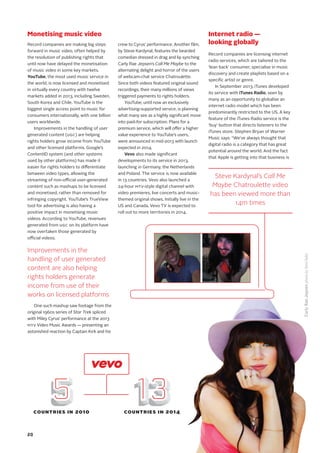
Monetising music video
Record companies are making big steps
forward in music video, often helped by
the resolution of publishing rights that
until now have delayed the monetisation
of music video in some key markets.
YouTube, the most used music service in
the world, is now licensed and monetised
in virtually every country with twelve
markets added in 2013, including Sweden,
South Korea and Chile. YouTube is the
biggest single access point to music for
consumers internationally, with one billion
users worldwide.
Improvements in the handling of user
generated content (UGC) are helping
rights holders grow income from YouTube
and other licensed platforms. Google’s
ContentID system (and other systems
used by other platforms) has made it
easier for rights holders to differentiate
between video types, allowing the
streaming of non-official user-generated
content such as mashups to be licensed
and monetised, rather than removed for
infringing copyright. YouTube’s TrueView
tool for advertising is also having a
positive impact in monetising music
videos. According to YouTube, revenues
generated from UGC on its platform have
now overtaken those generated by
official videos.
One such mashup saw footage from the
original 1960s series of Star Trek spliced
with Miley Cyrus’ performance at the 2013
MTV Video Music Awards — presenting an
astonished reaction by Captain Kirk and his
crew to Cyrus’ performance. Another film,
by Steve Kardynal, features the bearded
comedian dressed in drag and lip synching
Carly Rae Jepsen’s Call Me Maybe to the
alternating delight and horror of the users
of webcam-chat service Chatroulette.
Since both videos featured original sound
recordings, their many millions of views
triggered payments to rights holders.
YouTube, until now an exclusively
advertising-supported service, is planning
what many see as a highly significant move
into paid-for subscription. Plans for a
premium service, which will offer a higher
value experience to YouTube’s users,
were announced in mid-2013 with launch
expected in 2014.
Vevo also made significant
developments to its service in 2013,
launching in Germany, the Netherlands
and Poland. The service is now available
in 13 countries. Vevo also launched a
24-hour MTV-style digital channel with
video premieres, live concerts and music-
themed original shows. Initially live in the
US and Canada, Vevo TV is expected to
roll out to more territories in 2014.
Internet radio —
looking globally
Record companies are licensing internet
radio services, which are tailored to the
‘lean back’ consumer, specialise in music
discovery and create playlists based on a
specific artist or genre.
In September 2013, iTunes developed
its service with iTunes Radio, seen by
many as an opportunity to globalise an
internet radio model which has been
predominantly restricted to the US. A key
feature of the iTunes Radio service is the
‘buy’ button that directs listeners to the
iTunes store. Stephen Bryan of Warner
Music says: “We’ve always thought that
digital radio is a category that has great
potential around the world. And the fact
that Apple is getting into that business is
Improvements in the
handling of user generated
content are also helping
rights holders generate
income from use of their
works on licensed platforms
CarlyRaeJepsenphotobyReidRolls
5 135 135 135 135 13COUNTRIES IN 2010 COUNTRIES IN 2014
Steve Kardynal’s Call Me
Maybe Chatroulette video
has been viewed more than
14m times
20
ISPs leverage the value
of music: KPN-Spotify
Music services looking for access to the mass
audience can partner with ISPs to offer a music
service bundled with phone and data packages.
These are commonplace in Europe and North America,
offering streaming services access to a vast audience,
an established and convenient payment system and
adding value to ISP services. Spotify’s partnership with
KPN in the Netherlands is often held up as a textbook
example of a successful ISP agreement.
For ISPs, a successful partnership in music
streaming brings considerable rewards. One of
the most talked-about successes of 2013 has been
Spotify’s cooperation with ISP KPN. Marnix Laurs,
head of content and partnerships at KPN, says the
cooperation between the ISP’s “Triple Play” service,
which bundles Spotify’s premium tier for free in the
top two propositions, has exceeded expectations.
The partnership is one of the measures KPN
has taken to increase customer acquisition, and
advance customer loyalty. With that, it helps KPN to
compete with its two larger competitors, Ziggo and
Liberty Global. Customer acquisition and stimulating
loyalty are the key metrics of success for any ISP.
“There is fierce competition among ISPs, not just
in the Netherlands but everywhere. We partnered
with Spotify because we were looking for a way to
distinguish ourselves from the others. We looked at
how we could engage music subscriptions to boost
customer acquisition and grow customer lifetime
value. We wanted something that was innovative, that
covered the whole Dutch market and that showed off
the strength of our network. Putting all that together,
we saw music streaming as the answer.”
The Netherlands is one of the fastest-growing
markets for music streaming services, with overall
digital revenues up 56.1 per cent in 2013, with much
of the credit going to success of the KPN-Spotify
partnership.
“KPN definitely believes that the Spotify service,
and streaming services in general, can be appealing
to all customer target groups”, Laurs says. “For
the over-45 age group we are convinced we can
establish a high level of penetration. This will grow as
customers use, and start to love, the service. Younger
target groups are growing up in a world in which the
opportunities they are being offered now will be ones
they use for the rest of their lives — that is why KPN
thinks there is a huge potential for streaming services.”
a sign that the global digital radio business
is going to start to heat up. There are a
great number of consumers who listen to
radio and are casual buyers of CDs and
downloads, and digital radio will provide a
huge opportunity for us to better target
and reach these fans.”
US internet radio service Pandora, also
available in Australia and New Zealand
is the best-known standalone internet
radio service with more than 70 million
users. Subscription services such as Rdio,
Rhapsody and Spotify also provide free
ad-supported, radio-based services to
attract new users.
Engaging in emerging
markets
With underdeveloped payment systems,
high piracy rates and little tradition of
paying for music, many large global
markets are yet to reach their vast
potential. The growth of smartphones
and licensed music services, however,
is starting to change that and emerging
markets are a key focus for international
record companies in 2014.
Dennis Kooker, president, global
digital business & US sales at Sony Music
Entertainment, says: “We see growth in
emerging markets significantly outpacing
the rest of the world with the friction
around distribution and reaching the
consumer removed because of mobile
technology and properly licensed music
services. Tackling piracy and making the
shift to licensed consumption remains
very challenging in some of the markets
with the highest potential. Expansion
of services focused on pre-paid billing
mechanisms is also critical as the vast
majority of consumers are accustomed to
paying bills by pre-paid methods versus
using credit cards.”
“We’ve always thought that digital
radio is a category that has great
potential around the world.”
Stephen Bryan, Warner Music
21
Rapid digital growth
in Latin America
Markets in Latin America are already
confirming this potential, with digital
revenues growing 124 per cent over the
last three years, compared to a global
average of 28 per cent. To build on this
growth and unlock value across the mass
market is requiring new ways of thinking.
Key strategies include collaboration with
mobile operators and ISPs, bundled music
packages and pre-paid music subscription
on devices. In Latin America a number
of new partnerships were launched or
extended in 2013 as digital revenues
grew by 28.1 per cent.
Spotify announced a partnership in
Mexico with Telefonica which bundles
their music service with phone and data
services. Deezer partnered with ISP Tigo
to cover Central America and the Andean
region and Napster partnered with ISP
Terra to bring the Rhapsody-owned service
to Latin America for the first time. US
service Muve offers daily or weekly pre-
paid mobile music subscriptions starting
from 50 cents a day and launched in Brazil
in cooperation with TIM, the country’s
second largest ISP. Alejandro Duque, vice
president, business development and
digital, Latin America at Universal Music
Group, says: “It’s important to remember
that credit card penetration is still not
very high in this region so when a service
only allows credit card billing they’re
catering for a small percentage of the
population. That is why doing deals with
carriers, or with any company that is going
to enable mass billing, is absolutely the
key to success.”
Piracy remains a huge problem in the
region. Luis San Martin, director general
of Multimusic, Mexico’s leading music
content broker for independent artists,
says: “We’re fighting piracy on the streets,
our robots are searching the internet and
we’re campaigning to get the government
to deal with the issue. Before, when we
didn’t take action, people thought that it
was OK to break the law. Now we’re an
industry that is taking responsibility for
its content.”
Local services thrive
in Asia
Record companies are engaging actively
in markets across Asia. In the last
two years, the region’s larger markets
outside Japan have seen the rollout of
all the major download, subscription
and streaming services, combined with
increased competition from local services
such as Taiwan-based KKBOX. Services
such as Deezer, iTunes and Spotify are
seeing healthy growth in sales among
a largely higher income, credit card-
owning demographic, complementing
ad-supported services that are
free-to-consumer.
In China, licensing agreements are in
place with eight major digital platforms,
part of a push towards a paid-for online
model (see China case study, page 36).
In India, already Asia’s second largest
music market after Japan, local streaming
services Gaana and Saavn, which target
domestic and international higher-income
Indian customers, are growing fast.
Sandy Monteiro, president, South-
East Asia for Universal Music Group,
sees enormous growth potential in Asia
markets. “Last year was a milestone year,
AnittaphotobyWashingtonPossatoArminVanBuurenphotobyChrisDavison
124% 28%124% 28%124% 28%124% 28%124% 28%DIGITAL GROWTH IN LATIN
AMERICA 2010–2013
AVERAGE GLOBAL DIGITAL
GROWTH 2010–2013
Country % growth
Peru +149%
colombia +85%
venezuela +85%
Figure 11: Digital growth in Latin
America, 2013, Selected Countries
Source: IFPI
22
because in 2013 we saw the arrival of
major global services in Asia. So for the
first time we are seeing the kind of digital
services available that already exist in
America and Europe. The global services
have been very diligent in ensuring they
have a huge domestic repertoire base
before they launch in Asia markets, but
KKBOX has taken the fight to them by
expanding around the region.”
In a region with historically rampant
levels of piracy, record companies and legal
services in Asia have been working to open
up the mass market. As in Latin America,
they are partnering with ISPs. Deezer’s
partnership with Thailand’s second largest
telecom company Dtac has been hailed as
a major success. For Universal, Monteiro
says more telco partnerships will follow
when operators see the competitive
advantage in linking with music services:
“Somewhere along the lines the telcos
will come around and understand how to
better monetise their platforms.”
Russia shows potential
Russia remains an underdeveloped
market, but one of huge opportunity.
Music revenue rose by 12 per cent to
US$69 million in Russia in 2013 after the
arrival of iTunes, illustrating the potential
in that country. Record companies have
licensed more than a dozen digital music
services, including local services such
as Yandex, Trava and several mobile
operators. While the industry is trying to
find licensing solutions, these services are
struggling to fulfil their potential because
of high rates of digital piracy. Russia’s
largest online social network, vKontakte,
operates a heavily used unlicensed music
service, which has been the subject of
legal action by rights holders. While such
services continue to operate in disregard
of music copyrights, it is difficult to
establish a sustainable licensed digital
music market in Russia.
KKBOX: Asia’s local service
fights its corner
Although international services have made more
headlines in 2013, Asia is home to one of the world’s
first music subscription services, KKBOX, which is
now competing against the global players with its
own locally-branded freemium service. The service,
along with iTunes, helped fuel strong digital sales
growth in its native Taiwan in 2013, with revenues
up 46 per cent.
Founded in 2004, KKBOX is one of Asia’s leading
digital music services. It provides limited free
streams for its 10 million-plus free users, and an
unlimited, fully-portable, integrated mobile, tablet
and desktop service for its 1.5 million-plus paying
subscribers. The service is now available across Asia
in Hong Kong, Japan, Macau, Malaysia, Singapore,
Taiwan and Thailand.
Like other digital services, KKBOX is competing
on music discovery and curation as it is on
distribution. Chris Lin, founder and CEO of KKBOX
set out from the start to create a superior
experience for consumers used to free unlicensed
services. It has built a differentiated music brand
with quality magazine-style editorial, a move that
has seen the company extend its brand into printed
magazines and TV programming. The service
became a hit in Taiwan and quickly launched in Hong
Kong and other Asian markets. In 2013, it launched
another innovation, ‘Listen With’, which allows
users of the service to listen live with others with
“70–80 per cent” of domestic artists using KKBOX.
“We’re trying to build our service into a premium
brand. You can get free music from YouTube, from
piracy, but there’s something that you cannot get
which is a closer feeling, closer distance with
artists . . . interaction. That’s what we’re trying to
build — a VIP-club type of feeling.”
All players in the legitimate digital music market
across Asia agree that piracy remains a huge problem
for the sector. Chris Lin says he is competing with
15 or 20 illegal services from China that are active.
“People call us the leading platform in Asia, but I in
fact would say the leading platform is still piracy.”
23
Daft Punk’s Random Access Memories
was one of the most significant global
releases of 2013. The band delivered a
sophisticated contemporary record that
its record label backed with an innovative
marketing campaign.
John Fleckenstein, EVP, International
at Sony Music Entertainment, says
that it was the trusted partnership
between the band and record
company that enabled them to
create a campaign as exciting
as the album itself. “In the
summer of 2012, around ten of us
convened in a Paris studio to meet
Daft Punk, listen to the album and
understand their vision for how
they wanted it released to the world.
It was immediately apparent that the
music was truly exceptional and we
needed a campaign that matched the
scale of their vision.”
Having over six months between
the first meeting and the album’s
release meant Sony Music had time
to put together a sophisticated global
campaign. “Fundamental to our
success was our ability to communicate
internally within Sony the vision behind
the project and the power of music.
We visited every key market — usually
with the group themselves and their
manager. We played them the full album
and evangelized the concepts behind
our launch.”
Certain elements made the campaign
unique. First, the artists are two Robots.
They do not have a ‘public’ voice — they
do not do interviews or have Twitter
accounts. Second, they had a globally
charged fan base rabid for more music
and information. And, third, Sony needed
to be creative knowing it did not have
unlimited funds.
In answer to this, first Sony music
employed scale and timing — everything
global, everything simultaneous. Second,
in tune with the group’s vision, Sony
Music employed an interesting approach:
every action was to be carried out in the
physical world, but get reflected into to
the digital/social media world.
This came out of the group’s
inspiration from some of the film and
album premieres of the ’70s and ’80s
whose launch campaigns were ‘larger
than life.’ Campaigns that left fans
wondering and wanting more — driven
by a compelling sense of mystery that
made the debuts immensely exciting.
“Our campaign started with tightly
coordinated outdoor advertising placed
in known worldwide locations and a
short mysterious TV teaser using a riff
from Get Lucky. Fans saw these things,
recorded them and shared them like
crazy. Billboards were placed in highly
recognisable locations around the
globe — in London, in Los Angeles, in
Tokyo — fuelling this ‘it’s happening
everywhere’ excitement amongst fans.
For the teaser, Columbia Records in
the US premiered the piece during SNL.
Sony UK bought ‘road blocks’ across
TV at a specific time. In response, fans
immediately began generating their
own content and conversing — one of
them even created a popular 10-minute
audio loop of the riff in the teaser video.
This larger than life approach was
also taken all the way through to
the album launch. “For instance,
in Australia, our local company
decided to debut the album
at the Wee Waa county fair
— which because of global
time zones, technically
became our first play. They
first announced the event in
the local printed newspaper,
which then sent the internet
into a frenzy of speculation as
people asked: why would Daft Punk
launch their album in a town in the
middle of the Australian outback? The
intrigue generated global headlines and
ultimately media even travelled to the
small town for the event.”
The album was released across all
formats simultaneously. Random Access
Memories was the biggest ever pre-
ordered album on iTunes at that point.
It hit number 1 in 97 iTunes stores —
while simultaneously breaking the
record for the most streamed album
of all time on Spotify.
The Random Access Memories
campaign highlights how artists and
labels can work together to generate a
phenomenal level of global interest in
an album launch. It also showcases how
activity in the physical world can be used
to motivate fans to be in the vanguard of
an artist’s digital campaign.
Daft Punk: A physical campaign in the digital world
Long live the
record label
Long live the
record label
Long live the
record label
Long live the
record label
Long live the
record label
“We needed a campaign
that matched the scale
of their vision.”
— John Fleckenstein, Sony Music
DaftPunkphotocourtesyofSonyMusic
24
Avicii has gone almost overnight from
being a club DJ in Sweden to a global artist
who plays in the world’s biggest arenas.
He worked with his management and
record company on a world conquering
campaign fuelled by innovative electronic
dance music (EDM) and harnessing online
social networks.
Per Sundin, senior vice president,
Nordic region, Universal Music Group
International, first discovered Avicii on
YouTube, where he had posted a song,
Bromance, the instrumental version of
what later became Seek Bromance, under
the pseudonym Tim Berg. Sundin was
searching for EDM acts after witnessing the
popularity of a new generation of artists at
the Pacha nightclub in Ibiza.
Sundin was impressed by the song
and the harmonies and, of course, the
amount of views the unreleased song had
gained and approached Avicii’s manager,
Arash Pournouri, signing a deal to release
it across the Nordic region. It was a
successful hit and they followed up with
the single Fade Into Darkness. Sundin was
encouraged by the reaction to these two
tracks to energise Universal Music’s global
network to promote Avicii’s single Levels,
which became his first global hit selling
more than five million copies.
In January 2013, Avicii launched a
campaign in partnership with Ericsson, to
create the world’s first ‘crowd sourced’
hit song. Fans sent basslines, effects,
melodies, rhythms and vocals to Avicii for
him to edit and release as a finished track.
He also released the track Three Million to
mark the acquisition of his three millionth
Facebook fan.
Avicii and his record label then prepared
to promote his debut album True and its
lead single Wake Me Up. The album was
unveiled at the Ultra music festival in Miami
in a live performance featuring a range of
artists who had collaborated on the album,
including Aloe Blacc, the vocalist on Wake
Me Up. EDM fans at the festival disliked
the album that featured elements of other
genres, including country music, and there
was strong hostility across online social
networks over the next 24 hours.
Sundin says: “This is where we had to
hold our nerve. We knew we had a great
album. We knew this was a shock to
hardcore EDM fans, but we were convinced
this album would take Avicii to a whole
new level.”
This judgment proved correct as Wake
Me Up topped the charts in more than
20 countries and has now sold more than
8.5 million copies worldwide. The single
also proved a huge success on Spotify,
becoming the most streamed track in the
service’s history with more than 190 million
streams to date. Avicii’s single Hey Brother
also proved another global hit on Spotify
and in download sales.
Per Sundin says: “The campaign has
been a game changer for the whole music
industry. Avicii has built his loyal global fan
base through online social media. We’ve
focused our marketing resources on
targeting the under 30s in the world they
live in. That means focusing much more
on social media, rather than traditional
newspapers and linear television.”
Sundin also points to the success
of Avicii’s brand partnership deals with
the likes of Ericsson and Ralph Lauren.
“Business understands that music is the
frontrunner of change in society and they
want to harness its emotional power.
Artists know that working with brands
helps them reach a broader audience.
EDM is built around the collaboration of
DJs, songwriters and artists and this is an
extension of that. Collaboration is the
new creation.”
The campaign to take Avicii from
Swedish club DJ to global superstar
underlines how online social media,
properly harnessed, can help artists and
record companies speed up the process of
building a global fan base. It also highlights
daring to be innovative can help take an
artist to a whole new audience.
“Avicii has built his loyal
global fan base through
online social media.”
— Per Sundin, Universal
Avicii: From club DJ to global superstar
AviciiphotobyJocobSchulman
25
In 2013 we successfully introduced our lossless
streaming product – WiMP HiFi. Alongside the best
sound quality, we have now included our magazine
in our apps. Combining the two makes the ultimate
music moment, where you can listen without
compromise and read great music stories.
WiMP HiFi is a premium product for people who care
about sound and music. It has been introduced at a
higher pricepoint and has given the opportunity to
improve revenue for labels and artists.
Why? Simply because music matters.
Great sound
and great stories.
www.wimpmusic.com
Warner Music Nashville/Atlantic Records
recording artist Hunter Hayes released a
new version of his song Everybody’s Got
Somebody But Me featuring label-mate
Jason Mraz as part of the Encore edition
of his eponymous debut album. Atlantic
and Warner Music Nashville wanted to use
YouTube to help attract new audiences
to Hunter’s music. They felt there was an
opportunity to reach Generation C, create
a compelling piece for Hunter’s fans, and
extend the reach to new audiences.
Jeremy Holley, senior vice president,
consumer and interactive marketing,
Warner Music Nashville, says that digital
channels such as YouTube are central
to the label’s promotion of Country
artists. “There is a misconception that
Country music fans are not digitally savvy,
but that’s just not true. Hunter and his
audience are highly engaged in the space
and we thought it would be a great way to
give them a campaign that was engaging.”
The label contacted YouTube and
sounded the platform out about an
interesting campaign.
Rather than film in Nashville, Warner
arranged to shoot in Los Angeles at
YouTube’s own creative space, the
YouTube Hangar. This enabled the label
to pull together a range of the ‘YouTube
Stars’ who post their own versions of
hit songs onto the platform together
and invite them to perform with Hayes
and Mraz.
Content creators ranging from Tyler
Ward to Kina Granis submitted their
own versions of Hayes’ song and Warner
Music Nashville along with Hunter
created a mash-up of the results. It then
brought together Hayes, Mraz and all
the ‘YouTube Stars’ to create a one-shot
music video featuring all of them, dubbed
the ‘YouTube Orchestra’, for the mash-up
track. Holley said: “Hunter and Jason had
a blast. They even partially recreated the
video when they played the track at the
Country Music Awards.”
This unique approach to filming
YouTube material for a song meant
that Warner Music Nashville could
run a lengthy campaign that engaged
significant numbers of music fans. The
individual ‘YouTube Stars’ released their
own versions of the track and then the
‘YouTube Orchestra’ video was released
ahead of the official music video. Holley
says: “This enabled us to build excitement
and expectations around the multiple
video releases. It allowed us to extend the
typical runway of a music video by one
month. We received a significant spike
in views, engagement, and built more
familiarity around the track than we would
normally have.”
The whole approach was built around
the Nashville mantra, “It all starts with a
song.” Holley says: “It’s really cool to hear
such different variations of the track from
acoustic to a capella. A powerful song
transcends all formats and demographics.”
Holley says the campaign saw digital
teams from across Warner Music Group
(Warner Music Nashville, Atlantic Records
and Warner Bros. Records) work together
to make it a success. He believes that
major labels and publishers are still at the
heart of the music industry. “There is a
reason YouTube Stars — who are hugely
talented — cover our songs. Living in
Nashville and seeing how much work goes
into the creative process is inspiring. We
have writers and artists in town that cross
collaborate and extending this to other
musicians in the YouTube ecosystem only
adds more value.”
“There is a misconception that Country music fans are
not digitally savvy, but that’s just not true.”
— Jeremy Holley, Warner Music
Hunter Hayes: The YouTube orchestra
HunterHayesphotobyGuzmanforStocklandMartel.com
27
www.stingraydigital.com
Stingray Digital delivers
a complete set of
ADVANCED MUSIC SERVICES
to more than
105 million households in
113 countries,
providing an unparalleledproviding an unparalleled
distribution platform for music
content of all types.
British singer-songwriter Mike Rosenberg,
better known as Passenger, first came
to the attention of German independent
label Embassy of Music in early 2012.
Once the frontman of the UK-based
band of the same name, Rosenberg had
moved to Australia in 2010 as a solo artist,
before signing to leading independent
label Inertia Records. Wanting to build on
Rosenberg’s Australian success, Inertia
worked with Embassy of Music to launch
his career in continental Europe.
Embassy of Music MD Konrad von
Löhneysen says Passenger had already
built up a strong following on Facebook,
but a combination of social media with
traditional marketing helped take him
from a little-known singer-songwriter
with a small but loyal following to
top-ten success across Europe and
Australasia. Before breaking the artist in
their native Germany, the label used its
network leverage a successful campaign
in the smaller Dutch market working in
partnership with Sony Music Netherlands.
“German radio is really fragmented.
Even though we knew we had a potential
hit in Let Her Go it’s hard to create an
impact with an unknown artist from a
standing start. The radio market is far
smaller in the Netherlands. Working
closely with a top Dutch radio plugger,
we helped get the record to number
one in November 2012. That was the
turning point.”
This success gave the label a platform
to reach the German market, with a
promotional campaign, again focused on
radio, followed in the New Year.
Von Löhneysen said while Facebook
was also a critical channel in the
campaign, the label didn’t view it solely
as a sales channel. Embassy of Music
used Facebook’s geo-IP technology to
filter updates by territory, enabling them
to work with the artist to provide fans
with useful updates on tour dates and
new releases, without compromising his
artistic integrity. “Passenger had built a
relationship with fans, we didn’t want to
take over the page and compromise that
— it’s all him.”
Passenger’s Facebook following in
Germany grew to 140,000 through 2013,
as the label capitalised on its success in
the Netherlands to launch him in Germany
and across Europe. Having topped the
German singles chart in February 2013,
Let Her Go went to number 1 in Austria,
Belgium, Sweden, Switzerland, Australia
and New Zealand, as well as number 2 in
the UK. Album All the Little Lights entered
the top ten in a dozen global markets,
going Platinum in Germany and Australia,
as well as Gold in the UK.
“Any artist can upload a YouTube video,
put out an album, talk to their fans. And
it’s best when it all comes from them.”
adds von Löhneysen. “But traditional
media is also important to take them to
the next level. Not every artist can be
like Radiohead, who had years of label
support helping them build their fanbase.
A record label’s experience in marketing,
plugging, and breaking artists is still a vital
complement to what the artist can do on
social media, not an alternative.”
“A record label’s experience in marketing, plugging, and
breaking artists is still a vital complement to what the artist
can do on social media, not an alternative.”
— Konrad von Löhneysen, Embassy of Music
Working in partnership: Passenger and the Embassy of Music
29
Record companies are increasingly
partnering with brands and, in some cases,
becoming valuable brands themselves.
One example has been the strategy of
Sony Music in Brazil. The company says it
has built up its digital presence, becoming
the number one record label in the world
on Facebook, with more than 7.8 million
fans (consolidating Sony Music Brazil
and Sony Music Gospel pages) and more
than 63 million fans on the co-managed
Brazilian cast Facebook pages. It is also
the leader on Google+, with more than
1.1 million followers, as well as Instagram
and Foursquare. This gave Sony Music
Brazil a platform that was attractive to
both brands and artists.
Alexandre Schiavo, president, Sony
Music Brazil, says: “We decided in 2005 to
become fully focused on digital channels.
My own background was in digital and I
realised that the new generation of social
media would be revolutionary for us.
We knew it would give us direct contact
with music fans on a scale that was
unimaginable before.”
“We ran competitions for brands and
helped them connect with music fans on
a huge scale. Our partnership with Sony
Electronics Brazil saw the company go
from 180,000 to two million Facebook
fans in just seven months. We replicated
music content on their Facebook page and
generated exclusive content for them.
We effectively became their digital
advertising agency focused on music and
entertainment.”
The record label paid artists for the
work they delivered for brands, but
because it had a long-term relationship
with the performers, it could often deliver
more for the brand than a regular agency
could. The partnerships also benefited
artists. “If the artist wanted to do a third
or fourth music video that wasn’t in the
original plan, we could generate money
from the brand partnerships to make
that deliverable.”
One example of such a partnership
was the campaign for local rock band
Capital Inicial involving Sony Electronics.
The band shot a music video in the desert
in Chile using a 360° camera, with
Sony Electronics paying for the shoot.
The band also ran a competition on Sony
Electronics’ Facebook page that saw the
winner go on a trip to São Paulo with the
band to go shopping for musical products.
This approach is also being taken
to a global audience. Sony is one of
the sponsors of the 2014 World Cup,
with Sony Music producing the official
soundtrack album. The record company
worked with Sony Corp on a competition
featuring Ricky Martin which invited
fans worldwide to write a song for him
to sing. The winner of the “SuperSong”
competition is to have their work
recorded by Ricky Martin and be included
in the official soundtrack, before travelling
to the World Cup final.
Schiavo says: “Our work is about
engaging people and having fun. Offering
them something that money can’t buy and
exciting them about artists and brands.
We’re now taking this work from Brazil to
a global market.”
Sony Music Brazil has also run social
media campaigns for brands including
Coca Cola, Nestlé, Skol Beer, Gol Airlines,
Puig Fragrances and Telecom Italia. The
company has developed a presence across
a range of additional digital and social
networks including Vine, Flickr, Tumblr,
Twitter, YouTube and Vevo.
Schiavo says: “We’re projecting further
huge growth in this area over the next
few years. Brands are looking for music
content and artists can benefit from
the right strategic partnerships. We
can do things that were unthinkable a
few years ago. We can fill up a stadium
with fans of a band without placing a
single advertisement — only using digital
activations. Music fans are starting to
see record companies in a completely
different way — they never had this level
of engagement in the past.”
“Music fans are starting to see record companies in a
completely different way — they never had this level of
engagement in the past.”
— Alexandre Schiavo, Sony Music Brazil
“We can do things that were unthinkable”: Engaging fans in social networks in Brazil
CapitalInicialphotobyMarceloRossiRickyMartinphotobyOmarCruz
30
Katy Perry is a global phenomenon —
her latest album topped the charts in 100
countries and she is the most followed
personality in the world on Twitter.
PRISM, her third studio album, was
released in 2013 and featured a number
of tracks that had promotional campaigns
built around them. Bob Semanovich, SVP,
marketing at Capitol Music Group says:
“Our plan for Katy is not built around a
traditional album release cycle, where
we concentrate our promotional effort
around one date. There are lots of singles
on PRISM and there will be lots of Katy
campaigns for the next 18 months and
beyond.”
The lead promotional single Roar was
released in August. Katy released four
short teaser videos heralding the new
stage in Perry’s creative development.
A lyric video was released in which,
unusually for a star of her stature, Katy
appeared. She spelled out the lyrics
to Roar in emoticons, and the video
generated almost 70 million views. The
official video was promoted using a classic
1930s-style Hollywood movie poster and
a series of online teasers. The video went
on to be viewed around 360 million times
on YouTube alone, while Roar topped the
charts in 97 countries.
Perry works tireless to promote her
music and the domestic and international
teams at Capitol Music Group help
harness her social media platforms to
promote her wide range of appearances.
She performed Roar at the close of the
MTV Video Music Awards in the US, in
addition to embarking on four major
international promotional trips in the span
of just a few months, including Australia,
Canada, France, Germany, Italy and Japan.
Meredith Gardner, VP, digital
marketing, Capitol Music Group, says:
“Katy’s really authentic and that’s what
makes her Twitter so powerful. She
tweets in her own voice about what she’s
seeing and doing. She’s also good at
surprising her fans, jumping on Twitter for
an impromptu Q&A or sharing Twitpics of
what she’s up to.”
The team helps identify great
opportunities to showcase her music
and uses social media to highlight her
appearances. Kieran Thurgood, director,
international, Capitol Music Group,
adds: “Katy is a global superstar, but it’s
incredibly important for us to execute
marketing and promotional strategy on
a local level so fans around the world
can truly connect with her and her music
in a very natural way. We work hard to
ensure Katy has the most impactful global
media platforms to do what she does.
Examples of this include Katy’s stunning
performance on the X-Factor finale
in the UK, performing alongside local
contestants on Germany’s The Voice, a
special Sunrise performance in front of
Sydney Harbour Bridge in Australia,
a major TV promotion with MSN & Visa in
Canada, a landmark visit to China with the
prestigious China National Orchestra and
a phenomenal performance at the MTV
European Music Awards in Amsterdam.”
Katy Perry also announced her new album
via a giant gold-plated truck with ‘KATY
PERRY — PRISM — 10.22.13’ inscribed
across the sides. The campaign was
replicated in Mexico and also in the UK,
where Perry-branded gold-plated taxis
chauffeured artists and celebrities to the
2013 iTunes Festival in London.
Hot on the heels of Roar, a brand
partnership deal with MTV, who in turn
partnered with Pepsi resulted in a major
promotion of PRISM. Fans were given the
opportunity to unlock song titles, lyrics
and snippets from the album by tweeting
#KATYNOW. They could also listen to
previews of the tracks Dark Horse and
Walking on Air and vote on which they
wanted to have early release on iTunes.
The second single from PRISM
was Unconditionally. This was
backed by the promotional campaign
#KatyUnconditionally that invited fans to
share an Instagram of what unconditional
love meant to them and upload it with
their story and location to appear in an
online PRISM map of the world.
Capitol Music Group’s campaigns to
support Katy Perry highlight how music
companies have transformed their
marketing and promotional strategies.
The success of the PRISM campaigns also
highlights how important multiple hit
singles are to continuously drive ongoing
interest in an artist and keep them in
the spotlight.
“Our plan for Katy is not built around a traditional album
release cycle, where we concentrate our promotional
effort around one date.”
— Bob Semanovich, Capitol Music
Katy Perry: A global phenomenon
KatyPerryphotobyCassBird
31
Tommy Torres is a Puerto Rican born
singer-songwriter who, until recently, was
highly respected by his peers but had not
yet become established in the mainstream
music market. Warner Music Group (WMG)
helped him break through to a broader
audience of music fans through the
creation of an innovative Twitter campaign.
Gaby Martinez, vice president,
marketing, Warner Music Latin America
& General Manager, Warner Music Latina
explains that Torres was able to harness
Twitter to create a debate around one
of his songs, giving his fans a sense of
ownership of it. “His song Querido Tommy
was inspired by a fan who wrote to him
and said that he loved his girlfriend but
could not put this feeling into words and
asked for the artist’s help to express
himself. He launched a campaign on
Twitter to ask his fans if he should help
this man express his feelings to his
girlfriend.”
Torres generated more than 3,000
interactions in this online debate and
then posted his song on Twitter before it
was released to radio stations for airplay.
WMG promoted the campaign across
its online properties, generating extra
attention from music fans. Other stars,
such as Ricky Martin and Alejandro Sanz,
retweeted his messages.
Martinez says: “It was an example of
how an artist can use social media to
take the pulse of their fans. People felt
they were part of Tommy’s story and had
ownership over the song.”
Torres released his next two singles on
Twitter ahead of their first radio airplay
and found that on each occasion he
generated more interactions. He now has
a total Twitter follower base of more than
500,000 people.
The whole campaign helped Torres
break through into the mainstream music
scene. His album 12 Historias debuted at
number one the Nielsen Soundscan Latin
chart in the US.
Gaby Martinez says it is not unusual
to see Latin artists use digital channels
to promote themselves and that whole
market for Latin music is increasingly
evolving in terms of revenue generation.
“In the US, we see younger urban Latin
artists generating more interest through
digital channels, while traditional Latin
Country artists tend to have more of a
bias towards physical sales. In Mexico, the
market is split almost 50:50, as iTunes
has proved extremely successful in a
country where it can price its music in
local currency. Other markets, including
Torres’ native Puerto Rico, are still more
dominated by physical sales.”
Martinez says that digital platforms
are now central to all the artist campaigns
WMG runs for its Latin artists. “With
channels such as YouTube you can really
see which songs music fans are engaging
with. Radio stations may choose to heavily
play certain tracks, but unless people are
searching for them on YouTube, you are
not really connecting.”
Despite this, Martinez believes that
digital channels tend to follow market
trends, not lead them. “Yes we’re signing
more urban Latin artists these days, and
they perform well on digital channels, but
the trend towards such performers was
happening anyway. Digital is reflecting
the market. While we see new platforms
come into the market and more diversified
revenues are starting to come in, our key
job is still to scour the market for talent
and sign the best artists we can.”
Tommy Torres: Harnessing the power of Twitter
“People felt they were part
of Tommy’s story and had
ownership over the song.”
— Gaby Martinez, Warner Music,
Latin America
TommyTorrescourtesyofWarnerMusic
32
MUSIC REMAINS — A 90-second race through time filmed at London’s
world-famous Abbey Road studios, Music Remains is a celebration of recorded
music at the centre of people’s lives.
YEARS HAVE PASSED,
AND NOTHING’S THE SAME
BUT YOU’RE THE ONE THING
THAT ALWAYS REMAINS
WWW.MUSICREMAINS.ORG
A return to growth
T
he Swedish music industry
has a seen an encouraging
revival in just three years,
from a low of US$144.8 million
in 2008, revenues grew to US$194.2
million in 2013. During the same period,
digital’s share of total revenues increased
from 8 per cent to 70 per cent, with
subscription services accounting for
94 per cent of the digital market.
The turnaround dates back to 2009
when the combined effect of The Pirate
Bay trial and a new anti-piracy law
persuaded many consumers to try the
new Spotify service. Many preferred
streaming to illegally downloading music.
Streaming and subscription has helped
migrate music consumption from piracy
to the licensed environment. Consumer
research published by GfK in September
2013 showed that nine out of 10 paying
subscribers to Spotify say they download
illegally “less often”; seven of 10 of the
service’s free users say the same.
Spotify’s success was also boosted
by a partnership with telcoms firm Telia,
whose bundled deal offered customers
three months’ free access to the service.
The majority continued to pay afterwards.
Having benefited from reduced churn,
Telia later rolled out the deal across
Scandinavia.
A continuous
revenue stream
The subscription revolution has changed
the way rights holders are paid, with
artists whose music is continuously
listened to on Spotify benefiting from a
constant revenue stream. Jacob Key, vice
president, digital strategy and business
development, Europe, Warner Music,
says: “Repertoire can now make more
money over a longer period of time.
The consumption model enables a much
longer product life cycle, and generates
more revenues over time for most artists.”
Per Sundin cites Lars Winnerbäck, one of
the top-selling Swedish artists over many
years. “He has remained in the Spotify
top ten for years without releasing a
new album. His management thinks that
Spotify is fantastic.”
Another Swedish artist, DJ John de
Sohn, has had four hit singles, the latest
being Taking It Back, and is considered a
‘Spotify phenomenon’. He says: “Streaming
services have been a key part of reaching
a new audience with my music. My last
three singles have accumulated over
30 million streams in Sweden, and Spotify
has been an instrumental part of building
my artist brand and live business. For
recorded music, streaming is by far the
biggest revenue source for me.”
Subscription services have also
removed a barrier to music discovery.
Jacob Herbst, head of digital sales and
business development (Sweden), Sony
Music Entertainment, says: “The barrier
to listen to a new artist is lower than it
was when you had to buy their album.
We now pay out royalties to more artists
now than ever before. Ten years ago, the
vast majority of our revenue came from a
smaller number of artists.”
Growing diversity
New artists have benefited from the
younger audience that streaming attracts.
Label executive say streaming users
are younger and that is having an effect
on A&R. Urban music and electronic
dance music consistently ‘over index’ on
streaming services, which means that
record companies are striving to sign
more artists performing in these genres.
Per Sundin says: “Streaming is the most
democratic tool we have ever been part
of. The range of artists being listened to is
wider. Swedish hip-hop artists are making
money again. We’ve been able to invest in
them because of Spotify.”
A market
transformed
A market
transformed
A market
transformed
A market
transformed
A market
transformed
A market
transformed
“For recorded music,
streaming is by far the biggest
revenue source for me.”
— DJ John de Sohn
“If you look at business models
over 20 years, you have the
potential to get much more
revenue with streaming.”
— Jacob Key, Warner Music
“Ten years ago, the vast
majority of our revenue
came from a smaller number
of artists.”
— Jacob Herbst, Sony Music Entertainment
SWEDEN
34
Dance music, too, leans towards digital.
Jonas Sjöström is CEO of Playground
Music Scandinavia AB, an independent
record company which owns the digital-
only dance label Uniform Beat, home to
artists such as Adam Rickfors. He says:
“The entire dance market is 98 per cent
digital. It means we can sell music
globally without licensing deals and no
manufacturing costs, but we still have to
promote it everywhere and pay for the
local expertise to do that.”
Subscription services have paved the
way for the rise of the playlist. Jacob
Herbst of Sony says: “We built a strategy
around playlists that evolved into the Filtr
brand. It’s all about building up the label
as a trustworthy source of music. Labels
now run large above-the-line advertising
campaigns promoting playlist brands.”
IFPI Sweden has changed its charts to
include streaming, also bringing it into its
Gold and Platinum award certifications,
which traditionally went to artists who
crossed a certain sales threshold. Jacob
Herbst says: “As an industry, we’re now
increasing the number of units required
for Gold and Platinum awards after more
than 10 years of bringing them down.
And even with that, we are giving away
more Gold and Platinum awards than for
many years.”
What next in Sweden?
Few in the industry think the evolution
of the Swedish market is over. The focus
now is on how streaming is benefiting
A&R and marketing. Per Sundin of
Universal says: “We have seen the
consumption revolution, but now we’re
seeing radical changes in A&R and
marketing as record companies adapt to
a changed environment.” Jacob Key cites
singer Robyn, who launched three mini-
albums with several singles, promoting
them over 18 months before releasing her
album. “Marketing strategies are changing.
You need to keep investing for two,
three or four years to get people to keep
listening to an album.”
Digital services themselves continue
to evolve. WiMP has become the first
streaming service to launch a super
premium service with higher audio quality
and others are talking about new deals
such as family packages. Meanwhile, a
landmark was reached in October 2013
when YouTube became monetised for the
first time in Sweden.
“Streaming is the most
democratic tool we have
ever been part of”
— Per Sundin, Universal
89% 34%89% 34%89% 34%89% 34%89% 34%OF SPOTIFY SUBSCRIBERS
DOWNLOAD ILLEGALLY LESS OFTEN
OVERALL MARKET
GROWTH 2008–2013
Avicii photo by Alex Wessely
JohndeSohnphotobyGustavModérWiking
35
CHINA
C
hina is a market of enormous
potential, long stifled by piracy.
Ranked just 21st in the world,
2013 revenues were estimated
at US$82.6 million.
Yet the landscape for the music
industry in China is changing. Over the
last two years, major record companies
and some independents have licensed
eight of China’s major online music
services, most of them previously
copyright infringing. The deals trace
back to a landmark agreement struck in
2011 between three international record
companies and internet giant Baidu, that
involved the settlement of anti-piracy
litigation and a commitment by Baidu to
close its infringing ‘deep links’ service.
The opportunity for the music industry
lies in China’s vast internet population,
with 618 million users in 2013, with
81 per cent connected to mobile.
Sunny Chang, president, Greater China,
Universal Music Group International, says:
“The Baidu deal was a trigger that led
to other internet companies changing
their approach and becoming licensed.
We believe that in three to five years the
market will be open and China could be
one of the top markets in the world.”
Moving to the paid model
The government is providing more vocal
support for the paid model. Vice Minister
Yan Xiaohong of the National Copyright
Administration of China (NCAC) says:
“The time for paying for music in China
has already come — this is not just a
principle, but also a necessary practice.
But what is also important is that,
whichever we choose, whether it be the
paid or advertising-supported model, we
must make sure that rights holders are
rewarded.” Independent record companies
agree. Mike Songke, vice president of
the CMIC, the organisation representing
local Chinese labels, says a paid model
will encourage investment in local artists
and help develop a thriving Chinese music
business.
There are challenges ahead, however.
Along with competition from hundreds
of unlicensed services, CMIC sees
the low share of revenues going of
music rights holders in China as a key
barrier to development of the sector.
A study published by CMIC in 2012
estimated the total value of the digital
music sector in China at RMB30 billion
(US$4.9 billion), but the study estimated
that a very small share of that revenue
(less than 3 per cent) was being shared
with copyright holders. Songke makes
comparison with China’s booming film
industry where box office returns are
being ploughed back for re-investment
into local film productions. “Nowadays it
isn’t just piracy that is our problem — we
have to get a fairer distribution system
that motivates our industry, just like in the
film industry.”
China’s licensed digital services are
fast-evolving, with some expectations of
consolidation in the sector at the time
of this report’s publication. One of the
leading services that run a paid offering
New hopes
for a licensed
music market
New hopes
for a licensed
music market
New hopes
for a licensed
music market
New hopes
for a licensed
music market
New hopes
for a licensed
music market
New hopes
for a licensed
music market
“The time for paying for
music in China has already
come — this is not just
a principle, but also a
necessary practice.”
— Vice Minister Yan Xiaohong, NCAC
“We have to get a fairer
distribution system that
motivates our industry, just
like in the film industry.”
— Mike Songke, CMIC
36
Fan Fan courtesy of Linfair Records
alongside its free streaming service is
Kuwo. CEO Lei Ming, says: “In China the
majority of people now use legal music
— that’s a very good environment to be
in, but the big question is how can we
transfer consumers from free to paid, and
how to do that without pushing users to
illegal sites?” Another leading service is
Tencent, which has amassed three million
paying subscribers for its subscription
service Green Diamond. Pursuing a
different strategy is Baidu, China’s largest
search engine. Baidu offers a free music
streaming service and, in addition, a paid-
for tier offering expanded cloud storage
space and high quality larger files. As with
Kuwo, the vast majority of Baidu’s users
choose the free-to-consumer option.
Kaiser Kuo, director of international
communications, says: “Baidu has an
ad-funded model and our core strategy
is based on online advertising and
dominating at consumers’ main points of
entry to the internet.”
The largest digital service is China
Mobile, with 700 million users in total
and 50 million active paying ringback
tone customers. In addition, there are
20 million paying subscribers to the
operator’s subscription and limited-
download music service, Migu Music.
Liu Yu Xing, assistant of the general
manager of China Mobile Music Base, says:
“It is not just recording companies and
musicians in China who want to get to this
paid-for model — it is the objective of the
operators too.”
Record companies also want to step
up artist development in mainland China.
In the short term this is a challenging
task due both to undeveloped production
facilities and to regulations limiting non-
Chinese investment both in production
and in distribution of music.
In the absence of a developed market
for sales of recordings or performance
rights, labels working in China rely heavily
on management and live performance
income. Most big-selling artists are
developed out of Taiwan, dubbed the
‘Hollywood’ of the region. One of the
leading indies active in China is Taiwan-
based Linfair Records. The label’s top
artists include Fan Fan, a judge on China’s
growing and influential TV talent shows,
and Yu Chen Ching (Harlem), a Taiwanese
singer who is the label’s top male artist.
Linfair Records chairman Denver
Chang says that CD sales and
management income cannot be the long
term future for record companies in
China: “The paid model is the foundation
to run a record company. The good news
is that we know that the platforms want
to have paid services, and the government
recognises that too. The interests of
the music industry and the internet
companies are aligned.”
Tackling piracy
Record companies and digital services
agree on the critical continued role
of copyright enforcement in turning
around the Chinese market. Following
the licensing deals that some repertoire
owners have struck with the major digital
platforms, the government now has a
vital part to play in tackling the thousands
of remaining small and medium sized
infringing sites.
NCAC Vice Minister Yan Xiaohong
says the government has stepped
up actions both in enforcement and
promoting consumer awareness of
intellectual property rights. “Nine years
ago when I started in this role, we were
talking about copyright theoretically
but since then dramatic changes have
happened. Criminal penalties for copyright
infringement have been strengthened
and enforcement against illegal sites
intensified.”
618M
21
500M
618M
21
500M
618M
21
500M
618M
21
500M
618M
21
500M
ACTIVE INTERNET USERS IN 2013
WORLD RANKING
MUSIC MARKET
MOBILE WEB USERS
37
D
espite its huge influence on
music repertoire across the
globe, most countries in Africa
have not historically been
significant markets for the international
music industry. Today, that is beginning
to change. Digital technology is enabling
the recording industry to effectively reach
mass numbers of consumers across Africa
for the first time. Across the continent,
international record companies are
working to establish innovative services
and invest in A&R.
Africa’s economies are growing
rapidly and smartphone penetration,
though small, is soaring. The International
Telecoms Union reported in March 2013
that mobile broadband penetration
in Sub-Saharan Africa increased from
2 per cent in 2010 to 11 per cent in 2013.
Sean Watson, managing director of Sony
Music Entertainment Africa, says: “The
forecasts for smartphone growth in Africa
over the next few years are staggering.”
Digital services are
being established
International services are opening for
business, domestic platforms are growing
stronger and new services are being
developed. Ulrik Cahn, VP digital business
emerging markets, Universal Music Group,
says: “You can really feel that something
impressive is happening with digital music
in Africa now. Two years ago, the digital
business was almost all ringtones, today
products and services are taking off and
interest from our global partners in the
continent is greater than it has ever been.”
Africa already had a domestic digital
music business, partnered with leading
regional and national telco operators.
These include MTN Nigeria, with 17 million
subscribers, and Safaricom, with 10 million
subscribers, have helped build a sizeable
ringback tone market. International record
companies are establishing strong local
direct relationships with local partners
— telcos, aggregators, local services,
publishing societies and independent
labels. Digital revenues to international
companies in Africa are currently small
but fast-growing: South Africa, the
region’s largest market has seen digital
music revenues take off in 2013 following
the arrival of iTunes and several music
streaming services, such as Deezer, rara
and Simfy. Digital revenues doubled in the
year, accounting for 14 per cent of a total
market worth US$63 million.
International services such as Deezer,
iTunes, Simfy and YouTube are now also
operating across the continent, and while
they are still small compared to the telcos,
insiders estimate iTunes now accounts
for 40 to 50 per cent of digital revenues
in South Africa. Other established local
services include Spinlet and iRoking in
Nigeria and Mdundo in Kenya.
THE KLEEK, a pan-African mobile
music streaming service, backed by
Universal Music and electronics giant
Samsung, and licensed by Sony Music,
launched in March 2013. THE KLEEK offers
an interactive voice response service as
well as an app featuring a huge range
of playlists. The app is preloaded on
Samsung smartphones whose owners can
use it free of charge. Randall Abrahams,
managing director, Universal Music South
and sub-Saharan Africa, says: “Music fans
in Africa have never had access to such a
rich and engaging licensed service before,
THE KLEEK marks a sea change in the
development of the digital market in
the region.”
Guillaume Quelet, VP, digital business
development, Sony Music Entertainment,
who looks after three Francophone
markets in North Africa, says partnerships
with mobile carriers are key. “It’s
about creating services that appeal to
consumers in pre-paid markets who often
have limited disposable incomes. I think
there will soon be exciting new deals that
will also include unusual features such as
live tours.”
Emerging
opportunity
Emerging
opportunity
Emerging
opportunity
Emerging
opportunity
Emerging
opportunity
Emerging
opportunity
AFRICA
“The forecasts for
smartphone growth in
Africa over the next few
years are staggering.”
— Sean Watson, Sony Music
Entertainment Africa
“You can really feel that
something impressive is
happening with digital music
in Africa now.”
— Ulrik Cahn, Universal Music Group
38
Keko photo by Bicepts Photography
Xtatic photo by Erik Foster
Expanding A&R activity
Record companies are increasing their
A&R activity across the region. Sean
Watson says: “Sony Music Entertainment
has already made a significant investment
in the development of the phenomenal
talent in Sub-Saharan Africa and we are
committed to continuing to partner with
African artists to endeavour to bring their
music not only to the world, but to African
music lovers across their own continent.”
Recent signings by Sony Music include
Nigerian artist D’Banj and Rose Muhando,
a Tanzanian gospel artist. Exciting, new
young artists include Ugandan style icon
Keko; and Kenyan rapper and singer-
songwriter Xtatic.
Randall Abrahams of Universal says:
“We’re engaging with artists across
sub-Saharan Africa and in particular with
independent labels and entrepreneurs
as they are at the cutting edge of artist
development in the region. We have a
significant long-term commitment to
investing in African artists and taking
them beyond the continent to an
international audience. Universal’s labels
have long invested in African music and
are home to artists such as South African
superstar Zahara, Joey B and Shatta Wale
from Ghana, MadTraxx and Necessary
Noize from Kenya and Mozambican artist
Lizha James with tracks produced by
rising South African star Uhuru.
Guillaume Quelet says he is also
investing in local artists. “Many French
urban artists have roots in North Africa
and are hugely popular, but we are also
looking to develop more local talent.”
2%
107%
11%2%
107%
11%2%
107%
11%2%
107%
11%2%
107%
11%2010
MOBILE BROADBAND PENETRATION
IN SUBSAHARAN AFRICA
DIGITAL MUSIC GROWTH IN
SOUTH AFRICA (2013)
2013
39
T
he music industry is a business whose success
depends on certainty in the legal environment
and on copyright law. This is a constant and
ever-changing challenge — the music market
internationally continues to be distorted by unfair competition
from unlicensed services.
IFPI estimates, based on comScore/Nielsen data, that
26 per cent of internet users worldwide regularly access
unlicensed services. This estimate applies only to desktop-
based devices: it does not include the emerging, but as yet
unquantified, threat of smartphone and tablet-based mobile
piracy as consumers migrate to those devices.
Digital piracy is the biggest single threat to the
development of the licensed music sector and to investment
in artists. It undermines the licensed music business across
many forms and channels — unlicensed streaming websites,
peer-to-peer (P2P) file-sharing networks, cyberlockers and
aggregators, unlicensed streaming and stream ripping and
mobile applications.
The industry is responding not with a single strategy, but
with a comprehensive, multi-pronged approach. It includes:
consumer education on copyright and the value of music;
working with law enforcement agencies to tackle online
piracy; litigation against online pirate services; and engaging
with policymakers and legislators worldwide to create an
environment in which the music sector can grow. The industry
is also working with online stores to remove infringing apps
and to ensure that apps cannot access illegal websites.
The industry believes all parties in the digital economy
have a responsibility to support legitimate digital commerce
and help tackle piracy in all its forms. Record companies are
working with advertisers, domain registrars, internet service
providers (ISPs), payment providers and search engines
to achieve this goal. Courts around the world are finding
that the law also requires greater cooperation from online
intermediaries.
Consumer attitudes to piracy
It is not just music rights holders who believe that
intermediaries have responsibilities to tackle piracy.
Consumers believe this too. According to research from
Ipsos MediaCT across ten countries, more than half of all
internet users think search engines should prioritise licensed
services in search results, a proportion that increases to
57 per cent among those who use unlicensed services.
A similar proportion of internet users (52 per cent) think
that companies should not advertise on unlicensed services,
a figure that increases to 55 per cent of those who use
unlicensed sites.
Improving the
environment for
digital music
Improving the
environment for
digital music
Improving the
environment for
digital music
Improving the
environment for
digital music
Improving the
environment for
digital music
55%
55%
52%
57%
55%
55%
Search engines should give priority to licensed digital music services
over pirate services in their search results
Accessing music through services that don’t have the copyright owner’s
permission is unfair to those creating and producing the content
Companies should not advertise on websites that offer music without
the copyright owner’s permission
Figure 12: Consumers agree that intermediaries should...
Source: Ipsos MediaCT
All internet users Pirate users
40
Website blocking proves effective
Actions by ISPs have become a widely-accepted and effective
way of curbing piracy online. Increasingly common is the blocking
of websites that make available infringing content. In recent
years, courts in 10 EU countries have ordered ISPs to block users’
access to specific services that structurally infringe copyright
law. Courts and authorities in other countries including India,
Indonesia, Malaysia, Mexico, Norway, South Korea and Turkey
have made similar orders. On the legislative front, in 2013, Norway
adopted new website blocking legislation and Italy became the
first country in Europe where an administrative body — the Italian
communications authority AGCOM — is empowered to authorise
website blocking.
Despite misrepresentation by some anti-copyright
campaigners, courts have consistently found that the blocking
of sites providing illegal content achieves an appropriate balance
of fundamental rights. In November 2013, the Advocate General
at the Court of Justice of the European Union said that website
blocking is available under EU law.
Website blocking measures implemented by ISPs have been
effective. Between January 2012 and July 2013, European
countries where blocking orders are in place saw BitTorrent use
decline by 11 per cent, while European countries without such
orders saw BitTorrent use increase by 15 per cent (comScore/
Nielsen). The effect was especially pronounced in two countries,
Italy and the UK, where the highest number of illegal services have
been blocked. In Italy, BitTorrent traffic declined by 13 per cent in
2013 and in the UK BitTorrent traffic declined by 20 per cent over
the same period. The industry believes that website blocking is an
effective tool to help tackle digital piracy and should be available
in more countries worldwide. It also needs to be extended to
cover mobile networks.
Additionally, rights holders work with ISPs on notification
programmes aimed at educating users about the value of
copyright. Such schemes exist in Chile, France, Ireland, New
Zealand, South Korea and the US. Account holders are notified
that their account is being used unlawfully, with the possibility of
deterrent consequences such as fines if warnings are repeatedly
ignored. These programmes have proven effective where
vKontakte: Stifling a licensed
business in Russia
Russia is a vast potential market stifled by rampant
copyright infringement. At the centre of the Russian
music scene is vKontakte, the country’s dominant
online social network and its largest distributor
of music. vKontatke operates an unlicensed music
service allows users to upload and store music and
video files, which then become available for all other
users of the service to search and stream.
vKontakte is providing access to tens of
thousands of the most popular songs by local and
interntional artists. This is damaging the licensed
business and preventing investment in Russia’s
music sector. Searches for the Top 20 Billboard
singles, the Top 20 UK singles and the Top 20
Russian singles generates thousands of results for
most tracks.
In February 2014, the scale and harmful impact
of vKontakte’s music service was illuminated by the
US Trade Representative (USTR) in its “Notorious
Markets list”, a respected barometer of respect
for copyright in countries around the world. For
the fourth year in a row, the Russian internet
giant was included for its record on copyright
infringement. The US government report says:
vKontakte’s business model “appears to include
enabling the unauthorized reproduction and
distribution, including streaming, of music and other
content through the site and associated software
applications.”
AVERAGE DAILY USERS
OF VKONTAKTE
55M55M55M55M55M
-11%
+15%
-11%
+15%
-11%
+15%
-11%
+15%
-11%
+15%
IN EU COUNTRIES WITH
WEBSITE BLOCKING
IN EU COUNTRIES
WITHOUT BLOCKS
BIT TORRENT USE
41
Source: IFPI Top five artists in the BillboardTop 100, 8th March 2014
Figure 13: Infringing links on the first page of search results by
artist name and ‘mp3’
implemented, with use of unlicensed P2P networks declining by
27 per cent since September 2010 in France (Nielsen) and by 19
per cent since August 2011 in New Zealand (comScore).
Stopping payments to pirate services
The music industry’s anti-piracy work with payment providers,
leading to the withdrawal of payment services to infringing sites,
has been a positive example of successful cooperation. Since
2011, leading international providers such as American Express,
MasterCard, PayPal and Visa have been responding to action
by rights holders and the City of London Police to ensure their
services are not abused by illegal businesses wherever they
operate (see box opposite).
Cutting off advertising revenue
Advertising is a major source of income for many online pirate
services worldwide. In February 2014, the Digital Citizens Alliance
published research conducted by MediaLink which showed 596
infringing sites generated US$227 million in advertising revenues
in 2013, with adverts appearing from blue chip brands including
AT&T, Lego and Toyota.
Rights holders are working on the issue with the advertising
industry and intermediaries in all possible ways available to them.
Advertisers recognise that the appearance of their branding on
pirate sites can be damaging for their reputation. However, many
brands do not know or cannot control where their advertising is
being placed, and there can be several intermediaries between
the brand and the websites on which their advert appears.
The advertising industry is engaged on this issue in a number
of countries. In Australia, Music Rights Australia (MRA) is working
with the Audited Media Association of Australia (AMAA) to raise
awareness of the damage ad-supported pirate sites have on the
creative industries and develop a code to stop the placement of
advertising on known sites associated with piracy. “We recognise
this is an issue that needs to be tackled. Brands don’t want to
appear on inappropriate sites and that is why we are working
closely with rights holders to ensure we have a strategic solution
for all,” says Paul Dovas, CEO of AMAA. Discussions are also at
various stages in other countries including Italy and Mexico.
In the UK, rights holders and advertising bodies are working
with the City of London Police (PIPCU) to reduce adverts on
pirate sites. In 2013, a successful pilot study was carried out by
technology company White Bullet on behalf of the police. The
project led to a fall in the number of mainstream ads appearing
on such sites. This success has led to the police launching a
permanent programme in 2014.
Search engines still have more to do
Search engines have pledged to do more to tackle online
piracy, but there is still a long way to go. In August 2012, Google
announced that it was altering its algorithm to take account of
notices received from rights holders to place infringing sites
lower down in search results.
Unfortunately, this seems to have had little impact. A search
for the name of any leading artist followed by the term ‘mp3’ in
the leading search engines still returns a vast proportion of illegal
links on the first page of results.
Search engines continue to be a major gateway to pirate
content. In September 2013, a MillwardBrown Digital study
for the Motion Picture Association of America revealed that
between 2010 and 2012, almost three-quarters of consumers
(74 per cent) said they used search engines as a discovery or
navigational tool when first using unlicensed services.
Infringing links dominate search results
Although rights holders are able to submit requests to remove
infringing content to Google and other search engines, the
number of requests accepted is capped and so rights holders are
only able to report a fraction of the infringing links available.
For instance, by January 2014, the global recording industry
had sent more than 100 million requests to Google to remove
links to infringing content, an amount that would have been
227m
74%
227m
74%
227m
74%
227m
74%
227m
74%
(US$) PIRATE SITES’
ESTIMATED AD REVENUES IN 2013
CONSUMERS INTRODUCED TO PIRATE
SERVICES THROUGH SEARCH
Artist Google Yahoo! Bing
Pharrell Williams 80% 90% 80%
Katy Perry 100% 80% 80%
Jason Derulo 80% 90% 90%
John Legend 100% 70% 80%
Beyoncé 90% 90% 90%
“This is an issue that needs to be tackled.
Brands don’t want to appear on
inappropriate sites”
— Paul Dovas, AMAA
42
100M+100M+100M+100M+100M+REQUESTS TO REMOVE INFRINGING
LINKS TO GOOGLE IN 2014
UK’s City of London Police:
Tackling crime online
In the UK, the City of London Police has played a
key role in tackling international organised crime
because of its location in one of the world’s leading
financial centres. It has recently established the
Police Intellectual Property Crime Unit (PIPCU) to
focus specifically on IP crime. The unit is funded by
the Intellectual Property Office, which is part of the
Department of Business, Innovation and Skills, until
June 2015.
Britain’s strict anti-money laundering legislation
enables the police to seek and confiscate revenues
generated by criminals through illegal activity.
PIPCU has worked with rights holders and payment
providers on an evidence-based approach that
encourages payment providers to proactively
remove services from illegal websites.
Following this success with payment providers,
the unit also began to look at the placement of
adverts on illegal websites. DCI Andrew Fyfe, the
head of PIPCU, says: “Advertisers didn’t realise
they were funding criminal enterprises, that every
time an ad appeared revenue went to the criminal
organisations behind these sites.
“The aim was to educate the industry about
the problem. Some people argued that piracy is
not a serious crime and we shouldn’t spend time
tackling it, but you don’t tackle one type of crime
on the internet and exclude another. This is about
corporate responsibility and setting the social
parameters of what is acceptable online.”
PIPCU is also expanding its activities to work
with domain registrars, ISPs and search engines
to tackle digital piracy. The borderless nature of
internet crime means that the City of London Police
is working with law enforcement agencies around
the world on its various cases. The unit also works
with rights holders across all creative industries,
as well as brand owners, to tackle a wide range of
intellectual property crime.
considerably higher were it not for the cap on the number of
requests that Google imposes on individual rights holder groups.
While Google has taken some steps to develop licensed
services and improve its reaction to anti-piracy notices
from rights holders, the music industry believes it has the
technological expertise to do more. In January 2014, IFPI
issued a statement calling on search engines to take a number
of measures: including fulfilling the promise to demote sites
receiving extensive numbers of piracy notices and ensuring
that the “take down” of a song is effective and does not mean
temporary removal — to be replaced two seconds later.
Courts are finding that the law requires search engines to do
more to curb piracy. In 2012 the French Supreme Court required
Google to eliminate terms associated with piracy from its
Autocomplete function. In November 2013, the Paris High Court
ordered a number of search engines, including Google, to ensure
that links to 16 unlicensed streaming sites do not appear in
search results regardless of whether a user specifically searched
for these websites.
Legal action against piracy
In some circumstances, the recording industry has to taken
legal actions against large scale online piracy services.
The industry has been engaged in litigation against the
operator of the BitTorrent service isoHunt, one of the largest
unauthorised BitTorrent sites in the world, with millions of
users and a vast catalogue of music and films. Action taken by
the film companies in the US found the site liable for copyright
infringement. In October 2013 the site reached a separate legal
settlement with the US movie industry. Action by the record
industry is continuing.
Action also continues to be taken against cyberlockers
that are providing a platform for music piracy. In January 2012,
action by the FBI led to the closure of Megaupload. In Germany,
the authors’ collecting society GEMA was successful in a case
brought against Rapidshare, where the Federal Court of Justice
ordered the service to prevent further infringements of over
4,800 titles of GEMA’s repertoire. In the US, the movie industry
was successful in a case against cyberlocker Hotfile where a
court found the service liable for copyright infringements. After
agreeing to pay US$80 million damages to the film studios, the
site shut down. The industry will continue to pursue enforcement
action against the operators of other similar services. Streaming
service Grooveshark has been blocked by ISPs in Denmark and
South Korea as a result of music industry action.
43
A Afghanistan: Deezer Albania: Deezer Algeria: Deezer Andorra: Deezer, Spotify Angola: Deezer, THE KLEEK Anguilla: iTunes
Antigua & Barbuda: Deezer, iTunes Argentina: BajáMúsica, Batanga, Cien Radios, Daily Motion, Deezer, Faro Latino, Ideas Musik,
iTunes, Larala, Movistar, MTV, Personal, Rdio, Spotify, Ubbi Música, Xbox Music, YouTube Armenia: Deezer, iTunes Aruba: Deezer
Australia: 7digital, Bandit.fm, Beatport, BigPond Music, Blackberry World, Deezer, Getmusic.com.au, Google Play, Guvera, iHeart
Radio, iTunes, JB Hi Fi NOW, MOG, Music Unlimited, Nokia Mix Radio, Optus, Pandora, rara.com, Rdio, Samsung Music Hub, Songl,
Spotify, The InSong, Vevo, VidZone, Xbox Music, YouTube Austria: 3Music, 7digital, A1 Music, AmazonMP3, Ampya, Artistxite,
Classical.com, Deezer, DG Webshop, eMusic, Finetunes, Google Play, iTunes, Jamba, JUKE, Ladezone, Last.fm, Mediamarkt,
Musicload, MySpace, MyVideo, Napster, Naxos, Nokia Mix Radio, Preiser, Qobuz, rara.com, Rdio, Saturn, Schlager.tv, Simfy, SMS.at,
Soulseduction, Spotify, Telering, T-Mobile, VidZone, Weltbild, Xbox Music, YouTube, Zed Azerbaijan: Deezer, iTunes
B Bahamas: Deezer, iTunes Bahrain: Deezer, iTunes Bangladesh: Deezer Barbados: Deezer, iTunes Belarus: Deezer, iTunes, Yandex
Music Belgium: 7digital, Beatport, Bleep, Bloom FM, Deezer, DJTUNES, Downloadmusic, eMusic, Fnac, Google Play, iTunes, Jamba,
Jamster, Juke, Junodownload, Legal Download, Music Unlimited, Muziekweb, MUZU.TV, Napster, Qobuz, rara.com, Rdio, Simfy,
Skynet, Spotify, Traxsource, VidZone, Xbox Music, YouTube Belize: Binbit, Deezer, Digicel, iTunes, Movistar, YouTube Benin: Deezer
Bermuda: Deezer, iTunes Bhutan: Deezer Bolivia: Batanga, Deezer, iTunes, Rdio, Spotify, YouTube Bosnia and Herzegovina: Deezer
Botswana: Deezer, iTunes Brazil: Deezer, Digital Virgo, Ideas Musik, iMusica, iTunes, Kboing, Mercado da Musica, Mundo Oi, Music
Unlimited, Nokia Mix Radio, Power Music Club (GVT), rara.com, Rdio, Samsung Music Hub, Terra Musica Powered by Napster, TIM
Music Store, Toing, UOL Megastore, Vevo, Vivo Musica by Napster, Xbox Music, Yahoo! Musica, YouTube British Virgin Islands: Deezer,
iTunes Brunei: Deezer, iTunes Bulgaria: 4fun, 7digital, Akazoo, Deezer, eMusic, iTunes, M.Dir.bg, Mobiltel, Spotify Burkina Faso:
Deezer, iTunes Burundi: Deezer
C Cambodia: Deezer, iTunes Cameroon: Deezer Canada: 7digital, Archambault, ArtistXite, AstralRadio, Bell Mobility, Blackberry Music
Store, CBC Music, Classical Archives, Daily Motion, Deezer, eMusic, Galaxie Mobile, HMV Digital, iTunes, Mediazoic, Motime, MTV, Music
Unlimited, Naxos, Nokia Mix Radio, Qello, rara.com, Rdio, Siren Music, Slacker, Songza, Vevo, Xbox Music, YouTube, Zik Cape Verde:
Deezer, iTunes Cayman Islands: Deezer, iTunes Central African Republic: Deezer Chad: Deezer Chile: Batanga, Bazuca, Claro, Deezer,
Entel-Napster, iTunes, Movistar, Portaldisc, Rdio, Spotify, YouTube China: 1ting, Baidu, China Mobile, China Telecom, Douban, Duomi,
Kugou, Kuwo, Netease, Nokia Mix Radio, Tencent, Xiami Chinese Taipei: Emome, Far Eastone, Hami+ Music, HiNet Funplay, iNDIEVOX,
iTunes, KKBOX, MTV, muziU, myMusic, Omusic, Spotify, Taiwan Mobile, VIBO, Vimeo, YouTube Colombia: Batanga, Binbit, Codiscos,
Deezer, ETB Musica, Ideas Musik, iTunes, Movistar, Prodiscos – Entertainment Store, Rdio, Spotify, Tigo, YouTube Comoros: Deezer
Costa Rica: Batanga, Binbit, Deezer, Digicel, iTunes, Movistar, Rdio, Spotify, YouTube Croatia: Cedeterija, Dallas Music Shop, Deezer
Cyprus: 7digital, Deezer, eMusic, iTunes, Spotify Czech Republic: 7digital, Bontonline, Clickmusic, Deezer, eMusic, Google Play, iTunes,
Koule, Mix_r.cz, MusicJet, O2, rara.com, Rdio, Spotify, Supraphonline, T-Music, Vodafone, YouTube
D Democratic Republic of Congo: Deezer Denmark: BibZoom.dk, CDON, Deezer, eMusic, iTunes, M1, Music Unlimited, Napster,
rara.com, Rdio, Shop2download, Spotify, TDC Play, VidZone, WiMP, Xbox Music, YouSeeMusik (JUKE), YouTube Djibouti: Deezer
Dominica: Deezer, iTunes Dominican Republic: Deezer, iTunes, Rdio, Spotify
E East Timor: Deezer Ecuador: Batanga, Binbit, Deezer, Ideas Musik, iTunes, Movistar, Rdio, Spotify, YouTube Egypt: Alamelphan, Anghamy,
Deezer, iTunes, Mazzika Box, Yala Music, YouTube El Salvador: Batanga, Binbit, Deezer, Digicel, iTunes, Movistar, Rdio, Spotify, YouTube
Equatorial Guinea: Deezer Eritrea: Deezer Estonia: 7digital, Deezer, eMusic, iTunes, muusika24.ee, rara.com, Rdio, Spotify Ethiopia: Deezer
Digital Music
Services
Worldwide
Digital Music
Services
Worldwide
Digital Music
Services
Worldwide
Digital Music
Services
Worldwide
Digital Music
Services
WorldwideThe featured list of licensed digital music services appears on the Pro-Music information resource (www.pro-music.org) at the time of
the report’s publication and it is the most comprehensive directory of the world’s legal digital music services. The list numbers over 450*
licensed services in over 100 territories.
*450 – although services are listed in every country they appear, they are only counted once in the overall figure e.g. iTunes is counted once in the figure of 450 etc.
44
F Fiji: Deezer, iTunes Finland: 7digital, CDON, City Market CM Store, Deezer, Digianttila, eMusic, Google Play, iTunes, Musa24.fi,
Music Unlimited, Napster, Nokia Mix Radio, NRJ Kauppa Mobile, rara.com, Rdio, Spotify, VidZone, Xbox Music, YouTube France:
121 MusicStore, 7digital, Altermusique, AmazonMP3, Beatport, cd1d, Daily Motion, Deezer, Echopolite, eMusic, Ezic, FNAC Jukebox,
Google Play, iTunes, Jamendo, Jazz en ligne, Last.fm, Music Unlimited, musicMe, Musicovery, MyClubbingStore, MySurround,
Napster, Nokia Mix Radio, Qobuz, rara.com, Rdio, Samsung Music Hub, SFR Music, Spotify, Starzik, Vevo, VidZone, Virgin Mega,
Xbox Music, YouTube, Zaoza
G Gabon: Deezer Gambia: Deezer, iTunes Georgia: Deezer Germany: 7digital, AmazonMP3, Ampya, Artistxite, Beatport, boomkat,
Classics Online, Clipfish, Col-legno, Deezer, digital-tunes, DJ Shop, DJTUNES, elixic.de, eMusic, e-Plus unlimited, Eventim Music,
Finetunes, Google Play, Highresaudio, iTunes, Jamba, Juke, Junodownload, Last.fm, Linn Records, Make Music TV, Maxdome,
Mediamarkt, Medionmusic, MTV, Music Unlimited, Musicload, MUZU.TV, MyVideo, Napster, Naxos Music Jazz Library, Nokia Mix
Radio, O2, Putpat, Qobuz, rara.com, Rdio, Samsung Music Hub, Saturn , Schlager.tv, shop2download, Simfy, Spotify, tape.tv,
T-Mobile, Tonspion.de, trackitdown, traxsource, Vevo, VidZone, Vodafone, Weltbild, whatpeopleplay.com, WiMP, Xbox Music, zwo3.
net Ghana: Deezer, iTunes, THE KLEEK Greece: 7digital, Akazoo, Cosmote, Daily Motion, Deezer, eMusic, HOL Music Club, iTunes,
Juno Download, mpGreek, MTV, MySpace, Napster, Naxos, Spotify, Vimeo, Wind, YouTube Greenland: Deezer
Grenada: Deezer, iTunes Guatemala: Batanga, Binbit, Deezer, Digicel, iTunes, Movistar, Rdio, Spotify, YouTube
Guinea: Deezer Guinea-Bissau: Deezer, iTunes Guyana: Deezer
H Haiti: Deezer Honduras: Batanga, Binbit, Deezer, Digicel, iTunes, Movistar, Rdio, Spotify, YouTube Hong Kong:
1010, 3Music, CMHK Soliton, Eolasia.com, hifitrack, iTunes, KKBOX, Moov, Musicholic, MusicOne, Newsic Daily,
OleGoK, Qlala, rara.com, Rdio, SmarTone iN, Soliton, Spotify, YouTube Hungary: Dalok, Deezer, Google Play,
Hungaroton, iTunes, Muzzia, rara.com, Rdio, Songo, Spotify, YouTube, Zene! 24/7
I Iceland: 7digital, Bedroom Community, Deezer, Gogoyoko, Rdio, Spotify, Tonlist.is India: 7digital, Artist Aloud, Gaana,
In, IndiaONE, iTunes, Meridhun, My Band, Nokia Mix Radio, Raaga, Saavn, Saregama, Smash Hits, TeluguOne Indonesia:
Arena Musik, Deezer, Guvera, iTunes, Langit Musik, Melon Indonesia, Musikkamu, Ohdio, YouTube Iraq: Deezer Ireland: 7digital,
ArtistXite, Bleep, Blinkbox, Deezer, eMusic, Golden Discs, Google Play, iTunes, Last.fm, Music Unlimited, MUZU.TV, MySpace,
Napster, Nokia Mix Radio, Qobuz, rara.com, Rdio, Spotify, Vevo, VidZone, Xbox Music, YouTube Israel: iTunes, Rdio, YouTube Italy:
7digital, AmazonMP3, Azzurra Music, Beatport, CUBOMUSICA, Deezer, eMusic, Google Play, IBS, InnDigital, iTunes, Jamba, Juke,
Last.fm, MP3.it, Music Unlimited, Napster, Net Music Media World, Nokia Mix Radio, Playme, rara.com, Rdio, Samsung Music Hub,
Spotify, Vevo, Xbox Music, YouTube Ivory Coast: Deezer
J Jamaica: Deezer, REGGAEinc Japan: Beatport, BeeTV, Best Hit J-Pop, clubDAM, Dwango, FaRao, GyaO!, ICJ, iTunes, KKBOX,
Konami, Lismo, Listen Japan, Listen Radio, mora, mu-mo, Music Airport, Music Chef, Music Unlimited, Music.jp stream, Musing,
MySound, Naxos, NOTTV, NTT DoCoMo Music Store, Oricon ME, Reco-Choku, Tsutaya Musico, Utapass, UULA, Xbox Music,
YouTube Jordan: Deezer, iTunes
K Kazakhstan: Deezer, iTunes, Yandex Music Kenya: Deezer, iTunes, Mdundo, THE KLEEK Kiribati: Deezer Kuwait: Deezer
Kyrgyzstan: Deezer, iTunes
L Laos: Deezer, iTunes Latvia: 7digital, Deezer, eMusic, iTunes, rara.com, Rdio, Spotify Lebanon: Deezer, iTunes Lesotho: Deezer
Liberia: Deezer Libya: Deezer Liechtenstein: 7digital, Deezer, Google Play, Rdio, Spotify Lithuania: 7digital, Deezer, eMusic,
iTunes, rara.com, Rdio, Spotify Luxembourg: 7digital, Deezer, eMusic, Google Play, iTunes, Napster, Qobuz, rara.com, Rdio, Spotify,
VidZone
M Macau: iTunes, KKBOX Macedonia: Deezer Madagascar: Deezer Malawi: Deezer Malaysia: Akazoo, Deezer, DigiMusic, Infogo,
iTunes, KKBOX, Maxis Music Unlimited, rara.com, Rdio, Spotify, The Cube, Wowloud, YouTube Maldives: Deezer Mali: Deezer Malta:
7digital, Deezer, eMusic, iTunes, Spotify Marshall Islands: Deezer Mauritiana: Deezer Mauritius: Deezer, iTunes Mexico: Batanga,
Corona Music, Deezer, Entretonos Movistar, EsMas Movil, Flycell, Google Play, Ideas Musik, Ideas Telcel, iTodo, iTunes, Mientras
Contesto de Iusacell, Mixup Digital, Movistar, Music Unlimited, Nextel , Nokia Mix Radio, rara.com, Rdio, Spotify, Terra Live Music,
Terra TV, Xbox Music, YouTube Micronesia: Deezer, iTunes Moldova: Deezer, iTunes Monaco: Deezer, Rdio, Spotify Mongolia:
Deezer, iTunes Montenegro: Deezer Morocco: Deezer Mozambique: Deezer, iTunes
N Namibia: Deezer, iTunes Nauru: Deezer Nepal: Deezer, iTunes Netherlands: 7digital, Countdownload, Deezer, Downloadmusic,
eMusic, GlandigoMusic, Google Play, iTunes, Jamba, Juke, Last.fm, legal download, Mikkimusic, MSN, MTV, Music Unlimited,
Muziekweb, Napster, Nokia Mix Radio, Qobuz, Radio 538, rara.com, Rdio, Spotify, Talpadownloads, TuneTribe, Vevo, VidZone,
Xbox Music, You Make Music, YouTube, zazell.nl, Ziggo Muziek New Zealand: 7digital, Amplifier, Bandit.fm, Deezer, Fishpond,
Google Play, iHeart Radio, iTunes, Music Unlimited, MySpace, Pandora, rara.com, Rdio, Spotify, The InSong, theaudience, Vevo,
Vodafone New Zealand, Xbox Music, YouTube Nicaragua: Batanga, Binbit, Deezer, Digicel, iTunes, Movistar, Rdio, Spotify, YouTube
Niger: Deezer, iTunes Nigeria: Deezer, iRoking, iTunes, Spinlet, THE KLEEK Norway: 7digital, CDON, Deezer, iTunes, Jamba, Music
Unlimited, Musicnodes, Musikk Online, Musikkverket & Playcom, Napster, Nokia Mix Radio, Platekompaniet, rara.com, Rdio, Spotify,
VidZone, WiMP, Xbox Music
O Oman: Deezer, iTunes
45
P Pakistan: Deezer Palau: Deezer Panama: Batanga, Binbit, Deezer, Digicel, iTunes, Movistar, Rdio, Spotify, YouTube
Papua New Guinea: Deezer, iTunes Paraguay: Batanga, Bluecaps, Claro, Deezer, Ideas Musik, iTunes, Movistar, Personal, Rdio,
Spotify, Tigo, YouTube Peru: Batanga, Binbit, Deezer, Ideas Musik, iTunes, Movistar, Rdio, Spotify, YouTube Philippines: Deezer,
Globe, iTunes, OPM2Go, Smart, Spinnr, Sun, YouTube Poland: 7digital, Daily Motion, Deezer, Empik.com, eMusic, Gaude.pl, interia
muzyka, iplay.pl, iTunes, Last.fm, Mood, MTV, Muzo, Muzodajnia, MySpace, Nokia Mix Radio, NuPlays, Onet Muzyka, Orange, Play
The Music, Plus – Muzyka, rara.com, Rdio, Soho.pl, Spotify, T-Mobile, Tuba.pl, Vevo WiMP, wp.pl muzyka, YouTube Portugal: 7digital,
Beatport, Deezer, eMusic, Google Play, iTunes, Jamba, Myway, Napster, Nokia Mix Radio, Optimus, Qmúsika, rara.com, Rdio, Spotify,
VidZone, Vodafone, Xbox Music, YouTube
Q Qatar: Deezer, iTunes
R Republic of the Congo: Deezer Romania: 7digital, Cosmote, Deezer, Get Music, iTunes, Orange, Rimba, Trilulilu.ro, Triplu, Vodafone,
YouTube, Zonga Russia: Beeline, ClipYou.ru, Deezer, Google Play, iTunes, iviMusic, Megafon (Trava), Muz.ru, Nokia Mix Radio, Svoy,
Tele2, Yandex Music, YouTube, Zvooq Rwanda: Deezer
S Saint Kitts and Nevis: Deezer, iTunes Saint Lucia: Deezer Saint Vincent and the Grenadines: Deezer Samoa: Deezer
San Marino: Deezer Sao Tome and Principe: Deezer Saudi Arabia: Deezer, iTunes, Nokia Mix Radio Senegal: Deezer Serbia:
Deezer Seychelles: Deezer Sierra Leone: Deezer Singapore: 7digital, Deezer, iTunes, KKBOX, M 1 Music Store, MeRadio, Nokia Mix
Radio, rara.com, Singtel AMPed, Singtel Ideas, Spotify, Starhub Music Anywhere, YouTube Slovakia: 7digital, Deezer, eMusic, iTunes,
MusicJet, Orange, Spotify, Telekom, YouTube Slovenia: 7digital, Deezer, eMusic, iTunes Solomon Islands: Deezer Somalia: Deezer
South Africa: Deezer, iTunes, Lookandlisten.co.za, MTN Play, MySpace, Nokia Mix Radio, rara.com, Rdio, Simfy, THE KLEEK, Vimeo,
YouTube South Korea: Bugs, Cyworld BGM, Daum Music, Deezer, Genie, Groovers.kr, Helume, Hyundai Card Music, MelOn, Mnet,
Monkey3, MPION, MUV, Naver Music, Ollehmusic, Soribada, YouTube Spain: 7digital, AmazonMP3, Beatport, Blinko (Buongiorno),
DaDa, Deezer, eMusic, Google Play, iTunes, Last.fm, Mediamarkt, Movistar, MTV, Music Unlimited, MUZU.TV, Napster, Naxos, Nokia Mix
Radio, rara.com, Rdio, Samsung Music Hub, Spotify, Tuenti, Vevo, VidZone, Vodafone, Xbox Music, YouTube Sri Lanka: Deezer, iTunes
Suriname: Deezer Swaziland: Deezer, iTunes Sweden: 7digital, CDON, Deezer, eClassical, eMusic, iTunes, Klicktrack, Music Unlimited,
MySpace, Napster, Nokia Mix Radio, rara.com, Rdio, Sound Pollution, Spotify, Vimeo, WiMP, Xbox Music, YouTube Switzerland:
7digital, Akazoo, AmazonMP3, ArtistXite, Cede.ch, Deezer, Ex Libris, Finetunes, Google Play, Hitparade.ch, iTunes, Jamster, Juke,
Musicload, Napster, Nokia Mix Radio, Qobuz, rara.com, Rdio, Simfy, Spotify, Sunrise Joylife, VidZone, Weltbild, Xbox Music
T Tajikistan: Deezer, iTunes Thailand: 8 tracks, AIS, BEC-Tero Music, Daily Motion, Deezer, DTAC, H Music, i-humm, iTunes, KKBOX,
MTV, Music Combo, Music One, MySpace, Qikplay, ThinkSmart, True Digital, True MP3 Combo, Vimeo, W Club, YouTube Togo:
Deezer Tonga: Deezer Trinidad and Tobago: Deezer, iTunes Tunisia: Deezer Turkey: Avea, Deezer, Fizy.com, iTunes, MusicClub,
Spotify, TTnetmuzik, Turkcell, YouTube Turkmenistan: Deezer, iTunes Tuvalu: Deezer
U UAE: Deezer, iTunes, Nokia Mix Radio Uganda: Deezer, iTunes UK: 7digital, Amazing Tunes, AmazonMP3, ArtistXite, Beatport,
Bleep, Blinkbox, Bloom.fm, Boomkat, Classical Archives, Classical.com, Classics Online, Daily Motion, Deezer, Drum & Bass Arena,
eMusic, Fairsharemusic, Google Play, Highresaudio, Historic Recordings, HMV Digital, Imodownload, iTunes, Jamster, Jango,
Junodownload, last.fm, Linn Records, MixRadio (Nokia), Mobile Chilli, MSN, MTV, Music Unlimited, Musicovery, MUZU.TV, My Music
Anywhere, MySpace, Napster, Naxos, Nectar Music Store, O2 , Orange, Play.com, Pure Music, Psonar, Qobuz, rara.com, Rdio,
Running Trax, Sainsburys, Samsung Music Hub, Spotify, Textatrack UK, The Classical Shop, trackitdown, Traxsource, TuneTribe,
Vevo, Vidzone, Virgin, Xbox Music, Yahoo! Music, YouTube Ukraine: Deezer, iTunes, Last.fm, MusicClub, MUZon, Yandex Music,
YouTube United Republic of Tanzania: Deezer Uruguay: Antel Musica, Batanga, Butia, Claro, Deezer, Ideas Musik, Movistar, Rdio,
Spotify, Tmuy, YouTube USA: 7digital, Acoustic Sounds, Alltel Wireless, AmazonMP3, AOL Radio Plus, Arkiv Music, ArtistXite,
AT&T Wireless, Beatport, Beats Music, Blackberry World, CD Universe, ChristianBook.com, Classical Archives, Cricket, Daily
Motion, eMusic, Free All Music, Freegal Music, Google Play, Guvera, Hastings, Hdtracks, Hulu, Insound, iOldies, iTunes, iTunes Radio,
Liquid Spins, MetroPCS, MTV, Music Choice, Music Unlimited, MusicGivz, Muve Music, MySpace, Myxer, Nokia Mix Radio, Nokia+,
Pro Studio Masters, Qello, rara.com, Rdio, Rhapsody, Samsung Music Hub, Slacker, Spotify, Sprint, TheOverflow, T-Mobile, Verizon
Wireless, Vevo, Virgin, Xbox Music, Yahoo! Music, YouTube, ZUUS Uzbekistan: Deezer, iTunes
V Vanuatu: Deezer Venezuela: Batanga, Binbit, Deezer, Digicel, Ichamo, iTunes, Movistar, Rdio, YouTube Vietnam: Deezer, iTunes
Y Yemen: Deezer
Z Zambia: Deezer Zimbabwe: Deezer, iTunes
This is a list of digital music services from around the world that appears on
the Pro-Music website (www.pro-music.org). Pro-Music is endorsed by an alliance
of organisations representing international record companies (majors and
independents), publishers, performing artists and musicians’ unions.
The list is compiled by IFPI based on information from its national groups at
time of publication. It does not purport to be exhaustive and IFPI cannot guarantee
its 100 per cent accuracy. Readers should consult www.pro-music.org for the most
up to date information.
46
We’ve decided
to do it
differently.
Maybe we’re
completely
wrong.
Music is back
The World’s Finest Music Service
Hi-Fi Music Streaming
LossLess and HD Downloads
With much more to read and admire
Contact us! Sebastien Alexandre, Director, Legal and Business Affairs: sebastien.alexandre@qobuz.com
■ Over $1bn paid to rightsholders since launch
■ 1.5 billion playlists and counting
■ Now available in 55 markets
We couldn’t have done it without you.
Thanks from all of us at Spotify.
It’s been another big year for Spotify.
Here are a few reasons why...
Thank you!

Digital music-report-2014

  • 1.
    L I GH T I N G U P N E W M A R K E T S
  • 3.
    4 Introduction Plácido Domingo,Chairman, IFPI Frances Moore, Chief Executive, IFPI 6 Facts, Figures and Trends Streaming and subscriptions surge A diverse global market A mixed economy of revenue streams Revival in Scandinavia US stabilises as Europe grows Lighting up developing markets Attracting consumers to licensed services 12 Most Popular Artists of 2013 Top selling global albums IFPI Global Recording Artist Chart Top global singles The importance of local repertoire 16 Lighting Up New Markets and Models The move to mobile Access & ownership The rise and rise of streaming and subscription More discovery, more from mobile Streaming: “A sustainable income” Monetising music video Internet radio — looking globally Engaging in emerging markets ISPs leverage the value of music: KPN-Spotify Rapid digital growth in Latin America Local services thrive in Asia Russia shows potential KKBOX: Asia’s local service fights its corner 24 Long Live the Record Label Daft Punk: A physical campaign in the digital world Avicii: From club DJ to global superstar Hunter Hayes: The YouTube orchestra Passenger and the Embassy of Music Engaging fans in social networks in Brazil Katy Perry: A global phenomenon Tommy Torres: Harnessing the power of Twitter 34 Sweden: A Market Transformed A return to growth A continuous revenue stream Growing diversity What next in Sweden? 36 China: New Hopes for a Licensed Music Market Moving to the paid model Tackling piracy 38 Africa: Emerging Opportunity Digital services being established Expanding A&R activity 40 Improving the Environment for Digital Music Consumer attitudes to piracy Website blocking proves effective vKontakte: Stifling a licensed business in Russia Stopping payments to pirate services Cutting off advertising revenue Search engines still have more to do Infringing links dominate search results Legal action against piracy UK’s City of London Police: Tackling crime online 44 Digital Music Services Worldwide This report includes new findings from a consumer study carried out by Ipsos MediaCT, commissioned by IFPI. © IFPI 2014 All data, copy and images are subject to copyright and may not be reproduced, transmitted or made available without permission from IFPI. www.ifpi.org @ifpi_org Designed by design to communicate ContentsContentsContentsContentsContents 3
  • 4.
    The technology changes:the music remains I am very pleased to introduce IFPI’s latest Digital Music Report which gives an excellent overview of how the music industry is investing and adapting in the digital world. I am now in my third year as chairman of IFPI and during this time I have been able to witness close up the amazing transformation of our music industry. My career in music has spanned more than four decades. The first recordings of my work were available on vinyl LPs or cassettes that had to be listened to on a record or tape player. Today, my music is available on a huge range of digital services. People can listen to an opera as they go about their everyday lives. They can constantly discover new music on recommendation services. They can engage with artists on social networks. We no longer rely on physical delivery of the music we love to hear. This new digital world has brought great new ways to access culture. At the same time, technological change has forced us to ask a fundamental question — what does this mean for copyright and the rights of creators? The answer is clear: while the formats have changed, the music remains. In a world of constant change, music is something of lasting value. I want to see a digital world that provides young artists with the kind of opportunities I was fortunate enough to have early in my career. Artists still need to be able to benefit from investment by record companies to build a career. That can only happen if governments around the world play their part in making sure the laws that protected creators in the physical delivery age are updated for the digital delivery age. This is the message I try to convey when I travel the world and talk to senior politicians. Copyright provides the basis of the modern digital music marketplace. Confidence in copyright enables rights holders to license exciting new services that music fans love. There are 37 million songs available today on these leading digital services. To listen to them all would take a lifetime. That is a source of cultural enrichment that we could not have dreamed of when I was a young artist beginning my career. We must build on this success to create a genuinely sustainable digital marketplace that will continue to fund investment in artists so that more great music can be created. IntroductionIntroductionIntroductionIntroductionIntroduction PLÁCIDO DOMINGO CHAIRMAN, IFPI “Copyright provides the basis of the modern digital music marketplace.” 4
  • 5.
    The digital musicbusiness is on the move and lighting up new markets IFPI’s Digital Music Report 2014 shows a fast-changing, dynamic and optimistic global music industry. Recorded music revenues in most major markets have returned to growth. Streaming and subscription services are thriving. And digital music is moving into a clearly identifiable new phase as record companies, having licensed services across the world, now start to tap the enormous potential of emerging markets. There was a lot of good news in our industry in 2013 — albeit with some less good news as well. The US music market continued to stabilise, growing slightly in trade revenue terms, helped by rising consumer demand for music streaming services. Europe returned to growth after 12 years, its top five markets seeing revenues up. In Japan, however, the world’s number two music market, falling revenues had a significant negative impact on what was otherwise a largely positive global picture. New services with big global ambitions are launching, such as Beats and iTunes Radio — services that we hope will soon spread around the world. Meanwhile, the existing international services, such as Deezer, Google Play, iTunes, Spotify and YouTube are generating income in many new markets following their global expansion. The competition is intense and consumer choice is ever-widening — these are very positive dynamics in the development of the digital music landscape. It is now clear that music streaming and subscription is a mainstream model for our business. In 2011, there were eight million paying subscribers to subscription services — today there are 28 million. Ad-supported and subscription streams are rising in most markets, helping grow overall digital revenues for record companies and artists. The music industry has become a mixed economy of diverse consumer channels and revenue streams. This has been an amazing transformation, dramatically expanding the way artists reach their fans across the globe. Reflecting this shift, IFPI has launched its Global Recording Artists Chart, which highlights the success of artists across physical sales, downloads and streaming. The chart, launched in 2014, is a new metric of success reflecting the popularity of artists across the various ways consumers enjoy music. Congratulations to One Direction for being the first act to top this unique new chart. These are all positive developments which, to some degree, extend the industry’s achievements of the last few years in our core markets. But this report goes further: it also shows how digital music, on a global scale, is going to the next level. Emerging markets have huge potential, and, through digital, the music business is moving to unlock it. Most of these territories are seeing internet and mobile music penetration soaring, with rising demand for handheld devices. The great news is that a wide variety of licensed music services are available to meet this demand. Emerging music markets also need new ways of thinking in the digital world, particularly in countries with undeveloped payment systems and low credit card usage. It is early days, but in this report you can read about some of the early signs of progress. In China, we are licensing music services and bringing huge numbers of consumers into the digital marketplace. Record companies are stepping up their activity in Africa as technology offers the opportunity to reach many consumers for the first time. In Latin America, labels are licensing services in innovative ways such as pre-paid deals and special daily subscriptions packages, aimed to reach the widest possible audience. None of these exciting developments changes the fact that there is still one overriding obstacle to market development in most emerging markets — and that is rampant digital piracy. This is a top priority for IFPI and our national groups around the world. Our focus on creating a fair playing field, supported by strong laws and effective enforcement, remains undiminished. This report shows an industry on the move. Most of our major traditional markets have stabilised and the challenge now is to tap the huge potential of emerging markets and achieve sustainable year-on-year global growth. As the digital entertainment revolution moves from one phase to the next, the music business continues to lead the way for other creative industries. FRANCES MOORE CHIEF EXECUTIVE, IFPI “There is a pioneering spirit among record companies as they expand into these new territories.” FrancesMoorePhotobyGrahamFlack 5
  • 6.
    FACTS, FIGURES AND TRENDS FACTS,FIGURES AND TRENDS FACTS, FIGURES AND TRENDS FACTS, FIGURES AND TRENDS FACTS, FIGURES AND TRENDS T he music business continues to expand into new markets and create new business models, attracting more users to digital music services and bringing artists to a wider global audience. The industry’s digital revenues grew by 4.3 per cent in 2013 to US$5.9 billion. There was steep growth in both revenues and user numbers for subscription services, continued revenue growth from ad-supported services and stable income from download sales in most markets. Globally, digital now accounts for 39 per cent of total industry global revenues and in three of the world’s top 10 markets, digital channels account for the majority of revenues. Overall, recorded music revenues grew in Europe and Latin America and continued to stabilise in the US, growing 0.8 per cent in trade terms1. Music sales on a global scale, however, were sharply influenced by a steep 16.7 per cent fall in Japan, the world’s second largest market. Outside Japan, global music revenues were down 0.1 per cent; including Japan, they fell 3.9 per cent to an estimated US$15 billion. THE PROPORTION OF THE INDUSTRY’S REVENUES FROM DIGITAL CHANNELS THE INDUSTRY’S DIGITAL REVENUES IN 2013 5.9 2013 5.6 2012 5.1 2011 4.6 2010 4.4 2009 4.0 2008 Figure 1: Global digital revenues 2008–13 (US$ Billions) Source: IFPI PharrellWilliamsphotobyMimiValdes 1. US recorded music sales are reported in retail terms in the US while IFPI’s global figures are reported in terms of trade value. US revenues declined 0.5% in retail value 39% US$ 5.9Bn 39% US$ 5.9Bn 39% US$ 5.9Bn 39% US$ 5.9Bn 39% US$ 5.9Bn 6
  • 7.
    Streaming and subscriptionssurge Subscription services, part of an increasingly diverse mix of industry revenue streams, are going from strength to strength. Revenues from music subscription services — including free- to-consumer and paid-for tiers — grew by 51.3 per cent in 2013, exceeding US$1 billion for the first time and growing consistently across all major markets. Global brands such as Deezer and Spotify are reaping the benefits of geographical expansion, while regional services such as Rdio, KKBOX and WiMP continue to attract new users. New entrants including Beats Music and YouTube launched, or announced plans to launch, subscription services in early 2014. The subscription model is leading to more payment for music by consumers, many of whom appear to be shifting from pirate services to a licensed music environment that pays artists and rights holders. The number of paying subscribers to subscription services rose to 28 million in 2013, up 40 per cent on 2012 and up from only eight million in 2010. Revenues from advertising-supported streaming services, such as YouTube and Vevo, are also growing — up 17.6 per cent in 2013. Music video revenues in particular increased as the industry extended the monetisation of YouTube to more than 50 countries, adding 13 territories in 2013. Vevo has performed strongly, hitting 5.5 billion monthly views in December 2013, a 46 per cent year-on-year increase, and attracting 243 million unique viewers worldwide. Record companies have adapted their business to a model increasingly based on access to music, and not only ownership of music. This reflects in the growing share of subscription and streaming revenues as a percentage of digital revenues globally. The industry now derives 27 per cent of its digital revenues from subscription and ad-supported streaming services, up from 14 per cent in 2011. The digital download model remains a key revenue stream, however. Downloads still account for a substantial two-thirds of digital revenues (67 per cent) and are helping to propel digital growth in certain developing markets such as South Africa, Hong Kong, Philippines and Slovakia. Downloads have seen a slight decline in overall value globally, although digital album sales remain on an upward curve as consumers still show strong demand for owning the album format. Revenues from downloads globally fell slightly by 2.1 per cent in value, the decline being offset by increases in streaming and subscription revenue to generate overall digital revenue growth in the majority of markets. Revenue from performance rights — generated from broadcast, internet radio stations and venues — saw strong growth. Performance rights income was US$1.1 billion globally in 2013, increasing by an estimated 19 per cent in 2013, more than double the growth rate in 2012, and accounting for 7.4 per cent of total record industry revenue. Income from synchronisation deals, in which music is placed in advertisements, films or television programmes, declined by 3.4 per cent in 2013, and now accounts for 2.1 per cent of total industry revenue. Despite the overall transition to digital, physical music sales still account for a major proportion of industry revenues in many major markets. Gifting and deluxe box sets remain popular while vinyl continues to grow as a niche product. Physical formats account for more than half (51.4 per cent) of all global revenues, compared to 56.1 per cent in 2012. Although global physical sales value declined by 11.7 per cent in 2013, major markets including Germany, Italy, the UK and the US saw a slow-down in the rate of physical decline. France’s physical sales increased by 0.8 per cent, helped by a local repertoire boom which saw French repertoire accounting for 17 of the French top 20 albums of 2013. While vinyl sales account for only a small fraction of the overall industry revenues, they have seen an increase in recent years in some key markets. In the US, vinyl sales increased by 32 per cent in 2013 (Nielsen Soundscan), and in the UK, they increased by 101 per cent in 2013 (BPI). 51.3% 28m51.3% 28m51.3% 28m51.3% 28m51.3% 28mINCREASE IN SUBSCRIPTION STREAMING REVENUES PAYING USERS OF SUBSCRIPTION SERVICES “Music has always been at the forefront of the digital revolution, leading the way for other creative industries and defining the future of digital entertainment. Today music’s digital revolution is moving to the next phase as consumers embrace streaming and subscription models in markets around the world.” — Edgar Berger, Chairman and CEO, International, Sony Music Entertainment 7
  • 9.
    A diverse globalmarket Geographically, the world music market is highly diverse, with markets growing at different speeds and favouring different consumption models. This is borne out by consumer research conducted by Ipsos MediaCT for IFPI in November 2013 (see Figure 3). It shows contrasting preferences for service types in Germany, UK and US (where downloads are more popular) and in France, Italy and Sweden (where streaming is the favoured model). A mixed economy of revenue streams Amid the wide variations, there are three perceptible groups of markets: first, countries in northern Europe, where streaming and subscription services are dominating; second, the major markets of North America and Europe where streaming is growing fast but downloads continue to deliver the major revenue; and third, a swathe of other countries including emerging markets, such as Brazil and Mexico, where both downloads and ad-supported streaming are growing rapidly from a lower base. 19% 6% 5% 26% 67%64% 8%3% 1%1% Downloads Mobile Subscription Ad-supported streams Other Subscriptions Downloads 47 36 32 23 22 7 9 15 27 33 21 12 Sweden France Italy USA UK Germany Source: Ipsos MediaCT *Also includes free users of subscription services Source: IFPI Figure 3: % Internet users using music subscriptions* / download services in past 6 months Figure 2: Digital revenue breakdown by format, 2008–2013 20132008 Subscription and ad-supported streaming services have grown from 9% to 27% of digital revenues in the last five years. PaulaFernandesPhotobyGutoCosta 9
  • 10.
    Revival in Scandinavia Scandinaviancountries Denmark, Norway and Sweden are a showcase of music industry revival, demonstrating the regenerating potential of the streaming model. Sweden’s market grew by 5.7 per cent in 2013, Denmark’s grew by 4.7 per cent, and Norway’s by 2.4 per cent (see Figure 4). 409 392 361361 2010 2011 2012 2013 US stabilises as Europe grows Digital revenues in the US, the world’s largest digital market, grew by 3.4 per cent in 2013, with digital now accounting for 60 per cent of the US market. This helped sustain the stabilisation of the US market over recent years. In 2013 overall US market revenues grew slightly by 0.8 per cent in trade terms, whilst declining 0.5 per cent in retail value. Europe saw digital growth of 13.3 per cent, helping that region post its first overall market increase since 2001. Five of the region’s largest markets, France, Italy, Germany, Netherlands and the UK, returned to overall growth. Japan, the world’s second largest national market which accounts for a fifth of global revenues, is in a challenging phase of transition to digital. In 2013, sharp declines in physical sales were coupled with declines in legacy mobile products such as ringtones. Given the relatively recent launch of smartphone-supported download stores, the potential of subscription radio, and the expected arrival of more subscription services in 2014, prospects appear better for the future of the Japanese digital sector. In 2013 there was sharp growth in subscription revenue (up 204 per cent) and download sales. Lighting up developing markets With the spread of digital services across the world in the last three years, record companies are intensely focused on the potential of developing markets. These are territories with a vast potential consumer base but with little previous retail infrastructure and traditionally high levels of piracy. Growth is also driven by increasing smartphone penetration, and increasing investment in local record companies and domestic repertoire. Figure 4: Music market 2008–13 (US$ Millions) in Sweden, Norway and Denmark “The recorded music business remains challenging — good news includes the growth of streaming/subscription, and the continuing explosion of mobile devices means we can reach millions of consumers in emerging markets for the first time. The world is transitioning at different speeds in different regions and 2013 was a set-back in the world’s second biggest market — Japan. In time Japan will bounce back as more digital business partners enter this vibrant market.” — Max Hole, Chairman and CEO, Universal Music Group International Source: IFPI JohndeSohnphotobyGustavModérWiking 13.3%13.3%13.3%13.3%13.3%DIGITAL GROWTH IN EUROPE 10
  • 11.
    Outside the globaltop 10 markets, 15 territories saw overall growth in 2013: Argentina, Central America, Chile, Colombia, Denmark, Greece, Iceland, Netherlands, Norway, Paraguay, Peru, Russia, Sweden, Taiwan and Venezuela. Some of the emerging economies in this list posted significant increases in digital revenue, including Argentina (+69 per cent), Colombia (+85 per cent), Indonesia (+112 per cent), Peru (+149 per cent), South Africa (+107 per cent) and Venezuela (+85 per cent). Overall, Latin America experienced 27.6 per cent digital growth in 2013. Attracting consumers to licensed services One of the key hallmarks of digital music today is the high level of consumer awareness and engagement in digital services. Record companies are licensing a diverse range of services, successfully meeting different consumer preferences. This is illustrated in research undertaken by Ipsos MediaCT across ten leading music markets for this report. Now in its second year, the research shows 61 per cent of internet users aged 16–64 engaged in some legitimate digital music activity in the past six months. Among younger consumers (16–24) this figure is higher at 77 per cent. The research also finds that consumer satisfaction with digital services remains high. Three-quarters of licensed services’ customers (76 per cent) describe them as “excellent”, “very good” or “fairly good” while even the majority of those using unlicensed services (56 per cent) recognise “there are good services available for legally accessing digital music.” The findings also identify a range of reasons why consumers choose different services, and what qualities of those services they most value. People mainly choose subscription services to discover new music (41 per cent), with 39 per cent saying they offer a “legitimate environment.” 37 per cent like the ability to listen, without having to buy each song. The most common reason people use download services is the security/ ease of payment (46 per cent), while 41 per cent value the guarantee of legality and 39 per cent cite “trust” in the company. The ability to listen for free (69 per cent), music discovery (46 per cent), were the main drivers for video streaming services. The study also shows that the vast majority of consumers are aware of the availability of licensed services and the range of choice available. The table below compares awareness levels in the 10 selected markets surveyed by Ipsos MediaCT (accounting for the fact that services are not launched in all those markets). 61%61%61%61%61%PROPORTION OF INTERNET USERS USING LICENSED DIGITAL MUSIC SERVICES “Emerging markets will remain a priority for the industry because of the sheer size of the opportunity. The potential of these markets is unlocked by the widespread adoption of technology and the creation of models that monetise music in ways that fit with local demand for — and attitudes towards — music.” — Stu Bergen, President, International, Warner Recorded Music 91 73 61 59 40 38 YouTube iTunes Amazon MP3 Spotify Deezer Vevo Source: Ipsos MediaCT Countries where awareness was asked on survey: iTunes – All except South Korea Spotify – All except Brazil (launching in 2014), Japan and South Korea Vevo – All except Japan and Mexico Deezer – All except Japan, South Korea, Sweden, US Amazon MP3 – only Germany, UK, Italy, Japan and US (out of the countries surveyed) Figure 5: Consumer awareness of licensed services in 10 selected markets in 2013 Imagine Dragons photo by Nick Walker 11
  • 12.
    Most popular artists of2013 Most popular artists of 2013 Most popular artists of 2013 Most popular artists of 2013 Most popular artists of 2013 Source: IFPI Top selling global albums O ne Direction topped the global albums chart, with Midnight Memories selling four million units. The album was the fastest selling of 2013 in the UK and sold more than a million copies in its first five weeks of release in the US. It topped the charts in dozens of countries worldwide, from Australia to Sweden. Eminem’s The Marshall Mathers LP 2 took the runner-up spot on the global albums chart, selling 3.8 million units. The album debuted at number one in the Billboard Top 200 chart and Eminem became the first American artist to achieve seven consecutive number one albums in the UK. The album also topped the charts in countries from Austria to Canada. Figure 6: Top ten best selling albums of 2013 EminemcourtesyofUMGBrunoMarsphotobyKaiZFengLadyGagaphotobyMeeno Michael Bublé courtesy of Warner Music Rank Album & Artist Total sales (m) 1 Midnight Memories One Direction 4.0 2 The Marshall Mathers Lp2 Eminem 3.8 3 The 20/20 Experience Justin Timberlake 3.6 4 Unorthodox Jukebox Bruno Mars 3.2 5 Random Access Memories Daft Punk 3.2 6 Prism Katy Perry 2.8 7 To Be Loved Michael Bublé 2.4 8 Night Visions Imagine Dragons 2.4 9 Artpop Lady Gaga 2.3 10 Beyoncé Beyoncé 2.3 12
  • 13.
    wv 1 OneDirection 2 Eminem 3 Justin Timberlake 4 Bruno Mars 5 katy perry IFPI Global Recording Artist Chart In 2014, IFPI published its first ever global recording artists chart to accurately capture the popularity of artists across a wider range of channels, including digital downloads, physical format sales and streaming services. The chart gives a fuller picture of the popularity of artists across the many different formats and channels through which fans now listen to music. The inaugural chart was topped by One Direction, the IFPI Global Recording Artists of 2013, on the back of the success of their third studio album Midnight Memories, which contained the hit singles Best Song Ever and Story of My Life. The album topped the US Billboard Top 200 chart, making One Direction the first group in the charts history to debut at No.1 with its first three albums. The video for Best Song Ever attracted almost 200 million views on YouTube and Story of My Life more than 100 million views. The band’s music was also heavily streamed on services such as Deezer and Spotify. The second spot was claimed by Eminem, driven by the success of his eighth studio album The Marshall Mathers LP 2, which featured the singles Berzerk, Survival, Rap God and The Monster. The album featured guest appearances from Skylar Grey, Kendrick Lamar, Rihanna and Nate Ruess. The album topped the charts in many major music markets including the US, UK, Germany and Australia. v 6 P!nk 7 macklemore & ryan Lewis 8 rihanna 9 michael bublé 10 Daft Punk Source: IFPI The compilation of the IFPI Global RecordingArtist Chart has been independently verified through certain agreed procedures by BDO LLP. BDO LLP has verified that IFPI has compiled the chart correctly in line with the outlined procedures.The certain agreed upon procedures carried out by BDO did not constitute an audit or review. photo courtesy of UMG photo by John Keatley photo courtesy of Sony photo by Andrew Macpherson photo byTom Munro photo courtesy of UMG photo by Kai Z Feng photo courtesy of Warner Music photo by Cass Bird photo by David Black Figure 7: IFPI Global Recording Artist Chart The IFPI Global Recording ArtistAward One Direction photo by JM Enternational 13
  • 15.
    Top global singles The2013 global singles chart was topped by Robin Thicke, the American-Canadian singer whose Blurred Lines topped the charts in 14 countries. The song was taken from his sixth studio album, also called Blurred Lines. The track, which featured T.I. and Pharrell Williams, was promoted with a video directed by Diane Martel that featured models Elle Evans, Jessi M’Bengue and Emily Ratajkowski and attracted more than one million views on Vevo in its first day of release. Thicke performed the song with Miley Cyrus at the MTV Video Awards, in the process setting the record for an event generating the most tweets per minute (360,000). Macklemore and Ryan Lewis’ Thrift Shop was the second best performing single. It was the fifth single from the hip hop duo’s debut studio album The Heist. The track went to number one in nine countries and the accompanying video attracted more than 485 million views on YouTube. Rank Single & Artist Total units* (m) 1 blurred lines robin thicke feat. T.I. and pharrell 14.8 2 thrift shop macklemore & ryan lewis feat. Wanz 13.4 3 wake me up avicii 11.1 4 just give me a reason P!nk Feat. nate ruess 9.9 5 roar katy perry 9.9 6 get lucky daft punk ft. pharrell williams & nile rodgers 9.3 7 radioactive imagine dragons 8.6 8 when I was your man bruno mars 8.3 9 scream & shout will.i.am feat. britney spears 8.1 10 stay rihanna 7.9 The importance of local repertoire Investment in local repertoire remains the lifeblood of the international music industry. Album charts in individual markets demonstrate the continuing strength of local repertoire as a share of overall music sales. In many markets, local artists account for the vast majority of the top selling albums of 2013. In France, for example, 17 of the top 20 selling albums of 2013 were local repertoire, up from 10 in 2011. In Germany, seven of the top 10 selling albums in 2013 were local repertoire, a trend reflected in 13 selected non-English language markets (see Figure 9). Record companies are also focused on promoting locally signed artists around the world. Warner Music points to its Japanese breakthrough artist Kyary Pamyu Pamyu undertaking her second world tour, while a new wave of Scandinavian artists aspire to follow the career trajectory of David Guetta, signed in France and now a global phenomenon. Figure 8: Top global singles Country % South Korea 100% Japan 100% Brazil 90% Italy 90% Sweden 90% France 80% Denmark 80% Netherlands 80% Germany 70% Norway 60% Spain 60% Portugal 50% Malaysia 50% Figure 9: Percentage of top ten albums in 2013 that were by locally signed artists Source: IFPI, National Groups Source: IFPI *Units include single-track downloads and track-equivalent streams. Blurred Lines attracted more than one million views on Vevo in its first day of release Lars Winnerbäck photo by Jonas Linell 15
  • 16.
    LIGHTING UP NEW MARKETS ANDMODELS LIGHTING UP NEW MARKETS AND MODELS LIGHTING UP NEW MARKETS AND MODELS LIGHTING UP NEW MARKETS AND MODELS DIGITAL MUSIC IN 2014 LIGHTING UP NEW MARKETS AND MODELS T he music industry is continuing its transformation into a global digital business, expanding into new markets and extending new access models to more territories across all continents. Record companies are successfully delivering music through digital channels, broadening the world of licensed music, and innovating to bring artists to a global audience. Music still leads the way for other creative industries — including books, films and TV — in monetising its core product for the digital world. The move to mobile Underpinning these developments is the global shift of music consumption to smartphone-based mobile platforms. Digital music has moved rapidly from a fixed line desktop PC experience to on-the-go consumption on wireless smartphones and tablet devices. Record companies are now monetising the consumption of music in ways that were not possible a few years ago. The smartphones boom is an unprecedented opportunity for the music business. At the end of 2012, just 12.9 per cent of mobile devices worldwide were classed as smartphones. With penetration forecast to reach 36.2 per cent by the end of 2016 (Portio Mobile Factbook), there is huge potential for mobile to increase the reach of music services. According to Ole Obermann, executive vice president, digital partner development at Sony Music Entertainment: “The advent of the smartphone as a music listening device has been profound for the music business. With 30 per cent plus of the world’s population projected to own a smartphone by 2016 that equates to over two billion potential music service customers worldwide.” Record companies are harnessing the power of smartphones with a new generation of partnerships. For example, Warner Music has signed a deal with Shazam to boost its marketing and A&R activity. The record company recently launched Linkin Park’s single Guilty All The Same exclusively on Shazam, with users who had previously Shazamed the band getting advance notification of the release and all those using the service on the day of the launch getting a link to the track. Increased competition between the Android and Apple iOS platforms has opened the market and widened consumer choice. Streaming services, in particular, are thriving on Android devices. According to Stephen Bryan, executive vice president, digital strategy and business development, Warner Music Group: “Android has created a number of new opportunities for us to reach consumers with different suites of services. As consumers are moving to the Cloud, many of them are ending up in the Android eco-system where we have a lot of very high quality services waiting for them.” Access & ownership Digital music is also moving from a model based largely on ownership to a more multifaceted model built around access. This is breaking down the traditional distinctions between the “Android has created a number of new opportunities for us to reach consumers with different suites of services.” — Stephen Bryan, Warner Music Group “The advent of the smartphone as a music listening device has been profound for the music business.” — Ole Obermann, Sony Music Entertainment 16
  • 17.
    KingsonJinphotobyZhemingZhangSource:Portio GLOBAL SMARTPHONE PENETRATION 2011 (770M) 2016(3067M) 13% 36% 13% 36% 13% 36% 13% 36% 13% 36% major services. Rob Wells, president of global digital business at Universal Music Group, says: “There’s a blurring of the lines between the models. iTunes Radio is a stream. iTunes Match is a subscription, and on the back of it is a download service. “Service definitions are getting more and more complicated, but this is to the benefit of the consumer, who is getting more and more choice. The greater the variety of consumer offerings there are in the marketplace, the more they will spend on music and the more engaging their experience will be.” In the last three years record companies have licensed services to operate in more than 150 countries. Those services are now growing in markedly different ways internationally. Rob Wells says: “Each market is different according to socio-economic factors, infrastructure, credit card penetration, the willingness of carriers to implement carrier billing, anti-piracy legislation. These are all in the mix. The transition is always going one way — it is just a question of how fast it’s going to happen.” While the biggest growth area is music subscription (revenues up 51.3 per cent globally in 2013), downloads remain substantially the largest revenue segment of the digital music business (67 per cent). They are seeing strong growth, especially in certain developing markets where iTunes has relatively recently arrived — notably, South Africa, Taiwan and countries in South East Asia. The arrival of iTunes more than doubled the value of the South African digital music market within the space of one year. The rise and rise of streaming and subscription Record companies’ revenue streams continue to diversify, with streaming and subscription accounting for a growing proportion of income. The industry has licensed the expansion of global services, such as Deezer and Spotify, and backed regional services such as Muve, Napster, Rdio & WiMP. Asian subscription service KKBOX is expanding to new markets while streaming is growing in Africa with THE KLEEK and Deezer. The impact of streaming, alongside an improved enforcement environment, in helping revive markets in Scandinavia is well-documented (see Sweden case study, page 34). Research also shows that streaming services are successfully helping to reduce piracy. GfK research in Sweden in 2013 showed nine in 10 paying users of Spotify download illegally less often. For consumers, streaming services’ unlimited access and specialist playlists encourage discovery. “Each market is different . . . The transition is always going one way — it is just a question of how fast it’s going to happen.” — Rob Wells, Universal Music Group 17
  • 18.
    “This is theway people are consuming music, so the debate about whether it’s a model to embrace has been put to rest over the last year.” — Ken Parks, Spotify “If you want to thrive it cannot be a market of what you already know, but helping people build their own musical identity by cracking the discovery process.” — Axel Dauchez, Deezer will.i.amphotobyTheBridge More discovery, more from mobile A few years ago depth and volume of catalogue were key battlegrounds among digital services. Today, with major services offering up to 37 million tracks, competition has shifted to recommendation and discovery. Francis Keeling, global head of digital business, Universal Music Group, says: “To fully engage users, services need to provide a well-curated experience. Music fans love to discover new music, and digital services need to be experts at music recommendation.” Streaming services are particularly focused on developing a mobile-first offer and increasing scale through ISP partnerships. With smartphones now the primary point of internet access for many people, Spotify recently introduced a free mobile tier which aims to encourage more users to engage and ultimately subscribe to the full Premium service. A new ‘Discover’ feature offers enhanced recommendations as well as playlisting. Spotify also introduced the Browse editorial pages, which curate playlists by mood, genre or news item. Spotify entered 38 new markets in 2013, including Argentina, Hong Kong, Malaysia, Mexico, Singapore and Taiwan, as well as countries across Eastern Europe. The service is now live in 55 markets and has a paying subscriber base of more than six million. Ken Parks, chief content officer at Spotify, believes music subscription has hit a tipping point. “This is the way people are consuming music, so the debate about whether it’s a model to embrace has been put to rest over the last year. Unlike the distribution of physical product we can reach every person on the planet, at least every person with a smartphone. It opens up huge opportunities in the developing world, where countries have leapfrogged fixed line internet and gone straight to wireless.” Already present in more than 180 territories, Deezer has five million paying subscribers, 12 million active unique users and partnerships with mobile operators across 31 territories. CEO Axel Dauchez says good editorial is vital to bring through new acts and meet the long-term needs of the consumer — both of which are critical for the long-term future of the music business. He says Deezer’s focus on editorial — with emphasis on curating new, domestic repertoire through a network of editors — is a compelling point of difference. “Being a jukebox solves the short-term need. But in the long run you have no differentiation versus your competitors or piracy. If you want to thrive it cannot be a market of what you already know, but helping people build their own musical identity by cracking the discovery process.” Google Play Music All Access was the fastest-growing subscription service in 2013. Having launched the subscription service in the US in 2013, Google Play Music now has three components — the Play Music Store (à-la-carte downloads), Scan and Match (locker) and now All Access (subscription) — live in 21 countries on four continents by early 2014. All Access is designed to work seamlessly alongside the existing Google Play free scan-and-match locker service that allows users to store their existing music library in the cloud and stream it remotely or access it offline from any Android or iOS device. Zahavah Levine, director of global music partnerships for Android, says the rapid take up of Google’s smartphone operating system has driven the success of Google Play as it provides easy access to a massive global smartphone audience. “Subscribers are the best music customers we have. 120 dollars a year is substantially more than the average user spends on purchasing tracks. Relative to the industry’s overall revenue, subscription revenue is still a small piece but it’s growing fast.” Beats Music, an offshoot of the consumer electronics company owned by Dr Dre and Jimmy Iovine, launched its subscription service in 2014. CEO Ian Rogers believes the paid-for US music subscription business is achieving only a fraction of its huge potential. “There are 100 million people paying for cable 2013201220112010 28 20 13 8 Figure 10: Total paying subscribers worldwide (m) Source: IFPI estimates 18
  • 19.
    38 5m 21 38 5m 21 38 5m 21 38 5m 21 38 5m 21COUNTRIES Streaming: “A sustainable income” Artistsin countries with high rates of streaming have recognised the benefits to them, both financial and creative. Carl Vernersson is from the management company At Night Management who manage the international best-selling Swedish DJ Avicii. He points to three key benefits to artists of streaming services. First, financial: “From a financial perspective, streaming gives songs a longer life and sustainability, meaning that you receive income over a long time. It may not be as much as when you get something peaking on a download service in the first three or four weeks. But with streaming, it generates income for ten, fifteen or twenty years, and that is royalties, not just publishing income. Looking outside Sweden, I think that once services like Spotify are established for a couple of years it will show artists that streaming is a sustainable income, not a six-month-per-album income.” A second benefit Vernersson points to is creative: “With the streaming revenue model, it’s even more important to deliver a solid album and not just a bundle or a single. That is something that I like about streaming from a creative perspective. People aren’t forced to go for a bundle-only download to get a single. They can make their own playlist and explore music in a way that wasn’t possible before — even though the concept of playlists has existed for a very long time.” Third, Vernersson says streaming services have helped revive a market formerly driven by piracy: “The big success for piracy was the accessibility it gave — people didn’t have to go to the record store, they could download the single and have it. Now, streaming services have achieved the same accessibility as piracy and more — but the difference is that they are making money and are able to pay artists. And that is great in so many ways.” and satellite TV subscriptions in the US, but only a few million music subscribers today. We see the US subscription market growing to 50 million and beyond.” Unlike most subscription services, Beats Music will not offer a free tier. It believes its roots as an artist-oriented company focused on curation will provide a point of difference that encourages people to pay for a premium product. Rogers says partnership with AT&T will have a major impact and allow them to market the service to customers on family packages. “Until recently, major US operators have only dabbled with music services rather than using music as a marketing differentiation. With AT&T, we’re aggressively marketing a unique offer for the entire family to mainstream America.” The service intends to expand internationally. Subscription services are also opening up new opportunities beyond mobile handsets and tablets. rara has recently launched Europe’s first integrated in-car on demand music streaming service with BMW. Available in virtually all new BMW models across six European markets, rara with BMW Online Entertainment streams directly to the vehicle’s embedded SIM with no need to plug in a smartphone. The service, which offers instant access to over 24 million tracks and more than 200 curated music channels, includes a cross-border unlimited data roaming package and costs €390 in the first year and €220 in subsequent years. It is believed that the market for integrated in-car audio streaming will grow exponentially in the next few years. AviciiphotobyAlexWessely “We’re aggressively marketing a unique offer for the entire family to mainstream America.” — Ian Rogers, Beats Music Streaming has driven a revival Swedish market with increased investment inA&R PAYING SUBSCRIBERS NEW MARKETS IN 2013 19
  • 20.
    Monetising music video Recordcompanies are making big steps forward in music video, often helped by the resolution of publishing rights that until now have delayed the monetisation of music video in some key markets. YouTube, the most used music service in the world, is now licensed and monetised in virtually every country with twelve markets added in 2013, including Sweden, South Korea and Chile. YouTube is the biggest single access point to music for consumers internationally, with one billion users worldwide. Improvements in the handling of user generated content (UGC) are helping rights holders grow income from YouTube and other licensed platforms. Google’s ContentID system (and other systems used by other platforms) has made it easier for rights holders to differentiate between video types, allowing the streaming of non-official user-generated content such as mashups to be licensed and monetised, rather than removed for infringing copyright. YouTube’s TrueView tool for advertising is also having a positive impact in monetising music videos. According to YouTube, revenues generated from UGC on its platform have now overtaken those generated by official videos. One such mashup saw footage from the original 1960s series of Star Trek spliced with Miley Cyrus’ performance at the 2013 MTV Video Music Awards — presenting an astonished reaction by Captain Kirk and his crew to Cyrus’ performance. Another film, by Steve Kardynal, features the bearded comedian dressed in drag and lip synching Carly Rae Jepsen’s Call Me Maybe to the alternating delight and horror of the users of webcam-chat service Chatroulette. Since both videos featured original sound recordings, their many millions of views triggered payments to rights holders. YouTube, until now an exclusively advertising-supported service, is planning what many see as a highly significant move into paid-for subscription. Plans for a premium service, which will offer a higher value experience to YouTube’s users, were announced in mid-2013 with launch expected in 2014. Vevo also made significant developments to its service in 2013, launching in Germany, the Netherlands and Poland. The service is now available in 13 countries. Vevo also launched a 24-hour MTV-style digital channel with video premieres, live concerts and music- themed original shows. Initially live in the US and Canada, Vevo TV is expected to roll out to more territories in 2014. Internet radio — looking globally Record companies are licensing internet radio services, which are tailored to the ‘lean back’ consumer, specialise in music discovery and create playlists based on a specific artist or genre. In September 2013, iTunes developed its service with iTunes Radio, seen by many as an opportunity to globalise an internet radio model which has been predominantly restricted to the US. A key feature of the iTunes Radio service is the ‘buy’ button that directs listeners to the iTunes store. Stephen Bryan of Warner Music says: “We’ve always thought that digital radio is a category that has great potential around the world. And the fact that Apple is getting into that business is Improvements in the handling of user generated content are also helping rights holders generate income from use of their works on licensed platforms CarlyRaeJepsenphotobyReidRolls 5 135 135 135 135 13COUNTRIES IN 2010 COUNTRIES IN 2014 Steve Kardynal’s Call Me Maybe Chatroulette video has been viewed more than 14m times 20
  • 21.
    ISPs leverage thevalue of music: KPN-Spotify Music services looking for access to the mass audience can partner with ISPs to offer a music service bundled with phone and data packages. These are commonplace in Europe and North America, offering streaming services access to a vast audience, an established and convenient payment system and adding value to ISP services. Spotify’s partnership with KPN in the Netherlands is often held up as a textbook example of a successful ISP agreement. For ISPs, a successful partnership in music streaming brings considerable rewards. One of the most talked-about successes of 2013 has been Spotify’s cooperation with ISP KPN. Marnix Laurs, head of content and partnerships at KPN, says the cooperation between the ISP’s “Triple Play” service, which bundles Spotify’s premium tier for free in the top two propositions, has exceeded expectations. The partnership is one of the measures KPN has taken to increase customer acquisition, and advance customer loyalty. With that, it helps KPN to compete with its two larger competitors, Ziggo and Liberty Global. Customer acquisition and stimulating loyalty are the key metrics of success for any ISP. “There is fierce competition among ISPs, not just in the Netherlands but everywhere. We partnered with Spotify because we were looking for a way to distinguish ourselves from the others. We looked at how we could engage music subscriptions to boost customer acquisition and grow customer lifetime value. We wanted something that was innovative, that covered the whole Dutch market and that showed off the strength of our network. Putting all that together, we saw music streaming as the answer.” The Netherlands is one of the fastest-growing markets for music streaming services, with overall digital revenues up 56.1 per cent in 2013, with much of the credit going to success of the KPN-Spotify partnership. “KPN definitely believes that the Spotify service, and streaming services in general, can be appealing to all customer target groups”, Laurs says. “For the over-45 age group we are convinced we can establish a high level of penetration. This will grow as customers use, and start to love, the service. Younger target groups are growing up in a world in which the opportunities they are being offered now will be ones they use for the rest of their lives — that is why KPN thinks there is a huge potential for streaming services.” a sign that the global digital radio business is going to start to heat up. There are a great number of consumers who listen to radio and are casual buyers of CDs and downloads, and digital radio will provide a huge opportunity for us to better target and reach these fans.” US internet radio service Pandora, also available in Australia and New Zealand is the best-known standalone internet radio service with more than 70 million users. Subscription services such as Rdio, Rhapsody and Spotify also provide free ad-supported, radio-based services to attract new users. Engaging in emerging markets With underdeveloped payment systems, high piracy rates and little tradition of paying for music, many large global markets are yet to reach their vast potential. The growth of smartphones and licensed music services, however, is starting to change that and emerging markets are a key focus for international record companies in 2014. Dennis Kooker, president, global digital business & US sales at Sony Music Entertainment, says: “We see growth in emerging markets significantly outpacing the rest of the world with the friction around distribution and reaching the consumer removed because of mobile technology and properly licensed music services. Tackling piracy and making the shift to licensed consumption remains very challenging in some of the markets with the highest potential. Expansion of services focused on pre-paid billing mechanisms is also critical as the vast majority of consumers are accustomed to paying bills by pre-paid methods versus using credit cards.” “We’ve always thought that digital radio is a category that has great potential around the world.” Stephen Bryan, Warner Music 21
  • 22.
    Rapid digital growth inLatin America Markets in Latin America are already confirming this potential, with digital revenues growing 124 per cent over the last three years, compared to a global average of 28 per cent. To build on this growth and unlock value across the mass market is requiring new ways of thinking. Key strategies include collaboration with mobile operators and ISPs, bundled music packages and pre-paid music subscription on devices. In Latin America a number of new partnerships were launched or extended in 2013 as digital revenues grew by 28.1 per cent. Spotify announced a partnership in Mexico with Telefonica which bundles their music service with phone and data services. Deezer partnered with ISP Tigo to cover Central America and the Andean region and Napster partnered with ISP Terra to bring the Rhapsody-owned service to Latin America for the first time. US service Muve offers daily or weekly pre- paid mobile music subscriptions starting from 50 cents a day and launched in Brazil in cooperation with TIM, the country’s second largest ISP. Alejandro Duque, vice president, business development and digital, Latin America at Universal Music Group, says: “It’s important to remember that credit card penetration is still not very high in this region so when a service only allows credit card billing they’re catering for a small percentage of the population. That is why doing deals with carriers, or with any company that is going to enable mass billing, is absolutely the key to success.” Piracy remains a huge problem in the region. Luis San Martin, director general of Multimusic, Mexico’s leading music content broker for independent artists, says: “We’re fighting piracy on the streets, our robots are searching the internet and we’re campaigning to get the government to deal with the issue. Before, when we didn’t take action, people thought that it was OK to break the law. Now we’re an industry that is taking responsibility for its content.” Local services thrive in Asia Record companies are engaging actively in markets across Asia. In the last two years, the region’s larger markets outside Japan have seen the rollout of all the major download, subscription and streaming services, combined with increased competition from local services such as Taiwan-based KKBOX. Services such as Deezer, iTunes and Spotify are seeing healthy growth in sales among a largely higher income, credit card- owning demographic, complementing ad-supported services that are free-to-consumer. In China, licensing agreements are in place with eight major digital platforms, part of a push towards a paid-for online model (see China case study, page 36). In India, already Asia’s second largest music market after Japan, local streaming services Gaana and Saavn, which target domestic and international higher-income Indian customers, are growing fast. Sandy Monteiro, president, South- East Asia for Universal Music Group, sees enormous growth potential in Asia markets. “Last year was a milestone year, AnittaphotobyWashingtonPossatoArminVanBuurenphotobyChrisDavison 124% 28%124% 28%124% 28%124% 28%124% 28%DIGITAL GROWTH IN LATIN AMERICA 2010–2013 AVERAGE GLOBAL DIGITAL GROWTH 2010–2013 Country % growth Peru +149% colombia +85% venezuela +85% Figure 11: Digital growth in Latin America, 2013, Selected Countries Source: IFPI 22
  • 23.
    because in 2013we saw the arrival of major global services in Asia. So for the first time we are seeing the kind of digital services available that already exist in America and Europe. The global services have been very diligent in ensuring they have a huge domestic repertoire base before they launch in Asia markets, but KKBOX has taken the fight to them by expanding around the region.” In a region with historically rampant levels of piracy, record companies and legal services in Asia have been working to open up the mass market. As in Latin America, they are partnering with ISPs. Deezer’s partnership with Thailand’s second largest telecom company Dtac has been hailed as a major success. For Universal, Monteiro says more telco partnerships will follow when operators see the competitive advantage in linking with music services: “Somewhere along the lines the telcos will come around and understand how to better monetise their platforms.” Russia shows potential Russia remains an underdeveloped market, but one of huge opportunity. Music revenue rose by 12 per cent to US$69 million in Russia in 2013 after the arrival of iTunes, illustrating the potential in that country. Record companies have licensed more than a dozen digital music services, including local services such as Yandex, Trava and several mobile operators. While the industry is trying to find licensing solutions, these services are struggling to fulfil their potential because of high rates of digital piracy. Russia’s largest online social network, vKontakte, operates a heavily used unlicensed music service, which has been the subject of legal action by rights holders. While such services continue to operate in disregard of music copyrights, it is difficult to establish a sustainable licensed digital music market in Russia. KKBOX: Asia’s local service fights its corner Although international services have made more headlines in 2013, Asia is home to one of the world’s first music subscription services, KKBOX, which is now competing against the global players with its own locally-branded freemium service. The service, along with iTunes, helped fuel strong digital sales growth in its native Taiwan in 2013, with revenues up 46 per cent. Founded in 2004, KKBOX is one of Asia’s leading digital music services. It provides limited free streams for its 10 million-plus free users, and an unlimited, fully-portable, integrated mobile, tablet and desktop service for its 1.5 million-plus paying subscribers. The service is now available across Asia in Hong Kong, Japan, Macau, Malaysia, Singapore, Taiwan and Thailand. Like other digital services, KKBOX is competing on music discovery and curation as it is on distribution. Chris Lin, founder and CEO of KKBOX set out from the start to create a superior experience for consumers used to free unlicensed services. It has built a differentiated music brand with quality magazine-style editorial, a move that has seen the company extend its brand into printed magazines and TV programming. The service became a hit in Taiwan and quickly launched in Hong Kong and other Asian markets. In 2013, it launched another innovation, ‘Listen With’, which allows users of the service to listen live with others with “70–80 per cent” of domestic artists using KKBOX. “We’re trying to build our service into a premium brand. You can get free music from YouTube, from piracy, but there’s something that you cannot get which is a closer feeling, closer distance with artists . . . interaction. That’s what we’re trying to build — a VIP-club type of feeling.” All players in the legitimate digital music market across Asia agree that piracy remains a huge problem for the sector. Chris Lin says he is competing with 15 or 20 illegal services from China that are active. “People call us the leading platform in Asia, but I in fact would say the leading platform is still piracy.” 23
  • 24.
    Daft Punk’s RandomAccess Memories was one of the most significant global releases of 2013. The band delivered a sophisticated contemporary record that its record label backed with an innovative marketing campaign. John Fleckenstein, EVP, International at Sony Music Entertainment, says that it was the trusted partnership between the band and record company that enabled them to create a campaign as exciting as the album itself. “In the summer of 2012, around ten of us convened in a Paris studio to meet Daft Punk, listen to the album and understand their vision for how they wanted it released to the world. It was immediately apparent that the music was truly exceptional and we needed a campaign that matched the scale of their vision.” Having over six months between the first meeting and the album’s release meant Sony Music had time to put together a sophisticated global campaign. “Fundamental to our success was our ability to communicate internally within Sony the vision behind the project and the power of music. We visited every key market — usually with the group themselves and their manager. We played them the full album and evangelized the concepts behind our launch.” Certain elements made the campaign unique. First, the artists are two Robots. They do not have a ‘public’ voice — they do not do interviews or have Twitter accounts. Second, they had a globally charged fan base rabid for more music and information. And, third, Sony needed to be creative knowing it did not have unlimited funds. In answer to this, first Sony music employed scale and timing — everything global, everything simultaneous. Second, in tune with the group’s vision, Sony Music employed an interesting approach: every action was to be carried out in the physical world, but get reflected into to the digital/social media world. This came out of the group’s inspiration from some of the film and album premieres of the ’70s and ’80s whose launch campaigns were ‘larger than life.’ Campaigns that left fans wondering and wanting more — driven by a compelling sense of mystery that made the debuts immensely exciting. “Our campaign started with tightly coordinated outdoor advertising placed in known worldwide locations and a short mysterious TV teaser using a riff from Get Lucky. Fans saw these things, recorded them and shared them like crazy. Billboards were placed in highly recognisable locations around the globe — in London, in Los Angeles, in Tokyo — fuelling this ‘it’s happening everywhere’ excitement amongst fans. For the teaser, Columbia Records in the US premiered the piece during SNL. Sony UK bought ‘road blocks’ across TV at a specific time. In response, fans immediately began generating their own content and conversing — one of them even created a popular 10-minute audio loop of the riff in the teaser video. This larger than life approach was also taken all the way through to the album launch. “For instance, in Australia, our local company decided to debut the album at the Wee Waa county fair — which because of global time zones, technically became our first play. They first announced the event in the local printed newspaper, which then sent the internet into a frenzy of speculation as people asked: why would Daft Punk launch their album in a town in the middle of the Australian outback? The intrigue generated global headlines and ultimately media even travelled to the small town for the event.” The album was released across all formats simultaneously. Random Access Memories was the biggest ever pre- ordered album on iTunes at that point. It hit number 1 in 97 iTunes stores — while simultaneously breaking the record for the most streamed album of all time on Spotify. The Random Access Memories campaign highlights how artists and labels can work together to generate a phenomenal level of global interest in an album launch. It also showcases how activity in the physical world can be used to motivate fans to be in the vanguard of an artist’s digital campaign. Daft Punk: A physical campaign in the digital world Long live the record label Long live the record label Long live the record label Long live the record label Long live the record label “We needed a campaign that matched the scale of their vision.” — John Fleckenstein, Sony Music DaftPunkphotocourtesyofSonyMusic 24
  • 25.
    Avicii has gonealmost overnight from being a club DJ in Sweden to a global artist who plays in the world’s biggest arenas. He worked with his management and record company on a world conquering campaign fuelled by innovative electronic dance music (EDM) and harnessing online social networks. Per Sundin, senior vice president, Nordic region, Universal Music Group International, first discovered Avicii on YouTube, where he had posted a song, Bromance, the instrumental version of what later became Seek Bromance, under the pseudonym Tim Berg. Sundin was searching for EDM acts after witnessing the popularity of a new generation of artists at the Pacha nightclub in Ibiza. Sundin was impressed by the song and the harmonies and, of course, the amount of views the unreleased song had gained and approached Avicii’s manager, Arash Pournouri, signing a deal to release it across the Nordic region. It was a successful hit and they followed up with the single Fade Into Darkness. Sundin was encouraged by the reaction to these two tracks to energise Universal Music’s global network to promote Avicii’s single Levels, which became his first global hit selling more than five million copies. In January 2013, Avicii launched a campaign in partnership with Ericsson, to create the world’s first ‘crowd sourced’ hit song. Fans sent basslines, effects, melodies, rhythms and vocals to Avicii for him to edit and release as a finished track. He also released the track Three Million to mark the acquisition of his three millionth Facebook fan. Avicii and his record label then prepared to promote his debut album True and its lead single Wake Me Up. The album was unveiled at the Ultra music festival in Miami in a live performance featuring a range of artists who had collaborated on the album, including Aloe Blacc, the vocalist on Wake Me Up. EDM fans at the festival disliked the album that featured elements of other genres, including country music, and there was strong hostility across online social networks over the next 24 hours. Sundin says: “This is where we had to hold our nerve. We knew we had a great album. We knew this was a shock to hardcore EDM fans, but we were convinced this album would take Avicii to a whole new level.” This judgment proved correct as Wake Me Up topped the charts in more than 20 countries and has now sold more than 8.5 million copies worldwide. The single also proved a huge success on Spotify, becoming the most streamed track in the service’s history with more than 190 million streams to date. Avicii’s single Hey Brother also proved another global hit on Spotify and in download sales. Per Sundin says: “The campaign has been a game changer for the whole music industry. Avicii has built his loyal global fan base through online social media. We’ve focused our marketing resources on targeting the under 30s in the world they live in. That means focusing much more on social media, rather than traditional newspapers and linear television.” Sundin also points to the success of Avicii’s brand partnership deals with the likes of Ericsson and Ralph Lauren. “Business understands that music is the frontrunner of change in society and they want to harness its emotional power. Artists know that working with brands helps them reach a broader audience. EDM is built around the collaboration of DJs, songwriters and artists and this is an extension of that. Collaboration is the new creation.” The campaign to take Avicii from Swedish club DJ to global superstar underlines how online social media, properly harnessed, can help artists and record companies speed up the process of building a global fan base. It also highlights daring to be innovative can help take an artist to a whole new audience. “Avicii has built his loyal global fan base through online social media.” — Per Sundin, Universal Avicii: From club DJ to global superstar AviciiphotobyJocobSchulman 25
  • 26.
    In 2013 wesuccessfully introduced our lossless streaming product – WiMP HiFi. Alongside the best sound quality, we have now included our magazine in our apps. Combining the two makes the ultimate music moment, where you can listen without compromise and read great music stories. WiMP HiFi is a premium product for people who care about sound and music. It has been introduced at a higher pricepoint and has given the opportunity to improve revenue for labels and artists. Why? Simply because music matters. Great sound and great stories. www.wimpmusic.com
  • 27.
    Warner Music Nashville/AtlanticRecords recording artist Hunter Hayes released a new version of his song Everybody’s Got Somebody But Me featuring label-mate Jason Mraz as part of the Encore edition of his eponymous debut album. Atlantic and Warner Music Nashville wanted to use YouTube to help attract new audiences to Hunter’s music. They felt there was an opportunity to reach Generation C, create a compelling piece for Hunter’s fans, and extend the reach to new audiences. Jeremy Holley, senior vice president, consumer and interactive marketing, Warner Music Nashville, says that digital channels such as YouTube are central to the label’s promotion of Country artists. “There is a misconception that Country music fans are not digitally savvy, but that’s just not true. Hunter and his audience are highly engaged in the space and we thought it would be a great way to give them a campaign that was engaging.” The label contacted YouTube and sounded the platform out about an interesting campaign. Rather than film in Nashville, Warner arranged to shoot in Los Angeles at YouTube’s own creative space, the YouTube Hangar. This enabled the label to pull together a range of the ‘YouTube Stars’ who post their own versions of hit songs onto the platform together and invite them to perform with Hayes and Mraz. Content creators ranging from Tyler Ward to Kina Granis submitted their own versions of Hayes’ song and Warner Music Nashville along with Hunter created a mash-up of the results. It then brought together Hayes, Mraz and all the ‘YouTube Stars’ to create a one-shot music video featuring all of them, dubbed the ‘YouTube Orchestra’, for the mash-up track. Holley said: “Hunter and Jason had a blast. They even partially recreated the video when they played the track at the Country Music Awards.” This unique approach to filming YouTube material for a song meant that Warner Music Nashville could run a lengthy campaign that engaged significant numbers of music fans. The individual ‘YouTube Stars’ released their own versions of the track and then the ‘YouTube Orchestra’ video was released ahead of the official music video. Holley says: “This enabled us to build excitement and expectations around the multiple video releases. It allowed us to extend the typical runway of a music video by one month. We received a significant spike in views, engagement, and built more familiarity around the track than we would normally have.” The whole approach was built around the Nashville mantra, “It all starts with a song.” Holley says: “It’s really cool to hear such different variations of the track from acoustic to a capella. A powerful song transcends all formats and demographics.” Holley says the campaign saw digital teams from across Warner Music Group (Warner Music Nashville, Atlantic Records and Warner Bros. Records) work together to make it a success. He believes that major labels and publishers are still at the heart of the music industry. “There is a reason YouTube Stars — who are hugely talented — cover our songs. Living in Nashville and seeing how much work goes into the creative process is inspiring. We have writers and artists in town that cross collaborate and extending this to other musicians in the YouTube ecosystem only adds more value.” “There is a misconception that Country music fans are not digitally savvy, but that’s just not true.” — Jeremy Holley, Warner Music Hunter Hayes: The YouTube orchestra HunterHayesphotobyGuzmanforStocklandMartel.com 27
  • 28.
    www.stingraydigital.com Stingray Digital delivers acomplete set of ADVANCED MUSIC SERVICES to more than 105 million households in 113 countries, providing an unparalleledproviding an unparalleled distribution platform for music content of all types.
  • 29.
    British singer-songwriter MikeRosenberg, better known as Passenger, first came to the attention of German independent label Embassy of Music in early 2012. Once the frontman of the UK-based band of the same name, Rosenberg had moved to Australia in 2010 as a solo artist, before signing to leading independent label Inertia Records. Wanting to build on Rosenberg’s Australian success, Inertia worked with Embassy of Music to launch his career in continental Europe. Embassy of Music MD Konrad von Löhneysen says Passenger had already built up a strong following on Facebook, but a combination of social media with traditional marketing helped take him from a little-known singer-songwriter with a small but loyal following to top-ten success across Europe and Australasia. Before breaking the artist in their native Germany, the label used its network leverage a successful campaign in the smaller Dutch market working in partnership with Sony Music Netherlands. “German radio is really fragmented. Even though we knew we had a potential hit in Let Her Go it’s hard to create an impact with an unknown artist from a standing start. The radio market is far smaller in the Netherlands. Working closely with a top Dutch radio plugger, we helped get the record to number one in November 2012. That was the turning point.” This success gave the label a platform to reach the German market, with a promotional campaign, again focused on radio, followed in the New Year. Von Löhneysen said while Facebook was also a critical channel in the campaign, the label didn’t view it solely as a sales channel. Embassy of Music used Facebook’s geo-IP technology to filter updates by territory, enabling them to work with the artist to provide fans with useful updates on tour dates and new releases, without compromising his artistic integrity. “Passenger had built a relationship with fans, we didn’t want to take over the page and compromise that — it’s all him.” Passenger’s Facebook following in Germany grew to 140,000 through 2013, as the label capitalised on its success in the Netherlands to launch him in Germany and across Europe. Having topped the German singles chart in February 2013, Let Her Go went to number 1 in Austria, Belgium, Sweden, Switzerland, Australia and New Zealand, as well as number 2 in the UK. Album All the Little Lights entered the top ten in a dozen global markets, going Platinum in Germany and Australia, as well as Gold in the UK. “Any artist can upload a YouTube video, put out an album, talk to their fans. And it’s best when it all comes from them.” adds von Löhneysen. “But traditional media is also important to take them to the next level. Not every artist can be like Radiohead, who had years of label support helping them build their fanbase. A record label’s experience in marketing, plugging, and breaking artists is still a vital complement to what the artist can do on social media, not an alternative.” “A record label’s experience in marketing, plugging, and breaking artists is still a vital complement to what the artist can do on social media, not an alternative.” — Konrad von Löhneysen, Embassy of Music Working in partnership: Passenger and the Embassy of Music 29
  • 30.
    Record companies areincreasingly partnering with brands and, in some cases, becoming valuable brands themselves. One example has been the strategy of Sony Music in Brazil. The company says it has built up its digital presence, becoming the number one record label in the world on Facebook, with more than 7.8 million fans (consolidating Sony Music Brazil and Sony Music Gospel pages) and more than 63 million fans on the co-managed Brazilian cast Facebook pages. It is also the leader on Google+, with more than 1.1 million followers, as well as Instagram and Foursquare. This gave Sony Music Brazil a platform that was attractive to both brands and artists. Alexandre Schiavo, president, Sony Music Brazil, says: “We decided in 2005 to become fully focused on digital channels. My own background was in digital and I realised that the new generation of social media would be revolutionary for us. We knew it would give us direct contact with music fans on a scale that was unimaginable before.” “We ran competitions for brands and helped them connect with music fans on a huge scale. Our partnership with Sony Electronics Brazil saw the company go from 180,000 to two million Facebook fans in just seven months. We replicated music content on their Facebook page and generated exclusive content for them. We effectively became their digital advertising agency focused on music and entertainment.” The record label paid artists for the work they delivered for brands, but because it had a long-term relationship with the performers, it could often deliver more for the brand than a regular agency could. The partnerships also benefited artists. “If the artist wanted to do a third or fourth music video that wasn’t in the original plan, we could generate money from the brand partnerships to make that deliverable.” One example of such a partnership was the campaign for local rock band Capital Inicial involving Sony Electronics. The band shot a music video in the desert in Chile using a 360° camera, with Sony Electronics paying for the shoot. The band also ran a competition on Sony Electronics’ Facebook page that saw the winner go on a trip to São Paulo with the band to go shopping for musical products. This approach is also being taken to a global audience. Sony is one of the sponsors of the 2014 World Cup, with Sony Music producing the official soundtrack album. The record company worked with Sony Corp on a competition featuring Ricky Martin which invited fans worldwide to write a song for him to sing. The winner of the “SuperSong” competition is to have their work recorded by Ricky Martin and be included in the official soundtrack, before travelling to the World Cup final. Schiavo says: “Our work is about engaging people and having fun. Offering them something that money can’t buy and exciting them about artists and brands. We’re now taking this work from Brazil to a global market.” Sony Music Brazil has also run social media campaigns for brands including Coca Cola, Nestlé, Skol Beer, Gol Airlines, Puig Fragrances and Telecom Italia. The company has developed a presence across a range of additional digital and social networks including Vine, Flickr, Tumblr, Twitter, YouTube and Vevo. Schiavo says: “We’re projecting further huge growth in this area over the next few years. Brands are looking for music content and artists can benefit from the right strategic partnerships. We can do things that were unthinkable a few years ago. We can fill up a stadium with fans of a band without placing a single advertisement — only using digital activations. Music fans are starting to see record companies in a completely different way — they never had this level of engagement in the past.” “Music fans are starting to see record companies in a completely different way — they never had this level of engagement in the past.” — Alexandre Schiavo, Sony Music Brazil “We can do things that were unthinkable”: Engaging fans in social networks in Brazil CapitalInicialphotobyMarceloRossiRickyMartinphotobyOmarCruz 30
  • 31.
    Katy Perry isa global phenomenon — her latest album topped the charts in 100 countries and she is the most followed personality in the world on Twitter. PRISM, her third studio album, was released in 2013 and featured a number of tracks that had promotional campaigns built around them. Bob Semanovich, SVP, marketing at Capitol Music Group says: “Our plan for Katy is not built around a traditional album release cycle, where we concentrate our promotional effort around one date. There are lots of singles on PRISM and there will be lots of Katy campaigns for the next 18 months and beyond.” The lead promotional single Roar was released in August. Katy released four short teaser videos heralding the new stage in Perry’s creative development. A lyric video was released in which, unusually for a star of her stature, Katy appeared. She spelled out the lyrics to Roar in emoticons, and the video generated almost 70 million views. The official video was promoted using a classic 1930s-style Hollywood movie poster and a series of online teasers. The video went on to be viewed around 360 million times on YouTube alone, while Roar topped the charts in 97 countries. Perry works tireless to promote her music and the domestic and international teams at Capitol Music Group help harness her social media platforms to promote her wide range of appearances. She performed Roar at the close of the MTV Video Music Awards in the US, in addition to embarking on four major international promotional trips in the span of just a few months, including Australia, Canada, France, Germany, Italy and Japan. Meredith Gardner, VP, digital marketing, Capitol Music Group, says: “Katy’s really authentic and that’s what makes her Twitter so powerful. She tweets in her own voice about what she’s seeing and doing. She’s also good at surprising her fans, jumping on Twitter for an impromptu Q&A or sharing Twitpics of what she’s up to.” The team helps identify great opportunities to showcase her music and uses social media to highlight her appearances. Kieran Thurgood, director, international, Capitol Music Group, adds: “Katy is a global superstar, but it’s incredibly important for us to execute marketing and promotional strategy on a local level so fans around the world can truly connect with her and her music in a very natural way. We work hard to ensure Katy has the most impactful global media platforms to do what she does. Examples of this include Katy’s stunning performance on the X-Factor finale in the UK, performing alongside local contestants on Germany’s The Voice, a special Sunrise performance in front of Sydney Harbour Bridge in Australia, a major TV promotion with MSN & Visa in Canada, a landmark visit to China with the prestigious China National Orchestra and a phenomenal performance at the MTV European Music Awards in Amsterdam.” Katy Perry also announced her new album via a giant gold-plated truck with ‘KATY PERRY — PRISM — 10.22.13’ inscribed across the sides. The campaign was replicated in Mexico and also in the UK, where Perry-branded gold-plated taxis chauffeured artists and celebrities to the 2013 iTunes Festival in London. Hot on the heels of Roar, a brand partnership deal with MTV, who in turn partnered with Pepsi resulted in a major promotion of PRISM. Fans were given the opportunity to unlock song titles, lyrics and snippets from the album by tweeting #KATYNOW. They could also listen to previews of the tracks Dark Horse and Walking on Air and vote on which they wanted to have early release on iTunes. The second single from PRISM was Unconditionally. This was backed by the promotional campaign #KatyUnconditionally that invited fans to share an Instagram of what unconditional love meant to them and upload it with their story and location to appear in an online PRISM map of the world. Capitol Music Group’s campaigns to support Katy Perry highlight how music companies have transformed their marketing and promotional strategies. The success of the PRISM campaigns also highlights how important multiple hit singles are to continuously drive ongoing interest in an artist and keep them in the spotlight. “Our plan for Katy is not built around a traditional album release cycle, where we concentrate our promotional effort around one date.” — Bob Semanovich, Capitol Music Katy Perry: A global phenomenon KatyPerryphotobyCassBird 31
  • 32.
    Tommy Torres isa Puerto Rican born singer-songwriter who, until recently, was highly respected by his peers but had not yet become established in the mainstream music market. Warner Music Group (WMG) helped him break through to a broader audience of music fans through the creation of an innovative Twitter campaign. Gaby Martinez, vice president, marketing, Warner Music Latin America & General Manager, Warner Music Latina explains that Torres was able to harness Twitter to create a debate around one of his songs, giving his fans a sense of ownership of it. “His song Querido Tommy was inspired by a fan who wrote to him and said that he loved his girlfriend but could not put this feeling into words and asked for the artist’s help to express himself. He launched a campaign on Twitter to ask his fans if he should help this man express his feelings to his girlfriend.” Torres generated more than 3,000 interactions in this online debate and then posted his song on Twitter before it was released to radio stations for airplay. WMG promoted the campaign across its online properties, generating extra attention from music fans. Other stars, such as Ricky Martin and Alejandro Sanz, retweeted his messages. Martinez says: “It was an example of how an artist can use social media to take the pulse of their fans. People felt they were part of Tommy’s story and had ownership over the song.” Torres released his next two singles on Twitter ahead of their first radio airplay and found that on each occasion he generated more interactions. He now has a total Twitter follower base of more than 500,000 people. The whole campaign helped Torres break through into the mainstream music scene. His album 12 Historias debuted at number one the Nielsen Soundscan Latin chart in the US. Gaby Martinez says it is not unusual to see Latin artists use digital channels to promote themselves and that whole market for Latin music is increasingly evolving in terms of revenue generation. “In the US, we see younger urban Latin artists generating more interest through digital channels, while traditional Latin Country artists tend to have more of a bias towards physical sales. In Mexico, the market is split almost 50:50, as iTunes has proved extremely successful in a country where it can price its music in local currency. Other markets, including Torres’ native Puerto Rico, are still more dominated by physical sales.” Martinez says that digital platforms are now central to all the artist campaigns WMG runs for its Latin artists. “With channels such as YouTube you can really see which songs music fans are engaging with. Radio stations may choose to heavily play certain tracks, but unless people are searching for them on YouTube, you are not really connecting.” Despite this, Martinez believes that digital channels tend to follow market trends, not lead them. “Yes we’re signing more urban Latin artists these days, and they perform well on digital channels, but the trend towards such performers was happening anyway. Digital is reflecting the market. While we see new platforms come into the market and more diversified revenues are starting to come in, our key job is still to scour the market for talent and sign the best artists we can.” Tommy Torres: Harnessing the power of Twitter “People felt they were part of Tommy’s story and had ownership over the song.” — Gaby Martinez, Warner Music, Latin America TommyTorrescourtesyofWarnerMusic 32
  • 33.
    MUSIC REMAINS —A 90-second race through time filmed at London’s world-famous Abbey Road studios, Music Remains is a celebration of recorded music at the centre of people’s lives. YEARS HAVE PASSED, AND NOTHING’S THE SAME BUT YOU’RE THE ONE THING THAT ALWAYS REMAINS WWW.MUSICREMAINS.ORG
  • 34.
    A return togrowth T he Swedish music industry has a seen an encouraging revival in just three years, from a low of US$144.8 million in 2008, revenues grew to US$194.2 million in 2013. During the same period, digital’s share of total revenues increased from 8 per cent to 70 per cent, with subscription services accounting for 94 per cent of the digital market. The turnaround dates back to 2009 when the combined effect of The Pirate Bay trial and a new anti-piracy law persuaded many consumers to try the new Spotify service. Many preferred streaming to illegally downloading music. Streaming and subscription has helped migrate music consumption from piracy to the licensed environment. Consumer research published by GfK in September 2013 showed that nine out of 10 paying subscribers to Spotify say they download illegally “less often”; seven of 10 of the service’s free users say the same. Spotify’s success was also boosted by a partnership with telcoms firm Telia, whose bundled deal offered customers three months’ free access to the service. The majority continued to pay afterwards. Having benefited from reduced churn, Telia later rolled out the deal across Scandinavia. A continuous revenue stream The subscription revolution has changed the way rights holders are paid, with artists whose music is continuously listened to on Spotify benefiting from a constant revenue stream. Jacob Key, vice president, digital strategy and business development, Europe, Warner Music, says: “Repertoire can now make more money over a longer period of time. The consumption model enables a much longer product life cycle, and generates more revenues over time for most artists.” Per Sundin cites Lars Winnerbäck, one of the top-selling Swedish artists over many years. “He has remained in the Spotify top ten for years without releasing a new album. His management thinks that Spotify is fantastic.” Another Swedish artist, DJ John de Sohn, has had four hit singles, the latest being Taking It Back, and is considered a ‘Spotify phenomenon’. He says: “Streaming services have been a key part of reaching a new audience with my music. My last three singles have accumulated over 30 million streams in Sweden, and Spotify has been an instrumental part of building my artist brand and live business. For recorded music, streaming is by far the biggest revenue source for me.” Subscription services have also removed a barrier to music discovery. Jacob Herbst, head of digital sales and business development (Sweden), Sony Music Entertainment, says: “The barrier to listen to a new artist is lower than it was when you had to buy their album. We now pay out royalties to more artists now than ever before. Ten years ago, the vast majority of our revenue came from a smaller number of artists.” Growing diversity New artists have benefited from the younger audience that streaming attracts. Label executive say streaming users are younger and that is having an effect on A&R. Urban music and electronic dance music consistently ‘over index’ on streaming services, which means that record companies are striving to sign more artists performing in these genres. Per Sundin says: “Streaming is the most democratic tool we have ever been part of. The range of artists being listened to is wider. Swedish hip-hop artists are making money again. We’ve been able to invest in them because of Spotify.” A market transformed A market transformed A market transformed A market transformed A market transformed A market transformed “For recorded music, streaming is by far the biggest revenue source for me.” — DJ John de Sohn “If you look at business models over 20 years, you have the potential to get much more revenue with streaming.” — Jacob Key, Warner Music “Ten years ago, the vast majority of our revenue came from a smaller number of artists.” — Jacob Herbst, Sony Music Entertainment SWEDEN 34
  • 35.
    Dance music, too,leans towards digital. Jonas Sjöström is CEO of Playground Music Scandinavia AB, an independent record company which owns the digital- only dance label Uniform Beat, home to artists such as Adam Rickfors. He says: “The entire dance market is 98 per cent digital. It means we can sell music globally without licensing deals and no manufacturing costs, but we still have to promote it everywhere and pay for the local expertise to do that.” Subscription services have paved the way for the rise of the playlist. Jacob Herbst of Sony says: “We built a strategy around playlists that evolved into the Filtr brand. It’s all about building up the label as a trustworthy source of music. Labels now run large above-the-line advertising campaigns promoting playlist brands.” IFPI Sweden has changed its charts to include streaming, also bringing it into its Gold and Platinum award certifications, which traditionally went to artists who crossed a certain sales threshold. Jacob Herbst says: “As an industry, we’re now increasing the number of units required for Gold and Platinum awards after more than 10 years of bringing them down. And even with that, we are giving away more Gold and Platinum awards than for many years.” What next in Sweden? Few in the industry think the evolution of the Swedish market is over. The focus now is on how streaming is benefiting A&R and marketing. Per Sundin of Universal says: “We have seen the consumption revolution, but now we’re seeing radical changes in A&R and marketing as record companies adapt to a changed environment.” Jacob Key cites singer Robyn, who launched three mini- albums with several singles, promoting them over 18 months before releasing her album. “Marketing strategies are changing. You need to keep investing for two, three or four years to get people to keep listening to an album.” Digital services themselves continue to evolve. WiMP has become the first streaming service to launch a super premium service with higher audio quality and others are talking about new deals such as family packages. Meanwhile, a landmark was reached in October 2013 when YouTube became monetised for the first time in Sweden. “Streaming is the most democratic tool we have ever been part of” — Per Sundin, Universal 89% 34%89% 34%89% 34%89% 34%89% 34%OF SPOTIFY SUBSCRIBERS DOWNLOAD ILLEGALLY LESS OFTEN OVERALL MARKET GROWTH 2008–2013 Avicii photo by Alex Wessely JohndeSohnphotobyGustavModérWiking 35
  • 36.
    CHINA C hina is amarket of enormous potential, long stifled by piracy. Ranked just 21st in the world, 2013 revenues were estimated at US$82.6 million. Yet the landscape for the music industry in China is changing. Over the last two years, major record companies and some independents have licensed eight of China’s major online music services, most of them previously copyright infringing. The deals trace back to a landmark agreement struck in 2011 between three international record companies and internet giant Baidu, that involved the settlement of anti-piracy litigation and a commitment by Baidu to close its infringing ‘deep links’ service. The opportunity for the music industry lies in China’s vast internet population, with 618 million users in 2013, with 81 per cent connected to mobile. Sunny Chang, president, Greater China, Universal Music Group International, says: “The Baidu deal was a trigger that led to other internet companies changing their approach and becoming licensed. We believe that in three to five years the market will be open and China could be one of the top markets in the world.” Moving to the paid model The government is providing more vocal support for the paid model. Vice Minister Yan Xiaohong of the National Copyright Administration of China (NCAC) says: “The time for paying for music in China has already come — this is not just a principle, but also a necessary practice. But what is also important is that, whichever we choose, whether it be the paid or advertising-supported model, we must make sure that rights holders are rewarded.” Independent record companies agree. Mike Songke, vice president of the CMIC, the organisation representing local Chinese labels, says a paid model will encourage investment in local artists and help develop a thriving Chinese music business. There are challenges ahead, however. Along with competition from hundreds of unlicensed services, CMIC sees the low share of revenues going of music rights holders in China as a key barrier to development of the sector. A study published by CMIC in 2012 estimated the total value of the digital music sector in China at RMB30 billion (US$4.9 billion), but the study estimated that a very small share of that revenue (less than 3 per cent) was being shared with copyright holders. Songke makes comparison with China’s booming film industry where box office returns are being ploughed back for re-investment into local film productions. “Nowadays it isn’t just piracy that is our problem — we have to get a fairer distribution system that motivates our industry, just like in the film industry.” China’s licensed digital services are fast-evolving, with some expectations of consolidation in the sector at the time of this report’s publication. One of the leading services that run a paid offering New hopes for a licensed music market New hopes for a licensed music market New hopes for a licensed music market New hopes for a licensed music market New hopes for a licensed music market New hopes for a licensed music market “The time for paying for music in China has already come — this is not just a principle, but also a necessary practice.” — Vice Minister Yan Xiaohong, NCAC “We have to get a fairer distribution system that motivates our industry, just like in the film industry.” — Mike Songke, CMIC 36
  • 37.
    Fan Fan courtesyof Linfair Records alongside its free streaming service is Kuwo. CEO Lei Ming, says: “In China the majority of people now use legal music — that’s a very good environment to be in, but the big question is how can we transfer consumers from free to paid, and how to do that without pushing users to illegal sites?” Another leading service is Tencent, which has amassed three million paying subscribers for its subscription service Green Diamond. Pursuing a different strategy is Baidu, China’s largest search engine. Baidu offers a free music streaming service and, in addition, a paid- for tier offering expanded cloud storage space and high quality larger files. As with Kuwo, the vast majority of Baidu’s users choose the free-to-consumer option. Kaiser Kuo, director of international communications, says: “Baidu has an ad-funded model and our core strategy is based on online advertising and dominating at consumers’ main points of entry to the internet.” The largest digital service is China Mobile, with 700 million users in total and 50 million active paying ringback tone customers. In addition, there are 20 million paying subscribers to the operator’s subscription and limited- download music service, Migu Music. Liu Yu Xing, assistant of the general manager of China Mobile Music Base, says: “It is not just recording companies and musicians in China who want to get to this paid-for model — it is the objective of the operators too.” Record companies also want to step up artist development in mainland China. In the short term this is a challenging task due both to undeveloped production facilities and to regulations limiting non- Chinese investment both in production and in distribution of music. In the absence of a developed market for sales of recordings or performance rights, labels working in China rely heavily on management and live performance income. Most big-selling artists are developed out of Taiwan, dubbed the ‘Hollywood’ of the region. One of the leading indies active in China is Taiwan- based Linfair Records. The label’s top artists include Fan Fan, a judge on China’s growing and influential TV talent shows, and Yu Chen Ching (Harlem), a Taiwanese singer who is the label’s top male artist. Linfair Records chairman Denver Chang says that CD sales and management income cannot be the long term future for record companies in China: “The paid model is the foundation to run a record company. The good news is that we know that the platforms want to have paid services, and the government recognises that too. The interests of the music industry and the internet companies are aligned.” Tackling piracy Record companies and digital services agree on the critical continued role of copyright enforcement in turning around the Chinese market. Following the licensing deals that some repertoire owners have struck with the major digital platforms, the government now has a vital part to play in tackling the thousands of remaining small and medium sized infringing sites. NCAC Vice Minister Yan Xiaohong says the government has stepped up actions both in enforcement and promoting consumer awareness of intellectual property rights. “Nine years ago when I started in this role, we were talking about copyright theoretically but since then dramatic changes have happened. Criminal penalties for copyright infringement have been strengthened and enforcement against illegal sites intensified.” 618M 21 500M 618M 21 500M 618M 21 500M 618M 21 500M 618M 21 500M ACTIVE INTERNET USERS IN 2013 WORLD RANKING MUSIC MARKET MOBILE WEB USERS 37
  • 38.
    D espite its hugeinfluence on music repertoire across the globe, most countries in Africa have not historically been significant markets for the international music industry. Today, that is beginning to change. Digital technology is enabling the recording industry to effectively reach mass numbers of consumers across Africa for the first time. Across the continent, international record companies are working to establish innovative services and invest in A&R. Africa’s economies are growing rapidly and smartphone penetration, though small, is soaring. The International Telecoms Union reported in March 2013 that mobile broadband penetration in Sub-Saharan Africa increased from 2 per cent in 2010 to 11 per cent in 2013. Sean Watson, managing director of Sony Music Entertainment Africa, says: “The forecasts for smartphone growth in Africa over the next few years are staggering.” Digital services are being established International services are opening for business, domestic platforms are growing stronger and new services are being developed. Ulrik Cahn, VP digital business emerging markets, Universal Music Group, says: “You can really feel that something impressive is happening with digital music in Africa now. Two years ago, the digital business was almost all ringtones, today products and services are taking off and interest from our global partners in the continent is greater than it has ever been.” Africa already had a domestic digital music business, partnered with leading regional and national telco operators. These include MTN Nigeria, with 17 million subscribers, and Safaricom, with 10 million subscribers, have helped build a sizeable ringback tone market. International record companies are establishing strong local direct relationships with local partners — telcos, aggregators, local services, publishing societies and independent labels. Digital revenues to international companies in Africa are currently small but fast-growing: South Africa, the region’s largest market has seen digital music revenues take off in 2013 following the arrival of iTunes and several music streaming services, such as Deezer, rara and Simfy. Digital revenues doubled in the year, accounting for 14 per cent of a total market worth US$63 million. International services such as Deezer, iTunes, Simfy and YouTube are now also operating across the continent, and while they are still small compared to the telcos, insiders estimate iTunes now accounts for 40 to 50 per cent of digital revenues in South Africa. Other established local services include Spinlet and iRoking in Nigeria and Mdundo in Kenya. THE KLEEK, a pan-African mobile music streaming service, backed by Universal Music and electronics giant Samsung, and licensed by Sony Music, launched in March 2013. THE KLEEK offers an interactive voice response service as well as an app featuring a huge range of playlists. The app is preloaded on Samsung smartphones whose owners can use it free of charge. Randall Abrahams, managing director, Universal Music South and sub-Saharan Africa, says: “Music fans in Africa have never had access to such a rich and engaging licensed service before, THE KLEEK marks a sea change in the development of the digital market in the region.” Guillaume Quelet, VP, digital business development, Sony Music Entertainment, who looks after three Francophone markets in North Africa, says partnerships with mobile carriers are key. “It’s about creating services that appeal to consumers in pre-paid markets who often have limited disposable incomes. I think there will soon be exciting new deals that will also include unusual features such as live tours.” Emerging opportunity Emerging opportunity Emerging opportunity Emerging opportunity Emerging opportunity Emerging opportunity AFRICA “The forecasts for smartphone growth in Africa over the next few years are staggering.” — Sean Watson, Sony Music Entertainment Africa “You can really feel that something impressive is happening with digital music in Africa now.” — Ulrik Cahn, Universal Music Group 38
  • 39.
    Keko photo byBicepts Photography Xtatic photo by Erik Foster Expanding A&R activity Record companies are increasing their A&R activity across the region. Sean Watson says: “Sony Music Entertainment has already made a significant investment in the development of the phenomenal talent in Sub-Saharan Africa and we are committed to continuing to partner with African artists to endeavour to bring their music not only to the world, but to African music lovers across their own continent.” Recent signings by Sony Music include Nigerian artist D’Banj and Rose Muhando, a Tanzanian gospel artist. Exciting, new young artists include Ugandan style icon Keko; and Kenyan rapper and singer- songwriter Xtatic. Randall Abrahams of Universal says: “We’re engaging with artists across sub-Saharan Africa and in particular with independent labels and entrepreneurs as they are at the cutting edge of artist development in the region. We have a significant long-term commitment to investing in African artists and taking them beyond the continent to an international audience. Universal’s labels have long invested in African music and are home to artists such as South African superstar Zahara, Joey B and Shatta Wale from Ghana, MadTraxx and Necessary Noize from Kenya and Mozambican artist Lizha James with tracks produced by rising South African star Uhuru. Guillaume Quelet says he is also investing in local artists. “Many French urban artists have roots in North Africa and are hugely popular, but we are also looking to develop more local talent.” 2% 107% 11%2% 107% 11%2% 107% 11%2% 107% 11%2% 107% 11%2010 MOBILE BROADBAND PENETRATION IN SUBSAHARAN AFRICA DIGITAL MUSIC GROWTH IN SOUTH AFRICA (2013) 2013 39
  • 40.
    T he music industryis a business whose success depends on certainty in the legal environment and on copyright law. This is a constant and ever-changing challenge — the music market internationally continues to be distorted by unfair competition from unlicensed services. IFPI estimates, based on comScore/Nielsen data, that 26 per cent of internet users worldwide regularly access unlicensed services. This estimate applies only to desktop- based devices: it does not include the emerging, but as yet unquantified, threat of smartphone and tablet-based mobile piracy as consumers migrate to those devices. Digital piracy is the biggest single threat to the development of the licensed music sector and to investment in artists. It undermines the licensed music business across many forms and channels — unlicensed streaming websites, peer-to-peer (P2P) file-sharing networks, cyberlockers and aggregators, unlicensed streaming and stream ripping and mobile applications. The industry is responding not with a single strategy, but with a comprehensive, multi-pronged approach. It includes: consumer education on copyright and the value of music; working with law enforcement agencies to tackle online piracy; litigation against online pirate services; and engaging with policymakers and legislators worldwide to create an environment in which the music sector can grow. The industry is also working with online stores to remove infringing apps and to ensure that apps cannot access illegal websites. The industry believes all parties in the digital economy have a responsibility to support legitimate digital commerce and help tackle piracy in all its forms. Record companies are working with advertisers, domain registrars, internet service providers (ISPs), payment providers and search engines to achieve this goal. Courts around the world are finding that the law also requires greater cooperation from online intermediaries. Consumer attitudes to piracy It is not just music rights holders who believe that intermediaries have responsibilities to tackle piracy. Consumers believe this too. According to research from Ipsos MediaCT across ten countries, more than half of all internet users think search engines should prioritise licensed services in search results, a proportion that increases to 57 per cent among those who use unlicensed services. A similar proportion of internet users (52 per cent) think that companies should not advertise on unlicensed services, a figure that increases to 55 per cent of those who use unlicensed sites. Improving the environment for digital music Improving the environment for digital music Improving the environment for digital music Improving the environment for digital music Improving the environment for digital music 55% 55% 52% 57% 55% 55% Search engines should give priority to licensed digital music services over pirate services in their search results Accessing music through services that don’t have the copyright owner’s permission is unfair to those creating and producing the content Companies should not advertise on websites that offer music without the copyright owner’s permission Figure 12: Consumers agree that intermediaries should... Source: Ipsos MediaCT All internet users Pirate users 40
  • 41.
    Website blocking proveseffective Actions by ISPs have become a widely-accepted and effective way of curbing piracy online. Increasingly common is the blocking of websites that make available infringing content. In recent years, courts in 10 EU countries have ordered ISPs to block users’ access to specific services that structurally infringe copyright law. Courts and authorities in other countries including India, Indonesia, Malaysia, Mexico, Norway, South Korea and Turkey have made similar orders. On the legislative front, in 2013, Norway adopted new website blocking legislation and Italy became the first country in Europe where an administrative body — the Italian communications authority AGCOM — is empowered to authorise website blocking. Despite misrepresentation by some anti-copyright campaigners, courts have consistently found that the blocking of sites providing illegal content achieves an appropriate balance of fundamental rights. In November 2013, the Advocate General at the Court of Justice of the European Union said that website blocking is available under EU law. Website blocking measures implemented by ISPs have been effective. Between January 2012 and July 2013, European countries where blocking orders are in place saw BitTorrent use decline by 11 per cent, while European countries without such orders saw BitTorrent use increase by 15 per cent (comScore/ Nielsen). The effect was especially pronounced in two countries, Italy and the UK, where the highest number of illegal services have been blocked. In Italy, BitTorrent traffic declined by 13 per cent in 2013 and in the UK BitTorrent traffic declined by 20 per cent over the same period. The industry believes that website blocking is an effective tool to help tackle digital piracy and should be available in more countries worldwide. It also needs to be extended to cover mobile networks. Additionally, rights holders work with ISPs on notification programmes aimed at educating users about the value of copyright. Such schemes exist in Chile, France, Ireland, New Zealand, South Korea and the US. Account holders are notified that their account is being used unlawfully, with the possibility of deterrent consequences such as fines if warnings are repeatedly ignored. These programmes have proven effective where vKontakte: Stifling a licensed business in Russia Russia is a vast potential market stifled by rampant copyright infringement. At the centre of the Russian music scene is vKontakte, the country’s dominant online social network and its largest distributor of music. vKontatke operates an unlicensed music service allows users to upload and store music and video files, which then become available for all other users of the service to search and stream. vKontakte is providing access to tens of thousands of the most popular songs by local and interntional artists. This is damaging the licensed business and preventing investment in Russia’s music sector. Searches for the Top 20 Billboard singles, the Top 20 UK singles and the Top 20 Russian singles generates thousands of results for most tracks. In February 2014, the scale and harmful impact of vKontakte’s music service was illuminated by the US Trade Representative (USTR) in its “Notorious Markets list”, a respected barometer of respect for copyright in countries around the world. For the fourth year in a row, the Russian internet giant was included for its record on copyright infringement. The US government report says: vKontakte’s business model “appears to include enabling the unauthorized reproduction and distribution, including streaming, of music and other content through the site and associated software applications.” AVERAGE DAILY USERS OF VKONTAKTE 55M55M55M55M55M -11% +15% -11% +15% -11% +15% -11% +15% -11% +15% IN EU COUNTRIES WITH WEBSITE BLOCKING IN EU COUNTRIES WITHOUT BLOCKS BIT TORRENT USE 41
  • 42.
    Source: IFPI Topfive artists in the BillboardTop 100, 8th March 2014 Figure 13: Infringing links on the first page of search results by artist name and ‘mp3’ implemented, with use of unlicensed P2P networks declining by 27 per cent since September 2010 in France (Nielsen) and by 19 per cent since August 2011 in New Zealand (comScore). Stopping payments to pirate services The music industry’s anti-piracy work with payment providers, leading to the withdrawal of payment services to infringing sites, has been a positive example of successful cooperation. Since 2011, leading international providers such as American Express, MasterCard, PayPal and Visa have been responding to action by rights holders and the City of London Police to ensure their services are not abused by illegal businesses wherever they operate (see box opposite). Cutting off advertising revenue Advertising is a major source of income for many online pirate services worldwide. In February 2014, the Digital Citizens Alliance published research conducted by MediaLink which showed 596 infringing sites generated US$227 million in advertising revenues in 2013, with adverts appearing from blue chip brands including AT&T, Lego and Toyota. Rights holders are working on the issue with the advertising industry and intermediaries in all possible ways available to them. Advertisers recognise that the appearance of their branding on pirate sites can be damaging for their reputation. However, many brands do not know or cannot control where their advertising is being placed, and there can be several intermediaries between the brand and the websites on which their advert appears. The advertising industry is engaged on this issue in a number of countries. In Australia, Music Rights Australia (MRA) is working with the Audited Media Association of Australia (AMAA) to raise awareness of the damage ad-supported pirate sites have on the creative industries and develop a code to stop the placement of advertising on known sites associated with piracy. “We recognise this is an issue that needs to be tackled. Brands don’t want to appear on inappropriate sites and that is why we are working closely with rights holders to ensure we have a strategic solution for all,” says Paul Dovas, CEO of AMAA. Discussions are also at various stages in other countries including Italy and Mexico. In the UK, rights holders and advertising bodies are working with the City of London Police (PIPCU) to reduce adverts on pirate sites. In 2013, a successful pilot study was carried out by technology company White Bullet on behalf of the police. The project led to a fall in the number of mainstream ads appearing on such sites. This success has led to the police launching a permanent programme in 2014. Search engines still have more to do Search engines have pledged to do more to tackle online piracy, but there is still a long way to go. In August 2012, Google announced that it was altering its algorithm to take account of notices received from rights holders to place infringing sites lower down in search results. Unfortunately, this seems to have had little impact. A search for the name of any leading artist followed by the term ‘mp3’ in the leading search engines still returns a vast proportion of illegal links on the first page of results. Search engines continue to be a major gateway to pirate content. In September 2013, a MillwardBrown Digital study for the Motion Picture Association of America revealed that between 2010 and 2012, almost three-quarters of consumers (74 per cent) said they used search engines as a discovery or navigational tool when first using unlicensed services. Infringing links dominate search results Although rights holders are able to submit requests to remove infringing content to Google and other search engines, the number of requests accepted is capped and so rights holders are only able to report a fraction of the infringing links available. For instance, by January 2014, the global recording industry had sent more than 100 million requests to Google to remove links to infringing content, an amount that would have been 227m 74% 227m 74% 227m 74% 227m 74% 227m 74% (US$) PIRATE SITES’ ESTIMATED AD REVENUES IN 2013 CONSUMERS INTRODUCED TO PIRATE SERVICES THROUGH SEARCH Artist Google Yahoo! Bing Pharrell Williams 80% 90% 80% Katy Perry 100% 80% 80% Jason Derulo 80% 90% 90% John Legend 100% 70% 80% Beyoncé 90% 90% 90% “This is an issue that needs to be tackled. Brands don’t want to appear on inappropriate sites” — Paul Dovas, AMAA 42
  • 43.
    100M+100M+100M+100M+100M+REQUESTS TO REMOVEINFRINGING LINKS TO GOOGLE IN 2014 UK’s City of London Police: Tackling crime online In the UK, the City of London Police has played a key role in tackling international organised crime because of its location in one of the world’s leading financial centres. It has recently established the Police Intellectual Property Crime Unit (PIPCU) to focus specifically on IP crime. The unit is funded by the Intellectual Property Office, which is part of the Department of Business, Innovation and Skills, until June 2015. Britain’s strict anti-money laundering legislation enables the police to seek and confiscate revenues generated by criminals through illegal activity. PIPCU has worked with rights holders and payment providers on an evidence-based approach that encourages payment providers to proactively remove services from illegal websites. Following this success with payment providers, the unit also began to look at the placement of adverts on illegal websites. DCI Andrew Fyfe, the head of PIPCU, says: “Advertisers didn’t realise they were funding criminal enterprises, that every time an ad appeared revenue went to the criminal organisations behind these sites. “The aim was to educate the industry about the problem. Some people argued that piracy is not a serious crime and we shouldn’t spend time tackling it, but you don’t tackle one type of crime on the internet and exclude another. This is about corporate responsibility and setting the social parameters of what is acceptable online.” PIPCU is also expanding its activities to work with domain registrars, ISPs and search engines to tackle digital piracy. The borderless nature of internet crime means that the City of London Police is working with law enforcement agencies around the world on its various cases. The unit also works with rights holders across all creative industries, as well as brand owners, to tackle a wide range of intellectual property crime. considerably higher were it not for the cap on the number of requests that Google imposes on individual rights holder groups. While Google has taken some steps to develop licensed services and improve its reaction to anti-piracy notices from rights holders, the music industry believes it has the technological expertise to do more. In January 2014, IFPI issued a statement calling on search engines to take a number of measures: including fulfilling the promise to demote sites receiving extensive numbers of piracy notices and ensuring that the “take down” of a song is effective and does not mean temporary removal — to be replaced two seconds later. Courts are finding that the law requires search engines to do more to curb piracy. In 2012 the French Supreme Court required Google to eliminate terms associated with piracy from its Autocomplete function. In November 2013, the Paris High Court ordered a number of search engines, including Google, to ensure that links to 16 unlicensed streaming sites do not appear in search results regardless of whether a user specifically searched for these websites. Legal action against piracy In some circumstances, the recording industry has to taken legal actions against large scale online piracy services. The industry has been engaged in litigation against the operator of the BitTorrent service isoHunt, one of the largest unauthorised BitTorrent sites in the world, with millions of users and a vast catalogue of music and films. Action taken by the film companies in the US found the site liable for copyright infringement. In October 2013 the site reached a separate legal settlement with the US movie industry. Action by the record industry is continuing. Action also continues to be taken against cyberlockers that are providing a platform for music piracy. In January 2012, action by the FBI led to the closure of Megaupload. In Germany, the authors’ collecting society GEMA was successful in a case brought against Rapidshare, where the Federal Court of Justice ordered the service to prevent further infringements of over 4,800 titles of GEMA’s repertoire. In the US, the movie industry was successful in a case against cyberlocker Hotfile where a court found the service liable for copyright infringements. After agreeing to pay US$80 million damages to the film studios, the site shut down. The industry will continue to pursue enforcement action against the operators of other similar services. Streaming service Grooveshark has been blocked by ISPs in Denmark and South Korea as a result of music industry action. 43
  • 44.
    A Afghanistan: DeezerAlbania: Deezer Algeria: Deezer Andorra: Deezer, Spotify Angola: Deezer, THE KLEEK Anguilla: iTunes Antigua & Barbuda: Deezer, iTunes Argentina: BajáMúsica, Batanga, Cien Radios, Daily Motion, Deezer, Faro Latino, Ideas Musik, iTunes, Larala, Movistar, MTV, Personal, Rdio, Spotify, Ubbi Música, Xbox Music, YouTube Armenia: Deezer, iTunes Aruba: Deezer Australia: 7digital, Bandit.fm, Beatport, BigPond Music, Blackberry World, Deezer, Getmusic.com.au, Google Play, Guvera, iHeart Radio, iTunes, JB Hi Fi NOW, MOG, Music Unlimited, Nokia Mix Radio, Optus, Pandora, rara.com, Rdio, Samsung Music Hub, Songl, Spotify, The InSong, Vevo, VidZone, Xbox Music, YouTube Austria: 3Music, 7digital, A1 Music, AmazonMP3, Ampya, Artistxite, Classical.com, Deezer, DG Webshop, eMusic, Finetunes, Google Play, iTunes, Jamba, JUKE, Ladezone, Last.fm, Mediamarkt, Musicload, MySpace, MyVideo, Napster, Naxos, Nokia Mix Radio, Preiser, Qobuz, rara.com, Rdio, Saturn, Schlager.tv, Simfy, SMS.at, Soulseduction, Spotify, Telering, T-Mobile, VidZone, Weltbild, Xbox Music, YouTube, Zed Azerbaijan: Deezer, iTunes B Bahamas: Deezer, iTunes Bahrain: Deezer, iTunes Bangladesh: Deezer Barbados: Deezer, iTunes Belarus: Deezer, iTunes, Yandex Music Belgium: 7digital, Beatport, Bleep, Bloom FM, Deezer, DJTUNES, Downloadmusic, eMusic, Fnac, Google Play, iTunes, Jamba, Jamster, Juke, Junodownload, Legal Download, Music Unlimited, Muziekweb, MUZU.TV, Napster, Qobuz, rara.com, Rdio, Simfy, Skynet, Spotify, Traxsource, VidZone, Xbox Music, YouTube Belize: Binbit, Deezer, Digicel, iTunes, Movistar, YouTube Benin: Deezer Bermuda: Deezer, iTunes Bhutan: Deezer Bolivia: Batanga, Deezer, iTunes, Rdio, Spotify, YouTube Bosnia and Herzegovina: Deezer Botswana: Deezer, iTunes Brazil: Deezer, Digital Virgo, Ideas Musik, iMusica, iTunes, Kboing, Mercado da Musica, Mundo Oi, Music Unlimited, Nokia Mix Radio, Power Music Club (GVT), rara.com, Rdio, Samsung Music Hub, Terra Musica Powered by Napster, TIM Music Store, Toing, UOL Megastore, Vevo, Vivo Musica by Napster, Xbox Music, Yahoo! Musica, YouTube British Virgin Islands: Deezer, iTunes Brunei: Deezer, iTunes Bulgaria: 4fun, 7digital, Akazoo, Deezer, eMusic, iTunes, M.Dir.bg, Mobiltel, Spotify Burkina Faso: Deezer, iTunes Burundi: Deezer C Cambodia: Deezer, iTunes Cameroon: Deezer Canada: 7digital, Archambault, ArtistXite, AstralRadio, Bell Mobility, Blackberry Music Store, CBC Music, Classical Archives, Daily Motion, Deezer, eMusic, Galaxie Mobile, HMV Digital, iTunes, Mediazoic, Motime, MTV, Music Unlimited, Naxos, Nokia Mix Radio, Qello, rara.com, Rdio, Siren Music, Slacker, Songza, Vevo, Xbox Music, YouTube, Zik Cape Verde: Deezer, iTunes Cayman Islands: Deezer, iTunes Central African Republic: Deezer Chad: Deezer Chile: Batanga, Bazuca, Claro, Deezer, Entel-Napster, iTunes, Movistar, Portaldisc, Rdio, Spotify, YouTube China: 1ting, Baidu, China Mobile, China Telecom, Douban, Duomi, Kugou, Kuwo, Netease, Nokia Mix Radio, Tencent, Xiami Chinese Taipei: Emome, Far Eastone, Hami+ Music, HiNet Funplay, iNDIEVOX, iTunes, KKBOX, MTV, muziU, myMusic, Omusic, Spotify, Taiwan Mobile, VIBO, Vimeo, YouTube Colombia: Batanga, Binbit, Codiscos, Deezer, ETB Musica, Ideas Musik, iTunes, Movistar, Prodiscos – Entertainment Store, Rdio, Spotify, Tigo, YouTube Comoros: Deezer Costa Rica: Batanga, Binbit, Deezer, Digicel, iTunes, Movistar, Rdio, Spotify, YouTube Croatia: Cedeterija, Dallas Music Shop, Deezer Cyprus: 7digital, Deezer, eMusic, iTunes, Spotify Czech Republic: 7digital, Bontonline, Clickmusic, Deezer, eMusic, Google Play, iTunes, Koule, Mix_r.cz, MusicJet, O2, rara.com, Rdio, Spotify, Supraphonline, T-Music, Vodafone, YouTube D Democratic Republic of Congo: Deezer Denmark: BibZoom.dk, CDON, Deezer, eMusic, iTunes, M1, Music Unlimited, Napster, rara.com, Rdio, Shop2download, Spotify, TDC Play, VidZone, WiMP, Xbox Music, YouSeeMusik (JUKE), YouTube Djibouti: Deezer Dominica: Deezer, iTunes Dominican Republic: Deezer, iTunes, Rdio, Spotify E East Timor: Deezer Ecuador: Batanga, Binbit, Deezer, Ideas Musik, iTunes, Movistar, Rdio, Spotify, YouTube Egypt: Alamelphan, Anghamy, Deezer, iTunes, Mazzika Box, Yala Music, YouTube El Salvador: Batanga, Binbit, Deezer, Digicel, iTunes, Movistar, Rdio, Spotify, YouTube Equatorial Guinea: Deezer Eritrea: Deezer Estonia: 7digital, Deezer, eMusic, iTunes, muusika24.ee, rara.com, Rdio, Spotify Ethiopia: Deezer Digital Music Services Worldwide Digital Music Services Worldwide Digital Music Services Worldwide Digital Music Services Worldwide Digital Music Services WorldwideThe featured list of licensed digital music services appears on the Pro-Music information resource (www.pro-music.org) at the time of the report’s publication and it is the most comprehensive directory of the world’s legal digital music services. The list numbers over 450* licensed services in over 100 territories. *450 – although services are listed in every country they appear, they are only counted once in the overall figure e.g. iTunes is counted once in the figure of 450 etc. 44
  • 45.
    F Fiji: Deezer,iTunes Finland: 7digital, CDON, City Market CM Store, Deezer, Digianttila, eMusic, Google Play, iTunes, Musa24.fi, Music Unlimited, Napster, Nokia Mix Radio, NRJ Kauppa Mobile, rara.com, Rdio, Spotify, VidZone, Xbox Music, YouTube France: 121 MusicStore, 7digital, Altermusique, AmazonMP3, Beatport, cd1d, Daily Motion, Deezer, Echopolite, eMusic, Ezic, FNAC Jukebox, Google Play, iTunes, Jamendo, Jazz en ligne, Last.fm, Music Unlimited, musicMe, Musicovery, MyClubbingStore, MySurround, Napster, Nokia Mix Radio, Qobuz, rara.com, Rdio, Samsung Music Hub, SFR Music, Spotify, Starzik, Vevo, VidZone, Virgin Mega, Xbox Music, YouTube, Zaoza G Gabon: Deezer Gambia: Deezer, iTunes Georgia: Deezer Germany: 7digital, AmazonMP3, Ampya, Artistxite, Beatport, boomkat, Classics Online, Clipfish, Col-legno, Deezer, digital-tunes, DJ Shop, DJTUNES, elixic.de, eMusic, e-Plus unlimited, Eventim Music, Finetunes, Google Play, Highresaudio, iTunes, Jamba, Juke, Junodownload, Last.fm, Linn Records, Make Music TV, Maxdome, Mediamarkt, Medionmusic, MTV, Music Unlimited, Musicload, MUZU.TV, MyVideo, Napster, Naxos Music Jazz Library, Nokia Mix Radio, O2, Putpat, Qobuz, rara.com, Rdio, Samsung Music Hub, Saturn , Schlager.tv, shop2download, Simfy, Spotify, tape.tv, T-Mobile, Tonspion.de, trackitdown, traxsource, Vevo, VidZone, Vodafone, Weltbild, whatpeopleplay.com, WiMP, Xbox Music, zwo3. net Ghana: Deezer, iTunes, THE KLEEK Greece: 7digital, Akazoo, Cosmote, Daily Motion, Deezer, eMusic, HOL Music Club, iTunes, Juno Download, mpGreek, MTV, MySpace, Napster, Naxos, Spotify, Vimeo, Wind, YouTube Greenland: Deezer Grenada: Deezer, iTunes Guatemala: Batanga, Binbit, Deezer, Digicel, iTunes, Movistar, Rdio, Spotify, YouTube Guinea: Deezer Guinea-Bissau: Deezer, iTunes Guyana: Deezer H Haiti: Deezer Honduras: Batanga, Binbit, Deezer, Digicel, iTunes, Movistar, Rdio, Spotify, YouTube Hong Kong: 1010, 3Music, CMHK Soliton, Eolasia.com, hifitrack, iTunes, KKBOX, Moov, Musicholic, MusicOne, Newsic Daily, OleGoK, Qlala, rara.com, Rdio, SmarTone iN, Soliton, Spotify, YouTube Hungary: Dalok, Deezer, Google Play, Hungaroton, iTunes, Muzzia, rara.com, Rdio, Songo, Spotify, YouTube, Zene! 24/7 I Iceland: 7digital, Bedroom Community, Deezer, Gogoyoko, Rdio, Spotify, Tonlist.is India: 7digital, Artist Aloud, Gaana, In, IndiaONE, iTunes, Meridhun, My Band, Nokia Mix Radio, Raaga, Saavn, Saregama, Smash Hits, TeluguOne Indonesia: Arena Musik, Deezer, Guvera, iTunes, Langit Musik, Melon Indonesia, Musikkamu, Ohdio, YouTube Iraq: Deezer Ireland: 7digital, ArtistXite, Bleep, Blinkbox, Deezer, eMusic, Golden Discs, Google Play, iTunes, Last.fm, Music Unlimited, MUZU.TV, MySpace, Napster, Nokia Mix Radio, Qobuz, rara.com, Rdio, Spotify, Vevo, VidZone, Xbox Music, YouTube Israel: iTunes, Rdio, YouTube Italy: 7digital, AmazonMP3, Azzurra Music, Beatport, CUBOMUSICA, Deezer, eMusic, Google Play, IBS, InnDigital, iTunes, Jamba, Juke, Last.fm, MP3.it, Music Unlimited, Napster, Net Music Media World, Nokia Mix Radio, Playme, rara.com, Rdio, Samsung Music Hub, Spotify, Vevo, Xbox Music, YouTube Ivory Coast: Deezer J Jamaica: Deezer, REGGAEinc Japan: Beatport, BeeTV, Best Hit J-Pop, clubDAM, Dwango, FaRao, GyaO!, ICJ, iTunes, KKBOX, Konami, Lismo, Listen Japan, Listen Radio, mora, mu-mo, Music Airport, Music Chef, Music Unlimited, Music.jp stream, Musing, MySound, Naxos, NOTTV, NTT DoCoMo Music Store, Oricon ME, Reco-Choku, Tsutaya Musico, Utapass, UULA, Xbox Music, YouTube Jordan: Deezer, iTunes K Kazakhstan: Deezer, iTunes, Yandex Music Kenya: Deezer, iTunes, Mdundo, THE KLEEK Kiribati: Deezer Kuwait: Deezer Kyrgyzstan: Deezer, iTunes L Laos: Deezer, iTunes Latvia: 7digital, Deezer, eMusic, iTunes, rara.com, Rdio, Spotify Lebanon: Deezer, iTunes Lesotho: Deezer Liberia: Deezer Libya: Deezer Liechtenstein: 7digital, Deezer, Google Play, Rdio, Spotify Lithuania: 7digital, Deezer, eMusic, iTunes, rara.com, Rdio, Spotify Luxembourg: 7digital, Deezer, eMusic, Google Play, iTunes, Napster, Qobuz, rara.com, Rdio, Spotify, VidZone M Macau: iTunes, KKBOX Macedonia: Deezer Madagascar: Deezer Malawi: Deezer Malaysia: Akazoo, Deezer, DigiMusic, Infogo, iTunes, KKBOX, Maxis Music Unlimited, rara.com, Rdio, Spotify, The Cube, Wowloud, YouTube Maldives: Deezer Mali: Deezer Malta: 7digital, Deezer, eMusic, iTunes, Spotify Marshall Islands: Deezer Mauritiana: Deezer Mauritius: Deezer, iTunes Mexico: Batanga, Corona Music, Deezer, Entretonos Movistar, EsMas Movil, Flycell, Google Play, Ideas Musik, Ideas Telcel, iTodo, iTunes, Mientras Contesto de Iusacell, Mixup Digital, Movistar, Music Unlimited, Nextel , Nokia Mix Radio, rara.com, Rdio, Spotify, Terra Live Music, Terra TV, Xbox Music, YouTube Micronesia: Deezer, iTunes Moldova: Deezer, iTunes Monaco: Deezer, Rdio, Spotify Mongolia: Deezer, iTunes Montenegro: Deezer Morocco: Deezer Mozambique: Deezer, iTunes N Namibia: Deezer, iTunes Nauru: Deezer Nepal: Deezer, iTunes Netherlands: 7digital, Countdownload, Deezer, Downloadmusic, eMusic, GlandigoMusic, Google Play, iTunes, Jamba, Juke, Last.fm, legal download, Mikkimusic, MSN, MTV, Music Unlimited, Muziekweb, Napster, Nokia Mix Radio, Qobuz, Radio 538, rara.com, Rdio, Spotify, Talpadownloads, TuneTribe, Vevo, VidZone, Xbox Music, You Make Music, YouTube, zazell.nl, Ziggo Muziek New Zealand: 7digital, Amplifier, Bandit.fm, Deezer, Fishpond, Google Play, iHeart Radio, iTunes, Music Unlimited, MySpace, Pandora, rara.com, Rdio, Spotify, The InSong, theaudience, Vevo, Vodafone New Zealand, Xbox Music, YouTube Nicaragua: Batanga, Binbit, Deezer, Digicel, iTunes, Movistar, Rdio, Spotify, YouTube Niger: Deezer, iTunes Nigeria: Deezer, iRoking, iTunes, Spinlet, THE KLEEK Norway: 7digital, CDON, Deezer, iTunes, Jamba, Music Unlimited, Musicnodes, Musikk Online, Musikkverket & Playcom, Napster, Nokia Mix Radio, Platekompaniet, rara.com, Rdio, Spotify, VidZone, WiMP, Xbox Music O Oman: Deezer, iTunes 45
  • 46.
    P Pakistan: DeezerPalau: Deezer Panama: Batanga, Binbit, Deezer, Digicel, iTunes, Movistar, Rdio, Spotify, YouTube Papua New Guinea: Deezer, iTunes Paraguay: Batanga, Bluecaps, Claro, Deezer, Ideas Musik, iTunes, Movistar, Personal, Rdio, Spotify, Tigo, YouTube Peru: Batanga, Binbit, Deezer, Ideas Musik, iTunes, Movistar, Rdio, Spotify, YouTube Philippines: Deezer, Globe, iTunes, OPM2Go, Smart, Spinnr, Sun, YouTube Poland: 7digital, Daily Motion, Deezer, Empik.com, eMusic, Gaude.pl, interia muzyka, iplay.pl, iTunes, Last.fm, Mood, MTV, Muzo, Muzodajnia, MySpace, Nokia Mix Radio, NuPlays, Onet Muzyka, Orange, Play The Music, Plus – Muzyka, rara.com, Rdio, Soho.pl, Spotify, T-Mobile, Tuba.pl, Vevo WiMP, wp.pl muzyka, YouTube Portugal: 7digital, Beatport, Deezer, eMusic, Google Play, iTunes, Jamba, Myway, Napster, Nokia Mix Radio, Optimus, Qmúsika, rara.com, Rdio, Spotify, VidZone, Vodafone, Xbox Music, YouTube Q Qatar: Deezer, iTunes R Republic of the Congo: Deezer Romania: 7digital, Cosmote, Deezer, Get Music, iTunes, Orange, Rimba, Trilulilu.ro, Triplu, Vodafone, YouTube, Zonga Russia: Beeline, ClipYou.ru, Deezer, Google Play, iTunes, iviMusic, Megafon (Trava), Muz.ru, Nokia Mix Radio, Svoy, Tele2, Yandex Music, YouTube, Zvooq Rwanda: Deezer S Saint Kitts and Nevis: Deezer, iTunes Saint Lucia: Deezer Saint Vincent and the Grenadines: Deezer Samoa: Deezer San Marino: Deezer Sao Tome and Principe: Deezer Saudi Arabia: Deezer, iTunes, Nokia Mix Radio Senegal: Deezer Serbia: Deezer Seychelles: Deezer Sierra Leone: Deezer Singapore: 7digital, Deezer, iTunes, KKBOX, M 1 Music Store, MeRadio, Nokia Mix Radio, rara.com, Singtel AMPed, Singtel Ideas, Spotify, Starhub Music Anywhere, YouTube Slovakia: 7digital, Deezer, eMusic, iTunes, MusicJet, Orange, Spotify, Telekom, YouTube Slovenia: 7digital, Deezer, eMusic, iTunes Solomon Islands: Deezer Somalia: Deezer South Africa: Deezer, iTunes, Lookandlisten.co.za, MTN Play, MySpace, Nokia Mix Radio, rara.com, Rdio, Simfy, THE KLEEK, Vimeo, YouTube South Korea: Bugs, Cyworld BGM, Daum Music, Deezer, Genie, Groovers.kr, Helume, Hyundai Card Music, MelOn, Mnet, Monkey3, MPION, MUV, Naver Music, Ollehmusic, Soribada, YouTube Spain: 7digital, AmazonMP3, Beatport, Blinko (Buongiorno), DaDa, Deezer, eMusic, Google Play, iTunes, Last.fm, Mediamarkt, Movistar, MTV, Music Unlimited, MUZU.TV, Napster, Naxos, Nokia Mix Radio, rara.com, Rdio, Samsung Music Hub, Spotify, Tuenti, Vevo, VidZone, Vodafone, Xbox Music, YouTube Sri Lanka: Deezer, iTunes Suriname: Deezer Swaziland: Deezer, iTunes Sweden: 7digital, CDON, Deezer, eClassical, eMusic, iTunes, Klicktrack, Music Unlimited, MySpace, Napster, Nokia Mix Radio, rara.com, Rdio, Sound Pollution, Spotify, Vimeo, WiMP, Xbox Music, YouTube Switzerland: 7digital, Akazoo, AmazonMP3, ArtistXite, Cede.ch, Deezer, Ex Libris, Finetunes, Google Play, Hitparade.ch, iTunes, Jamster, Juke, Musicload, Napster, Nokia Mix Radio, Qobuz, rara.com, Rdio, Simfy, Spotify, Sunrise Joylife, VidZone, Weltbild, Xbox Music T Tajikistan: Deezer, iTunes Thailand: 8 tracks, AIS, BEC-Tero Music, Daily Motion, Deezer, DTAC, H Music, i-humm, iTunes, KKBOX, MTV, Music Combo, Music One, MySpace, Qikplay, ThinkSmart, True Digital, True MP3 Combo, Vimeo, W Club, YouTube Togo: Deezer Tonga: Deezer Trinidad and Tobago: Deezer, iTunes Tunisia: Deezer Turkey: Avea, Deezer, Fizy.com, iTunes, MusicClub, Spotify, TTnetmuzik, Turkcell, YouTube Turkmenistan: Deezer, iTunes Tuvalu: Deezer U UAE: Deezer, iTunes, Nokia Mix Radio Uganda: Deezer, iTunes UK: 7digital, Amazing Tunes, AmazonMP3, ArtistXite, Beatport, Bleep, Blinkbox, Bloom.fm, Boomkat, Classical Archives, Classical.com, Classics Online, Daily Motion, Deezer, Drum & Bass Arena, eMusic, Fairsharemusic, Google Play, Highresaudio, Historic Recordings, HMV Digital, Imodownload, iTunes, Jamster, Jango, Junodownload, last.fm, Linn Records, MixRadio (Nokia), Mobile Chilli, MSN, MTV, Music Unlimited, Musicovery, MUZU.TV, My Music Anywhere, MySpace, Napster, Naxos, Nectar Music Store, O2 , Orange, Play.com, Pure Music, Psonar, Qobuz, rara.com, Rdio, Running Trax, Sainsburys, Samsung Music Hub, Spotify, Textatrack UK, The Classical Shop, trackitdown, Traxsource, TuneTribe, Vevo, Vidzone, Virgin, Xbox Music, Yahoo! Music, YouTube Ukraine: Deezer, iTunes, Last.fm, MusicClub, MUZon, Yandex Music, YouTube United Republic of Tanzania: Deezer Uruguay: Antel Musica, Batanga, Butia, Claro, Deezer, Ideas Musik, Movistar, Rdio, Spotify, Tmuy, YouTube USA: 7digital, Acoustic Sounds, Alltel Wireless, AmazonMP3, AOL Radio Plus, Arkiv Music, ArtistXite, AT&T Wireless, Beatport, Beats Music, Blackberry World, CD Universe, ChristianBook.com, Classical Archives, Cricket, Daily Motion, eMusic, Free All Music, Freegal Music, Google Play, Guvera, Hastings, Hdtracks, Hulu, Insound, iOldies, iTunes, iTunes Radio, Liquid Spins, MetroPCS, MTV, Music Choice, Music Unlimited, MusicGivz, Muve Music, MySpace, Myxer, Nokia Mix Radio, Nokia+, Pro Studio Masters, Qello, rara.com, Rdio, Rhapsody, Samsung Music Hub, Slacker, Spotify, Sprint, TheOverflow, T-Mobile, Verizon Wireless, Vevo, Virgin, Xbox Music, Yahoo! Music, YouTube, ZUUS Uzbekistan: Deezer, iTunes V Vanuatu: Deezer Venezuela: Batanga, Binbit, Deezer, Digicel, Ichamo, iTunes, Movistar, Rdio, YouTube Vietnam: Deezer, iTunes Y Yemen: Deezer Z Zambia: Deezer Zimbabwe: Deezer, iTunes This is a list of digital music services from around the world that appears on the Pro-Music website (www.pro-music.org). Pro-Music is endorsed by an alliance of organisations representing international record companies (majors and independents), publishers, performing artists and musicians’ unions. The list is compiled by IFPI based on information from its national groups at time of publication. It does not purport to be exhaustive and IFPI cannot guarantee its 100 per cent accuracy. Readers should consult www.pro-music.org for the most up to date information. 46
  • 47.
    We’ve decided to doit differently. Maybe we’re completely wrong. Music is back The World’s Finest Music Service Hi-Fi Music Streaming LossLess and HD Downloads With much more to read and admire Contact us! Sebastien Alexandre, Director, Legal and Business Affairs: sebastien.alexandre@qobuz.com
  • 48.
    ■ Over $1bnpaid to rightsholders since launch ■ 1.5 billion playlists and counting ■ Now available in 55 markets We couldn’t have done it without you. Thanks from all of us at Spotify. It’s been another big year for Spotify. Here are a few reasons why... Thank you!