INTERIM GUIDELINES FOR
ASSESSMENT AND GRADING IN LIGHT
OF THE BASIC EDUCATION LEARNING
CONTINUITY PLAN
DepEd Order
No. 031 s. 2020
ERLINDA G. DAEL, PhD, CESE
Chief Education Supervisor (CID)
1. In its commitment to ensure teaching and learning continuity while looking after
the health, safety, and wellbeing of its learners, teachers, and personnel, the
Department of Education (DepEd) issued DepEd Order No. 012, s. 2020 titled
Adoption of the Basic Education Learning Continuity Plan {BE-LCP) for School
Year (SY) 2020- 2021 in light of the COVID-19 Pandemic.
2. To supplement the said DO, the DepEd issues the Interim Policy Guidelines for
Assessment and Grading in Light of the Basic Education Learning Continuity
Plan (Enclosure No. 1) to provide guidance on the assessment of student
learning and on the grading scheme to be adopted this school year.
3. As DepEd pursues learning continuity, it is imperative for schools to take stock
of assessment and grading practices that will most meaningfully support learner
development and respond to varied contexts at this time.
4. The policy is grounded on the following principles:
a. Assessment should be holistic and authentic in capturing the attainment
of the most essential learning competencies;
b. Assessment is integral for understanding student learning and
development;
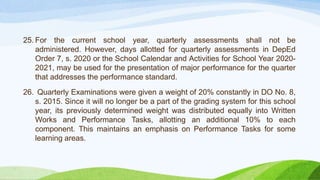
c. A variety of assessment strategies is necessary, with formative
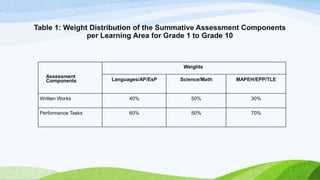
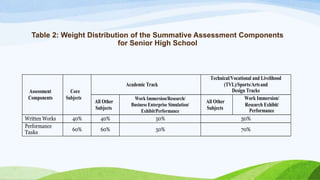
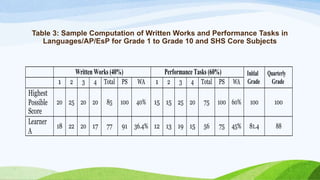
assessment taking priority to inform teaching and promote growth and
mastery;
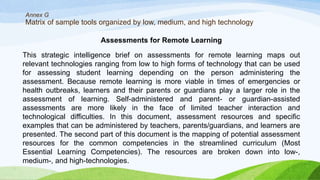
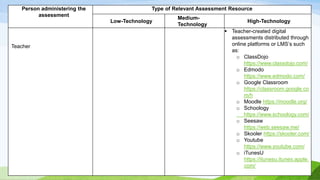
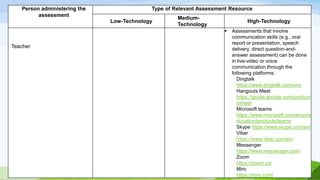
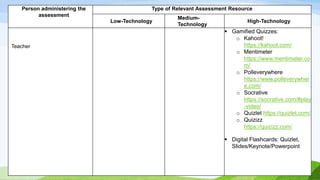
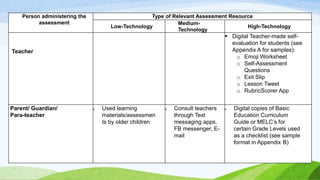
d. Assessment and feedback should be a shared responsibility among
teachers, learners, and their families; and
e. Assessment and grading should have a positive impact on learning.
5. This policy shall be implemented in all public elementary and secondary
schools nationwide for SY 2020-2021. While DO No. 8, s. 2015 titled Policy
Guidelines on Classroom Assessment for the K to 12 Basic Education
Program is still in effect, provisions inconsistent with these new guidelines are
suspended for this school year.
6. Private schools, technical and vocational institutions, and higher education
institutions, including state and local universities and colleges offering the K to 12
Basic Education Program are encouraged to implement these interim policy
guidelines as well. Private schools and institutions are permitted to modify these
policy guidelines according to their philosophy, vision, and mission, with the
approval of their respective DepEd regional office.
7. Additional information to help implement effective assessment practices that are
in line with the principles of this policy can be found in the Classroom
Assessment Resource Book (Enclosure No. 2).
8. For inquiries, please contact the Bureau of Learning Delivery, 4th Floor,
Bonifacio Building, Department of Education Central Office, DepEd
Complex, Meralco Avenue, Pasig City through email at
bld.od@deped.gov.ph or at telephone numbers (02) 8637 -4346 and (02)
8637-4347.
9. Immediate dissemination of and strict compliance with this Order is
directed.
INTERIM POLICY GUIDELINES FOR ASSESSMENT AND GRADING IN LIGHT
OF THE BASIC EDUCATION LEARNING CONTINUITY PLAN
I. Rationale
1. The continuing threat of COVID-19 in the country and the world brings about
unprecedented challenges to basic education. As schools prepare for SY 2020–
2021, teachers and parents must adapt to alternative learning modalities to ensure
that learners achieve essential curricular goals. This will require creative and
innovative ways of designing optimal learning experiences and assessing learning
progress effectively under adverse circumstances.
2. As stated in DepEd Order (DO) No. 8, s. 2015, the Policy Guidelines in Classroom
Assessment for the K to 12 Basic Education Program, assessment should be used
to inform and improve classroom practices and promote learning outcomes.
However, in distance or blended learning environments, it is necessary to utilize
alternative tools and strategies for assessing and supporting learning, while
avoiding creating undue pressure on the teachers, learners and their families.
II. Scope
3. This DepEd Order provides for the Interim Policy Guidelines for Assessment
and Grading in light of the Basic Education Learning Continuity Plan (BE-
LCP) that will be implemented by public elementary and secondary schools
nationwide this SY 2020–2021.
4. Private schools, technical and vocational institutions, and higher education
institutions including state and local universities and colleges offering the K to
12 Basic Education Program are encouraged to implement these interim policy
guidelines as well. Private schools and institutions are permitted to modify these
policy guidelines according to their Philosophy, Vision, and Mission, with the
approval of their respective DepEd Regional Office.
III. Definition of Terms
5. For the purposes of this policy, the following terms are defined as follows:
a. Classroom Assessment is an ongoing process of identifying,
gathering, organizing, and interpreting quantitative and qualitative
information about what learners know and can do.
b. Formative Assessment is a process that involves teachers using
evidence about what learners know and can do to inform and improve
their teaching. This process, through the teacher’s immediate
feedback, enables students to take responsibility for their own learning
and identify areas where they do well and where they need help.
Summative Assessment is an assessment that is usually administered
toward the end of a learning period to measure the extent to which the
learners have mastered the essential learning competencies, the results
of which are recorded and are used to report the learner’s achievement.
c. Grading is the way of reporting assessment data by assigning a value to
the results as a record of students' ability, achievement, or progress
(Association for Supervision and Curriculum Development, 2020).
IV. Policy Statement
6. The DepEd is committed to ensure educational continuity in this time of crisis while
looking after the health, safety, and well-being of all its learners, teachers, and
personnel. Schools must adopt assessment and grading practices that can most
meaningfully support student development and respond to varied contexts at this
time.
7. This policy is grounded on the following principles:
a. Assessment should be holistic and authentic in capturing the attainment of most
essential learning competencies;
b. Assessment is integral for understanding student learning and development;
c. A variety of assessment strategies is necessary, with formative assessment
taking priority to inform teaching and promote growth and mastery;
d. Assessment and feedback should be a shared responsibility among teachers,
learners, and their families; and
e. Assessment and grading should have a positive impact on learning.
8. Teachers, school leaders, learners, and parents must commit to uphold the integrity
of learning and instruction in the context of distance education. The main desired
outcomes of this policy are:
a. To ensure that all learners are fairly assessed and graded in the continuation of
education during this health crisis; and
b. To emphasize that learning standards shall be attained, with the provision of
reasonable leniency and considerations for possible difficulties met by the
learner.
V. Procedures
9. Distance learning poses challenges for teachers and learners in the conduct of
assessment, including limitations on giving immediate feedback, and the need to
account for different contexts in designing, implementing, and grading assessment
tasks.
10. To address these challenges, learners, teachers, and parents/guardians
each have significant roles and responsibilities:
a. Teachers. For this school year, particular focus will be given to the
following:
i. Designing the assessment to allow for flexibility in multiple
modalities;
ii. Communicating to learners and parents/guardians the design and
standards for grading the assessment;
iii. Setting up mechanisms to monitor and record progress remotely;
iv. Giving timely, constructive, and relevant feedback; and
v. Facilitating remediation for learners who need further guidance.
b. Learners. Learners are expected to be proactive in updating their teacher of their
situation, progress and challenges encountered. A non-mandatory Self-Monitoring
Tool (see Annex E) may be accomplished independently or with the assistance of
their parent/guardian, if necessary. It is NOT required to accomplish the self-
monitoring tool, but its usage is highly recommended to keep track of learners’
academic progress.
c. Parents and guardians. DepEd aims to develop independent learners who can
study and work on the assessments on their own. However, in this school year’s
implementation of distance learning modalities, parents and guardians will play a
crucial role in guiding their children in adapting to the changes of distance learning
processes.
Thus, only when necessary, parents/guardians are requested to assist in the
assessment process by:
i. Communicating with the teacher to give updates on their child’s situation,
progress, and challenges encountered; and
ii. Guiding their children in accomplishing the assessment tasks and/or
monitoring tools designed by their teacher.
Mary Grace V. Gallana
Education Program Supervisor
A. Planning the Assessment
11. Teachers need to be creative and flexible in assessing student learning, while still
adhering to the principles of quality assessment practice. With safety, health, and
well-being foremost in mind, assessment decisions must be made in the best
interest of all learners, ensuring that all assessment activities:
a. align with the most essential learning competencies;
b. are reliable, valid and transparent;
c. are fair, inclusive and equitable;
d. are practical and manageable for both learners and teachers;
e. give learners a range of ways to demonstrate their learning; and
f. provide timely and accurate information as basis for feedback.
12. In distance learning modalities, teachers shall design assessments bearing the
assumption that the learners will asynchronously take them and have open access
to various sources.
13. When deciding on which assessment methods to use, it is important to consider
the following questions:
a. What is the purpose of the assessment?
b. What will be assessed?
c. Which method would best allow learners to demonstrate what they have
learned, considering their learning modality?
d. Which method would make it easy to gather evidence of learners’ progress
over time?
e. Will the assessment be completed individually or in groups?
f. Will the assessment be taken at the same time or submitted within a specific
period?
g. How will class size affect the way the assessment will be conducted?
h. How can technology help?
14. In order to inform teaching and promote growth and mastery, formative
assessment strategies should:
a. establish clear learning targets and success criteria;
b. elicit useful evidence of learning;
c. provide timely and effective feedback;
d. engage learners in assessing and improving each other’s work; and
e. increase ownership of their own learning (adapted from Wiliam & Leahy, 2015).
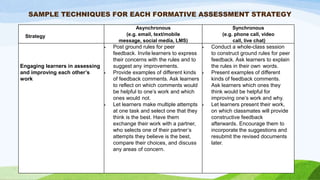
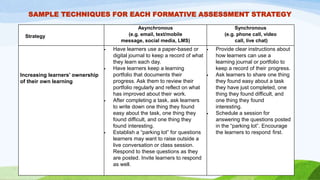
Annex A provides a matrix of sample techniques for each formative assessment
strategy. Teachers are highly encouraged to adapt these techniques where
appropriate, and to explore other alternatives that are feasible in their respective
contexts.
15. Formative assessment is about getting better, so it should be specific, frequent, repetitive,
and free from the restrictions of grading (Christodolou, 2016). It should target skills that are
necessary to the attainment of learning competencies as measured in summative
assessments.
16. To evaluate student learning at particular points in each quarter, summative assessments
shall continue in the form of written works and performance tasks.
a. Written works shall be administered to assess essential knowledge and understandings
through quizzes and long/unit tests. Items should be distributed across the Cognitive
Process Dimensions (DepEd, 2015, p. 4) using a combination of selected-response and
constructed- response formats so that all are adequately covered.
b. Performance tasks refer to assessment tasks that “allow learners to show what they
know and are able to do in diverse ways. They may create or innovate products or do
performance-based tasks [including] skill demonstrations, group presentations, oral
work, multimedia presentations, and research projects. It is important to note that
written outputs may also be considered as performance tasks” (DepEd, 2015, pp. 7–
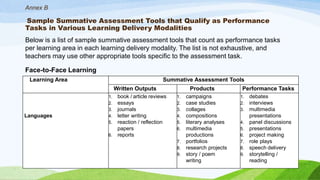
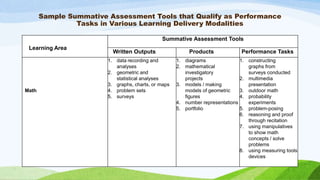
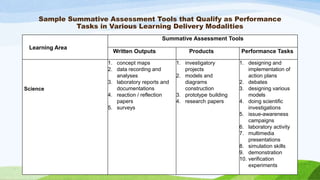
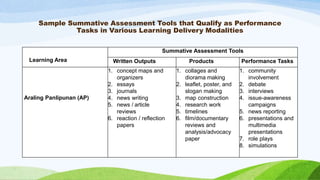
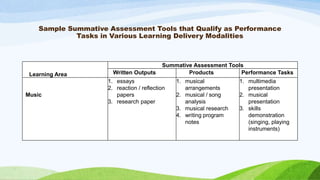
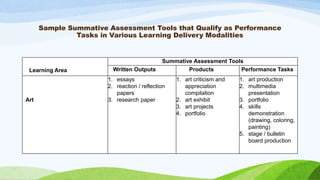
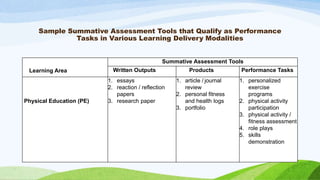
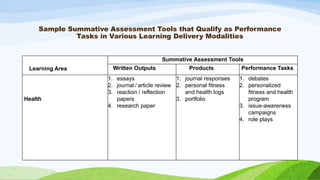
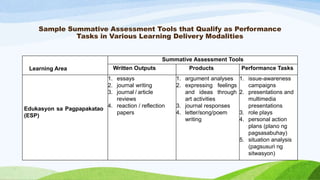
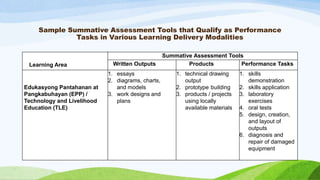
8). Annex B provides a list of sample summative assessments that fall under performance
task for the purpose of this policy.
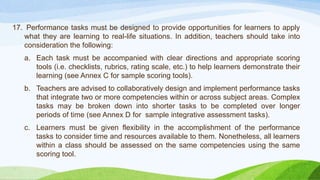
17. Performance tasks must be designed to provide opportunities for learners to apply
what they are learning to real-life situations. In addition, teachers should take into
consideration the following:
a. Each task must be accompanied with clear directions and appropriate scoring
tools (i.e. checklists, rubrics, rating scale, etc.) to help learners demonstrate their
learning (see Annex C for sample scoring tools).
b. Teachers are advised to collaboratively design and implement performance tasks
that integrate two or more competencies within or across subject areas. Complex
tasks may be broken down into shorter tasks to be completed over longer
periods of time (see Annex D for sample integrative assessment tasks).
c. Learners must be given flexibility in the accomplishment of the performance
tasks to consider time and resources available to them. Nonetheless, all learners
within a class should be assessed on the same competencies using the same
scoring tool.
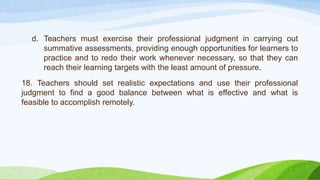
d. Teachers must exercise their professional judgment in carrying out
summative assessments, providing enough opportunities for learners to
practice and to redo their work whenever necessary, so that they can
reach their learning targets with the least amount of pressure.
18. Teachers should set realistic expectations and use their professional
judgment to find a good balance between what is effective and what is
feasible to accomplish remotely.
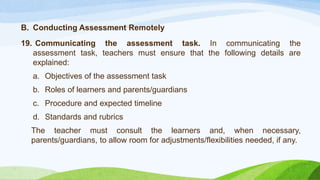
B. Conducting Assessment Remotely
19. Communicating the assessment task. In communicating the
assessment task, teachers must ensure that the following details are
explained:
a. Objectives of the assessment task
b. Roles of learners and parents/guardians
c. Procedure and expected timeline
d. Standards and rubrics
The teacher must consult the learners and, when necessary,
parents/guardians, to allow room for adjustments/flexibilities needed, if any.
B. Conducting Assessment Remotely
20.Record of progress. The collection and recording of evidences of learning
is integral for monitoring student learning and development. Listed below are
some sample strategies for this purpose:
a. Self-Monitoring Tool (see Annex E; consider the needs of learners per
key stage, e.g. early grades need assistance from parents, while older
learners are expected to accomplish self-reflection tools on their own.)
b. Check-ins of teacher with learner (during assessment period)
c. Evidence of learning in the student's learning portfolio
Lindo M. Cayadong
Education Program Supervisor (Math and Science)
C. Feedback and Remediation
21. To benefit student learning, both formative and summative assessment must
be accompanied with timely, constructive, and meaningful feedback based on
the learner’s record of progress. In giving feedback, teachers need to
maximize available communication options (e.g. writing feedback on the
output, texting feedback via SMS, and using online channels, among others).
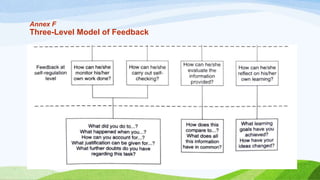
Annex F provides a guide to help frame decisions on appropriate feedback to
learners.
22. Consistent with DO No. 8, s. 2015, “teachers should ensure that learners
receive remediation when they earn raw scores which are consistently below
expectation” in summative assessments “by the fifth week of any quarter. This
will prevent a student from failing in any learning area at the end of the year.”
D. Grading and Promotion
23.The challenges brought to light by the coronavirus pandemic, specifically
the implementation of different distance learning delivery modalities, have
sparked a larger conversation about the role grades play in student
learning, prompting education sectors to rethink traditional grading
schemes. The grading system implemented in this interim policy provides
reasonable leniency to learners who are put to a larger disadvantage by the
pandemic, but at the same does not compromise the integrity and
principles of assessment and grading.
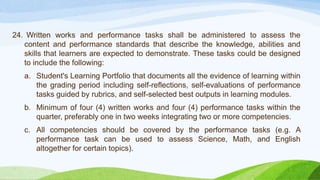
24. Written works and performance tasks shall be administered to assess the
content and performance standards that describe the knowledge, abilities and
skills that learners are expected to demonstrate. These tasks could be designed
to include the following:
a. Student's Learning Portfolio that documents all the evidence of learning within
the grading period including self-reflections, self-evaluations of performance
tasks guided by rubrics, and self-selected best outputs in learning modules.
b. Minimum of four (4) written works and four (4) performance tasks within the
quarter, preferably one in two weeks integrating two or more competencies.
c. All competencies should be covered by the performance tasks (e.g. A
performance task can be used to assess Science, Math, and English
altogether for certain topics).
25. For the current school year, quarterly assessments shall not be
administered. However, days allotted for quarterly assessments in DepEd
Order 7, s. 2020 or the School Calendar and Activities for School Year 2020-
2021, may be used for the presentation of major performance for the quarter
that addresses the performance standard.
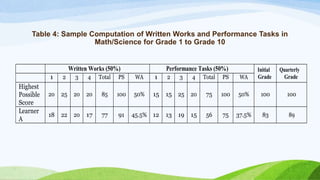
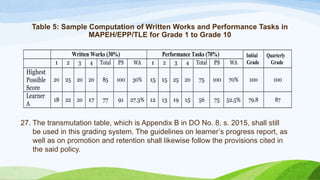
26. Quarterly Examinations were given a weight of 20% constantly in DO No. 8,
s. 2015. Since it will no longer be a part of the grading system for this school
year, its previously determined weight was distributed equally into Written
Works and Performance Tasks, allotting an additional 10% to each
component. This maintains an emphasis on Performance Tasks for some
learning areas.
Table 1: Weight Distribution of the Summative Assessment Components
per Learning Area for Grade 1 to Grade 10
Assessment
Components
Weights
Languages/AP/EsP Science/Math MAPEH/EPP/TLE
Written Works 40% 50% 30%
Performance Tasks 60% 50% 70%
Table 2: Weight Distribution of the Summative Assessment Components
for Senior High School
Assessment
Components
Core
Subjects
Academic Track
Technical/Vocational and Livelihood
(TVL)/Sports/Artsand
Design Tracks
All Other
Subjects
Work Immersion/Research/
Business Enterprise Simulation/
Exhibit/Performance
All Other
Subjects
Work Immersion/
Research Exhibit/
Performance
Written Works 40% 40% 50% 30%
Performance
Tasks
60% 60% 50% 70%
Table 3: Sample Computation of Written Works and Performance Tasks in
Languages/AP/EsP for Grade 1 to Grade 10 and SHS Core Subjects
Written Works (40%) Performance Tasks (60%) Initial
Grade
Quarterly
Grade
1 2 3 4 Total PS WA 1 2 3 4 Total PS WA
Highest
Possible
Score
20 25 20 20 85 100 40% 15 15 25 20 75 100 60% 100 100
Learner
A
18 22 20 17 77 91 36.4% 12 13 19 15 56 75 45% 81.4 88
Table 4: Sample Computation of Written Works and Performance Tasks in
Math/Science for Grade 1 to Grade 10
Written Works (50%) Performance Tasks (50%) Initial
Grade
Quarterly
Grade
1 2 3 4 Total PS WA 1 2 3 4 Total PS WA
Highest
Possible
Score
20 25 20 20 85 100 50% 15 15 25 20 75 100 50% 100 100
Learner
A
18 22 20 17 77 91 45.5% 12 13 19 15 56 75 37.5% 83 89
Table 5: Sample Computation of Written Works and Performance Tasks in
MAPEH/EPP/TLE for Grade 1 to Grade 10
27. The transmutation table, which is Appendix B in DO No. 8, s. 2015, shall still
be used in this grading system. The guidelines on learner’s progress report, as
well as on promotion and retention shall likewise follow the provisions cited in
the said policy.
Written Works (30%) Performance Tasks (70%) Initial
Grade
Quarterly
Grade
1 2 3 4 Total PS WA 1 2 3 4 Total PS WA
Highest
Possible
Score
20 25 20 20 85 100 30% 15 15 25 20 75 100 70% 100 100
Learner
A
18 22 20 17 77 91 27.3% 12 13 19 15 56 75 52.5% 79.8 87
E. Role of Technology
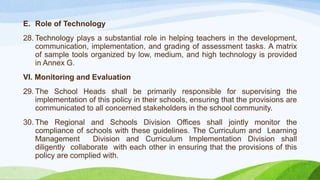
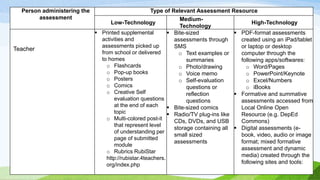
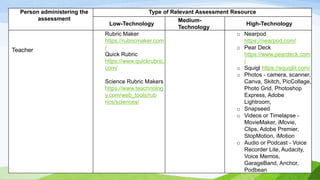
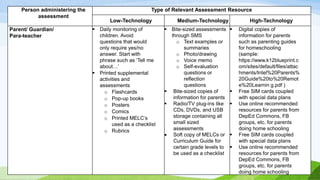
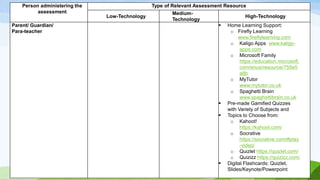
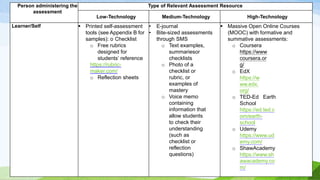
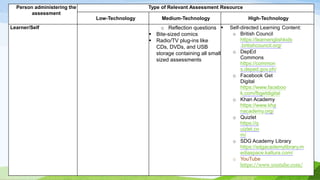
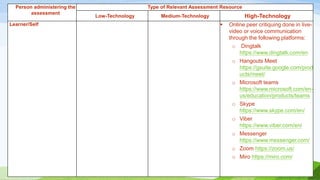
28. Technology plays a substantial role in helping teachers in the development,
communication, implementation, and grading of assessment tasks. A matrix
of sample tools organized by low, medium, and high technology is provided
in Annex G.
VI. Monitoring and Evaluation
29. The School Heads shall be primarily responsible for supervising the
implementation of this policy in their schools, ensuring that the provisions are
communicated to all concerned stakeholders in the school community.
30. The Regional and Schools Division Offices shall jointly monitor the
compliance of schools with these guidelines. The Curriculum and Learning
Management Division and Curriculum Implementation Division shall
diligently collaborate with each other in ensuring that the provisions of this
policy are complied with.
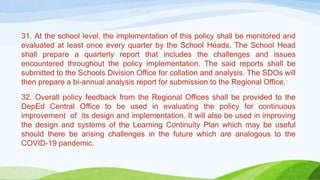
31. At the school level, the implementation of this policy shall be monitored and
evaluated at least once every quarter by the School Heads. The School Head
shall prepare a quarterly report that includes the challenges and issues
encountered throughout the policy implementation. The said reports shall be
submitted to the Schools Division Office for collation and analysis. The SDOs will
then prepare a bi-annual analysis report for submission to the Regional Office.
32. Overall policy feedback from the Regional Offices shall be provided to the
DepEd Central Office to be used in evaluating the policy for continuous
improvement of its design and implementation. It will also be used in improving
the design and systems of the Learning Continuity Plan which may be useful
should there be arising challenges in the future which are analogous to the
COVID-19 pandemic.
Ferminia M. Labis, PhD
Education Program Supervisor (Araling Panlipunan)
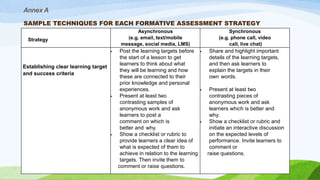
Annex A
SAMPLE TECHNIQUES FOR EACH FORMATIVE ASSESSMENT STRATEGY
Strategy
Asynchronous
(e.g. email, text/mobile
message, social media, LMS)
Synchronous
(e.g. phone call, video
call, live chat)
Establishing clear learning target
and success criteria
 Post the learning targets before
the start of a lesson to get
learners to think about what
they will be learning and how
these are connected to their
prior knowledge and personal
experiences.
 Present at least two
contrasting samples of
anonymous work and ask
learners to post a
comment on which is
better and why.
 Show a checklist or rubric to
provide learners a clear idea of
what is expected of them to
achieve in relation to the learning
targets. Then invite them to
comment or raise questions.
 Share and highlight important
details of the learning targets,
and then ask learners to
explain the targets in their
own words.
 Present at least two
contrasting pieces of
anonymous work and ask
learners which is better and
why.
 Show a checklist or rubric and
initiate an interactive discussion
on the expected levels of
performance. Invite learners to
comment or
raise questions.
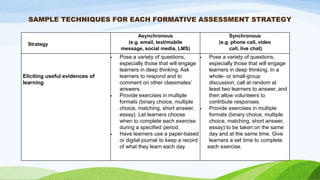
SAMPLE TECHNIQUES FOR EACH FORMATIVE ASSESSMENT STRATEGY
Strategy
Asynchronous
(e.g. email, text/mobile
message, social media, LMS)
Synchronous
(e.g. phone call, video
call, live chat)
Eliciting useful evidences of
learning
 Pose a variety of questions,
especially those that will engage
learners in deep thinking. Ask
learners to respond and to
comment on other classmates’
answers.
 Provide exercises in multiple
formats (binary choice, multiple
choice, matching, short answer,
essay). Let learners choose
when to complete each exercise
during a specified period.
 Have learners use a paper-based
or digital journal to keep a record
of what they learn each day.
 Pose a variety of questions,
especially those that will engage
learners in deep thinking. In a
whole- or small-group
discussion, call at random at
least two learners to answer, and
then allow volunteers to
contribute responses.
 Provide exercises in multiple
formats (binary choice, multiple
choice, matching, short answer,
essay) to be taken on the same
day and at the same time. Give
learners a set time to complete
each exercise.
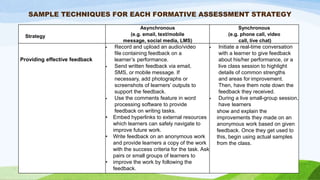
SAMPLE TECHNIQUES FOR EACH FORMATIVE ASSESSMENT STRATEGY
Strategy
Asynchronous
(e.g. email, text/mobile
message, social media, LMS)
Synchronous
(e.g. phone call, video
call, live chat)
Providing effective feedback
 Record and upload an audio/video
file containing feedback on a
learner’s performance.
 Send written feedback via email,
SMS, or mobile message. If
necessary, add photographs or
screenshots of learners’ outputs to
support the feedback.
 Use the comments feature in word
processing software to provide
feedback on writing tasks.
• Embed hyperlinks to external resources
which learners can safely navigate to
improve future work.
• Write feedback on an anonymous work
and provide learners a copy of the work
with the success criteria for the task. Ask
pairs or small groups of learners to
• improve the work by following the
feedback.
 Initiate a real-time conversation
with a learner to give feedback
about his/her performance, or a
live class session to highlight
details of common strengths
and areas for improvement.
Then, have them note down the
feedback they received.
 During a live small-group session,
have learners
show and explain the
improvements they made on an
anonymous work based on given
feedback. Once they get used to
this, begin using actual samples
from the class.
SAMPLE TECHNIQUES FOR EACH FORMATIVE ASSESSMENT STRATEGY
Strategy
Asynchronous
(e.g. email, text/mobile
message, social media, LMS)
Synchronous
(e.g. phone call, video
call, live chat)
Engaging learners in assessing
and improving each other’s
work
 Post ground rules for peer
feedback. Invite learners to express
their concerns with the rules and to
suggest any improvements.
 Provide examples of different kinds
of feedback comments. Ask learners
to reflect on which comments would
be helpful to one’s work and which
ones would not.
 Let learners make multiple attempts
at one task and select one that they
think is the best. Have them
exchange their work with a partner,
who selects one of their partner’s
attempts they believe is the best,
compare their choices, and discuss
any areas of concern.
 Conduct a whole-class session
to construct ground rules for peer
feedback. Ask learners to explain
the rules in their own words.
 Present examples of different
kinds of feedback comments.
Ask learners which ones they
think would be helpful for
improving one’s work and why.
 Let learners present their work,
on which classmates will provide
constructive feedback
afterwards. Encourage them to
incorporate the suggestions and
resubmit the revised documents
later.
SAMPLE TECHNIQUES FOR EACH FORMATIVE ASSESSMENT STRATEGY
Strategy
Asynchronous
(e.g. email, text/mobile
message, social media, LMS)
Synchronous
(e.g. phone call, video
call, live chat)
Increasing learners’ ownership
of their own learning
 Have learners use a paper-based or
digital journal to keep a record of what
they learn each day.
 Have learners keep a learning
portfolio that documents their
progress. Ask them to review their
portfolio regularly and reflect on what
has improved about their work.
 After completing a task, ask learners
to write down one thing they found
easy about the task, one thing they
found difficult, and one thing they
found interesting.
 Establish a “parking lot” for questions
learners may want to raise outside a
live conversation or class session.
Respond to these questions as they
are posted. Invite learners to respond
as well.
 Provide clear instructions about
how learners can use a
learning journal or portfolio to
keep a record of their progress.
 Ask learners to share one thing
they found easy about a task
they have just completed, one
thing they found difficult, and
one thing they found
interesting.
 Schedule a session for
answering the questions posted
in the “parking lot”. Encourage
the learners to respond first.
Maria Teresa M. Absin, PhD
Chief Education Supervisor (SGOD)
Annex B
Sample Summative Assessment Tools that Qualify as Performance
Tasks in Various Learning Delivery Modalities
Below is a list of sample summative assessment tools that count as performance tasks
per learning area in each learning delivery modality. The list is not exhaustive, and
teachers may use other appropriate tools specific to the assessment task.
Face-to-Face Learning
Learning Area Summative Assessment Tools
Written Outputs Products Performance Tasks
Languages
1. book / article reviews
2. essays
3. journals
4. letter writing
5. reaction / reflection
papers
6. reports
1. campaigns
2. case studies
3. collages
4. compositions
5. literary analyses
6. multimedia
productions
7. portfolios
8. research projects
9. story / poem
writing
1. debates
2. interviews
3. multimedia
presentations
4. panel discussions
5. presentations
6. project making
7. role plays
8. speech delivery
9. storytelling /
reading
Sample Summative Assessment Tools that Qualify as Performance
Tasks in Various Learning Delivery Modalities
Learning Area
Summative Assessment Tools
Written Outputs Products Performance Tasks
Math
1. data recording and
analyses
2. geometric and
statistical analyses
3. graphs, charts, or maps
4. problem sets
5. surveys
1. diagrams
2. mathematical
investigatory
projects
3. models / making
models of geometric
figures
4. number representations
5. portfolio
1. constructing
graphs from
surveys conducted
2. multimedia
presentation
3. outdoor math
4. probability
experiments
5. problem-posing
6. reasoning and proof
through recitation
7. using manipulatives
to show math
concepts / solve
problems
8. using measuring tools
devices
Sample Summative Assessment Tools that Qualify as Performance
Tasks in Various Learning Delivery Modalities
Learning Area
Summative Assessment Tools
Written Outputs Products Performance Tasks
Science
1. concept maps
2. data recording and
analyses
3. laboratory reports and
documentations
4. reaction / reflection
papers
5. surveys
1. investigatory
projects
2. models and
diagrams
construction
3. prototype building
4. research papers
1. designing and
implementation of
action plans
2. debates
3. designing various
models
4. doing scientific
investigations
5. issue-awareness
campaigns
6. laboratory activity
7. multimedia
presentations
8. simulation skills
9. demonstration
10. verification
experiments
Sample Summative Assessment Tools that Qualify as Performance
Tasks in Various Learning Delivery Modalities
Learning Area
Summative Assessment Tools
Written Outputs Products Performance Tasks
Araling Panlipunan (AP)
1. concept maps and
organizers
2. essays
3. journals
4. news writing
5. news / article
reviews
6. reaction / reflection
papers
1. collages and
diorama making
2. leaflet, poster, and
slogan making
3. map construction
4. research work
5. timelines
6. film/documentary
reviews and
analysis/advocacy
paper
1. community
involvement
2. debate
3. interviews
4. issue-awareness
campaigns
5. news reporting
6. presentations and
multimedia
presentations
7. role plays
8. simulations
Sample Summative Assessment Tools that Qualify as Performance
Tasks in Various Learning Delivery Modalities
Learning Area
Summative Assessment Tools
Written Outputs Products Performance Tasks
Music
1. essays
2. reaction / reflection
papers
3. research paper
1. musical
arrangements
2. musical / song
analysis
3. musical research
4. writing program
notes
1. multimedia
presentation
2. musical
presentation
3. skills
demonstration
(singing, playing
instruments)
Sample Summative Assessment Tools that Qualify as Performance
Tasks in Various Learning Delivery Modalities
Learning Area
Summative Assessment Tools
Written Outputs Products Performance Tasks
Art
1. essays
2. reaction / reflection
papers
3. research paper
1. art criticism and
appreciation
compilation
2. art exhibit
3. art projects
4. portfolio
1. art production
2. multimedia
presentation
3. portfolio
4. skills
demonstration
(drawing, coloring,
painting)
5. stage / bulletin
board production
Sample Summative Assessment Tools that Qualify as Performance
Tasks in Various Learning Delivery Modalities
Learning Area
Summative Assessment Tools
Written Outputs Products Performance Tasks
Physical Education (PE)
1. essays
2. reaction / reflection
papers
3. research paper
1. article / journal
review
2. personal fitness
and health logs
3. portfolio
1. personalized
exercise
programs
2. physical activity
participation
3. physical activity /
fitness assessment
4. role plays
5. skills
demonstration
Sample Summative Assessment Tools that Qualify as Performance
Tasks in Various Learning Delivery Modalities
Learning Area
Summative Assessment Tools
Written Outputs Products Performance Tasks
Health
1. essays
2. journal / article review
3. reaction / reflection
papers
4. research paper
1. journal responses
2. personal fitness
and health logs
3. portfolio
1. debates
2. personalized
fitness and health
program
3. issue-awareness
campaigns
4. role plays
Sample Summative Assessment Tools that Qualify as Performance
Tasks in Various Learning Delivery Modalities
Learning Area
Summative Assessment Tools
Written Outputs Products Performance Tasks
Edukasyon sa Pagpapakatao
(ESP)
1. essays
2. journal writing
3. journal / article
reviews
4. reaction / reflection
papers
1. argument analyses
2. expressing feelings
and ideas through
art activities
3. journal responses
4. letter/song/poem
writing
1. issue-awareness
campaigns
2. presentations and
multimedia
presentations
3. role plays
4. personal action
plans (plano ng
pagsasabuhay)
5. situation analysis
(pagsusuri ng
sitwasyon)
Sample Summative Assessment Tools that Qualify as Performance
Tasks in Various Learning Delivery Modalities
Learning Area
Summative Assessment Tools
Written Outputs Products Performance Tasks
Edukasyong Pantahanan at
Pangkabuhayan (EPP) /
Technology and Livelihood
Education (TLE)
1. essays
2. diagrams, charts,
and models
3. work designs and
plans
1. technical drawing
output
2. prototype building
3. products / projects
using locally
available materials
1. skills
demonstration
2. skills application
3. laboratory
exercises
4. oral tests
5. design, creation,
and layout of
outputs
6. diagnosis and
repair of damaged
equipment
Sample Summative Assessment Tools that Qualify as Performance
Tasks in Various Learning Delivery Modalities
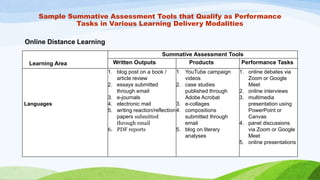
Online Distance Learning
Learning Area
Summative Assessment Tools
Written Outputs Products Performance Tasks
Languages
1. blog post on a book /
article review
2. essays submitted
through email
3. e-journals
4. electronic mail
5. writing reaction/reflection
papers submitted
through email
6. PDF reports
1. YouTube campaign
videos
2. case studies
published through
Adobe Acrobat
3. e-collages
4. compositions
submitted through
email
5. blog on literary
analyses
1. online debates via
Zoom or Google
Meet
2. online interviews
3. multimedia
presentation using
PowerPoint or
Canvas
4. panel discussions
via Zoom or Google
Meet
5. online presentations
Sally S. Aguilar
Education Program Supervisor (Filipino)
Sample Summative Assessment Tools that Qualify as Performance
Tasks in Various Learning Delivery Modalities
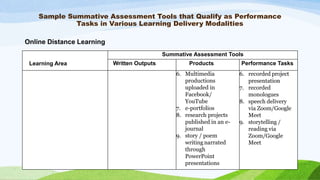
Online Distance Learning
Learning Area
Summative Assessment Tools
Written Outputs Products Performance Tasks
6. Multimedia
productions
uploaded in
Facebook/
YouTube
7. e-portfolios
8. research projects
published in an e-
journal
9. story / poem
writing narrated
through
PowerPoint
presentations
6. recorded project
presentation
7. recorded
monologues
8. speech delivery
via Zoom/Google
Meet
9. storytelling /
reading via
Zoom/Google
Meet
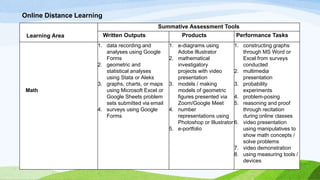
Online Distance Learning
Learning Area
Summative Assessment Tools
Written Outputs Products Performance Tasks
Math
1. data recording and
analyses using Google
Forms
2. geometric and
statistical analyses
using Stata or Aleks
3. graphs, charts, or maps
using Microsoft Excel or
Google Sheets problem
sets submitted via email
4. surveys using Google
Forms
1. e-diagrams using
Adobe Illustrator
2. mathematical
investigatory
projects with video
presentation
3. models / making
models of geometric
figures presented via
Zoom/Google Meet
4. number
representations using
Photoshop or Illustrator
5. e-portfolio
1. constructing graphs
through MS Word or
Excel from surveys
conducted
2. multimedia
presentation
3. probability
experiments
4. problem-posing
5. reasoning and proof
through recitation
during online classes
6. video presentation
using manipulatives to
show math concepts /
solve problems
7. video demonstration
8. using measuring tools /
devices
Online Distance Learning
Learning Area
Summative Assessment Tools
Written Outputs Products Performance Tasks
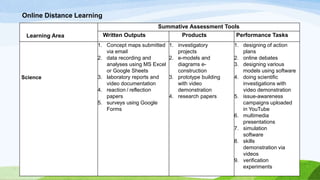
Science
1. Concept maps submitted
via email
2. data recording and
analyses using MS Excel
or Google Sheets
3. laboratory reports and
video documentation
4. reaction / reflection
papers
5. surveys using Google
Forms
1. investigatory
projects
2. e-models and
diagrams e-
construction
3. prototype building
with video
demonstration
4. research papers
1. designing of action
plans
2. online debates
3. designing various
models using software
4. doing scientific
investigations with
video demonstration
5. issue-awareness
campaigns uploaded
in YouTube
6. multimedia
presentations
7. simulation
software
8. skills
demonstration via
videos
9. verification
experiments
Online Distance Learning
Learning Area
Summative Assessment Tools
Written Outputs Products Performance Tasks
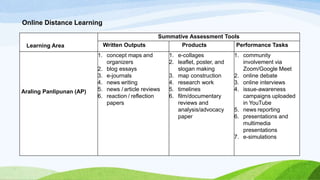
Araling Panlipunan (AP)
1. concept maps and
organizers
2. blog essays
3. e-journals
4. news writing
5. news / article reviews
6. reaction / reflection
papers
1. e-collages
2. leaflet, poster, and
slogan making
3. map construction
4. research work
5. timelines
6. film/documentary
reviews and
analysis/advocacy
paper
1. community
involvement via
Zoom/Google Meet
2. online debate
3. online interviews
4. issue-awareness
campaigns uploaded
in YouTube
5. news reporting
6. presentations and
multimedia
presentations
7. e-simulations
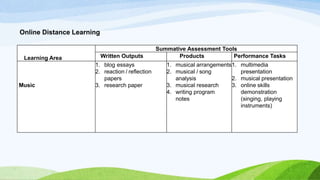
Online Distance Learning
Learning Area
Summative Assessment Tools
Written Outputs Products Performance Tasks
Music
1. blog essays
2. reaction / reflection
papers
3. research paper
1. musical arrangements
2. musical / song
analysis
3. musical research
4. writing program
notes
1. multimedia
presentation
2. musical presentation
3. online skills
demonstration
(singing, playing
instruments)
Online Distance Learning
Learning Area
Summative Assessment Tools
Written Outputs Products Performance Tasks
Art
1. blog essays
2. reaction / reflection
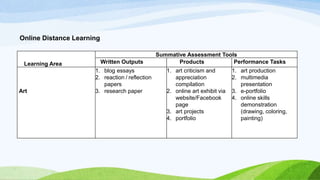
papers
3. research paper
1. art criticism and
appreciation
compilation
2. online art exhibit via
website/Facebook
page
3. art projects
4. portfolio
1. art production
2. multimedia
presentation
3. e-portfolio
4. online skills
demonstration
(drawing, coloring,
painting)
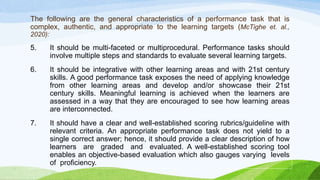
Online Distance Learning
Learning Area
Summative Assessment Tools
Written Outputs Products Performance Tasks
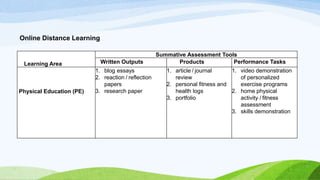
Physical Education (PE)
1. blog essays
2. reaction / reflection
papers
3. research paper
1. article / journal
review
2. personal fitness and
health logs
3. portfolio
1. video demonstration
of personalized
exercise programs
2. home physical
activity / fitness
assessment
3. skills demonstration
Online Distance Learning
Learning Area
Summative Assessment Tools
Written Outputs Products Performance Tasks
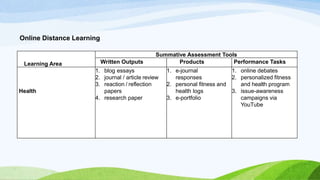
Health
1. blog essays
2. journal / article review
3. reaction / reflection
papers
4. research paper
1. e-journal
responses
2. personal fitness and
health logs
3. e-portfolio
1. online debates
2. personalized fitness
and health program
3. issue-awareness
campaigns via
YouTube
Online Distance Learning
Learning Area
Summative Assessment Tools
Written Outputs Products Performance Tasks
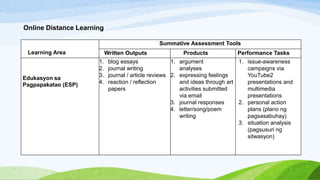
Edukasyon sa
Pagpapakatao (ESP)
1. blog essays
2. journal writing
3. journal / article reviews
4. reaction / reflection
papers
1. argument
analyses
2. expressing feelings
and ideas through art
activities submitted
via email
3. journal responses
4. letter/song/poem
writing
1. issue-awareness
campaigns via
YouTube2
presentations and
multimedia
presentations
2. personal action
plans (plano ng
pagsasabuhay)
3. situation analysis
(pagsusuri ng
sitwasyon)
Online Distance Learning
Learning Area
Summative Assessment Tools
Written Outputs Products Performance Tasks
Edukasyong Pantahanan at
Pangkabuhayan (EPP) /
Technology and Livelihood
Education (TLE)
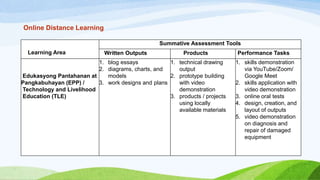
1. blog essays
2. diagrams, charts, and
models
3. work designs and plans
1. technical drawing
output
2. prototype building
with video
demonstration
3. products / projects
using locally
available materials
1. skills demonstration
via YouTube/Zoom/
Google Meet
2. skills application with
video demonstration
3. online oral tests
4. design, creation, and
layout of outputs
5. video demonstration
on diagnosis and
repair of damaged
equipment
Merly B. Mabelin
Education Program Supervisor
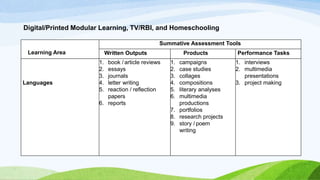
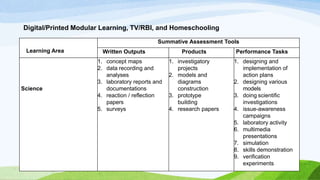
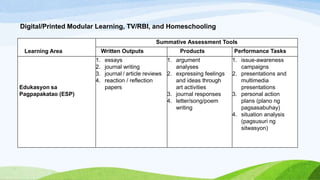
Digital/Printed Modular Learning, TV/RBI, and Homeschooling
Learning Area
Summative Assessment Tools
Written Outputs Products Performance Tasks
Languages
1. book / article reviews
2. essays
3. journals
4. letter writing
5. reaction / reflection
papers
6. reports
1. campaigns
2. case studies
3. collages
4. compositions
5. literary analyses
6. multimedia
productions
7. portfolios
8. research projects
9. story / poem
writing
1. interviews
2. multimedia
presentations
3. project making
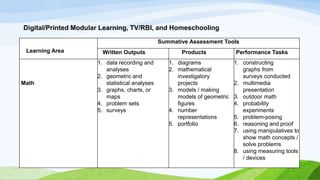
Digital/Printed Modular Learning, TV/RBI, and Homeschooling
Learning Area
Summative Assessment Tools
Written Outputs Products Performance Tasks
Math
1. data recording and
analyses
2. geometric and
statistical analyses
3. graphs, charts, or
maps
4. problem sets
5. surveys
1. diagrams
2. mathematical
investigatory
projects
3. models / making
models of geometric
figures
4. number
representations
5. portfolio
1. constructing
graphs from
surveys conducted
2. multimedia
presentation
3. outdoor math
4. probability
experiments
5. problem-posing
6. reasoning and proof
7. using manipulatives to
show math concepts /
solve problems
8. using measuring tools
/ devices
Digital/Printed Modular Learning, TV/RBI, and Homeschooling
Learning Area
Summative Assessment Tools
Written Outputs Products Performance Tasks
Science
1. concept maps
2. data recording and
analyses
3. laboratory reports and
documentations
4. reaction / reflection
papers
5. surveys
1. investigatory
projects
2. models and
diagrams
construction
3. prototype
building
4. research papers
1. designing and
implementation of
action plans
2. designing various
models
3. doing scientific
investigations
4. issue-awareness
campaigns
5. laboratory activity
6. multimedia
presentations
7. simulation
8. skills demonstration
9. verification
experiments
Digital/Printed Modular Learning, TV/RBI, and Homeschooling
Learning Area
Summative Assessment Tools
Written Outputs Products Performance Tasks
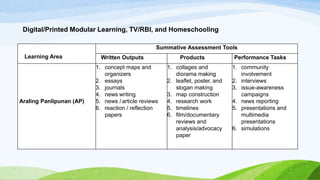
Araling Panlipunan (AP)
1. concept maps and
organizers
2. essays
3. journals
4. news writing
5. news / article reviews
6. reaction / reflection
papers
1. collages and
diorama making
2. leaflet, poster, and
slogan making
3. map construction
4. research work
5. timelines
6. film/documentary
reviews and
analysis/advocacy
paper
1. community
involvement
2. interviews
3. issue-awareness
campaigns
4. news reporting
5. presentations and
multimedia
presentations
6. simulations
Digital/Printed Modular Learning, TV/RBI, and Homeschooling
Learning Area
Summative Assessment Tools
Written Outputs Products Performance Tasks
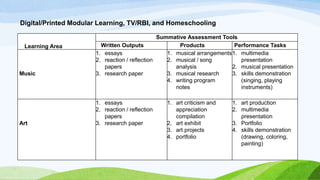
Music
1. essays
2. reaction / reflection
papers
3. research paper
1. musical arrangements
2. musical / song
analysis
3. musical research
4. writing program
notes
1. multimedia
presentation
2. musical presentation
3. skills demonstration
(singing, playing
instruments)
Art
1. essays
2. reaction / reflection
papers
3. research paper
1. art criticism and
appreciation
compilation
2. art exhibit
3. art projects
4. portfolio
1. art production
2. multimedia
presentation
3. Portfolio
4. skills demonstration
(drawing, coloring,
painting)
Digital/Printed Modular Learning, TV/RBI, and Homeschooling
Learning Area
Summative Assessment Tools
Written Outputs Products Performance Tasks
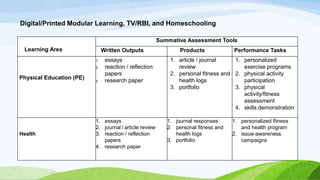
Physical Education (PE)
1. essays
2. reaction / reflection
papers
3. research paper
1. article / journal
review
2. personal fitness and
health logs
3. portfolio
1. personalized
exercise programs
2. physical activity
participation
3. physical
activity/fitness
assessment
4. skills demonstration
Health
1. essays
2. journal / article review
3. reaction / reflection
papers
4. research paper
1. journal responses
2. personal fitness and
health logs
3. portfolio
1. personalized fitness
and health program
2. issue-awareness
campaigns
Digital/Printed Modular Learning, TV/RBI, and Homeschooling
Learning Area
Summative Assessment Tools
Written Outputs Products Performance Tasks
Edukasyon sa
Pagpapakatao (ESP)
1. essays
2. journal writing
3. journal / article reviews
4. reaction / reflection
papers
1. argument
analyses
2. expressing feelings
and ideas through
art activities
3. journal responses
4. letter/song/poem
writing
1. issue-awareness
campaigns
2. presentations and
multimedia
presentations
3. personal action
plans (plano ng
pagsasabuhay)
4. situation analysis
(pagsusuri ng
sitwasyon)
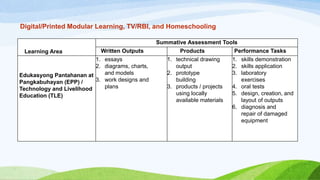
Digital/Printed Modular Learning, TV/RBI, and Homeschooling
Learning Area
Summative Assessment Tools
Written Outputs Products Performance Tasks
Edukasyong Pantahanan at
Pangkabuhayan (EPP) /
Technology and Livelihood
Education (TLE)
1. essays
2. diagrams, charts,
and models
3. work designs and
plans
1. technical drawing
output
2. prototype
building
3. products / projects
using locally
available materials
1. skills demonstration
2. skills application
3. laboratory
exercises
4. oral tests
5. design, creation, and
layout of outputs
6. diagnosis and
repair of damaged
equipment
Celieto B. Magsayo
Education Program Supervisor (LR)
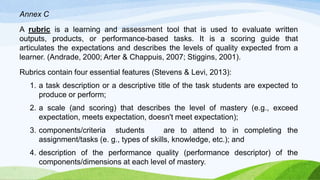
Annex C
A rubric is a learning and assessment tool that is used to evaluate written
outputs, products, or performance-based tasks. It is a scoring guide that
articulates the expectations and describes the levels of quality expected from a
learner. (Andrade, 2000; Arter & Chappuis, 2007; Stiggins, 2001).
Rubrics contain four essential features (Stevens & Levi, 2013):
1. a task description or a descriptive title of the task students are expected to
produce or perform;
2. a scale (and scoring) that describes the level of mastery (e.g., exceed
expectation, meets expectation, doesn't meet expectation);
3. components/criteria students are to attend to in completing the
assignment/tasks (e. g., types of skills, knowledge, etc.); and
4. description of the performance quality (performance descriptor) of the
components/dimensions at each level of mastery.
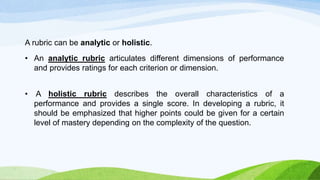
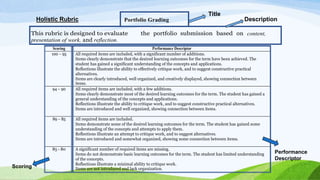
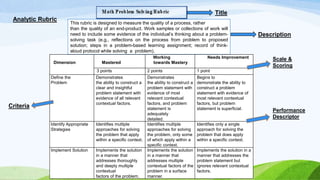
A rubric can be analytic or holistic.
• An analytic rubric articulates different dimensions of performance
and provides ratings for each criterion or dimension.
• A holistic rubric describes the overall characteristics of a
performance and provides a single score. In developing a rubric, it
should be emphasized that higher points could be given for a certain
level of mastery depending on the complexity of the question.
Portfolio Grading
This rubric is designed to evaluate
presentation of work, and reflection.
the portfolio submission based on content,
Holistic Rubric
Title
Description
Scoring Performance Descriptor
100 – 95 All required items are included, with a significant number of additions.
Items clearly demonstrate that the desired learning outcomes for the term have been achieved. The
student has gained a significant understanding of the concepts and applications.
Reflections illustrate the ability to effectively critique work, and to suggest constructive practical
alternatives.
Items are clearly introduced, well organized, and creatively displayed, showing connection between
items.
94 – 90 All required items are included, with a few additions.
Items clearly demonstrate most of the desired learning outcomes for the term. The student has gained a
general understanding of the concepts and applications.
Reflections illustrate the ability to critique work, and to suggest constructive practical alternatives.
Items are introduced and well organized, showing connection between items.
89 – 85 All required items are included.
Items demonstrate some of the desired learning outcomes for the term. The student has gained some
understanding of the concepts and attempts to apply them.
Reflections illustrate an attempt to critique work, and to suggest alternatives.
Items are introduced and somewhat organized, showing some connection between items.
85 - 80 A significant number of required items are missing.
Items do not demonstrate basic learning outcomes for the term. The student has limited understanding
of the concepts.
Reflections illustrate a minimal ability to critique work.
Items are not introduced and lack organization.
Scoring
Performance
Descriptor
This rubric is designed to measure the quality of a process, rather
than the quality of an end-product. Work samples or collections of work will
need to include some evidence of the individual’s thinking about a problem-
solving task (e.g., reflections on the process from problem to proposed
solution; steps in a problem-based learning assignment; record of think-
aloud protocol while solving a problem).
Analytic Rubric
Dimension Mastered
Working
towards Mastery
Needs Improvement
3 points 2 points 1 point
Define the
Problem
Demonstrates
the ability to construct a
clear and insightful
problem statement with
evidence of all relevant
contextual factors.
Demonstrates
the ability to construct a
problem statement with
evidence of most
relevant contextual
factors, and problem
statement is
adequately
detailed.
Begins to
demonstrate the ability to
construct a problem
statement with evidence of
most relevant contextual
factors, but problem
statement is superficial.
Identify Appropriate
Strategies
Identifies multiple
approaches for solving
the problem that apply
within a specific context.
Identifies multiple
approaches for solving
the problem, only some
of which apply within a
specific context.
Identifies only a single
approach for solving the
problem that does apply
within a specific context.
Implement Solution Implements the solution
in a manner that
addresses thoroughly
and deeply multiple
contextual
factors of the problem.
Implements the solution
in a manner that
addresses multiple
contextual factors of the
problem in a surface
manner.
Implements the solution in a
manner that addresses the
problem statement but
ignores relevant contextual
factors.
Title
Description
Scale &
Scoring
Criteria
Performance
Descriptor
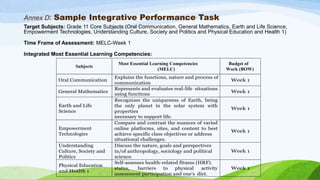
Annex D: Sample Integrative Performance Task
Target Subjects: Grade 11 Core Subjects (Oral Communication, General Mathematics, Earth and Life Science,
Empowerment Technologies, Understanding Culture, Society and Politics and Physical Education and Health 1)
Time Frame of Assessment: MELC-Week 1
Integrated Most Essential Learning Competencies:
Subjects
Most Essential Learning Competencies
(MELC)
Budget of
Work (BOW)
Oral Communication
Explains the functions, nature and process of
communication
Week 1
General Mathematics
Represents and evaluates real-life situations
using functions
Week 1
Earth and Life
Science
Recognizes the uniqueness of Earth, being
the only planet in the solar system with
properties
necessary to support life.
Week 1
Empowerment
Technologies
Compare and contrast the nuances of varied
online platforms, sites, and content to best
achieve specific class objectives or address
situational challenges.
Week 1
Understanding
Culture, Society and
Politics
Discuss the nature, goals and perspectives
in/of anthropology, sociology and political
science.
Week 1
Physical Education
and Health 1
Self-assesses health-related fitness (HRF).
status, barriers to physical activity
assessment participation and one’s diet.
Week 1
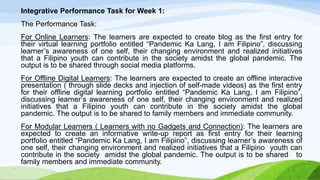
Integrative Performance Task for Week 1:
The Performance Task:
For Online Learners: The learners are expected to create blog as the first entry for
their virtual learning portfolio entitled “Pandemic Ka Lang, I am Filipino”, discussing
learner’s awareness of one self, their changing environment and realized initiatives
that a Filipino youth can contribute in the society amidst the global pandemic. The
output is to be shared through social media platforms.
For Offline Digital Learners: The learners are expected to create an offline interactive
presentation ( through slide decks and injection of self-made videos) as the first entry
for their offline digital learning portfolio entitled “Pandemic Ka Lang, I am Filipino”,
discussing learner’s awareness of one self, their changing environment and realized
initiatives that a Filipino youth can contribute in the society amidst the global
pandemic. The output is to be shared to family members and immediate community.
For Modular Learners ( Learners with no Gadgets and Connection): The learners are
expected to create an informative write-up report as first entry for their learning
portfolio entitled “Pandemic Ka Lang, I am Filipino”, discussing learner’s awareness of
one self, their changing environment and realized initiatives that a Filipino youth can
contribute in the society amidst the global pandemic. The output is to be shared to
family members and immediate community.
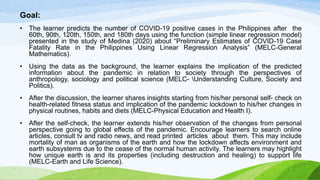
Goal:
• The learner predicts the number of COVID-19 positive cases in the Philippines after the
60th, 90th, 120th, 150th, and 180th days using the function (simple linear regression model)
presented in the study of Medina (2020) about “Preliminary Estimates of COVID-19 Case
Fatality Rate in the Philippines Using Linear Regression Analysis” (MELC-General
Mathematics).
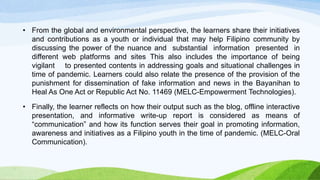
• Using the data as the background, the learner explains the implication of the predicted
information about the pandemic in relation to society through the perspectives of
anthropology, sociology and political science (MELC- Understanding Culture, Society and
Politics).
• After the discussion, the learner shares insights starting from his/her personal self- check on
health-related fitness status and implication of the pandemic lockdown to his/her changes in
physical routines, habits and diets (MELC-Physical Education and Health I).
• After the self-check, the learner extends his/her observation of the changes from personal
perspective going to global effects of the pandemic. Encourage learners to search online
articles, consult tv and radio news, and read printed articles about them. This may include
mortality of man as organisms of the earth and how the lockdown affects environment and
earth subsystems due to the cease of the normal human activity. The learners may highlight
how unique earth is and its properties (including destruction and healing) to support life
(MELC-Earth and Life Science).
• From the global and environmental perspective, the learners share their initiatives
and contributions as a youth or individual that may help Filipino community by
discussing the power of the nuance and substantial information presented in
different web platforms and sites This also includes the importance of being
vigilant to presented contents in addressing goals and situational challenges in
time of pandemic. Learners could also relate the presence of the provision of the
punishment for dissemination of fake information and news in the Bayanihan to
Heal As One Act or Republic Act No. 11469 (MELC-Empowerment Technologies).
• Finally, the learner reflects on how their output such as the blog, offline interactive
presentation, and informative write-up report is considered as means of
“communication” and how its function serves their goal in promoting information,
awareness and initiatives as a Filipino youth in the time of pandemic. (MELC-Oral
Communication).
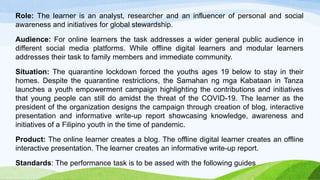
Role: The learner is an analyst, researcher and an influencer of personal and social
awareness and initiatives for global stewardship.
Audience: For online learners the task addresses a wider general public audience in
different social media platforms. While offline digital learners and modular learners
addresses their task to family members and immediate community.
Situation: The quarantine lockdown forced the youths ages 19 below to stay in their
homes. Despite the quarantine restrictions, the Samahan ng mga Kabataan in Tanza
launches a youth empowerment campaign highlighting the contributions and initiatives
that young people can still do amidst the threat of the COVID-19. The learner as the
president of the organization designs the campaign through creation of blog, interactive
presentation and informative write-up report showcasing knowledge, awareness and
initiatives of a Filipino youth in the time of pandemic.
Product: The online learner creates a blog. The offline digital learner creates an offline
interactive presentation. The learner creates an informative write-up report.
Standards: The performance task is to be assed with the following guides
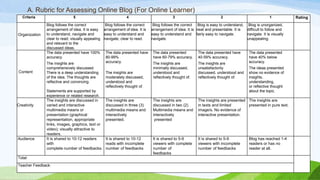
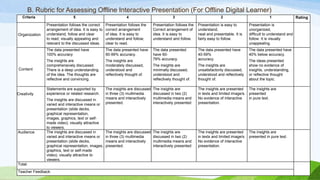
A. Rubric for Assessing Online Blog (For Online Learner)
Criteria 5 4 3 2 1 Rating
Organization
Blog follows the correct
arrangement of idea. It is easy
to understand, navigate and
clear to read; visually appealing
and relevant to the
discussed ideas.
Blog follows the correct
arrangement of idea. It is
easy to understand and
navigate; clear to read.
Blog follows the correct
arrangement of idea. It is
easy to understand and
navigate.
Blog is easy to understand,
neat and presentable. It is
fairly easy to navigate.
Blog is unorganized,
difficult to follow and
navigate. It is visually
unappealing.
Content
The data presented have 100%
accuracy.
The insights are
comprehensively discussed.
There is a deep understanding
of the idea. The thoughts are
reflective and convincing.
Statements are supported by
experience or related research.
The data presented have
80-99%
accuracy.
The insights are
moderately discussed,
understood and
reflectively thought of.
The data presented
have 60-79% accuracy.
The insights are
minimally discussed,
understood and
reflectively thought of.
The data presented have
40-59% accuracy.
The insights are
unsatisfactorily
discussed, understood and
reflectively thought of.
The data presented
have 40% below
accuracy.
The ideas presented
show no evidence of
insights,
understanding,
or reflective thought
about the topic.
Creativity
The insights are discussed in
varied and interactive
multimedia means or
presentation (graphical
representation, appropriate
links, images, graphics, text or
video); visually attractive to
readers.
The insights are
discussed in three (3)
multimedia means and
interactively
presented.
The insights are
discussed in two (2)
Multimedia means and
interactively
presented
The insights are presented
in texts and limited
image/s. No evidence of
interactive presentation.
The insights are
presented in pure text.
Audience It is shared to 10-12 readers
with
complete number of feedbacks.
It is shared to 10-12
reads with incomplete
number of feedbacks
It is shared to 5-9
viewers with complete
number of
feedbacks
It is shared to 5-9
viewers with incomplete
number of feedbacks
Blog has reached 1-4
readers or has no
reader at all.
Total:
Teacher Feedback:
B. Rubric for Assessing Offline Interactive Presentation (For Offline Digital Learner)
Criteria 5 4 3 2 1 Rating
Organization
Presentation follows the correct
arrangement of idea. It is easy to
understand, follow and clear
to read; visually appealing and
relevant to the discussed ideas.
Presentation follows the
correct arrangement
of idea. It is easy to
understand and follow;
clear to read.
Presentation follows the
Correct arrangement of
idea. It is easy to
understand and follow.
Presentation is easy to
understand,
neat and presentable. It is
fairly easy to follow.
Presentation is
unorganized,
difficult to understand and
follow. It is visually
unappealing.
Content
The data presented have
100% accuracy
The insights are
comprehensively discussed.
There is a deep understanding
of the idea. The thoughts are
reflective and convincing.
The data presented have
80-99% accuracy.
The insights are
moderately discussed,
understood and
reflectively thought of.
The data presented
have 60-
79% accuracy.
The insights are
minimally discussed,
understood and
reflectively thought of.
The data presented have
40-59%
accuracy.
The insights are
unsatisfactorily discussed,
understood and reflectively
thought of.
The data presented have
40% below accuracy.
The ideas presented
show no evidence of
insights, understanding,
or reflective thought
about the topic.
Creativity
Statements are supported by
experience or related research.
The insights are discussed in
varied and interactive means or
presentation (slide decks,
graphical representation,
images, graphics, text or self-
made video); visually attractive
to viewers.
The insights are discussed
in three (3) multimedia
means and interactively
presented.
The insights are
discussed in two (2)
multimedia means and
interactively presented
The insights are presented
in texts and limited image/s.
No evidence of interactive
presentation.
The insights are
presented
in pure text.
Audience The insights are discussed in
varied and interactive means or
presentation (slide decks,
graphical representation, images,
graphics, text or self-made
video); visually attractive to
viewers.
The insights are discussed
in three (3) multimedia
means and interactively
presented.
The insights are
discussed in two (2)
multimedia means and
interactively presented
The insights are presented
in texts and limited image/s.
No evidence of interactive
presentation.
The insights are
presented in pure text.
Total:
Teacher Feedback:
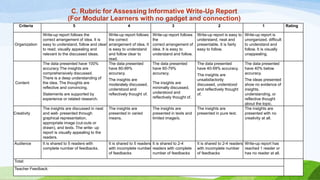
C. Rubric for Assessing Informative Write-Up Report
(For Modular Learners with no gadget and connection)
Criteria 5 4 3 2 1 Rating
Organization
Write-up report follows the
correct arrangement of idea. It is
easy to understand, follow and clear
to read; visually appealing and
relevant to the discussed ideas.
Write-up report follows
the correct
arrangement of idea. It
is easy to understand
and follow clear to
read.
Write-up report follows
the
correct arrangement of
idea. It is easy to
understand and follow.
Write-up report is easy to
understand, neat and
presentable. It is fairly
easy to follow.
Write-up report is
unorganized, difficult
to understand and
follow. It is visually
unappealing.
Content
The data presented have 100%
accuracy The insights are
comprehensively discussed.
There is a deep understanding of
the idea. The thoughts are
reflective and convincing.
Statements are supported by
experience or related research.
The data presented
have 80-99%
accuracy.
The insights are
moderately discussed,
understood and
reflectively thought of.
The data presented
have 60-79%
accuracy.
The insights are
minimally discussed,
understood and
reflectively thought of.
The data presented
have 40-59% accuracy.
The insights are
unsatisfactorily
discussed, understood
and reflectively thought
of.
The data presented
have 40% below
accuracy.
The ideas presented
show no evidence of
insights,
understanding, or
reflective thought
about the topic.
Creativity
The insights are discussed in neat
and well- presented through
graphical representation,
appropriate image (cut-outs or
drawn), and texts. The write- up
report is visually appealing to the
readers.
The insights are
presented in varied
means.
The insights are
presented in texts and
limited image/s.
The insights are
presented in pure text.
The insights are
presented with no
creativity at all.
Audience It is shared to 5 readers with
complete number of feedbacks.
It is shared to 5 readers
with incomplete number
of feedbacks
It is shared to 2-4
readers with complete
number of feedbacks
It is shared to 2-4 readers
with incomplete number
of feedbacks
Write-up report has
reached 1 reader or
has no reader at all.
Total:
Teacher Feedback:
Johnny D. Redondo
Education Program Supervisor (MAPEH)
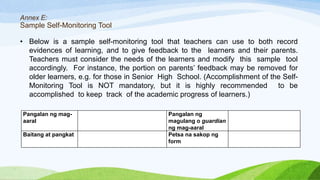
Annex E:
Sample Self-Monitoring Tool
• Below is a sample self-monitoring tool that teachers can use to both record
evidences of learning, and to give feedback to the learners and their parents.
Teachers must consider the needs of the learners and modify this sample tool
accordingly. For instance, the portion on parents’ feedback may be removed for
older learners, e.g. for those in Senior High School. (Accomplishment of the Self-
Monitoring Tool is NOT mandatory, but it is highly recommended to be
accomplished to keep track of the academic progress of learners.)
Pangalan ng mag-
aaral
Pangalan ng
magulang o guardian
ng mag-aaral
Baitang at pangkat Petsa na sakop ng
form
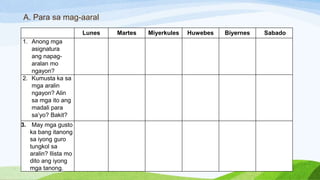
A. Para sa mag-aaral
Lunes Martes Miyerkules Huwebes Biyernes Sabado
1. Anong mga
asignatura
ang napag-
aralan mo
ngayon?
2. Kumusta ka sa
mga aralin
ngayon? Alin
sa mga ito ang
madali para
sa’yo? Bakit?
3. May mga gusto
ka bang itanong
sa iyong guro
tungkol sa
aralin? Ilista mo
dito ang iyong
mga tanong.
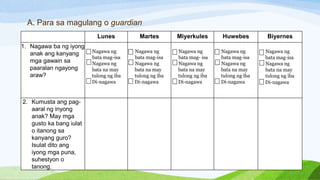
A. Para sa magulang o guardian
Lunes Martes Miyerkules Huwebes Biyernes
1. Nagawa ba ng iyong
anak ang kanyang
mga gawain sa
paaralan ngayong
araw?
Nagawa ng
bata mag-isa
Nagawa ng
bata na may
tulong ng iba
Di-nagawa
Nagawa ng
bata mag-isa
Nagawa ng
bata na may
tulong ng iba
Di-nagawa
Nagawa ng
bata mag- isa
Nagawa ng
bata na may
tulong ng iba
Di-nagawa
Nagawa ng
bata mag-isa
Nagawa ng
bata na may
tulong ng iba
Di-nagawa
Nagawa ng
bata mag-isa
Nagawa ng
bata na may
tulong ng iba
Di-nagawa
2. Kumusta ang pag-
aaral ng inyong
anak? May mga
gusto ka bang iulat
o itanong sa
kanyang guro?
Isulat dito ang
iyong mga puna,
suhestyon o
tanong.
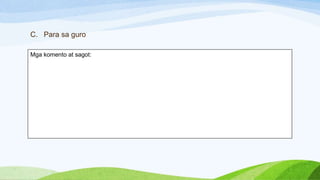
C. Para sa guro
Mga komento at sagot:
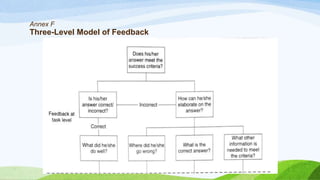
Annex F
Three-Level Model of Feedback
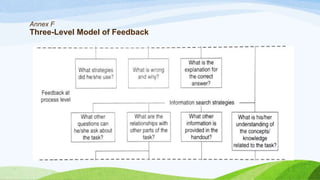
Annex F
Three-Level Model of Feedback
Annex F
Three-Level Model of Feedback
Danny A. Asio
Senior Education Program Specialist (School Mgt & M & E)
Annex G
Matrix of sample tools organized by low, medium, and high technology
Assessments for Remote Learning
This strategic intelligence brief on assessments for remote learning maps out
relevant technologies ranging from low to high forms of technology that can be used
for assessing student learning depending on the person administering the
assessment. Because remote learning is more viable in times of emergencies or
health outbreaks, learners and their parents or guardians play a larger role in the
assessment of learning. Self-administered and parent- or guardian-assisted
assessments are more likely in the face of limited teacher interaction and
technological difficulties. In this document, assessment resources and specific
examples that can be administered by teachers, parents/guardians, and learners are
presented. The second part of this document is the mapping of potential assessment
resources for the common competencies in the streamlined curriculum (Most
Essential Learning Competencies). The resources are broken down into low-,
medium-, and high-technologies.
Person administering the
assessment
Type of Relevant Assessment Resource
Low-Technology
Medium-
Technology
High-Technology
Teacher
 Printed supplemental
activities and
assessments picked up
from school or delivered
to homes
o Flashcards
o Pop-up books
o Posters
o Comics
o Creative Self
evaluation questions
at the end of each
topic
o Multi-colored post-it
that represent level
of understanding per
page of submitted
module
o Rubrics RubiStar
http://rubistar.4teachers.
org/index.php
 Bite-sized
assessments through
SMS
o Text examples or
summaries
o Photo/drawing
o Voice memo
o Self-evaluation
questions or
reflection
questions
 Bite-sized comics
 Radio/TV plug-ins like
CDs, DVDs, and USB
storage containing all
small sized
assessments
 PDF-format assessments
created using an iPad/tablet
or laptop or desktop
computer through the
following apps/softwares:
o Word/Pages
o PowerPoint/Keynote
o Excel/Numbers
o iBooks
 Formative and summative
assessments accessed from
Local Online Open
Resource (e.g. DepEd
Commons)
 Digital assessments (e-
book, video, audio or image
format; mixed formative
assessment and dynamic
media) created through the
following sites and tools:
Person administering the
assessment
Type of Relevant Assessment Resource
Low-Technology
Medium-
Technology
High-Technology
Teacher
Rubric Maker
https://rubricmaker.com
/
Quick Rubric
https://www.quickrubric.
com/
Science Rubric Makers
https://www.teachnolog
y.com/web_tools/rub
rics/sciences/
o Nearpod
https://nearpod.com/
o Pear Deck
https://www.peardeck.com
/
o Squigl https://squiglit.com/
o Photos - camera, scanner,
Canva, Skitch, PicCollage,
Photo Grid, Photoshop
Express, Adobe
Lightroom,
o Snapseed
o Videos or Timelapse -
MovieMaker, iMovie,
Clips, Adobe Premier,
StopMotion, iMotion
o Audio or Podcast - Voice
Recorder Lite, Audacity,
Voice Memos,
GarageBand, Anchor,
Podbean
Person administering the
assessment
Type of Relevant Assessment Resource
Low-Technology
Medium-
Technology
High-Technology
Teacher
 Teacher-created digital
assessments distributed through
online platforms or LMS’s such
as:
o ClassDojo
https://www.classdojo.com/
o Edmodo
https://www.edmodo.com/
o Google Classroom
https://classroom.google.co
m/h
o Moodle https://moodle.org/
o Schoology
https://www.schoology.com/
o Seesaw
https://web.seesaw.me/
o Skooler https://skooler.com/
o Youtube
https://www.youtube.com/
o iTunesU
https://itunesu.itunes.apple.
com/
Person administering the
assessment
Type of Relevant Assessment Resource
Low-Technology
Medium-
Technology
High-Technology
Teacher
 Assessments that involve
communication skills (e.g., oral
report or presentation, speech
delivery, direct question-and-
answer assessment) can be done
in live-video or voice
communication through the
following platforms:
Dingtalk
https://www.dingtalk.com/eno
Hangouts Meet
https://gsuite.google.com/product
s/meet
Microsoft teams
https://www.microsoft.com/enus/e
ducation/products/teams
Skype https://www.skype.com/en/
Viber
https://www.viber.com/en/
Messenger
https://www.messenger.com/
Zoom
https://zoom.us/
Miro
https://miro.com/
Person administering the
assessment
Type of Relevant Assessment Resource
Low-Technology
Medium-
Technology
High-Technology
Teacher
 Gamified Quizzes:
o Kahoot!
https://kahoot.com/
o Mentimeter
https://www.mentimeter.co
m/
o Polleverywhere
https://www.polleverywher
e.com/
o Socrative
https://socrative.com/#play
-video/
o Quizlet https://quizlet.com/
o Quizizz
https://quizizz.com/
 Digital Flashcards: Quizlet,
Slides/Keynote/Powerpoint
Person administering the
assessment
Type of Relevant Assessment Resource
Low-Technology
Medium-
Technology
High-Technology
Teacher
 Digital Teacher-made self-
evaluation for students (see
Appendix A for samples):
o Emoji Worksheet
o Self-Assessment
Questions
o Exit Slip
o Lesson Tweet
o RubricScorer App
Parent/ Guardian/
Para-teacher
 Used learning
materials/assessmen
ts by older children
 Consult teachers
through Text
messaging apps,
FB messenger, E-
mail
 Digital copies of Basic
Education Curriculum
Guide or MELC’s for
certain Grade Levels used
as a checklist (see sample
format in Appendix B)
Person administering the
assessment
Type of Relevant Assessment Resource
Low-Technology Medium-Technology High-Technology
Parent/ Guardian/
Para-teacher
 Daily monitoring of
children. Avoid
questions that would
only require yes/no
answer. Start with
phrase such as ‘Tell me
about…’
 Printed supplemental
activities and
assessments
o Flashcards
o Pop-up books
o Posters
o Comics
o Printed MELC’s
used as a checklist
o Rubrics
 Bite-sized assessments
through SMS
o Text examples or
summaries
o Photo/drawing
o Voice memo
o Self-evaluation
questions or
reflection
questions
 Bite-sized copies of
information for parents
 Radio/TV plug-ins like
CDs, DVDs, and USB
storage containing all
small sized
assessments
 Soft copy of MELCs or
Curriculum Guide for
certain grade levels to
be used as a checklist
 Digital copies of
information for parents
such as parenting guides
for homeschooling
(sample:
https://www.k12blueprint.c
om/sites/default/files/attac
hments/Intel%20Parents%
20Guide%20to%20Remot
e%20Learnin g.pdf )
 Free SIM cards coupled
with special data plans
 Use online recommended
resources for parents from
DepEd Commons, FB
groups, etc. for parents
doing home schooling
 Free SIM cards coupled
with special data plans
 Use online recommended
resources for parents from
DepEd Commons, FB
groups, etc. for parents
doing home schooling
Person administering the
assessment
Type of Relevant Assessment Resource
Low-Technology
Medium-
Technology
High-Technology
Parent/ Guardian/
Para-teacher
 Home Learning Support:
o Firefly Learning
www.fireflylearning.com
o Kaligo Apps www.kaligo-
apps.com
o Microsoft Family
https://education.microsoft.
com/enus/resource/755e5
a8b
o MyTutor
www.mytutor.co.uk
o Spaghetti Brain
www.spaghettibrain.co.uk
 Pre-made Gamified Quizzes
with Variety of Subjects and
 Topics to Choose from:
o Kahoot!
https://kahoot.com/
o Socrative
https://socrative.com/#play
-video/
o Quizlet https://quizlet.com/
o Quizizz https://quizizz.com/
 Digital Flashcards: Quizlet,
Slides/Keynote/Powerpoint
Person administering the
assessment
Type of Relevant Assessment Resource
Low-Technology Medium-Technology High-Technology
Learner/Self  Printed self-assessment
tools (see Appendix B for
samples): o Checklist
o Free rubrics
designed for
students’ reference
https://rubric-
maker.com/
o Reflection sheets
• E-journal
• Bite-sized assessments
through SMS
o Text examples,
summariesor
checklists
o Photo of a
checklist or
rubric, or
examples of
mastery
o Voice memo
containing
information that
allow students
to check their
understanding
(such as
checklist or
reflection
questions)
 Massive Open Online Courses
(MOOC) with formative and
summative assessments:
o Coursera
https://www
coursera.or
g/
o EdX
https://w
ww.edx.
org/
o TED-Ed Earth
School
https://ed.ted.c
om/earth-
school
o Udemy
https://www.ud
emy.com/
o ShawAcademy
https://www.sh
awacademy.co
m/
Person administering the
assessment
Type of Relevant Assessment Resource
Low-Technology Medium-Technology High-Technology
Learner/Self o Reflection questions
 Bite-sized comics
 Radio/TV plug-ins like
CDs, DVDs, and USB
storage containing all small
sized assessments
 Self-directed Learning Content:
o British Council
https://learnenglishkids
.britishcouncil.org/
o DepEd
Commons
https://common
s.deped.gov.ph/
o Facebook Get
Digital
https://www.faceboo
k.com/fbgetdigital
o Khan Academy
https://www.kha
nacademy.org/
o Quizlet
https://q
uizlet.co
m/
o SDG Academy Library
https://sdgacademylibrary.m
ediaspace.kaltura.com/
o YouTube
https://www.youtube.com/
Person administering the
assessment
Type of Relevant Assessment Resource
Low-Technology Medium-Technology High-Technology
Learner/Self  Online peer critiquing done in live-
video or voice communication
through the following platforms:
o Dingtalk
https://www.dingtalk.com/en
o Hangouts Meet
https://gsuite.google.com/prod
ucts/meet/
o Microsoft teams
https://www.microsoft.com/en-
us/education/products/teams
o Skype
https://www.skype.com/en/
o Viber
https://www.viber.com/en/
o Messenger
https://www.messenger.com/
o Zoom https://zoom.us/
o Miro https://miro.com/
Annex H
Guidelines for Teachers in Determining the Appropriate
Performance Task for a Learning Standard
• It is strongly suggested that teachers use innovative and suitable
techniques in designing and planning performance tasks. The list in
Annex B may serve as a guide in choosing or deciding what
performance task is most appropriate for a certain learning standard,
and it is recommended that teachers conceptualize and contextualize
performance tasks depending on the needs and nature of their
learners.
The following are the general characteristics of a performance task that is
complex, authentic, and appropriate to the learning targets (McTighe et. al., 2020):
1. It heeds the application of knowledge and skills, and not just recall or
recognition of a concept. A performance task should be an evidence of the
learners’ understanding and analysis of the lesson.
2. It is not limited to a single correct answer. Performance tasks should
encourage creativity and individuality among learners and should diminish
the notion that there is only one correct way of thinking or there is only one
way of solving problems.
3. It should be contextualized based on real-life problems. An authentic
performance task should mirror realistic conditions where students can
pose possible solutions.
4. It should provide proof of the learners’ understanding through transfer. An
appropriate performance task should subject the learners to a new situation
where they can apply the concepts they have learned.
The following are the general characteristics of a performance task that is
complex, authentic, and appropriate to the learning targets (McTighe et. al.,
2020):
5. It should be multi-faceted or multiprocedural. Performance tasks should
involve multiple steps and standards to evaluate several learning targets.
6. It should be integrative with other learning areas and with 21st century
skills. A good performance task exposes the need of applying knowledge
from other learning areas and develop and/or showcase their 21st
century skills. Meaningful learning is achieved when the learners are
assessed in a way that they are encouraged to see how learning areas
are interconnected.
7. It should have a clear and well-established scoring rubrics/guideline with
relevant criteria. An appropriate performance task does not yield to a
single correct answer; hence, it should provide a clear description of how
learners are graded and evaluated. A well-established scoring tool
enables an objective-based evaluation which also gauges varying levels
of proficiency.
ERLINDA G. DAEL, PhD, CESE
Chief Education Supervisor (CID)
Next Steps:
• Suggested Strategies/Scheme in Crafting
the Performance Tasks and Written Works
17. Performance tasks must be designed to provide opportunities for learners to apply
what they are learning to real-life situations. In addition, teachers should take into
consideration the following:
a. Each task must be accompanied with clear directions and appropriate scoring
tools (i.e. checklists, rubrics, rating scale, etc.) to help learners demonstrate their
learning (see Annex C for sample scoring tools).
b. Teachers are advised to collaboratively design and implement performance tasks
that integrate two or more competencies within or across subject areas. Complex
tasks may be broken down into shorter tasks to be completed over longer
periods of time (see Annex D for sample integrative assessment tasks).
c. Learners must be given flexibility in the accomplishment of the performance
tasks to consider time and resources available to them. Nonetheless, all learners
within a class should be assessed on the same competencies using the same
scoring tool.
d. Teachers must exercise their professional judgment in carrying out
summative assessments, providing enough opportunities for learners to
practice and to redo their work whenever necessary, so that they can
reach their learning targets with the least amount of pressure.
18. Teachers should set realistic expectations and use their professional
judgment to find a good balance between what is effective and what is
feasible to accomplish remotely.
B. Conducting Assessment Remotely
19. Communicating the assessment task. In communicating the
assessment task, teachers must ensure that the following details are
explained:
a. Objectives of the assessment task
b. Roles of learners and parents/guardians
c. Procedure and expected timeline
d. Standards and rubrics
The teacher must consult the learners and, when necessary,
parents/guardians, to allow room for adjustments/flexibilities needed, if any.
24. Written works and performance tasks shall be administered to assess the
content and performance standards that describe the knowledge, abilities and
skills that learners are expected to demonstrate. These tasks could be designed
to include the following:
a. Student's Learning Portfolio that documents all the evidence of learning within
the grading period including self-reflections, self-evaluations of performance
tasks guided by rubrics, and self-selected best outputs in learning modules.
b. Minimum of four (4) written works and four (4) performance tasks within the
quarter, preferably one in two weeks integrating two or more competencies.
c. All competencies should be covered by the performance tasks (e.g. A
performance task can be used to assess Science, Math, and English
altogether for certain topics).
The following are the general characteristics of a performance task that is
complex, authentic, and appropriate to the learning targets (McTighe et. al.,
2020):
5. It should be multi-faceted or multiprocedural. Performance tasks should
involve multiple steps and standards to evaluate several learning targets.
6. It should be integrative with other learning areas and with 21st century
skills. A good performance task exposes the need of applying knowledge
from other learning areas and develop and/or showcase their 21st
century skills. Meaningful learning is achieved when the learners are
assessed in a way that they are encouraged to see how learning areas
are interconnected.
7. It should have a clear and well-established scoring rubrics/guideline with
relevant criteria. An appropriate performance task does not yield to a
single correct answer; hence, it should provide a clear description of how
learners are graded and evaluated. A well-established scoring tool
enables an objective-based evaluation which also gauges varying levels
of proficiency.
Outputs: Performance Tasks and Written Works
For First Quarter to Fourth Quarter –suggestions for merging
1. Merging of Related MELCs in Crafting Performance Tasks and Written Works
2. Content-Based Instruction in Various Learning Areas or producing performance
tasks or written works integrating subject areas which means showing
interconnectedness of learning areas
3. Thematic Value-laden Lesson: all learning areas have themes which means for
each quarter, the genres shall rotate on the theme like
 Myself – first quarter
 My Family- second quarter
 My Community- third quarter
 Things Around Me- fourth quarter
 Example- English, MTB-MLE, Filipino stories are about self. For other subjects like TLE, EsP, AP,
MAPEH- genres have motivation stories about myself.
https://www.google.com/search?q=thank+you+quotation&tbm=isch&ved=2ahUKEwjk7I68hLjsAhXPxIsBHbkVAI8Q2-
cCegQIABAA&oq=Thank+you&gs_lcp=CgNpbWcQARgAMgQIABBDMgQIABBDMgcIABCxAxBDMgcIABCxAxBDMgQIABBDMgcIABCxAxBDMgUIABCxAzIFCAAQsQMyBQgAELEDMgUIABCxAzoCCAA6CAgAELEDEIMBUPT9DFiajg1gsKINaABwAHgAg
AGJAYgBhgeSAQM1LjSYAQCgAQGqAQtnd3Mtd2l6LWltZ8ABAQ&sclient=img&ei=QwGJX6S_DM-Jr7wPuauA-Ag&rlz=1C1CHZL_enPH711PH712#imgrc=hqLy2gSXVDsl1M

EDITED-WITH-FOCAL-PERSONS-INTERIM-GUIDELINES-FOR-ASSESSMENT-AND-GRADING-IN-LIGHT-.-ppt.pptx

  • 1.
    INTERIM GUIDELINES FOR ASSESSMENTAND GRADING IN LIGHT OF THE BASIC EDUCATION LEARNING CONTINUITY PLAN DepEd Order No. 031 s. 2020
  • 2.
    ERLINDA G. DAEL,PhD, CESE Chief Education Supervisor (CID)
  • 3.
    1. In itscommitment to ensure teaching and learning continuity while looking after the health, safety, and wellbeing of its learners, teachers, and personnel, the Department of Education (DepEd) issued DepEd Order No. 012, s. 2020 titled Adoption of the Basic Education Learning Continuity Plan {BE-LCP) for School Year (SY) 2020- 2021 in light of the COVID-19 Pandemic. 2. To supplement the said DO, the DepEd issues the Interim Policy Guidelines for Assessment and Grading in Light of the Basic Education Learning Continuity Plan (Enclosure No. 1) to provide guidance on the assessment of student learning and on the grading scheme to be adopted this school year. 3. As DepEd pursues learning continuity, it is imperative for schools to take stock of assessment and grading practices that will most meaningfully support learner development and respond to varied contexts at this time.
  • 4.
    4. The policyis grounded on the following principles: a. Assessment should be holistic and authentic in capturing the attainment of the most essential learning competencies; b. Assessment is integral for understanding student learning and development; c. A variety of assessment strategies is necessary, with formative assessment taking priority to inform teaching and promote growth and mastery; d. Assessment and feedback should be a shared responsibility among teachers, learners, and their families; and e. Assessment and grading should have a positive impact on learning.
  • 5.
    5. This policyshall be implemented in all public elementary and secondary schools nationwide for SY 2020-2021. While DO No. 8, s. 2015 titled Policy Guidelines on Classroom Assessment for the K to 12 Basic Education Program is still in effect, provisions inconsistent with these new guidelines are suspended for this school year. 6. Private schools, technical and vocational institutions, and higher education institutions, including state and local universities and colleges offering the K to 12 Basic Education Program are encouraged to implement these interim policy guidelines as well. Private schools and institutions are permitted to modify these policy guidelines according to their philosophy, vision, and mission, with the approval of their respective DepEd regional office. 7. Additional information to help implement effective assessment practices that are in line with the principles of this policy can be found in the Classroom Assessment Resource Book (Enclosure No. 2).
  • 6.
    8. For inquiries,please contact the Bureau of Learning Delivery, 4th Floor, Bonifacio Building, Department of Education Central Office, DepEd Complex, Meralco Avenue, Pasig City through email at bld.od@deped.gov.ph or at telephone numbers (02) 8637 -4346 and (02) 8637-4347. 9. Immediate dissemination of and strict compliance with this Order is directed.
  • 7.
    INTERIM POLICY GUIDELINESFOR ASSESSMENT AND GRADING IN LIGHT OF THE BASIC EDUCATION LEARNING CONTINUITY PLAN I. Rationale 1. The continuing threat of COVID-19 in the country and the world brings about unprecedented challenges to basic education. As schools prepare for SY 2020– 2021, teachers and parents must adapt to alternative learning modalities to ensure that learners achieve essential curricular goals. This will require creative and innovative ways of designing optimal learning experiences and assessing learning progress effectively under adverse circumstances. 2. As stated in DepEd Order (DO) No. 8, s. 2015, the Policy Guidelines in Classroom Assessment for the K to 12 Basic Education Program, assessment should be used to inform and improve classroom practices and promote learning outcomes. However, in distance or blended learning environments, it is necessary to utilize alternative tools and strategies for assessing and supporting learning, while avoiding creating undue pressure on the teachers, learners and their families.
  • 8.
    II. Scope 3. ThisDepEd Order provides for the Interim Policy Guidelines for Assessment and Grading in light of the Basic Education Learning Continuity Plan (BE- LCP) that will be implemented by public elementary and secondary schools nationwide this SY 2020–2021. 4. Private schools, technical and vocational institutions, and higher education institutions including state and local universities and colleges offering the K to 12 Basic Education Program are encouraged to implement these interim policy guidelines as well. Private schools and institutions are permitted to modify these policy guidelines according to their Philosophy, Vision, and Mission, with the approval of their respective DepEd Regional Office.
  • 9.
    III. Definition ofTerms 5. For the purposes of this policy, the following terms are defined as follows: a. Classroom Assessment is an ongoing process of identifying, gathering, organizing, and interpreting quantitative and qualitative information about what learners know and can do. b. Formative Assessment is a process that involves teachers using evidence about what learners know and can do to inform and improve their teaching. This process, through the teacher’s immediate feedback, enables students to take responsibility for their own learning and identify areas where they do well and where they need help.
  • 10.
    Summative Assessment isan assessment that is usually administered toward the end of a learning period to measure the extent to which the learners have mastered the essential learning competencies, the results of which are recorded and are used to report the learner’s achievement. c. Grading is the way of reporting assessment data by assigning a value to the results as a record of students' ability, achievement, or progress (Association for Supervision and Curriculum Development, 2020).
  • 11.
    IV. Policy Statement 6.The DepEd is committed to ensure educational continuity in this time of crisis while looking after the health, safety, and well-being of all its learners, teachers, and personnel. Schools must adopt assessment and grading practices that can most meaningfully support student development and respond to varied contexts at this time. 7. This policy is grounded on the following principles: a. Assessment should be holistic and authentic in capturing the attainment of most essential learning competencies; b. Assessment is integral for understanding student learning and development; c. A variety of assessment strategies is necessary, with formative assessment taking priority to inform teaching and promote growth and mastery; d. Assessment and feedback should be a shared responsibility among teachers, learners, and their families; and e. Assessment and grading should have a positive impact on learning.
  • 12.
    8. Teachers, schoolleaders, learners, and parents must commit to uphold the integrity of learning and instruction in the context of distance education. The main desired outcomes of this policy are: a. To ensure that all learners are fairly assessed and graded in the continuation of education during this health crisis; and b. To emphasize that learning standards shall be attained, with the provision of reasonable leniency and considerations for possible difficulties met by the learner. V. Procedures 9. Distance learning poses challenges for teachers and learners in the conduct of assessment, including limitations on giving immediate feedback, and the need to account for different contexts in designing, implementing, and grading assessment tasks.
  • 13.
    10. To addressthese challenges, learners, teachers, and parents/guardians each have significant roles and responsibilities: a. Teachers. For this school year, particular focus will be given to the following: i. Designing the assessment to allow for flexibility in multiple modalities; ii. Communicating to learners and parents/guardians the design and standards for grading the assessment; iii. Setting up mechanisms to monitor and record progress remotely; iv. Giving timely, constructive, and relevant feedback; and v. Facilitating remediation for learners who need further guidance.
  • 14.
    b. Learners. Learnersare expected to be proactive in updating their teacher of their situation, progress and challenges encountered. A non-mandatory Self-Monitoring Tool (see Annex E) may be accomplished independently or with the assistance of their parent/guardian, if necessary. It is NOT required to accomplish the self- monitoring tool, but its usage is highly recommended to keep track of learners’ academic progress. c. Parents and guardians. DepEd aims to develop independent learners who can study and work on the assessments on their own. However, in this school year’s implementation of distance learning modalities, parents and guardians will play a crucial role in guiding their children in adapting to the changes of distance learning processes. Thus, only when necessary, parents/guardians are requested to assist in the assessment process by: i. Communicating with the teacher to give updates on their child’s situation, progress, and challenges encountered; and ii. Guiding their children in accomplishing the assessment tasks and/or monitoring tools designed by their teacher.
  • 15.
    Mary Grace V.Gallana Education Program Supervisor
  • 16.
    A. Planning theAssessment 11. Teachers need to be creative and flexible in assessing student learning, while still adhering to the principles of quality assessment practice. With safety, health, and well-being foremost in mind, assessment decisions must be made in the best interest of all learners, ensuring that all assessment activities: a. align with the most essential learning competencies; b. are reliable, valid and transparent; c. are fair, inclusive and equitable; d. are practical and manageable for both learners and teachers; e. give learners a range of ways to demonstrate their learning; and f. provide timely and accurate information as basis for feedback. 12. In distance learning modalities, teachers shall design assessments bearing the assumption that the learners will asynchronously take them and have open access to various sources.
  • 17.
    13. When decidingon which assessment methods to use, it is important to consider the following questions: a. What is the purpose of the assessment? b. What will be assessed? c. Which method would best allow learners to demonstrate what they have learned, considering their learning modality? d. Which method would make it easy to gather evidence of learners’ progress over time? e. Will the assessment be completed individually or in groups? f. Will the assessment be taken at the same time or submitted within a specific period? g. How will class size affect the way the assessment will be conducted? h. How can technology help?
  • 18.
    14. In orderto inform teaching and promote growth and mastery, formative assessment strategies should: a. establish clear learning targets and success criteria; b. elicit useful evidence of learning; c. provide timely and effective feedback; d. engage learners in assessing and improving each other’s work; and e. increase ownership of their own learning (adapted from Wiliam & Leahy, 2015). Annex A provides a matrix of sample techniques for each formative assessment strategy. Teachers are highly encouraged to adapt these techniques where appropriate, and to explore other alternatives that are feasible in their respective contexts.
  • 19.
    15. Formative assessmentis about getting better, so it should be specific, frequent, repetitive, and free from the restrictions of grading (Christodolou, 2016). It should target skills that are necessary to the attainment of learning competencies as measured in summative assessments. 16. To evaluate student learning at particular points in each quarter, summative assessments shall continue in the form of written works and performance tasks. a. Written works shall be administered to assess essential knowledge and understandings through quizzes and long/unit tests. Items should be distributed across the Cognitive Process Dimensions (DepEd, 2015, p. 4) using a combination of selected-response and constructed- response formats so that all are adequately covered. b. Performance tasks refer to assessment tasks that “allow learners to show what they know and are able to do in diverse ways. They may create or innovate products or do performance-based tasks [including] skill demonstrations, group presentations, oral work, multimedia presentations, and research projects. It is important to note that written outputs may also be considered as performance tasks” (DepEd, 2015, pp. 7– 8). Annex B provides a list of sample summative assessments that fall under performance task for the purpose of this policy.
  • 20.
    17. Performance tasksmust be designed to provide opportunities for learners to apply what they are learning to real-life situations. In addition, teachers should take into consideration the following: a. Each task must be accompanied with clear directions and appropriate scoring tools (i.e. checklists, rubrics, rating scale, etc.) to help learners demonstrate their learning (see Annex C for sample scoring tools). b. Teachers are advised to collaboratively design and implement performance tasks that integrate two or more competencies within or across subject areas. Complex tasks may be broken down into shorter tasks to be completed over longer periods of time (see Annex D for sample integrative assessment tasks). c. Learners must be given flexibility in the accomplishment of the performance tasks to consider time and resources available to them. Nonetheless, all learners within a class should be assessed on the same competencies using the same scoring tool.
  • 21.
    d. Teachers mustexercise their professional judgment in carrying out summative assessments, providing enough opportunities for learners to practice and to redo their work whenever necessary, so that they can reach their learning targets with the least amount of pressure. 18. Teachers should set realistic expectations and use their professional judgment to find a good balance between what is effective and what is feasible to accomplish remotely.
  • 22.
    B. Conducting AssessmentRemotely 19. Communicating the assessment task. In communicating the assessment task, teachers must ensure that the following details are explained: a. Objectives of the assessment task b. Roles of learners and parents/guardians c. Procedure and expected timeline d. Standards and rubrics The teacher must consult the learners and, when necessary, parents/guardians, to allow room for adjustments/flexibilities needed, if any.
  • 23.
    B. Conducting AssessmentRemotely 20.Record of progress. The collection and recording of evidences of learning is integral for monitoring student learning and development. Listed below are some sample strategies for this purpose: a. Self-Monitoring Tool (see Annex E; consider the needs of learners per key stage, e.g. early grades need assistance from parents, while older learners are expected to accomplish self-reflection tools on their own.) b. Check-ins of teacher with learner (during assessment period) c. Evidence of learning in the student's learning portfolio
  • 24.
    Lindo M. Cayadong EducationProgram Supervisor (Math and Science)
  • 25.
    C. Feedback andRemediation 21. To benefit student learning, both formative and summative assessment must be accompanied with timely, constructive, and meaningful feedback based on the learner’s record of progress. In giving feedback, teachers need to maximize available communication options (e.g. writing feedback on the output, texting feedback via SMS, and using online channels, among others). Annex F provides a guide to help frame decisions on appropriate feedback to learners. 22. Consistent with DO No. 8, s. 2015, “teachers should ensure that learners receive remediation when they earn raw scores which are consistently below expectation” in summative assessments “by the fifth week of any quarter. This will prevent a student from failing in any learning area at the end of the year.”
  • 26.
    D. Grading andPromotion 23.The challenges brought to light by the coronavirus pandemic, specifically the implementation of different distance learning delivery modalities, have sparked a larger conversation about the role grades play in student learning, prompting education sectors to rethink traditional grading schemes. The grading system implemented in this interim policy provides reasonable leniency to learners who are put to a larger disadvantage by the pandemic, but at the same does not compromise the integrity and principles of assessment and grading.
  • 27.
    24. Written worksand performance tasks shall be administered to assess the content and performance standards that describe the knowledge, abilities and skills that learners are expected to demonstrate. These tasks could be designed to include the following: a. Student's Learning Portfolio that documents all the evidence of learning within the grading period including self-reflections, self-evaluations of performance tasks guided by rubrics, and self-selected best outputs in learning modules. b. Minimum of four (4) written works and four (4) performance tasks within the quarter, preferably one in two weeks integrating two or more competencies. c. All competencies should be covered by the performance tasks (e.g. A performance task can be used to assess Science, Math, and English altogether for certain topics).
  • 28.
    25. For thecurrent school year, quarterly assessments shall not be administered. However, days allotted for quarterly assessments in DepEd Order 7, s. 2020 or the School Calendar and Activities for School Year 2020- 2021, may be used for the presentation of major performance for the quarter that addresses the performance standard. 26. Quarterly Examinations were given a weight of 20% constantly in DO No. 8, s. 2015. Since it will no longer be a part of the grading system for this school year, its previously determined weight was distributed equally into Written Works and Performance Tasks, allotting an additional 10% to each component. This maintains an emphasis on Performance Tasks for some learning areas.
  • 29.
    Table 1: WeightDistribution of the Summative Assessment Components per Learning Area for Grade 1 to Grade 10 Assessment Components Weights Languages/AP/EsP Science/Math MAPEH/EPP/TLE Written Works 40% 50% 30% Performance Tasks 60% 50% 70%
  • 30.
    Table 2: WeightDistribution of the Summative Assessment Components for Senior High School Assessment Components Core Subjects Academic Track Technical/Vocational and Livelihood (TVL)/Sports/Artsand Design Tracks All Other Subjects Work Immersion/Research/ Business Enterprise Simulation/ Exhibit/Performance All Other Subjects Work Immersion/ Research Exhibit/ Performance Written Works 40% 40% 50% 30% Performance Tasks 60% 60% 50% 70%
  • 31.
    Table 3: SampleComputation of Written Works and Performance Tasks in Languages/AP/EsP for Grade 1 to Grade 10 and SHS Core Subjects Written Works (40%) Performance Tasks (60%) Initial Grade Quarterly Grade 1 2 3 4 Total PS WA 1 2 3 4 Total PS WA Highest Possible Score 20 25 20 20 85 100 40% 15 15 25 20 75 100 60% 100 100 Learner A 18 22 20 17 77 91 36.4% 12 13 19 15 56 75 45% 81.4 88
  • 32.
    Table 4: SampleComputation of Written Works and Performance Tasks in Math/Science for Grade 1 to Grade 10 Written Works (50%) Performance Tasks (50%) Initial Grade Quarterly Grade 1 2 3 4 Total PS WA 1 2 3 4 Total PS WA Highest Possible Score 20 25 20 20 85 100 50% 15 15 25 20 75 100 50% 100 100 Learner A 18 22 20 17 77 91 45.5% 12 13 19 15 56 75 37.5% 83 89
  • 33.
    Table 5: SampleComputation of Written Works and Performance Tasks in MAPEH/EPP/TLE for Grade 1 to Grade 10 27. The transmutation table, which is Appendix B in DO No. 8, s. 2015, shall still be used in this grading system. The guidelines on learner’s progress report, as well as on promotion and retention shall likewise follow the provisions cited in the said policy. Written Works (30%) Performance Tasks (70%) Initial Grade Quarterly Grade 1 2 3 4 Total PS WA 1 2 3 4 Total PS WA Highest Possible Score 20 25 20 20 85 100 30% 15 15 25 20 75 100 70% 100 100 Learner A 18 22 20 17 77 91 27.3% 12 13 19 15 56 75 52.5% 79.8 87
  • 34.
    E. Role ofTechnology 28. Technology plays a substantial role in helping teachers in the development, communication, implementation, and grading of assessment tasks. A matrix of sample tools organized by low, medium, and high technology is provided in Annex G. VI. Monitoring and Evaluation 29. The School Heads shall be primarily responsible for supervising the implementation of this policy in their schools, ensuring that the provisions are communicated to all concerned stakeholders in the school community. 30. The Regional and Schools Division Offices shall jointly monitor the compliance of schools with these guidelines. The Curriculum and Learning Management Division and Curriculum Implementation Division shall diligently collaborate with each other in ensuring that the provisions of this policy are complied with.
  • 35.
    31. At theschool level, the implementation of this policy shall be monitored and evaluated at least once every quarter by the School Heads. The School Head shall prepare a quarterly report that includes the challenges and issues encountered throughout the policy implementation. The said reports shall be submitted to the Schools Division Office for collation and analysis. The SDOs will then prepare a bi-annual analysis report for submission to the Regional Office. 32. Overall policy feedback from the Regional Offices shall be provided to the DepEd Central Office to be used in evaluating the policy for continuous improvement of its design and implementation. It will also be used in improving the design and systems of the Learning Continuity Plan which may be useful should there be arising challenges in the future which are analogous to the COVID-19 pandemic.
  • 36.
    Ferminia M. Labis,PhD Education Program Supervisor (Araling Panlipunan)
  • 37.
    Annex A SAMPLE TECHNIQUESFOR EACH FORMATIVE ASSESSMENT STRATEGY Strategy Asynchronous (e.g. email, text/mobile message, social media, LMS) Synchronous (e.g. phone call, video call, live chat) Establishing clear learning target and success criteria  Post the learning targets before the start of a lesson to get learners to think about what they will be learning and how these are connected to their prior knowledge and personal experiences.  Present at least two contrasting samples of anonymous work and ask learners to post a comment on which is better and why.  Show a checklist or rubric to provide learners a clear idea of what is expected of them to achieve in relation to the learning targets. Then invite them to comment or raise questions.  Share and highlight important details of the learning targets, and then ask learners to explain the targets in their own words.  Present at least two contrasting pieces of anonymous work and ask learners which is better and why.  Show a checklist or rubric and initiate an interactive discussion on the expected levels of performance. Invite learners to comment or raise questions.
  • 38.
    SAMPLE TECHNIQUES FOREACH FORMATIVE ASSESSMENT STRATEGY Strategy Asynchronous (e.g. email, text/mobile message, social media, LMS) Synchronous (e.g. phone call, video call, live chat) Eliciting useful evidences of learning  Pose a variety of questions, especially those that will engage learners in deep thinking. Ask learners to respond and to comment on other classmates’ answers.  Provide exercises in multiple formats (binary choice, multiple choice, matching, short answer, essay). Let learners choose when to complete each exercise during a specified period.  Have learners use a paper-based or digital journal to keep a record of what they learn each day.  Pose a variety of questions, especially those that will engage learners in deep thinking. In a whole- or small-group discussion, call at random at least two learners to answer, and then allow volunteers to contribute responses.  Provide exercises in multiple formats (binary choice, multiple choice, matching, short answer, essay) to be taken on the same day and at the same time. Give learners a set time to complete each exercise.
  • 39.
    SAMPLE TECHNIQUES FOREACH FORMATIVE ASSESSMENT STRATEGY Strategy Asynchronous (e.g. email, text/mobile message, social media, LMS) Synchronous (e.g. phone call, video call, live chat) Providing effective feedback  Record and upload an audio/video file containing feedback on a learner’s performance.  Send written feedback via email, SMS, or mobile message. If necessary, add photographs or screenshots of learners’ outputs to support the feedback.  Use the comments feature in word processing software to provide feedback on writing tasks. • Embed hyperlinks to external resources which learners can safely navigate to improve future work. • Write feedback on an anonymous work and provide learners a copy of the work with the success criteria for the task. Ask pairs or small groups of learners to • improve the work by following the feedback.  Initiate a real-time conversation with a learner to give feedback about his/her performance, or a live class session to highlight details of common strengths and areas for improvement. Then, have them note down the feedback they received.  During a live small-group session, have learners show and explain the improvements they made on an anonymous work based on given feedback. Once they get used to this, begin using actual samples from the class.
  • 40.
    SAMPLE TECHNIQUES FOREACH FORMATIVE ASSESSMENT STRATEGY Strategy Asynchronous (e.g. email, text/mobile message, social media, LMS) Synchronous (e.g. phone call, video call, live chat) Engaging learners in assessing and improving each other’s work  Post ground rules for peer feedback. Invite learners to express their concerns with the rules and to suggest any improvements.  Provide examples of different kinds of feedback comments. Ask learners to reflect on which comments would be helpful to one’s work and which ones would not.  Let learners make multiple attempts at one task and select one that they think is the best. Have them exchange their work with a partner, who selects one of their partner’s attempts they believe is the best, compare their choices, and discuss any areas of concern.  Conduct a whole-class session to construct ground rules for peer feedback. Ask learners to explain the rules in their own words.  Present examples of different kinds of feedback comments. Ask learners which ones they think would be helpful for improving one’s work and why.  Let learners present their work, on which classmates will provide constructive feedback afterwards. Encourage them to incorporate the suggestions and resubmit the revised documents later.
  • 41.
    SAMPLE TECHNIQUES FOREACH FORMATIVE ASSESSMENT STRATEGY Strategy Asynchronous (e.g. email, text/mobile message, social media, LMS) Synchronous (e.g. phone call, video call, live chat) Increasing learners’ ownership of their own learning  Have learners use a paper-based or digital journal to keep a record of what they learn each day.  Have learners keep a learning portfolio that documents their progress. Ask them to review their portfolio regularly and reflect on what has improved about their work.  After completing a task, ask learners to write down one thing they found easy about the task, one thing they found difficult, and one thing they found interesting.  Establish a “parking lot” for questions learners may want to raise outside a live conversation or class session. Respond to these questions as they are posted. Invite learners to respond as well.  Provide clear instructions about how learners can use a learning journal or portfolio to keep a record of their progress.  Ask learners to share one thing they found easy about a task they have just completed, one thing they found difficult, and one thing they found interesting.  Schedule a session for answering the questions posted in the “parking lot”. Encourage the learners to respond first.
  • 42.
    Maria Teresa M.Absin, PhD Chief Education Supervisor (SGOD)
  • 43.
    Annex B Sample SummativeAssessment Tools that Qualify as Performance Tasks in Various Learning Delivery Modalities Below is a list of sample summative assessment tools that count as performance tasks per learning area in each learning delivery modality. The list is not exhaustive, and teachers may use other appropriate tools specific to the assessment task. Face-to-Face Learning Learning Area Summative Assessment Tools Written Outputs Products Performance Tasks Languages 1. book / article reviews 2. essays 3. journals 4. letter writing 5. reaction / reflection papers 6. reports 1. campaigns 2. case studies 3. collages 4. compositions 5. literary analyses 6. multimedia productions 7. portfolios 8. research projects 9. story / poem writing 1. debates 2. interviews 3. multimedia presentations 4. panel discussions 5. presentations 6. project making 7. role plays 8. speech delivery 9. storytelling / reading
  • 44.
    Sample Summative AssessmentTools that Qualify as Performance Tasks in Various Learning Delivery Modalities Learning Area Summative Assessment Tools Written Outputs Products Performance Tasks Math 1. data recording and analyses 2. geometric and statistical analyses 3. graphs, charts, or maps 4. problem sets 5. surveys 1. diagrams 2. mathematical investigatory projects 3. models / making models of geometric figures 4. number representations 5. portfolio 1. constructing graphs from surveys conducted 2. multimedia presentation 3. outdoor math 4. probability experiments 5. problem-posing 6. reasoning and proof through recitation 7. using manipulatives to show math concepts / solve problems 8. using measuring tools devices
  • 45.
    Sample Summative AssessmentTools that Qualify as Performance Tasks in Various Learning Delivery Modalities Learning Area Summative Assessment Tools Written Outputs Products Performance Tasks Science 1. concept maps 2. data recording and analyses 3. laboratory reports and documentations 4. reaction / reflection papers 5. surveys 1. investigatory projects 2. models and diagrams construction 3. prototype building 4. research papers 1. designing and implementation of action plans 2. debates 3. designing various models 4. doing scientific investigations 5. issue-awareness campaigns 6. laboratory activity 7. multimedia presentations 8. simulation skills 9. demonstration 10. verification experiments
  • 46.
    Sample Summative AssessmentTools that Qualify as Performance Tasks in Various Learning Delivery Modalities Learning Area Summative Assessment Tools Written Outputs Products Performance Tasks Araling Panlipunan (AP) 1. concept maps and organizers 2. essays 3. journals 4. news writing 5. news / article reviews 6. reaction / reflection papers 1. collages and diorama making 2. leaflet, poster, and slogan making 3. map construction 4. research work 5. timelines 6. film/documentary reviews and analysis/advocacy paper 1. community involvement 2. debate 3. interviews 4. issue-awareness campaigns 5. news reporting 6. presentations and multimedia presentations 7. role plays 8. simulations
  • 47.
    Sample Summative AssessmentTools that Qualify as Performance Tasks in Various Learning Delivery Modalities Learning Area Summative Assessment Tools Written Outputs Products Performance Tasks Music 1. essays 2. reaction / reflection papers 3. research paper 1. musical arrangements 2. musical / song analysis 3. musical research 4. writing program notes 1. multimedia presentation 2. musical presentation 3. skills demonstration (singing, playing instruments)
  • 48.
    Sample Summative AssessmentTools that Qualify as Performance Tasks in Various Learning Delivery Modalities Learning Area Summative Assessment Tools Written Outputs Products Performance Tasks Art 1. essays 2. reaction / reflection papers 3. research paper 1. art criticism and appreciation compilation 2. art exhibit 3. art projects 4. portfolio 1. art production 2. multimedia presentation 3. portfolio 4. skills demonstration (drawing, coloring, painting) 5. stage / bulletin board production
  • 49.
    Sample Summative AssessmentTools that Qualify as Performance Tasks in Various Learning Delivery Modalities Learning Area Summative Assessment Tools Written Outputs Products Performance Tasks Physical Education (PE) 1. essays 2. reaction / reflection papers 3. research paper 1. article / journal review 2. personal fitness and health logs 3. portfolio 1. personalized exercise programs 2. physical activity participation 3. physical activity / fitness assessment 4. role plays 5. skills demonstration
  • 50.
    Sample Summative AssessmentTools that Qualify as Performance Tasks in Various Learning Delivery Modalities Learning Area Summative Assessment Tools Written Outputs Products Performance Tasks Health 1. essays 2. journal / article review 3. reaction / reflection papers 4. research paper 1. journal responses 2. personal fitness and health logs 3. portfolio 1. debates 2. personalized fitness and health program 3. issue-awareness campaigns 4. role plays
  • 51.
    Sample Summative AssessmentTools that Qualify as Performance Tasks in Various Learning Delivery Modalities Learning Area Summative Assessment Tools Written Outputs Products Performance Tasks Edukasyon sa Pagpapakatao (ESP) 1. essays 2. journal writing 3. journal / article reviews 4. reaction / reflection papers 1. argument analyses 2. expressing feelings and ideas through art activities 3. journal responses 4. letter/song/poem writing 1. issue-awareness campaigns 2. presentations and multimedia presentations 3. role plays 4. personal action plans (plano ng pagsasabuhay) 5. situation analysis (pagsusuri ng sitwasyon)
  • 52.
    Sample Summative AssessmentTools that Qualify as Performance Tasks in Various Learning Delivery Modalities Learning Area Summative Assessment Tools Written Outputs Products Performance Tasks Edukasyong Pantahanan at Pangkabuhayan (EPP) / Technology and Livelihood Education (TLE) 1. essays 2. diagrams, charts, and models 3. work designs and plans 1. technical drawing output 2. prototype building 3. products / projects using locally available materials 1. skills demonstration 2. skills application 3. laboratory exercises 4. oral tests 5. design, creation, and layout of outputs 6. diagnosis and repair of damaged equipment
  • 53.
    Sample Summative AssessmentTools that Qualify as Performance Tasks in Various Learning Delivery Modalities Online Distance Learning Learning Area Summative Assessment Tools Written Outputs Products Performance Tasks Languages 1. blog post on a book / article review 2. essays submitted through email 3. e-journals 4. electronic mail 5. writing reaction/reflection papers submitted through email 6. PDF reports 1. YouTube campaign videos 2. case studies published through Adobe Acrobat 3. e-collages 4. compositions submitted through email 5. blog on literary analyses 1. online debates via Zoom or Google Meet 2. online interviews 3. multimedia presentation using PowerPoint or Canvas 4. panel discussions via Zoom or Google Meet 5. online presentations
  • 54.
    Sally S. Aguilar EducationProgram Supervisor (Filipino)
  • 55.
    Sample Summative AssessmentTools that Qualify as Performance Tasks in Various Learning Delivery Modalities Online Distance Learning Learning Area Summative Assessment Tools Written Outputs Products Performance Tasks 6. Multimedia productions uploaded in Facebook/ YouTube 7. e-portfolios 8. research projects published in an e- journal 9. story / poem writing narrated through PowerPoint presentations 6. recorded project presentation 7. recorded monologues 8. speech delivery via Zoom/Google Meet 9. storytelling / reading via Zoom/Google Meet
  • 56.
    Online Distance Learning LearningArea Summative Assessment Tools Written Outputs Products Performance Tasks Math 1. data recording and analyses using Google Forms 2. geometric and statistical analyses using Stata or Aleks 3. graphs, charts, or maps using Microsoft Excel or Google Sheets problem sets submitted via email 4. surveys using Google Forms 1. e-diagrams using Adobe Illustrator 2. mathematical investigatory projects with video presentation 3. models / making models of geometric figures presented via Zoom/Google Meet 4. number representations using Photoshop or Illustrator 5. e-portfolio 1. constructing graphs through MS Word or Excel from surveys conducted 2. multimedia presentation 3. probability experiments 4. problem-posing 5. reasoning and proof through recitation during online classes 6. video presentation using manipulatives to show math concepts / solve problems 7. video demonstration 8. using measuring tools / devices
  • 57.
    Online Distance Learning LearningArea Summative Assessment Tools Written Outputs Products Performance Tasks Science 1. Concept maps submitted via email 2. data recording and analyses using MS Excel or Google Sheets 3. laboratory reports and video documentation 4. reaction / reflection papers 5. surveys using Google Forms 1. investigatory projects 2. e-models and diagrams e- construction 3. prototype building with video demonstration 4. research papers 1. designing of action plans 2. online debates 3. designing various models using software 4. doing scientific investigations with video demonstration 5. issue-awareness campaigns uploaded in YouTube 6. multimedia presentations 7. simulation software 8. skills demonstration via videos 9. verification experiments
  • 58.
    Online Distance Learning LearningArea Summative Assessment Tools Written Outputs Products Performance Tasks Araling Panlipunan (AP) 1. concept maps and organizers 2. blog essays 3. e-journals 4. news writing 5. news / article reviews 6. reaction / reflection papers 1. e-collages 2. leaflet, poster, and slogan making 3. map construction 4. research work 5. timelines 6. film/documentary reviews and analysis/advocacy paper 1. community involvement via Zoom/Google Meet 2. online debate 3. online interviews 4. issue-awareness campaigns uploaded in YouTube 5. news reporting 6. presentations and multimedia presentations 7. e-simulations
  • 59.
    Online Distance Learning LearningArea Summative Assessment Tools Written Outputs Products Performance Tasks Music 1. blog essays 2. reaction / reflection papers 3. research paper 1. musical arrangements 2. musical / song analysis 3. musical research 4. writing program notes 1. multimedia presentation 2. musical presentation 3. online skills demonstration (singing, playing instruments)
  • 60.
    Online Distance Learning LearningArea Summative Assessment Tools Written Outputs Products Performance Tasks Art 1. blog essays 2. reaction / reflection papers 3. research paper 1. art criticism and appreciation compilation 2. online art exhibit via website/Facebook page 3. art projects 4. portfolio 1. art production 2. multimedia presentation 3. e-portfolio 4. online skills demonstration (drawing, coloring, painting)
  • 61.
    Online Distance Learning LearningArea Summative Assessment Tools Written Outputs Products Performance Tasks Physical Education (PE) 1. blog essays 2. reaction / reflection papers 3. research paper 1. article / journal review 2. personal fitness and health logs 3. portfolio 1. video demonstration of personalized exercise programs 2. home physical activity / fitness assessment 3. skills demonstration
  • 62.
    Online Distance Learning LearningArea Summative Assessment Tools Written Outputs Products Performance Tasks Health 1. blog essays 2. journal / article review 3. reaction / reflection papers 4. research paper 1. e-journal responses 2. personal fitness and health logs 3. e-portfolio 1. online debates 2. personalized fitness and health program 3. issue-awareness campaigns via YouTube
  • 63.
    Online Distance Learning LearningArea Summative Assessment Tools Written Outputs Products Performance Tasks Edukasyon sa Pagpapakatao (ESP) 1. blog essays 2. journal writing 3. journal / article reviews 4. reaction / reflection papers 1. argument analyses 2. expressing feelings and ideas through art activities submitted via email 3. journal responses 4. letter/song/poem writing 1. issue-awareness campaigns via YouTube2 presentations and multimedia presentations 2. personal action plans (plano ng pagsasabuhay) 3. situation analysis (pagsusuri ng sitwasyon)
  • 64.
    Online Distance Learning LearningArea Summative Assessment Tools Written Outputs Products Performance Tasks Edukasyong Pantahanan at Pangkabuhayan (EPP) / Technology and Livelihood Education (TLE) 1. blog essays 2. diagrams, charts, and models 3. work designs and plans 1. technical drawing output 2. prototype building with video demonstration 3. products / projects using locally available materials 1. skills demonstration via YouTube/Zoom/ Google Meet 2. skills application with video demonstration 3. online oral tests 4. design, creation, and layout of outputs 5. video demonstration on diagnosis and repair of damaged equipment
  • 65.
    Merly B. Mabelin EducationProgram Supervisor
  • 66.
    Digital/Printed Modular Learning,TV/RBI, and Homeschooling Learning Area Summative Assessment Tools Written Outputs Products Performance Tasks Languages 1. book / article reviews 2. essays 3. journals 4. letter writing 5. reaction / reflection papers 6. reports 1. campaigns 2. case studies 3. collages 4. compositions 5. literary analyses 6. multimedia productions 7. portfolios 8. research projects 9. story / poem writing 1. interviews 2. multimedia presentations 3. project making
  • 67.
    Digital/Printed Modular Learning,TV/RBI, and Homeschooling Learning Area Summative Assessment Tools Written Outputs Products Performance Tasks Math 1. data recording and analyses 2. geometric and statistical analyses 3. graphs, charts, or maps 4. problem sets 5. surveys 1. diagrams 2. mathematical investigatory projects 3. models / making models of geometric figures 4. number representations 5. portfolio 1. constructing graphs from surveys conducted 2. multimedia presentation 3. outdoor math 4. probability experiments 5. problem-posing 6. reasoning and proof 7. using manipulatives to show math concepts / solve problems 8. using measuring tools / devices
  • 68.
    Digital/Printed Modular Learning,TV/RBI, and Homeschooling Learning Area Summative Assessment Tools Written Outputs Products Performance Tasks Science 1. concept maps 2. data recording and analyses 3. laboratory reports and documentations 4. reaction / reflection papers 5. surveys 1. investigatory projects 2. models and diagrams construction 3. prototype building 4. research papers 1. designing and implementation of action plans 2. designing various models 3. doing scientific investigations 4. issue-awareness campaigns 5. laboratory activity 6. multimedia presentations 7. simulation 8. skills demonstration 9. verification experiments
  • 69.
    Digital/Printed Modular Learning,TV/RBI, and Homeschooling Learning Area Summative Assessment Tools Written Outputs Products Performance Tasks Araling Panlipunan (AP) 1. concept maps and organizers 2. essays 3. journals 4. news writing 5. news / article reviews 6. reaction / reflection papers 1. collages and diorama making 2. leaflet, poster, and slogan making 3. map construction 4. research work 5. timelines 6. film/documentary reviews and analysis/advocacy paper 1. community involvement 2. interviews 3. issue-awareness campaigns 4. news reporting 5. presentations and multimedia presentations 6. simulations
  • 70.
    Digital/Printed Modular Learning,TV/RBI, and Homeschooling Learning Area Summative Assessment Tools Written Outputs Products Performance Tasks Music 1. essays 2. reaction / reflection papers 3. research paper 1. musical arrangements 2. musical / song analysis 3. musical research 4. writing program notes 1. multimedia presentation 2. musical presentation 3. skills demonstration (singing, playing instruments) Art 1. essays 2. reaction / reflection papers 3. research paper 1. art criticism and appreciation compilation 2. art exhibit 3. art projects 4. portfolio 1. art production 2. multimedia presentation 3. Portfolio 4. skills demonstration (drawing, coloring, painting)
  • 71.
    Digital/Printed Modular Learning,TV/RBI, and Homeschooling Learning Area Summative Assessment Tools Written Outputs Products Performance Tasks Physical Education (PE) 1. essays 2. reaction / reflection papers 3. research paper 1. article / journal review 2. personal fitness and health logs 3. portfolio 1. personalized exercise programs 2. physical activity participation 3. physical activity/fitness assessment 4. skills demonstration Health 1. essays 2. journal / article review 3. reaction / reflection papers 4. research paper 1. journal responses 2. personal fitness and health logs 3. portfolio 1. personalized fitness and health program 2. issue-awareness campaigns
  • 72.
    Digital/Printed Modular Learning,TV/RBI, and Homeschooling Learning Area Summative Assessment Tools Written Outputs Products Performance Tasks Edukasyon sa Pagpapakatao (ESP) 1. essays 2. journal writing 3. journal / article reviews 4. reaction / reflection papers 1. argument analyses 2. expressing feelings and ideas through art activities 3. journal responses 4. letter/song/poem writing 1. issue-awareness campaigns 2. presentations and multimedia presentations 3. personal action plans (plano ng pagsasabuhay) 4. situation analysis (pagsusuri ng sitwasyon)
  • 73.
    Digital/Printed Modular Learning,TV/RBI, and Homeschooling Learning Area Summative Assessment Tools Written Outputs Products Performance Tasks Edukasyong Pantahanan at Pangkabuhayan (EPP) / Technology and Livelihood Education (TLE) 1. essays 2. diagrams, charts, and models 3. work designs and plans 1. technical drawing output 2. prototype building 3. products / projects using locally available materials 1. skills demonstration 2. skills application 3. laboratory exercises 4. oral tests 5. design, creation, and layout of outputs 6. diagnosis and repair of damaged equipment
  • 74.
    Celieto B. Magsayo EducationProgram Supervisor (LR)
  • 75.
    Annex C A rubricis a learning and assessment tool that is used to evaluate written outputs, products, or performance-based tasks. It is a scoring guide that articulates the expectations and describes the levels of quality expected from a learner. (Andrade, 2000; Arter & Chappuis, 2007; Stiggins, 2001). Rubrics contain four essential features (Stevens & Levi, 2013): 1. a task description or a descriptive title of the task students are expected to produce or perform; 2. a scale (and scoring) that describes the level of mastery (e.g., exceed expectation, meets expectation, doesn't meet expectation); 3. components/criteria students are to attend to in completing the assignment/tasks (e. g., types of skills, knowledge, etc.); and 4. description of the performance quality (performance descriptor) of the components/dimensions at each level of mastery.
  • 76.
    A rubric canbe analytic or holistic. • An analytic rubric articulates different dimensions of performance and provides ratings for each criterion or dimension. • A holistic rubric describes the overall characteristics of a performance and provides a single score. In developing a rubric, it should be emphasized that higher points could be given for a certain level of mastery depending on the complexity of the question.
  • 77.
    Portfolio Grading This rubricis designed to evaluate presentation of work, and reflection. the portfolio submission based on content, Holistic Rubric Title Description Scoring Performance Descriptor 100 – 95 All required items are included, with a significant number of additions. Items clearly demonstrate that the desired learning outcomes for the term have been achieved. The student has gained a significant understanding of the concepts and applications. Reflections illustrate the ability to effectively critique work, and to suggest constructive practical alternatives. Items are clearly introduced, well organized, and creatively displayed, showing connection between items. 94 – 90 All required items are included, with a few additions. Items clearly demonstrate most of the desired learning outcomes for the term. The student has gained a general understanding of the concepts and applications. Reflections illustrate the ability to critique work, and to suggest constructive practical alternatives. Items are introduced and well organized, showing connection between items. 89 – 85 All required items are included. Items demonstrate some of the desired learning outcomes for the term. The student has gained some understanding of the concepts and attempts to apply them. Reflections illustrate an attempt to critique work, and to suggest alternatives. Items are introduced and somewhat organized, showing some connection between items. 85 - 80 A significant number of required items are missing. Items do not demonstrate basic learning outcomes for the term. The student has limited understanding of the concepts. Reflections illustrate a minimal ability to critique work. Items are not introduced and lack organization. Scoring Performance Descriptor
  • 78.
    This rubric isdesigned to measure the quality of a process, rather than the quality of an end-product. Work samples or collections of work will need to include some evidence of the individual’s thinking about a problem- solving task (e.g., reflections on the process from problem to proposed solution; steps in a problem-based learning assignment; record of think- aloud protocol while solving a problem). Analytic Rubric Dimension Mastered Working towards Mastery Needs Improvement 3 points 2 points 1 point Define the Problem Demonstrates the ability to construct a clear and insightful problem statement with evidence of all relevant contextual factors. Demonstrates the ability to construct a problem statement with evidence of most relevant contextual factors, and problem statement is adequately detailed. Begins to demonstrate the ability to construct a problem statement with evidence of most relevant contextual factors, but problem statement is superficial. Identify Appropriate Strategies Identifies multiple approaches for solving the problem that apply within a specific context. Identifies multiple approaches for solving the problem, only some of which apply within a specific context. Identifies only a single approach for solving the problem that does apply within a specific context. Implement Solution Implements the solution in a manner that addresses thoroughly and deeply multiple contextual factors of the problem. Implements the solution in a manner that addresses multiple contextual factors of the problem in a surface manner. Implements the solution in a manner that addresses the problem statement but ignores relevant contextual factors. Title Description Scale & Scoring Criteria Performance Descriptor
  • 79.
    Annex D: SampleIntegrative Performance Task Target Subjects: Grade 11 Core Subjects (Oral Communication, General Mathematics, Earth and Life Science, Empowerment Technologies, Understanding Culture, Society and Politics and Physical Education and Health 1) Time Frame of Assessment: MELC-Week 1 Integrated Most Essential Learning Competencies: Subjects Most Essential Learning Competencies (MELC) Budget of Work (BOW) Oral Communication Explains the functions, nature and process of communication Week 1 General Mathematics Represents and evaluates real-life situations using functions Week 1 Earth and Life Science Recognizes the uniqueness of Earth, being the only planet in the solar system with properties necessary to support life. Week 1 Empowerment Technologies Compare and contrast the nuances of varied online platforms, sites, and content to best achieve specific class objectives or address situational challenges. Week 1 Understanding Culture, Society and Politics Discuss the nature, goals and perspectives in/of anthropology, sociology and political science. Week 1 Physical Education and Health 1 Self-assesses health-related fitness (HRF). status, barriers to physical activity assessment participation and one’s diet. Week 1
  • 80.
    Integrative Performance Taskfor Week 1: The Performance Task: For Online Learners: The learners are expected to create blog as the first entry for their virtual learning portfolio entitled “Pandemic Ka Lang, I am Filipino”, discussing learner’s awareness of one self, their changing environment and realized initiatives that a Filipino youth can contribute in the society amidst the global pandemic. The output is to be shared through social media platforms. For Offline Digital Learners: The learners are expected to create an offline interactive presentation ( through slide decks and injection of self-made videos) as the first entry for their offline digital learning portfolio entitled “Pandemic Ka Lang, I am Filipino”, discussing learner’s awareness of one self, their changing environment and realized initiatives that a Filipino youth can contribute in the society amidst the global pandemic. The output is to be shared to family members and immediate community. For Modular Learners ( Learners with no Gadgets and Connection): The learners are expected to create an informative write-up report as first entry for their learning portfolio entitled “Pandemic Ka Lang, I am Filipino”, discussing learner’s awareness of one self, their changing environment and realized initiatives that a Filipino youth can contribute in the society amidst the global pandemic. The output is to be shared to family members and immediate community.
  • 81.
    Goal: • The learnerpredicts the number of COVID-19 positive cases in the Philippines after the 60th, 90th, 120th, 150th, and 180th days using the function (simple linear regression model) presented in the study of Medina (2020) about “Preliminary Estimates of COVID-19 Case Fatality Rate in the Philippines Using Linear Regression Analysis” (MELC-General Mathematics). • Using the data as the background, the learner explains the implication of the predicted information about the pandemic in relation to society through the perspectives of anthropology, sociology and political science (MELC- Understanding Culture, Society and Politics). • After the discussion, the learner shares insights starting from his/her personal self- check on health-related fitness status and implication of the pandemic lockdown to his/her changes in physical routines, habits and diets (MELC-Physical Education and Health I). • After the self-check, the learner extends his/her observation of the changes from personal perspective going to global effects of the pandemic. Encourage learners to search online articles, consult tv and radio news, and read printed articles about them. This may include mortality of man as organisms of the earth and how the lockdown affects environment and earth subsystems due to the cease of the normal human activity. The learners may highlight how unique earth is and its properties (including destruction and healing) to support life (MELC-Earth and Life Science).
  • 82.
    • From theglobal and environmental perspective, the learners share their initiatives and contributions as a youth or individual that may help Filipino community by discussing the power of the nuance and substantial information presented in different web platforms and sites This also includes the importance of being vigilant to presented contents in addressing goals and situational challenges in time of pandemic. Learners could also relate the presence of the provision of the punishment for dissemination of fake information and news in the Bayanihan to Heal As One Act or Republic Act No. 11469 (MELC-Empowerment Technologies). • Finally, the learner reflects on how their output such as the blog, offline interactive presentation, and informative write-up report is considered as means of “communication” and how its function serves their goal in promoting information, awareness and initiatives as a Filipino youth in the time of pandemic. (MELC-Oral Communication).
  • 83.
    Role: The learneris an analyst, researcher and an influencer of personal and social awareness and initiatives for global stewardship. Audience: For online learners the task addresses a wider general public audience in different social media platforms. While offline digital learners and modular learners addresses their task to family members and immediate community. Situation: The quarantine lockdown forced the youths ages 19 below to stay in their homes. Despite the quarantine restrictions, the Samahan ng mga Kabataan in Tanza launches a youth empowerment campaign highlighting the contributions and initiatives that young people can still do amidst the threat of the COVID-19. The learner as the president of the organization designs the campaign through creation of blog, interactive presentation and informative write-up report showcasing knowledge, awareness and initiatives of a Filipino youth in the time of pandemic. Product: The online learner creates a blog. The offline digital learner creates an offline interactive presentation. The learner creates an informative write-up report. Standards: The performance task is to be assed with the following guides
  • 84.
    A. Rubric forAssessing Online Blog (For Online Learner) Criteria 5 4 3 2 1 Rating Organization Blog follows the correct arrangement of idea. It is easy to understand, navigate and clear to read; visually appealing and relevant to the discussed ideas. Blog follows the correct arrangement of idea. It is easy to understand and navigate; clear to read. Blog follows the correct arrangement of idea. It is easy to understand and navigate. Blog is easy to understand, neat and presentable. It is fairly easy to navigate. Blog is unorganized, difficult to follow and navigate. It is visually unappealing. Content The data presented have 100% accuracy. The insights are comprehensively discussed. There is a deep understanding of the idea. The thoughts are reflective and convincing. Statements are supported by experience or related research. The data presented have 80-99% accuracy. The insights are moderately discussed, understood and reflectively thought of. The data presented have 60-79% accuracy. The insights are minimally discussed, understood and reflectively thought of. The data presented have 40-59% accuracy. The insights are unsatisfactorily discussed, understood and reflectively thought of. The data presented have 40% below accuracy. The ideas presented show no evidence of insights, understanding, or reflective thought about the topic. Creativity The insights are discussed in varied and interactive multimedia means or presentation (graphical representation, appropriate links, images, graphics, text or video); visually attractive to readers. The insights are discussed in three (3) multimedia means and interactively presented. The insights are discussed in two (2) Multimedia means and interactively presented The insights are presented in texts and limited image/s. No evidence of interactive presentation. The insights are presented in pure text. Audience It is shared to 10-12 readers with complete number of feedbacks. It is shared to 10-12 reads with incomplete number of feedbacks It is shared to 5-9 viewers with complete number of feedbacks It is shared to 5-9 viewers with incomplete number of feedbacks Blog has reached 1-4 readers or has no reader at all. Total: Teacher Feedback:
  • 85.
    B. Rubric forAssessing Offline Interactive Presentation (For Offline Digital Learner) Criteria 5 4 3 2 1 Rating Organization Presentation follows the correct arrangement of idea. It is easy to understand, follow and clear to read; visually appealing and relevant to the discussed ideas. Presentation follows the correct arrangement of idea. It is easy to understand and follow; clear to read. Presentation follows the Correct arrangement of idea. It is easy to understand and follow. Presentation is easy to understand, neat and presentable. It is fairly easy to follow. Presentation is unorganized, difficult to understand and follow. It is visually unappealing. Content The data presented have 100% accuracy The insights are comprehensively discussed. There is a deep understanding of the idea. The thoughts are reflective and convincing. The data presented have 80-99% accuracy. The insights are moderately discussed, understood and reflectively thought of. The data presented have 60- 79% accuracy. The insights are minimally discussed, understood and reflectively thought of. The data presented have 40-59% accuracy. The insights are unsatisfactorily discussed, understood and reflectively thought of. The data presented have 40% below accuracy. The ideas presented show no evidence of insights, understanding, or reflective thought about the topic. Creativity Statements are supported by experience or related research. The insights are discussed in varied and interactive means or presentation (slide decks, graphical representation, images, graphics, text or self- made video); visually attractive to viewers. The insights are discussed in three (3) multimedia means and interactively presented. The insights are discussed in two (2) multimedia means and interactively presented The insights are presented in texts and limited image/s. No evidence of interactive presentation. The insights are presented in pure text. Audience The insights are discussed in varied and interactive means or presentation (slide decks, graphical representation, images, graphics, text or self-made video); visually attractive to viewers. The insights are discussed in three (3) multimedia means and interactively presented. The insights are discussed in two (2) multimedia means and interactively presented The insights are presented in texts and limited image/s. No evidence of interactive presentation. The insights are presented in pure text. Total: Teacher Feedback:
  • 86.
    C. Rubric forAssessing Informative Write-Up Report (For Modular Learners with no gadget and connection) Criteria 5 4 3 2 1 Rating Organization Write-up report follows the correct arrangement of idea. It is easy to understand, follow and clear to read; visually appealing and relevant to the discussed ideas. Write-up report follows the correct arrangement of idea. It is easy to understand and follow clear to read. Write-up report follows the correct arrangement of idea. It is easy to understand and follow. Write-up report is easy to understand, neat and presentable. It is fairly easy to follow. Write-up report is unorganized, difficult to understand and follow. It is visually unappealing. Content The data presented have 100% accuracy The insights are comprehensively discussed. There is a deep understanding of the idea. The thoughts are reflective and convincing. Statements are supported by experience or related research. The data presented have 80-99% accuracy. The insights are moderately discussed, understood and reflectively thought of. The data presented have 60-79% accuracy. The insights are minimally discussed, understood and reflectively thought of. The data presented have 40-59% accuracy. The insights are unsatisfactorily discussed, understood and reflectively thought of. The data presented have 40% below accuracy. The ideas presented show no evidence of insights, understanding, or reflective thought about the topic. Creativity The insights are discussed in neat and well- presented through graphical representation, appropriate image (cut-outs or drawn), and texts. The write- up report is visually appealing to the readers. The insights are presented in varied means. The insights are presented in texts and limited image/s. The insights are presented in pure text. The insights are presented with no creativity at all. Audience It is shared to 5 readers with complete number of feedbacks. It is shared to 5 readers with incomplete number of feedbacks It is shared to 2-4 readers with complete number of feedbacks It is shared to 2-4 readers with incomplete number of feedbacks Write-up report has reached 1 reader or has no reader at all. Total: Teacher Feedback:
  • 87.
    Johnny D. Redondo EducationProgram Supervisor (MAPEH)
  • 88.
    Annex E: Sample Self-MonitoringTool • Below is a sample self-monitoring tool that teachers can use to both record evidences of learning, and to give feedback to the learners and their parents. Teachers must consider the needs of the learners and modify this sample tool accordingly. For instance, the portion on parents’ feedback may be removed for older learners, e.g. for those in Senior High School. (Accomplishment of the Self- Monitoring Tool is NOT mandatory, but it is highly recommended to be accomplished to keep track of the academic progress of learners.) Pangalan ng mag- aaral Pangalan ng magulang o guardian ng mag-aaral Baitang at pangkat Petsa na sakop ng form
  • 89.
    A. Para samag-aaral Lunes Martes Miyerkules Huwebes Biyernes Sabado 1. Anong mga asignatura ang napag- aralan mo ngayon? 2. Kumusta ka sa mga aralin ngayon? Alin sa mga ito ang madali para sa’yo? Bakit? 3. May mga gusto ka bang itanong sa iyong guro tungkol sa aralin? Ilista mo dito ang iyong mga tanong.
  • 90.
    A. Para samagulang o guardian Lunes Martes Miyerkules Huwebes Biyernes 1. Nagawa ba ng iyong anak ang kanyang mga gawain sa paaralan ngayong araw? Nagawa ng bata mag-isa Nagawa ng bata na may tulong ng iba Di-nagawa Nagawa ng bata mag-isa Nagawa ng bata na may tulong ng iba Di-nagawa Nagawa ng bata mag- isa Nagawa ng bata na may tulong ng iba Di-nagawa Nagawa ng bata mag-isa Nagawa ng bata na may tulong ng iba Di-nagawa Nagawa ng bata mag-isa Nagawa ng bata na may tulong ng iba Di-nagawa 2. Kumusta ang pag- aaral ng inyong anak? May mga gusto ka bang iulat o itanong sa kanyang guro? Isulat dito ang iyong mga puna, suhestyon o tanong.
  • 91.
    C. Para saguro Mga komento at sagot:
  • 92.
  • 93.
  • 94.
  • 95.
    Danny A. Asio SeniorEducation Program Specialist (School Mgt & M & E)
  • 96.
    Annex G Matrix ofsample tools organized by low, medium, and high technology Assessments for Remote Learning This strategic intelligence brief on assessments for remote learning maps out relevant technologies ranging from low to high forms of technology that can be used for assessing student learning depending on the person administering the assessment. Because remote learning is more viable in times of emergencies or health outbreaks, learners and their parents or guardians play a larger role in the assessment of learning. Self-administered and parent- or guardian-assisted assessments are more likely in the face of limited teacher interaction and technological difficulties. In this document, assessment resources and specific examples that can be administered by teachers, parents/guardians, and learners are presented. The second part of this document is the mapping of potential assessment resources for the common competencies in the streamlined curriculum (Most Essential Learning Competencies). The resources are broken down into low-, medium-, and high-technologies.
  • 97.
    Person administering the assessment Typeof Relevant Assessment Resource Low-Technology Medium- Technology High-Technology Teacher  Printed supplemental activities and assessments picked up from school or delivered to homes o Flashcards o Pop-up books o Posters o Comics o Creative Self evaluation questions at the end of each topic o Multi-colored post-it that represent level of understanding per page of submitted module o Rubrics RubiStar http://rubistar.4teachers. org/index.php  Bite-sized assessments through SMS o Text examples or summaries o Photo/drawing o Voice memo o Self-evaluation questions or reflection questions  Bite-sized comics  Radio/TV plug-ins like CDs, DVDs, and USB storage containing all small sized assessments  PDF-format assessments created using an iPad/tablet or laptop or desktop computer through the following apps/softwares: o Word/Pages o PowerPoint/Keynote o Excel/Numbers o iBooks  Formative and summative assessments accessed from Local Online Open Resource (e.g. DepEd Commons)  Digital assessments (e- book, video, audio or image format; mixed formative assessment and dynamic media) created through the following sites and tools:
  • 98.
    Person administering the assessment Typeof Relevant Assessment Resource Low-Technology Medium- Technology High-Technology Teacher Rubric Maker https://rubricmaker.com / Quick Rubric https://www.quickrubric. com/ Science Rubric Makers https://www.teachnolog y.com/web_tools/rub rics/sciences/ o Nearpod https://nearpod.com/ o Pear Deck https://www.peardeck.com / o Squigl https://squiglit.com/ o Photos - camera, scanner, Canva, Skitch, PicCollage, Photo Grid, Photoshop Express, Adobe Lightroom, o Snapseed o Videos or Timelapse - MovieMaker, iMovie, Clips, Adobe Premier, StopMotion, iMotion o Audio or Podcast - Voice Recorder Lite, Audacity, Voice Memos, GarageBand, Anchor, Podbean
  • 99.
    Person administering the assessment Typeof Relevant Assessment Resource Low-Technology Medium- Technology High-Technology Teacher  Teacher-created digital assessments distributed through online platforms or LMS’s such as: o ClassDojo https://www.classdojo.com/ o Edmodo https://www.edmodo.com/ o Google Classroom https://classroom.google.co m/h o Moodle https://moodle.org/ o Schoology https://www.schoology.com/ o Seesaw https://web.seesaw.me/ o Skooler https://skooler.com/ o Youtube https://www.youtube.com/ o iTunesU https://itunesu.itunes.apple. com/
  • 100.
    Person administering the assessment Typeof Relevant Assessment Resource Low-Technology Medium- Technology High-Technology Teacher  Assessments that involve communication skills (e.g., oral report or presentation, speech delivery, direct question-and- answer assessment) can be done in live-video or voice communication through the following platforms: Dingtalk https://www.dingtalk.com/eno Hangouts Meet https://gsuite.google.com/product s/meet Microsoft teams https://www.microsoft.com/enus/e ducation/products/teams Skype https://www.skype.com/en/ Viber https://www.viber.com/en/ Messenger https://www.messenger.com/ Zoom https://zoom.us/ Miro https://miro.com/
  • 101.
    Person administering the assessment Typeof Relevant Assessment Resource Low-Technology Medium- Technology High-Technology Teacher  Gamified Quizzes: o Kahoot! https://kahoot.com/ o Mentimeter https://www.mentimeter.co m/ o Polleverywhere https://www.polleverywher e.com/ o Socrative https://socrative.com/#play -video/ o Quizlet https://quizlet.com/ o Quizizz https://quizizz.com/  Digital Flashcards: Quizlet, Slides/Keynote/Powerpoint
  • 102.
    Person administering the assessment Typeof Relevant Assessment Resource Low-Technology Medium- Technology High-Technology Teacher  Digital Teacher-made self- evaluation for students (see Appendix A for samples): o Emoji Worksheet o Self-Assessment Questions o Exit Slip o Lesson Tweet o RubricScorer App Parent/ Guardian/ Para-teacher  Used learning materials/assessmen ts by older children  Consult teachers through Text messaging apps, FB messenger, E- mail  Digital copies of Basic Education Curriculum Guide or MELC’s for certain Grade Levels used as a checklist (see sample format in Appendix B)
  • 103.
    Person administering the assessment Typeof Relevant Assessment Resource Low-Technology Medium-Technology High-Technology Parent/ Guardian/ Para-teacher  Daily monitoring of children. Avoid questions that would only require yes/no answer. Start with phrase such as ‘Tell me about…’  Printed supplemental activities and assessments o Flashcards o Pop-up books o Posters o Comics o Printed MELC’s used as a checklist o Rubrics  Bite-sized assessments through SMS o Text examples or summaries o Photo/drawing o Voice memo o Self-evaluation questions or reflection questions  Bite-sized copies of information for parents  Radio/TV plug-ins like CDs, DVDs, and USB storage containing all small sized assessments  Soft copy of MELCs or Curriculum Guide for certain grade levels to be used as a checklist  Digital copies of information for parents such as parenting guides for homeschooling (sample: https://www.k12blueprint.c om/sites/default/files/attac hments/Intel%20Parents% 20Guide%20to%20Remot e%20Learnin g.pdf )  Free SIM cards coupled with special data plans  Use online recommended resources for parents from DepEd Commons, FB groups, etc. for parents doing home schooling  Free SIM cards coupled with special data plans  Use online recommended resources for parents from DepEd Commons, FB groups, etc. for parents doing home schooling
  • 104.
    Person administering the assessment Typeof Relevant Assessment Resource Low-Technology Medium- Technology High-Technology Parent/ Guardian/ Para-teacher  Home Learning Support: o Firefly Learning www.fireflylearning.com o Kaligo Apps www.kaligo- apps.com o Microsoft Family https://education.microsoft. com/enus/resource/755e5 a8b o MyTutor www.mytutor.co.uk o Spaghetti Brain www.spaghettibrain.co.uk  Pre-made Gamified Quizzes with Variety of Subjects and  Topics to Choose from: o Kahoot! https://kahoot.com/ o Socrative https://socrative.com/#play -video/ o Quizlet https://quizlet.com/ o Quizizz https://quizizz.com/  Digital Flashcards: Quizlet, Slides/Keynote/Powerpoint
  • 105.
    Person administering the assessment Typeof Relevant Assessment Resource Low-Technology Medium-Technology High-Technology Learner/Self  Printed self-assessment tools (see Appendix B for samples): o Checklist o Free rubrics designed for students’ reference https://rubric- maker.com/ o Reflection sheets • E-journal • Bite-sized assessments through SMS o Text examples, summariesor checklists o Photo of a checklist or rubric, or examples of mastery o Voice memo containing information that allow students to check their understanding (such as checklist or reflection questions)  Massive Open Online Courses (MOOC) with formative and summative assessments: o Coursera https://www coursera.or g/ o EdX https://w ww.edx. org/ o TED-Ed Earth School https://ed.ted.c om/earth- school o Udemy https://www.ud emy.com/ o ShawAcademy https://www.sh awacademy.co m/
  • 106.
    Person administering the assessment Typeof Relevant Assessment Resource Low-Technology Medium-Technology High-Technology Learner/Self o Reflection questions  Bite-sized comics  Radio/TV plug-ins like CDs, DVDs, and USB storage containing all small sized assessments  Self-directed Learning Content: o British Council https://learnenglishkids .britishcouncil.org/ o DepEd Commons https://common s.deped.gov.ph/ o Facebook Get Digital https://www.faceboo k.com/fbgetdigital o Khan Academy https://www.kha nacademy.org/ o Quizlet https://q uizlet.co m/ o SDG Academy Library https://sdgacademylibrary.m ediaspace.kaltura.com/ o YouTube https://www.youtube.com/
  • 107.
    Person administering the assessment Typeof Relevant Assessment Resource Low-Technology Medium-Technology High-Technology Learner/Self  Online peer critiquing done in live- video or voice communication through the following platforms: o Dingtalk https://www.dingtalk.com/en o Hangouts Meet https://gsuite.google.com/prod ucts/meet/ o Microsoft teams https://www.microsoft.com/en- us/education/products/teams o Skype https://www.skype.com/en/ o Viber https://www.viber.com/en/ o Messenger https://www.messenger.com/ o Zoom https://zoom.us/ o Miro https://miro.com/
  • 108.
    Annex H Guidelines forTeachers in Determining the Appropriate Performance Task for a Learning Standard • It is strongly suggested that teachers use innovative and suitable techniques in designing and planning performance tasks. The list in Annex B may serve as a guide in choosing or deciding what performance task is most appropriate for a certain learning standard, and it is recommended that teachers conceptualize and contextualize performance tasks depending on the needs and nature of their learners.
  • 109.
    The following arethe general characteristics of a performance task that is complex, authentic, and appropriate to the learning targets (McTighe et. al., 2020): 1. It heeds the application of knowledge and skills, and not just recall or recognition of a concept. A performance task should be an evidence of the learners’ understanding and analysis of the lesson. 2. It is not limited to a single correct answer. Performance tasks should encourage creativity and individuality among learners and should diminish the notion that there is only one correct way of thinking or there is only one way of solving problems. 3. It should be contextualized based on real-life problems. An authentic performance task should mirror realistic conditions where students can pose possible solutions. 4. It should provide proof of the learners’ understanding through transfer. An appropriate performance task should subject the learners to a new situation where they can apply the concepts they have learned.
  • 110.
    The following arethe general characteristics of a performance task that is complex, authentic, and appropriate to the learning targets (McTighe et. al., 2020): 5. It should be multi-faceted or multiprocedural. Performance tasks should involve multiple steps and standards to evaluate several learning targets. 6. It should be integrative with other learning areas and with 21st century skills. A good performance task exposes the need of applying knowledge from other learning areas and develop and/or showcase their 21st century skills. Meaningful learning is achieved when the learners are assessed in a way that they are encouraged to see how learning areas are interconnected. 7. It should have a clear and well-established scoring rubrics/guideline with relevant criteria. An appropriate performance task does not yield to a single correct answer; hence, it should provide a clear description of how learners are graded and evaluated. A well-established scoring tool enables an objective-based evaluation which also gauges varying levels of proficiency.
  • 111.
    ERLINDA G. DAEL,PhD, CESE Chief Education Supervisor (CID)
  • 112.
    Next Steps: • SuggestedStrategies/Scheme in Crafting the Performance Tasks and Written Works
  • 113.
    17. Performance tasksmust be designed to provide opportunities for learners to apply what they are learning to real-life situations. In addition, teachers should take into consideration the following: a. Each task must be accompanied with clear directions and appropriate scoring tools (i.e. checklists, rubrics, rating scale, etc.) to help learners demonstrate their learning (see Annex C for sample scoring tools). b. Teachers are advised to collaboratively design and implement performance tasks that integrate two or more competencies within or across subject areas. Complex tasks may be broken down into shorter tasks to be completed over longer periods of time (see Annex D for sample integrative assessment tasks). c. Learners must be given flexibility in the accomplishment of the performance tasks to consider time and resources available to them. Nonetheless, all learners within a class should be assessed on the same competencies using the same scoring tool.
  • 114.
    d. Teachers mustexercise their professional judgment in carrying out summative assessments, providing enough opportunities for learners to practice and to redo their work whenever necessary, so that they can reach their learning targets with the least amount of pressure. 18. Teachers should set realistic expectations and use their professional judgment to find a good balance between what is effective and what is feasible to accomplish remotely.
  • 115.
    B. Conducting AssessmentRemotely 19. Communicating the assessment task. In communicating the assessment task, teachers must ensure that the following details are explained: a. Objectives of the assessment task b. Roles of learners and parents/guardians c. Procedure and expected timeline d. Standards and rubrics The teacher must consult the learners and, when necessary, parents/guardians, to allow room for adjustments/flexibilities needed, if any.
  • 116.
    24. Written worksand performance tasks shall be administered to assess the content and performance standards that describe the knowledge, abilities and skills that learners are expected to demonstrate. These tasks could be designed to include the following: a. Student's Learning Portfolio that documents all the evidence of learning within the grading period including self-reflections, self-evaluations of performance tasks guided by rubrics, and self-selected best outputs in learning modules. b. Minimum of four (4) written works and four (4) performance tasks within the quarter, preferably one in two weeks integrating two or more competencies. c. All competencies should be covered by the performance tasks (e.g. A performance task can be used to assess Science, Math, and English altogether for certain topics).
  • 117.
    The following arethe general characteristics of a performance task that is complex, authentic, and appropriate to the learning targets (McTighe et. al., 2020): 5. It should be multi-faceted or multiprocedural. Performance tasks should involve multiple steps and standards to evaluate several learning targets. 6. It should be integrative with other learning areas and with 21st century skills. A good performance task exposes the need of applying knowledge from other learning areas and develop and/or showcase their 21st century skills. Meaningful learning is achieved when the learners are assessed in a way that they are encouraged to see how learning areas are interconnected. 7. It should have a clear and well-established scoring rubrics/guideline with relevant criteria. An appropriate performance task does not yield to a single correct answer; hence, it should provide a clear description of how learners are graded and evaluated. A well-established scoring tool enables an objective-based evaluation which also gauges varying levels of proficiency.
  • 118.
    Outputs: Performance Tasksand Written Works For First Quarter to Fourth Quarter –suggestions for merging 1. Merging of Related MELCs in Crafting Performance Tasks and Written Works 2. Content-Based Instruction in Various Learning Areas or producing performance tasks or written works integrating subject areas which means showing interconnectedness of learning areas 3. Thematic Value-laden Lesson: all learning areas have themes which means for each quarter, the genres shall rotate on the theme like  Myself – first quarter  My Family- second quarter  My Community- third quarter  Things Around Me- fourth quarter  Example- English, MTB-MLE, Filipino stories are about self. For other subjects like TLE, EsP, AP, MAPEH- genres have motivation stories about myself.
  • 120.