

Digital Disruption and
Digital Business Models
October 14, 2017
Greger Ottosson, PhD. Product Management, IBM
22
Why are billions $$$ being invested
in messaging apps …
… just to offer them free of charge?
33
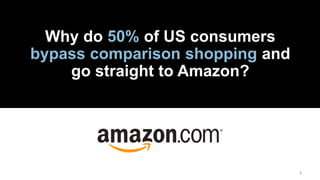
Why do 50% of US consumers
bypass comparison shopping and
go straight to Amazon?
44
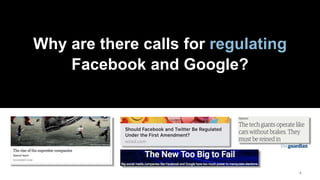
Why are there calls for regulating
Facebook and Google?
55
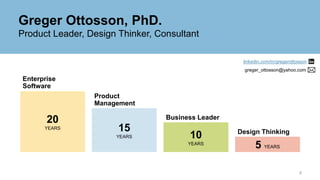
Greger Ottosson, PhD.
Product Leader, Design Thinker, Consultant
Enterprise
Software
20
YEARS 15
YEARS
Product
Management
linkedin.com/in/gregerottosson
greger_ottosson@yahoo.com
Business Leader
10
YEARS
Design Thinking
5 YEARS
66
1. Digital
2. Digital Value Chains
3. Data Science & Open Source
4. UX for Digital Entrepreneurs
7
Digital
8
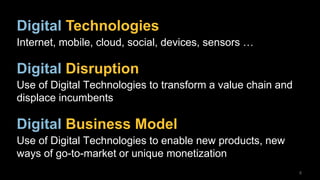
Digital Technologies
Internet, mobile, cloud, social, devices, sensors …
Digital Disruption
Use of Digital Technologies to transform a value chain and
displace incumbents
Digital Business Model
Use of Digital Technologies to enable new products, new
ways of go-to-market or unique monetization
99
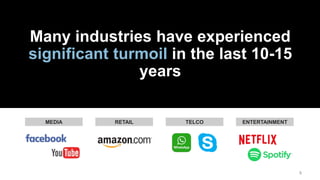
Many industries have experienced
significant turmoil in the last 10-15
years
MEDIA RETAIL TELCO ENTERTAINMENT
1010
Even “protected” industries are
starting to see digital approaches….
BANKING REAL ESTATE HEALTH CARE INSURANCE
1111
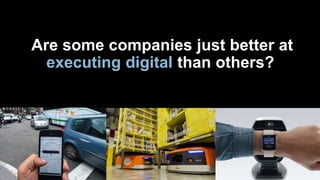
Are some companies just better at
executing digital than others?
1212
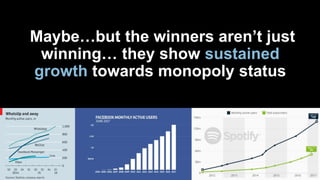
Maybe…but the winners aren’t just
winning… they show sustained
growth towards monopoly status
1313
The bigger they get,
the stronger they become
Why is that?
14
Digital Value Chains
1515
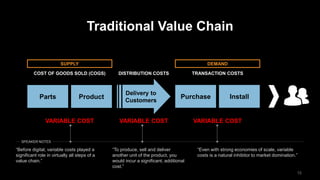
Traditional Value Chain
COST OF GOODS SOLD (COGS)
Delivery to
Customers
TRANSACTION COSTSDISTRIBUTION COSTS
Purchase InstallParts Product
SUPPLY DEMAND
VARIABLE COST VARIABLE COST VARIABLE COST
“Before digital, variable costs played a
significant role in virtually all steps of a
value chain.”
“To produce, sell and deliver
another unit of the product, you
would incur a significant, additional
cost.”
“Even with strong economies of scale, variable
costs is a natural inhibitor to market domination.”
SPEAKER NOTES
1616
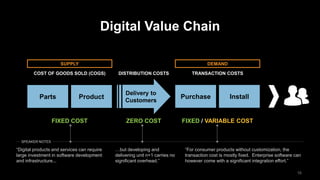
Digital Value Chain
COST OF GOODS SOLD (COGS)
Delivery to
Customers
TRANSACTION COSTSDISTRIBUTION COSTS
Purchase InstallParts Product
SUPPLY DEMAND
FIXED COST ZERO COST FIXED / VARIABLE COST
“Digital products and services can require
large investment in software development
and infrastructure...
…but developing and
delivering unit n+1 carries no
significant overhead.”
“For consumer products without customization, the
transaction cost is mostly fixed. Enterprise software can
however come with a significant integration effort.”
SPEAKER NOTES
1717
Many digital disrupters are targeting
industries where incumbents own or
operate physical assets
A couple of examples…
1818
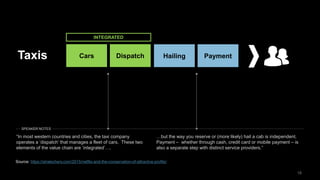
Cars Dispatch
INTEGRATED
Hailing Payment
“In most western countries and cities, the taxi company
operates a ’dispatch’ that manages a fleet of cars. These two
elements of the value chain are ’integrated’….
…but the way you reserve or (more likely) hail a cab is independent.
Payment – whether through cash, credit card or mobile payment – is
also a separate step with distinct service providers.”
Taxis
SPEAKER NOTES
Source: https://stratechery.com/2015/netflix-and-the-conservation-of-attractive-profits/
1919
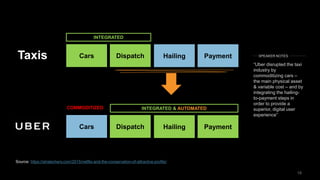
Cars Dispatch
COMMODITIZED
Hailing Payment
INTEGRATED & AUTOMATED
Cars Dispatch
INTEGRATED
Hailing PaymentTaxis
“Uber disrupted the taxi
industry by
commoditizing cars –
the main physical asset
& variable cost – and by
integrating the hailing-
to-payment steps in
order to provide a
superior, digital user
experience”
SPEAKER NOTES
Source: https://stratechery.com/2015/netflix-and-the-conservation-of-attractive-profits/
2020
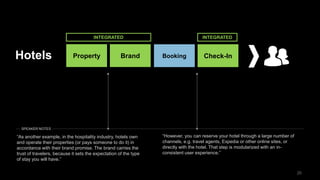
Property Brand
INTEGRATED
Booking Check-In
INTEGRATED
“As another example, in the hospitality industry, hotels own
and operate their properties (or pays someone to do it) in
accordance with their brand promise. The brand carries the
trust of travelers, because it sets the expectation of the type
of stay you will have.”
“However, you can reserve your hotel through a large number of
channels, e.g. travel agents, Expedia or other online sites, or
directly with the hotel. That step is modularized with an in-
consistent user experience.”
SPEAKER NOTES
Hotels
2121
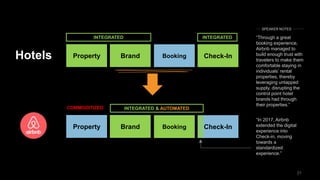
Property Brand Booking
INTEGRATED & AUTOMATED
Property Brand
INTEGRATED
Booking
COMMODITIZED
Check-In
Check-In
INTEGRATED “Through a great
booking experience,
Airbnb managed to
build enough trust with
travelers to make them
comfortable staying in
individuals’ rental
properties, thereby
leveraging untapped
supply, disrupting the
control point hotel
brands had through
their properties.”
SPEAKER NOTES
“In 2017, Airbnb
extended the digital
experience into
Check-in, moving
towards a
standardized
experience.”
Hotels
2222
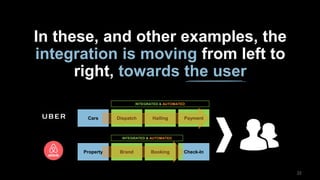
INTEGRATED & AUTOMATED
Cars Dispatch Hailing Payment
INTEGRATED & AUTOMATED
Property Brand Booking Check-In
In these, and other examples, the
integration is moving from left to
right, towards the user
2323
There are three lessons we can learn
about how this shift is done
2424
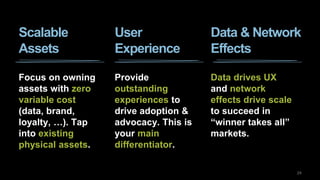
Focus on owning
assets with zero
variable cost
(data, brand,
loyalty, …). Tap
into existing
physical assets.
Provide
outstanding
experiences to
drive adoption &
advocacy. This is
your main
differentiator.
Data drives UX
and network
effects drive scale
to succeed in
“winner takes all”
markets.
Scalable
Assets
User
Experience
Data & Network
Effects
25
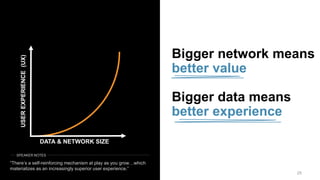
USEREXPERIENCE(UX)
DATA & NETWORK SIZE
Bigger network means
better value
Bigger data means
better experience
SPEAKER NOTES
“There’s a self-reinforcing mechanism at play as you grow…which
materializes as an increasingly superior user experience.”
2626
Let’s see if we can apply the value
chain framework in another
industry…
27
Data Science & Open Source
28
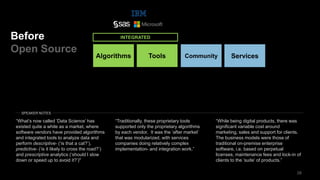
Before
Open Source
Algorithms Tools
INTEGRATED
Community Services
“What’s now called ’Data Science’ has
existed quite a while as a market, where
software vendors have provided algorithms
and integrated tools to analyze data and
perform descriptive- (‘is that a cat?’),
predictive- (‘is it likely to cross the road?’)
and prescriptive analytics (‘should I slow
down or speed up to avoid it?’)"
“Traditionally, these proprietary tools
supported only the proprietary algorithms
by each vendor. It was the ‘after market’
that was modularized, with services
companies doing relatively complex
implementation- and integration work.”
“While being digital products, there was
significant variable cost around
marketing, sales and support for clients.
The business models were those of
traditional on-premise enterprise
software, i.e. based on perpetual
licenses, maintenance fees and lock-in of
clients to the ’suite’ of products.”
SPEAKER NOTES
29
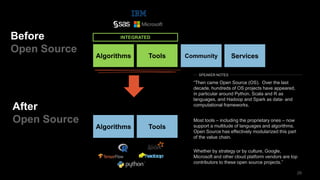
Before
Open Source
Algorithms Tools
Algorithms Tools
INTEGRATED
Community Services
After
Open Source
“Then came Open Source (OS). Over the last
decade, hundreds of OS projects have appeared,
in particular around Python, Scala and R as
languages, and Hadoop and Spark as data- and
computational frameworks.
SPEAKER NOTES
Most tools – including the proprietary ones – now
support a multitude of languages and algorithms.
Open Source has effectively modularized this part
of the value chain.
Whether by strategy or by culture, Google,
Microsoft and other cloud platform vendors are top
contributors to these open source projects.”
30
Algorithms Tools
Cloud
Platform
Community
Algorithms Tools
INTEGRATED
Community Services
Services
INTEGRATION IN PROGRESS
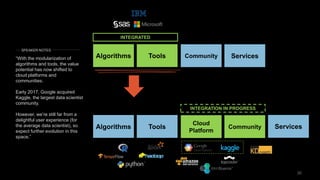
“With the modularization of
algorithms and tools, the value
potential has now shifted to
cloud platforms and
communities.
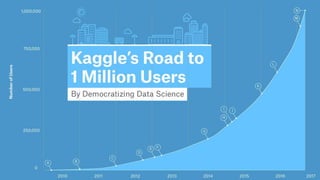
Early 2017, Google acquired
Kaggle, the largest data scientist
community.
However, we’re still far from a
delightful user experience (for
the average data scientist), so
expect further evolution in this
space.”
SPEAKER NOTES
313131
3232
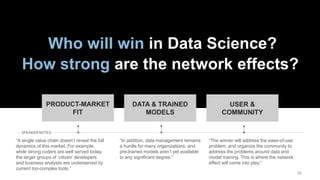
Who will win in Data Science?
How strong are the network effects?
PRODUCT-MARKET
FIT
DATA & TRAINED
MODELS
USER &
COMMUNITY
“A single value chain doesn’t reveal the full
dynamics of this market. For example,
while strong coders are well served today,
the larger groups of ‘citizen’ developers
and business analysts are underserved by
current too-complex tools.”
“In addition, data management remains
a hurdle for many organizations, and
pre-trained models aren’t yet available
to any significant degree.”
“The winner will address the ease-of-use
problem, and organize the community to
address the problems around data and
model training. This is where the network
effect will come into play.”
SPEAKER NOTES
33
UX for Digital Entrepreneurs
3434
We’ve talked a lot about the
importance of User Experience in
digital disruption…
3535
…and that user experience spans
all touch points with the user
3636
Let’s look at a framework that
captures all aspects of the user
experience
3737
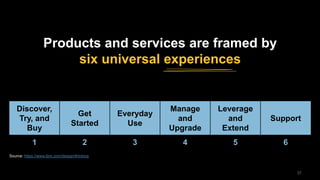
Discover,
Try, and
Buy
Get
Started
Everyday
Use
Manage
and
Upgrade
Leverage
and
Extend
Support
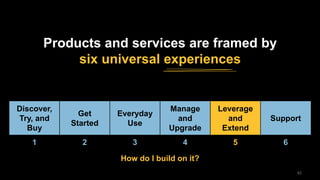
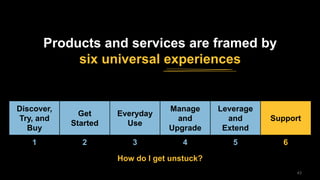
1 2 3 4 5 6
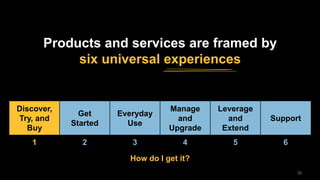
Products and services are framed by
six universal experiences
Source: https://www.ibm.com/design/thinking
3838
Discover,
Try, and
Buy
Get
Started
Everyday
Use
Manage
and
Upgrade
Leverage
and
Extend
Support
1 2 3 4 5 6
How do I get it?
Products and services are framed by
six universal experiences
3939
Discover,
Try, and
Buy
Get
Started
Everyday
Use
Manage
and
Upgrade
Leverage
and
Extend
Support
1 2 3 4 5 6
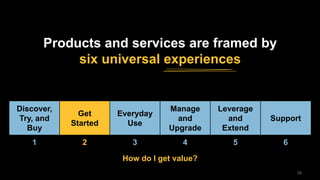
How do I get value?
Products and services are framed by
six universal experiences
4040
Discover,
Try, and
Buy
Get
Started
Everyday
Use
Manage
and
Upgrade
Leverage
and
Extend
Support
1 2 3 4 5 6
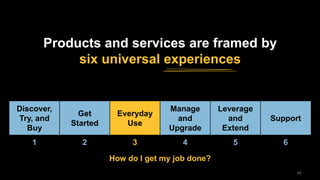
How do I get my job done?
Products and services are framed by
six universal experiences
4141
Discover,
Try, and
Buy
Get
Started
Everyday
Use
Manage
and
Upgrade
Leverage
and
Extend
Support
1 2 3 4 5 6
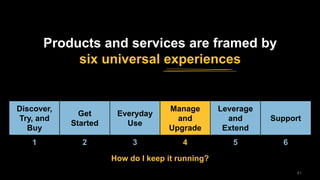
How do I keep it running?
Products and services are framed by
six universal experiences
4242
Discover,
Try, and
Buy
Get
Started
Everyday
Use
Manage
and
Upgrade
Leverage
and
Extend
Support
1 2 3 4 5 6
How do I build on it?
Products and services are framed by
six universal experiences
4343
Discover,
Try, and
Buy
Get
Started
Everyday
Use
Manage
and
Upgrade
Leverage
and
Extend
Support
1 2 3 4 5 6
How do I get unstuck?
Products and services are framed by
six universal experiences
44
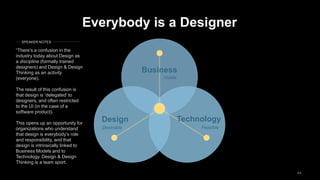
Business
TechnologyDesign
Desirable Feasible
Viable
Everybody is a Designer
“There’s a confusion in the
industry today about Design as
a discipline (formally trained
designers) and Design & Design
Thinking as an activity
(everyone).
The result of this confusion is
that design is ’delegated’ to
designers, and often restricted
to the UI (in the case of a
software product).
This opens up an opportunity for
organizations who understand
that design is everybody’s role
and responsibility, and that
design is intrinsically linked to
Business Models and to
Technology. Design & Design
Thinking is a team sport.
SPEAKER NOTES
4545
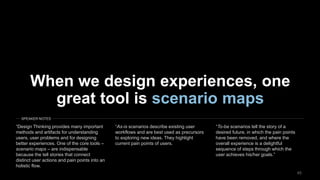
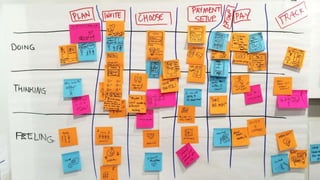
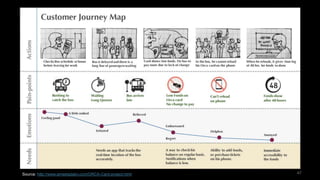
When we design experiences, one
great tool is scenario maps
“Design Thinking provides many important
methods and artifacts for understanding
users, user problems and for designing
better experiences. One of the core tools –
scenario maps – are indispensable
because the tell stories that connect
distinct user actions and pain points into an
holistic flow.
“As-is scenarios describe existing user
workflows and are best used as precursors
to exploring new ideas. They highlight
current pain points of users.
“To-be scenarios tell the story of a
desired future, in which the pain points
have been removed, and where the
overall experience is a delightful
sequence of steps through which the
user achieves his/her goals.”
SPEAKER NOTES
4747Source: http://www.ameetadalvi.com/ORCA-Card-project.html
48
How can the six experiences drive
your disruption?
4949
Discover,
Try, and
Buy
Get
Started
Everyday
Use
Manage
and
Upgrade
Leverage
and
Extend
Support
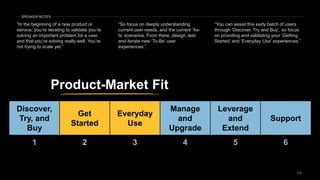
1 2 3 4 5 6
Product-Market Fit
“In the beginning of a new product or
service, you’re iterating to validate you’re
solving an important problem for a user,
and that you’re solving really well. You’re
not trying to scale yet.”
“So focus on deeply understanding
current user needs, and the current ‘As-
Is’ scenarios. From there, design, test
and iterate new ‘To-Be’ user
experiences.”
“You can assist this early batch of users
through ‘Discover, Try and Buy’, so focus
on providing and validating your ‘Getting
Started’ and ‘Everyday Use’ experiences.”
SPEAKER NOTES
5050
Discover,
Try, and
Buy
Get
Started
Everyday
Use
Manage
and
Upgrade
Leverage
and
Extend
Support
1 2 3 4 5 6
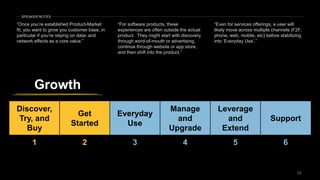
Growth
“Once you’re established Product-Market
fit, you want to grow you customer base, in
particular if you’re relying on data- and
network effects as a core value.”
“For software products, these
experiences are often outside the actual
product. They might start with discovery
through word-of-mouth or advertising,
continue through website or app store,
and then shift into the product.”
“Even for services offerings, a user will
likely move across multiple channels (F2F,
phone, web, mobile, etc) before stabilizing
into ‘Everyday Use’.”
SPEAKER NOTES
5151
Discover,
Try, and
Buy
Get
Started
Manage
and
Upgrade
Leverage
and
Extend
Support
1 2 3 4 5 6
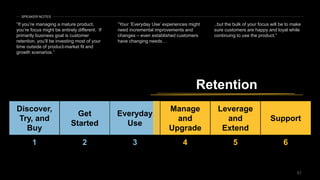
Retention
Everyday
Use
“If you’re managing a mature product,
you’re focus might be entirely different. If
primarily business goal is customer
retention, you’ll be investing most of your
time outside of product-market fit and
growth scenarios.”
“Your ‘Everyday Use’ experiences might
need incremental improvements and
changes – even established customers
have changing needs…
..but the bulk of your focus will be to make
sure customers are happy and loyal while
continuing to use the product.”
SPEAKER NOTES
52
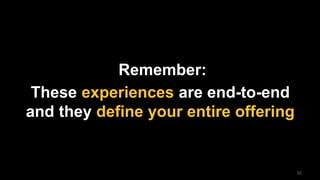
Remember:
These experiences are end-to-end
and they define your entire offering
5353
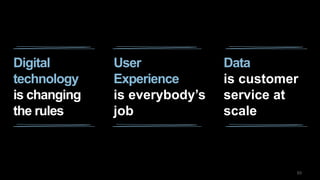
Data
is customer
service at
scale
Digital
technology
is changing
the rules
User
Experience
is everybody’s
job
54
https://www.linkedin.com/in/gregerottosson
greger_ottosson@yahoo.com
Stay in touch
Further learning
IBM Design Thinking https://www.ibm.com/design/thinking/
Stratechery https://stratechery.com/
Thanks to Kathryn McKinnon for visually communicating the information in this presentation
https://www.linkedin.com/in/kmckinnon/

'Digital Disruption & Digital Business Models' - EDHEC Business School Keynote Oct 14 2017

  • 1.
    Digital Disruption and DigitalBusiness Models October 14, 2017 Greger Ottosson, PhD. Product Management, IBM
  • 2.
    22 Why are billions$$$ being invested in messaging apps … … just to offer them free of charge?
  • 3.
    33 Why do 50%of US consumers bypass comparison shopping and go straight to Amazon?
  • 4.
    44 Why are therecalls for regulating Facebook and Google?
  • 5.
    55 Greger Ottosson, PhD. ProductLeader, Design Thinker, Consultant Enterprise Software 20 YEARS 15 YEARS Product Management linkedin.com/in/gregerottosson greger_ottosson@yahoo.com Business Leader 10 YEARS Design Thinking 5 YEARS
  • 6.
    66 1. Digital 2. DigitalValue Chains 3. Data Science & Open Source 4. UX for Digital Entrepreneurs
  • 7.
  • 8.
    8 Digital Technologies Internet, mobile,cloud, social, devices, sensors … Digital Disruption Use of Digital Technologies to transform a value chain and displace incumbents Digital Business Model Use of Digital Technologies to enable new products, new ways of go-to-market or unique monetization
  • 9.
    99 Many industries haveexperienced significant turmoil in the last 10-15 years MEDIA RETAIL TELCO ENTERTAINMENT
  • 10.
    1010 Even “protected” industriesare starting to see digital approaches…. BANKING REAL ESTATE HEALTH CARE INSURANCE
  • 11.
    1111 Are some companiesjust better at executing digital than others?
  • 12.
    1212 Maybe…but the winnersaren’t just winning… they show sustained growth towards monopoly status
  • 13.
    1313 The bigger theyget, the stronger they become Why is that?
  • 14.
  • 15.
    1515 Traditional Value Chain COSTOF GOODS SOLD (COGS) Delivery to Customers TRANSACTION COSTSDISTRIBUTION COSTS Purchase InstallParts Product SUPPLY DEMAND VARIABLE COST VARIABLE COST VARIABLE COST “Before digital, variable costs played a significant role in virtually all steps of a value chain.” “To produce, sell and deliver another unit of the product, you would incur a significant, additional cost.” “Even with strong economies of scale, variable costs is a natural inhibitor to market domination.” SPEAKER NOTES
  • 16.
    1616 Digital Value Chain COSTOF GOODS SOLD (COGS) Delivery to Customers TRANSACTION COSTSDISTRIBUTION COSTS Purchase InstallParts Product SUPPLY DEMAND FIXED COST ZERO COST FIXED / VARIABLE COST “Digital products and services can require large investment in software development and infrastructure... …but developing and delivering unit n+1 carries no significant overhead.” “For consumer products without customization, the transaction cost is mostly fixed. Enterprise software can however come with a significant integration effort.” SPEAKER NOTES
  • 17.
    1717 Many digital disruptersare targeting industries where incumbents own or operate physical assets A couple of examples…
  • 18.
    1818 Cars Dispatch INTEGRATED Hailing Payment “Inmost western countries and cities, the taxi company operates a ’dispatch’ that manages a fleet of cars. These two elements of the value chain are ’integrated’…. …but the way you reserve or (more likely) hail a cab is independent. Payment – whether through cash, credit card or mobile payment – is also a separate step with distinct service providers.” Taxis SPEAKER NOTES Source: https://stratechery.com/2015/netflix-and-the-conservation-of-attractive-profits/
  • 19.
    1919 Cars Dispatch COMMODITIZED Hailing Payment INTEGRATED& AUTOMATED Cars Dispatch INTEGRATED Hailing PaymentTaxis “Uber disrupted the taxi industry by commoditizing cars – the main physical asset & variable cost – and by integrating the hailing- to-payment steps in order to provide a superior, digital user experience” SPEAKER NOTES Source: https://stratechery.com/2015/netflix-and-the-conservation-of-attractive-profits/
  • 20.
    2020 Property Brand INTEGRATED Booking Check-In INTEGRATED “Asanother example, in the hospitality industry, hotels own and operate their properties (or pays someone to do it) in accordance with their brand promise. The brand carries the trust of travelers, because it sets the expectation of the type of stay you will have.” “However, you can reserve your hotel through a large number of channels, e.g. travel agents, Expedia or other online sites, or directly with the hotel. That step is modularized with an in- consistent user experience.” SPEAKER NOTES Hotels
  • 21.
    2121 Property Brand Booking INTEGRATED& AUTOMATED Property Brand INTEGRATED Booking COMMODITIZED Check-In Check-In INTEGRATED “Through a great booking experience, Airbnb managed to build enough trust with travelers to make them comfortable staying in individuals’ rental properties, thereby leveraging untapped supply, disrupting the control point hotel brands had through their properties.” SPEAKER NOTES “In 2017, Airbnb extended the digital experience into Check-in, moving towards a standardized experience.” Hotels
  • 22.
    2222 INTEGRATED & AUTOMATED CarsDispatch Hailing Payment INTEGRATED & AUTOMATED Property Brand Booking Check-In In these, and other examples, the integration is moving from left to right, towards the user
  • 23.
    2323 There are threelessons we can learn about how this shift is done
  • 24.
    2424 Focus on owning assetswith zero variable cost (data, brand, loyalty, …). Tap into existing physical assets. Provide outstanding experiences to drive adoption & advocacy. This is your main differentiator. Data drives UX and network effects drive scale to succeed in “winner takes all” markets. Scalable Assets User Experience Data & Network Effects
  • 25.
    25 USEREXPERIENCE(UX) DATA & NETWORKSIZE Bigger network means better value Bigger data means better experience SPEAKER NOTES “There’s a self-reinforcing mechanism at play as you grow…which materializes as an increasingly superior user experience.”
  • 26.
    2626 Let’s see ifwe can apply the value chain framework in another industry…
  • 27.
    27 Data Science &Open Source
  • 28.
    28 Before Open Source Algorithms Tools INTEGRATED CommunityServices “What’s now called ’Data Science’ has existed quite a while as a market, where software vendors have provided algorithms and integrated tools to analyze data and perform descriptive- (‘is that a cat?’), predictive- (‘is it likely to cross the road?’) and prescriptive analytics (‘should I slow down or speed up to avoid it?’)" “Traditionally, these proprietary tools supported only the proprietary algorithms by each vendor. It was the ‘after market’ that was modularized, with services companies doing relatively complex implementation- and integration work.” “While being digital products, there was significant variable cost around marketing, sales and support for clients. The business models were those of traditional on-premise enterprise software, i.e. based on perpetual licenses, maintenance fees and lock-in of clients to the ’suite’ of products.” SPEAKER NOTES
  • 29.
    29 Before Open Source Algorithms Tools AlgorithmsTools INTEGRATED Community Services After Open Source “Then came Open Source (OS). Over the last decade, hundreds of OS projects have appeared, in particular around Python, Scala and R as languages, and Hadoop and Spark as data- and computational frameworks. SPEAKER NOTES Most tools – including the proprietary ones – now support a multitude of languages and algorithms. Open Source has effectively modularized this part of the value chain. Whether by strategy or by culture, Google, Microsoft and other cloud platform vendors are top contributors to these open source projects.”
  • 30.
    30 Algorithms Tools Cloud Platform Community Algorithms Tools INTEGRATED CommunityServices Services INTEGRATION IN PROGRESS “With the modularization of algorithms and tools, the value potential has now shifted to cloud platforms and communities. Early 2017, Google acquired Kaggle, the largest data scientist community. However, we’re still far from a delightful user experience (for the average data scientist), so expect further evolution in this space.” SPEAKER NOTES
  • 31.
  • 32.
    3232 Who will winin Data Science? How strong are the network effects? PRODUCT-MARKET FIT DATA & TRAINED MODELS USER & COMMUNITY “A single value chain doesn’t reveal the full dynamics of this market. For example, while strong coders are well served today, the larger groups of ‘citizen’ developers and business analysts are underserved by current too-complex tools.” “In addition, data management remains a hurdle for many organizations, and pre-trained models aren’t yet available to any significant degree.” “The winner will address the ease-of-use problem, and organize the community to address the problems around data and model training. This is where the network effect will come into play.” SPEAKER NOTES
  • 33.
    33 UX for DigitalEntrepreneurs
  • 34.
    3434 We’ve talked alot about the importance of User Experience in digital disruption…
  • 35.
    3535 …and that userexperience spans all touch points with the user
  • 36.
    3636 Let’s look ata framework that captures all aspects of the user experience
  • 37.
    3737 Discover, Try, and Buy Get Started Everyday Use Manage and Upgrade Leverage and Extend Support 1 23 4 5 6 Products and services are framed by six universal experiences Source: https://www.ibm.com/design/thinking
  • 38.
    3838 Discover, Try, and Buy Get Started Everyday Use Manage and Upgrade Leverage and Extend Support 1 23 4 5 6 How do I get it? Products and services are framed by six universal experiences
  • 39.
    3939 Discover, Try, and Buy Get Started Everyday Use Manage and Upgrade Leverage and Extend Support 1 23 4 5 6 How do I get value? Products and services are framed by six universal experiences
  • 40.
    4040 Discover, Try, and Buy Get Started Everyday Use Manage and Upgrade Leverage and Extend Support 1 23 4 5 6 How do I get my job done? Products and services are framed by six universal experiences
  • 41.
    4141 Discover, Try, and Buy Get Started Everyday Use Manage and Upgrade Leverage and Extend Support 1 23 4 5 6 How do I keep it running? Products and services are framed by six universal experiences
  • 42.
    4242 Discover, Try, and Buy Get Started Everyday Use Manage and Upgrade Leverage and Extend Support 1 23 4 5 6 How do I build on it? Products and services are framed by six universal experiences
  • 43.
    4343 Discover, Try, and Buy Get Started Everyday Use Manage and Upgrade Leverage and Extend Support 1 23 4 5 6 How do I get unstuck? Products and services are framed by six universal experiences
  • 44.
    44 Business TechnologyDesign Desirable Feasible Viable Everybody isa Designer “There’s a confusion in the industry today about Design as a discipline (formally trained designers) and Design & Design Thinking as an activity (everyone). The result of this confusion is that design is ’delegated’ to designers, and often restricted to the UI (in the case of a software product). This opens up an opportunity for organizations who understand that design is everybody’s role and responsibility, and that design is intrinsically linked to Business Models and to Technology. Design & Design Thinking is a team sport. SPEAKER NOTES
  • 45.
    4545 When we designexperiences, one great tool is scenario maps “Design Thinking provides many important methods and artifacts for understanding users, user problems and for designing better experiences. One of the core tools – scenario maps – are indispensable because the tell stories that connect distinct user actions and pain points into an holistic flow. “As-is scenarios describe existing user workflows and are best used as precursors to exploring new ideas. They highlight current pain points of users. “To-be scenarios tell the story of a desired future, in which the pain points have been removed, and where the overall experience is a delightful sequence of steps through which the user achieves his/her goals.” SPEAKER NOTES
  • 47.
  • 48.
    48 How can thesix experiences drive your disruption?
  • 49.
    4949 Discover, Try, and Buy Get Started Everyday Use Manage and Upgrade Leverage and Extend Support 1 23 4 5 6 Product-Market Fit “In the beginning of a new product or service, you’re iterating to validate you’re solving an important problem for a user, and that you’re solving really well. You’re not trying to scale yet.” “So focus on deeply understanding current user needs, and the current ‘As- Is’ scenarios. From there, design, test and iterate new ‘To-Be’ user experiences.” “You can assist this early batch of users through ‘Discover, Try and Buy’, so focus on providing and validating your ‘Getting Started’ and ‘Everyday Use’ experiences.” SPEAKER NOTES
  • 50.
    5050 Discover, Try, and Buy Get Started Everyday Use Manage and Upgrade Leverage and Extend Support 1 23 4 5 6 Growth “Once you’re established Product-Market fit, you want to grow you customer base, in particular if you’re relying on data- and network effects as a core value.” “For software products, these experiences are often outside the actual product. They might start with discovery through word-of-mouth or advertising, continue through website or app store, and then shift into the product.” “Even for services offerings, a user will likely move across multiple channels (F2F, phone, web, mobile, etc) before stabilizing into ‘Everyday Use’.” SPEAKER NOTES
  • 51.
    5151 Discover, Try, and Buy Get Started Manage and Upgrade Leverage and Extend Support 1 23 4 5 6 Retention Everyday Use “If you’re managing a mature product, you’re focus might be entirely different. If primarily business goal is customer retention, you’ll be investing most of your time outside of product-market fit and growth scenarios.” “Your ‘Everyday Use’ experiences might need incremental improvements and changes – even established customers have changing needs… ..but the bulk of your focus will be to make sure customers are happy and loyal while continuing to use the product.” SPEAKER NOTES
  • 52.
    52 Remember: These experiences areend-to-end and they define your entire offering
  • 53.
    5353 Data is customer service at scale Digital technology ischanging the rules User Experience is everybody’s job
  • 54.
    54 https://www.linkedin.com/in/gregerottosson greger_ottosson@yahoo.com Stay in touch Furtherlearning IBM Design Thinking https://www.ibm.com/design/thinking/ Stratechery https://stratechery.com/ Thanks to Kathryn McKinnon for visually communicating the information in this presentation https://www.linkedin.com/in/kmckinnon/