Ecosystems
based water
management:
From innovation
to practice
Dr. Chris Dickens IWMI
c.dickens@cgiar.org
©Eddy Wymenga
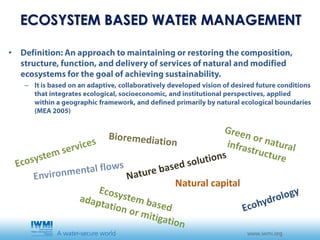
ECOSYSTEM BASED WATER MANAGEMENT
•
–
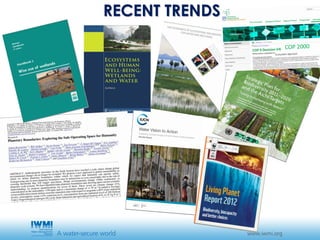
RECENT TRENDS
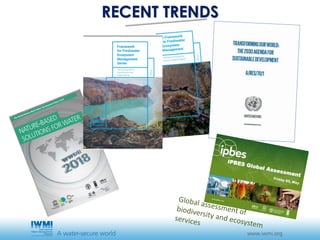
RECENT TRENDS
Environmental flows describe the
quantity, timing, and quality of
freshwater flows and levels necessary
to sustain aquatic ecosystems which,
in turn, support human cultures,
economies, livelihoods, and well-
being.
Brisbane declaration of environmental flows (2018)© pictures Gordon O’Brien
River conditions required to maintain Social and
Ecological Endpoints
PROBFLO
a new e-flows
framework – O’Brien et al.
2018
© pictures Gordon O’Brien
If you don’t know where you
are going, then any road will
get there
(George Harrison – Beetles)
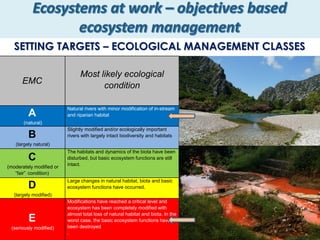
SETTING TARGETS – ECOLOGICAL MANAGEMENT CLASSES
EMC
Most likely ecological
condition
A
(natural)
Natural rivers with minor modification of in-stream
and riparian habitat
B
(largely natural)
Slightly modified and/or ecologically important
rivers with largely intact biodiversity and habitats
C
(moderately modified or
“fair” condition)
The habitats and dynamics of the biota have been
disturbed, but basic ecosystem functions are still
intact.
D
(largely modified)
Large changes in natural habitat, biota and basic
ecosystem functions have occurred.
E
(seriously modified)
Modifications have reached a critical level and
ecosystem has been completely modified with
almost total loss of natural habitat and biota. In the
worst case, the basic ecosystem functions have
been destroyed
.
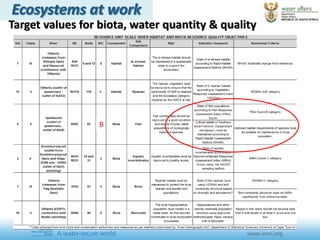
Target values for biota, water quantity & quality
B
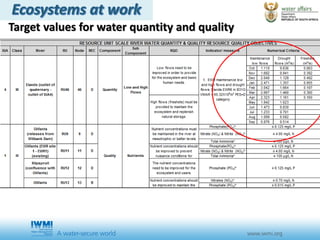
Target values for water quantity and quality
17 SDGs for people-planet-prosperity-peace-partnership
12
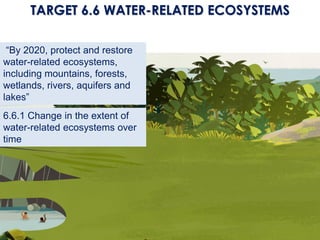
TARGET 6.6 WATER-RELATED ECOSYSTEMS
“By 2020, protect and restore
water-related ecosystems,
including mountains, forests,
wetlands, rivers, aquifers and
lakes”
6.6.1 Change in the extent of
water-related ecosystems over
time
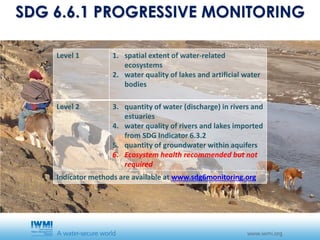
SDG 6.6.1 PROGRESSIVE MONITORING
Level 1 1. spatial extent of water-related
ecosystems
2. water quality of lakes and artificial water
bodies
Level 2 3. quantity of water (discharge) in rivers and
estuaries
4. water quality of rivers and lakes imported
from SDG Indicator 6.3.2
5. quantity of groundwater within aquifers
6. Ecosystem health recommended but not
required
Indicator methods are available at www.sdg6monitoring.org
WATER-RELATED ECOSYSTEM COMPONENTS
MONITORED BY THE SDGS
Biological
Physical
Chemical
Spatial extent
Water quantity
Nutrients
DO
Conductivity
pH
Chlorophyll in
lakes
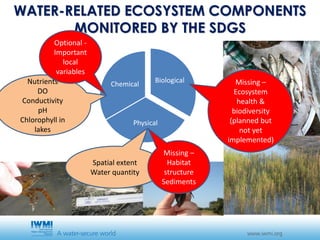
WATER-RELATED ECOSYSTEM COMPONENTS
MONITORED BY THE SDGS
Biological
Physical
Chemical
Spatial extent
Water quantity
Nutrients
DO
Conductivity
pH
Chlorophyll in
lakes
Missing –
Ecosystem
health &
biodiversity
(planned but
not yet
implemented)
Missing –
Habitat
structure
Sediments
Optional -
Important
local
variables
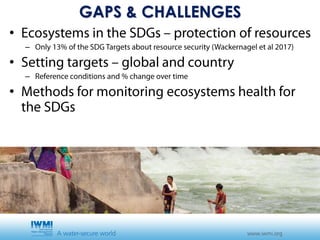
GAPS & CHALLENGES
•
–
•
–
•
THANK YOU!

Ecosystems based water management: From innovation to practice

  • 1.
    Ecosystems based water management: From innovation topractice Dr. Chris Dickens IWMI c.dickens@cgiar.org ©Eddy Wymenga
  • 2.
    ECOSYSTEM BASED WATERMANAGEMENT • –
  • 3.
  • 4.
  • 5.
    Environmental flows describethe quantity, timing, and quality of freshwater flows and levels necessary to sustain aquatic ecosystems which, in turn, support human cultures, economies, livelihoods, and well- being. Brisbane declaration of environmental flows (2018)© pictures Gordon O’Brien
  • 6.
    River conditions requiredto maintain Social and Ecological Endpoints PROBFLO a new e-flows framework – O’Brien et al. 2018 © pictures Gordon O’Brien
  • 7.
    If you don’tknow where you are going, then any road will get there (George Harrison – Beetles)
  • 8.
    SETTING TARGETS –ECOLOGICAL MANAGEMENT CLASSES EMC Most likely ecological condition A (natural) Natural rivers with minor modification of in-stream and riparian habitat B (largely natural) Slightly modified and/or ecologically important rivers with largely intact biodiversity and habitats C (moderately modified or “fair” condition) The habitats and dynamics of the biota have been disturbed, but basic ecosystem functions are still intact. D (largely modified) Large changes in natural habitat, biota and basic ecosystem functions have occurred. E (seriously modified) Modifications have reached a critical level and ecosystem has been completely modified with almost total loss of natural habitat and biota. In the worst case, the basic ecosystem functions have been destroyed .
  • 9.
    Target values forbiota, water quantity & quality B
  • 10.
    Target values forwater quantity and quality
  • 11.
    Target values forwater quantity and quality
  • 12.
    17 SDGs forpeople-planet-prosperity-peace-partnership 12
  • 13.
    TARGET 6.6 WATER-RELATEDECOSYSTEMS “By 2020, protect and restore water-related ecosystems, including mountains, forests, wetlands, rivers, aquifers and lakes” 6.6.1 Change in the extent of water-related ecosystems over time
  • 14.
    SDG 6.6.1 PROGRESSIVEMONITORING Level 1 1. spatial extent of water-related ecosystems 2. water quality of lakes and artificial water bodies Level 2 3. quantity of water (discharge) in rivers and estuaries 4. water quality of rivers and lakes imported from SDG Indicator 6.3.2 5. quantity of groundwater within aquifers 6. Ecosystem health recommended but not required Indicator methods are available at www.sdg6monitoring.org
  • 15.
    WATER-RELATED ECOSYSTEM COMPONENTS MONITOREDBY THE SDGS Biological Physical Chemical Spatial extent Water quantity Nutrients DO Conductivity pH Chlorophyll in lakes
  • 16.
    WATER-RELATED ECOSYSTEM COMPONENTS MONITOREDBY THE SDGS Biological Physical Chemical Spatial extent Water quantity Nutrients DO Conductivity pH Chlorophyll in lakes Missing – Ecosystem health & biodiversity (planned but not yet implemented) Missing – Habitat structure Sediments Optional - Important local variables
  • 17.
  • 18.