

Starting with the name of Allah
The Most Merciful and Beneficent.
DEBT
MANAGEMENT
GROUP MEMBERS
MAHEEN AHMED
FAKHIR FARAZ
ZAFFAR HUSSAIN
SARA AKABAR
What is Debt?
“It is an amount of money borrowed by one party from another.”
 Bonds and loans are example of debt
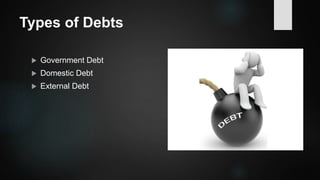
Types of Debts
 Government Debt
 Domestic Debt
 External Debt
What is Debt Management?
“Debt management is one of several debt-relief options for those
who are struggling to keep up with a growing pile of bills each
month. When you sign up for a debt management plan. You pay
a single company every month instead of all of your creditors.”
Economy Of Pakistan
 In terms of purchasing power parity (PPP) Pakistan’s economy is
the 27th largest in the world.
 44th largest in terms of nominal GDP.
 Pakistan's estimated nominal GDP as of 2011 is US $202 billion.
 The GDP by PPP is US $838,164 million and debt-to-GDP ratio is
55.5%.
 Population of Pakistan below the poverty line is 12.4% (2014).
 Economic growth rate is 5% average per annum since 1947-2011.
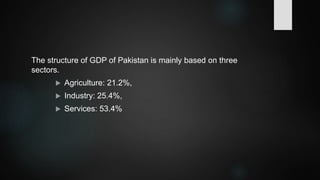
The structure of GDP of Pakistan is mainly based on three
sectors.
 Agriculture: 21.2%,
 Industry: 25.4%,
 Services: 53.4%
Debt Management performed by
 Ministry of Finance (EAD and FD)
 EAD: (Economic Affairs Division) deals with implementation,
monitoring and record keeping.
 FD: (Finance Division) responsible for policy making relating to debt
 State Bank of Pakistan
 Planning Commission
 Central Directorate of National Saving-maintains all the relevant information on
domestic public debt raised thorough National Saving Schemes.
 Debt Policy Coordination Office (DPCO)
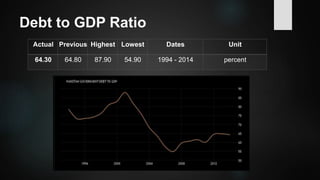
Debt to GDP Ratio
Actual Previous Highest Lowest Dates Unit
64.30 64.80 87.90 54.90 1994 - 2014 percent
Debt And Liabilities Of Pakistan
 Public Debt
 Domestic Debt
 External Debt
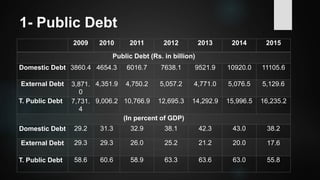
1- Public Debt
2009 2010 2011 2012 2013 2014 2015
Public Debt (Rs. in billion)
Domestic Debt 3860.4 4654.3 6016.7 7638.1 9521.9 10920.0 11105.6
External Debt 3,871.
0
4,351.9 4,750.2 5,057.2 4,771.0 5,076.5 5,129.6
T. Public Debt 7,731.
4
9,006.2 10,766.9 12,695.3 14,292.9 15,996.5 16,235.2
(In percent of GDP)
Domestic Debt 29.2 31.3 32.9 38.1 42.3 43.0 38.2
External Debt 29.3 29.3 26.0 25.2 21.2 20.0 17.6
T. Public Debt 58.6 60.6 58.9 63.3 63.6 63.0 55.8
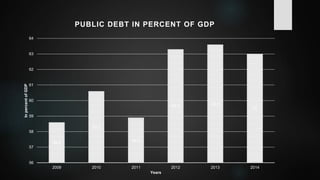
58.6
60.6
58.9
63.3
63.6
63
56
57
58
59
60
61
62
63
64
2009 2010 2011 2012 2013 2014
InpercentofGDP
Years
PUBLIC DEBT IN PERCENT OF GDP
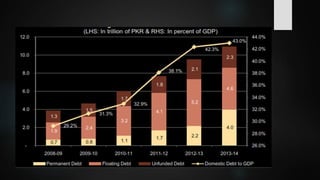
Domestic Debt
 Permanent debt (medium and long-term)
 Floating Debt (short-term)
 Unfunded Debt (primarily made up of the various instruments
available under the National Savings Schemes)
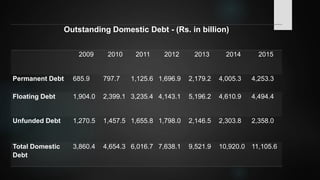
Outstanding Domestic Debt - (Rs. in billion)
2009 2010 2011 2012 2013 2014 2015
Permanent Debt 685.9 797.7 1,125.6 1,696.9 2,179.2 4,005.3 4,253.3
Floating Debt 1,904.0 2,399.1 3,235.4 4,143.1 5,196.2 4,610.9 4,494.4
Unfunded Debt 1,270.5 1,457.5 1,655.8 1,798.0 2,146.5 2,303.8 2,358.0
Total Domestic
Debt
3,860.4 4,654.3 6,016.7 7,638.1 9,521.9 10,920.0 11,105.6
External Debt
 Pakistan’s External Debt and Liabilities (EDL) comprises all foreign currency
debt contracted by the public and private sector as well as foreign exchange
liabilities of State Bank Pakistan.
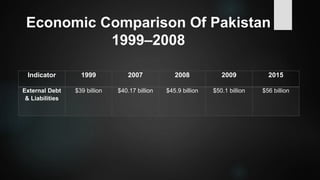
Economic Comparison Of Pakistan
1999–2008
Indicator 1999 2007 2008 2009 2015
External Debt
& Liabilities
$39 billion $40.17 billion $45.9 billion $50.1 billion $56 billion
Debt And Liabilities In 2015
 As of March 2015, the total debt liabilities of the country stood at
Rs19299.2 billion.
 The debt-to-gross domestic product (GDP) ratio stands at 66.4%,
in which foreign debt is Rs6.4 trillion and domestic debt is Rs12
trillion.
 The external debt servicing reached close to $7 billion in fiscal
year 2014, which is almost 50% of the current reserves of the
State Bank of Pakistan.
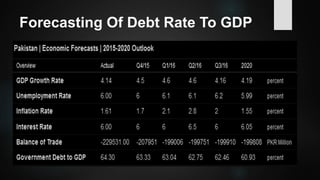
Forecasting Of Debt Rate To GDP
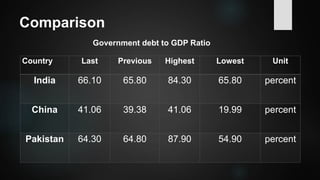
Comparison
Country Last Previous Highest Lowest Unit
India 66.10 65.80 84.30 65.80 percent
China 41.06 39.38 41.06 19.99 percent
Pakistan 64.30 64.80 87.90 54.90 percent
Government debt to GDP Ratio
Issues In Debt Management
1. Debt Trap And Primary Surplus: This is a condition in which
there is no money to deal past debt and it is necessary to take loans to
come across the outstanding debt. This leads ultimately to a crippling cycle
and rapid accumulation of debt.
2. External Debt Sustainability: The major issue is one of
external debt sustainability. The MTDS (Medium Term Debt
Strategy) suggests the initiation of relatively high cost
Eurobonds annually
Steps Taken For Debt Management
 Fiscal Responsibility And Debt Limitation (FRDL):
According to this act, total public debt should not exceed 60%
of the GDP.
 Medium Term Debt Strategy (MTDS): To raise the maturity
profile of domestic debt
Problems in Debt Management
 Poor coordination and information flow between debt management agencies.
 Outdated data management systems and limited computer access across
different departments
 Long term planning and project feasibility are the least priority at the level of
policy making and implementation.
 Decisions regarding debt issues are mostly based on personal inclinations,
political motives and vested interests.
 Debt management in Pakistan - not an integrated part of overall
macroeconomic policies especially the fiscal and monetary policies.
Problems in Debt Management
 Fiscal consolidation lost (missed revenue targets with rising expenditures)
 Failure of FRDL Act (on account of Government’s inability to contain the revenue
deficit)
 Debt management- in spite of addressing these core issues work under
subservience to political influence and bureaucratic mindset.
 Lack of adoption of strict guidelines for effective debt management
 Proposals put forward by debt reduction Committee in 2001 are still not
implemented seriously
 DPCO not playing the crucial role of managing debt as was envisaged under
FRDL Act 2005
Consequences Of Poor Debt
Management
The increase in the debt stock and rise in the debt burden in the
recent past has negatively affected the economy.
 Eroding the purchasing power through a hike in inflation.
 Diverting resources from development.
 Economic growth also being affected.
Policy Recommendations
 Enforcement of prudent debt management strategy- which
should not only focus on exploring the cheap and efficient
sources of financing.
 The composition of domestic debt should be altered through
development of domestic capital markets for long term
government securities.
 Adoption of a rule based fiscal policy.
 Better policy formulation and institutional strengthening in
various entities involved in management of debt
 Professional advice needed on matters relating to domestic and
external borrowing.
Policy Recommendations
 Well defined Debt strategy should be adopted
 Free of bureaucratic and political pressures.
 An improvement in the macroeconomic environment of the country
should be focused.
 An expansion of government revenues and exports while eliminating the
excess of current government expenditures over revenues and
improvement in the quality of resource use in public sector.
 Enforcing the strategies effectively as steps were taken before as well but
failed to be effectively implemented and therefore failed to bring about
any real change in the debt Position of Pakistan.
Ecoprojectslides

Ecoprojectslides

  • 1.
    Starting with thename of Allah The Most Merciful and Beneficent.
  • 2.
    DEBT MANAGEMENT GROUP MEMBERS MAHEEN AHMED FAKHIRFARAZ ZAFFAR HUSSAIN SARA AKABAR
  • 3.
    What is Debt? “Itis an amount of money borrowed by one party from another.”  Bonds and loans are example of debt
  • 4.
    Types of Debts Government Debt  Domestic Debt  External Debt
  • 5.
    What is DebtManagement? “Debt management is one of several debt-relief options for those who are struggling to keep up with a growing pile of bills each month. When you sign up for a debt management plan. You pay a single company every month instead of all of your creditors.”
  • 6.
    Economy Of Pakistan In terms of purchasing power parity (PPP) Pakistan’s economy is the 27th largest in the world.  44th largest in terms of nominal GDP.  Pakistan's estimated nominal GDP as of 2011 is US $202 billion.  The GDP by PPP is US $838,164 million and debt-to-GDP ratio is 55.5%.  Population of Pakistan below the poverty line is 12.4% (2014).  Economic growth rate is 5% average per annum since 1947-2011.
  • 7.
    The structure ofGDP of Pakistan is mainly based on three sectors.  Agriculture: 21.2%,  Industry: 25.4%,  Services: 53.4%
  • 8.
    Debt Management performedby  Ministry of Finance (EAD and FD)  EAD: (Economic Affairs Division) deals with implementation, monitoring and record keeping.  FD: (Finance Division) responsible for policy making relating to debt  State Bank of Pakistan  Planning Commission  Central Directorate of National Saving-maintains all the relevant information on domestic public debt raised thorough National Saving Schemes.  Debt Policy Coordination Office (DPCO)
  • 9.
    Debt to GDPRatio Actual Previous Highest Lowest Dates Unit 64.30 64.80 87.90 54.90 1994 - 2014 percent
  • 10.
    Debt And LiabilitiesOf Pakistan  Public Debt  Domestic Debt  External Debt
  • 11.
    1- Public Debt 20092010 2011 2012 2013 2014 2015 Public Debt (Rs. in billion) Domestic Debt 3860.4 4654.3 6016.7 7638.1 9521.9 10920.0 11105.6 External Debt 3,871. 0 4,351.9 4,750.2 5,057.2 4,771.0 5,076.5 5,129.6 T. Public Debt 7,731. 4 9,006.2 10,766.9 12,695.3 14,292.9 15,996.5 16,235.2 (In percent of GDP) Domestic Debt 29.2 31.3 32.9 38.1 42.3 43.0 38.2 External Debt 29.3 29.3 26.0 25.2 21.2 20.0 17.6 T. Public Debt 58.6 60.6 58.9 63.3 63.6 63.0 55.8
  • 12.
    58.6 60.6 58.9 63.3 63.6 63 56 57 58 59 60 61 62 63 64 2009 2010 20112012 2013 2014 InpercentofGDP Years PUBLIC DEBT IN PERCENT OF GDP
  • 13.
    Domestic Debt  Permanentdebt (medium and long-term)  Floating Debt (short-term)  Unfunded Debt (primarily made up of the various instruments available under the National Savings Schemes)
  • 14.
    Outstanding Domestic Debt- (Rs. in billion) 2009 2010 2011 2012 2013 2014 2015 Permanent Debt 685.9 797.7 1,125.6 1,696.9 2,179.2 4,005.3 4,253.3 Floating Debt 1,904.0 2,399.1 3,235.4 4,143.1 5,196.2 4,610.9 4,494.4 Unfunded Debt 1,270.5 1,457.5 1,655.8 1,798.0 2,146.5 2,303.8 2,358.0 Total Domestic Debt 3,860.4 4,654.3 6,016.7 7,638.1 9,521.9 10,920.0 11,105.6
  • 16.
    External Debt  Pakistan’sExternal Debt and Liabilities (EDL) comprises all foreign currency debt contracted by the public and private sector as well as foreign exchange liabilities of State Bank Pakistan.
  • 17.
    Economic Comparison OfPakistan 1999–2008 Indicator 1999 2007 2008 2009 2015 External Debt & Liabilities $39 billion $40.17 billion $45.9 billion $50.1 billion $56 billion
  • 18.
    Debt And LiabilitiesIn 2015  As of March 2015, the total debt liabilities of the country stood at Rs19299.2 billion.  The debt-to-gross domestic product (GDP) ratio stands at 66.4%, in which foreign debt is Rs6.4 trillion and domestic debt is Rs12 trillion.  The external debt servicing reached close to $7 billion in fiscal year 2014, which is almost 50% of the current reserves of the State Bank of Pakistan.
  • 19.
  • 20.
    Comparison Country Last PreviousHighest Lowest Unit India 66.10 65.80 84.30 65.80 percent China 41.06 39.38 41.06 19.99 percent Pakistan 64.30 64.80 87.90 54.90 percent Government debt to GDP Ratio
  • 21.
    Issues In DebtManagement 1. Debt Trap And Primary Surplus: This is a condition in which there is no money to deal past debt and it is necessary to take loans to come across the outstanding debt. This leads ultimately to a crippling cycle and rapid accumulation of debt. 2. External Debt Sustainability: The major issue is one of external debt sustainability. The MTDS (Medium Term Debt Strategy) suggests the initiation of relatively high cost Eurobonds annually
  • 22.
    Steps Taken ForDebt Management  Fiscal Responsibility And Debt Limitation (FRDL): According to this act, total public debt should not exceed 60% of the GDP.  Medium Term Debt Strategy (MTDS): To raise the maturity profile of domestic debt
  • 23.
    Problems in DebtManagement  Poor coordination and information flow between debt management agencies.  Outdated data management systems and limited computer access across different departments  Long term planning and project feasibility are the least priority at the level of policy making and implementation.  Decisions regarding debt issues are mostly based on personal inclinations, political motives and vested interests.  Debt management in Pakistan - not an integrated part of overall macroeconomic policies especially the fiscal and monetary policies.
  • 24.
    Problems in DebtManagement  Fiscal consolidation lost (missed revenue targets with rising expenditures)  Failure of FRDL Act (on account of Government’s inability to contain the revenue deficit)  Debt management- in spite of addressing these core issues work under subservience to political influence and bureaucratic mindset.  Lack of adoption of strict guidelines for effective debt management  Proposals put forward by debt reduction Committee in 2001 are still not implemented seriously  DPCO not playing the crucial role of managing debt as was envisaged under FRDL Act 2005
  • 25.
    Consequences Of PoorDebt Management The increase in the debt stock and rise in the debt burden in the recent past has negatively affected the economy.  Eroding the purchasing power through a hike in inflation.  Diverting resources from development.  Economic growth also being affected.
  • 26.
    Policy Recommendations  Enforcementof prudent debt management strategy- which should not only focus on exploring the cheap and efficient sources of financing.  The composition of domestic debt should be altered through development of domestic capital markets for long term government securities.  Adoption of a rule based fiscal policy.  Better policy formulation and institutional strengthening in various entities involved in management of debt  Professional advice needed on matters relating to domestic and external borrowing.
  • 27.
    Policy Recommendations  Welldefined Debt strategy should be adopted  Free of bureaucratic and political pressures.  An improvement in the macroeconomic environment of the country should be focused.  An expansion of government revenues and exports while eliminating the excess of current government expenditures over revenues and improvement in the quality of resource use in public sector.  Enforcing the strategies effectively as steps were taken before as well but failed to be effectively implemented and therefore failed to bring about any real change in the debt Position of Pakistan.