Design Patterns Round-trip


     A trip in the marvellous
    country of design pattern
    application and detection
Us
     n   Hervé Albin-Amiot
         – 3rd year PhD student
         – Partly funded by Soft-Maint S.A. (France)

     n   Yann-Gaël Guéhéneuc
         – 2nd year PhD student
         – Partly funded by Object Technology
           International, Inc. (Canada)

     n   PhDs hosted by the
         École des Mines de Nantes
Overview on design patterns

n Design   patterns are useful for:
  – Designing
  – Implementating
  – Documentating
  – Re-engineering
n Design   patterns are difficult to use:
  – Lack of formalism
  – And thus, lack of automation
Our Goals

n We   want:
 – To help designer
 – To help maintainer
n We   do not want:
 – To replace the designer
 – To be Caliph in the Caliph's stead
n We need to automate the uses of
 design patterns
Goals of the automation

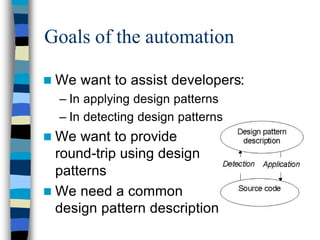
n We   want to assist developers:
  – In applying design patterns
  – In detecting design patterns
n We  want to provide
  round-trip using design
  patterns
n We need a common
  design pattern description
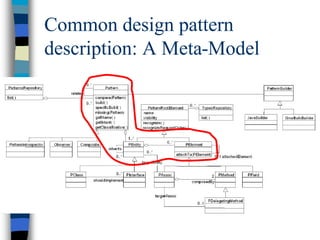
Common design pattern
description: A Meta-Model
Abstract model
                                 Informal descriptions
                                 from [GoF]


      Translates into          Instance of Pattern

                               Instance of PInterface

                               Instance of PClass

                               Instance of PAssoc

                               Instance of PDelegation

                        name() Instance of PMethod
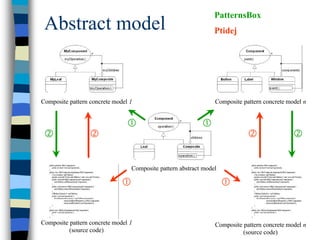
PatternsBox
 Abstract model                                                  Ptidej


Composite pattern concrete model 1                               Composite pattern concrete model n


                                •                           •
 ‚                ‚                                                          ‚                ‚


                                  Composite pattern abstract model

                              •                                      •


Composite pattern concrete model 1                               Composite pattern concrete model n
          (source code)                                                    (source code)
ic
A Bas xample : Application   1/4
     E
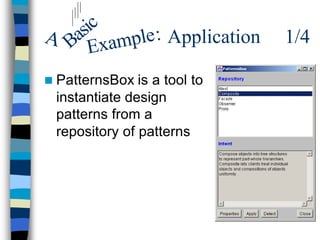
n PatternsBox is a tool to
 instantiate design
 patterns from a
 repository of patterns
ic
A Bas xample : Application   2/4
     E
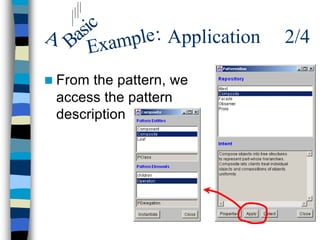
n From the pattern, we
 access the pattern
 description
ic
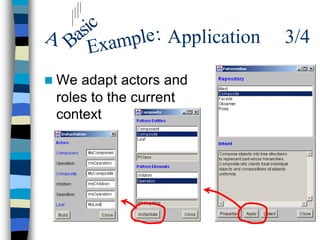
A Bas xample : Application   3/4
     E
n We adapt actors and
 roles to the current
 context
ic
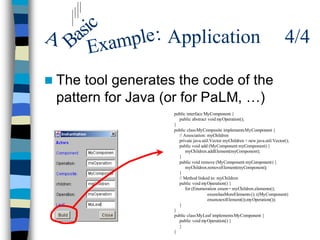
A Bas xample : Application                                                      4/4
     E
n The tool generates the code of the
 pattern for Java (or for PaLM, …)
                    public interface MyComponent {
                      public abstract void myOperation();
                    }
                    public class MyComposite implements MyComponent {
                      // Association: myChildren
                      private java.util.Vector myChildren = new java.util.Vector();
                      public void add (MyComponent myComponent) {
                          myChildren.addElement(myComponent);
                      }
                      public void remove (MyComponent myComponent) {
                          myChildren.removeElement(myComponent);
                      }
                      // Method linked to: myChildren
                      public void myOperation() {
                          for (Enumeration enum= myChildren.elements();
                                      enum.hasMoreElements (); ((MyComponent)
                                      enum.nextElement()).myOperation());
                      }
                    }
                    public class MyLeaf implements MyComponent {
                      public void myOperation() {
                      }
                    }
ic
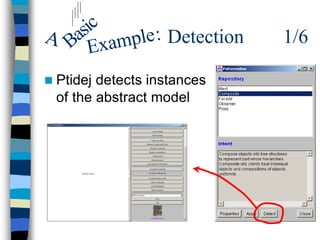
A Bas xample : Detection     1/6
     E
n Ptidej detects instances
  of the abstract model
ic
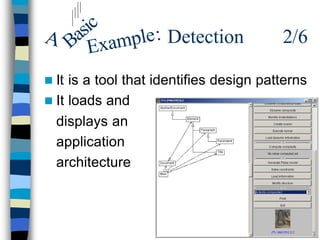
A Bas xample : Detection                 2/6
     E
n It is a tool that identifies design patterns
n It loads and
  displays an
  application
  architecture
ic
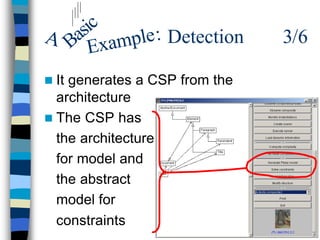
A Bas xample : Detection       3/6
     E
n Itgenerates a CSP from the
  architecture
n The CSP has
  the architecture
  for model and
  the abstract
  model for
  constraints
ic
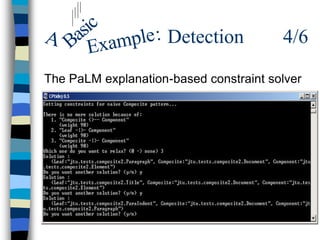
A Bas xample : Detection                4/6
     E
The PaLM explanation-based constraint solver
ic
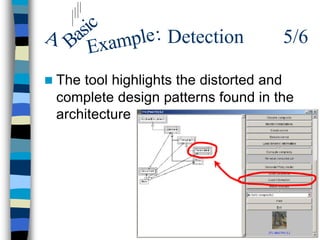
A Bas xample : Detection            5/6
     E
n Thetool highlights the distorted and
 complete design patterns found in the
 architecture
ic
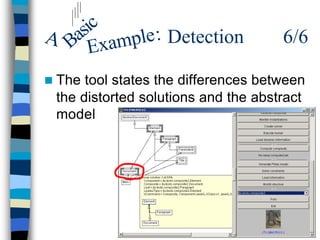
A Bas xample : Detection             6/6
     E
n The tool states the differences between
 the distorted solutions and the abstract
 model
Future                                 1/2

n To   have two separate meta-models
  – One specific for design patterns
  – One specific for source code
n To extend PatternsBox to apply design
  patterns to existing code using a
  source-to-source transformation engine
n To use XML for the patterns repository
  and XSLT to generate Java examples
Future                               2/2

n To take few months of holidays
n To manage dynamic information
n To define an operational semantics for
  association, aggregation, … links
n To improve the
  constraints
n To integrate our
  tools with IDEs

ECOOP01 PhDOOS.ppt

  • 1.
    Design Patterns Round-trip A trip in the marvellous country of design pattern application and detection
  • 2.
    Us n Hervé Albin-Amiot – 3rd year PhD student – Partly funded by Soft-Maint S.A. (France) n Yann-Gaël Guéhéneuc – 2nd year PhD student – Partly funded by Object Technology International, Inc. (Canada) n PhDs hosted by the École des Mines de Nantes
  • 3.
    Overview on designpatterns n Design patterns are useful for: – Designing – Implementating – Documentating – Re-engineering n Design patterns are difficult to use: – Lack of formalism – And thus, lack of automation
  • 4.
    Our Goals n We want: – To help designer – To help maintainer n We do not want: – To replace the designer – To be Caliph in the Caliph's stead n We need to automate the uses of design patterns
  • 5.
    Goals of theautomation n We want to assist developers: – In applying design patterns – In detecting design patterns n We want to provide round-trip using design patterns n We need a common design pattern description
  • 6.
  • 7.
    Abstract model Informal descriptions from [GoF] Translates into Instance of Pattern Instance of PInterface Instance of PClass Instance of PAssoc Instance of PDelegation name() Instance of PMethod
  • 8.
    PatternsBox Abstract model Ptidej Composite pattern concrete model 1 Composite pattern concrete model n • • ‚ ‚ ‚ ‚ Composite pattern abstract model • • Composite pattern concrete model 1 Composite pattern concrete model n (source code) (source code)
  • 9.
    ic A Bas xample: Application 1/4 E n PatternsBox is a tool to instantiate design patterns from a repository of patterns
  • 10.
    ic A Bas xample: Application 2/4 E n From the pattern, we access the pattern description
  • 11.
    ic A Bas xample: Application 3/4 E n We adapt actors and roles to the current context
  • 12.
    ic A Bas xample: Application 4/4 E n The tool generates the code of the pattern for Java (or for PaLM, …) public interface MyComponent { public abstract void myOperation(); } public class MyComposite implements MyComponent { // Association: myChildren private java.util.Vector myChildren = new java.util.Vector(); public void add (MyComponent myComponent) { myChildren.addElement(myComponent); } public void remove (MyComponent myComponent) { myChildren.removeElement(myComponent); } // Method linked to: myChildren public void myOperation() { for (Enumeration enum= myChildren.elements(); enum.hasMoreElements (); ((MyComponent) enum.nextElement()).myOperation()); } } public class MyLeaf implements MyComponent { public void myOperation() { } }
  • 13.
    ic A Bas xample: Detection 1/6 E n Ptidej detects instances of the abstract model
  • 14.
    ic A Bas xample: Detection 2/6 E n It is a tool that identifies design patterns n It loads and displays an application architecture
  • 15.
    ic A Bas xample: Detection 3/6 E n Itgenerates a CSP from the architecture n The CSP has the architecture for model and the abstract model for constraints
  • 16.
    ic A Bas xample: Detection 4/6 E The PaLM explanation-based constraint solver
  • 17.
    ic A Bas xample: Detection 5/6 E n Thetool highlights the distorted and complete design patterns found in the architecture
  • 18.
    ic A Bas xample: Detection 6/6 E n The tool states the differences between the distorted solutions and the abstract model
  • 19.
    Future 1/2 n To have two separate meta-models – One specific for design patterns – One specific for source code n To extend PatternsBox to apply design patterns to existing code using a source-to-source transformation engine n To use XML for the patterns repository and XSLT to generate Java examples
  • 20.
    Future 2/2 n To take few months of holidays n To manage dynamic information n To define an operational semantics for association, aggregation, … links n To improve the constraints n To integrate our tools with IDEs