Lesson 6: Basic Long-Term
Financial Concepts
“A peso today is
worth more than a
peso tomorrow”
Interest
The most basic finance-related formula is the
computation of interest. It is computed as follows:
Where:
= Interest
= Principal
= Interest Rate
= Time Period
Interest
As a review, try this exercise by identifying
the a) principal, b) interest rate, and time period
in the examples below.
1. Your mother invested P 18 000 in government
securities that yields 6% annually for two years.
2. Your father obtained a car loan for P 800 000
with an annual rate of 15% for 5 years.
3. Your sister placed her graduation gifts
amounting to P 25 000 in a special savings
account that provides an interest of 2% for 8
months.
Interest
4. Your brother borrowed from your neighbor P 7
000 to buy a new mobile phone. The neighbor
charged 11% for the borrowed amount payable
after three years.
5. You deposited P 5 000 from the savings of your
daily allowance in a time deposit account with
your savings bank at a rate of 15% per annum.
This will mature in 6 months.
Interest
In general business terms, interest is defined as
the cost of using money over time. This definition is in
close agreement with the definition used by
economists, who prefer to say that interest represents
the time value of money.
Interest is the excess of resources (usually cash)
received or paid over the amount of resources loaned
or borrowed which is called the principal.
Simple Interest
Simple Interest is the product of the
principal amount multiplied by the
period’s interest rate (a one-year rate in
standard).
Simple Interest
Example: You invested P 10 000 for 3 years at 9%
and the proceeds from the investment will be
collected at the end of 3 years. Using a simple
interest assumption, the calculation will be as
follows:
Year Principal Interest
Cumulative
Interest
Total
1 P10,000 10,000 0.09 = P900 P900 P10,900
2 P10,000
10,000 0.09 = P900
P1,800 P11,800
3 P10,000
10,000 0.09 = P900
P2,700 P12,700
Compound Interest
Compound interest is the interest
paid on both the principal and the
amount of interest accumulated in prior
periods.
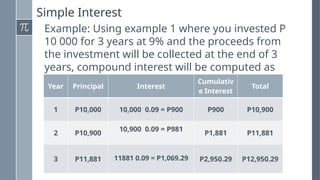
Simple Interest
Example: Using example 1 where you invested P
10 000 for 3 years at 9% and the proceeds from
the investment will be collected at the end of 3
years, compound interest will be computed as
follows:
Year Principal Interest
Cumulativ
e Interest
Total
1 P10,000 10,000 0.09 = P900 P900 P10,900
2 P10,900
10,900 0.09 = P981
P1,881 P11,881
3 P11,881 11881 0.09 = P1,069.29 P2,950.29 P12,950.29
Compound Interest
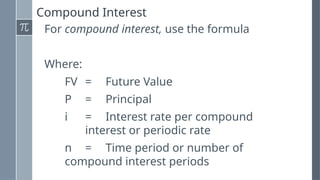
For compound interest, use the formula
Where:
FV = Future Value
P = Principal
i = Interest rate per compound
interest or periodic rate
n = Time period or number of
compound interest periods
Compound Interest
Subtract the principal from the future value to
get the compound interest. Hence,
Where:
= Compound Interest
FV = Future Value
P = Principal
Future Value of Money
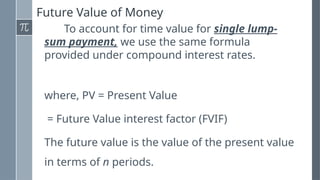
To account for time value for single lump-
sum payment, we use the same formula
provided under compound interest rates.
where, PV = Present Value
= Future Value interest factor (FVIF)
The future value is the value of the present value
in terms of n periods.
Future Value of Money
Example: Using the formula, find the future
values of P 1 000 compounded at a 10% annual
interest at the end of one year, two years and five
years.
Solution: PV = P1,000 and i = 0.10
Formula:
Year 1
Year 2
Year 5
Future Value of Money
Example: Determine the compound amount on
an investment at the end of 2 years if P 20 000 is
deposited at 4% compounded a) semi-annually
and b) quarterly.
Solution: a) Given: , ,
b) Given: , ,
Present Value of Money
To get the present value of lump-sum;
where, Present value interest factor
(PVIF) or discount factor.
Present Value of Money
Example: Jack would like to buy a car two years
from now using the proceeds of a 20% investment
that is compounded semi-annually. If the
projected price of the car is P 1 400 000, how
much money must be invested today to earn the
price of the car?
Solution:
Given: , ,

Lesson 6 Basic Long-Term Financial Concept.pptx

  • 1.
    Lesson 6: BasicLong-Term Financial Concepts
  • 2.
    “A peso todayis worth more than a peso tomorrow”
  • 3.
    Interest The most basicfinance-related formula is the computation of interest. It is computed as follows: Where: = Interest = Principal = Interest Rate = Time Period
  • 4.
    Interest As a review,try this exercise by identifying the a) principal, b) interest rate, and time period in the examples below. 1. Your mother invested P 18 000 in government securities that yields 6% annually for two years. 2. Your father obtained a car loan for P 800 000 with an annual rate of 15% for 5 years. 3. Your sister placed her graduation gifts amounting to P 25 000 in a special savings account that provides an interest of 2% for 8 months.
  • 5.
    Interest 4. Your brotherborrowed from your neighbor P 7 000 to buy a new mobile phone. The neighbor charged 11% for the borrowed amount payable after three years. 5. You deposited P 5 000 from the savings of your daily allowance in a time deposit account with your savings bank at a rate of 15% per annum. This will mature in 6 months.
  • 6.
    Interest In general businessterms, interest is defined as the cost of using money over time. This definition is in close agreement with the definition used by economists, who prefer to say that interest represents the time value of money. Interest is the excess of resources (usually cash) received or paid over the amount of resources loaned or borrowed which is called the principal.
  • 7.
    Simple Interest Simple Interestis the product of the principal amount multiplied by the period’s interest rate (a one-year rate in standard).
  • 8.
    Simple Interest Example: Youinvested P 10 000 for 3 years at 9% and the proceeds from the investment will be collected at the end of 3 years. Using a simple interest assumption, the calculation will be as follows: Year Principal Interest Cumulative Interest Total 1 P10,000 10,000 0.09 = P900 P900 P10,900 2 P10,000 10,000 0.09 = P900 P1,800 P11,800 3 P10,000 10,000 0.09 = P900 P2,700 P12,700
  • 9.
    Compound Interest Compound interestis the interest paid on both the principal and the amount of interest accumulated in prior periods.
  • 10.
    Simple Interest Example: Usingexample 1 where you invested P 10 000 for 3 years at 9% and the proceeds from the investment will be collected at the end of 3 years, compound interest will be computed as follows: Year Principal Interest Cumulativ e Interest Total 1 P10,000 10,000 0.09 = P900 P900 P10,900 2 P10,900 10,900 0.09 = P981 P1,881 P11,881 3 P11,881 11881 0.09 = P1,069.29 P2,950.29 P12,950.29
  • 11.
    Compound Interest For compoundinterest, use the formula Where: FV = Future Value P = Principal i = Interest rate per compound interest or periodic rate n = Time period or number of compound interest periods
  • 12.
    Compound Interest Subtract theprincipal from the future value to get the compound interest. Hence, Where: = Compound Interest FV = Future Value P = Principal
  • 13.
    Future Value ofMoney To account for time value for single lump- sum payment, we use the same formula provided under compound interest rates. where, PV = Present Value = Future Value interest factor (FVIF) The future value is the value of the present value in terms of n periods.
  • 14.
    Future Value ofMoney Example: Using the formula, find the future values of P 1 000 compounded at a 10% annual interest at the end of one year, two years and five years. Solution: PV = P1,000 and i = 0.10 Formula: Year 1 Year 2 Year 5
  • 15.
    Future Value ofMoney Example: Determine the compound amount on an investment at the end of 2 years if P 20 000 is deposited at 4% compounded a) semi-annually and b) quarterly. Solution: a) Given: , , b) Given: , ,
  • 16.
    Present Value ofMoney To get the present value of lump-sum; where, Present value interest factor (PVIF) or discount factor.
  • 17.
    Present Value ofMoney Example: Jack would like to buy a car two years from now using the proceeds of a 20% investment that is compounded semi-annually. If the projected price of the car is P 1 400 000, how much money must be invested today to earn the price of the car? Solution: Given: , ,