THE
ECONOMIC
PROBLEMS
LESSON 2
2 Annual Review May 19, 2024
OBJECTIVES
At the end of this lesson, you will be able to:
a. state the central economic problem of
resource allocation;
b. enumerate the four factors of production
needed to produce economic goods and
services;
c. enumerate the three economic questions and
know how economic systems differ in
managing these questions; and
d. define and draw the production possibilities
frontier and use it to analyze production,
resource allocation, and growth of the
economy over time.
3 Annual Review May 19, 2024
Following up on the discussion of scarcity as the central economic
problem having limited resources to satisfy unlimited wants and
needs, a nation is faced with three economic problems that deal
with the production, distribution and consumption of goods and
services.
Introduction
4 Annual Review May 19, 2024
Factors of Production
There are four main factors of production used to create goods and services in the
economy. They pertain to the term resources or inputs of production. The return on the use of
these inputs of production is called factor income. There resources are as follows:
 Land – This represents land and similar natural resources available such as
farms and agricultural land. Factor income: Rent
 Labor – This represents human capital such as workers and employees that
transform raw materials and regulate equipment in production. Factor income:
Wage
 Capital – This represents physical assets such as production facilities,
warehouse, and technology used in the production. It can also refer to
investment capital. Factor income: Interest
 Entrepreneurship – This represents the managerial ability of man in deciding
how much of and what way the other factors are to be used in production.
Factor income: Profit
5 Annual Review May 19, 2024
Goods and Services
Resources are combined in a variety of ways to produce goods and services.
 Good – an item you can see, feel and touch that requires scarce resources to produce and satisfies
human wants.
 Service – something not physical that requires scarce resources to produce and satisfies human wants.
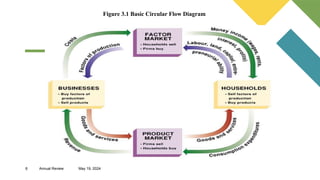
The Circular Flow Diagram – This is an economic model that illustrates the flow
of factors of production in the economy.
6 Annual Review May 19, 2024
Figure 3.1 Basic Circular Flow Diagram
7 Annual Review May 19, 2024
 Households provide factor inputs to firms in exchange for income in the form of wages, rent and
dividends.
 Firms provide goods and services to households in exchange for profit in the form of payments for
the goods and services.
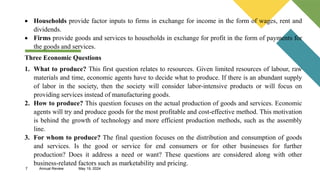
Three Economic Questions
1. What to produce? This first question relates to resources. Given limited resources of labour, raw
materials and time, economic agents have to decide what to produce. If there is an abundant supply
of labor in the society, then the society will consider labor-intensive products or will focus on
providing services instead of manufacturing goods.
2. How to produce? This question focuses on the actual production of goods and services. Economic
agents will try and produce goods for the most profitable and cost-effective method. This motivation
is behind the growth of technology and more efficient production methods, such as the assembly
line.
3. For whom to produce? The final question focuses on the distribution and consumption of goods
and services. Is the good or service for end consumers or for other businesses for further
production? Does it address a need or want? These questions are considered along with other
business-related factors such as marketability and pricing.
8 Annual Review May 19, 2024
These economic problems or dilemmas are the center of each country’s
economic policies. Government policies are geared toward addressing the
concerns on a national level. For instance, should the Philippine government
invest in research to produce vaccine for Covid-19 or should it rely on China or
Russia? Should it prioritize building roads and improving infrastructure or should
it focus on health and poverty alleviation programs? Because resources are
limited (in this case, the government budget) the country cannot afford to address
all economic issues, at the same time in equal manners. These are illustrations of
economic issues faced by the country that are grounded on the same concepts of
what, how, and for whom.
“
E C O N O M I C P R O B L E M S
O F T H E C O U N T R Y
10 Annual Review May 19, 2024
•UNEMPLOYMENT
•POVERTY
•POORQUALITYOF
INFRASTUCTURE
•INCOMEINEQUALITY
11 Annual Review May 19, 2024
UNEMPLOYMENT
COMMON CAUSES
• The number of people entering the job market has been greater than the
number of jobs created.
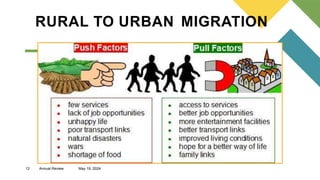
• The rural-urban migration increases due to employment
opportunities.
• May of the unemployed individuals are college graduates.
12 Annual Review May 19, 2024
RURAL TO URBAN MIGRATION
13 Annual Review May 19, 2024
WHAT CAN BE DONE TO SOLVE
UNEMPLOYMENT PROBLEM?
1. Appropriate economic policies for labor-intensive
industries.
2. Improve the educational system of the country
especially in the rural areas
3. Minimize rural-urban migration by improving the
economic environment in rural areas.
14 Annual Review May 19, 2024
WHAT CAN BE DONE TO SOLVE
UNEMPLOYMENT PROBLEM?
4.Proper coordination between government and the
private sector to solve the problem of job mismatch.
5. Slowing population growth. Philippine growth must
increase faster than the population. Limit the size of
6. Provision of more investment opportunities to
encourage local and international investment.
15 Annual Review May 19, 2024
POVERTY
COMMON CAUSES
•Increase in population
•Increase in the cost of living
•Unemployment
•Income inequality
16 Annual Review May 19, 2024
WHAT CAN BE DONE TO SOLVE
THE POVERTY PROBLEM?
1. Reduce unemployment
2. Appropriate policy on labor income
3. Provision of unemployment benefits for those who
will be unemployed due to natural or man made
calamities.
Ex.Typhoon, Bombing of terrorists, Earthquake
17 Annual Review May 19, 2024
WHAT CAN BE DONE TO SOLVE
THE POVERTY PROBLEM?
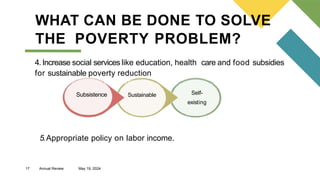
4. Increase social services like education, health care and food subsidies
for sustainable poverty reduction
Subsistence
Subsistence Sustainable Self-
existing
5.Appropriate policy on labor income.
18 Annual Review May 19, 2024
POOR QUALITY OF
INFRASTRUCTURE
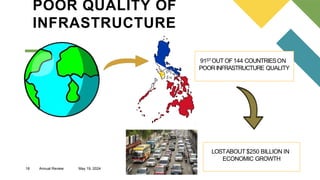
91STOUT OF144 COUNTRIESON
POORINFRASTRUCTURE QUALITY
LOSTABOUT $250 BILLION IN
ECONOMIC GROWTH
19 Annual Review May 19, 2024
WHAT CAN BE DONE TO IMPROVE
THE QUALITY OF
INFRASTRUCTURE?
1. The government shall implement fiscal reform
program
2. Continue reform in key sectors- particularly
power, roads and water – to improve cost
recovery, competition, and institutional
credibility and to sharply reduce corruption.
20 Annual Review May 19, 2024
WHAT CAN BE DONE TO IMPROVE
THE QUALITY OF
INFRASTRUCTURE?
3.Improving central oversight of the planning
and coordination of investments
4.Focus on investments through public-private
partnerships to achieve faster delivery of service
21 Annual Review May 19, 2024
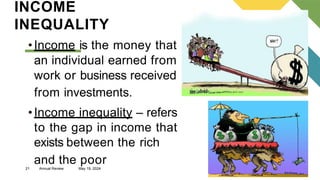
INCOME
INEQUALITY
•Income is the money that
an individual earned from
work or business received
from investments.
•Income inequality – refers
to the gap in income that
exists between the rich
and the poor
22 Annual Review May 19, 2024
MAJOR CAUSES OF INCOME
INEQUALITY
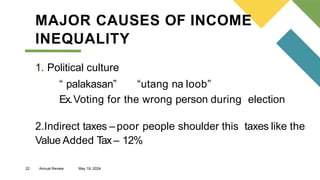
1. Political culture
“ palakasan” “utang na loob”
Ex.Voting for the wrong person during election
2.Indirect taxes –poor people shoulder this taxes like the
Value Added Tax– 12%
23 Annual Review May 19, 2024
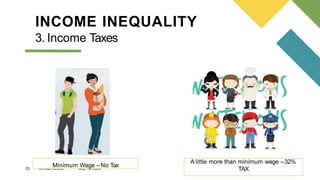
3. Income Taxes
INCOME INEQUALITY
Minimum Wage – No Tax
A little more than minimum wage –32%
TAX
24 Annual Review May 19, 2024
WHAT CAN BE DONE TO SOLVE
THE PROBLEM OF INCOME
INEQUALITY
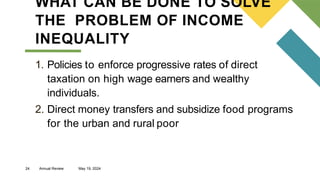
1. Policies to enforce progressive rates of direct
taxation on high wage earners and wealthy
individuals.
2. Direct money transfers and subsidize food programs
for the urban and rural poor
25 Annual Review May 19, 2024
SOLUTIONS TO INCOME
INEQUALITY
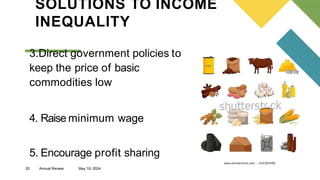
3.Direct government policies to
keep the price of basic
commodities low
4. Raise minimum wage
5. Encourage profit sharing
Thank you
Thanks to your commitment and strong work ethic, we
know next year will be even better than the last.
We look forward to working together.
Contoso
sales@contoso.com

The Economic Problem and Economic Factors

  • 1.
  • 2.
    2 Annual ReviewMay 19, 2024 OBJECTIVES At the end of this lesson, you will be able to: a. state the central economic problem of resource allocation; b. enumerate the four factors of production needed to produce economic goods and services; c. enumerate the three economic questions and know how economic systems differ in managing these questions; and d. define and draw the production possibilities frontier and use it to analyze production, resource allocation, and growth of the economy over time.
  • 3.
    3 Annual ReviewMay 19, 2024 Following up on the discussion of scarcity as the central economic problem having limited resources to satisfy unlimited wants and needs, a nation is faced with three economic problems that deal with the production, distribution and consumption of goods and services. Introduction
  • 4.
    4 Annual ReviewMay 19, 2024 Factors of Production There are four main factors of production used to create goods and services in the economy. They pertain to the term resources or inputs of production. The return on the use of these inputs of production is called factor income. There resources are as follows:  Land – This represents land and similar natural resources available such as farms and agricultural land. Factor income: Rent  Labor – This represents human capital such as workers and employees that transform raw materials and regulate equipment in production. Factor income: Wage  Capital – This represents physical assets such as production facilities, warehouse, and technology used in the production. It can also refer to investment capital. Factor income: Interest  Entrepreneurship – This represents the managerial ability of man in deciding how much of and what way the other factors are to be used in production. Factor income: Profit
  • 5.
    5 Annual ReviewMay 19, 2024 Goods and Services Resources are combined in a variety of ways to produce goods and services.  Good – an item you can see, feel and touch that requires scarce resources to produce and satisfies human wants.  Service – something not physical that requires scarce resources to produce and satisfies human wants. The Circular Flow Diagram – This is an economic model that illustrates the flow of factors of production in the economy.
  • 6.
    6 Annual ReviewMay 19, 2024 Figure 3.1 Basic Circular Flow Diagram
  • 7.
    7 Annual ReviewMay 19, 2024  Households provide factor inputs to firms in exchange for income in the form of wages, rent and dividends.  Firms provide goods and services to households in exchange for profit in the form of payments for the goods and services. Three Economic Questions 1. What to produce? This first question relates to resources. Given limited resources of labour, raw materials and time, economic agents have to decide what to produce. If there is an abundant supply of labor in the society, then the society will consider labor-intensive products or will focus on providing services instead of manufacturing goods. 2. How to produce? This question focuses on the actual production of goods and services. Economic agents will try and produce goods for the most profitable and cost-effective method. This motivation is behind the growth of technology and more efficient production methods, such as the assembly line. 3. For whom to produce? The final question focuses on the distribution and consumption of goods and services. Is the good or service for end consumers or for other businesses for further production? Does it address a need or want? These questions are considered along with other business-related factors such as marketability and pricing.
  • 8.
    8 Annual ReviewMay 19, 2024 These economic problems or dilemmas are the center of each country’s economic policies. Government policies are geared toward addressing the concerns on a national level. For instance, should the Philippine government invest in research to produce vaccine for Covid-19 or should it rely on China or Russia? Should it prioritize building roads and improving infrastructure or should it focus on health and poverty alleviation programs? Because resources are limited (in this case, the government budget) the country cannot afford to address all economic issues, at the same time in equal manners. These are illustrations of economic issues faced by the country that are grounded on the same concepts of what, how, and for whom.
  • 9.
    “ E C ON O M I C P R O B L E M S O F T H E C O U N T R Y
  • 10.
    10 Annual ReviewMay 19, 2024 •UNEMPLOYMENT •POVERTY •POORQUALITYOF INFRASTUCTURE •INCOMEINEQUALITY
  • 11.
    11 Annual ReviewMay 19, 2024 UNEMPLOYMENT COMMON CAUSES • The number of people entering the job market has been greater than the number of jobs created. • The rural-urban migration increases due to employment opportunities. • May of the unemployed individuals are college graduates.
  • 12.
    12 Annual ReviewMay 19, 2024 RURAL TO URBAN MIGRATION
  • 13.
    13 Annual ReviewMay 19, 2024 WHAT CAN BE DONE TO SOLVE UNEMPLOYMENT PROBLEM? 1. Appropriate economic policies for labor-intensive industries. 2. Improve the educational system of the country especially in the rural areas 3. Minimize rural-urban migration by improving the economic environment in rural areas.
  • 14.
    14 Annual ReviewMay 19, 2024 WHAT CAN BE DONE TO SOLVE UNEMPLOYMENT PROBLEM? 4.Proper coordination between government and the private sector to solve the problem of job mismatch. 5. Slowing population growth. Philippine growth must increase faster than the population. Limit the size of 6. Provision of more investment opportunities to encourage local and international investment.
  • 15.
    15 Annual ReviewMay 19, 2024 POVERTY COMMON CAUSES •Increase in population •Increase in the cost of living •Unemployment •Income inequality
  • 16.
    16 Annual ReviewMay 19, 2024 WHAT CAN BE DONE TO SOLVE THE POVERTY PROBLEM? 1. Reduce unemployment 2. Appropriate policy on labor income 3. Provision of unemployment benefits for those who will be unemployed due to natural or man made calamities. Ex.Typhoon, Bombing of terrorists, Earthquake
  • 17.
    17 Annual ReviewMay 19, 2024 WHAT CAN BE DONE TO SOLVE THE POVERTY PROBLEM? 4. Increase social services like education, health care and food subsidies for sustainable poverty reduction Subsistence Subsistence Sustainable Self- existing 5.Appropriate policy on labor income.
  • 18.
    18 Annual ReviewMay 19, 2024 POOR QUALITY OF INFRASTRUCTURE 91STOUT OF144 COUNTRIESON POORINFRASTRUCTURE QUALITY LOSTABOUT $250 BILLION IN ECONOMIC GROWTH
  • 19.
    19 Annual ReviewMay 19, 2024 WHAT CAN BE DONE TO IMPROVE THE QUALITY OF INFRASTRUCTURE? 1. The government shall implement fiscal reform program 2. Continue reform in key sectors- particularly power, roads and water – to improve cost recovery, competition, and institutional credibility and to sharply reduce corruption.
  • 20.
    20 Annual ReviewMay 19, 2024 WHAT CAN BE DONE TO IMPROVE THE QUALITY OF INFRASTRUCTURE? 3.Improving central oversight of the planning and coordination of investments 4.Focus on investments through public-private partnerships to achieve faster delivery of service
  • 21.
    21 Annual ReviewMay 19, 2024 INCOME INEQUALITY •Income is the money that an individual earned from work or business received from investments. •Income inequality – refers to the gap in income that exists between the rich and the poor
  • 22.
    22 Annual ReviewMay 19, 2024 MAJOR CAUSES OF INCOME INEQUALITY 1. Political culture “ palakasan” “utang na loob” Ex.Voting for the wrong person during election 2.Indirect taxes –poor people shoulder this taxes like the Value Added Tax– 12%
  • 23.
    23 Annual ReviewMay 19, 2024 3. Income Taxes INCOME INEQUALITY Minimum Wage – No Tax A little more than minimum wage –32% TAX
  • 24.
    24 Annual ReviewMay 19, 2024 WHAT CAN BE DONE TO SOLVE THE PROBLEM OF INCOME INEQUALITY 1. Policies to enforce progressive rates of direct taxation on high wage earners and wealthy individuals. 2. Direct money transfers and subsidize food programs for the urban and rural poor
  • 25.
    25 Annual ReviewMay 19, 2024 SOLUTIONS TO INCOME INEQUALITY 3.Direct government policies to keep the price of basic commodities low 4. Raise minimum wage 5. Encourage profit sharing
  • 26.
    Thank you Thanks toyour commitment and strong work ethic, we know next year will be even better than the last. We look forward to working together. Contoso sales@contoso.com