LET’S CHECK YOURPRIOR KNOWLEDGE…
Directions: Identify what scarce resource is represented in
each picture. Analyze the supporting sentence of each item
and write MICRO if it belongs to microeconomics and
MACRO if it is macroeconomics. Jumbled word is provided
to guide you identify the scarce resource asked.
3.
Many people arenot able to eat enough in
a day because of the lockdowns during the
pandemic.
4.
People are havinga problem on saving
money due to Inflation or increase in
the price level of goods and services.
Some students inrural areas are having
trouble doing their work due to lack
of internet access.
8.
There’s a shortageof school supplies in
the market of some remote islands due to
the delayed delivery from the suppliers
caused by restrictions on transportation
during the pandemic.
LOOHCS SUPPEILS
9.
Medical practitioners donot have enough
supplies to protect themselves
during the COVID-19 pandemic.
10.
WHAT IS IT?
Economicsis a branch of
social science concerned with
the use of limited resources
to meet boundless desires
(Rabanal, 2018).
11.
NATURE OF ECONOMICS
Itinvolves a systematized collection of facts and
figures.
It is based on the formulation of theories and laws.
It deals with the cause-and-effect relationship.
12.
SCOPE OF ECONOMICS
Microeconomicsstudies the
behavior of individual market
participants such as
consumers, producers, and resource
owners, as well as corporations.
13.
SCOPE OF ECONOMICS
Itis more concerned with the
flow of commodities from the
business to the consumer, as well
as the movement of resources from
the resource owner to the
business.
14.
SCOPE OF ECONOMICS
Italso deals with the
process of determining the
price of commodities,
commonly known as Price
Theory.
15.
Elasticity: The ratioof change in the percentage
of one variable to another variable is
determined by elasticity. For example, demand
elasticity of income, demand elasticity of price,
demand elasticity of supply, and so on.
CHARACTERISTICS OF MICROECONOMICS:
16.
Theory of Production:It entails the
conversion of inputs into outputs in a cost-
effective manner. Packaging, shipping,
storage, and manufacturing are only a
few examples.
CHARACTERISTICS OF MICROECONOMICS:
17.
Cost of Production:This theory
evaluates the object price based
on the cost of resources.
CHARACTERISTICS OF MICROECONOMICS:
18.
Oligopoly: It refersto the
market domination of tiny
businesses.
CHARACTERISTICS OF MICROECONOMICS:
19.
Macroeconomics is abranch of
economics that studies the whole
economy and the issues that affect
it.
SCOPE OF ECONOMICS
Macroeconomics is concernedwith
the nature of economic growth, as
well as the extension of productive
capacity and national income.
SCOPE OF ECONOMICS
22.
AGGREGATES AND THEIRINTERACTIONS
OF MACROECONOMICS:
Growth: It investigates the elements that
contribute to economic growth, such as
an increase in a country's output per
capita through time.
23.
AGGREGATES AND THEIRINTERACTIONS
OF MACROECONOMICS:
Business Cycle: It argues for the central bank
and the government to collaborate in
formulating monetary and fiscal policies to track
output throughout the business cycle.
24.
AGGREGATES AND THEIRINTERACTIONS
OF MACROECONOMICS:
Unemployment: The unemployment rate is
used to calculate it. It is caused by a
number of variables, including pay increases, a
shortage of job openings, and so forth.
25.
AGGREGATES AND THEIRINTERACTIONS
OF MACROECONOMICS:
Inflation and Deflation: Inflation refers to an increase
in a commodity's price, whereas deflation refers to a
reduction in a commodity's price. These indicators are
useful for assessing the state of a country's economy.
26.
ECONOMICS AS ANAPPLIED
SCIENCE
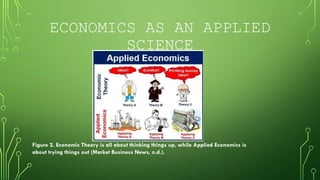
Figure 2. Economic Theory is all about thinking things up, while Applied Economics is
about trying things out (Market Business News, n.d.).
27.
ECONOMICS AS ANAPPLIED
SCIENCE
Applied Economics, as opposed to
economic theory, is the study of
economics in real world settings. It
is the application of economic ideas
and theories to real-world
circumstances with the goal of
predicting the results.
28.
ECONOMICS AS ANAPPLIED
SCIENCE
It is the application of economic
theory and econometrics to specific
situations in order to analyze possible
outcomes.
29.
It is characterizedby the application of the
core, referring to economic theory and
econometrics, as a means of dealing with
practical issues in fields such as demographic
economics, labor economics, business
economics, agricultural economics,
development economics, education economics,
health economics, monetary
economics, economic history, and many others.
30.
WHAT IS ECONOMETRICS?
Econometrics– is the application of statistical
and mathematical theories to economics for
the purpose of (Cambodian Economist Group, n.d.):
⚫ Testing hypotheses
⚫ Forecasting future trends
31.
Econometrics Example:
Real lifeapplication of
econometrics would be to study
the hypothesis that as a
person’s income increases,
spending increases (Macalinao,
E. M., 2017).
32.
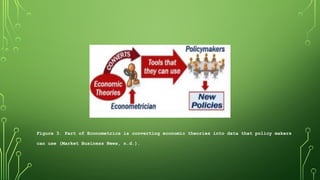
Figure 3. Partof Econometrics is converting economic theories into data that policy makers
can use (Market Business News, n.d.).
33.
WHAT IS THEIMPORTANCE OF APPLIED
ECONOMIC APPLICATION?
1. When economics is applied to a firm, a household, or a country, it
helps to eliminate any attempts to make a situation appear worse or
better than it is.
• Applied economics becomes a powerful tool for revealing the genuine
and entire situation so that actions can be taken.
Example:
Applied economics can be used to evaluate a company's earnings. The
findings may aid CEOs in devising tactics to increase sales.
34.
WHAT IS THEIMPORTANCE OF APPLIED
ECONOMIC APPLICATION?
2. Applied economics serves as a framework for determining what activities can be
taken to improve the current economic condition in a reasonable manner.
• by examining each aspect, it is possible to improve areas where performance is
lacking.
Example:
• Buying and selling products and services
• The utilization of raw materials
• Within the organization, there is a division of labor (e.g., firm, company, agency)
35.
WHAT IS THEIMPORTANCE OF APPLIED
ECONOMIC APPLICATION?
3. Applied economics may educate you the way to
avoid making costly mistakes.
• to review what steps were taken to improve and
correct situations and continue good
strategies to keep the economy flowing in a correct
direction.
36.
LET’S CHECK YOURUNDERSTANDING…
Directions. Give what is asked
for in each item. Write your
answers in your notebook.
37.
LET’S CHECK YOURUNDERSTANDING…
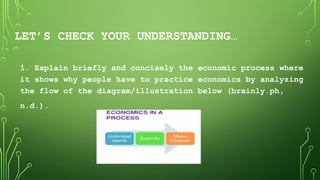
1. Explain briefly and concisely the economic process where
it shows why people have to practice economics by analyzing
the flow of the diagram/illustration below (brainly.ph,
n.d.).
38.
LET’S CHECK YOURUNDERSTANDING…
2. The scope of economics can be understood under two
subheads: Microeconomics and
Macroeconomics. Explain in the Venn diagram their
differences and similarities.
39.
LET’S CHECK YOURUNDERSTANDING…
3. Explain applied economics application by stating its
importance and their examples. Make use of a diagram to
show your explanation.
40.
LET’S CHECK YOURUNDERSTANDING…
How does resource scarcity impact
economic growth and development?
What are the implications for
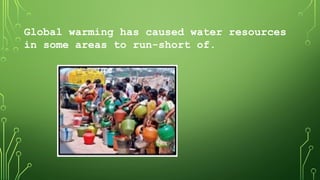
energy, water and food security?
Editor's Notes
#10 Everybody goes through each day faced with constraints or limitations: motorists
complain of high gasoline prices, times when people suffer because of a shortage of
chicken within the market, or insufficient allowance for a student who has to buy books and
faculty supplies. People always complain about not having enough-not enough food on the
table, not enough money to pay one’s debts, or not enough income to fulfill all the family’s
needs.
With this, we can say that there is an existing scarcity and there is insufficiency to
satisfy the requirements of consumers and insufficiency of resources for producers that
hamper enough production of products and services. And that is the reason why we have to
practice economics.
Economics is a branch of social science concerned with the use of limited resources to
meet boundless desires (Rabanal, 2018).
The desire to have as many goods and services as possible is a part of human
behavior. Consumer's salary and purchasing power, however, limit their ability to purchase
goods and services. As a result, consumers must conduct economics in this setting"
(Introduction to Economics, n.d.).
Because economics is derived from the ancient Greek word oikonomia, which means
family or household management (Top 4 Definitions of Economics, n.d.), Alfred Marshall, a
well-known economist, defined economics as a study of humans engaged in everyday
activities. “It investigates part of the individual and social activity that is most intimately
related to the acquisition and use of material requisites of well-being,” he says.
Because of the presence of scarcity, there’s a necessity for man, to create decisions in
choosing a way to maximize the utilization of scarce resources to satisfy as many needs as
possible. As an example, a worker who includes a monthly budget must choose the way to
utilize it to pay the rent, buy food, and buy new clothes. If his budget isn’t enough, then the
worker needs to hand over a number of this stuff. If he decides to not buy new clothes this
year, then this is the choice to give up.
The social science of economics is described as the study of the production,
distribution, and consumption of goods and services (The Nature and Scope of Economics,
2018).
Economic studies became one of the most important subjects of recent times as it
evolved over the nineteenth century. Economics plays a critical part in the smooth operation
of both a small store and a country. Without the use of economic principles, no business can
thrive. The field of economics is vast and diverse. The interaction of economic agents and the
way economies run are central to the nature and scope of economics.
#11
These characteristics that demonstrate the nature of economics is linked to science.
Various economic theories are built on logical reasoning, and real-life scenarios are utilized
to develop models on which assumptions are made, much as they are in science.
The foundation of economic theory is the evaluation of human interactions in terms of
desires, decision-making, and constraints. Because of the complexity of human motivation
and systems, assumptions have been established that serve as the foundation for consumer
and company behavior theories, which are both used to simulate circular flow interactions
within the economy.
Economics provides a simple foundation for comprehending the complexity of the
world's relationships. The circular flow picture in Task 4 Figure 1 by Irconomics 2008, for
example, depicts the economic framework associated to the dynamic interconnection of
economic agents. The circular flow is limited to households and businesses in the figure
above, while some renderings include the government and foreign trading partners.
In the case of consumer and corporate behavior, economics gives sophisticated
frameworks for analyzing complicated societal interactions. Representatives who grasp how
salaries and consumption move between consumers and producers are better able to
understand the relationship's symbiosis rather than focusing on the controversial elements
that surface from time to time.
Individuals can become better decision-makers in their own lives and maintain a
balance with respect to an externality that has the ability to supplement or hinder their
ambitions by having a grasp of the foundations of economics. Knowing the basics of
economics allows an individual to be an active and informed participant instead of a passive
economic agent, as economic theories serve as a foundation for decision-making and
regulatory policy.
Economics is a social science that studies the relationship between the production and
consumption of commodities and services in a finite resource environment. The discipline
focuses on how economic agents behave or interact both individually (microeconomics) and
collectively aggregate (macroeconomics).
#27 Simply put, applied economics is the study of how theories work in the real world. At
either the macroeconomic or microeconomic levels, the discipline can be applied.
Microeconomics examines economics at the individual consumer company level,
whereas macroeconomics examines the entire economy.
#35 By investigating and analyzing real-world economic problems, we should always be
ready to increase human wellbeing among Filipinos. Applying economic theory in our lives
means to handle actual economic issues and be able to do something about it. The concept of
scarcity and selection should encourage us as individuals to assist in our own way to provide
solutions to the country’s economic problems.