Introduction
× Economics is, in fact, the study of how a
society decides on what, how and for whom to
produce. While the so called microeconomics
analysis focuses on a detailed treatment of
individual decisions about some particular
commodities, the so called macroeconomics
analysis emphasizes the interactions in the
economy as a whole.
2
Introduction
× Similar to any other social science,
economics has appeared in power system
field, too. Like any other man-made
industry, electric power industry in
confronted with revenues and cost;
resulting in economic principles to be
continuously observed. The emerged
electric power markets have resulted in full
involvements of this industry in economics
based theories, applications and principles.
3
DEFINITION OF TERMS
COST
The money that a company earns by providing services in a
given period such as a year.
REVENUE
The expense incurred in providing the services during a
period.
PROFIT
The excess of revenue over the cost.
DEFINITION OF TERMS
OPERATIONAL COST
Cost incurred in investing on machinery equipment and
buildings used in providing the services.
INVESTMENT COST
Cost incurred in running a system to provide the services.
Wages, resources , taxes are such typical costs.
DEPRECIATION
Loss in value resulting from the use of machinery and equipment
during the period.
DEFINITION OF TERMS
NOMINAL INTEREST RATE
The rate of such loss in value.
DEPRECIATION RATE
Annual percentage increase in the nominal value of a
financial asset.
INFLATION RATE
Percentage increase per a specific period (typically a year) in the
average price of goods and services.
DEFINITION OF TERMS
PRESENT VALUE
The nominal interest rate minus the inflation rate.
REAL INTEREST RATE
Present value of some money at some future date is the
sum that it lent out today, would accumulate to x by that
future date. If this present value is represented by P and
the annual interest rate is termed I, after N years we would
have (F).
DEFINITION OF TERMS
SALVATION VALUE
Discount factor is the factor used in calculating present
values. It is equal to 1/(1+i)n .
DISCOUNT FACTOR
Real value of an asset/ equipment, remaining, at a specific
time and after considering the depreciation rate.
DEFINITION OF TERMS
GDP measures the output product produced by factors of
production located in a domestic economy regardless of who
owns these factors. GDP measures the value of output produced
within the economy. While most of this output would be
produced by domestic factors of production, there may be some
exceptions.
GROSS DOMESTIC PRODUCT (GDP)
DEFINITION OF TERMS
GNP measures the total income earned by domestic citizens
regardless of the country in which their factor services are
supplied. GNP equals GDP plus net property income from
abroad.
GROSS NATIONAL PRODUCT (GDP)
NOMINAL GNP
Measures GNP at the prices prevailing when income is
earned.
DEFINITION OF TERMS
PER CAPITA INCOME (or per capita real GNP
Real GNP or GNP at constant prices adjusts for inflation by
measuring GNP in different year at the prevailing at some
particular calendar data known as the base year.
REAL GNP
Real GNP divided by the total population. It is real GNP
per head.
The flow of money, both the input and
the outputs, resulting from a project is
called cash-flow. In order to
understand this concept, we should
first define the time value of money.
CASH-FLOW CONCEPT
TIME VALUE OF MONEY
Any one easily understands that “money makes
money”. In other words, if we invest an amount of X,
we expect some percent to be added at the end of
the year. In other words ₱ X at present worth more
in the future. This concept is used if someone invests
or borrows money.
TIME VALUE OF MONEY
EXAMPLE 1:
If someone invests ₱ 100 on a project with
a 5% predicted return, he or she would gain
₱105 at the end of the year. In other words,
₱100 at present would worth ₱105 in one
year time
TIME VALUE OF MONEY
EXAMPLE 2:
Assume someone borrows ₱100 to pay it
back within a year with an annual interest
rate of 10%. He or she would have to return
₱110 at the end of the year.
ECONOMIC TERMS
INFLOWS (such as income)
OUTFLOWS (such as a cost)
Both types may occur at present or in a specific time in
the future. We should, then, define the present value of
money (P) and the future value of money (F). The
number of periods is assumed to be n while the
interest rate is assumed to be i (%).
ECONOMIC TERMS
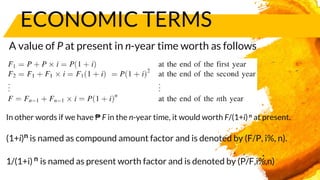
A value of P at present in n-year time worth as follows
In other words if we have ₱ F in the n-year time, it would worth F/(1+i)n at present.
(1+i)n is named as compound amount factor and is denoted by (F/P, i%, n).
1/(1+i) n is named as present worth factor and is denoted by (P/F,i%,n)
ECONOMIC TERMS
EXAMPLE 3:
If we repeat example 1 (time value of
money) for a 5 year period, the investor
gains ₱ (1+0.05)5 x 100= ₱127.6 at the end
of the fifth year.
ECONOMIC TERMS
EXAMPLE 4:
What happens if we repeat example 2 for a 10 year
period. In other words, the borrower has to pay
back the money in a 10 year time. We can readily
check that the borrower should return a total
amount of ₱ (1+0.1)10 x 100= ₱259.4 at the end of
the 10 year time.
Thanks!
Any questions?
Reported by: Montebon, Adrian Roy L.
BSEE-III
20

economic principles

  • 2.
    Introduction × Economics is,in fact, the study of how a society decides on what, how and for whom to produce. While the so called microeconomics analysis focuses on a detailed treatment of individual decisions about some particular commodities, the so called macroeconomics analysis emphasizes the interactions in the economy as a whole. 2
  • 3.
    Introduction × Similar toany other social science, economics has appeared in power system field, too. Like any other man-made industry, electric power industry in confronted with revenues and cost; resulting in economic principles to be continuously observed. The emerged electric power markets have resulted in full involvements of this industry in economics based theories, applications and principles. 3
  • 4.
    DEFINITION OF TERMS COST Themoney that a company earns by providing services in a given period such as a year. REVENUE The expense incurred in providing the services during a period. PROFIT The excess of revenue over the cost.
  • 5.
    DEFINITION OF TERMS OPERATIONALCOST Cost incurred in investing on machinery equipment and buildings used in providing the services. INVESTMENT COST Cost incurred in running a system to provide the services. Wages, resources , taxes are such typical costs. DEPRECIATION Loss in value resulting from the use of machinery and equipment during the period.
  • 6.
    DEFINITION OF TERMS NOMINALINTEREST RATE The rate of such loss in value. DEPRECIATION RATE Annual percentage increase in the nominal value of a financial asset. INFLATION RATE Percentage increase per a specific period (typically a year) in the average price of goods and services.
  • 7.
    DEFINITION OF TERMS PRESENTVALUE The nominal interest rate minus the inflation rate. REAL INTEREST RATE Present value of some money at some future date is the sum that it lent out today, would accumulate to x by that future date. If this present value is represented by P and the annual interest rate is termed I, after N years we would have (F).
  • 8.
    DEFINITION OF TERMS SALVATIONVALUE Discount factor is the factor used in calculating present values. It is equal to 1/(1+i)n . DISCOUNT FACTOR Real value of an asset/ equipment, remaining, at a specific time and after considering the depreciation rate.
  • 9.
    DEFINITION OF TERMS GDPmeasures the output product produced by factors of production located in a domestic economy regardless of who owns these factors. GDP measures the value of output produced within the economy. While most of this output would be produced by domestic factors of production, there may be some exceptions. GROSS DOMESTIC PRODUCT (GDP)
  • 10.
    DEFINITION OF TERMS GNPmeasures the total income earned by domestic citizens regardless of the country in which their factor services are supplied. GNP equals GDP plus net property income from abroad. GROSS NATIONAL PRODUCT (GDP) NOMINAL GNP Measures GNP at the prices prevailing when income is earned.
  • 11.
    DEFINITION OF TERMS PERCAPITA INCOME (or per capita real GNP Real GNP or GNP at constant prices adjusts for inflation by measuring GNP in different year at the prevailing at some particular calendar data known as the base year. REAL GNP Real GNP divided by the total population. It is real GNP per head.
  • 12.
    The flow ofmoney, both the input and the outputs, resulting from a project is called cash-flow. In order to understand this concept, we should first define the time value of money. CASH-FLOW CONCEPT
  • 13.
    TIME VALUE OFMONEY Any one easily understands that “money makes money”. In other words, if we invest an amount of X, we expect some percent to be added at the end of the year. In other words ₱ X at present worth more in the future. This concept is used if someone invests or borrows money.
  • 14.
    TIME VALUE OFMONEY EXAMPLE 1: If someone invests ₱ 100 on a project with a 5% predicted return, he or she would gain ₱105 at the end of the year. In other words, ₱100 at present would worth ₱105 in one year time
  • 15.
    TIME VALUE OFMONEY EXAMPLE 2: Assume someone borrows ₱100 to pay it back within a year with an annual interest rate of 10%. He or she would have to return ₱110 at the end of the year.
  • 16.
    ECONOMIC TERMS INFLOWS (suchas income) OUTFLOWS (such as a cost) Both types may occur at present or in a specific time in the future. We should, then, define the present value of money (P) and the future value of money (F). The number of periods is assumed to be n while the interest rate is assumed to be i (%).
  • 17.
    ECONOMIC TERMS A valueof P at present in n-year time worth as follows In other words if we have ₱ F in the n-year time, it would worth F/(1+i)n at present. (1+i)n is named as compound amount factor and is denoted by (F/P, i%, n). 1/(1+i) n is named as present worth factor and is denoted by (P/F,i%,n)
  • 18.
    ECONOMIC TERMS EXAMPLE 3: Ifwe repeat example 1 (time value of money) for a 5 year period, the investor gains ₱ (1+0.05)5 x 100= ₱127.6 at the end of the fifth year.
  • 19.
    ECONOMIC TERMS EXAMPLE 4: Whathappens if we repeat example 2 for a 10 year period. In other words, the borrower has to pay back the money in a 10 year time. We can readily check that the borrower should return a total amount of ₱ (1+0.1)10 x 100= ₱259.4 at the end of the 10 year time.
  • 20.
    Thanks! Any questions? Reported by:Montebon, Adrian Roy L. BSEE-III 20