Housing and the Economy:
  Impacts and Forecasts

Geoffrey J.D. Hewings, Ph.D.
Director
Regional Economics Applications Laboratory (REAL)
University of Illinois
Institute of Government and Public Affairs
217.333.4740 217.244.9339 (fax)
hewings@illinois.edu
www.real.illinois.edu

                Illinois Association of REALTORS® January 2013
                Public Policy Meetings
Regional Economics Applications
Laboratory - University of Illinois

   Founded in 1989 initially as collaborative venture with
    the Federal Reserve Bank of Chicago

   Objective: enhance analytical capability for public
    policy decision-making at the urban and regional scale
    with an initial focus on Chicago and the Midwest

   Employs doctoral students from economics,
    agricultural economics, urban and regional planning
    and geography
2012-2013 Highlights
   Last half of 2012 revealed positive changes in prices
   Significant increase in sales volume
   Resolution of foreclosure issues saw significant
    increase in foreclosed properties
   Consumer optimism dampened by “fiscal cliff issues in
    Washington and the failure of Illinois state government
    to address deficit and unfunded pension obligations
   Combination of enhanced inventory, historically low
    interest rates and accelerating costs of renting should
    fuel the housing market in 2013
State of Illinois Economies

•   State is 330,000 below prior peak (November
    2000) “translates” into loss state income tax
    revenue of $0.4 billion+ in lost sales and income
    tax

But…need to add considerations of:
•   population growth since 2000
•   decrease in labor force participation rates
•   Large number in part-time who would like full-time
    employment THEN…
State of Illinois Economies

 State probably needs to add close to:

 •   647,000 jobs to achieve equivalent level to
     November 2000

 •   Chicago would need to add 285,000 jobs to
     return to 2000 level and another 100-140,000
     to account for additional factors noted
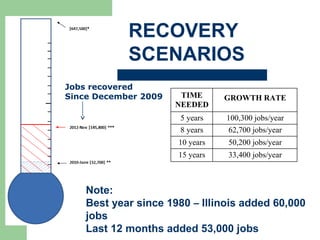
RECOVERY
            SCENARIOS
Jobs recovered
Since December 2009


    Note:
    Best year since 1980 – Illinois added 60,000
    jobs
    Last 12 months added 53,000 jobs
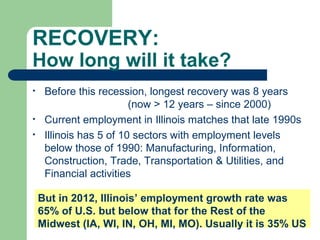
RECOVERY:
How long will it take?
•    Before this recession, longest recovery was 8 years
                         (now > 12 years – since 2000)
•    Current employment in Illinois matches that late 1990s
•    Illinois has 5 of 10 sectors with employment levels
     below those of 1990: Manufacturing, Information,
     Construction, Trade, Transportation & Utilities, and
     Financial activities

    But in 2012, Illinois’ employment growth rate was
    65% of U.S. but below that for the Rest of the
    Midwest (IA, WI, IN, OH, MI, MO). Usually it is 35% US
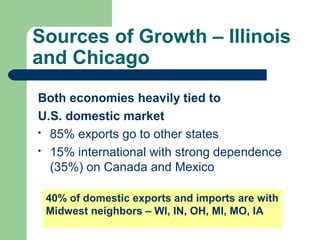
Sources of Growth – Illinois
and Chicago
Both economies heavily tied to
U.S. domestic market
 85% exports go to other states
 15% international with strong dependence
  (35%) on Canada and Mexico

 40% of domestic exports and imports are with
 Midwest neighbors – WI, IN, OH, MI, MO, IA
Sources of Growth – Illinois
and Chicago

    Recovery of Chicago and Illinois tied in
    with U.S. recovery but especially Midwest
    recovery

    Political leaders in Midwest fail to appreciate
     the negative effects of “job poaching” (e.g.
     the Indiana ad “Are you Illinoyed?”)
    Illinois is in a sense the economic locomotive
     for Midwest economy
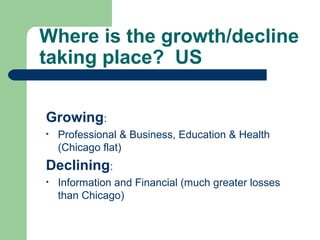
Where is the growth/decline
taking place? US

Growing:
•   Professional & Business, Education & Health
    (Chicago flat)
Declining:
•   Information and Financial (much greater losses
    than Chicago)
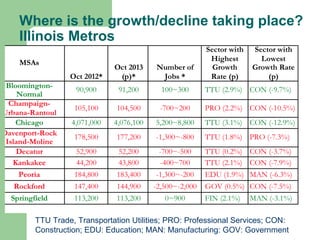
Where is the growth/decline taking place?
Illinois Metros


  TTU Trade, Transportation Utilities; PRO: Professional Services; CON:
  Construction; EDU: Education; MAN: Manufacturing: GOV: Government
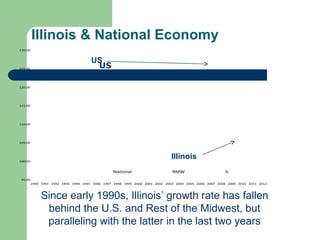
Illinois & National Economy
130.00


                                      US
125.00                                 US

120.00


115.00


110.00


105.00


100.00
                                                                            Illinois
                                                National                     RMW                      IL
 95.00
         1990 1991 1992 1993 1994 1995 1996 1997 1998 1999 2000 2001 2002 2003 2004 2005 2006 2007 2008 2009 2010 2011 2012


              Since early 1990s, Illinois’ growth rate has fallen
               behind the U.S. and Rest of the Midwest, but
               paralleling with the latter in the last two years
Illinois and National Economy


• Illinois’ performance is surprising in view of
  the fact that, unlike the Rest of the Midwest, it
  has a similar structure to the US
• Then, why have we underperformed US?
   • Lower population growth?
   • Loss of human capital?
   • Less competitive industries?
   • Governance issues?
Impacts of Migration &
Job Losses

• Probably see continued erosion of state’s
  competitive position (dropped from 4th to 15th
  in terms of per capita income in the last 15
  years)

• Average income of in-migrants lower than out-
  migrants leading to loss of income averaging
  $1billion over the 2000-2010 decade
  (translates into loss of 20,000 jobs)
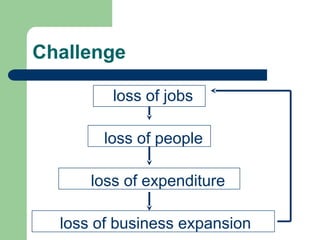
Challenge

         loss of jobs

        loss of people

      loss of expenditure

  loss of business expansion
Housing Market

Sources of Demand for Housing
Market
 •   New time buyers – special credit programs
 •   Housing turnover – people upsizing or
     downsizing
 •   Job relocation/migration
 •   Retirement
 •   Those currently “parked in rental properties”
Housing Market: Do
Incentive Programs Work?
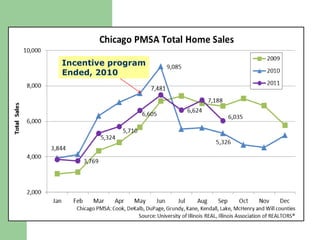
   Federal Government program successfully
    attracted buyers – but REAL estimated that
    CBO estimates were way too high
    (i.e., incremental sales associated with the program failed to
    account for sales that could normally have been expected to
    have been made)

   Secondly, after program ended, sales
    plummeted for several months eroding much
    of the benefit of the program

   In essence, all the program did was
    accelerate the timing of purchases
Incentive program
Ended, 2010
Housing Market: Turnover

    Turnover generating fewer sales as
    consumers become more risk adverse

•   In recent years, “time on the market” has
    extended to 15+ months (in the early 2000s,
    2-4 months was normal)

•   In December 2012, it was between 4-5
    months (pre-recession, 2+ months)
Housing Market: Turnover

•   Market segmentation by price becoming
    more pronounced
•   Time on market increases with price
•   However, note the significant decreases
    across all prices ranges comparing
    December 2012 with 2011
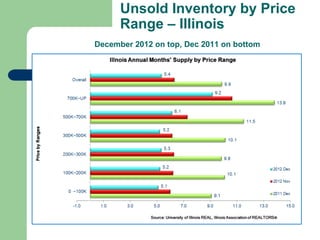
Unsold Inventory by Price
      Range – Illinois
December 2012 on top, Dec 2011 on bottom
Housing Market: Job
Relocation/Migration
Job relocation still important source of
demand but fewer people changing jobs

•   Migration rates have been declining since
    early 2000s - demographers are puzzled
    by this phenomenon
•   In a buoyant housing market and
    expectation of price appreciation,
    relocation often accompanied by sale and
    purchase of house
Housing Market: Job
Relocation/Migration
•   Now with job mobility down, those
    relocating often “parking” themselves in
    apartments to shelter against prospect of
    short-term negative equity in a home
•   Rental rates have thus risen in the last
    two years
•   A Deutsche Bank A.G., the cost of renting
    in Chicago was 31.3% higher than
    average after-tax monthly mortgage
    payments in the third quarter in 2012
Housing Market:
Retirement/Migration
•   Are retirees beginning to reconsider
    remaining in the Midwest?

•   Relative housing price declines greater in
    FL and AZ – suggesting that retirees could
    sell in IL (even below their desired price)
    and still afford the house they desire in FL
    or AZ
Housing Market:
Retirement/Migration
Is net effect positive or negative
for state?
•   Retiree incomes spent in Illinois
    generating positive ripple effects

•   Retirees remaining here are not selling
    their homes so there is a loss of energy in
    the housing market
Housing Market: Turnover
generates impacts

•   Through 2007, typical Illinois county
    experienced 11% turnover in households
    each year (5% in and 6% out)

•   Further 6-12% change houses within the
    same county

•   Rates tend to be higher in metro counties
Housing Market: Turnover
generates impacts

•   Illinois Total Direct Expenditures on a home
    sale is $28,581 (payments to REALTORS®,
    bank loan origination fees, state and county
    taxes, fix-up costs) source: recent IAR study
•   In 2010 111,319 sales so direct impact
    was $3.2 billion
•   Generates about $7.9 billion annually
    through ripple effect
Housing Market: Turnover
generates impacts
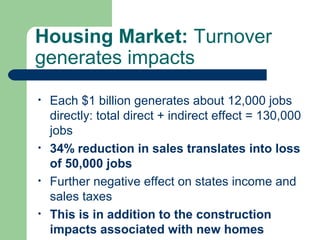
•   Each $1 billion generates about 12,000 jobs
    directly: total direct + indirect effect = 130,000
    jobs
•   34% reduction in sales translates into loss
    of 50,000 jobs
•   Further negative effect on states income and
    sales taxes
•   This is in addition to the construction
    impacts associated with new homes
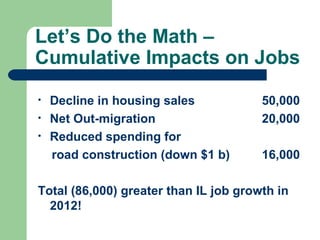
Let’s Do the Math –
Cumulative Impacts on Jobs
•   Decline in housing sales           50,000
•   Net Out-migration                  20,000
•   Reduced spending for
    road construction (down $1 b)      16,000

Total (86,000) greater than IL job growth in
  2012!
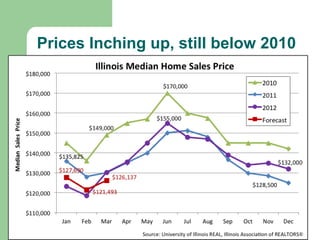
Prices Inching up, still below 2010
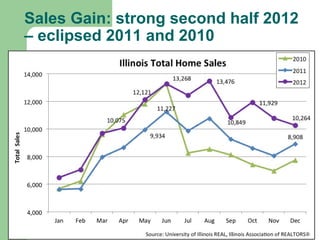
Sales Gain: strong second half 2012
– eclipsed 2011 and 2010
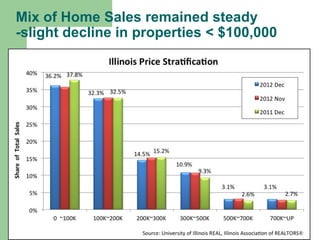
Mix of Home Sales remained steady
-slight decline in properties < $100,000
If sales have increased, why haven’t
prices? The Foreclosure Overhang

 Three   parts to consider:
  –   Filings
       Occurwhen mortgagee cannot make
        payments
  –   Sales
       Sale    of property returned to owner of the note
  –   Inventory
       Accumulation     of foreclosed properties not yet
        sold
The Foreclosure Overhang…..

More on inventory
•   Illinois uses the judicial foreclosure process.
•   A typical foreclosure case in Illinois takes 210 to 270
    days.
•   However, if the borrower tries to fight against the
    foreclosure process, then it will take much longer to
    finish the foreclosure process – accumulating in the
    inventory.
The Foreclosure Overhang…..

More on inventory
•   According to RealtyTrac, Chicago MSA has the
    highest foreclosure stock among the top 20 MSAs.
    Sooner or later, part of the foreclosure inventory will
    turn into foreclosure sales or short sales.
•   For several months in 2012, Illinois led nation in
    foreclosure sales
•   This foreclosure inventory generates large impact for
    the future housing market sales and prices.
The Foreclosure Overhang…..

More on inventory: Good news –
 Bad news
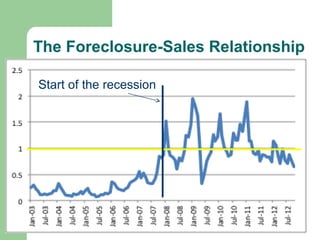
•   Bad news: foreclosed property sales drag down
    median prices
•   Good news: number of foreclosed sales greater
    than new additions to the inventory
•   Faster the foreclosed properties are moved,
    greater the possibility for some sustained price
    recovery (estimate 2 years)
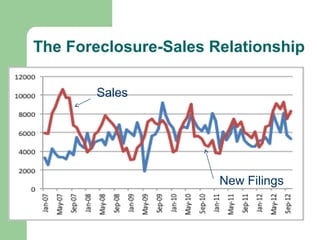
The Foreclosure-Sales Relationship

       Sales


                       New Filings
The Foreclosure-Sales Relationship

Start of the recession
Housing Market: Current
Situation: Sales
 In  December, year-over-year increase in sales
  slowed down: 10,264 houses were sold in
  Illinois, 15.2% more than a year ago.

 In
   Chicago, 7,372 houses were sold, 19.2%
  more than last December.
Housing Market: Current
Situation: Prices
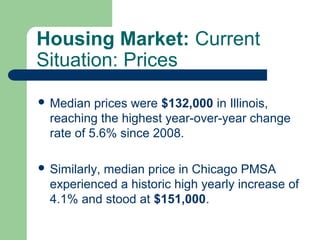
 Median   prices were $132,000 in Illinois,
  reaching the highest year-over-year change
  rate of 5.6% since 2008.

 Similarly,
           median price in Chicago PMSA
  experienced a historic high yearly increase of
  4.1% and stood at $151,000.
2013 Illinois Forecast: Prices
2013 Illinois Forecast: Price
Changes (year over year by month)
Housing Market:
Next 12 Months
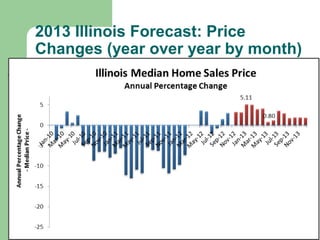
Through mid Year:
   • Year-over-year changes in monthly sales are
     mixed in both Illinois and Chicago;
Mid Year through December
   • Mixed changes tending to group around + or -
     1-3%.
Housing Market:
Next 12 Months
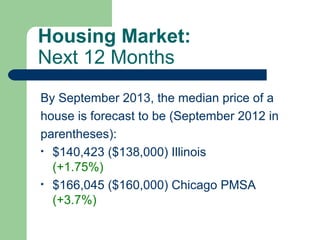
By September 2013, the median price of a
house is forecast to be (September 2012 in
parentheses):
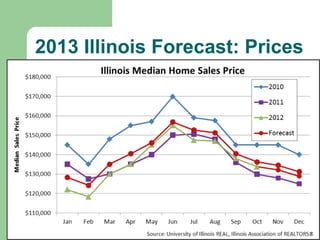
• $140,423 ($138,000) Illinois
  (+1.75%)
• $166,045 ($160,000) Chicago PMSA
  (+3.7%)
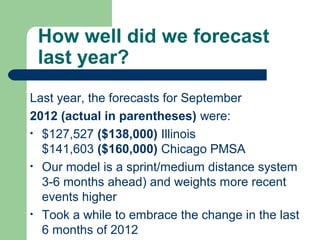
How well did we forecast
 last year?
Last year, the forecasts for September
2012 (actual in parentheses) were:
• $127,527 ($138,000) Illinois
  $141,603 ($160,000) Chicago PMSA
• Our model is a sprint/medium distance system
  3-6 months ahead) and weights more recent
  events higher
• Took a while to embrace the change in the last
  6 months of 2012
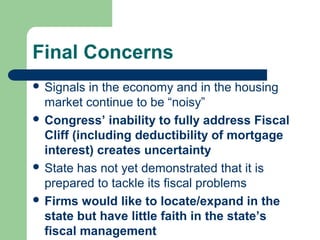
Final Concerns
 Signals  in the economy and in the housing
  market continue to be “noisy”
 Congress’ inability to fully address Fiscal
  Cliff (including deductibility of mortgage
  interest) creates uncertainty
 State has not yet demonstrated that it is
  prepared to tackle its fiscal problems
 Firms would like to locate/expand in the
  state but have little faith in the state’s
  fiscal management
Illinois’ Opportunities
 Re-shoring  is beginning to gather momentum
    Boston Consulting Group estimated Chinese
     wages will approach US levels in 3-5 years
 Developments in 3-D manufacturing have the
  capacity to change the state’s locational
  competitive advantage
 Do we have the leadership in place…?
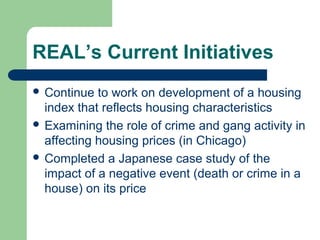
REAL’s Current Initiatives
 Continue  to work on development of a housing
  index that reflects housing characteristics
 Examining the role of crime and gang activity in
  affecting housing prices (in Chicago)
 Completed a Japanese case study of the
  impact of a negative event (death or crime in a
  house) on its price
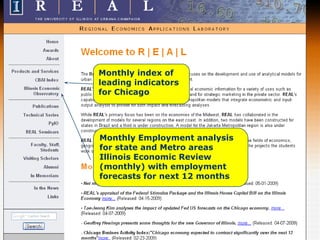
Monthly index of
leading indicators
for Chicago


            L

Monthly Employment analysis
for state and Metro areas
Illinois Economic Review
(monthly) with employment
forecasts for next 12 months
For More Information


       www.real.illinois.edu
www.illinoisrealtor.org/marketstats

Economic Forecast 2013

  • 1.
    Housing and theEconomy: Impacts and Forecasts Geoffrey J.D. Hewings, Ph.D. Director Regional Economics Applications Laboratory (REAL) University of Illinois Institute of Government and Public Affairs 217.333.4740 217.244.9339 (fax) hewings@illinois.edu www.real.illinois.edu Illinois Association of REALTORS® January 2013 Public Policy Meetings
  • 2.
    Regional Economics Applications Laboratory- University of Illinois  Founded in 1989 initially as collaborative venture with the Federal Reserve Bank of Chicago  Objective: enhance analytical capability for public policy decision-making at the urban and regional scale with an initial focus on Chicago and the Midwest  Employs doctoral students from economics, agricultural economics, urban and regional planning and geography
  • 3.
    2012-2013 Highlights  Last half of 2012 revealed positive changes in prices  Significant increase in sales volume  Resolution of foreclosure issues saw significant increase in foreclosed properties  Consumer optimism dampened by “fiscal cliff issues in Washington and the failure of Illinois state government to address deficit and unfunded pension obligations  Combination of enhanced inventory, historically low interest rates and accelerating costs of renting should fuel the housing market in 2013
  • 4.
    State of IllinoisEconomies • State is 330,000 below prior peak (November 2000) “translates” into loss state income tax revenue of $0.4 billion+ in lost sales and income tax But…need to add considerations of: • population growth since 2000 • decrease in labor force participation rates • Large number in part-time who would like full-time employment THEN…
  • 5.
    State of IllinoisEconomies State probably needs to add close to: • 647,000 jobs to achieve equivalent level to November 2000 • Chicago would need to add 285,000 jobs to return to 2000 level and another 100-140,000 to account for additional factors noted
  • 6.
    RECOVERY SCENARIOS Jobs recovered Since December 2009 Note: Best year since 1980 – Illinois added 60,000 jobs Last 12 months added 53,000 jobs
  • 7.
    RECOVERY: How long willit take? • Before this recession, longest recovery was 8 years (now > 12 years – since 2000) • Current employment in Illinois matches that late 1990s • Illinois has 5 of 10 sectors with employment levels below those of 1990: Manufacturing, Information, Construction, Trade, Transportation & Utilities, and Financial activities But in 2012, Illinois’ employment growth rate was 65% of U.S. but below that for the Rest of the Midwest (IA, WI, IN, OH, MI, MO). Usually it is 35% US
  • 8.
    Sources of Growth– Illinois and Chicago Both economies heavily tied to U.S. domestic market  85% exports go to other states  15% international with strong dependence (35%) on Canada and Mexico 40% of domestic exports and imports are with Midwest neighbors – WI, IN, OH, MI, MO, IA
  • 9.
    Sources of Growth– Illinois and Chicago Recovery of Chicago and Illinois tied in with U.S. recovery but especially Midwest recovery  Political leaders in Midwest fail to appreciate the negative effects of “job poaching” (e.g. the Indiana ad “Are you Illinoyed?”)  Illinois is in a sense the economic locomotive for Midwest economy
  • 10.
    Where is thegrowth/decline taking place? US Growing: • Professional & Business, Education & Health (Chicago flat) Declining: • Information and Financial (much greater losses than Chicago)
  • 11.
    Where is thegrowth/decline taking place? Illinois Metros TTU Trade, Transportation Utilities; PRO: Professional Services; CON: Construction; EDU: Education; MAN: Manufacturing: GOV: Government
  • 12.
    Illinois & NationalEconomy 130.00 US 125.00 US 120.00 115.00 110.00 105.00 100.00 Illinois National RMW IL 95.00 1990 1991 1992 1993 1994 1995 1996 1997 1998 1999 2000 2001 2002 2003 2004 2005 2006 2007 2008 2009 2010 2011 2012 Since early 1990s, Illinois’ growth rate has fallen behind the U.S. and Rest of the Midwest, but paralleling with the latter in the last two years
  • 13.
    Illinois and NationalEconomy • Illinois’ performance is surprising in view of the fact that, unlike the Rest of the Midwest, it has a similar structure to the US • Then, why have we underperformed US? • Lower population growth? • Loss of human capital? • Less competitive industries? • Governance issues?
  • 14.
    Impacts of Migration& Job Losses • Probably see continued erosion of state’s competitive position (dropped from 4th to 15th in terms of per capita income in the last 15 years) • Average income of in-migrants lower than out- migrants leading to loss of income averaging $1billion over the 2000-2010 decade (translates into loss of 20,000 jobs)
  • 15.
    Challenge loss of jobs loss of people loss of expenditure loss of business expansion
  • 16.
    Housing Market Sources ofDemand for Housing Market • New time buyers – special credit programs • Housing turnover – people upsizing or downsizing • Job relocation/migration • Retirement • Those currently “parked in rental properties”
  • 17.
    Housing Market: Do IncentivePrograms Work?  Federal Government program successfully attracted buyers – but REAL estimated that CBO estimates were way too high (i.e., incremental sales associated with the program failed to account for sales that could normally have been expected to have been made)  Secondly, after program ended, sales plummeted for several months eroding much of the benefit of the program  In essence, all the program did was accelerate the timing of purchases
  • 18.
  • 19.
    Housing Market: Turnover Turnover generating fewer sales as consumers become more risk adverse • In recent years, “time on the market” has extended to 15+ months (in the early 2000s, 2-4 months was normal) • In December 2012, it was between 4-5 months (pre-recession, 2+ months)
  • 20.
    Housing Market: Turnover • Market segmentation by price becoming more pronounced • Time on market increases with price • However, note the significant decreases across all prices ranges comparing December 2012 with 2011
  • 21.
    Unsold Inventory byPrice Range – Illinois December 2012 on top, Dec 2011 on bottom
  • 22.
    Housing Market: Job Relocation/Migration Jobrelocation still important source of demand but fewer people changing jobs • Migration rates have been declining since early 2000s - demographers are puzzled by this phenomenon • In a buoyant housing market and expectation of price appreciation, relocation often accompanied by sale and purchase of house
  • 23.
    Housing Market: Job Relocation/Migration • Now with job mobility down, those relocating often “parking” themselves in apartments to shelter against prospect of short-term negative equity in a home • Rental rates have thus risen in the last two years • A Deutsche Bank A.G., the cost of renting in Chicago was 31.3% higher than average after-tax monthly mortgage payments in the third quarter in 2012
  • 24.
    Housing Market: Retirement/Migration • Are retirees beginning to reconsider remaining in the Midwest? • Relative housing price declines greater in FL and AZ – suggesting that retirees could sell in IL (even below their desired price) and still afford the house they desire in FL or AZ
  • 25.
    Housing Market: Retirement/Migration Is neteffect positive or negative for state? • Retiree incomes spent in Illinois generating positive ripple effects • Retirees remaining here are not selling their homes so there is a loss of energy in the housing market
  • 26.
    Housing Market: Turnover generatesimpacts • Through 2007, typical Illinois county experienced 11% turnover in households each year (5% in and 6% out) • Further 6-12% change houses within the same county • Rates tend to be higher in metro counties
  • 27.
    Housing Market: Turnover generatesimpacts • Illinois Total Direct Expenditures on a home sale is $28,581 (payments to REALTORS®, bank loan origination fees, state and county taxes, fix-up costs) source: recent IAR study • In 2010 111,319 sales so direct impact was $3.2 billion • Generates about $7.9 billion annually through ripple effect
  • 28.
    Housing Market: Turnover generatesimpacts • Each $1 billion generates about 12,000 jobs directly: total direct + indirect effect = 130,000 jobs • 34% reduction in sales translates into loss of 50,000 jobs • Further negative effect on states income and sales taxes • This is in addition to the construction impacts associated with new homes
  • 29.
    Let’s Do theMath – Cumulative Impacts on Jobs • Decline in housing sales 50,000 • Net Out-migration 20,000 • Reduced spending for road construction (down $1 b) 16,000 Total (86,000) greater than IL job growth in 2012!
  • 30.
    Prices Inching up,still below 2010
  • 31.
    Sales Gain: strongsecond half 2012 – eclipsed 2011 and 2010
  • 32.
    Mix of HomeSales remained steady -slight decline in properties < $100,000
  • 33.
    If sales haveincreased, why haven’t prices? The Foreclosure Overhang  Three parts to consider: – Filings Occurwhen mortgagee cannot make payments – Sales Sale of property returned to owner of the note – Inventory Accumulation of foreclosed properties not yet sold
  • 34.
    The Foreclosure Overhang….. Moreon inventory • Illinois uses the judicial foreclosure process. • A typical foreclosure case in Illinois takes 210 to 270 days. • However, if the borrower tries to fight against the foreclosure process, then it will take much longer to finish the foreclosure process – accumulating in the inventory.
  • 35.
    The Foreclosure Overhang….. Moreon inventory • According to RealtyTrac, Chicago MSA has the highest foreclosure stock among the top 20 MSAs. Sooner or later, part of the foreclosure inventory will turn into foreclosure sales or short sales. • For several months in 2012, Illinois led nation in foreclosure sales • This foreclosure inventory generates large impact for the future housing market sales and prices.
  • 36.
    The Foreclosure Overhang….. Moreon inventory: Good news – Bad news • Bad news: foreclosed property sales drag down median prices • Good news: number of foreclosed sales greater than new additions to the inventory • Faster the foreclosed properties are moved, greater the possibility for some sustained price recovery (estimate 2 years)
  • 37.
  • 38.
  • 39.
    Housing Market: Current Situation:Sales  In December, year-over-year increase in sales slowed down: 10,264 houses were sold in Illinois, 15.2% more than a year ago.  In Chicago, 7,372 houses were sold, 19.2% more than last December.
  • 40.
    Housing Market: Current Situation:Prices  Median prices were $132,000 in Illinois, reaching the highest year-over-year change rate of 5.6% since 2008.  Similarly, median price in Chicago PMSA experienced a historic high yearly increase of 4.1% and stood at $151,000.
  • 41.
  • 42.
    2013 Illinois Forecast:Price Changes (year over year by month)
  • 43.
    Housing Market: Next 12Months Through mid Year: • Year-over-year changes in monthly sales are mixed in both Illinois and Chicago; Mid Year through December • Mixed changes tending to group around + or - 1-3%.
  • 44.
    Housing Market: Next 12Months By September 2013, the median price of a house is forecast to be (September 2012 in parentheses): • $140,423 ($138,000) Illinois (+1.75%) • $166,045 ($160,000) Chicago PMSA (+3.7%)
  • 45.
    How well didwe forecast last year? Last year, the forecasts for September 2012 (actual in parentheses) were: • $127,527 ($138,000) Illinois $141,603 ($160,000) Chicago PMSA • Our model is a sprint/medium distance system 3-6 months ahead) and weights more recent events higher • Took a while to embrace the change in the last 6 months of 2012
  • 46.
    Final Concerns  Signals in the economy and in the housing market continue to be “noisy”  Congress’ inability to fully address Fiscal Cliff (including deductibility of mortgage interest) creates uncertainty  State has not yet demonstrated that it is prepared to tackle its fiscal problems  Firms would like to locate/expand in the state but have little faith in the state’s fiscal management
  • 47.
    Illinois’ Opportunities  Re-shoring is beginning to gather momentum  Boston Consulting Group estimated Chinese wages will approach US levels in 3-5 years  Developments in 3-D manufacturing have the capacity to change the state’s locational competitive advantage  Do we have the leadership in place…?
  • 48.
    REAL’s Current Initiatives Continue to work on development of a housing index that reflects housing characteristics  Examining the role of crime and gang activity in affecting housing prices (in Chicago)  Completed a Japanese case study of the impact of a negative event (death or crime in a house) on its price
  • 49.
    Monthly index of leadingindicators for Chicago L Monthly Employment analysis for state and Metro areas Illinois Economic Review (monthly) with employment forecasts for next 12 months
  • 50.
    For More Information www.real.illinois.edu www.illinoisrealtor.org/marketstats