L AV E A B R A C H M A N
J U LY 4 2 0 1 4
L A F A B R I Q U E D E L A C I T E
- I N T E R N AT I O N A L
S E M I N A R
ABOUT GREATER OHIO POLICY CENTER
A non-partisan NGO based in
Columbus, Ohio that
champions revitalization and
sustainable redevelopment in
Ohio through policy and
practice:
• Revitalize Ohio’s urban
cores and metropolitan
regions
• Achieve sustainable land
reuse and economic growth
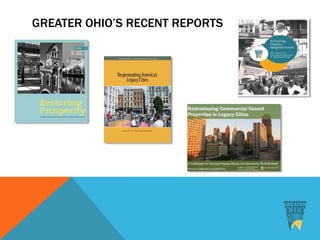
GREATER OHIO’S RECENT REPORTS
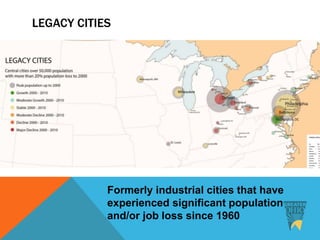
LEGACY CITIES
Formerly industrial cities that have
experienced significant population
and/or job loss since 1960
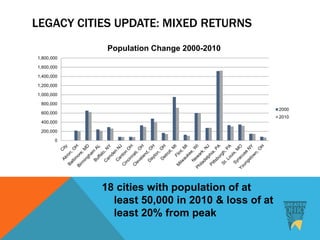
LEGACY CITIES UPDATE: MIXED RETURNS
18 cities with population of at
least 50,000 in 2010 & loss of at
least 20% from peak
0
200,000
400,000
600,000
800,000
1,000,000
1,200,000
1,400,000
1,600,000
1,800,000
Population Change 2000-2010
2000
2010
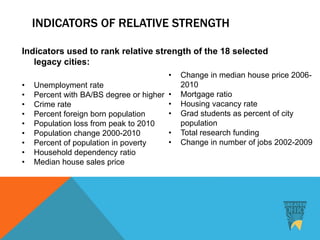
INDICATORS OF RELATIVE STRENGTH
Indicators used to rank relative strength of the 18 selected
legacy cities:
• Unemployment rate
• Percent with BA/BS degree or higher
• Crime rate
• Percent foreign born population
• Population loss from peak to 2010
• Population change 2000-2010
• Percent of population in poverty
• Household dependency ratio
• Median house sales price
• Change in median house price 2006-
2010
• Mortgage ratio
• Housing vacancy rate
• Grad students as percent of city
population
• Total research funding
• Change in number of jobs 2002-2009
-50
-40
-30
-20
-10
0
10
20
Detroit
Cleveland
Buffalo
Birmingham
Pittsburgh
St.Louis
Philadelphia
Baltimore
TOTAL
25-34
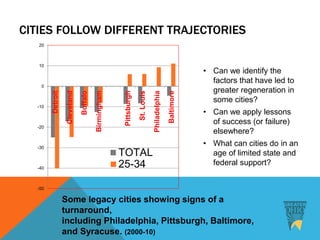
CITIES FOLLOW DIFFERENT TRAJECTORIES
Some legacy cities showing signs of a
turnaround,
including Philadelphia, Pittsburgh, Baltimore,
and Syracuse. (2000-10)
• Can we identify the
factors that have led to
greater regeneration in
some cities?
• Can we apply lessons
of success (or failure)
elsewhere?
• What can cities do in an
age of limited state and
federal support?
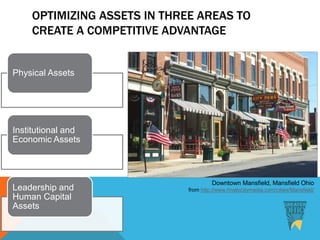
OPTIMIZING ASSETS IN THREE AREAS TO
CREATE A COMPETITIVE ADVANTAGE
Downtown Mansfield, Mansfield Ohio
from http://www.hivelocitymedia.com/cities/Mansfield/
Physical Assets
Institutional and
Economic Assets
Leadership and
Human Capital
Assets
LEVERAGING ASSETS: STRATEGIES THAT ARE
MAKING AN IMPACT
• Target resources in viable neighborhoods
• Focus on rebuilding the downtown
• Repurpose vacant land for new uses
• Leverage economic assets to build competitive
advantage
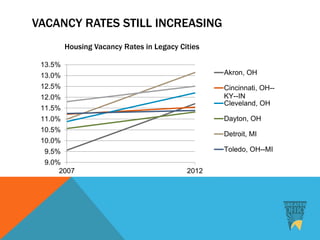
VACANCY RATES STILL INCREASING
9.0%
9.5%
10.0%
10.5%
11.0%
11.5%
12.0%
12.5%
13.0%
13.5%
2007 2012
Akron, OH
Cincinnati, OH--
KY--IN
Cleveland, OH
Dayton, OH
Detroit, MI
Toledo, OH--MI
Housing Vacancy Rates in Legacy Cities
ENCOURAGING STATE POLICIES
• Brownfields Cleanup Fund
(grants/loans)
• Land banks
• Expedited foreclosure
• New Market Tax Credits/State historic
tax credits
TARGET RESOURCES IN VIABLE
NEIGHBORHOODS
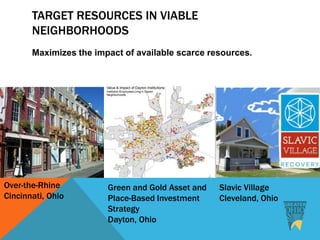
Maximizes the impact of available scarce resources.
Over-the-Rhine
Cincinnati, Ohio
Slavic Village
Cleveland, Ohio
Green and Gold Asset and
Place-Based Investment
Strategy
Dayton, Ohio
TARGET RESOURCES IN VIABLE
NEIGHBORHOODS
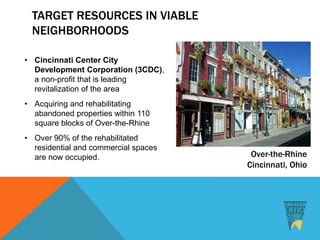
• Cincinnati Center City
Development Corporation (3CDC),
a non-profit that is leading
revitalization of the area
• Acquiring and rehabilitating
abandoned properties within 110
square blocks of Over-the-Rhine
• Over 90% of the rehabilitated
residential and commercial spaces
are now occupied. Over-the-Rhine
Cincinnati, Ohio
TARGET RESOURCES IN VIABLE
NEIGHBORHOODS
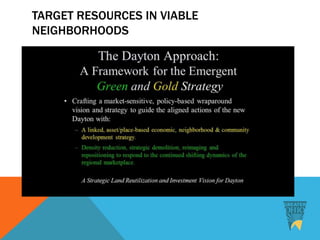
TARGET RESOURCES IN VIABLE
NEIGHBORHOODS
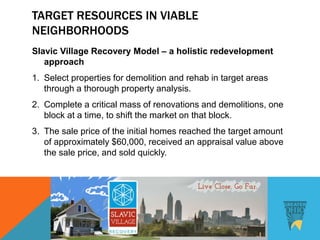
Slavic Village Recovery Model – a holistic redevelopment
approach
1. Select properties for demolition and rehab in target areas
through a thorough property analysis.
2. Complete a critical mass of renovations and demolitions, one
block at a time, to shift the market on that block.
3. The sale price of the initial homes reached the target amount
of approximately $60,000, received an appraisal value above
the sale price, and sold quickly.
FOCUS ON REBUILDING THE DOWNTOWN
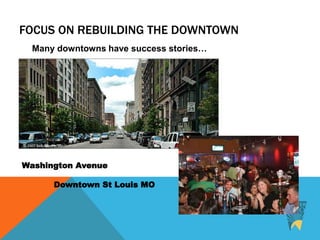
Washington Avenue
Downtown St Louis MO
Many downtowns have success stories…
FOCUS ON REBUILDING THE DOWNTOWN
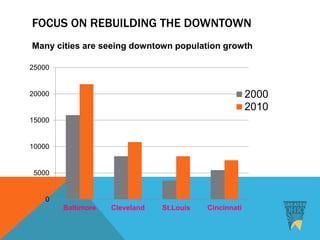
Many cities are seeing downtown population growth
0
5000
10000
15000
20000
25000
Baltimore Cleveland St.Louis Cincinnati
2000
2010
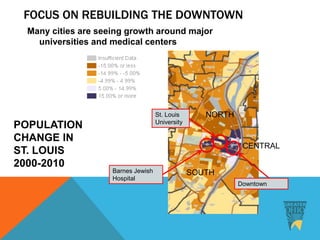
POPULATION
CHANGE IN
ST. LOUIS
2000-2010
Downtown
St. Louis
University
Barnes Jewish
Hospital
NORTH
SOUTH
CENTRAL
FOCUS ON REBUILDING THE DOWNTOWN
Many cities are seeing growth around major
universities and medical centers
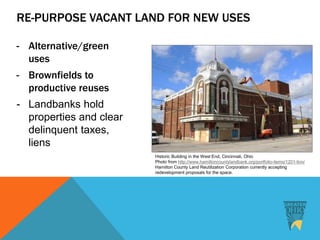
Historic Building in the West End, Cincinnati, Ohio
Photo from http://www.hamiltoncountylandbank.org/portfolio-items/1201-linn/
Hamilton County Land Reutilization Corporation currently accepting
redevelopment proposals for the space.
RE-PURPOSE VACANT LAND FOR NEW USES
- Alternative/green
uses
- Brownfields to
productive reuses
- Landbanks hold
properties and clear
delinquent taxes,
liens
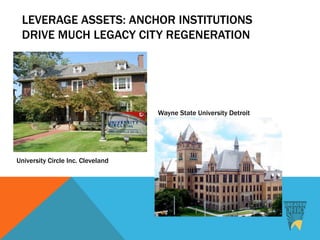
LEVERAGE ASSETS: ANCHOR INSTITUTIONS
DRIVE MUCH LEGACY CITY REGENERATION
Wayne State University Detroit
University Circle Inc. Cleveland
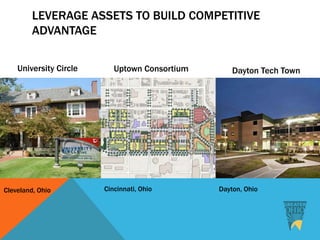
LEVERAGE ASSETS TO BUILD COMPETITIVE
ADVANTAGE
University Circle
Cleveland, Ohio Cincinnati, Ohio Dayton, Ohio
Uptown Consortium Dayton Tech Town
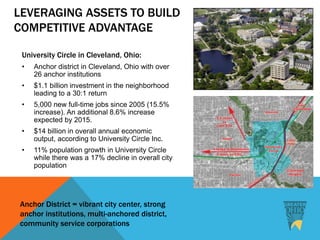
University Circle in Cleveland, Ohio:
• Anchor district in Cleveland, Ohio with over
26 anchor institutions
• $1.1 billion investment in the neighborhood
leading to a 30:1 return
• 5,000 new full-time jobs since 2005 (15.5%
increase). An additional 8.6% increase
expected by 2015.
• $14 billion in overall annual economic
output, according to University Circle Inc.
• 11% population growth in University Circle
while there was a 17% decline in overall city
population
Anchor District = vibrant city center, strong
anchor institutions, multi-anchored district,
community service corporations
LEVERAGING ASSETS TO BUILD
COMPETITIVE ADVANTAGE
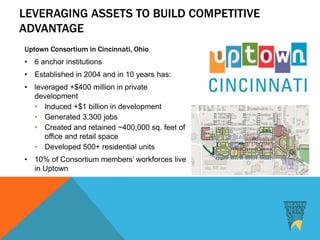
Uptown Consortium in Cincinnati, Ohio
• 6 anchor institutions
• Established in 2004 and in 10 years has:
• leveraged +$400 million in private
development
• Induced +$1 billion in development
• Generated 3,300 jobs
• Created and retained ~400,000 sq. feet of
office and retail space
• Developed 500+ residential units
• 10% of Consortium members’ workforces live
in Uptown
LEVERAGING ASSETS TO BUILD COMPETITIVE
ADVANTAGE
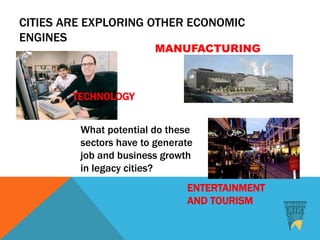
CITIES ARE EXPLORING OTHER ECONOMIC
ENGINES
ENTERTAINMENT
AND TOURISM
TECHNOLOGY
What potential do these
sectors have to generate
job and business growth
in legacy cities?
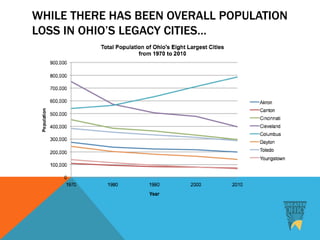
WHILE THERE HAS BEEN OVERALL POPULATION
LOSS IN OHIO’S LEGACY CITIES…
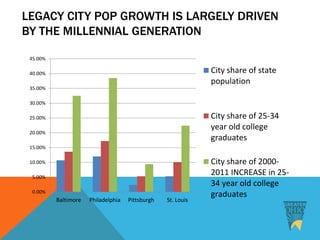
LEGACY CITY POP GROWTH IS LARGELY DRIVEN
BY THE MILLENNIAL GENERATION
0.00%
5.00%
10.00%
15.00%
20.00%
25.00%
30.00%
35.00%
40.00%
45.00%
Baltimore Philadelphia Pittsburgh St. Louis
City share of state
population
City share of 25-34
year old college
graduates
City share of 2000-
2011 INCREASE in 25-
34 year old college
graduates
OPPORTUNITY TO LEVERAGE & ATTRACT THIS
POPULATION
• Some legacy cities are attracting increasing
numbers of Millennials
• Ohio’s cities will need to do more to attract this
population in order to compete
• What are the barriers? What still needs to be done?
CRITICAL CHALLENGES
Equity
Solving the regionalism conundrum
• Rising legacy costs, declining tax base
• Aging infrastructure
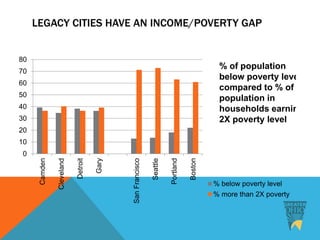
LEGACY CITIES HAVE AN INCOME/POVERTY GAP
0
10
20
30
40
50
60
70
80
Camden
Cleveland
Detroit
Gary
SanFrancisco
Seattle
Portland
Boston
% below poverty level
% more than 2X poverty
% of population
below poverty level
compared to % of
population in
households earning
2X poverty level
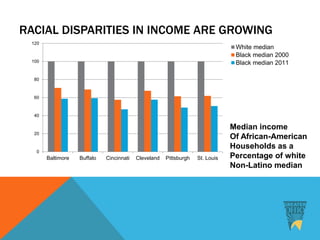
RACIAL DISPARITIES IN INCOME ARE GROWING
0
20
40
60
80
100
120
Baltimore Buffalo Cincinnati Cleveland Pittsburgh St. Louis
White median
Black median 2000
Black median 2011
Median income
Of African-American
Households as a
Percentage of white
Non-Latino median
WHY REGIONS MATTER FOR ECONOMIC
REGROWTH
• Cities and their regions are
economically interdependent
• Collaborations and new governance
structures can increase fiscal
efficiency and economic attraction.
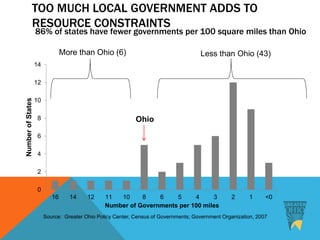
TOO MUCH LOCAL GOVERNMENT ADDS TO
RESOURCE CONSTRAINTS
86% of states have fewer governments per 100 square miles than Ohio
Source: Greater Ohio Policy Center, Census of Governments; Government Organization, 2007
0
2
4
6
8
10
12
14
16 14 12 11 10 8 6 5 4 3 2 1 <0
NumberofStates
Number of Governments per 100 miles
Ohio
Less than Ohio (43)More than Ohio (6)
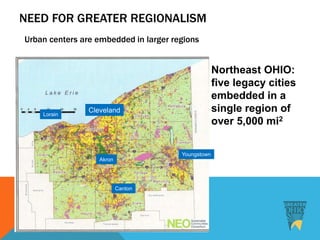
Cleveland
Akron
Canton
Youngstown
Lorain
Northeast OHIO:
five legacy cities
embedded in a
single region of
over 5,000 mi2
NEED FOR GREATER REGIONALISM
Urban centers are embedded in larger regions
CRITICAL NEXT STRATEGIES
• Use economic growth to increase community and
resident well-being
ď‚§ overcome forces leading to increased economic and
racial inequalities?
• Build stronger local governance and partnerships
ď‚§ create multifaceted public/private partnerships capable of
driving sustained regeneration?
• Increase the ties between cities and their regions
ď‚§ build effective regional linkages to foster stronger
economic growth throughout the region?
CRITICAL NEXT STRATEGIES
• Make change happen through strategic incrementalism
• taking incremental steps grounded in a coherent vision of
the future
• Consider a special paradigm for smaller/medium-sized
cities:
• Distinguish between those that are too big to fail and others
Lavea Brachman,
Executive
Director, Greater
Ohio Policy
Center
lbrachman@greaterohio.org

Transforming Legacy Cities for the Next Economy

  • 1.
    L AV EA B R A C H M A N J U LY 4 2 0 1 4 L A F A B R I Q U E D E L A C I T E - I N T E R N AT I O N A L S E M I N A R
  • 2.
    ABOUT GREATER OHIOPOLICY CENTER A non-partisan NGO based in Columbus, Ohio that champions revitalization and sustainable redevelopment in Ohio through policy and practice: • Revitalize Ohio’s urban cores and metropolitan regions • Achieve sustainable land reuse and economic growth
  • 3.
  • 5.
    LEGACY CITIES Formerly industrialcities that have experienced significant population and/or job loss since 1960
  • 6.
    LEGACY CITIES UPDATE:MIXED RETURNS 18 cities with population of at least 50,000 in 2010 & loss of at least 20% from peak 0 200,000 400,000 600,000 800,000 1,000,000 1,200,000 1,400,000 1,600,000 1,800,000 Population Change 2000-2010 2000 2010
  • 7.
    INDICATORS OF RELATIVESTRENGTH Indicators used to rank relative strength of the 18 selected legacy cities: • Unemployment rate • Percent with BA/BS degree or higher • Crime rate • Percent foreign born population • Population loss from peak to 2010 • Population change 2000-2010 • Percent of population in poverty • Household dependency ratio • Median house sales price • Change in median house price 2006- 2010 • Mortgage ratio • Housing vacancy rate • Grad students as percent of city population • Total research funding • Change in number of jobs 2002-2009
  • 8.
    -50 -40 -30 -20 -10 0 10 20 Detroit Cleveland Buffalo Birmingham Pittsburgh St.Louis Philadelphia Baltimore TOTAL 25-34 CITIES FOLLOW DIFFERENTTRAJECTORIES Some legacy cities showing signs of a turnaround, including Philadelphia, Pittsburgh, Baltimore, and Syracuse. (2000-10) • Can we identify the factors that have led to greater regeneration in some cities? • Can we apply lessons of success (or failure) elsewhere? • What can cities do in an age of limited state and federal support?
  • 9.
    OPTIMIZING ASSETS INTHREE AREAS TO CREATE A COMPETITIVE ADVANTAGE Downtown Mansfield, Mansfield Ohio from http://www.hivelocitymedia.com/cities/Mansfield/ Physical Assets Institutional and Economic Assets Leadership and Human Capital Assets
  • 11.
    LEVERAGING ASSETS: STRATEGIESTHAT ARE MAKING AN IMPACT • Target resources in viable neighborhoods • Focus on rebuilding the downtown • Repurpose vacant land for new uses • Leverage economic assets to build competitive advantage
  • 12.
    VACANCY RATES STILLINCREASING 9.0% 9.5% 10.0% 10.5% 11.0% 11.5% 12.0% 12.5% 13.0% 13.5% 2007 2012 Akron, OH Cincinnati, OH-- KY--IN Cleveland, OH Dayton, OH Detroit, MI Toledo, OH--MI Housing Vacancy Rates in Legacy Cities
  • 13.
    ENCOURAGING STATE POLICIES •Brownfields Cleanup Fund (grants/loans) • Land banks • Expedited foreclosure • New Market Tax Credits/State historic tax credits
  • 14.
    TARGET RESOURCES INVIABLE NEIGHBORHOODS Maximizes the impact of available scarce resources. Over-the-Rhine Cincinnati, Ohio Slavic Village Cleveland, Ohio Green and Gold Asset and Place-Based Investment Strategy Dayton, Ohio
  • 15.
    TARGET RESOURCES INVIABLE NEIGHBORHOODS • Cincinnati Center City Development Corporation (3CDC), a non-profit that is leading revitalization of the area • Acquiring and rehabilitating abandoned properties within 110 square blocks of Over-the-Rhine • Over 90% of the rehabilitated residential and commercial spaces are now occupied. Over-the-Rhine Cincinnati, Ohio

  • 16.
    TARGET RESOURCES INVIABLE NEIGHBORHOODS
  • 17.
    TARGET RESOURCES INVIABLE NEIGHBORHOODS Slavic Village Recovery Model – a holistic redevelopment approach 1. Select properties for demolition and rehab in target areas through a thorough property analysis. 2. Complete a critical mass of renovations and demolitions, one block at a time, to shift the market on that block. 3. The sale price of the initial homes reached the target amount of approximately $60,000, received an appraisal value above the sale price, and sold quickly.
  • 18.
    FOCUS ON REBUILDINGTHE DOWNTOWN Washington Avenue Downtown St Louis MO Many downtowns have success stories…
  • 19.
    FOCUS ON REBUILDINGTHE DOWNTOWN Many cities are seeing downtown population growth 0 5000 10000 15000 20000 25000 Baltimore Cleveland St.Louis Cincinnati 2000 2010
  • 20.
    POPULATION CHANGE IN ST. LOUIS 2000-2010 Downtown St.Louis University Barnes Jewish Hospital NORTH SOUTH CENTRAL FOCUS ON REBUILDING THE DOWNTOWN Many cities are seeing growth around major universities and medical centers
  • 21.
    Historic Building inthe West End, Cincinnati, Ohio Photo from http://www.hamiltoncountylandbank.org/portfolio-items/1201-linn/ Hamilton County Land Reutilization Corporation currently accepting redevelopment proposals for the space. RE-PURPOSE VACANT LAND FOR NEW USES - Alternative/green uses - Brownfields to productive reuses - Landbanks hold properties and clear delinquent taxes, liens
  • 22.
    LEVERAGE ASSETS: ANCHORINSTITUTIONS DRIVE MUCH LEGACY CITY REGENERATION Wayne State University Detroit University Circle Inc. Cleveland
  • 23.
    LEVERAGE ASSETS TOBUILD COMPETITIVE ADVANTAGE University Circle Cleveland, Ohio Cincinnati, Ohio Dayton, Ohio Uptown Consortium Dayton Tech Town
  • 24.
    University Circle inCleveland, Ohio: • Anchor district in Cleveland, Ohio with over 26 anchor institutions • $1.1 billion investment in the neighborhood leading to a 30:1 return • 5,000 new full-time jobs since 2005 (15.5% increase). An additional 8.6% increase expected by 2015. • $14 billion in overall annual economic output, according to University Circle Inc. • 11% population growth in University Circle while there was a 17% decline in overall city population Anchor District = vibrant city center, strong anchor institutions, multi-anchored district, community service corporations LEVERAGING ASSETS TO BUILD COMPETITIVE ADVANTAGE
  • 25.
    Uptown Consortium inCincinnati, Ohio • 6 anchor institutions • Established in 2004 and in 10 years has: • leveraged +$400 million in private development • Induced +$1 billion in development • Generated 3,300 jobs • Created and retained ~400,000 sq. feet of office and retail space • Developed 500+ residential units • 10% of Consortium members’ workforces live in Uptown LEVERAGING ASSETS TO BUILD COMPETITIVE ADVANTAGE
  • 26.
    CITIES ARE EXPLORINGOTHER ECONOMIC ENGINES ENTERTAINMENT AND TOURISM TECHNOLOGY What potential do these sectors have to generate job and business growth in legacy cities?
  • 28.
    WHILE THERE HASBEEN OVERALL POPULATION LOSS IN OHIO’S LEGACY CITIES…
  • 29.
    LEGACY CITY POPGROWTH IS LARGELY DRIVEN BY THE MILLENNIAL GENERATION 0.00% 5.00% 10.00% 15.00% 20.00% 25.00% 30.00% 35.00% 40.00% 45.00% Baltimore Philadelphia Pittsburgh St. Louis City share of state population City share of 25-34 year old college graduates City share of 2000- 2011 INCREASE in 25- 34 year old college graduates
  • 31.
    OPPORTUNITY TO LEVERAGE& ATTRACT THIS POPULATION • Some legacy cities are attracting increasing numbers of Millennials • Ohio’s cities will need to do more to attract this population in order to compete • What are the barriers? What still needs to be done?
  • 32.
    CRITICAL CHALLENGES Equity Solving theregionalism conundrum • Rising legacy costs, declining tax base • Aging infrastructure
  • 33.
    LEGACY CITIES HAVEAN INCOME/POVERTY GAP 0 10 20 30 40 50 60 70 80 Camden Cleveland Detroit Gary SanFrancisco Seattle Portland Boston % below poverty level % more than 2X poverty % of population below poverty level compared to % of population in households earning 2X poverty level
  • 34.
    RACIAL DISPARITIES ININCOME ARE GROWING 0 20 40 60 80 100 120 Baltimore Buffalo Cincinnati Cleveland Pittsburgh St. Louis White median Black median 2000 Black median 2011 Median income Of African-American Households as a Percentage of white Non-Latino median
  • 35.
    WHY REGIONS MATTERFOR ECONOMIC REGROWTH • Cities and their regions are economically interdependent • Collaborations and new governance structures can increase fiscal efficiency and economic attraction.
  • 36.
    TOO MUCH LOCALGOVERNMENT ADDS TO RESOURCE CONSTRAINTS 86% of states have fewer governments per 100 square miles than Ohio Source: Greater Ohio Policy Center, Census of Governments; Government Organization, 2007 0 2 4 6 8 10 12 14 16 14 12 11 10 8 6 5 4 3 2 1 <0 NumberofStates Number of Governments per 100 miles Ohio Less than Ohio (43)More than Ohio (6)
  • 37.
    Cleveland Akron Canton Youngstown Lorain Northeast OHIO: five legacycities embedded in a single region of over 5,000 mi2 NEED FOR GREATER REGIONALISM Urban centers are embedded in larger regions
  • 39.
    CRITICAL NEXT STRATEGIES •Use economic growth to increase community and resident well-being  overcome forces leading to increased economic and racial inequalities? • Build stronger local governance and partnerships  create multifaceted public/private partnerships capable of driving sustained regeneration? • Increase the ties between cities and their regions  build effective regional linkages to foster stronger economic growth throughout the region?
  • 40.
    CRITICAL NEXT STRATEGIES •Make change happen through strategic incrementalism • taking incremental steps grounded in a coherent vision of the future • Consider a special paradigm for smaller/medium-sized cities: • Distinguish between those that are too big to fail and others
  • 41.
    Lavea Brachman, Executive Director, Greater OhioPolicy Center lbrachman@greaterohio.org

Editor's Notes

  • #2 Introduction: a check in and framing the next generation of strategies
  • #3 Columbus-based, statewide organization Promote public policy to grow Ohio’s economy and improve Ohioans’ quality of life through sustainable land use and growth Non-partisan, non-profit, foundation-funded
  • #4 Restoring Prosperity: 3 year partnership with Brookings Institution Metropolitan Policy Program A statewide blueprint for Ohio’s transition to the next economy Action plan to influence state policy: 39 pragmatic policy recommendations
  • #6 Define legacy cities to provide context
  • #7 Summarize study of 18 LCs (4 showing signs of turnaround: Philadelphia, Pittsburgh, Baltimore, Syracuse)
  • #31 Export strategy
  • #34 I think this slide belongs here to demonstrate that there’s hope. Also, you don’t have enough time for another section of slides to make the point that there’s increasing demand for legacy cities.
  • #38 These are just two challenges