•The economic development in
India followed socialist-inspired policies for most of
its independent history, including state-ownership of
many sectors; India's per capita income increased at
only around 1% annualised rate in the three decades
after its independence.
•Since the mid-1980s, India has slowly opened up its
markets through economic liberalisation.
• After more fundamental reforms since 1991 and
their renewal in the 2000s, India has progressed
towards a free market economy
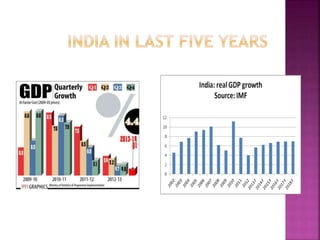
•In the late 2000s, India's growth reached 7.5%, which will double
the average income in a decade
•India's GDP growth during January–March period of 2015 was at
7.5% compared to China's 7%, making it the fastest growing
economy.
•During 2014-15, India's GDP growth recovered marginally to
7.3% from 6.9% in the previous fiscal.
•During 2014-15, India's services sector grew by 10.1%,
manufacturing sector by 7.1% & agriculture by 0.2%.
•The Indian government has forecast a growth of 8.1-8.5% during
2015-16.
•Bangladesh is a developing country that is classified as
a Next Eleven emerging market and one of the Frontier
Five.
•According to a recent opinion poll, Bangladesh has the
second most pro-capitalist population in the developing
world.
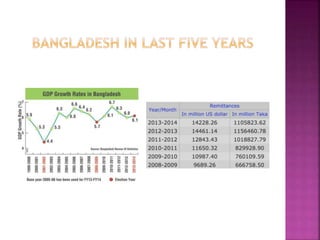
•Between 2004 and 2014, Bangladesh averaged a GDP
growth rate of 6%. The economy is increasingly led
by export-oriented industrialization.
•The Bangladesh telecoms industry has witnessed rapid growth over the years
and is dominated by foreign investors. The government has emphasized the
development of software services and hi-tech industries under the Digital
Bangladesh scheme.
•Bangladesh has substantial reserves of natural gas and coal; and many
international oil companies are involved in production and exploration activities
in the Bay of Bengal.
• Regional neighbours are keen to use Bangladeshi ports and railways
for transhipment. Located at the crossroads of SAARC,
the ASEAN+3, BIMSTEC, and the Indian Ocean, Bangladesh has the potential
to emerge as a regional economic and logistics hub.
•In 2015, per-capita income stood at USD 1,314.While achieving significant
macroeconomic stability, Bangladesh continues to face challenges such as
infrastructure deficits and energy shortages.
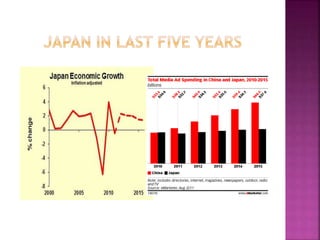
•The economy of Japan is the third largest in the world
by nominal GDP,the fourth largest by purchasing power parity and
is the world's second largest developed economy.
•
•According to the International Monetary Fund, the country's per
capita GDP(PPP) was at $36,899, the 22nd-highest in 2013.
•Japan is a member of G7. The Japanese economy is forecasted
by the Quarterly Tankan survey of business sentiment conducted
by the Bank of Japan.
•Japan is the world's third largest automobile
manufacturing country, has the largest electronics
goods industry, and is often ranked among the
world's most innovative countries leading several
measures of global patent filings.
• As of 2010, Japan possesses 13.7% of the
world's private financial assets (the second
largest in the world) at an estimated $14.6
trillion. As of 2013, 62 of the Fortune Global
500 companies are based in Japan.
•The United States is the world's largest national economy,
representing 22% of nominal global GDP and 17% of global
GDP (PPP). The United States' GDP was estimated to be
$17.841 trillion as of Q2 2015.
• The U.S. dollar is the currency most used in international
transactions and is the world's foremost reserve currency.
•Several countries use it as their official currency, and in
many others it is the de facto currency.[The United States
has a mixed economy[and has maintained a stable overall
GDP growth rate,[a moderate unemployment rate, and high
levels of research and capital investment.
•Its six largest trading partners
are Canada, China, Mexico, Japan, Germany, and South Korea
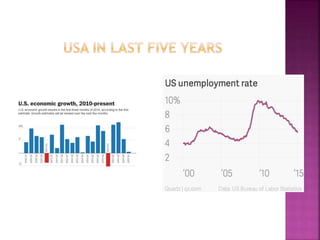
•The US economy went through an economic
downturn following the financial crisis of 2007–
08, with output as late as 2013 still below
potential according to the Congressional
Budget Office.
• The economy, however, began to recover in
the second half of 2009, and as of April
2015, unemployment had declined from a high
of 10% to 5.4%; the government's broader U-6
unemployment rate, which includes the part-
time underemployed, was 10.8%
Presentation prepared by Haya Naaz
Class IX B

Economic development1ppt

  • 2.
    •The economic developmentin India followed socialist-inspired policies for most of its independent history, including state-ownership of many sectors; India's per capita income increased at only around 1% annualised rate in the three decades after its independence. •Since the mid-1980s, India has slowly opened up its markets through economic liberalisation. • After more fundamental reforms since 1991 and their renewal in the 2000s, India has progressed towards a free market economy
  • 3.
    •In the late2000s, India's growth reached 7.5%, which will double the average income in a decade •India's GDP growth during January–March period of 2015 was at 7.5% compared to China's 7%, making it the fastest growing economy. •During 2014-15, India's GDP growth recovered marginally to 7.3% from 6.9% in the previous fiscal. •During 2014-15, India's services sector grew by 10.1%, manufacturing sector by 7.1% & agriculture by 0.2%. •The Indian government has forecast a growth of 8.1-8.5% during 2015-16.
  • 5.
    •Bangladesh is adeveloping country that is classified as a Next Eleven emerging market and one of the Frontier Five. •According to a recent opinion poll, Bangladesh has the second most pro-capitalist population in the developing world. •Between 2004 and 2014, Bangladesh averaged a GDP growth rate of 6%. The economy is increasingly led by export-oriented industrialization.
  • 6.
    •The Bangladesh telecomsindustry has witnessed rapid growth over the years and is dominated by foreign investors. The government has emphasized the development of software services and hi-tech industries under the Digital Bangladesh scheme. •Bangladesh has substantial reserves of natural gas and coal; and many international oil companies are involved in production and exploration activities in the Bay of Bengal. • Regional neighbours are keen to use Bangladeshi ports and railways for transhipment. Located at the crossroads of SAARC, the ASEAN+3, BIMSTEC, and the Indian Ocean, Bangladesh has the potential to emerge as a regional economic and logistics hub. •In 2015, per-capita income stood at USD 1,314.While achieving significant macroeconomic stability, Bangladesh continues to face challenges such as infrastructure deficits and energy shortages.
  • 8.
    •The economy ofJapan is the third largest in the world by nominal GDP,the fourth largest by purchasing power parity and is the world's second largest developed economy. • •According to the International Monetary Fund, the country's per capita GDP(PPP) was at $36,899, the 22nd-highest in 2013. •Japan is a member of G7. The Japanese economy is forecasted by the Quarterly Tankan survey of business sentiment conducted by the Bank of Japan.
  • 9.
    •Japan is theworld's third largest automobile manufacturing country, has the largest electronics goods industry, and is often ranked among the world's most innovative countries leading several measures of global patent filings. • As of 2010, Japan possesses 13.7% of the world's private financial assets (the second largest in the world) at an estimated $14.6 trillion. As of 2013, 62 of the Fortune Global 500 companies are based in Japan.
  • 11.
    •The United Statesis the world's largest national economy, representing 22% of nominal global GDP and 17% of global GDP (PPP). The United States' GDP was estimated to be $17.841 trillion as of Q2 2015. • The U.S. dollar is the currency most used in international transactions and is the world's foremost reserve currency. •Several countries use it as their official currency, and in many others it is the de facto currency.[The United States has a mixed economy[and has maintained a stable overall GDP growth rate,[a moderate unemployment rate, and high levels of research and capital investment. •Its six largest trading partners are Canada, China, Mexico, Japan, Germany, and South Korea
  • 12.
    •The US economywent through an economic downturn following the financial crisis of 2007– 08, with output as late as 2013 still below potential according to the Congressional Budget Office. • The economy, however, began to recover in the second half of 2009, and as of April 2015, unemployment had declined from a high of 10% to 5.4%; the government's broader U-6 unemployment rate, which includes the part- time underemployed, was 10.8%
  • 14.
    Presentation prepared byHaya Naaz Class IX B