@pesmou
Ecommerce
Landscape and Trends
Maria Thomas
December 17, 2015
@pesmou
@pesmou
Today’s Presenter
MARIA THOMAS
@pesmou
@pesmou
Today’s Agenda
 A Quick Look Back
 The Big [Macro] Picture
 The Big [Industry] Picture
 Trends and Sectors to Watch
@pesmou
The Early Days….
4
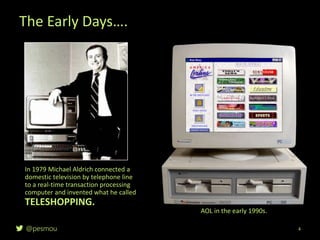
In 1979 Michael Aldrich connected a
domestic television by telephone line
to a real-time transaction processing
computer and invented what he called
TELESHOPPING.
AOL in the early 1990s.
@pesmou
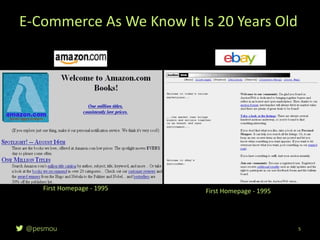
E-Commerce As We Know It Is 20 Years Old
5
First Homepage - 1995 First Homepage - 1995
@pesmou 6
Casualties of Phase I of E-commerce
Fashion retail web site
Boo.com launched in
1999. The company
burned $135 million of
venture capital in 18
months, and went
bankrupt in 2000.
Malmsten re-emerged
in 2011 as CEO of
luxury goods company
Lara Bohinc.
Founded in 1994,
TheGlobe.com was a
social network before
social networks existed,
and offered essentially
the same things that
Facebook would later.
But it made no money.
Pets.com launched in
August 1998. It became
famous for the millions
it spent on TV
advertising with the
Pets.com sock puppet.
The company IPO-ed in
February 2000 but was
liquidated 268 days later.
When eToys.com
shares hit a high of
$84.35 in October
1999, who could have
guessed that just 16
months later, the
company would warn
investors that its stock
was "worthless?"
@pesmou
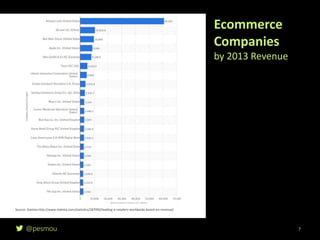
Ecommerce
Companies
by 2013 Revenue
Source: Statista http://www.statista.com/statistics/287950/leading-e-retailers-worldwide-based-on-revenue/
7
@pesmou
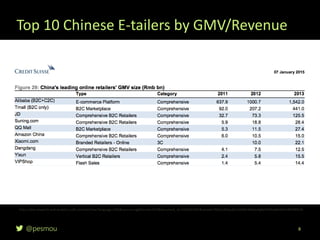
Top 10 Chinese E-tailers by GMV/Revenue
8
https://doc.research-and-analytics.csfb.com/docView?language=ENG&source=ulg&format=PDF&document_id=1042623391&serialid=f0GXsvM2pz8e1L0JM%2Bip6oRgNHFWbrq0e502nHRhff8%3D
@pesmou 9
The Big [Macro]Picture
@pesmou 10
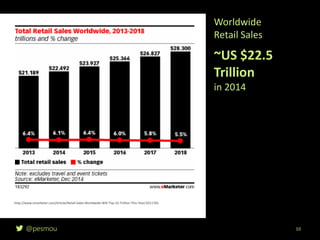
Worldwide
Retail Sales
~US $22.5
Trillion
in 2014
http://www.emarketer.com/Article/Retail-Sales-Worldwide-Will-Top-22-Trillion-This-Year/1011765
@pesmou 11
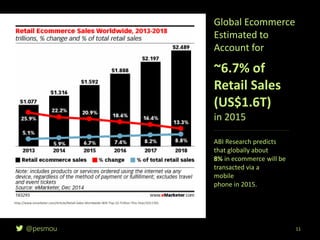
Global Ecommerce
Estimated to
Account for
~6.7% of
Retail Sales
(US$1.6T)
in 2015
http://www.emarketer.com/Article/Retail-Sales-Worldwide-Will-Top-22-Trillion-This-Year/1011765
ABI Research predicts
that globally about
8% in ecommerce will be
transacted via a
mobile
phone in 2015.
@pesmou
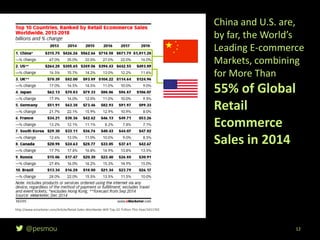
China and U.S. are,
by far, the World’s
Leading E-commerce
Markets, combining
for More Than
55% of Global
Retail
Ecommerce
Sales in 2014
http://www.emarketer.com/Article/Retail-Sales-Worldwide-Will-Top-22-Trillion-This-Year/1011765
12
@pesmou
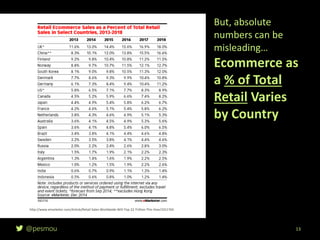
But, absolute
numbers can be
misleading…
Ecommerce as
a % of Total
Retail Varies
by Country
13
http://www.emarketer.com/Article/Retail-Sales-Worldwide-Will-Top-22-Trillion-This-Year/1011765
@pesmou
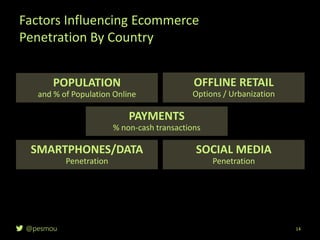
Factors Influencing Ecommerce
Penetration By Country
14
SMARTPHONES/DATA
Penetration
POPULATION
and % of Population Online
OFFLINE RETAIL
Options / Urbanization
PAYMENTS
% non-cash transactions
SOCIAL MEDIA
Penetration
@pesmou
POPULATION
AND % OF POPULATION ONLINE
15
@pesmou
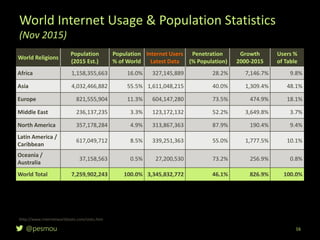
World Internet Usage & Population Statistics
(Nov 2015)
16
World Religions
Population
(2015 Est.)
Population
% of World
Internet Users
Latest Data
Penetration
(% Population)
Growth
2000-2015
Users %
of Table
Africa 1,158,355,663 16.0% 327,145,889 28.2% 7,146.7% 9.8%
Asia 4,032,466,882 55.5% 1,611,048,215 40.0% 1,309.4% 48.1%
Europe 821,555,904 11.3% 604,147,280 73.5% 474.9% 18.1%
Middle East 236,137,235 3.3% 123,172,132 52.2% 3,649.8% 3.7%
North America 357,178,284 4.9% 313,867,363 87.9% 190.4% 9.4%
Latin America /
Caribbean
617,049,712 8.5% 339,251,363 55.0% 1,777.5% 10.1%
Oceania /
Australia
37,158,563 0.5% 27,200,530 73.2% 256.9% 0.8%
World Total 7,259,902,243 100.0% 3,345,832,772 46.1% 826.9% 100.0%
http://www.internetworldstats.com/stats.htm
@pesmou
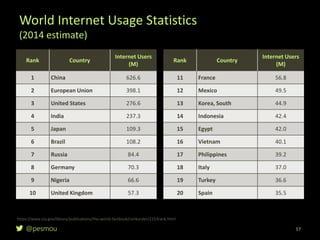
World Internet Usage Statistics
(2014 estimate)
17
Rank Country
Internet Users
(M)
1 China 626.6
2 European Union 398.1
3 United States 276.6
4 India 237.3
5 Japan 109.3
6 Brazil 108.2
7 Russia 84.4
8 Germany 70.3
9 Nigeria 66.6
10 United Kingdom 57.3
Rank Country
Internet Users
(M)
11 France 56.8
12 Mexico 49.5
13 Korea, South 44.9
14 Indonesia 42.4
15 Egypt 42.0
16 Vietnam 40.1
17 Philippines 39.2
18 Italy 37.0
19 Turkey 36.6
20 Spain 35.5
https://www.cia.gov/library/publications/the-world-factbook/rankorder/2153rank.html
@pesmou
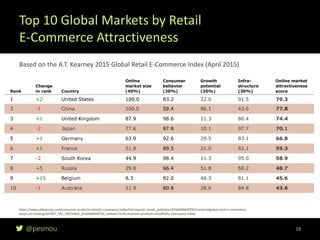
Top 10 Global Markets by Retail
E-Commerce Attractiveness
18
https://www.atkearney.com/consumer-products-retail/e-commerce-index/full-report/-/asset_publisher/87xbENNHPZ3D/content/global-retail-e-commerce-
keeps-on-clicking/10192?_101_INSTANCE_87xbENNHPZ3D_redirect=%2Fconsumer-products-retail%2Fe-commerce-index
Based on the A.T. Kearney 2015 Global Retail E-Commerce Index (April 2015)
@pesmou
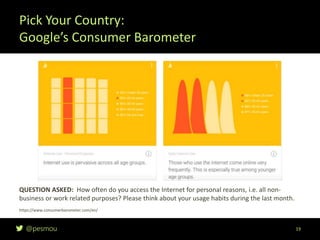
Pick Your Country:
Google’s Consumer Barometer
19
https://www.consumerbarometer.com/en/
QUESTION ASKED: How often do you access the Internet for personal reasons, i.e. all non-
business or work related purposes? Please think about your usage habits during the last month.
@pesmou
CROSS-BORDER E-COMMERCE
IS A HUGE OPPORTUNITY
BUT PAYMENT PREFERENCES VARY BY
COUNTRY
20
@pesmou 21
https://www.paypalobjects.com/digitalassets/c/website/marketing/global/pages/jobs/paypal-insights-2015-global-report-appendix-added.pdf
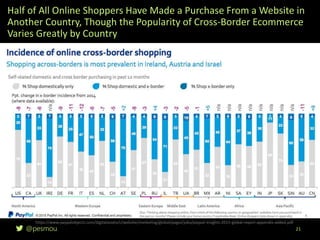
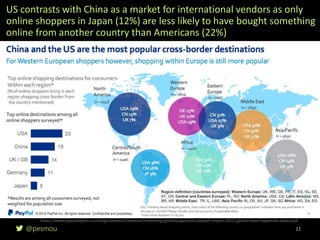
Half of All Online Shoppers Have Made a Purchase From a Website in
Another Country, Though the Popularity of Cross-Border Ecommerce
Varies Greatly by Country
@pesmou 22
https://www.paypalobjects.com/digitalassets/c/website/marketing/global/pages/jobs/paypal-insights-2015-global-report-appendix-added.pdf
US contrasts with China as a market for international vendors as only
online shoppers in Japan (12%) are less likely to have bought something
online from another country than Americans (22%)
@pesmou 23
https://www.paypalobjects.com/digitalassets/c/website/marketing/global/pages/jobs/paypal-insights-2015-global-report-appendix-added.pdf
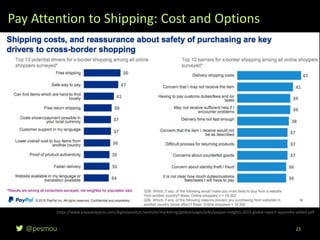
Pay Attention to Shipping: Cost and Options
@pesmou
https://www.internetretailer.com/static/uploads/071114_Blog_GlobalSales_Chart2.jpg
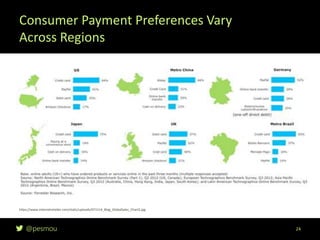
Consumer Payment Preferences Vary
Across Regions
24
@pesmou 25
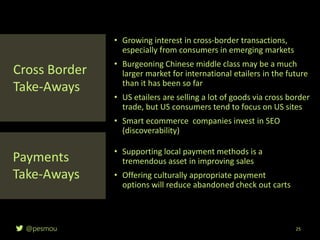
• Growing interest in cross-border transactions,
especially from consumers in emerging markets
• Burgeoning Chinese middle class may be a much
larger market for international etailers in the future
than it has been so far
• US etailers are selling a lot of goods via cross border
trade, but US consumers tend to focus on US sites
• Smart ecommerce companies invest in SEO
(discoverability)
Cross Border
Take-Aways
Payments
Take-Aways
• Supporting local payment methods is a
tremendous asset in improving sales
• Offering culturally appropriate payment
options will reduce abandoned check out carts
@pesmou
SMARTPHONE PENETRATION IS
IMPACTING ECOMMERCE
26
@pesmou
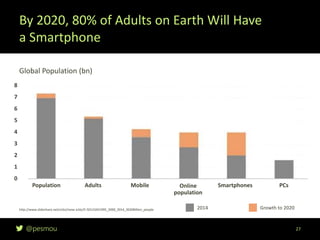
By 2020, 80% of Adults on Earth Will Have
a Smartphone
27
http://www.slideshare.net/a16z/mew-a16z/5-50123451995_2000_2014_2020Billion_people 2014 Growth to 2020
Global Population (bn)
Population Adults Mobile Online
population
5
4
3
2
1
0
8
7
6
Smartphones PCs
@pesmou
From this….
28
@pesmou
To this….
29
http://www.businesstoday.in/magazine/features/second-green-revolution-
likely-innovation-in-information-tech/story/222535.html
@pesmou
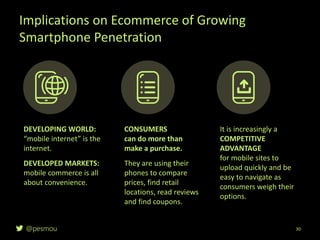
Implications on Ecommerce of Growing
Smartphone Penetration
30
DEVELOPING WORLD:
“mobile internet” is the
internet.
DEVELOPED MARKETS:
mobile commerce is all
about convenience.
CONSUMERS
can do more than
make a purchase.
They are using their
phones to compare
prices, find retail
locations, read reviews
and find coupons.
It is increasingly a
COMPETITIVE
ADVANTAGE
for mobile sites to
upload quickly and be
easy to navigate as
consumers weigh their
options.
@pesmou 31
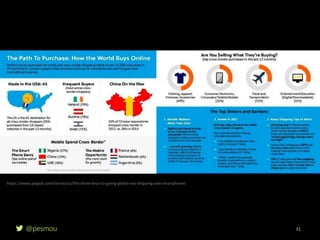
https://www.paypal.com/stories/us/the-three-keys-to-going-global-seo-shipping-and-smartphones
@pesmou 32
Social Media Penetration
@pesmou 33
http://www.nielsen.com/us/en/insights/reports/2015/global-trust-in-advertising-2015.html
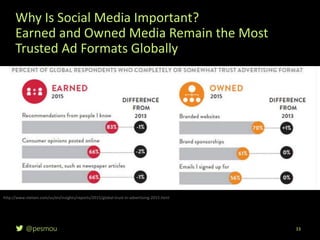
Why Is Social Media Important?
Earned and Owned Media Remain the Most
Trusted Ad Formats Globally
@pesmou 34
http://www.nielsen.com/us/en/insights/reports/2015/global-trust-in-advertising-2015.html
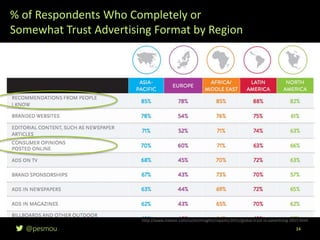
% of Respondents Who Completely or
Somewhat Trust Advertising Format by Region
@pesmou 35
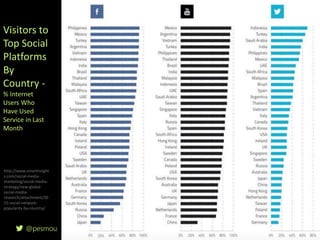
Visitors to
Top Social
Platforms
By
Country -
% Internet
Users Who
Have Used
Service in Last
Month
http://www.smartinsight
s.com/social-media-
marketing/social-media-
strategy/new-global-
social-media-
research/attachment/20
15-social-network-
popularity-by-country/
@pesmou 36
@pesmou 37
The Big [Industry] Picture
@pesmou 38
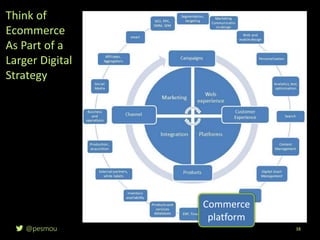
Think of
Ecommerce
As Part of a
Larger Digital
Strategy
Commerce
platform
@pesmou
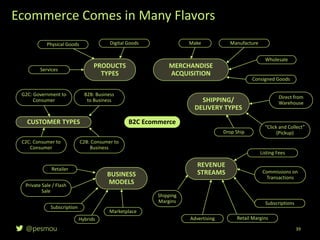
Ecommerce Comes in Many Flavors
39
B2C EcommerceCUSTOMER TYPES
G2C: Government to
Consumer
B2B: Business
to Business
C2C: Consumer to
Consumer
C2B: Consumer to
Business
PRODUCTS
TYPES
Physical Goods Digital Goods
Services
MERCHANDISE
ACQUISITION
Make Manufacture
Consigned Goods
Wholesale
SHIPPING/
DELIVERY TYPES
Direct from
Warehouse
Drop Ship
“Click and Collect”
(Pickup)
BUSINESS
MODELS
Retailer
Marketplace
Hybrids
Subscription
Private Sale / Flash
Sale
REVENUE
STREAMS Commissions on
Transactions
Listing Fees
Shipping
Margins
Advertising
Subscriptions
Retail Margins
@pesmou
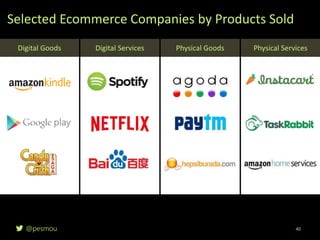
Selected Ecommerce Companies by Products Sold
40
Digital Goods Digital Services Physical Goods Physical Services
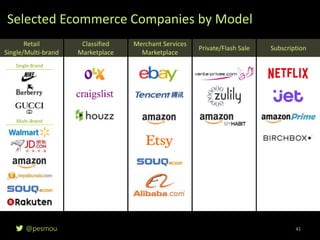
@pesmou 41
Retail
Single/Multi-brand
Classified
Marketplace
Merchant Services
Marketplace
Private/Flash Sale Subscription
Single Brand
Multi-Brand
Selected Ecommerce Companies by Model
@pesmou 42
© LUMA Partners LLC 2015
Coupon Aggregators
Community
Platform
Social
Enablers
Fulfillment /
Distribution
SaaS
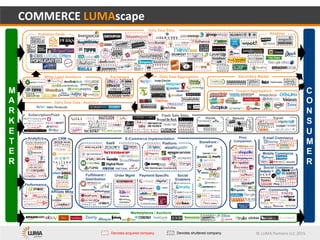
COMMERCE LUMAscape
Social Commerce
Affiliate Mktg
Secondary MarketDaily Deal AggregatorsWhite Label Solutions
Daily Deal Data / Analytics
Exchanges
Marketplaces / Auctions
Price
ComparisonStorefront /
Cart
Payment-SpecificOrder Mgmt
Flash Sale Sites
Daily Deal Sites
Publisher Deals Realtime
TravelBeautyHome
CRM
Subscription/Push
E-Commerce Implementation
Mobile Commerce
E-mail CommerceAnalytics
Performance
M
A
R
K
E
T
E
R
C
O
N
S
U
M
E
R
Denotes acquired company Denotes shuttered company
@pesmou 43
Know Your Competitive Advantage:
Hard to Compete With Amazon in Many Markets
@pesmou 44
Ecommerce Is Hard
@pesmou 45
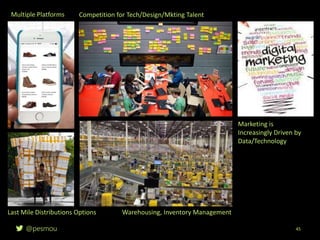
Multiple Platforms Competition for Tech/Design/Mkting Talent
Last Mile Distributions Options Warehousing, Inventory Management
Marketing is
Increasingly Driven by
Data/Technology
@pesmou 46
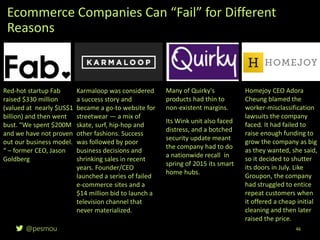
Ecommerce Companies Can “Fail” for Different
Reasons
Red-hot startup Fab
raised $330 million
(valued at nearly $US$1
billion) and then went
bust. “We spent $200M
and we have not proven
out our business model.
“ – former CEO, Jason
Goldberg
Karmaloop was considered
a success story and
became a go-to website for
streetwear — a mix of
skate, surf, hip-hop and
other fashions. Success
was followed by poor
business decisions and
shrinking sales in recent
years. Founder/CEO
launched a series of failed
e-commerce sites and a
$14 million bid to launch a
television channel that
never materialized.
Many of Quirky's
products had thin to
non-existent margins.
Its Wink unit also faced
distress, and a botched
security update meant
the company had to do
a nationwide recall in
spring of 2015 its smart
home hubs.
Homejoy CEO Adora
Cheung blamed the
worker-misclassification
lawsuits the company
faced. It had failed to
raise enough funding to
grow the company as big
as they wanted, she said,
so it decided to shutter
its doors in July. Like
Groupon, the company
had struggled to entice
repeat customers when
it offered a cheap initial
cleaning and then later
raised the price.
@pesmou
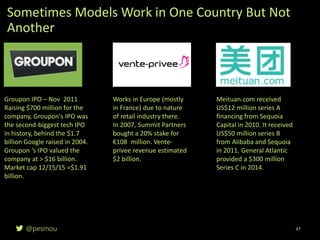
Sometimes Models Work in One Country But Not
Another
47
Groupon IPO – Nov 2011
Raising $700 million for the
company, Groupon's IPO was
the second-biggest tech IPO
in history, behind the $1.7
billion Google raised in 2004.
Groupon ‘s IPO valued the
company at > $16 billion.
Market cap 12/15/15 =$1.91
billion.
Works in Europe (mostly
in France) due to nature
of retail industry there.
In 2007, Summit Partners
bought a 20% stake for
€108 million. Vente-
privee revenue estimated
$2 billion.
Meituan.com received
US$12 million series A
financing from Sequoia
Capital in 2010. It received
US$50 million series B
from Alibaba and Sequoia
in 2011. General Atlantic
provided a $300 million
Series C in 2014.
@pesmou 48
For Traditional Ecommerce, Online Sales
Volume is a Product of Three Key Components
 Online store traffic/sessions in
number of sessions per time period
 Conversion % rate (total buyers
divided by total sessions for the
same time period)
 Average order value (AOV) for
same time period
@pesmou 49
In Many, But Not All
(e.g. Turkey and Other Emerging Markets),
Amazon.com Is a Dominant and Ruthless
Player; Alibaba Is Also a Global
Powerhouse
Many Companies Are Also Establishing
Marketplaces, So Competition Is
Increasingly Global
@pesmou 50
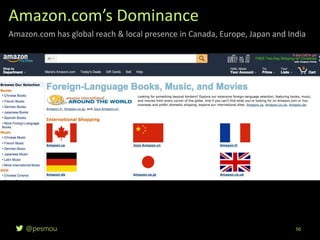
Amazon.com has global reach & local presence in Canada, Europe, Japan and India
Amazon.com’s Dominance
@pesmou 51
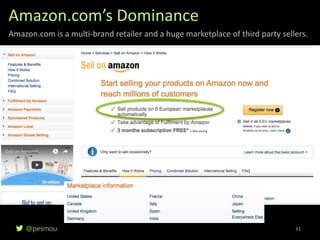
Amazon.com’s Dominance
Amazon.com is a multi-brand retailer and a huge marketplace of third party sellers.
@pesmou 52
Other Large Retailers Have Established Marketplaces
@pesmou 53
If You’re Not Yet Set Selling Online,
There is Some Good News
@pesmou 54
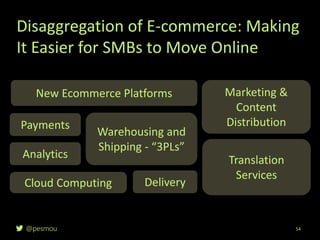
Disaggregation of E-commerce: Making
It Easier for SMBs to Move Online
Payments
Warehousing and
Shipping - “3PLs”
Delivery
New Ecommerce Platforms
Cloud Computing
Analytics Translation
Services
Marketing &
Content
Distribution
@pesmou
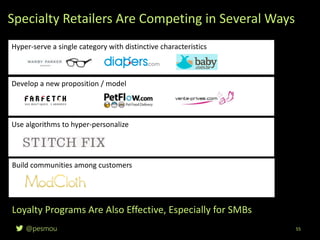
Develop a new proposition / model
Build communities among customers
Use algorithms to hyper-personalize
Hyper-serve a single category with distinctive characteristics
55
Specialty Retailers Are Competing in Several Ways
Loyalty Programs Are Also Effective, Especially for SMBs
@pesmou 56
Build vs. Buy
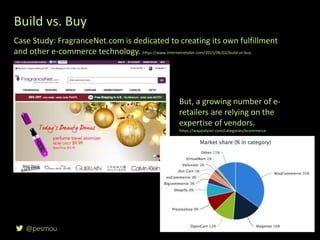
Case Study: FragranceNet.com is dedicated to creating its own fulfillment
and other e-commerce technology. https://www.internetretailer.com/2015/06/02/build-or-buy
But, a growing number of e-
retailers are relying on the
expertise of vendors.
https://wappalyzer.com/categories/ecommerce
@pesmou 57
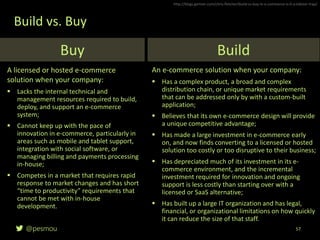
Buy Build
A licensed or hosted e-commerce
solution when your company:
 Lacks the internal technical and
management resources required to build,
deploy, and support an e-commerce
system;
 Cannot keep up with the pace of
innovation in e-commerce, particularly in
areas such as mobile and tablet support,
integration with social software, or
managing billing and payments processing
in-house;
 Competes in a market that requires rapid
response to market changes and has short
“time to productivity” requirements that
cannot be met with in-house
development.
An e-commerce solution when your company:
 Has a complex product, a broad and complex
distribution chain, or unique market requirements
that can be addressed only by with a custom-built
application;
 Believes that its own e-commerce design will provide
a unique competitive advantage;
 Has made a large investment in e-commerce early
on, and now finds converting to a licensed or hosted
solution too costly or too disruptive to their business;
 Has depreciated much of its investment in its e-
commerce environment, and the incremental
investment required for innovation and ongoing
support is less costly than starting over with a
licensed or SaaS alternative;
 Has built up a large IT organization and has legal,
financial, or organizational limitations on how quickly
it can reduce the size of that staff.
http://blogs.gartner.com/chris-fletcher/build-vs-buy-in-e-commerce-is-it-a-lobster-trap/
Build vs. Buy
@pesmou 58
Trends to Watch
China
Growing consumer class buying power
Recent Paypal survey: support the growth trend: 35% of online shoppers claim
to have shopped cross-border in 2015 vs. 26% in 2014
Payment technologies captive to ecommerce companies (Alipay, WeChat)
India
Major opportunity unfolding in India: battle between Flipkart and Amazon India
@pesmou
INDIA:
Quite early, local players following Amazon India
(partnering with Indian postal office and offering
same day delivery), smart phone is the eco-
system, but mobile data plans are constrained;
infrastructure can constrain design
PAYMENTS:
INDIA:
Cash on delivery is still dominant (Ola; Uber
started offering that); fraud really high; how to
get cash back to market; credit card penetration
low; two factor authentication imposed by Indian
govt  impacts conversion rate
Designing for Local Market:
Chinese apps tend to be more complex
59
https://soundcloud.com/a16z/india-china
CHINA:
More advanced – AliPay; WeChat; you
can pay with phone by showing QR
codes; AliPay is more than a payments
app (investment in stocks, get credit
score; order food; get coupons  it’s
about wealth generation)
TRANSACTIONS:
Critical; chip away at friction to get more
transactions
@pesmou 60
• Everything is becoming: connected, intelligent, real-time, multi-platform – DATA!
• Internet of Things (products-as-a-service)
• #Vcommerce (virtual reality is real)
• Re-urbanization in developed countries / urbanization China, India and beyond
• Rising consumer desire for individualization
• Social media moving further down the purchase funnel – share experiences
(Asos); customer service
• Last mile logistics – sell anything, anywhere
• Brands still matter but can be created (and die) quickly
Trends to Watch (con’t)
@pesmou 61
Asos Is On Trend
Private Label (Asos
brand) Retailer
Multi-brand Retailer
Global Appeal;
Free Delivery
Marketplace Platform
Content Marketing
Staff as Curators
User Generated Content
@pesmou 62
Sectors to Watch
• Ride sharing companies moving into food delivery and other adjacent business
• Food and food delivery (Ele.me - China)
• Health care & aging populations (Yao Xin - China)
• Work marketplaces
• Hard goods where economics are out of balance or unevenly distributed:
eyeglasses, matress (Casper – U.S.)
@pesmou 63
• Ecommerce is hard: led by tech and design
• Long-term perspective required
• Valuations not great in developed markets
• Most successful ecommerce companies (the three AAAs: Amazon,
Alibaba, Apple) offer a lot more than ecommerce
• Ecommerce and payments inextricably linked
• Mobile is eating the world
• Channels converging: omni-channel will win
• World shrinking: cross-border commerce is growing
Final Thoughts
@pesmou
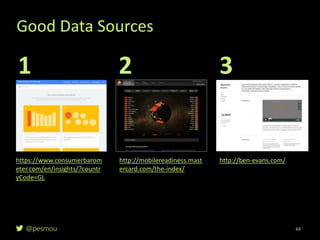
Good Data Sources
64
https://www.consumerbarom
eter.com/en/insights/?countr
yCode=GL
http://mobilereadiness.mast
ercard.com/the-index/
http://ben-evans.com/
1 2 3
@pesmou
THANK YOU!
Maria Thomas
mariachristinathomas@gmail.com
65

Ecommerce Landscape and Trends 12.17.15

  • 1.
    @pesmou Ecommerce Landscape and Trends MariaThomas December 17, 2015 @pesmou
  • 2.
  • 3.
    @pesmou Today’s Agenda  AQuick Look Back  The Big [Macro] Picture  The Big [Industry] Picture  Trends and Sectors to Watch
  • 4.
    @pesmou The Early Days…. 4 In1979 Michael Aldrich connected a domestic television by telephone line to a real-time transaction processing computer and invented what he called TELESHOPPING. AOL in the early 1990s.
  • 5.
    @pesmou E-Commerce As WeKnow It Is 20 Years Old 5 First Homepage - 1995 First Homepage - 1995
  • 6.
    @pesmou 6 Casualties ofPhase I of E-commerce Fashion retail web site Boo.com launched in 1999. The company burned $135 million of venture capital in 18 months, and went bankrupt in 2000. Malmsten re-emerged in 2011 as CEO of luxury goods company Lara Bohinc. Founded in 1994, TheGlobe.com was a social network before social networks existed, and offered essentially the same things that Facebook would later. But it made no money. Pets.com launched in August 1998. It became famous for the millions it spent on TV advertising with the Pets.com sock puppet. The company IPO-ed in February 2000 but was liquidated 268 days later. When eToys.com shares hit a high of $84.35 in October 1999, who could have guessed that just 16 months later, the company would warn investors that its stock was "worthless?"
  • 7.
    @pesmou Ecommerce Companies by 2013 Revenue Source:Statista http://www.statista.com/statistics/287950/leading-e-retailers-worldwide-based-on-revenue/ 7
  • 8.
    @pesmou Top 10 ChineseE-tailers by GMV/Revenue 8 https://doc.research-and-analytics.csfb.com/docView?language=ENG&source=ulg&format=PDF&document_id=1042623391&serialid=f0GXsvM2pz8e1L0JM%2Bip6oRgNHFWbrq0e502nHRhff8%3D
  • 9.
    @pesmou 9 The Big[Macro]Picture
  • 10.
    @pesmou 10 Worldwide Retail Sales ~US$22.5 Trillion in 2014 http://www.emarketer.com/Article/Retail-Sales-Worldwide-Will-Top-22-Trillion-This-Year/1011765
  • 11.
    @pesmou 11 Global Ecommerce Estimatedto Account for ~6.7% of Retail Sales (US$1.6T) in 2015 http://www.emarketer.com/Article/Retail-Sales-Worldwide-Will-Top-22-Trillion-This-Year/1011765 ABI Research predicts that globally about 8% in ecommerce will be transacted via a mobile phone in 2015.
  • 12.
    @pesmou China and U.S.are, by far, the World’s Leading E-commerce Markets, combining for More Than 55% of Global Retail Ecommerce Sales in 2014 http://www.emarketer.com/Article/Retail-Sales-Worldwide-Will-Top-22-Trillion-This-Year/1011765 12
  • 13.
    @pesmou But, absolute numbers canbe misleading… Ecommerce as a % of Total Retail Varies by Country 13 http://www.emarketer.com/Article/Retail-Sales-Worldwide-Will-Top-22-Trillion-This-Year/1011765
  • 14.
    @pesmou Factors Influencing Ecommerce PenetrationBy Country 14 SMARTPHONES/DATA Penetration POPULATION and % of Population Online OFFLINE RETAIL Options / Urbanization PAYMENTS % non-cash transactions SOCIAL MEDIA Penetration
  • 15.
    @pesmou POPULATION AND % OFPOPULATION ONLINE 15
  • 16.
    @pesmou World Internet Usage& Population Statistics (Nov 2015) 16 World Religions Population (2015 Est.) Population % of World Internet Users Latest Data Penetration (% Population) Growth 2000-2015 Users % of Table Africa 1,158,355,663 16.0% 327,145,889 28.2% 7,146.7% 9.8% Asia 4,032,466,882 55.5% 1,611,048,215 40.0% 1,309.4% 48.1% Europe 821,555,904 11.3% 604,147,280 73.5% 474.9% 18.1% Middle East 236,137,235 3.3% 123,172,132 52.2% 3,649.8% 3.7% North America 357,178,284 4.9% 313,867,363 87.9% 190.4% 9.4% Latin America / Caribbean 617,049,712 8.5% 339,251,363 55.0% 1,777.5% 10.1% Oceania / Australia 37,158,563 0.5% 27,200,530 73.2% 256.9% 0.8% World Total 7,259,902,243 100.0% 3,345,832,772 46.1% 826.9% 100.0% http://www.internetworldstats.com/stats.htm
  • 17.
    @pesmou World Internet UsageStatistics (2014 estimate) 17 Rank Country Internet Users (M) 1 China 626.6 2 European Union 398.1 3 United States 276.6 4 India 237.3 5 Japan 109.3 6 Brazil 108.2 7 Russia 84.4 8 Germany 70.3 9 Nigeria 66.6 10 United Kingdom 57.3 Rank Country Internet Users (M) 11 France 56.8 12 Mexico 49.5 13 Korea, South 44.9 14 Indonesia 42.4 15 Egypt 42.0 16 Vietnam 40.1 17 Philippines 39.2 18 Italy 37.0 19 Turkey 36.6 20 Spain 35.5 https://www.cia.gov/library/publications/the-world-factbook/rankorder/2153rank.html
  • 18.
    @pesmou Top 10 GlobalMarkets by Retail E-Commerce Attractiveness 18 https://www.atkearney.com/consumer-products-retail/e-commerce-index/full-report/-/asset_publisher/87xbENNHPZ3D/content/global-retail-e-commerce- keeps-on-clicking/10192?_101_INSTANCE_87xbENNHPZ3D_redirect=%2Fconsumer-products-retail%2Fe-commerce-index Based on the A.T. Kearney 2015 Global Retail E-Commerce Index (April 2015)
  • 19.
    @pesmou Pick Your Country: Google’sConsumer Barometer 19 https://www.consumerbarometer.com/en/ QUESTION ASKED: How often do you access the Internet for personal reasons, i.e. all non- business or work related purposes? Please think about your usage habits during the last month.
  • 20.
    @pesmou CROSS-BORDER E-COMMERCE IS AHUGE OPPORTUNITY BUT PAYMENT PREFERENCES VARY BY COUNTRY 20
  • 21.
    @pesmou 21 https://www.paypalobjects.com/digitalassets/c/website/marketing/global/pages/jobs/paypal-insights-2015-global-report-appendix-added.pdf Half ofAll Online Shoppers Have Made a Purchase From a Website in Another Country, Though the Popularity of Cross-Border Ecommerce Varies Greatly by Country
  • 22.
    @pesmou 22 https://www.paypalobjects.com/digitalassets/c/website/marketing/global/pages/jobs/paypal-insights-2015-global-report-appendix-added.pdf US contrastswith China as a market for international vendors as only online shoppers in Japan (12%) are less likely to have bought something online from another country than Americans (22%)
  • 23.
  • 24.
  • 25.
    @pesmou 25 • Growinginterest in cross-border transactions, especially from consumers in emerging markets • Burgeoning Chinese middle class may be a much larger market for international etailers in the future than it has been so far • US etailers are selling a lot of goods via cross border trade, but US consumers tend to focus on US sites • Smart ecommerce companies invest in SEO (discoverability) Cross Border Take-Aways Payments Take-Aways • Supporting local payment methods is a tremendous asset in improving sales • Offering culturally appropriate payment options will reduce abandoned check out carts
  • 26.
  • 27.
    @pesmou By 2020, 80%of Adults on Earth Will Have a Smartphone 27 http://www.slideshare.net/a16z/mew-a16z/5-50123451995_2000_2014_2020Billion_people 2014 Growth to 2020 Global Population (bn) Population Adults Mobile Online population 5 4 3 2 1 0 8 7 6 Smartphones PCs
  • 28.
  • 29.
  • 30.
    @pesmou Implications on Ecommerceof Growing Smartphone Penetration 30 DEVELOPING WORLD: “mobile internet” is the internet. DEVELOPED MARKETS: mobile commerce is all about convenience. CONSUMERS can do more than make a purchase. They are using their phones to compare prices, find retail locations, read reviews and find coupons. It is increasingly a COMPETITIVE ADVANTAGE for mobile sites to upload quickly and be easy to navigate as consumers weigh their options.
  • 31.
  • 32.
  • 33.
    @pesmou 33 http://www.nielsen.com/us/en/insights/reports/2015/global-trust-in-advertising-2015.html Why IsSocial Media Important? Earned and Owned Media Remain the Most Trusted Ad Formats Globally
  • 34.
    @pesmou 34 http://www.nielsen.com/us/en/insights/reports/2015/global-trust-in-advertising-2015.html % ofRespondents Who Completely or Somewhat Trust Advertising Format by Region
  • 35.
    @pesmou 35 Visitors to TopSocial Platforms By Country - % Internet Users Who Have Used Service in Last Month http://www.smartinsight s.com/social-media- marketing/social-media- strategy/new-global- social-media- research/attachment/20 15-social-network- popularity-by-country/
  • 36.
  • 37.
    @pesmou 37 The Big[Industry] Picture
  • 38.
    @pesmou 38 Think of Ecommerce AsPart of a Larger Digital Strategy Commerce platform
  • 39.
    @pesmou Ecommerce Comes inMany Flavors 39 B2C EcommerceCUSTOMER TYPES G2C: Government to Consumer B2B: Business to Business C2C: Consumer to Consumer C2B: Consumer to Business PRODUCTS TYPES Physical Goods Digital Goods Services MERCHANDISE ACQUISITION Make Manufacture Consigned Goods Wholesale SHIPPING/ DELIVERY TYPES Direct from Warehouse Drop Ship “Click and Collect” (Pickup) BUSINESS MODELS Retailer Marketplace Hybrids Subscription Private Sale / Flash Sale REVENUE STREAMS Commissions on Transactions Listing Fees Shipping Margins Advertising Subscriptions Retail Margins
  • 40.
    @pesmou Selected Ecommerce Companiesby Products Sold 40 Digital Goods Digital Services Physical Goods Physical Services
  • 41.
    @pesmou 41 Retail Single/Multi-brand Classified Marketplace Merchant Services Marketplace Private/FlashSale Subscription Single Brand Multi-Brand Selected Ecommerce Companies by Model
  • 42.
    @pesmou 42 © LUMAPartners LLC 2015 Coupon Aggregators Community Platform Social Enablers Fulfillment / Distribution SaaS COMMERCE LUMAscape Social Commerce Affiliate Mktg Secondary MarketDaily Deal AggregatorsWhite Label Solutions Daily Deal Data / Analytics Exchanges Marketplaces / Auctions Price ComparisonStorefront / Cart Payment-SpecificOrder Mgmt Flash Sale Sites Daily Deal Sites Publisher Deals Realtime TravelBeautyHome CRM Subscription/Push E-Commerce Implementation Mobile Commerce E-mail CommerceAnalytics Performance M A R K E T E R C O N S U M E R Denotes acquired company Denotes shuttered company
  • 43.
    @pesmou 43 Know YourCompetitive Advantage: Hard to Compete With Amazon in Many Markets
  • 44.
  • 45.
    @pesmou 45 Multiple PlatformsCompetition for Tech/Design/Mkting Talent Last Mile Distributions Options Warehousing, Inventory Management Marketing is Increasingly Driven by Data/Technology
  • 46.
    @pesmou 46 Ecommerce CompaniesCan “Fail” for Different Reasons Red-hot startup Fab raised $330 million (valued at nearly $US$1 billion) and then went bust. “We spent $200M and we have not proven out our business model. “ – former CEO, Jason Goldberg Karmaloop was considered a success story and became a go-to website for streetwear — a mix of skate, surf, hip-hop and other fashions. Success was followed by poor business decisions and shrinking sales in recent years. Founder/CEO launched a series of failed e-commerce sites and a $14 million bid to launch a television channel that never materialized. Many of Quirky's products had thin to non-existent margins. Its Wink unit also faced distress, and a botched security update meant the company had to do a nationwide recall in spring of 2015 its smart home hubs. Homejoy CEO Adora Cheung blamed the worker-misclassification lawsuits the company faced. It had failed to raise enough funding to grow the company as big as they wanted, she said, so it decided to shutter its doors in July. Like Groupon, the company had struggled to entice repeat customers when it offered a cheap initial cleaning and then later raised the price.
  • 47.
    @pesmou Sometimes Models Workin One Country But Not Another 47 Groupon IPO – Nov 2011 Raising $700 million for the company, Groupon's IPO was the second-biggest tech IPO in history, behind the $1.7 billion Google raised in 2004. Groupon ‘s IPO valued the company at > $16 billion. Market cap 12/15/15 =$1.91 billion. Works in Europe (mostly in France) due to nature of retail industry there. In 2007, Summit Partners bought a 20% stake for €108 million. Vente- privee revenue estimated $2 billion. Meituan.com received US$12 million series A financing from Sequoia Capital in 2010. It received US$50 million series B from Alibaba and Sequoia in 2011. General Atlantic provided a $300 million Series C in 2014.
  • 48.
    @pesmou 48 For TraditionalEcommerce, Online Sales Volume is a Product of Three Key Components  Online store traffic/sessions in number of sessions per time period  Conversion % rate (total buyers divided by total sessions for the same time period)  Average order value (AOV) for same time period
  • 49.
    @pesmou 49 In Many,But Not All (e.g. Turkey and Other Emerging Markets), Amazon.com Is a Dominant and Ruthless Player; Alibaba Is Also a Global Powerhouse Many Companies Are Also Establishing Marketplaces, So Competition Is Increasingly Global
  • 50.
    @pesmou 50 Amazon.com hasglobal reach & local presence in Canada, Europe, Japan and India Amazon.com’s Dominance
  • 51.
    @pesmou 51 Amazon.com’s Dominance Amazon.comis a multi-brand retailer and a huge marketplace of third party sellers.
  • 52.
    @pesmou 52 Other LargeRetailers Have Established Marketplaces
  • 53.
    @pesmou 53 If You’reNot Yet Set Selling Online, There is Some Good News
  • 54.
    @pesmou 54 Disaggregation ofE-commerce: Making It Easier for SMBs to Move Online Payments Warehousing and Shipping - “3PLs” Delivery New Ecommerce Platforms Cloud Computing Analytics Translation Services Marketing & Content Distribution
  • 55.
    @pesmou Develop a newproposition / model Build communities among customers Use algorithms to hyper-personalize Hyper-serve a single category with distinctive characteristics 55 Specialty Retailers Are Competing in Several Ways Loyalty Programs Are Also Effective, Especially for SMBs
  • 56.
    @pesmou 56 Build vs.Buy Case Study: FragranceNet.com is dedicated to creating its own fulfillment and other e-commerce technology. https://www.internetretailer.com/2015/06/02/build-or-buy But, a growing number of e- retailers are relying on the expertise of vendors. https://wappalyzer.com/categories/ecommerce
  • 57.
    @pesmou 57 Buy Build Alicensed or hosted e-commerce solution when your company:  Lacks the internal technical and management resources required to build, deploy, and support an e-commerce system;  Cannot keep up with the pace of innovation in e-commerce, particularly in areas such as mobile and tablet support, integration with social software, or managing billing and payments processing in-house;  Competes in a market that requires rapid response to market changes and has short “time to productivity” requirements that cannot be met with in-house development. An e-commerce solution when your company:  Has a complex product, a broad and complex distribution chain, or unique market requirements that can be addressed only by with a custom-built application;  Believes that its own e-commerce design will provide a unique competitive advantage;  Has made a large investment in e-commerce early on, and now finds converting to a licensed or hosted solution too costly or too disruptive to their business;  Has depreciated much of its investment in its e- commerce environment, and the incremental investment required for innovation and ongoing support is less costly than starting over with a licensed or SaaS alternative;  Has built up a large IT organization and has legal, financial, or organizational limitations on how quickly it can reduce the size of that staff. http://blogs.gartner.com/chris-fletcher/build-vs-buy-in-e-commerce-is-it-a-lobster-trap/ Build vs. Buy
  • 58.
    @pesmou 58 Trends toWatch China Growing consumer class buying power Recent Paypal survey: support the growth trend: 35% of online shoppers claim to have shopped cross-border in 2015 vs. 26% in 2014 Payment technologies captive to ecommerce companies (Alipay, WeChat) India Major opportunity unfolding in India: battle between Flipkart and Amazon India
  • 59.
    @pesmou INDIA: Quite early, localplayers following Amazon India (partnering with Indian postal office and offering same day delivery), smart phone is the eco- system, but mobile data plans are constrained; infrastructure can constrain design PAYMENTS: INDIA: Cash on delivery is still dominant (Ola; Uber started offering that); fraud really high; how to get cash back to market; credit card penetration low; two factor authentication imposed by Indian govt  impacts conversion rate Designing for Local Market: Chinese apps tend to be more complex 59 https://soundcloud.com/a16z/india-china CHINA: More advanced – AliPay; WeChat; you can pay with phone by showing QR codes; AliPay is more than a payments app (investment in stocks, get credit score; order food; get coupons  it’s about wealth generation) TRANSACTIONS: Critical; chip away at friction to get more transactions
  • 60.
    @pesmou 60 • Everythingis becoming: connected, intelligent, real-time, multi-platform – DATA! • Internet of Things (products-as-a-service) • #Vcommerce (virtual reality is real) • Re-urbanization in developed countries / urbanization China, India and beyond • Rising consumer desire for individualization • Social media moving further down the purchase funnel – share experiences (Asos); customer service • Last mile logistics – sell anything, anywhere • Brands still matter but can be created (and die) quickly Trends to Watch (con’t)
  • 61.
    @pesmou 61 Asos IsOn Trend Private Label (Asos brand) Retailer Multi-brand Retailer Global Appeal; Free Delivery Marketplace Platform Content Marketing Staff as Curators User Generated Content
  • 62.
    @pesmou 62 Sectors toWatch • Ride sharing companies moving into food delivery and other adjacent business • Food and food delivery (Ele.me - China) • Health care & aging populations (Yao Xin - China) • Work marketplaces • Hard goods where economics are out of balance or unevenly distributed: eyeglasses, matress (Casper – U.S.)
  • 63.
    @pesmou 63 • Ecommerceis hard: led by tech and design • Long-term perspective required • Valuations not great in developed markets • Most successful ecommerce companies (the three AAAs: Amazon, Alibaba, Apple) offer a lot more than ecommerce • Ecommerce and payments inextricably linked • Mobile is eating the world • Channels converging: omni-channel will win • World shrinking: cross-border commerce is growing Final Thoughts
  • 64.
  • 65.

Editor's Notes

  • #3 2
  • #4 3
  • #7 Good ideas here. Too early. “TheGlobe” – first social network. Pets.com – good idea before macros infrastructure
  • #8 Alibaba was not yet a public company when this chart was made.
  • #11 Rate of global retail growth is slowing
  • #12 When it comes to retail products and services purchased on the internet, ecommerce will account for 5.9% of the total retail market worldwide in 2014, or $1.316 trillion. By 2018, that share will increase significantly to 8.8%, yet retail ecommerce will still account for just a fraction of in-store purchases even as it nears $2.5 trillion by the end of this forecast.
  • #13 China’s growth over the next five years will widen the gap between the two countries, and China will exceed $1 trillion in retail ecommerce sales by 2018, accounting for more than 40% of the total worldwide. The US will maintain its position as the second-largest retail ecommerce market in 2018, totaling nearly $500 billion that year, while the UK will account for about one-quarter of that figure, landing in a distant third place. Ecommerce share of total retail sales can mean different things in different markets. In the case of the US, this metric shows the continued strength of brick-and-mortar retail, as well as US consumers’ appetite for purchasing in-store. Approximately 63% of the US population will make a digital purchase this year, yet only 6.5% of US retail sales are expected to come from internet transactions, increasing to 8.9% by 2018. In other words, a majority of US consumers are making purchases online, but more than $10 out of every $11 are still spent in stores. The other two largest ecommerce markets, China and the UK, have much higher proportions of online-to-total retail sales than the US, and ecommerce trends in each market are unique. For example, digital buyers—consumers who purchase online at least once during the year—will represent only 27.5% of China’s population in 2014, while more than 10% of all retail purchases occur via the internet. This points to the fact that consumers in China who buy online do so often. On the other hand, more than 73% of the UK’s population will make a purchase online this year. With ecommerce accounting for 13.0% of total retail sales in the UK—leading all countries by this metric—this high volume of digital buyers who purchase online often positions the UK as the third-largest ecommerce market, despite being only eighth-largest in total retail sales.
  • #14 Ecommerce share of total retail sales can mean different things in different markets. In the case of the US, this metric shows the continued strength of brick-and-mortar retail, as well as US consumers’ appetite for purchasing in-store. Approximately 63% of the US population will make a digital purchase this year, yet only 6.5% of US retail sales are expected to come from internet transactions, increasing to 8.9% by 2018. In other words, a majority of US consumers are making purchases online, but more than $10 out of every $11 are still spent in stores. The other two largest ecommerce markets, China and the UK, have much higher proportions of online-to-total retail sales than the US, and ecommerce trends in each market are unique. For example, digital buyers—consumers who purchase online at least once during the year—will represent only 27.5% of China’s population in 2014, while more than 10% of all retail purchases occur via the internet. This points to the fact that consumers in China who buy online do so often. On the other hand, more than 73% of the UK’s population will make a purchase online this year. With ecommerce accounting for 13.0% of total retail sales in the UK—leading all countries by this metric—this high volume of digital buyers who purchase online often positions the UK as the third-largest ecommerce market, despite being only eighth-largest in total retail sales.
  • #22 major ramifications for the marketing, web content, and product delivery of online retailers
  • #24 A report earlier this year indicated that data security, retailer trust, and ease of returns are the biggest barriers in cross-border shopping. PayPal found that costs were a barrier in cross-border shopping, including those related to international shipping.
  • #25 In Africa, where there are many different ways to pay, each region or country should be treated as a different market. For example, Kenyans typically use their mobile money accounts, M-Pesa, over bank accounts. In Nigeria, however, M-Pesa has barely made a ripple in the pond. The most common payment method there is the Interswitch Verve card, which is issued through 16 of the country’s major banks. Alipay, a popular payment method in places like China, has overtaken PayPal as the largest mobile payments platform globally, with more than 300 million registered mobile accounts.
  • #26 For example, in emerging markets like China, the combination of higher disposable incomes, coupled with a growing appetite for brand-name goods is creating high demand for U.S. and UK brands.
  • #28 This is the more relevant slide. http://www.economist.com/news/leaders/21645180-smartphone-ubiquitous-addictive-and-transformative-planet-phones
  • #31 Saying “mobile Internet” is like saying “color TV”
  • #32 summary
  • #34 Word of mouth and personal recommendations matter. Needing to reach, resonate with, and get a reaction from the right audience in a world of choice can make it difficult to decide where to allot one’s advertising dollars. While there isn’t one simple rule for maximizing advertising effectiveness in such a saturated market, understanding how consumers feel about the ads served on the various media platforms they use every day is a good place to start. WHO DO WE TRUST? The most credible advertising comes straight from the people we know and trust. More than eight-in-10 global respondents (83%) say they completely or somewhat trust the recommendations of friends and family. But trust isn’t confined only to those in our inner circle. In fact, two-thirds (66%) say they trust consumer opinions posted online—the third-most-trusted format. Owned (brand-managed) online channels are also among the most trusted advertising formats. In fact, branded websites are the second-most trusted format, with 70% of global respondents saying they completely or somewhat trust these sites. In addition, more than half of respondents (56%) trust emails they signed up for.
  • #36 \
  • #39 Flywheel
  • #46 For merchants and development teams, creating and managing shops is too hard. It’s incredibly challenging to scale on closed platforms and legacy technologies. I can’t stress this enough: It’s expensive. Difficult to staff. Hard to customize and maintain. Then there’s setting up shipping, payments, processing orders. And good luck trying to get your product feed formatted for search engines. Or adding social tags. Or creating email campaigns. Or acquiring and retaining customers. Or installing 3rd-party integrations.
  • #47 Some sold out of bankruptcy
  • #48 Generally Haven’t Found a Lasting Proposition (vente-privee Europe – possible exception)
  • #49 CAC, LTV
  • #51 https://newrepublic.com/article/126369/amazon-dominated-nearly-everything-year
  • #52 https://newrepublic.com/article/126369/amazon-dominated-nearly-everything-year
  • #54 So, how are companies doing this and why hard?
  • #55 Better e-commerce platforms: Shopify, Spree (First Data), Reaction Commerce(beta)
  • #56 a Good Example of Retailer-as-a-Platform
  • #62 a Good Example of Retailer-as-a-Platform
  • #63  GrubHub and Seamless may be household names in the United States, but China’s food-delivery apps are left something to be desired, so Ele.me – “hungry, yet?” in Chinese – set out to take over the market. The Shanghai-based service, which recently announced $630 in series F funding, serves 250 cities, delivering food from 200,000 restaurants to 20 million users. About $9.5 million in transactions are recorded every day by 40 million customers, 98 percent of which use Ele.me’s mobile app to order food. The company now has a valuation of $3 billion, making it the third most-funded startup in China. To better serve China’s massive aging population – the number of people aged 65 or older is projected to reach 223 million people by 2030 – the country’s healthcare industry is undergoing a digital makeover. Many feel the industry is in need of an overhaul due to poor hospital infrastructure and a lack of doctors to meet the population’s needs. 80 percent of China’s drug sales take place in hospitals now, but in the future they will shift to drug stores, and Yao Xin aims to educate and incentivize drugstore assistants to properly and safely distribute drugs. Many of these assistants are poorly paid, thus may not be fully dedicated to properly distributing medications. To improve their performance, Yao Xin uses virtual patients suffering various woes, and those who properly diagnose and treat patients receive bonuses that can be as high as four months of pay.
  • #64 For merchants and development teams, creating and managing shops is too hard. It’s incredibly challenging to scale on closed platforms and legacy technologies. It’s expensive. Difficult to staff. Hard to customize and maintain. Then there’s setting up shipping, payments, processing orders. And good luck trying to get your product feed formatted for search engines. Or adding social tags. Or creating email campaigns. Or acquiring and retaining customers. Or installing 3rd-party integrations. And oh my god I could go on...
  • #66 Non-linear path is Ok.