E-Commerce Globalization
Romeo P. Evangelista
What is E-Commerce
 It is the buying and selling of goods and services, or
the transmitting of funds or data, over an electronic
network, primarily the internet. These business
transactions occur either as business-to-business,
business-to-consumer, consumer-to-consumer or
consumer-to-business.
Globalization
 is the process in which people, ideas and goods
spread throughout the world, spurring more
interaction and integration between the world's
cultures, governments and economies.
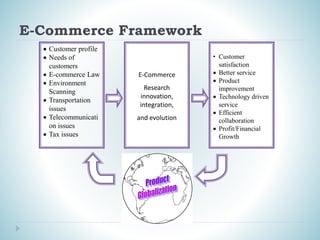
E-Commerce Framework
 Customer profile
 Needs of
customers
 E-commerce Law
 Environment
Scanning
 Transportation
issues
 Telecommunicati
on issues
 Tax issues
E-Commerce
Research
innovation,
integration,
and evolution
• Customer
satisfaction
 Better service
 Product
improvement
 Technology driven
service
 Efficient
collaboration
 Profit/Financial
Growth
E-Commerce Framework…
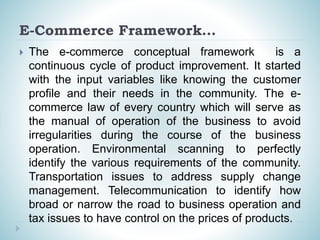
 The e-commerce conceptual framework is a
continuous cycle of product improvement. It started
with the input variables like knowing the customer
profile and their needs in the community. The e-
commerce law of every country which will serve as
the manual of operation of the business to avoid
irregularities during the course of the business
operation. Environmental scanning to perfectly
identify the various requirements of the community.
Transportation issues to address supply change
management. Telecommunication to identify how
broad or narrow the road to business operation and
tax issues to have control on the prices of products.
E-Commerce Framework…
 These inputs are the requirements of research to
come up with better product innovation and
integration that patches new product to existing
platform and the result is a new breed of product
evolution that customers are waiting to grab for
satisfying product experience.
E-Commerce Framework…
 The thirst of customers to new product innovation
has met, as a result of new product output that will
raise customer satisfaction, better service delivery
due to technology driven service. It will also promote
better and efficient collaboration among players in
the business environment, thus giving better profit
intake for the company
 The next scenario is product globalization.
E-Commerce Services
 e-brochure of product and services
 WYSIWYG of product and services
 E-Transactional – online payment
 E-support services – pre/post sales support
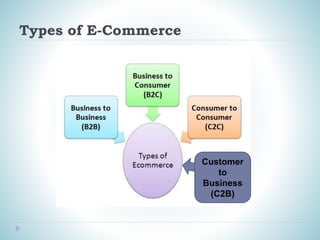
Types of E-Commerce
Customer
to
Business
(C2B)
Types of E-Commerce
 Business to Business (B2B): is one type of E-
commerce. This is when online businesses do business
with one another.
 Business to commerce, or B2C: is another type of E-
commerce. This is when a business offers to the public in
common such as purchases record. Ex. E-Shopping
 Customer to Business (C2B): is another type. It
includes a customer publishing a project online with a set
price range in mind. Companies then evaluation the
project and bid on it.
 Consumer to customer (C2C): is yet another form of E-
commerce. This is like eBay or websites like it. It is when
a site details various items to be mark
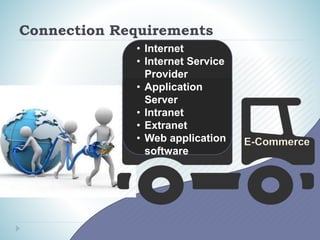
Connection Requirements
E-Commerce
• Internet
• Internet Service
Provider
• Application
Server
• Intranet
• Extranet
• Web application
software
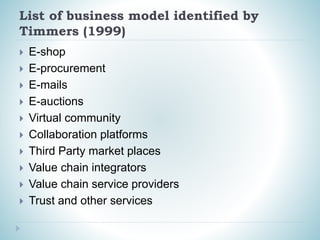
List of business model identified by
Timmers (1999)
 E-shop
 E-procurement
 E-mails
 E-auctions
 Virtual community
 Collaboration platforms
 Third Party market places
 Value chain integrators
 Value chain service providers
 Trust and other services
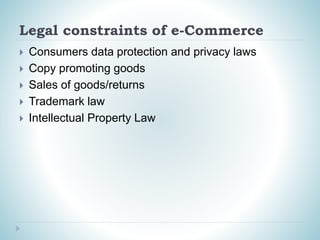
Legal constraints of e-Commerce
 Consumers data protection and privacy laws
 Copy promoting goods
 Sales of goods/returns
 Trademark law
 Intellectual Property Law
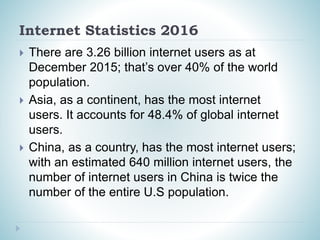
Internet Statistics 2016
 There are 3.26 billion internet users as at
December 2015; that’s over 40% of the world
population.
 Asia, as a continent, has the most internet
users. It accounts for 48.4% of global internet
users.
 China, as a country, has the most internet users;
with an estimated 640 million internet users, the
number of internet users in China is twice the
number of the entire U.S population.
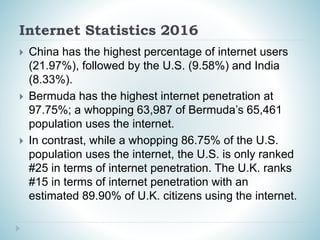
Internet Statistics 2016
 China has the highest percentage of internet users
(21.97%), followed by the U.S. (9.58%) and India
(8.33%).
 Bermuda has the highest internet penetration at
97.75%; a whopping 63,987 of Bermuda’s 65,461
population uses the internet.
 In contrast, while a whopping 86.75% of the U.S.
population uses the internet, the U.S. is only ranked
#25 in terms of internet penetration. The U.K. ranks
#15 in terms of internet penetration with an
estimated 89.90% of U.K. citizens using the internet.
Internet Statistics 2016
 Digital interactions influenced retail sales to the tune
of $2.2 trillion in 2015.
 By 2017, there will be more internet traffic than all
prior internet years combined
 Wi-Fi and mobile-connected devices will generate
68% of all internet traffic by 2017.
 In 2015, 64% of all in-store sales, or sales to the
tune of $2.2 trillion, were influenced by the internet.
Internet Statistics 2016
 Facebook now has 1.55 billion active users.
 2.9 billion Google searches are made every day.
 2.7 million blog posts are published every day.
e-Commerce Statistics
 40% of global internet users, or more than 1 billion
people, have bought products or goods online.
 The U.S. e-commerce economy is worth $349 billion
while China’s e-commerce economy is worth
$562.66 billion.
 A single second delay in your website loading time
can result in a 7% loss in conversion, and 40% of
web users will abandon a website if it takes longer
than 3 seconds to load.
e-Commerce Statistics
 Online retail sales in the U.K. reached an estimated
£52.25 billion in 2015, with the average shopper
spending £1,174.
 Worldwide B2C e-commerce sales reached $1.7
trillion in 2015, and it is estimated to reach $2.35
trillion by 2018.
 8 out of 10 consumers will shop online if offered free
shipping.
 Personalised recommendations can increase
conversion rates by up to 5.5 times.
e-Commerce Statistics
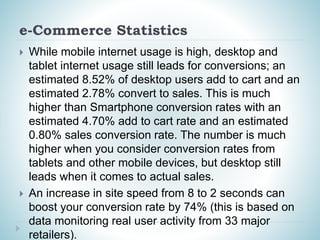
 While mobile internet usage is high, desktop and
tablet internet usage still leads for conversions; an
estimated 8.52% of desktop users add to cart and an
estimated 2.78% convert to sales. This is much
higher than Smartphone conversion rates with an
estimated 4.70% add to cart rate and an estimated
0.80% sales conversion rate. The number is much
higher when you consider conversion rates from
tablets and other mobile devices, but desktop still
leads when it comes to actual sales.
 An increase in site speed from 8 to 2 seconds can
boost your conversion rate by 74% (this is based on
data monitoring real user activity from 33 major
retailers).
e-Commerce Statistics
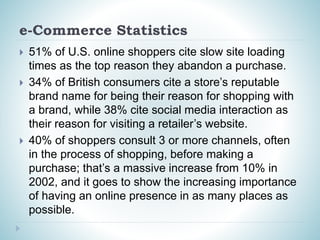
 51% of U.S. online shoppers cite slow site loading
times as the top reason they abandon a purchase.
 34% of British consumers cite a store’s reputable
brand name for being their reason for shopping with
a brand, while 38% cite social media interaction as
their reason for visiting a retailer’s website.
 40% of shoppers consult 3 or more channels, often
in the process of shopping, before making a
purchase; that’s a massive increase from 10% in
2002, and it goes to show the increasing importance
of having an online presence in as many places as
possible.
e-Commerce Statistics
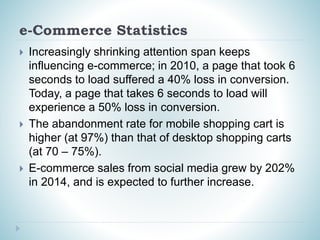
 Increasingly shrinking attention span keeps
influencing e-commerce; in 2010, a page that took 6
seconds to load suffered a 40% loss in conversion.
Today, a page that takes 6 seconds to load will
experience a 50% loss in conversion.
 The abandonment rate for mobile shopping cart is
higher (at 97%) than that of desktop shopping carts
(at 70 – 75%).
 E-commerce sales from social media grew by 202%
in 2014, and is expected to further increase.
e-Commerce Statistics
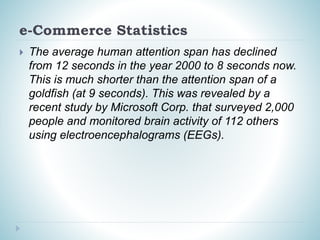
 The average human attention span has declined
from 12 seconds in the year 2000 to 8 seconds now.
This is much shorter than the attention span of a
goldfish (at 9 seconds). This was revealed by a
recent study by Microsoft Corp. that surveyed 2,000
people and monitored brain activity of 112 others
using electroencephalograms (EEGs).
References
 http://searchcio.techtarget.com/definition/e-
commerce
 http://e-business13.blogspot.com/ eted or marketed
amongst customers.
 http://www.techgenuine.com/blog/ecommerce/essent
ial-components-of-ecommerce-website/
 https://hostingfacts.com/internet-facts-stats-2016/

ecommerce

  • 1.
  • 2.
    What is E-Commerce It is the buying and selling of goods and services, or the transmitting of funds or data, over an electronic network, primarily the internet. These business transactions occur either as business-to-business, business-to-consumer, consumer-to-consumer or consumer-to-business.
  • 3.
    Globalization  is theprocess in which people, ideas and goods spread throughout the world, spurring more interaction and integration between the world's cultures, governments and economies.
  • 4.
    E-Commerce Framework  Customerprofile  Needs of customers  E-commerce Law  Environment Scanning  Transportation issues  Telecommunicati on issues  Tax issues E-Commerce Research innovation, integration, and evolution • Customer satisfaction  Better service  Product improvement  Technology driven service  Efficient collaboration  Profit/Financial Growth
  • 5.
    E-Commerce Framework…  Thee-commerce conceptual framework is a continuous cycle of product improvement. It started with the input variables like knowing the customer profile and their needs in the community. The e- commerce law of every country which will serve as the manual of operation of the business to avoid irregularities during the course of the business operation. Environmental scanning to perfectly identify the various requirements of the community. Transportation issues to address supply change management. Telecommunication to identify how broad or narrow the road to business operation and tax issues to have control on the prices of products.
  • 6.
    E-Commerce Framework…  Theseinputs are the requirements of research to come up with better product innovation and integration that patches new product to existing platform and the result is a new breed of product evolution that customers are waiting to grab for satisfying product experience.
  • 7.
    E-Commerce Framework…  Thethirst of customers to new product innovation has met, as a result of new product output that will raise customer satisfaction, better service delivery due to technology driven service. It will also promote better and efficient collaboration among players in the business environment, thus giving better profit intake for the company  The next scenario is product globalization.
  • 8.
    E-Commerce Services  e-brochureof product and services  WYSIWYG of product and services  E-Transactional – online payment  E-support services – pre/post sales support
  • 9.
  • 10.
    Types of E-Commerce Business to Business (B2B): is one type of E- commerce. This is when online businesses do business with one another.  Business to commerce, or B2C: is another type of E- commerce. This is when a business offers to the public in common such as purchases record. Ex. E-Shopping  Customer to Business (C2B): is another type. It includes a customer publishing a project online with a set price range in mind. Companies then evaluation the project and bid on it.  Consumer to customer (C2C): is yet another form of E- commerce. This is like eBay or websites like it. It is when a site details various items to be mark
  • 11.
    Connection Requirements E-Commerce • Internet •Internet Service Provider • Application Server • Intranet • Extranet • Web application software
  • 12.
    List of businessmodel identified by Timmers (1999)  E-shop  E-procurement  E-mails  E-auctions  Virtual community  Collaboration platforms  Third Party market places  Value chain integrators  Value chain service providers  Trust and other services
  • 13.
    Legal constraints ofe-Commerce  Consumers data protection and privacy laws  Copy promoting goods  Sales of goods/returns  Trademark law  Intellectual Property Law
  • 14.
    Internet Statistics 2016 There are 3.26 billion internet users as at December 2015; that’s over 40% of the world population.  Asia, as a continent, has the most internet users. It accounts for 48.4% of global internet users.  China, as a country, has the most internet users; with an estimated 640 million internet users, the number of internet users in China is twice the number of the entire U.S population.
  • 15.
    Internet Statistics 2016 China has the highest percentage of internet users (21.97%), followed by the U.S. (9.58%) and India (8.33%).  Bermuda has the highest internet penetration at 97.75%; a whopping 63,987 of Bermuda’s 65,461 population uses the internet.  In contrast, while a whopping 86.75% of the U.S. population uses the internet, the U.S. is only ranked #25 in terms of internet penetration. The U.K. ranks #15 in terms of internet penetration with an estimated 89.90% of U.K. citizens using the internet.
  • 16.
    Internet Statistics 2016 Digital interactions influenced retail sales to the tune of $2.2 trillion in 2015.  By 2017, there will be more internet traffic than all prior internet years combined  Wi-Fi and mobile-connected devices will generate 68% of all internet traffic by 2017.  In 2015, 64% of all in-store sales, or sales to the tune of $2.2 trillion, were influenced by the internet.
  • 17.
    Internet Statistics 2016 Facebook now has 1.55 billion active users.  2.9 billion Google searches are made every day.  2.7 million blog posts are published every day.
  • 18.
    e-Commerce Statistics  40%of global internet users, or more than 1 billion people, have bought products or goods online.  The U.S. e-commerce economy is worth $349 billion while China’s e-commerce economy is worth $562.66 billion.  A single second delay in your website loading time can result in a 7% loss in conversion, and 40% of web users will abandon a website if it takes longer than 3 seconds to load.
  • 19.
    e-Commerce Statistics  Onlineretail sales in the U.K. reached an estimated £52.25 billion in 2015, with the average shopper spending £1,174.  Worldwide B2C e-commerce sales reached $1.7 trillion in 2015, and it is estimated to reach $2.35 trillion by 2018.  8 out of 10 consumers will shop online if offered free shipping.  Personalised recommendations can increase conversion rates by up to 5.5 times.
  • 20.
    e-Commerce Statistics  Whilemobile internet usage is high, desktop and tablet internet usage still leads for conversions; an estimated 8.52% of desktop users add to cart and an estimated 2.78% convert to sales. This is much higher than Smartphone conversion rates with an estimated 4.70% add to cart rate and an estimated 0.80% sales conversion rate. The number is much higher when you consider conversion rates from tablets and other mobile devices, but desktop still leads when it comes to actual sales.  An increase in site speed from 8 to 2 seconds can boost your conversion rate by 74% (this is based on data monitoring real user activity from 33 major retailers).
  • 21.
    e-Commerce Statistics  51%of U.S. online shoppers cite slow site loading times as the top reason they abandon a purchase.  34% of British consumers cite a store’s reputable brand name for being their reason for shopping with a brand, while 38% cite social media interaction as their reason for visiting a retailer’s website.  40% of shoppers consult 3 or more channels, often in the process of shopping, before making a purchase; that’s a massive increase from 10% in 2002, and it goes to show the increasing importance of having an online presence in as many places as possible.
  • 22.
    e-Commerce Statistics  Increasinglyshrinking attention span keeps influencing e-commerce; in 2010, a page that took 6 seconds to load suffered a 40% loss in conversion. Today, a page that takes 6 seconds to load will experience a 50% loss in conversion.  The abandonment rate for mobile shopping cart is higher (at 97%) than that of desktop shopping carts (at 70 – 75%).  E-commerce sales from social media grew by 202% in 2014, and is expected to further increase.
  • 23.
    e-Commerce Statistics  Theaverage human attention span has declined from 12 seconds in the year 2000 to 8 seconds now. This is much shorter than the attention span of a goldfish (at 9 seconds). This was revealed by a recent study by Microsoft Corp. that surveyed 2,000 people and monitored brain activity of 112 others using electroencephalograms (EEGs).
  • 24.
    References  http://searchcio.techtarget.com/definition/e- commerce  http://e-business13.blogspot.com/eted or marketed amongst customers.  http://www.techgenuine.com/blog/ecommerce/essent ial-components-of-ecommerce-website/  https://hostingfacts.com/internet-facts-stats-2016/