 Name : Makwana Vijay K.
 Email : vijaykm7777@gmail.com
 Roll no. : 3434
 Enrollment no. : 2069108420180035
 M.A PART 1, SEM 2
 Submitted to : Department of English (MKBU)
 Topic : Eco-criticism
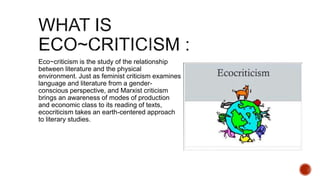
Eco~criticism is the study of the relationship
between literature and the physical
environment. Just as feminist criticism examines
language and literature from a gender-
conscious perspective, and Marxist criticism
brings an awareness of modes of production
and economic class to its reading of texts,
ecocriticism takes an earth-centered approach
to literary studies.
 “Ecocriticism takes as its subject
the interconnections between
nature and culture, specifically the
cultural artifacts of language and
literature. As a critical stance, it
has one foot in literature and the
other on land; as a theoretical
discourse, it negotiates between
the human and the nonhuman”
 We are facing a global crisis today, not
because of how ecosystems function but
rather because of how our ethical systems
function. Getting through the crisis requires
understanding our impact on nature as
precisely as possible, but even more, it
requires understanding those ethical
systems and using that understanding to
reform them. Historians, along with literary
scholars, anthropologists, and philosophers,
cannot do the reforming, of course, but they
can help with the understanding….
 “Worster and other historians are writing
environmental histories, studying the
reciprocal relationships between humans
and land, considering nature not just as the
stage upon which the human story is acted
out, but as an actor in the drama”
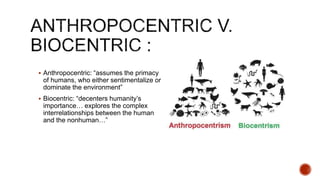
 Anthropocentric: “assumes the primacy
of humans, who either sentimentalize or
dominate the environment”
 Biocentric: “decenters humanity’s
importance… explores the complex
interrelationships between the human
and the nonhuman…”
 Domination Model: “The anthropocentric
view…exemplified both by the pastoral and the
literature of territorial expansion…humans dominate
the environment”
 Caretaking Model: “…still anthropocentric, positions
humans as caretakers of the earth.”
 Biocentric Model: “rejects anthropocentric views…
connectedness of all living and nonliving things.”
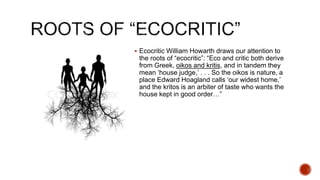
 Ecocritic William Howarth draws our attention to
the roots of “ecocritic”: “Eco and critic both derive
from Greek, oikos and kritis, and in tandem they
mean ‘house judge,’ . . . So the oikos is nature, a
place Edward Hoagland calls ‘our widest home,’
and the kritos is an arbiter of taste who wants the
house kept in good order…”
“If this belief from heaven be sent,
If such be Nature’s holy plan,
Have I not reason to lament
What man has made of man?”
~William Wordsworth
“ The woods are lovely dark and deep ,
But I have promises to keep,
Miles to go before I sleep”
~Robert Frost
Nature is an
infinite sphere
whose center is everywhere
and whose circumference
is nowhere.
~Blaise Pascal
Eco~criticism

Eco~criticism

  • 1.
     Name :Makwana Vijay K.  Email : vijaykm7777@gmail.com  Roll no. : 3434  Enrollment no. : 2069108420180035  M.A PART 1, SEM 2  Submitted to : Department of English (MKBU)  Topic : Eco-criticism
  • 2.
    Eco~criticism is thestudy of the relationship between literature and the physical environment. Just as feminist criticism examines language and literature from a gender- conscious perspective, and Marxist criticism brings an awareness of modes of production and economic class to its reading of texts, ecocriticism takes an earth-centered approach to literary studies.
  • 3.
     “Ecocriticism takesas its subject the interconnections between nature and culture, specifically the cultural artifacts of language and literature. As a critical stance, it has one foot in literature and the other on land; as a theoretical discourse, it negotiates between the human and the nonhuman”
  • 4.
     We arefacing a global crisis today, not because of how ecosystems function but rather because of how our ethical systems function. Getting through the crisis requires understanding our impact on nature as precisely as possible, but even more, it requires understanding those ethical systems and using that understanding to reform them. Historians, along with literary scholars, anthropologists, and philosophers, cannot do the reforming, of course, but they can help with the understanding….
  • 5.
     “Worster andother historians are writing environmental histories, studying the reciprocal relationships between humans and land, considering nature not just as the stage upon which the human story is acted out, but as an actor in the drama”
  • 6.
     Anthropocentric: “assumesthe primacy of humans, who either sentimentalize or dominate the environment”  Biocentric: “decenters humanity’s importance… explores the complex interrelationships between the human and the nonhuman…”
  • 7.
     Domination Model:“The anthropocentric view…exemplified both by the pastoral and the literature of territorial expansion…humans dominate the environment”  Caretaking Model: “…still anthropocentric, positions humans as caretakers of the earth.”  Biocentric Model: “rejects anthropocentric views… connectedness of all living and nonliving things.”
  • 8.
     Ecocritic WilliamHowarth draws our attention to the roots of “ecocritic”: “Eco and critic both derive from Greek, oikos and kritis, and in tandem they mean ‘house judge,’ . . . So the oikos is nature, a place Edward Hoagland calls ‘our widest home,’ and the kritos is an arbiter of taste who wants the house kept in good order…”
  • 11.
    “If this belieffrom heaven be sent, If such be Nature’s holy plan, Have I not reason to lament What man has made of man?” ~William Wordsworth “ The woods are lovely dark and deep , But I have promises to keep, Miles to go before I sleep” ~Robert Frost
  • 12.
    Nature is an infinitesphere whose center is everywhere and whose circumference is nowhere. ~Blaise Pascal