ECOCRITICISM
WHAT IS ECOCRITICISM?
 “. . . the study of the relationship between
literature and the physical environment.
Just as feminist criticism examines
language and literature from a gender-
conscious perspective, and Marxist
criticism brings an awareness of modes
of production and economic class to its
reading of texts, ecocriticism takes an
earth-centered approach to literary
studies”
(Glotfelty xviii).
QUESTIONS ECOCRITICS ASK….
 “How is nature represented in this
sonnet?
 What role does the physical setting play
in the plot of this novel?
 Are the values expressed in this play
consistent with ecological wisdom?
 How do our metaphors of the land
influence the way we treat it?
 How can we characterize nature writing
as a genre?” (Glotfelty xviii-xix)
WHAT IS IT?
 the youngest of revisionist movements that have
swept the humanities over the past few decades
 only in the 1990s that it began to gain
momentum
 first in the US and in the UK
 more and more literary scholars began to ask
what their field has to contribute to our
understanding of the unfolding environmental
crisis
AND…
 Initially focused on the reappraisal of
Romanticism (as the moment in Western
cultural history when still reigning
conceptions of nature were formed) and its
cultural progeny
 has since broadened to address the question,
of how cultures construct and are in turn
constructed by the non-human world
BACKGROUND
 Newer theory on the academic margins
 More popular on the American West Coast
 Emerging in the 1980s on the shoulders of
the environmental movement begun in the
1960s with the publication of Rachel
Carson’s Silent Spring, ecocriticism has been
and continues to be an “earth-centered
approach”
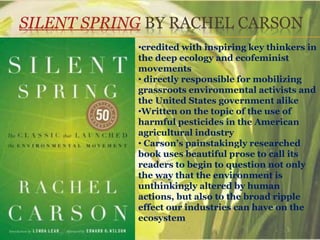
SILENT SPRING BY RACHEL CARSON
•credited with inspiring key thinkers in
the deep ecology and ecofeminist
movements
• directly responsible for mobilizing
grassroots environmental activists and
the United States government alike
•Written on the topic of the use of
harmful pesticides in the American
agricultural industry
• Carson’s painstakingly researched
book uses beautiful prose to call its
readers to begin to question not only
the way that the environment is
unthinkingly altered by human
actions, but also to the broad ripple
effect our industries can have on the
ecosystem
INTELLECTUAL INFLUENCES
Influenced by 3 major American Writers:
 Ralph Waldo Emerson (1803-1882)
 Margaret Fuller (1810-1850)
 Henry David Thoreau (1817-1862)
 All transcendentalists from the 1840’s
DEFINING ECOCRITICISM
 Ecocriticism is an umbrella term under
which a variety of approaches fall
 makes it a difficult term to define
 As ecocritic Lawrence Buell says, ecocriticism
is an “increasingly heterogeneous
movement”
 But, “simply put, ecocriticism is the study of
the relationship between literature and the
physical environment” (Glotfelty xviii).
DEFINING….
 Ecocriticism is interdisciplinary
 calls for collaboration between natural
scientists, writers, literary critics,
anthropologists, historians, and more
 Ecocriticism asks us to examine ourselves
and the world around us, critiquing the way
that we represent, interact with, and
construct the environment, both “natural”
and manmade
DEFINING
 At the heart of ecocriticism is “a commitment
to environmentality from whatever critical
vantage point” (Buell)
 The “challenge” for ecocritics is “keep[ing]
one eye on the ways in which ‘nature’ is
always […] culturally constructed, and the
other on the fact that nature really exists”
(Gerrard).
PROBLEMS…
 some reject the label “ecocriticism”
 has become identified with one particular strand
of scholarship that is ideologically aligned with
Deep Ecology and strongly committed to
political activism
 Suggest alternative designations, such as
“environmental/ecological literary studies” or
“green cultural studies”
 Nevertheless, the term ecocriticism has stuck
 As a large area where work on nature writing
can sit comfortably with a host of other areas
FIRST STAGE IN FEM/ECO CRITICISM
 The “images of women” stage, “concerned with
representations, concentrating on how
women are portrayed in canonical literature.”
 “Analogous efforts in ecocriticism study how
nature is represented in literature. “
 Stereotypes of nature: “Eden, Arcadia, virgin
land, miasmal swamp, savage wilderness”
 Absences are important: “where is the natural
world in this text?” (xxiii)
SECOND STAGE IN FEM/ECO CRITICISM
 The “women’s literary tradition stage…serves
the important function of consciousness
raising as it rediscovers, reissues, and
reconsiders literature by women.”
 Ecocriticism reconsiders “neglected genre of
nature writing.”
 Ecocritics draw from “existing critical theories—
psychoanalytic, new critical, feminist,
Bakhtinian, deconstructive…” (xxiii)
THIRD STAGE IN FEM/ECO CRITCISIM
 The “theoretical phase, which is far reaching
and complex, drawing on a wide range of
theories to raise fundamental questions about
the symbolic construction of gender and
sexuality within literary discourse.”
 “Analogous work in ecocriticism includes
examining the symbolic construction of
species. How has literary discourse defined the
human?” (xxiv)
ROOTS OF THE “ECOCRITIC”…
 Interestingly, ecocritic William Howarth
draws our attention to the roots of
“ecocritic”: “Eco and critic both derive from
Greek, oikos and kritis, and in tandem they
mean ‘house judge,’ . . . So the oikos is
nature, a place Edward Hoagland calls ‘our
widest home,’ and the kritos is an arbiter of
taste who wants the house kept in good
order…” (Howarth 69).
TROPES AND APPROACHES…
 Pastoral
 Wilderness
 Ecofeminism
PASTORAL
 trope found in British and American literature
 focuses on the dichotomy between urban and rural
life
 works which display pastoralism have a general
idealization of the nature and the rural and the
demonization of the urban
 Often, such works show a “retreat” from city life to
the country while romanticizing rural life, depicting
an idealized rural existence that “obscures” the
reality of the hard work living in such areas requires
(Gerrard 33).
BRANCHES…
 Greg Gerrard identifies three branches of the
pastoral:
 Classic Pastoral, “characterized by nostalgia” and
an appreciation of nature as a place for human
relaxation and reflection
 Romantic Pastoral, a period after the Industrial
Revolution that saw “rural independence” as
desirable against the expansion of the urban
 American Pastoralism, which “emphasize[d]
agrarianism” and represents land as a resource to be
cultivated, with farmland often creating a boundary
between the urban and the wilderness
WILDERNESS
 interesting focus for many ecocritics is the
way that wilderness is represented in
literature and popular culture
 approach examines the ways in which
wilderness is constructed, valued, and
engaged
 Representations of wilderness in British and
American culture can be separated into two
main tropes.
OLD WORLD WILDERNESS
 displays wilderness as a place beyond the
borders of civilization
 wherein wilderness is treated as a “threat,” a
place of “exile” (Gerrard 62)
 trope can be seen in Biblical tales of creation
and early British culture
 Old World wilderness is often conflated with
demonic practices in early American
literature
NEW WORLD WILDERNESS
 seen in portrayals of wilderness in later
American literature
 applies the pastoral trope of the “retreat” to
wilderness itself, seeing wilderness not as a
place to fear, but as a place to find sanctuary
 The New World wilderness trope has informed
much of the “American identity,” and often
constructs encounters with the wilderness that
lead to a more “authentic existence”
(Gerrard 71).
ECOFEMINISM
 branch of ecocriticism, ecofeminism primarily “analyzes the
interconnection of the oppression of women and nature”
 parallels between domination of land and the domination of
men over women
 ecofeminists examine hierarchical, gendered relationships,
in which the land is often equated with the feminine, seen as
a fertile resources and the property of man
 radical ecofeminism, reverses the patriarchal
domination of man over woman and nature,
 approach embraces the idea that women are inherently
closer to nature biologically, spiritually, and emotionally.
 Opposite approach feels -- no such thing as a “feminine
essence” that would make women more likely to connect
with nature
RESOURCES…..
Theory and Criticism
 Lawrence Buell - “The Environmental Imagination: Thoreau,
Nature Writing, and the Formation of American Culture” (1995)
and “Toxic Discourse,” 1998
 Charles Bressler - Literary criticism: an introduction to theory
and practice, 1999
 Cheryll Glotfelty and Harold Fromm – The Ecocriticism Reader:
Landmarks in Literary Ecology, (1996)
 Greg Garrard – Ecocriticism, 2004
 Donna Haraway - "A Cyborg Manifesto: Science, Technology, and
Socialist-Feminism in the Late Twentieth Century," (1991)
 ISLE: Interdisciplinary Studies in Literature and
Environment (Journal)
 Joseph Makus - The Comedy of Survival: literary ecology and a
play ethic, (1972)
 Leo Marx – The Machine in the Garden: Technology and the
Pastoral Ideal in America, (1964)
 Raymond Williams - The Country and The City, (1975)
LITERATURE & LITERARY FIGURES
 Edward Abbey: Desert Solitaire: A Season in the
Wilderness (1968), Appalachian Wilderness (1970),
The Monkey Wrench Gang (1975)
 Mary Hunter Austin: The Land of Little Rain (1903)
 Rachel Carson: Silent Spring (1962)
 Aldo Leopold: A Sand County Almanac: And
Sketches Here and There (1949)
 John Muir: A Thousand-Mile Walk to the Gulf (1916),
Studies in the Sierra (1950)
 Henry David Thoreau: Walden; or, Life in the
Woods (1854)
 Williams Wordsworth : Lyrical Ballads, with a Few
Other Poems (1798), Lyrical Ballads, with Other
Poems (1800)

Ecocriticism in literature Introduction

  • 1.
  • 2.
    WHAT IS ECOCRITICISM? “. . . the study of the relationship between literature and the physical environment. Just as feminist criticism examines language and literature from a gender- conscious perspective, and Marxist criticism brings an awareness of modes of production and economic class to its reading of texts, ecocriticism takes an earth-centered approach to literary studies” (Glotfelty xviii).
  • 3.
    QUESTIONS ECOCRITICS ASK…. “How is nature represented in this sonnet?  What role does the physical setting play in the plot of this novel?  Are the values expressed in this play consistent with ecological wisdom?  How do our metaphors of the land influence the way we treat it?  How can we characterize nature writing as a genre?” (Glotfelty xviii-xix)
  • 4.
    WHAT IS IT? the youngest of revisionist movements that have swept the humanities over the past few decades  only in the 1990s that it began to gain momentum  first in the US and in the UK  more and more literary scholars began to ask what their field has to contribute to our understanding of the unfolding environmental crisis
  • 5.
    AND…  Initially focusedon the reappraisal of Romanticism (as the moment in Western cultural history when still reigning conceptions of nature were formed) and its cultural progeny  has since broadened to address the question, of how cultures construct and are in turn constructed by the non-human world
  • 6.
    BACKGROUND  Newer theoryon the academic margins  More popular on the American West Coast  Emerging in the 1980s on the shoulders of the environmental movement begun in the 1960s with the publication of Rachel Carson’s Silent Spring, ecocriticism has been and continues to be an “earth-centered approach”
  • 7.
    SILENT SPRING BYRACHEL CARSON •credited with inspiring key thinkers in the deep ecology and ecofeminist movements • directly responsible for mobilizing grassroots environmental activists and the United States government alike •Written on the topic of the use of harmful pesticides in the American agricultural industry • Carson’s painstakingly researched book uses beautiful prose to call its readers to begin to question not only the way that the environment is unthinkingly altered by human actions, but also to the broad ripple effect our industries can have on the ecosystem
  • 8.
    INTELLECTUAL INFLUENCES Influenced by3 major American Writers:  Ralph Waldo Emerson (1803-1882)  Margaret Fuller (1810-1850)  Henry David Thoreau (1817-1862)  All transcendentalists from the 1840’s
  • 9.
    DEFINING ECOCRITICISM  Ecocriticismis an umbrella term under which a variety of approaches fall  makes it a difficult term to define  As ecocritic Lawrence Buell says, ecocriticism is an “increasingly heterogeneous movement”  But, “simply put, ecocriticism is the study of the relationship between literature and the physical environment” (Glotfelty xviii).
  • 10.
    DEFINING….  Ecocriticism isinterdisciplinary  calls for collaboration between natural scientists, writers, literary critics, anthropologists, historians, and more  Ecocriticism asks us to examine ourselves and the world around us, critiquing the way that we represent, interact with, and construct the environment, both “natural” and manmade
  • 11.
    DEFINING  At theheart of ecocriticism is “a commitment to environmentality from whatever critical vantage point” (Buell)  The “challenge” for ecocritics is “keep[ing] one eye on the ways in which ‘nature’ is always […] culturally constructed, and the other on the fact that nature really exists” (Gerrard).
  • 12.
    PROBLEMS…  some rejectthe label “ecocriticism”  has become identified with one particular strand of scholarship that is ideologically aligned with Deep Ecology and strongly committed to political activism  Suggest alternative designations, such as “environmental/ecological literary studies” or “green cultural studies”  Nevertheless, the term ecocriticism has stuck  As a large area where work on nature writing can sit comfortably with a host of other areas
  • 13.
    FIRST STAGE INFEM/ECO CRITICISM  The “images of women” stage, “concerned with representations, concentrating on how women are portrayed in canonical literature.”  “Analogous efforts in ecocriticism study how nature is represented in literature. “  Stereotypes of nature: “Eden, Arcadia, virgin land, miasmal swamp, savage wilderness”  Absences are important: “where is the natural world in this text?” (xxiii)
  • 14.
    SECOND STAGE INFEM/ECO CRITICISM  The “women’s literary tradition stage…serves the important function of consciousness raising as it rediscovers, reissues, and reconsiders literature by women.”  Ecocriticism reconsiders “neglected genre of nature writing.”  Ecocritics draw from “existing critical theories— psychoanalytic, new critical, feminist, Bakhtinian, deconstructive…” (xxiii)
  • 15.
    THIRD STAGE INFEM/ECO CRITCISIM  The “theoretical phase, which is far reaching and complex, drawing on a wide range of theories to raise fundamental questions about the symbolic construction of gender and sexuality within literary discourse.”  “Analogous work in ecocriticism includes examining the symbolic construction of species. How has literary discourse defined the human?” (xxiv)
  • 16.
    ROOTS OF THE“ECOCRITIC”…  Interestingly, ecocritic William Howarth draws our attention to the roots of “ecocritic”: “Eco and critic both derive from Greek, oikos and kritis, and in tandem they mean ‘house judge,’ . . . So the oikos is nature, a place Edward Hoagland calls ‘our widest home,’ and the kritos is an arbiter of taste who wants the house kept in good order…” (Howarth 69).
  • 17.
    TROPES AND APPROACHES… Pastoral  Wilderness  Ecofeminism
  • 18.
    PASTORAL  trope foundin British and American literature  focuses on the dichotomy between urban and rural life  works which display pastoralism have a general idealization of the nature and the rural and the demonization of the urban  Often, such works show a “retreat” from city life to the country while romanticizing rural life, depicting an idealized rural existence that “obscures” the reality of the hard work living in such areas requires (Gerrard 33).
  • 19.
    BRANCHES…  Greg Gerrardidentifies three branches of the pastoral:  Classic Pastoral, “characterized by nostalgia” and an appreciation of nature as a place for human relaxation and reflection  Romantic Pastoral, a period after the Industrial Revolution that saw “rural independence” as desirable against the expansion of the urban  American Pastoralism, which “emphasize[d] agrarianism” and represents land as a resource to be cultivated, with farmland often creating a boundary between the urban and the wilderness
  • 20.
    WILDERNESS  interesting focusfor many ecocritics is the way that wilderness is represented in literature and popular culture  approach examines the ways in which wilderness is constructed, valued, and engaged  Representations of wilderness in British and American culture can be separated into two main tropes.
  • 21.
    OLD WORLD WILDERNESS displays wilderness as a place beyond the borders of civilization  wherein wilderness is treated as a “threat,” a place of “exile” (Gerrard 62)  trope can be seen in Biblical tales of creation and early British culture  Old World wilderness is often conflated with demonic practices in early American literature
  • 22.
    NEW WORLD WILDERNESS seen in portrayals of wilderness in later American literature  applies the pastoral trope of the “retreat” to wilderness itself, seeing wilderness not as a place to fear, but as a place to find sanctuary  The New World wilderness trope has informed much of the “American identity,” and often constructs encounters with the wilderness that lead to a more “authentic existence” (Gerrard 71).
  • 23.
    ECOFEMINISM  branch ofecocriticism, ecofeminism primarily “analyzes the interconnection of the oppression of women and nature”  parallels between domination of land and the domination of men over women  ecofeminists examine hierarchical, gendered relationships, in which the land is often equated with the feminine, seen as a fertile resources and the property of man  radical ecofeminism, reverses the patriarchal domination of man over woman and nature,  approach embraces the idea that women are inherently closer to nature biologically, spiritually, and emotionally.  Opposite approach feels -- no such thing as a “feminine essence” that would make women more likely to connect with nature
  • 24.
    RESOURCES….. Theory and Criticism Lawrence Buell - “The Environmental Imagination: Thoreau, Nature Writing, and the Formation of American Culture” (1995) and “Toxic Discourse,” 1998  Charles Bressler - Literary criticism: an introduction to theory and practice, 1999  Cheryll Glotfelty and Harold Fromm – The Ecocriticism Reader: Landmarks in Literary Ecology, (1996)  Greg Garrard – Ecocriticism, 2004  Donna Haraway - "A Cyborg Manifesto: Science, Technology, and Socialist-Feminism in the Late Twentieth Century," (1991)  ISLE: Interdisciplinary Studies in Literature and Environment (Journal)  Joseph Makus - The Comedy of Survival: literary ecology and a play ethic, (1972)  Leo Marx – The Machine in the Garden: Technology and the Pastoral Ideal in America, (1964)  Raymond Williams - The Country and The City, (1975)
  • 25.
    LITERATURE & LITERARYFIGURES  Edward Abbey: Desert Solitaire: A Season in the Wilderness (1968), Appalachian Wilderness (1970), The Monkey Wrench Gang (1975)  Mary Hunter Austin: The Land of Little Rain (1903)  Rachel Carson: Silent Spring (1962)  Aldo Leopold: A Sand County Almanac: And Sketches Here and There (1949)  John Muir: A Thousand-Mile Walk to the Gulf (1916), Studies in the Sierra (1950)  Henry David Thoreau: Walden; or, Life in the Woods (1854)  Williams Wordsworth : Lyrical Ballads, with a Few Other Poems (1798), Lyrical Ballads, with Other Poems (1800)

Editor's Notes

  • #14 “Elaine Showalter’s model of the three developmental stages of feminist criticism provides a useful scheme for describing three analogous phases in ecocriticism.” “These studies contribute to the vital process of consciousness raising by exposing sexist stereotypes—witches, bitches, broads, and spinsters—and by locating absences, questioning the purported universality and even the aesthetic value of literature that distorts or ignores altogether the experience of half of the human race.” “Other topics include the frontier, animals, cities, specific geographical regions, rivers, mountains, deserts, Indians, technology, garbage, and the body” (xxii-xxiii).
  • #15 Nature writing: “a tradition of nature-oriented nonfiction that originates in England with Gilbert White’s A Natural History of Selbourne (1789) and extends to America through Henry Thoreau, John Burroughs, John Muir, Mary Austin, Aldo Leopold, Rachel Carson, Edward Abbey, Annie Dillard, Barry Lopez, Terry Tempest Williams, and many others.” “Another effort to promulgate environmentally enlightened works examines mainstream genres, identifying fiction and poetry writers whose work manifests ecological awareness. Figures like Willa Cather, Robinson Jeffers, W. S. Merwin, Adrienne Rich, Wallace Stegner, Gary Snyder, Mary Oliver, Ursula Le Guin, and Alice Walker have received much attention, as have Native American authors…” (xxiii)
  • #16 “Such a critique questions the dualisms prevalent in Western thought, dualisms that separate meaning from matter, sever mind from body, divide men from women, and wrench humanity from nature. A related endeavor is being carried out under the hybrid label ‘ecofeminism,’ a theoretical discourse whose theme is the link between the oppression of women and the domination of nature. Yet another theoretical project attempts to develop an ecological poetics, taking the science of ecology, with its concept of the ecosystem and its emphasis on interconnections and energy flow, as a metaphor for the way poetry functions in society. Ecocritics are also considering the philosophy currently known as deep ecology, exploring the implications that its radical critique of anthropocentrism might have for literary study.” (xxiv)