Key Features
	Cost-effective wireless solution for base■■
station connections at the network edge
	Standard ITU-R licensed bands:■■
7, 13, 15, 18, 23, and 38 GHz
	Native Mixed Mode■■ TM
NxE1 TDM plus
native Carrier Ethernet transport over the
same radio path
User selectable throughput up to 32 Mbps––
10/100 Base-T Ethernet, IEEE 802.3 standard––
Up to 16xE1 compliant to ITU-T G.703––
	Robust CPM modulation■■
	1+0, 1+1 protection with errorless Space■■
Diversity as standard
	Reduced opex costs and demands■■
for site services
Extremely low power consumption,––
<13W ODU
Reduced weight and size—simplifies––
installation
Low profile footprint—minimal for rack and––
outdoor loading
Single wrench install—direct antenna mount––
Built-in lightning protection on ODU––
PoE port
Low-cost, off-the-shelf Cat 5e cabling to––
outdoor unit
	Carrier grade QoS policing and prioritization■■
options (802.1p/q)
	ODU cabling supports Power-over-Ethernet■■
(802.3af)
	Management by ProVision and■■
Eclipse Portal
	Interoperable with Eclipse nodal INUe using■■
new RACspe
	RoHS and WEEE compliant■■
	Metro Ethernet Forum (MEF) 9 compliant■■
Eclipse Edge
ETSI Datasheet
Cost-effective Wireless Connections for the Mobile Network Edge
The new Eclipse Edge
redefines cost-effective
backhaul for network
operators poised for future
growth and seeking lowest
cost of ownership.
The Eclipse Edge is a fully
featured, highly reliable,
Fast Ethernet plus TDM
wireless transport system
that will simplify your
network migration to all-IP.
Multi-Service
The Eclipse Edge is a new, multi-service,
Ethernet + TDM solution optimized to
deliver the lowest cost of ownership and
simplify network migration to all-IP. This
compact, low power and simple-to-
deploy microwave radio will help reduce
CAPEX and OPEX for new network
extensions and cell-site connections.
Low CAPEX Entry Point
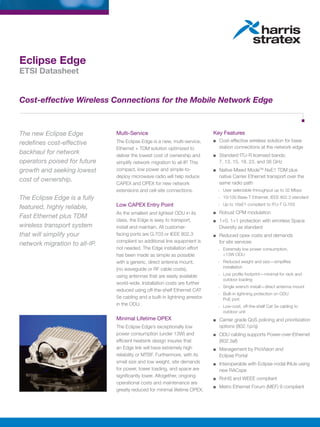
As the smallest and lightest ODU in its
class, the Edge is easy to transport,
install and maintain. All customer-
facing ports are G.703 or IEEE 802.3
compliant so additional line equipment is
not needed. The Edge installation effort
has been made as simple as possible
with a generic, direct antenna mount,
(no waveguide or RF cable costs),
using antennas that are easily available
world-wide. Installation costs are further
reduced using off-the-shelf Ethernet CAT
5e cabling and a built-in lightning arrestor
in the ODU.
Minimal Lifetime OPEX
The Eclipse Edge’s exceptionally low
power consumption (under 13W) and
efficient heatsink design insures that
an Edge link will have extremely high
reliability or MTBF. Furthermore, with its
small size and low weight, site demands
for power, tower loading, and space are
significantly lower. Altogether, ongoing
operational costs and maintenance are
greatly reduced for minimal lifetime OPEX.
Eclipse Edge Datasheet
02
Network Migration Using
Native Mixed ModeTM
The Eclipse Edge is the most efficient
solution to support network migration that
is both simple and cost-effective. Already
with a low CAPEX entry point, network
operators will further reduce OPEX costs
with both E1 and Fast Ethernet transport
in a single link.
Operators can connect directly to
16 E1 line connections as well as to
two, switched 10/100Base-T ports on
the Edge IDU front panel. No additional
line equipment is needed, saving on
added equipment, maintenance and
sparing costs.
In native mixed-mode operation, as
E1 tributaries are commissioned, the
Ethernet bandwidth is reduced from the
maximum 32 Mbit/s. Ethernet bandwidth
will increase when one or more E1s are
decommissioned.
Eclipse Liquid BandwidthTM
­—Native
mixed mode operation assigns available
radio capacity between the following two
types of traffic:
Native TDM■■
Guaranteed performance for––
delay-sensitive voice services
No circuit emulation or deployment of––
pseudo-wires
Configurable from 1E1 to 16E1––
Native Ethernet■■
Up to 32 Mbit/s full duplex operation––
No encapsulation within TDM––
frames, so no excess overheads
High throughput efficiency and low latency––
Built-in Layer 2 intelligent switch––
Traffic prioritization using 802.1p or––
Diffserv priorities
Jumbo frame support up to 2000 bytes––
Nodal and Metro Aggregation—
Eclipse Edge is fully compatible with
the advanced Eclipse Nodal Network
architecture.
Interoperable with Eclipse INU using■■
RACspe plug in
Ideal for low- to medium-capacity■■
network extensions in metro areas
Optimized Protection
Eclipse Edge provides an optimal solution
for protected terminals:
Single 1RU indoor unit supports a fully■■
protected terminal
Errorless diversity receiver switching■■
Easy upgrade from non-protected 1+0■■
to protected 1+1 operation
Interoperability with protected INU node■■
Operators can easily respond to changing
traffic requirements by using the Eclipse
Portal or Harris Stratex Network’s
ProVision Element Manager to either
change the link capacity or the traffic mix
between TDM and Ethernet, or both.
Without any additional equipment or
software upgrades, Eclipse Edge can
change between support for TDM
transport—up to 16 E1s—and a f ast
Ethernet bridge.
Reduced Environmental Impact
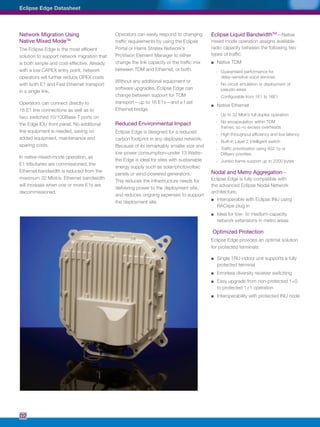
Eclipse Edge is designed for a reduced
carbon footprint in any deployed network.
Because of its remarkably smaller size and
low power consumption–under 13 Watts–
the Edge is ideal for sites with sustainable
energy supply such as solar/photovoltaic
panels or wind-powered generators.
This reduces the infrastructure needs for
delivering power to the deployment site,
and reduces ongoing expenses to support
the deployment site.
Eclipse Edge Datasheet
03
Eclipse Edge System Parameters
General
Operating Frequency Range 7 , 13, 15, 18, 23, 38 GHz
Digital Line Rate (TDM) 2.048 Mbit/s (E1)
Capacity Range Options (software configurable between NxE1 and Ethernet Data) 1 to 16xE1
2 to 32 Mbit/s Ethernet Data
Modulation CPM
Error Correction FEC, Reed Solomon Decoding
Radio Path Protection Options
Non Protected, 1+0 7-38 GHz
Protected Hot Standby, 1+1 7-38 GHz
Space Diversity, 1+1 7-38 GHz
Standards Compliance
EMC IDUspe EN 301 489-1, EN 301 489-4 (EN 55022 Class B)
Operation ODUspe ETS 300 019, Class 4.1
IDUspe ETS 300 019, Class 3.2
Storage / Transportation ETS 300 019, Class 1.2 / Class 2.3
Safety IEC 60950-1/EN 60950-1
Radio Frequency EN 302 217 Class 2
Water Ingress ODUspe IEC 60529 (IPX6)
Lightning Protection ODUspe (built-in) and IDUspe (external accessory) IEC 61000-4-5 Class 5
Environmental
Operating Temperature IDUspe Guaranteed -5° to +45° C
ODUspe Guaranteed -33° to +55° C
Humidity IDUspe Guaranteed 0 to 95%, non-condensing
ODUspe Guaranteed 0 to 100%
Altitude ODUspe Guaranteed 4,500 meters
Fault and Configuration Management
Protocol SNMP v2
Interface, electrical Ethernet 10/100 Base-T
Interface, physical 2 x RJ-45
Local/remote Configuration and Support Tool Eclipse Portal
Network Management Harris Stratex Networks ProVision
Engineering Orderwire Via optional VoIP handset
Emission Designator
Bandwidth 3.5MHz 7MHz 13.75MHz 14MHz 27.5MHz 28MHz
Emission Designator 3M50F7W 7M00F7W 13M75F7W 14M0F7W 27M5F7W 28M0F7W
IDUspe Specifications
Interfaces and Indicators
LED Indicators 3x Tri-state LEDs (‘IDU Status’, ‘ODU1 & ODU2 Status’)
Ethernet Traffic Interface, electrical Interface 10/100 Base-T
Connector 2x 8-pin RJ45
E1 Line Interface, electrical Standards Compliance Compliant to ITU-T Rec. G.703, G.823
Line Code HDB3
Impedance 75Ω unbalanced or 120Ω balanced, configurable
Connector 16xRJ45
IDU to ODU cable interface Compliant to IEEE 802.3af for Power Sourcing Equipment
Interface 100Base-T Ethernet with PoE
Connector 2 x RJ45 with MDI-X
NMS LAN interface Type 10/100 Base-T Ethernet
Connector 2xRJ45
Electrical and Mechanical
Input Voltage Range ± 20 to ± 60.0 Vdc
Power Consumption (IDUspe only) Single PoE (ODU) Port 10W
Two PoE (ODU) Ports 13W
Protection Circuit 5A Slow-Blow Fuse
Size / Weight 44mm (1RU) x 482mm x 160mm / 2.1 kg
All specifications are preliminary typical values unless otherwise stated, and are subject to change without notice.
Eclipse Edge Datasheet
Harris Stratex Networks and Eclipse are trademarks or registered trademarks
of Harris Stratex Networks Operating Corporation, a wholly owned subsidiary
of Harris Stratex Networks, Inc. and/or its subsidiaries in the United States
and other countries.
© Harris Stratex Networks, Inc. 2008
Data subject to change without notice.
d_etsi_EcliEdge_062108
www.harrisstratex.com
ODUspe Specifications
General
Frequency Band options 7, 13, 15, 18, 23, 38 GHz
ODU Interfaces
IDU to ODU cable (50m & 90m options available with one preterminated end) Shielded Weatherized Cat 5e
Cable length 100 Meters (Maximum)
Connector Connector Weatherproof RJ45 with MDI-X
AGC monitor point BNC
Antenna port Interface ODUspe standard
Polarisation, field selectable ODU rotation
Transmitter Specifications
Transmit Power Tolerance ± 2dB
Transmitter Source Synthesized
Frequency Stability ± 10 ppm
Manual Transmitter Power Control range 15dB
Resolution 1 dB
Accuracy ± 2dB
Automatic Transmitter Power Control Range Configurable over full manual attenuation
Synthesizer Resolution 250 KHz
Receiver Specifications
Receiver Source Synthesized
Frequency Stability 10 PPM
Residual (Background) Bit Error Rate 10-13
RSSI Accuracy [1]
-40 to -70 dBm, 0 to +35° C, ± 2dB
-25 to -85 dBm, -33 to +55° C, ± 4dB
Electrical and Mechanical
Power IEEE 802.3af PoE standard, Class 3 PD, maximum of 12.95W
Size / Weight 255mm x 250 mm x 110 mm / 2.6 kg
ODUspe RF Performance Specifications
System 7 GHz 13 GHz 15 GHz 18 GHz 23 GHz 38 GHz
Frequency Range, GHz 7.125 - 7.9 12.75 - 13.25 14.4 - 15.35 17.7 - 19.7 21.2 - 23.632 37.0 - 39.46
T-R Spacings supported, MHz 150, 154, 161, 168,
175, 196, 245
266 315, 420, 490,
644, 728
1010, 1092.5, 1120 1008, 1200, 1232 1260
Maximum Tuning Range (dependent upon T-R spacing), MHz 56 84 245 380 370 340
System Gain [2]
System Gain at 10-6
BER 4 Mbit/s /2xE1 3.5 MHz 116.0 dB 112.0 dB 112.0 dB 110.0 dB 110.0 dB 106.0 dB
8 Mbit/s /4xE1 7 MHz 114.0 dB 110.0 dB 110.0 dB 108.0 dB 108.0 dB 104.0 dB
16 Mbit/s /8xE1 13.75 / 14 MHz 111.0 dB 107.0 dB 107.0 dB 105.0 dB 105.0 dB 101.0 dB
32 Mbit/s /16xE1 27.5 / 28 MHz 107.0 dB 103.0 dB 103.0 dB 101.0 dB 101.0 dB 97.0 dB
Transmitter Specifications
Power Output, nominal 24.0 dBm 20.0 dBm 20.0 dBm 19.0 dBm 19.0 dBm 17.0 dBm
Receiver Specifications [2]
Threshold at 10-6
BER 4 Mbit/s /2xE1 3.5 MHz -92.0 dBm -92.0 dBm -92.0 dBm -91.0 dBm -91.0 dBm -89.0 dBm
8 Mbit/s /4xE1 7 MHz -90.0 dBm -90.0 dBm -90.0 dBm -89.0 dBm -89.0 dBm -87.0 dBm
16 Mbit/s /8xE1 13.75 / 14 MHz -87.0 dBm -87.0 dBm -87.0 dBm -86.0 dBm -86.0 dBm -84.0 dBm
32 Mbit/s /16xE1 27.5 / 28 MHz -83.0 dBm -83.0 dBm -83.0 dBm -82.0 dBm -82.0 dBm -80.0 dBm
All specifications are preliminary typical values unless otherwise stated, and are subject to change without notice.
[1] RSSI accuracy is only valid when there is no unwanted signal or potential interferer present within ±28MHz of the RX frequency.
[2] System Gain and Rx Threshold values are for BER=10-6
. Values for BER=10-3
are improved by 1dB.

Eclipse edge datasheet

  • 1.
    Key Features Cost-effective wirelesssolution for base■■ station connections at the network edge Standard ITU-R licensed bands:■■ 7, 13, 15, 18, 23, and 38 GHz Native Mixed Mode■■ TM NxE1 TDM plus native Carrier Ethernet transport over the same radio path User selectable throughput up to 32 Mbps–– 10/100 Base-T Ethernet, IEEE 802.3 standard–– Up to 16xE1 compliant to ITU-T G.703–– Robust CPM modulation■■ 1+0, 1+1 protection with errorless Space■■ Diversity as standard Reduced opex costs and demands■■ for site services Extremely low power consumption,–– <13W ODU Reduced weight and size—simplifies–– installation Low profile footprint—minimal for rack and–– outdoor loading Single wrench install—direct antenna mount–– Built-in lightning protection on ODU–– PoE port Low-cost, off-the-shelf Cat 5e cabling to–– outdoor unit Carrier grade QoS policing and prioritization■■ options (802.1p/q) ODU cabling supports Power-over-Ethernet■■ (802.3af) Management by ProVision and■■ Eclipse Portal Interoperable with Eclipse nodal INUe using■■ new RACspe RoHS and WEEE compliant■■ Metro Ethernet Forum (MEF) 9 compliant■■ Eclipse Edge ETSI Datasheet Cost-effective Wireless Connections for the Mobile Network Edge The new Eclipse Edge redefines cost-effective backhaul for network operators poised for future growth and seeking lowest cost of ownership. The Eclipse Edge is a fully featured, highly reliable, Fast Ethernet plus TDM wireless transport system that will simplify your network migration to all-IP. Multi-Service The Eclipse Edge is a new, multi-service, Ethernet + TDM solution optimized to deliver the lowest cost of ownership and simplify network migration to all-IP. This compact, low power and simple-to- deploy microwave radio will help reduce CAPEX and OPEX for new network extensions and cell-site connections. Low CAPEX Entry Point As the smallest and lightest ODU in its class, the Edge is easy to transport, install and maintain. All customer- facing ports are G.703 or IEEE 802.3 compliant so additional line equipment is not needed. The Edge installation effort has been made as simple as possible with a generic, direct antenna mount, (no waveguide or RF cable costs), using antennas that are easily available world-wide. Installation costs are further reduced using off-the-shelf Ethernet CAT 5e cabling and a built-in lightning arrestor in the ODU. Minimal Lifetime OPEX The Eclipse Edge’s exceptionally low power consumption (under 13W) and efficient heatsink design insures that an Edge link will have extremely high reliability or MTBF. Furthermore, with its small size and low weight, site demands for power, tower loading, and space are significantly lower. Altogether, ongoing operational costs and maintenance are greatly reduced for minimal lifetime OPEX.
  • 2.
    Eclipse Edge Datasheet 02 NetworkMigration Using Native Mixed ModeTM The Eclipse Edge is the most efficient solution to support network migration that is both simple and cost-effective. Already with a low CAPEX entry point, network operators will further reduce OPEX costs with both E1 and Fast Ethernet transport in a single link. Operators can connect directly to 16 E1 line connections as well as to two, switched 10/100Base-T ports on the Edge IDU front panel. No additional line equipment is needed, saving on added equipment, maintenance and sparing costs. In native mixed-mode operation, as E1 tributaries are commissioned, the Ethernet bandwidth is reduced from the maximum 32 Mbit/s. Ethernet bandwidth will increase when one or more E1s are decommissioned. Eclipse Liquid BandwidthTM ­—Native mixed mode operation assigns available radio capacity between the following two types of traffic: Native TDM■■ Guaranteed performance for–– delay-sensitive voice services No circuit emulation or deployment of–– pseudo-wires Configurable from 1E1 to 16E1–– Native Ethernet■■ Up to 32 Mbit/s full duplex operation–– No encapsulation within TDM–– frames, so no excess overheads High throughput efficiency and low latency–– Built-in Layer 2 intelligent switch–– Traffic prioritization using 802.1p or–– Diffserv priorities Jumbo frame support up to 2000 bytes–– Nodal and Metro Aggregation— Eclipse Edge is fully compatible with the advanced Eclipse Nodal Network architecture. Interoperable with Eclipse INU using■■ RACspe plug in Ideal for low- to medium-capacity■■ network extensions in metro areas Optimized Protection Eclipse Edge provides an optimal solution for protected terminals: Single 1RU indoor unit supports a fully■■ protected terminal Errorless diversity receiver switching■■ Easy upgrade from non-protected 1+0■■ to protected 1+1 operation Interoperability with protected INU node■■ Operators can easily respond to changing traffic requirements by using the Eclipse Portal or Harris Stratex Network’s ProVision Element Manager to either change the link capacity or the traffic mix between TDM and Ethernet, or both. Without any additional equipment or software upgrades, Eclipse Edge can change between support for TDM transport—up to 16 E1s—and a f ast Ethernet bridge. Reduced Environmental Impact Eclipse Edge is designed for a reduced carbon footprint in any deployed network. Because of its remarkably smaller size and low power consumption–under 13 Watts– the Edge is ideal for sites with sustainable energy supply such as solar/photovoltaic panels or wind-powered generators. This reduces the infrastructure needs for delivering power to the deployment site, and reduces ongoing expenses to support the deployment site.
  • 3.
    Eclipse Edge Datasheet 03 EclipseEdge System Parameters General Operating Frequency Range 7 , 13, 15, 18, 23, 38 GHz Digital Line Rate (TDM) 2.048 Mbit/s (E1) Capacity Range Options (software configurable between NxE1 and Ethernet Data) 1 to 16xE1 2 to 32 Mbit/s Ethernet Data Modulation CPM Error Correction FEC, Reed Solomon Decoding Radio Path Protection Options Non Protected, 1+0 7-38 GHz Protected Hot Standby, 1+1 7-38 GHz Space Diversity, 1+1 7-38 GHz Standards Compliance EMC IDUspe EN 301 489-1, EN 301 489-4 (EN 55022 Class B) Operation ODUspe ETS 300 019, Class 4.1 IDUspe ETS 300 019, Class 3.2 Storage / Transportation ETS 300 019, Class 1.2 / Class 2.3 Safety IEC 60950-1/EN 60950-1 Radio Frequency EN 302 217 Class 2 Water Ingress ODUspe IEC 60529 (IPX6) Lightning Protection ODUspe (built-in) and IDUspe (external accessory) IEC 61000-4-5 Class 5 Environmental Operating Temperature IDUspe Guaranteed -5° to +45° C ODUspe Guaranteed -33° to +55° C Humidity IDUspe Guaranteed 0 to 95%, non-condensing ODUspe Guaranteed 0 to 100% Altitude ODUspe Guaranteed 4,500 meters Fault and Configuration Management Protocol SNMP v2 Interface, electrical Ethernet 10/100 Base-T Interface, physical 2 x RJ-45 Local/remote Configuration and Support Tool Eclipse Portal Network Management Harris Stratex Networks ProVision Engineering Orderwire Via optional VoIP handset Emission Designator Bandwidth 3.5MHz 7MHz 13.75MHz 14MHz 27.5MHz 28MHz Emission Designator 3M50F7W 7M00F7W 13M75F7W 14M0F7W 27M5F7W 28M0F7W IDUspe Specifications Interfaces and Indicators LED Indicators 3x Tri-state LEDs (‘IDU Status’, ‘ODU1 & ODU2 Status’) Ethernet Traffic Interface, electrical Interface 10/100 Base-T Connector 2x 8-pin RJ45 E1 Line Interface, electrical Standards Compliance Compliant to ITU-T Rec. G.703, G.823 Line Code HDB3 Impedance 75Ω unbalanced or 120Ω balanced, configurable Connector 16xRJ45 IDU to ODU cable interface Compliant to IEEE 802.3af for Power Sourcing Equipment Interface 100Base-T Ethernet with PoE Connector 2 x RJ45 with MDI-X NMS LAN interface Type 10/100 Base-T Ethernet Connector 2xRJ45 Electrical and Mechanical Input Voltage Range ± 20 to ± 60.0 Vdc Power Consumption (IDUspe only) Single PoE (ODU) Port 10W Two PoE (ODU) Ports 13W Protection Circuit 5A Slow-Blow Fuse Size / Weight 44mm (1RU) x 482mm x 160mm / 2.1 kg All specifications are preliminary typical values unless otherwise stated, and are subject to change without notice.
  • 4.
    Eclipse Edge Datasheet HarrisStratex Networks and Eclipse are trademarks or registered trademarks of Harris Stratex Networks Operating Corporation, a wholly owned subsidiary of Harris Stratex Networks, Inc. and/or its subsidiaries in the United States and other countries. © Harris Stratex Networks, Inc. 2008 Data subject to change without notice. d_etsi_EcliEdge_062108 www.harrisstratex.com ODUspe Specifications General Frequency Band options 7, 13, 15, 18, 23, 38 GHz ODU Interfaces IDU to ODU cable (50m & 90m options available with one preterminated end) Shielded Weatherized Cat 5e Cable length 100 Meters (Maximum) Connector Connector Weatherproof RJ45 with MDI-X AGC monitor point BNC Antenna port Interface ODUspe standard Polarisation, field selectable ODU rotation Transmitter Specifications Transmit Power Tolerance ± 2dB Transmitter Source Synthesized Frequency Stability ± 10 ppm Manual Transmitter Power Control range 15dB Resolution 1 dB Accuracy ± 2dB Automatic Transmitter Power Control Range Configurable over full manual attenuation Synthesizer Resolution 250 KHz Receiver Specifications Receiver Source Synthesized Frequency Stability 10 PPM Residual (Background) Bit Error Rate 10-13 RSSI Accuracy [1] -40 to -70 dBm, 0 to +35° C, ± 2dB -25 to -85 dBm, -33 to +55° C, ± 4dB Electrical and Mechanical Power IEEE 802.3af PoE standard, Class 3 PD, maximum of 12.95W Size / Weight 255mm x 250 mm x 110 mm / 2.6 kg ODUspe RF Performance Specifications System 7 GHz 13 GHz 15 GHz 18 GHz 23 GHz 38 GHz Frequency Range, GHz 7.125 - 7.9 12.75 - 13.25 14.4 - 15.35 17.7 - 19.7 21.2 - 23.632 37.0 - 39.46 T-R Spacings supported, MHz 150, 154, 161, 168, 175, 196, 245 266 315, 420, 490, 644, 728 1010, 1092.5, 1120 1008, 1200, 1232 1260 Maximum Tuning Range (dependent upon T-R spacing), MHz 56 84 245 380 370 340 System Gain [2] System Gain at 10-6 BER 4 Mbit/s /2xE1 3.5 MHz 116.0 dB 112.0 dB 112.0 dB 110.0 dB 110.0 dB 106.0 dB 8 Mbit/s /4xE1 7 MHz 114.0 dB 110.0 dB 110.0 dB 108.0 dB 108.0 dB 104.0 dB 16 Mbit/s /8xE1 13.75 / 14 MHz 111.0 dB 107.0 dB 107.0 dB 105.0 dB 105.0 dB 101.0 dB 32 Mbit/s /16xE1 27.5 / 28 MHz 107.0 dB 103.0 dB 103.0 dB 101.0 dB 101.0 dB 97.0 dB Transmitter Specifications Power Output, nominal 24.0 dBm 20.0 dBm 20.0 dBm 19.0 dBm 19.0 dBm 17.0 dBm Receiver Specifications [2] Threshold at 10-6 BER 4 Mbit/s /2xE1 3.5 MHz -92.0 dBm -92.0 dBm -92.0 dBm -91.0 dBm -91.0 dBm -89.0 dBm 8 Mbit/s /4xE1 7 MHz -90.0 dBm -90.0 dBm -90.0 dBm -89.0 dBm -89.0 dBm -87.0 dBm 16 Mbit/s /8xE1 13.75 / 14 MHz -87.0 dBm -87.0 dBm -87.0 dBm -86.0 dBm -86.0 dBm -84.0 dBm 32 Mbit/s /16xE1 27.5 / 28 MHz -83.0 dBm -83.0 dBm -83.0 dBm -82.0 dBm -82.0 dBm -80.0 dBm All specifications are preliminary typical values unless otherwise stated, and are subject to change without notice. [1] RSSI accuracy is only valid when there is no unwanted signal or potential interferer present within ±28MHz of the RX frequency. [2] System Gain and Rx Threshold values are for BER=10-6 . Values for BER=10-3 are improved by 1dB.