Curation for OKM and information literacy
(IL) is beneficial for PhD students
Case study of Scoop it Oct 2015, Tallin, Estonia
GC Faure
MD, PhD
Prof Immunology
Université Lorraine
1975 (Once upon a time…)
2015 nihil novi sub sole?
• « Je suis la
référence » sic
• GOOGLE:
notrefamille.com
• Wikipedia?
Information literacy in higher
education:
• Society 2020 requires
– Multi-skilled learners
– Able to think critically
– Pose and solve problems
– Become independent and life long learners
 Postgraduate and PhD students
Topic, Project, Execution, Results, Sharing
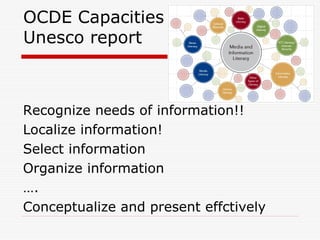
OCDE Capacities
Unesco report
Recognize needs of information!!
Localize information!
Select information
Organize information
….
Conceptualize and present effctively
Ensuring that (PhD) students
acquire competences in
• Knowing how to navigate the web
• Finding quality ressources
• Formulating questions
• Accessing potential sources
• Evaluating information for accuracy and
quality
• Organizing information
• Using information « to do something »
PhDs
Passive vs active learning
Their Challenge is
« reading and writing »
using published scientific literature
Finding, reading, understanding
Synthetizing
Writing in published journals
Communicating with laypeople, journalists, other
scientists… Sharing
Begin life long learning!
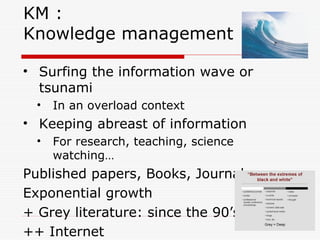
KM :
Knowledge management
• Surfing the information wave or
tsunami
• In an overload context
• Keeping abreast of information
• For research, teaching, science
watching…
Published papers, Books, Journals
Exponential growth
+ Grey literature: since the 90’s
++ Internet
OKM:
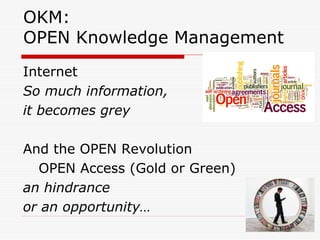
OPEN Knowledge Management
Internet
So much information,
it becomes grey
And the OPEN Revolution
OPEN Access (Gold or Green)
an hindrance
or an opportunity…
Recent Evolutions and Concerns
INFOBESITY
• Too much information is killing information...
• and knowledge
– Surinformation, Pollution informationnelle,
– Harcèlement textuel
• Networking
– From individuals and communities of interest
– To (social) networks
– Doubling time of information on the web?
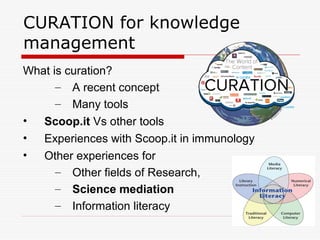
CURATION for knowledge
management
What is curation?
– A recent concept
– Many tools
• Scoop.it Vs other tools
• Experiences with Scoop.it in immunology
• Other experiences for
– Other fields of Research,
– Science mediation
– Information literacy
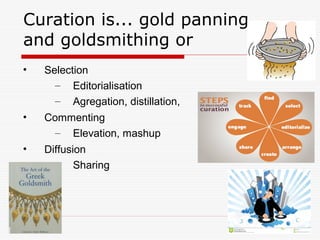
Curation is... gold panning
and goldsmithing or
• Selection
– Editorialisation
– Agregation, distillation,
• Commenting
– Elevation, mashup
• Diffusion
– Sharing
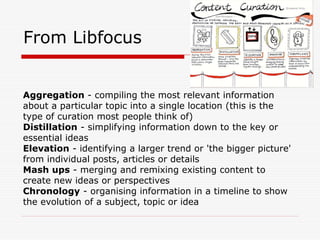
From Libfocus
Aggregation - compiling the most relevant information
about a particular topic into a single location (this is the
type of curation most people think of)
Distillation - simplifying information down to the key or
essential ideas
Elevation - identifying a larger trend or 'the bigger picture'
from individual posts, articles or details
Mash ups - merging and remixing existing content to
create new ideas or perspectives
Chronology - organising information in a timeline to show
the evolution of a subject, topic or idea
Curation tools (32)
• Google news
• Pearltrees, Paper.li, Pinterest, TumblR,
Storify, Sharezy, Flipboard...
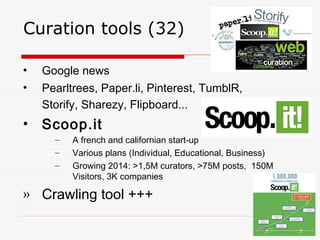
• Scoop.it
– A french and californian start-up
– Various plans (Individual, Educational, Business)
– Growing 2014: >1,5M curators, >75M posts, 150M
Visitors, 3K companies
» Crawling tool +++
Topics covered
with colleagues from Portugal, Spain, France...
• Basic Science, Biotechnologies, BioTherapies
– Immunology (>5,2K scoops, >40K visitors, >49,6K
views)
– From Flow Cytometry to Cytomics (>3.2K scoops, >6K
visitors, >13K views)
– Immunology and Biotherapies (5K scoops, 4K visitors,
>9K views)
– Mucosal Immunity (2,3K sc, 1.9K vis, 4,2K views)
• Immuno-Pathology
– Autoimmunity, (1.9K sc, 1.1K vis, 3,5K views)
– Allergy, (1.6K sc, 1.2K vis, 2.5K views)
– Neuroimmunology (1K, 5.5, 1.7)...
• History of immunology (0,3sc, 0,3vis, 900 views)
Other Immunology projects
using Scoop.it
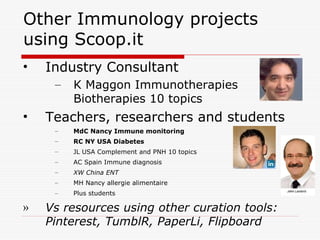
• Industry Consultant
– K Maggon Immunotherapies
Biotherapies 10 topics
• Teachers, researchers and students
– MdC Nancy Immune monitoring
– RC NY USA Diabetes
– JL USA Complement and PNH 10 topics
– AC Spain Immune diagnosis
– XW China ENT
– MH Nancy allergie alimentaire
– Plus students
» Vs resources using other curation tools:
Pinterest, TumblR, PaperLi, Flipboard
Other Life Sciences active
topics
• Chris Upton + Helpers U.Victoria
– Virology and bioinformatics 77K
– Next Generation sequencing
• C.Jacquet, IPM Lab Toulouse 56K
– Plants immunity, pathogens...
• D Blanchard 4.4K
– Biotech Pharma innovation
• Institut Pasteur de Tunis 17K
• Journées Internationales Biologie 19K
Skills which can be acquired
through Curation
1 Cognitive Load management
2 Design mindset and sensemaking
3 Novel and adaptive thinking and
New media literacy
4 Transdisciplinarity and Cross
cultural competency
5 Social Intelligence and Virtual
collaboration
From Nancy White: Developping future workskills through content curation. Innovation in Education
2012
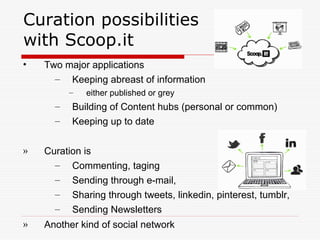
Curation possibilities
with Scoop.it
• Two major applications
– Keeping abreast of information
– either published or grey
– Building of Content hubs (personal or common)
– Keeping up to date
» Curation is
– Commenting, taging
– Sending through e-mail,
– Sharing through tweets, linkedin, pinterest, tumblr,
– Sending Newsletters
» Another kind of social network
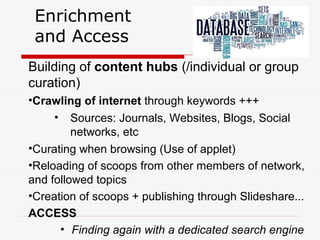
Enrichment
and Access
Building of content hubs (/individual or group
curation)
•Crawling of internet through keywords +++
• Sources: Journals, Websites, Blogs, Social
networks, etc
•Curating when browsing (Use of applet)
•Reloading of scoops from other members of network,
and followed topics
•Creation of scoops + publishing through Slideshare...
ACCESS
• Finding again with a dedicated search engine
Curation is for
knowledge management of ...
• Teachers
– Thought leadership and life long learning
» Trainees:
– Basic training and life long learning
• Collectivities
– Scientific Society, Academy
– Interest Network: ie GEIL, Coultry Club
– Research Labs, Units,
– Companies, with UtoB (University to Business)
opportunities?
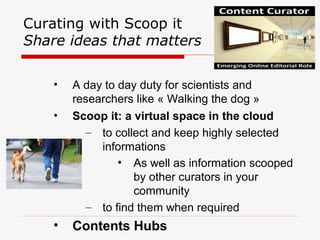
Curating with Scoop it
Share ideas that matters
• A day to day duty for scientists and
researchers like « Walking the dog »
• Scoop it: a virtual space in the cloud
– to collect and keep highly selected
informations
• As well as information scooped
by other curators in your
community
– to find them when required
• Contents Hubs
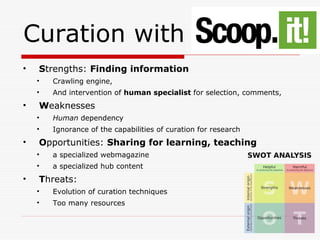
Curation with
• Strengths: Finding information
• Crawling engine,
• And intervention of human specialist for selection, comments,
• Weaknesses
• Human dependency
• Ignorance of the capabilities of curation for research
• Opportunities: Sharing for learning, teaching
• a specialized webmagazine
• a specialized hub content
• Threats:
• Evolution of curation techniques
• Too many resources
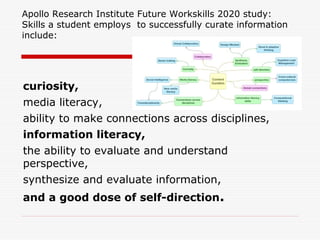
Apollo Research Institute Future Workskills 2020 study:
Skills a student employs to successfully curate information
include:
curiosity,
media literacy,
ability to make connections across disciplines,
information literacy,
the ability to evaluate and understand
perspective,
synthesize and evaluate information,
and a good dose of self-direction.
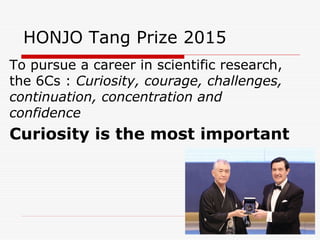
HONJO Tang Prize 2015
To pursue a career in scientific research,
the 6Cs : Curiosity, courage, challenges,
continuation, concentration and
confidence
Curiosity is the most important
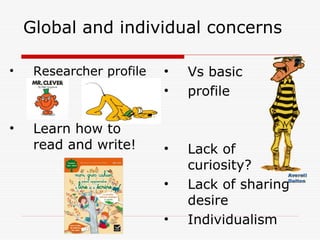
Global and individual concerns
• Researcher profile
• Learn how to
read and write!
• Vs basic
• profile
• Lack of
curiosity?
• Lack of sharing
desire
• Individualism
Summary
• Probably the best curation tool on the web for
serious information
– Crawling engine and enrichment capacities
• A virtual dedicated scientific news
webmagazine and content Hub
• easy to browse, and attractive
– For information literacy and curiosity
– The Search engine inside is a major asset
• The human factor of curation is the added
value compared to robots (SEO): selection,
editorialism
• And also the limit, requiring everyday work

ECIL 2015 Tallinn, Estonia

  • 1.
    Curation for OKMand information literacy (IL) is beneficial for PhD students Case study of Scoop it Oct 2015, Tallin, Estonia GC Faure MD, PhD Prof Immunology Université Lorraine
  • 2.
    1975 (Once upona time…) 2015 nihil novi sub sole? • « Je suis la référence » sic • GOOGLE: notrefamille.com • Wikipedia?
  • 3.
    Information literacy inhigher education: • Society 2020 requires – Multi-skilled learners – Able to think critically – Pose and solve problems – Become independent and life long learners  Postgraduate and PhD students Topic, Project, Execution, Results, Sharing
  • 4.
    OCDE Capacities Unesco report Recognizeneeds of information!! Localize information! Select information Organize information …. Conceptualize and present effctively
  • 5.
    Ensuring that (PhD)students acquire competences in • Knowing how to navigate the web • Finding quality ressources • Formulating questions • Accessing potential sources • Evaluating information for accuracy and quality • Organizing information • Using information « to do something »
  • 6.
    PhDs Passive vs activelearning Their Challenge is « reading and writing » using published scientific literature Finding, reading, understanding Synthetizing Writing in published journals Communicating with laypeople, journalists, other scientists… Sharing Begin life long learning!
  • 7.
    KM : Knowledge management •Surfing the information wave or tsunami • In an overload context • Keeping abreast of information • For research, teaching, science watching… Published papers, Books, Journals Exponential growth + Grey literature: since the 90’s ++ Internet
  • 8.
    OKM: OPEN Knowledge Management Internet Somuch information, it becomes grey And the OPEN Revolution OPEN Access (Gold or Green) an hindrance or an opportunity…
  • 9.
    Recent Evolutions andConcerns INFOBESITY • Too much information is killing information... • and knowledge – Surinformation, Pollution informationnelle, – Harcèlement textuel • Networking – From individuals and communities of interest – To (social) networks – Doubling time of information on the web?
  • 10.
    CURATION for knowledge management Whatis curation? – A recent concept – Many tools • Scoop.it Vs other tools • Experiences with Scoop.it in immunology • Other experiences for – Other fields of Research, – Science mediation – Information literacy
  • 11.
    Curation is... goldpanning and goldsmithing or • Selection – Editorialisation – Agregation, distillation, • Commenting – Elevation, mashup • Diffusion – Sharing
  • 12.
    From Libfocus Aggregation -compiling the most relevant information about a particular topic into a single location (this is the type of curation most people think of) Distillation - simplifying information down to the key or essential ideas Elevation - identifying a larger trend or 'the bigger picture' from individual posts, articles or details Mash ups - merging and remixing existing content to create new ideas or perspectives Chronology - organising information in a timeline to show the evolution of a subject, topic or idea
  • 13.
    Curation tools (32) •Google news • Pearltrees, Paper.li, Pinterest, TumblR, Storify, Sharezy, Flipboard... • Scoop.it – A french and californian start-up – Various plans (Individual, Educational, Business) – Growing 2014: >1,5M curators, >75M posts, 150M Visitors, 3K companies » Crawling tool +++
  • 14.
    Topics covered with colleaguesfrom Portugal, Spain, France... • Basic Science, Biotechnologies, BioTherapies – Immunology (>5,2K scoops, >40K visitors, >49,6K views) – From Flow Cytometry to Cytomics (>3.2K scoops, >6K visitors, >13K views) – Immunology and Biotherapies (5K scoops, 4K visitors, >9K views) – Mucosal Immunity (2,3K sc, 1.9K vis, 4,2K views) • Immuno-Pathology – Autoimmunity, (1.9K sc, 1.1K vis, 3,5K views) – Allergy, (1.6K sc, 1.2K vis, 2.5K views) – Neuroimmunology (1K, 5.5, 1.7)... • History of immunology (0,3sc, 0,3vis, 900 views)
  • 15.
    Other Immunology projects usingScoop.it • Industry Consultant – K Maggon Immunotherapies Biotherapies 10 topics • Teachers, researchers and students – MdC Nancy Immune monitoring – RC NY USA Diabetes – JL USA Complement and PNH 10 topics – AC Spain Immune diagnosis – XW China ENT – MH Nancy allergie alimentaire – Plus students » Vs resources using other curation tools: Pinterest, TumblR, PaperLi, Flipboard
  • 16.
    Other Life Sciencesactive topics • Chris Upton + Helpers U.Victoria – Virology and bioinformatics 77K – Next Generation sequencing • C.Jacquet, IPM Lab Toulouse 56K – Plants immunity, pathogens... • D Blanchard 4.4K – Biotech Pharma innovation • Institut Pasteur de Tunis 17K • Journées Internationales Biologie 19K
  • 17.
    Skills which canbe acquired through Curation 1 Cognitive Load management 2 Design mindset and sensemaking 3 Novel and adaptive thinking and New media literacy 4 Transdisciplinarity and Cross cultural competency 5 Social Intelligence and Virtual collaboration From Nancy White: Developping future workskills through content curation. Innovation in Education 2012
  • 18.
    Curation possibilities with Scoop.it •Two major applications – Keeping abreast of information – either published or grey – Building of Content hubs (personal or common) – Keeping up to date » Curation is – Commenting, taging – Sending through e-mail, – Sharing through tweets, linkedin, pinterest, tumblr, – Sending Newsletters » Another kind of social network
  • 19.
    Enrichment and Access Building ofcontent hubs (/individual or group curation) •Crawling of internet through keywords +++ • Sources: Journals, Websites, Blogs, Social networks, etc •Curating when browsing (Use of applet) •Reloading of scoops from other members of network, and followed topics •Creation of scoops + publishing through Slideshare... ACCESS • Finding again with a dedicated search engine
  • 20.
    Curation is for knowledgemanagement of ... • Teachers – Thought leadership and life long learning » Trainees: – Basic training and life long learning • Collectivities – Scientific Society, Academy – Interest Network: ie GEIL, Coultry Club – Research Labs, Units, – Companies, with UtoB (University to Business) opportunities?
  • 21.
    Curating with Scoopit Share ideas that matters • A day to day duty for scientists and researchers like « Walking the dog » • Scoop it: a virtual space in the cloud – to collect and keep highly selected informations • As well as information scooped by other curators in your community – to find them when required • Contents Hubs
  • 22.
    Curation with • Strengths:Finding information • Crawling engine, • And intervention of human specialist for selection, comments, • Weaknesses • Human dependency • Ignorance of the capabilities of curation for research • Opportunities: Sharing for learning, teaching • a specialized webmagazine • a specialized hub content • Threats: • Evolution of curation techniques • Too many resources
  • 23.
    Apollo Research InstituteFuture Workskills 2020 study: Skills a student employs to successfully curate information include: curiosity, media literacy, ability to make connections across disciplines, information literacy, the ability to evaluate and understand perspective, synthesize and evaluate information, and a good dose of self-direction.
  • 24.
    HONJO Tang Prize2015 To pursue a career in scientific research, the 6Cs : Curiosity, courage, challenges, continuation, concentration and confidence Curiosity is the most important
  • 25.
    Global and individualconcerns • Researcher profile • Learn how to read and write! • Vs basic • profile • Lack of curiosity? • Lack of sharing desire • Individualism
  • 26.
    Summary • Probably thebest curation tool on the web for serious information – Crawling engine and enrichment capacities • A virtual dedicated scientific news webmagazine and content Hub • easy to browse, and attractive – For information literacy and curiosity – The Search engine inside is a major asset • The human factor of curation is the added value compared to robots (SEO): selection, editorialism • And also the limit, requiring everyday work