CONTENT CURATION
FOR HEALTH AND INFORMATION LITERACIES
OF MEDICAL STUDENTS AND MDs
GC Faure MD, PhD
Immunologie
Faculté de Médecine
and CREM
Université Lorraine, Nancy
Overview
Background: Infobesity
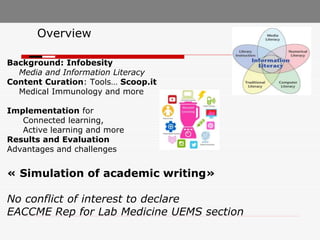
Media and Information Literacy
Content Curation: Tools… Scoop.it
Medical Immunology and more
Implementation for
Connected learning,
Active learning and more
Results and Evaluation
Advantages and challenges
« Simulation of academic writing»
No conflict of interest to declare
EACCME Rep for Lab Medicine UEMS section
MIL 2022
Media and Information Literacy
Although it was an objective for Society
2020
In the context of Infobesity
Health and MIL of medical students
remains poor
Content Curation
A not so recent concept (2010’s)
It allows to
find, select
aggregate
elevate, comment, editorialize
share
archive and retrieve later
Many tools>50… (Pinterest, Flipboard..)
• In our experience,
• https://www.scoop.it/u/gilbertcfaure
• one of the best curation tools on the web for « serious
information »
– Crawling engine and enrichment capacities
• A virtual scientific news journal and « content hub »
easy to browse with pictures
– Search engine « inside » is a major asset
• Human factor of curation is the added value compared
to robots (SEO), and AI.
• But the limit, requiring persistent work
Curating information is creating
Snippets (nuggets) of information
Title
Illustration
Summary
Comments
Tags: Keywords
Methods
UE Master 7.309
DIU Méthodologies de la recherche médicale et chirurgicale
Implementation of Scoop.it Content Curation tool
for active/hybrid learning in a module on
clinical research
50/100 students (medicine, maieutic) +10 chinese
students from Nancy Wuhan training program
Introductory course on Scientific Information
Access to Curated Resources by teachers
Open and maintain a medical topic of interest
using Scoop.it free plan (one topic, up to 50
posts)
Opinion and evaluation survey
after 3 months
Results (before course)
Literacies (information, digital,
health) poor for most french
students, better for chinese
No previous knowledge of concept of
content curation (but Pinterest) or of
Scoop.it tool
No specific training in information
usage,
either scientific or media
Results
Diversity of topics (Alzheimer,
Autoimmunity, Cancer, Cardiology,
Gynecology, Grafts, HIV, Neurology…
Phagotherapy…)
At least 25 posts… up to full load (65%)
Medical (80%) + Lay people resources
Keywords, Comments and summaries
Usage of English >60%
Evaluation/survey
Very positive
Discovery of information and medical
literature, either scientific
and/or for lay people, very much diverse than
previously thought
Discovery of medical and english vocabulary
Enjoyed active, and self learning
Different from passive courses
(ludique et intéressant, enrichissant…)
Understood micro/mobile-learning(s)
Willing to pursue (+++)
Limits
Time consuming
Language barriers of published papers
but positive on learning english
Discovery of costs of access of scientific
literature
Discovery of Open Access
Discussion:
Simulation of « self CPD » and of
academic writing !
An easy way of discovering new knowledge in
specific/new fields of interest
Learning to read and write
Stimulating curiosity
Developing health and information literacy
Building e-portfolio for research projects
Initiating autonomous learning
for Life Long Learning
Conclusion
Content curation is used for knowledge
management in corporate settings, and for
marketing purposes, teaching and learning in
other disciplines (geography..)
Can be used for blended-, hybrid-, self-, micro-
… learning by medical students engaged in
clinical research training.

NASCE2023.pptx

  • 1.
    CONTENT CURATION FOR HEALTHAND INFORMATION LITERACIES OF MEDICAL STUDENTS AND MDs GC Faure MD, PhD Immunologie Faculté de Médecine and CREM Université Lorraine, Nancy
  • 2.
    Overview Background: Infobesity Media andInformation Literacy Content Curation: Tools… Scoop.it Medical Immunology and more Implementation for Connected learning, Active learning and more Results and Evaluation Advantages and challenges « Simulation of academic writing» No conflict of interest to declare EACCME Rep for Lab Medicine UEMS section
  • 3.
    MIL 2022 Media andInformation Literacy Although it was an objective for Society 2020 In the context of Infobesity Health and MIL of medical students remains poor
  • 4.
    Content Curation A notso recent concept (2010’s) It allows to find, select aggregate elevate, comment, editorialize share archive and retrieve later Many tools>50… (Pinterest, Flipboard..)
  • 5.
    • In ourexperience, • https://www.scoop.it/u/gilbertcfaure • one of the best curation tools on the web for « serious information » – Crawling engine and enrichment capacities • A virtual scientific news journal and « content hub » easy to browse with pictures – Search engine « inside » is a major asset • Human factor of curation is the added value compared to robots (SEO), and AI. • But the limit, requiring persistent work
  • 6.
    Curating information iscreating Snippets (nuggets) of information Title Illustration Summary Comments Tags: Keywords
  • 7.
    Methods UE Master 7.309 DIUMéthodologies de la recherche médicale et chirurgicale Implementation of Scoop.it Content Curation tool for active/hybrid learning in a module on clinical research 50/100 students (medicine, maieutic) +10 chinese students from Nancy Wuhan training program Introductory course on Scientific Information Access to Curated Resources by teachers Open and maintain a medical topic of interest using Scoop.it free plan (one topic, up to 50 posts) Opinion and evaluation survey after 3 months
  • 8.
    Results (before course) Literacies(information, digital, health) poor for most french students, better for chinese No previous knowledge of concept of content curation (but Pinterest) or of Scoop.it tool No specific training in information usage, either scientific or media
  • 9.
    Results Diversity of topics(Alzheimer, Autoimmunity, Cancer, Cardiology, Gynecology, Grafts, HIV, Neurology… Phagotherapy…) At least 25 posts… up to full load (65%) Medical (80%) + Lay people resources Keywords, Comments and summaries Usage of English >60%
  • 10.
    Evaluation/survey Very positive Discovery ofinformation and medical literature, either scientific and/or for lay people, very much diverse than previously thought Discovery of medical and english vocabulary Enjoyed active, and self learning Different from passive courses (ludique et intéressant, enrichissant…) Understood micro/mobile-learning(s) Willing to pursue (+++)
  • 11.
    Limits Time consuming Language barriersof published papers but positive on learning english Discovery of costs of access of scientific literature Discovery of Open Access
  • 12.
    Discussion: Simulation of «self CPD » and of academic writing ! An easy way of discovering new knowledge in specific/new fields of interest Learning to read and write Stimulating curiosity Developing health and information literacy Building e-portfolio for research projects Initiating autonomous learning for Life Long Learning
  • 13.
    Conclusion Content curation isused for knowledge management in corporate settings, and for marketing purposes, teaching and learning in other disciplines (geography..) Can be used for blended-, hybrid-, self-, micro- … learning by medical students engaged in clinical research training.

Editor's Notes