Content Curation
to build and share Content Hubs for
Knowledge Management and Information Literacies
Gilbert C Faure MD, PhD
Prof Emeritus
Immunologie
et CREM
Université Lorraine, Nancy, FRANCE
No conflict of interest to declare
After Riga, Paris
Bobcatsss 2023
Oslo, Norway
Objectives of the study
3 challenges for medical students and
medical teachers in 2022
accessing relevant information and knowledge
teaching and learning to access knowledge
in other words, becoming and remaining
information and health literate
Compared to a doubling time of medical knowledge of 50 years in 1950, 7 years in 1980, and 3.5 years in
2010, the current doubling time is approximately 70 days.
Collective knowledge and
Investigative intelligence
Before: Libraries
Now: Internet / Infobesity
Thanks Sempé, Jane Hart
Is Content CURATION useful for
Knowledge Management
and metaliteracy?
A recent concept?
– Many tools: >50
• Pearltrees, Paper.li, Pinterest, TumblR, Storify,
Sharezy, Flipboard... Cronycle
• Scoop.it
– A French/US Start-up
– Various plans (Individual, Education, Business)
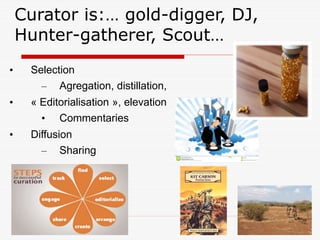
Curator is:… gold-digger, DJ,
Hunter-gatherer, Scout…
• Selection
– Agregation, distillation,
• « Editorialisation », elevation
• Commentaries
• Diffusion
– Sharing
Methods
Research Action: Open Knowledge
Content curation (OKCC/C3O)
Personal and colleagues’ networks
experiences for Research, Teaching
and Learning
Evaluation of topics from curators in
Biology related fields
Other subjects mainly related to
education
Immunology:
Topics covered by teachers (GCF et al.)
• Basic Science, Biotechnologies, BioTherapies
– Immunology (>7.7K scoops, >96K visitors, >126K
views)
– From Flow Cytometry to Cytomics (>4.6K scoops, >15,3K
visitors, >37,2K views)
– Immunology and Biotherapies (>9,3K scoops, >14,8K
visitors, >34,4K views)
– Mucosal Immunity (>4,9K scoops, >19,7 K views, >6,1
visitors)
• Immuno-Pathology…
– Auto-immunity, (>3,8K scoops, >15,3K views, >4,5K vis)
– Allergy and clinical immunology (>2,8K sc, >14,1K v, >4,3Kvis)
– Neuroimmunology (>2Ksc, >7,5Kv, >1,7K vis)
– History of Immunology (>1Ksc, >3,7Kv, >1,1Kvis)
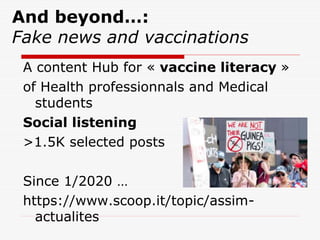
And beyond…:
Fake news and vaccinations
A content Hub for « vaccine literacy »
of Health professionnals and Medical
students
Social listening
>1.5K selected posts
Since 1/2020 …
https://www.scoop.it/topic/assim-
actualites
Topics …
by other curators
Biology related
Virology https://www.scoop.it/topic/virusworld;
Entomology https://www.scoop.it/topic/entomonews;
Other Science Fields
Geography https://www.scoop.it/topic/geography-education;
Education and Learning :
https://www.scoop.it/topic/tools-for-learners;
https://www.scoop.it/topic/21st-century-learning-and-teaching
Sino-french medical training program Nancy-
Wuhan 2020: 危机
Covid-19: 23/1/2020
https://www.scoop.it/topic/wuhan?page=6&tag=COVID-19
Long Distance teaching and learning:
classes 2015/6/7
Selected resources for homework
DIU: Active learning by students on
chosen topics building portfolio
UE Master 7.309
DIU Méthodologies de la recherche médicale et chirurgicales
Implementation of Scoop.it Content Curation tool
for active/hybrid learning in a module on
clinical research
50 students (medicine, maieutic) +10 chinese students
from Nancy Wuhan training program
Introductory course on Scientific Information
Access to Curated Resources by teachers
Open a medical topic of interest using Scoop.it free
plan (one topic, up to 50 posts)
Opinion and evaluation survey
after 3 months
Results
Knowledge management
Finding relevant information
Sharing information
Building Content Hubs for
communities of practice (CoPs)
Retrieving information
Interests for
Teachers, Researchers, Medical Doctors,
Master and PhD students
Medical students
Finding information
Either focused or serendipity
Building and enrichment of content hubs
with snippets of information
• Classical info Research (Pubmed, Google Scholar..)
• Web « Crawling » of internet with Scoop.it ,
personalized +++
• Sources: Published Journals, Websites, Blogs, Press releases,
Social networks (Twitter, Linkedin, Facebook..) Research
social networks (Researchgate..)
• Curating when browsing (applet)
• Shared scoops (scoop.it network)
• Creating scoops + publishing (Slideshare)
Sharing
and retrieving !
OPEN Webmagazine
Tagged, commented, discussed
Attractive (images)
Shared on other networks (Twitter, Linkedin
(25) Facebook, Google+
Via e-mails, newsletters
Content Hub searchable
Benefits for teachers and
researchers
(1)keeping abreast of information scientific
(and societal) for CPD and e-learning
(2)Building leadership in specific areas
(3)Joining specialists networks and interest
communities
(4)Opening new research fields (serendipity)
Benefits for research trainees
(1)Building of research content hubs and
portfolios (master and PhD)
(2) Becoming information literate, able to surf
the wave
(1) Resources, primary documents, databases,
predatory journals, Open Access
(2) Foreign languages
(3) for future life- long learning » in
universities, research centres, industries…
(1) PLN « personal learning network »
Health and information
literacies of medical students
Active learning
Discovery of
width of medical knowledge
information available for lay-people
communication with lay people
Interaction with professional networks
Understanding of fake news in health information
Self learning
Training Opportunities
New ways of learning: Flipped or blended or
hybrid
Information and digital literacy : mastering
information tools and techniques
Learning by reading and writing
Analysis (tags), summaries, comments
Stimulating curiosity in your research field and
beyond
Overview
Context:
Collective knowledge
Infobesity
Information and Health Literacy
Curation: Tools… Scoop.it
Medical Immunology
Other curators, other topics
Research action projects
Open Knowledge management
Information literacies
Reading, Writing, Learning, and more
Advantages and challenges
Disclaimer
once upon a time…
Europe SCICOM meetings
Paris MRES Comité stratégique IST
UHP Nancy 1 Chargé de mission DOC
AUF: ASSIM: maître toile
(http://www.assim.refer.org)
IUIS/ICSU with Michelle Letarte
Now: Emeritus, OKCC/C3O
And Sino-French Medical Training programs (Wuhan
and Kunming)
http://www.scoop.it/u/gilbertcfaure
https://fr2.slideshare.net/gcfaure
No conflict of interest to declare
Content curation
Taking care of contents
Information and Knowledge
Accessing
Teaching and Learning
To be information litterate
INFOBESITY
• « Trop d’information tue l’information... »
• And knowledge
– Surinformation, Pollution informationnelle,
– Harcèlement textuel
– Publications … hyperprolifics
• Social networks
– « Fake » news…
Curating information is
reading and writing
Title
Illustration
Summary
Comments
Tags: Keywords
Snippets or nuggets of
information
From Libfocus
Aggregation - compiling the most relevant information
about a particular topic into a single location (this is the
type of curation most people think of)
Distillation - simplifying information down to the key or
essential ideas
Elevation - identifying a larger trend or 'the bigger picture'
from individual posts, articles or details
Mash ups - merging and remixing existing content to
create new ideas or perspectives
Chronology - organising information in a timeline to show
the evolution of a subject, topic or idea
Topics covered by colleagues
and trainees
• By researchers and colleagues
– M. de Carvalho Nancy Immune monitoring
– R.Creusot, Columbia NY USA Diabetes
– Complement JD Lambris, Philadelphia, Pa, USA
• By students
– PhD students XW China ENT,
– Master students from Nancy-Wuhan Training program :
Methodologies of medical clinical and surgical research
– 15 chinese + 20 french 2020
– 10 chinese +50 french 2021 students
– Topics related to medicine and biology
– Bonus points on activity (research, posts, comments,
tags)
– Foreign language usage
Results
Diversity of topics (Alzheimer,
Autoimmunity, Cancer, Cardiology,
Gynecology, Grafts, HIV, Neurology…
Phagotherapy)
At least 25 posts… up to full load (65%)
Medical (80%) Lay people resources
Keywords, Comments and summaries
Usage of English >60%
Plus
Knowledge base
Vu par le documentaliste
Vu par l’enseignant
Information literacy 5PMIS
Adding SMIL (Scientific and Media IL)
Online learning
Connected Learning
Blended learning,
E-learning,
Self-learning
M-learning (micro-, mobile-)
Social learning
Invisible-, adaptative-
Reading and writing!
Digital Literacy, Curiosity
Summary
• In my experience, one of the best curation
tools on the web for serious information
– Crawling engine and enrichment capacities
• A virtual scientific news « journal » and
database easy to browse with pictures
– For information literacy and curiosity
– Search engine inside is a major asset
• The human factor of curation is the added
value compared to robots (SEO): selection,
editorialism
• And the limit, requiring everyday work
Information Literacy (IL)
in high education:
• Society 2020
– Multi-skilled learners
– Able to think critically
– Pose and solve problems
– Become independent and life long learners
• OCDE and UNESCO: (MIL) Media and
Information Literacy
Recognize needs of information!!
Localize information!
Select information
Organize information
Health Literacy
Challenges
Human factor of curation is added value
compared to algorithms: selection, editorialisation
But
Human dependency is the limit
Day to day duty of teachers, researchers like
« walking the dog »
Individualism of teachers and
researchers: reluctance to share
Permanence of tools

Bobcatsss2023.pptx

  • 1.
    Content Curation to buildand share Content Hubs for Knowledge Management and Information Literacies Gilbert C Faure MD, PhD Prof Emeritus Immunologie et CREM Université Lorraine, Nancy, FRANCE No conflict of interest to declare After Riga, Paris Bobcatsss 2023 Oslo, Norway
  • 2.
    Objectives of thestudy 3 challenges for medical students and medical teachers in 2022 accessing relevant information and knowledge teaching and learning to access knowledge in other words, becoming and remaining information and health literate Compared to a doubling time of medical knowledge of 50 years in 1950, 7 years in 1980, and 3.5 years in 2010, the current doubling time is approximately 70 days.
  • 3.
    Collective knowledge and Investigativeintelligence Before: Libraries Now: Internet / Infobesity Thanks Sempé, Jane Hart
  • 4.
    Is Content CURATIONuseful for Knowledge Management and metaliteracy? A recent concept? – Many tools: >50 • Pearltrees, Paper.li, Pinterest, TumblR, Storify, Sharezy, Flipboard... Cronycle • Scoop.it – A French/US Start-up – Various plans (Individual, Education, Business)
  • 5.
    Curator is:… gold-digger,DJ, Hunter-gatherer, Scout… • Selection – Agregation, distillation, • « Editorialisation », elevation • Commentaries • Diffusion – Sharing
  • 6.
    Methods Research Action: OpenKnowledge Content curation (OKCC/C3O) Personal and colleagues’ networks experiences for Research, Teaching and Learning Evaluation of topics from curators in Biology related fields Other subjects mainly related to education
  • 7.
    Immunology: Topics covered byteachers (GCF et al.) • Basic Science, Biotechnologies, BioTherapies – Immunology (>7.7K scoops, >96K visitors, >126K views) – From Flow Cytometry to Cytomics (>4.6K scoops, >15,3K visitors, >37,2K views) – Immunology and Biotherapies (>9,3K scoops, >14,8K visitors, >34,4K views) – Mucosal Immunity (>4,9K scoops, >19,7 K views, >6,1 visitors) • Immuno-Pathology… – Auto-immunity, (>3,8K scoops, >15,3K views, >4,5K vis) – Allergy and clinical immunology (>2,8K sc, >14,1K v, >4,3Kvis) – Neuroimmunology (>2Ksc, >7,5Kv, >1,7K vis) – History of Immunology (>1Ksc, >3,7Kv, >1,1Kvis)
  • 8.
    And beyond…: Fake newsand vaccinations A content Hub for « vaccine literacy » of Health professionnals and Medical students Social listening >1.5K selected posts Since 1/2020 … https://www.scoop.it/topic/assim- actualites
  • 9.
    Topics … by othercurators Biology related Virology https://www.scoop.it/topic/virusworld; Entomology https://www.scoop.it/topic/entomonews; Other Science Fields Geography https://www.scoop.it/topic/geography-education; Education and Learning : https://www.scoop.it/topic/tools-for-learners; https://www.scoop.it/topic/21st-century-learning-and-teaching
  • 10.
    Sino-french medical trainingprogram Nancy- Wuhan 2020: 危机 Covid-19: 23/1/2020 https://www.scoop.it/topic/wuhan?page=6&tag=COVID-19 Long Distance teaching and learning: classes 2015/6/7 Selected resources for homework DIU: Active learning by students on chosen topics building portfolio
  • 11.
    UE Master 7.309 DIUMéthodologies de la recherche médicale et chirurgicales Implementation of Scoop.it Content Curation tool for active/hybrid learning in a module on clinical research 50 students (medicine, maieutic) +10 chinese students from Nancy Wuhan training program Introductory course on Scientific Information Access to Curated Resources by teachers Open a medical topic of interest using Scoop.it free plan (one topic, up to 50 posts) Opinion and evaluation survey after 3 months
  • 12.
    Results Knowledge management Finding relevantinformation Sharing information Building Content Hubs for communities of practice (CoPs) Retrieving information Interests for Teachers, Researchers, Medical Doctors, Master and PhD students Medical students
  • 13.
    Finding information Either focusedor serendipity Building and enrichment of content hubs with snippets of information • Classical info Research (Pubmed, Google Scholar..) • Web « Crawling » of internet with Scoop.it , personalized +++ • Sources: Published Journals, Websites, Blogs, Press releases, Social networks (Twitter, Linkedin, Facebook..) Research social networks (Researchgate..) • Curating when browsing (applet) • Shared scoops (scoop.it network) • Creating scoops + publishing (Slideshare)
  • 14.
    Sharing and retrieving ! OPENWebmagazine Tagged, commented, discussed Attractive (images) Shared on other networks (Twitter, Linkedin (25) Facebook, Google+ Via e-mails, newsletters Content Hub searchable
  • 15.
    Benefits for teachersand researchers (1)keeping abreast of information scientific (and societal) for CPD and e-learning (2)Building leadership in specific areas (3)Joining specialists networks and interest communities (4)Opening new research fields (serendipity)
  • 16.
    Benefits for researchtrainees (1)Building of research content hubs and portfolios (master and PhD) (2) Becoming information literate, able to surf the wave (1) Resources, primary documents, databases, predatory journals, Open Access (2) Foreign languages (3) for future life- long learning » in universities, research centres, industries… (1) PLN « personal learning network »
  • 17.
    Health and information literaciesof medical students Active learning Discovery of width of medical knowledge information available for lay-people communication with lay people Interaction with professional networks Understanding of fake news in health information Self learning
  • 18.
    Training Opportunities New waysof learning: Flipped or blended or hybrid Information and digital literacy : mastering information tools and techniques Learning by reading and writing Analysis (tags), summaries, comments Stimulating curiosity in your research field and beyond
  • 19.
    Overview Context: Collective knowledge Infobesity Information andHealth Literacy Curation: Tools… Scoop.it Medical Immunology Other curators, other topics Research action projects Open Knowledge management Information literacies Reading, Writing, Learning, and more Advantages and challenges
  • 20.
    Disclaimer once upon atime… Europe SCICOM meetings Paris MRES Comité stratégique IST UHP Nancy 1 Chargé de mission DOC AUF: ASSIM: maître toile (http://www.assim.refer.org) IUIS/ICSU with Michelle Letarte Now: Emeritus, OKCC/C3O And Sino-French Medical Training programs (Wuhan and Kunming) http://www.scoop.it/u/gilbertcfaure https://fr2.slideshare.net/gcfaure No conflict of interest to declare
  • 22.
    Content curation Taking careof contents Information and Knowledge Accessing Teaching and Learning To be information litterate
  • 23.
    INFOBESITY • « Tropd’information tue l’information... » • And knowledge – Surinformation, Pollution informationnelle, – Harcèlement textuel – Publications … hyperprolifics • Social networks – « Fake » news…
  • 24.
    Curating information is readingand writing Title Illustration Summary Comments Tags: Keywords Snippets or nuggets of information
  • 25.
    From Libfocus Aggregation -compiling the most relevant information about a particular topic into a single location (this is the type of curation most people think of) Distillation - simplifying information down to the key or essential ideas Elevation - identifying a larger trend or 'the bigger picture' from individual posts, articles or details Mash ups - merging and remixing existing content to create new ideas or perspectives Chronology - organising information in a timeline to show the evolution of a subject, topic or idea
  • 26.
    Topics covered bycolleagues and trainees • By researchers and colleagues – M. de Carvalho Nancy Immune monitoring – R.Creusot, Columbia NY USA Diabetes – Complement JD Lambris, Philadelphia, Pa, USA • By students – PhD students XW China ENT, – Master students from Nancy-Wuhan Training program : Methodologies of medical clinical and surgical research – 15 chinese + 20 french 2020 – 10 chinese +50 french 2021 students – Topics related to medicine and biology – Bonus points on activity (research, posts, comments, tags) – Foreign language usage
  • 27.
    Results Diversity of topics(Alzheimer, Autoimmunity, Cancer, Cardiology, Gynecology, Grafts, HIV, Neurology… Phagotherapy) At least 25 posts… up to full load (65%) Medical (80%) Lay people resources Keywords, Comments and summaries Usage of English >60%
  • 28.
    Plus Knowledge base Vu parle documentaliste Vu par l’enseignant Information literacy 5PMIS Adding SMIL (Scientific and Media IL)
  • 29.
    Online learning Connected Learning Blendedlearning, E-learning, Self-learning M-learning (micro-, mobile-) Social learning Invisible-, adaptative- Reading and writing! Digital Literacy, Curiosity
  • 30.
    Summary • In myexperience, one of the best curation tools on the web for serious information – Crawling engine and enrichment capacities • A virtual scientific news « journal » and database easy to browse with pictures – For information literacy and curiosity – Search engine inside is a major asset • The human factor of curation is the added value compared to robots (SEO): selection, editorialism • And the limit, requiring everyday work
  • 31.
    Information Literacy (IL) inhigh education: • Society 2020 – Multi-skilled learners – Able to think critically – Pose and solve problems – Become independent and life long learners • OCDE and UNESCO: (MIL) Media and Information Literacy Recognize needs of information!! Localize information! Select information Organize information Health Literacy
  • 32.
    Challenges Human factor ofcuration is added value compared to algorithms: selection, editorialisation But Human dependency is the limit Day to day duty of teachers, researchers like « walking the dog » Individualism of teachers and researchers: reluctance to share Permanence of tools