UVA-M-0876
Rev.Sept.21, 2015
This public-sourced case was prepared by Jenny Mead, Senior Researcher; Paul W. Farris, Landmark Communications Professor of Business
Administration;and Andrew C.Wicks,Ruffin Professorof Business Administration,withassistancefrom KatherineAbbott (U.Va.’16). It was written
as a basis for class discussion rather than to illustrate effective or ineffective handling of an administrative situation. Copyright  2015 by the
University of Virginia Darden School Foundation, Charlottesville, VA. All rights reserved. To order copies, send an e-mail to
sales@dardenbusinesspublishing.com.No part ofthis publicationmaybe reproduced, stored in a retrievalsystem,used in a spreadsheet, or transmitted in any form or by
any means—electronic, mechanical, photocopying, recording, or otherwise—without the permission of the Darden School Foundation.
E-Cigarettes: The Wild, Wild West
In 2014, tobacco giant Reynolds American Inc. (RAI) had to confront the rapidly evolving global tobacco
industry landscape. E-cigarettes, once considered a fad, were becoming increasingly popular. Facing
uncharted territory, tobacco companies were uncertain about how to most successfully enter this market and
how to do so rapidly. An executive from Altria, the largest tobacco company in the United States, recognized
the difficulty of predicting how robust the market would become. “Adoption rates are pretty low at this
point…there is interest, but probably the products are not meeting the needs of people…that’s a challenge
that I think we and other people in the space are struggling and dealing with,” he said.1 RAI faced the same
uncertainties.
To explore this new market, combat Altria, and address declining cigarette consumption, in 2012, RAI
had begun acquisition talks with Lorillard, Inc., a smaller tobacco company. The talks would last two years
and culminate in a $27.4 billion deal, although there were difficult decisions along the way. RAI had
developed its own e-cigarette, Vuse, but Lorillard manufactured the popular blu eCigs, which in 2013 had
captured 47% of the U.S. e-cigarette market. Both RAI and Lorillard worried about scrutiny by antitrust
regulators if both Vuse and blu eCigs were housed in the same company. Growing health concerns and the
possible regulation of e-cigarettes were issues that complicated the decisions that had to be made. In early
2014, the U.S. Food and Drug Administration (FDA) had announced future regulations, and if laws
governing e-cigarettes were too draconian, the growth of the e-cigarette industry could be adversely affected.
RAI’s CEO Susan Cameron had publicly expressed her excitement about e-cigarettes by saying, “[Our]
strategic mission to transform the tobacco industry is a fascinating journey. I’m looking forward to the
opportunity to not just advance, but accelerate, that momentum.”2
Still, the road ahead did not appear smooth. It seemed to Cameron and RAI leadership that every week
brought changes in products, technology, marketing, or public/government perception. And there were the
questions: Were e-cigarettes truly in tobacco’s future? What was the potential for growth? Should RAI
proceed at top speed with this product or proceed cautiously? And how should the company navigate what its
CEO predicted would be a “fascinating journey”?
E-Cigarettes
1 Robert Powell, “Following the Customer,” Virginia Business, April 29, 2014.
2 Mike Esterl, “Tobacco CEO Who ‘Vapes’ Could Alter the Industry,” Wall Street Journal, July 14, 2014, B1.
Page 2 UVA-M-0876
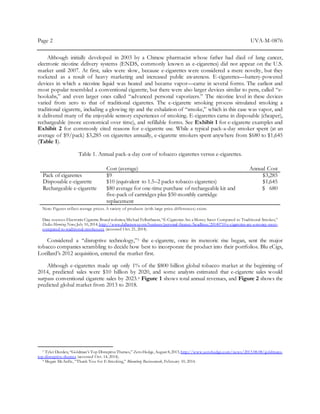
Although initially developed in 2003 by a Chinese pharmacist whose father had died of lung cancer,
electronic nicotine delivery systems (ENDS, commonly known as e-cigarettes) did not appear on the U.S.
market until 2007. At first, sales were slow, because e-cigarettes were considered a mere novelty, but they
rocketed as a result of heavy marketing and increased public awareness. E-cigarettes—battery-powered
devices in which a nicotine liquid was heated and became vapor—came in several forms. The earliest and
most popular resembled a conventional cigarette, but there were also larger devices similar to pens, called “e-
hookahs,” and even larger ones called “advanced personal vaporizers.” The nicotine level in these devices
varied from zero to that of traditional cigarettes. The e-cigarette smoking process simulated smoking a
traditional cigarette, including a glowing tip and the exhalation of “smoke,” which in this case was vapor, and
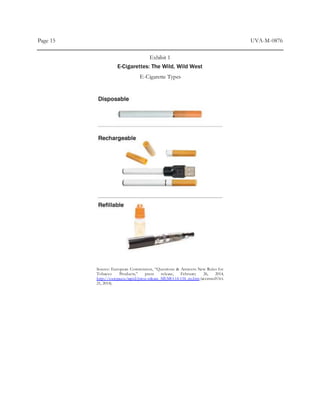
it delivered many of the enjoyable sensory experiences of smoking. E-cigarettes came in disposable (cheaper),
rechargeable (more economical over time), and refillable forms. See Exhibit 1 for e-cigarette examples and
Exhibit 2 for commonly cited reasons for e-cigarette use. While a typical pack-a-day smoker spent (at an
average of $9/pack) $3,285 on cigarettes annually, e-cigarette smokers spent anywhere from $680 to $1,645
(Table 1).
Table 1. Annual pack-a-day cost of tobacco cigarettes versus e-cigarettes.
Cost (average) Annual Cost
Pack of cigarettes $9 $3,285
Disposable e-cigarette $10 (equivalent to 1.5–2 packs tobacco cigarettes) $1,645
Rechargeable e-cigarette $80 average for one-time purchase of rechargeable kit and
five-pack of cartridges plus $50 monthly cartridge
replacement
$ 680
Note: Figures reflect average prices. A variety of products (with large price differences) exists.
Data sources:ElectronicCigarette Brand websites;Michael Felberbaum,“E-Cigarettes Are aMoney Saver Compared to Traditional Smokes,”
Dallas Morning News,July 10,2014,http://www.dallasnews.com/business/personal-finance/headlines/20140710-e-cigarettes-are-a-money-saver-
compared-to-traditional-smokes.ece (accessed Oct. 21, 2014).
Considered a “disruptive technology,”3 the e-cigarette, once its meteoric rise began, sent the major
tobacco companies scrambling to decide how best to incorporate the product into their portfolios. Blu eCigs,
Lorillard’s 2012 acquisition, entered the market first.
Although e-cigarettes made up only 1% of the $800 billion global tobacco market at the beginning of
2014, predicted sales were $10 billion by 2020, and some analysts estimated that e-cigarette sales would
surpass conventional cigarette sales by 2023.4 Figure 1 shows total annual revenues, and Figure 2 shows the
predicted global market from 2013 to 2018.
3 Tyler Durden,“Goldman’s Top DisruptiveThemes,” ZeroHedge,August 8,2013, http://www.zerohedge.com/news/2013-08-08/goldmans-
top-disruptive-themes (accessed Oct. 14, 2014).
4 Megan McArdle, “Thank You for E-Smoking,” Bloomberg Businessweek, February 10, 2014.
Page 3 UVA-M-0876
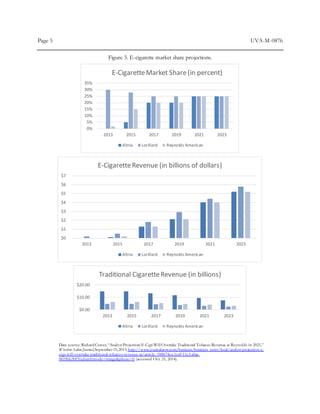
Figure 1. Total annual revenues of the e-cigarette market, 2008–2013.
Data source: Statistic Brain, “Electronic Cigarette Statistics,” www.statisticbrain.com/electronic-
cigarette-statistics (accessed Oct. 21, 2014).
Figure 2. Predicted global e-cigarette sales (dollars in millions).
Data source: “Global E-Cigarette Market 2014–2018,” ReportLinker, November 2013,
http://www.reportlinker.com (accessedOct.16,2014). The projected 2016–18 downturn was the result
of factoring in regulatory measures that might slow the market.
By 2014, there were almost 400 different e-cigarette brands and 7,000 different flavors. In the early years,
e-cigarettes were sold mainly over the Internet since, unlike tobacco products, it was legal to send them
through the mail. As of 2014, sales of e-cigarettes occurred primarily in convenience stores (30%), online
(26%), and through retail “vape shops” (17%).5 A pack of disposable e-cigarettes cost approximately $6 to $7,
5 Case study, “E-Cigarettes: Big Tobacco Moves in for the Kill,” MarketLine, June 30, 2014,
http://store.marketline.com/Product/e_cigarettes_big_tobacco_moves_in_for_the_kill_but_could_profits_disappear_in_a_puff_of_smoke?producti
d=ML00017-029 (accessed Oct. 16, 2014).
0
200
400
600
800
1,000
1,200
1,400
1,600
1,800
2008 2009 2010 2011 2012 2013
$USinmillions
27.00%
28.00%
29.00%
30.00%
31.00%
32.00%
33.00%
0.00
1,000.00
2,000.00
3,000.00
4,000.00
5,000.00
6,000.00
7,000.00
8,000.00
9,000.00
10,000.00
2013 2014 2015 2016 2017 2018
Revenue Growth Rate
Page 4 UVA-M-0876
while a rechargeable e-cigarette cost $12 to $15. A starter kit for the more elaborate devices cost anywhere
from $60 to $150. One disposable e-cigarette was equivalent to one or two packs of combustible cigarettes.
E-cigarette margins were attractive to retailers, who could mark them up by 200% to 400%, whereas the
markup for traditional cigarettes was 10% to 20%.6
The bulk of e-cigarette manufacturing took place in China, although in the spring of 2014, concerns
about the quality of e-cigarette ingredients began to push manufacturing to the United States. The years 2013
and 2014 also saw the rise of vape shops. In the United States, there were an estimated 5,000 such shops
where customers could sample an array of different flavors and devices. The United States had the largest
number of e-cigarette users (an estimated 18 million), but other countries were also seeing an increase:
Germany had an estimated 1.2 million users and Great Britain had 2.1 million.
In 2013, e-cigarette brand leaders were blu eCigs (37.2%), NJOY (32%), and LOGIC (19.8%), which
combined represented 89% of all e-cigarette sales in the United States; all other brands made up the
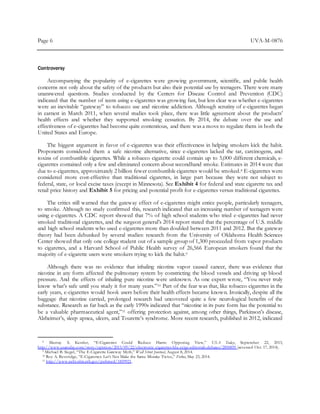
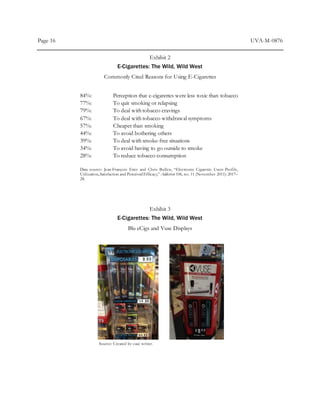
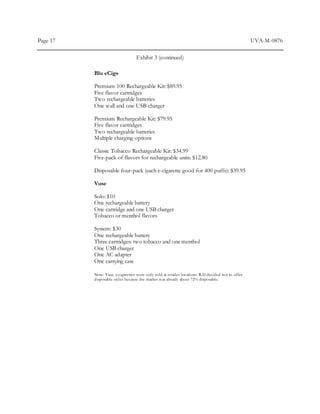
remaining 11%. See Exhibit 3 for blu eCigs and Vuse samples and pricing. Figure 3 provides projected e-
cigarette market share and revenues by company and projected traditional cigarette revenues by company.
The below list shows the global e-cigarette market by geographic segmentation in 2013:7
 North America 39.8%
 Western Europe 30.1%
 Asia-Pacific 16.2%
 Eastern and Central Europe 4.9%
 South America 4.2%
 Rest of the world 4.8%
6 Karen E. Klein, “Healthy Markups on E-Cigarettes Turn Vacant Storefronts into ‘Vape Shops,’” Bloomberg Businessweek, October 3, 2013,
http://www.businessweek.com/articles/2013-10-03/healthy-markups-on-e-cigarettes-turn-vacant-storefronts-into-vape-shops (accessed Oct. 21,
2014).
7 http://www.reportlinker.com.
Page 5 UVA-M-0876
Figure 3. E-cigarette market share projections.
Data source: RichardCraver,“Analyst Projection:E-Cigs WillOvertake Traditional Tobacco Revenue at Reynolds in 2021,”
Winston-Salem Journal,September15,2013, http://www.journalnow.com/business/business_news/local/analyst-projection-e-
cigs-will-overtake-traditional-tobacco-revenue-at/article_948674ca-1ca9-11e3-a0ae-
0019bb30f31a.html?mode=image&photo=0 (accessed Oct. 21, 2014).
0%
5%
10%
15%
20%
25%
30%
35%
2013 2015 2017 2019 2021 2023
E-CigaretteMarket Share(in percent)
Altria Lorillard Reynolds American
$0
$1
$2
$3
$4
$5
$6
$7
2013 2015 2017 2019 2021 2023
E-CigaretteRevenue (in billions of dollars)
Altria Lorillard Reynolds American
$0.00
$10.00
$20.00
2013 2015 2017 2019 2021 2023
Traditional CigaretteRevenue (in billions)
Altria Lorillard Reynolds American
Page 6 UVA-M-0876
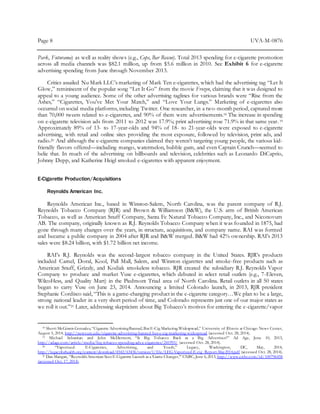
Controversy
Accompanying the popularity of e-cigarettes were growing government, scientific, and public health
concerns not only about the safety of the products but also their potential use by teenagers. There were many
unanswered questions. Studies conducted by the Centers for Disease Control and Prevention (CDC)
indicated that the number of teens using e-cigarettes was growing fast, but less clear was whether e-cigarettes
were an inevitable “gateway” to tobacco use and nicotine addiction. Although scrutiny of e-cigarettes began
in earnest in March 2011, when several studies took place, there was little agreement about the products’
health effects and whether they supported smoking cessation. By 2014, the debate over the use and
effectiveness of e-cigarettes had become quite contentious, and there was a move to regulate them in both the
United States and Europe.
The biggest argument in favor of e-cigarettes was their effectiveness in helping smokers kick the habit.
Proponents considered them a safe nicotine alternative, since e-cigarettes lacked the tar, carcinogens, and
toxins of combustible cigarettes. While a tobacco cigarette could contain up to 5,000 different chemicals, e-
cigarettes contained only a few and eliminated concern about secondhand smoke. Estimates in 2014 were that
due to e-cigarettes, approximately 2 billion fewer combustible cigarettes would be smoked.8 E-cigarettes were
considered more cost-effective than traditional cigarettes, in large part because they were not subject to
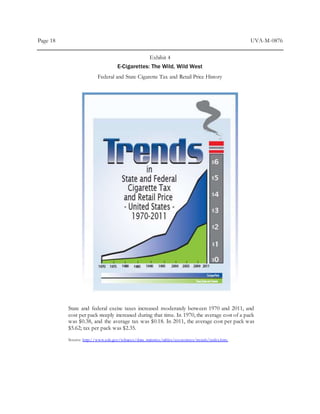
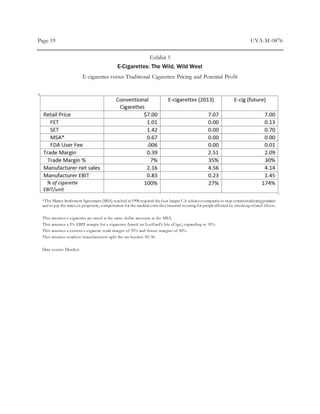
federal, state, or local excise taxes (except in Minnesota). See Exhibit 4 for federal and state cigarette tax and
retail price history and Exhibit 5 for pricing and potential profit for e-cigarettes versus traditional cigarettes.
The critics still warned that the gateway effect of e-cigarettes might entice people, particularly teenagers,
to smoke. Although no study confirmed this, research indicated that an increasing number of teenagers were
using e-cigarettes. A CDC report showed that 7% of high school students who tried e-cigarettes had never
smoked traditional cigarettes, and the surgeon general’s 2014 report stated that the percentage of U.S. middle
and high school students who used e-cigarettes more than doubled between 2011 and 2012. But the gateway
theory had been debunked by several studies: research from the University of Oklahoma Health Sciences
Center showed that only one college student out of a sample group of 1,300 proceeded from vapor products
to cigarettes, and a Harvard School of Public Health survey of 26,566 European smokers found that the
majority of e-cigarette users were smokers trying to kick the habit.9
Although there was no evidence that inhaling nicotine vapor caused cancer, there was evidence that
nicotine in any form affected the pulmonary system by constricting the blood vessels and driving up blood
pressure. And the effects of inhaling pure nicotine were unknown. As one expert wrote, “You never truly
know what’s safe until you study it for many years.”10 Part of the fear was that, like tobacco cigarettes in the
early years, e-cigarettes would hook users before their health effects became known. Ironically, despite all the
baggage that nicotine carried, prolonged research had uncovered quite a few neurological benefits of the
substance. Research as far back as the early 1990s indicated that “nicotine in its pure form has the potential to
be a valuable pharmaceutical agent,”11 offering protection against, among other things, Parkinson’s disease,
Alzheimer’s, sleep apnea, ulcers, and Tourette’s syndrome. More recent research, published in 2012, indicated
8 Murray S. Kessler, “E-Cigarettes Could Reduce Harm: Opposing View,” USA Today, September 22, 2013,
http://www.usatoday.com/story/opinion/2013/09/22/electronic-cigarettes-blu-ecigs-editorials-debates/2850859 (accessed Oct. 17, 2014).
9 Michael B. Siegel, “The E-Cigarette Gateway Myth,” Wall Street Journal, August 8, 2014.
10 Roy A. Beveridge, “E-Cigarettes: Let’s Not Make the Same Mistake Twice,” Forbes, May 23, 2014.
11 http://www.ncbi.nlm.nih.gov/pubmed/1859921.
Page 7 UVA-M-0876
that nicotine improved “cognitive defects in young adults with ADHD,” had positive effects in general on
memory and attention, and showed promise in treating Alzheimer’s and Parkinson’s.12
Quality control was also an issue for many critics; most e-cigarettes were manufactured in China with
little to no oversight. One specific health concern centered on e-cigarette vapor, which contained propylene
glycol, also used as fake theatrical smoke. Propylene glycol could irritate the lungs, and its long-term effects
were unknown. In addition, inadvertent exposure to the nicotine liquid in e-cigarette chambers could be
harmful or even fatal (particularly to the children and teens who mistakenly handled it). The CDC reported
that calls to poison-control centers involving nicotine exposure had skyrocketed from one per month to
approximately 215 per month, and many calls involved children under six years old.13 There were also
incidents of defective e-cigarettes exploding and causing severe facial burns.
Other critics claimed that some smokers would not use the e-cigarette as a smoking cessation device, but
to augment tobacco cigarettes with e-cigarettes in places where smoking was forbidden. Also while the
manufacturers claimed that the vapor was much safer than smoke, not enough scientific studies had been
conducted to ascertain whether this vapor contained carcinogens or toxins. The lack of long-term studies
contributed to the uncertainty regarding the overall effect of e-cigarettes on people’s health. Furthermore,
because the manufacturers were unregulated, it was impossible to know the makeup of the e-cigarette vapor.
Research
The research on e-cigarettes, both on the health effects and efficacies as a smoking cessation device, was
often contradictory. A 2011 Journal of Public Health Policy study claimed that “a preponderance of the available
evidence shows [e-cigarettes] to be much safer than tobacco cigarettes and comparable in toxicity to
conventional nicotine replacement products.”14 But another study cited harmful metal and silicate particles in
the aerosol mechanism in many e-cigarettes, most likely because of a lack of quality control in the device’s
design and manufacture.15 After a University of California, San Francisco, study claiming that e-cigarettes
caused air pollution was published simultaneously with a Boston University study citing no public health
hazards from e-cigarettes, an American Cancer Society doctor summed up the landscape of e-cigarette
research: “One study, two experienced researchers, and two sharply divided opinions of the same material.”16
In general, that was the tone of the research up to that point: scattered, contradictory, and inconclusive.
E-cigarette marketing
Unlike combustible cigarettes, e-cigarettes could be advertised on television as well as in magazines and
on billboards. A 2014 study published in Pediatrics concluded that the number of children under 18 years old
who were exposed to e-cigarette television advertising had risen by 256% from 2011 to 2013, and exposure
for young adults had risen by 321% during that same period.17 In 2013, approximately 80% of the advertising
was for Lorillard’s blu eCigs on cable channels, including Comedy Central, VH1, AMC, TV Land, and
Country Music Television. The most popular programming for e-cigarettes were mature cartoons (e.g., South
12 Dan Hurley,“GrowingList of Positive Effects of NicotineSeenfor Neurodegenerative Disorders,” Neurology Today (January 19, 2012), 37–38.
13 CDC, “New CDC Study Finds Dramatic Increase in E-Cigarette-Related Calls to Poison Centers,” press release, April 3, 2013,
http://www.cdc.gov/media/releases/2014/p0403-e-cigarette-poison.html (accessed Oct. 21, 2014).
14 McArdle.
15 “Metal and Silicate Particles Including Nanoparticles ArePresent in ElectronicCigarette Cartomizer Fluidand Aerosol,” PLOS ONE, March 20,
2013, http://www.plosone.org/article/info%3Adoi%2F10.1371%2Fjournal.pone.0057987 (accessed Oct. 17, 2014).
16 Thomas J. Glynn, “E-Cigarettes—It’s Complicated,” American Cancer Society blog, June 24, 2014,
http://www.cancer.org/cancer/news/expertvoices/post/2014/06/24/e-cigarettes-its-complicated.aspx (accessed Oct. 16, 2014).
17 James McIntosh, “High Rise in E-Cigarette TV Advertising for Young Adults,” Medical News Today Newsletter, June 2014,
http://www.medicalnewstoday.com/articles/277650.php (accessed Nov. 18, 2014).
Page 8 UVA-M-0876
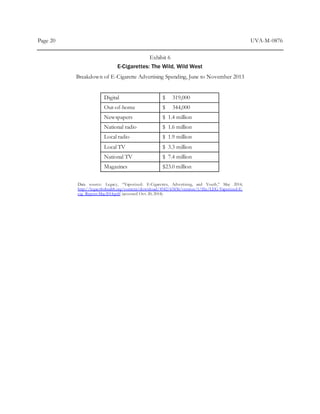
Park, Futurama) as well as reality shows (e.g., Cops, Bar Rescue). Total 2013 spending for e-cigarette promotion
across all media channels was $82.1 million, up from $5.6 million in 2010. See Exhibit 6 for e-cigarette
advertising spending from June through November 2013.
Critics assailed Nu Mark LLC’s marketing of Mark Ten e-cigarettes, which had the advertising tag “Let It
Glow,” reminiscent of the popular song “Let It Go” from the movie Frozen, claiming that it was designed to
appeal to a young audience. Some of the other advertising taglines for various brands were “Rise from the
Ashes,” “Cigarettes, You’ve Met Your Match,” and “Love Your Lungs.” Marketing of e-cigarettes also
occurred on social media platforms, including Twitter. One researcher, in a two-month period, captured more
than 70,000 tweets related to e-cigarettes, and 90% of them were advertisements.18 The increase in spending
on e-cigarette television ads from 2011 to 2012 was 17.9%; print advertising rose 71.9% in that same year.19
Approximately 89% of 13- to 17-year-olds and 94% of 18- to 21-year-olds were exposed to e-cigarette
advertising, with retail and online sites providing the most exposure, followed by television, print ads, and
radio.20 And although the e-cigarette companies claimed they weren’t targeting young people, the various kid-
friendly flavors offered—including mango, watermelon, bubble gum, and even Captain Crunch—seemed to
belie that. In much of the advertising on billboards and television, celebrities such as Leonardo DiCaprio,
Johnny Depp, and Katherine Heigl smoked e-cigarettes with apparent enjoyment.
E-Cigarette Production/Acquisitions
Reynolds American Inc.
Reynolds American Inc., based in Winston-Salem, North Carolina, was the parent company of R.J.
Reynolds Tobacco Company (RJR) and Brown & Williamson (B&W), the U.S. arm of British American
Tobacco, as well as American Snuff Company, Santa Fe Natural Tobacco Company, Inc., and Niconovum
AB. The company, originally known as R.J. Reynolds Tobacco Company when it was founded in 1875, had
gone through many changes over the years, in structure, acquisitions, and company name. RAI was formed
and became a public company in 2004 after RJR and B&W merged. B&W had 42% ownership. RAI’s 2013
sales were $8.24 billion, with $1.72 billion net income.
RAI’s R.J. Reynolds was the second-largest tobacco company in the United States. RJR’s products
included Camel, Doral, Kool, Pall Mall, Salem, and Winston cigarettes and smoke-free products such as
American Snuff, Grizzly, and Kodiak smokeless tobacco. RJR created the subsidiary R.J. Reynolds Vapor
Company to produce and market Vuse e-cigarettes, which debuted in select retail outlets (e.g., 7-Eleven,
WilcoHess, and Quality Mart) in the Piedmont Triad area of North Carolina. Retail outlets in all 50 states
began to carry Vuse on June 23, 2014. Announcing a limited Colorado launch, in 2013, RJR president
Stephanie Cordisco said, “This is a game-changing product in the e-cigarette category…We plan to be a large,
strong national leader in a very short period of time, and Colorado represents just one of our major states as
we roll it out.”21 Later, addressing skepticism about Big Tobacco’s motives for entering the e-cigarette/vapor
18 Sherri McGinnis Gonzalez,“Cigarette AdvertisingBanned,But E-Cig Marketing Widespread,” University of Illinois at Chicago News Center,
August 5, 2014, http://news.uic.edu/cigarette-advertising-banned-but-e-cig-marketing-widespread (accessed Oct. 28, 2014).
19 Michael Sebastian and John McDermott, “Is Big Tobacco Back as a Big Advertiser?” Ad Age, June 10, 2013,
http://adage.com/article/media/big-tobacco-spending-ads-e-cigarettes/241993/ (accessed Oct. 28, 2014).
20 “Vaporized: E-Cigarettes, Advertising, and Youth,” Legacy, Washington, DC, May, 2014,
http://legacyforhealth.org/content/download/4542/63436/version/1/file/LEG-Vaporized-E-cig_Report-May2014.pdf (accessed Oct. 28, 2014).
21 Dan Mangan, “ReynoldsAmerican Sees E-Cigarette Launch as a‘Game Changer,’” CNBC,June 6,2013, http://www.cnbc.com/id/100796458
(accessed Oct. 17, 2014).
Page 9 UVA-M-0876
game, Cordisco said, “We’re here to make sure we can put this industry on the right side of history…We’re
trying to redefine tobacco enjoyment and give smokers an alternative, one that potentially reduces harm.”22
22 Matt Richtel, “Tobacco Giants Attract Critics as They Move into E-Cigarettes,” International New York Times, June 18, 2014, 17.
Page 10 UVA-M-0876
Lorillard
In 2012, Lorillard, the third-largest tobacco company in the United States, had 14.5% market share of
traditional cigarettes and was known primarily for its Newport, Maverick, Kent, and True brands. Lorillard
bought blu eCigs for $135 million in 2012 and increased the product’s retail distribution from 10,000 stores to
more than 136,000, growing the brand into the market leader; it claimed a 47% share of the U.S. market by
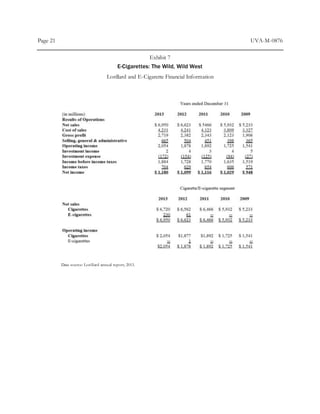
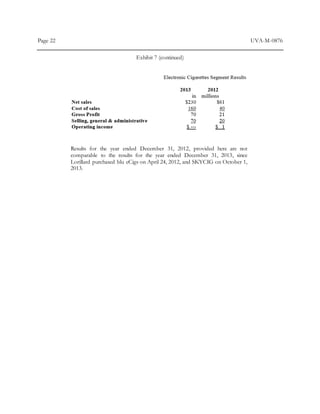
2014. Blu eCigs’ annual sales increased from $50 million to more than $200 million. (Exhibit 7 shows
Lorillard’s and blu eCigs’ financial information.) Despite Lorillard’s initial success with blu eCigs, the e-
cigarette industry’s rapid maturation dealt the product a blow in early 2014, when the rise of vaping and
second-generation technology (primarily the tanks) cost blu eCigs some market share (a 14% drop in first-
quarter and a 23% drop in second-quarter revenues). As explained in Lorillard’s annual report, 2013’s gross
profit and gross profit margin “were negatively impacted by the change in product offering arising from the
introduction of our new, lower-priced rechargeable kit that began shipping to wholesale late in the second
quarter of 2013 as well as higher promotional costs.”23 Blu eCigs also took a hit from the plethora of new e-
cigarette/vapor products streaming into the market.
Other companies
Other U.S. tobacco companies had scrambled to get into the e-cigarette/vapor business. In 2012, Altria
Group, the largest, formed Nu Mark to utilize its existing branding and supply-chain-management
infrastructure. Nu Mark test-marketed Mark Ten e-cigarettes in Indiana during August 2013 and in Arizona
during December 2013, and planned a national expansion for the second quarter of 2014. In February 2014,
Altria Group announced Nu Mark’s impending $110 million acquisition of Green Smoke, Inc., an e-vapor
business, along with its affiliates. In 2012, British American Tobacco acquired CN Creative, a start-up that
manufactured and supplied e-cigarettes. In addition to acquiring the British-based Nicocigs, Philip Morris
International was developing a “heat stick,” which heated rather than burned tobacco, and expected a 2015
release.
The Tobacco Industry
Although cigarette use had steadily declined over the decades since its health effects were determined, in
2012, smoking still topped the list of leading causes of preventable death. There were approximately 480,000
U.S. deaths annually and 5.4 million worldwide, and more than 16 million Americans were affected by a
smoking-related illness. Smoking-related costs in the United States were estimated at $289 billion, including
$133 billion for medical expenses, $156 billion in lost productivity, and $5.6 billion in secondhand smoke–
related loss of productivity. See Table 2 for smoking statistics and a breakdown of the U.S. smoking
population. There were contrarian voices, however. Economist Kip Viscusi of Vanderbilt University, in
discussing the cost of smoking—which was routinely touted, particularly by Congress, as a financial burden
on society—approached at it from another angle: “If you want to look at the costs imposed by smokers, you
have to look at all insurance costs, not just health costs. At least from a societal standpoint, smokers actually
save us money because they die sooner, and if you have a pension plan, they’re a bargain.”24 See Table 3 for
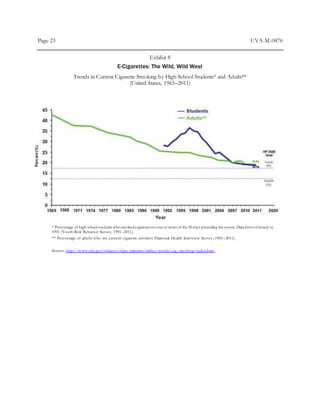
the leading tobacco companies and brands and Exhibit 8 for smoking statistics during the past five decades.
23 Lorillard annual report, 2013.
24 WilliamKip Viscusi,Ph.D.,TobaccoDocuments.org, http://tobaccodocuments.org/profiles/viscusi_w_kip_phd.html (accessed Oct. 21, 2014).
Page 11 UVA-M-0876
Table 2. Breakdown of tobacco smokers, 2013–14.25
Age
17.3% of adults aged 18–24 years
21.6% of adults aged 25–44 years
19.5% of adults aged 45–64 years
8.9% of adults aged 65 years and older
Race/Ethnicity
21.8% of American Indians/Alaska Natives (non-
Hispanic)
10.7% of Asians (non-Hispanic; excludes Native
Hawaiians and Pacific Islanders)
18.1% of Blacks (non-Hispanic)
12.5% of Hispanics
19.7% of Whites (non-Hispanic)
26.1% of multiple-race individuals
Education
24.7% of adults with 12 years or fewer of education
(no diploma)
41.9% of adults with a GED diploma
23.1% of adults with a high school diploma
9.1% of adults with an undergraduate college degree
5.9% of adults with a postgraduate college degree
Poverty Status
27.9% of adults who live below the poverty level
17.0% of adults who live at or above the poverty
level
9.3% of adults making more than $100,000
annually
Table 3. Leading tobacco companies and brands.
Company Name Brand Examples Market % Cigarettes Sold
Philip Morris USA Marlboro, Basic, Virginia Slims 46.10% 135.1 billion
Reynolds American Inc. Camel, Doral, Winston, Kool 24.90% 72.9 billion
Lorillard Newport, Maverick, Kent 13.70% 40 billion
All other companies USA Gold, Sonoma, Montclair 15.30% 45 billion
Data source: Centers for Disease Control and Prevention, “Economic Facts about U.S. Tobacco Production and Use,”
http://www.cdc.gov/tobacco/data_statistics/fact_sheets/economics/econ_facts (accessed Oct. 21, 2014).
In the 1960s, 50 million (42%) Americans smoked. One-half of all men and one-third of all women
smoked. By 2012, there were 42.1 million smokers, or 18% of all Americans, of which 20.5% of men and
15.8% of women smoked. In the United States, the regional breakdown of smokers was in the Midwest
(26.0%), the South (19.7%), the Northeast (16.5%), and the West (14.2%). Kentucky had the highest
concentration of smokers, at 28.3%, and Utah had the lowest concentration, at 10.6%. Approximately 70% of
smokers expressed a desire to quit, and 50% of these attempted to quit each year. Sadly, only 1 in 20
succeeded in quitting.26
The most popular brands were Marlboro (Altria), 40.3%; Newport (Lorillard), 11.7%; Camel (RJR), 7.6%;
and Pall Mall Box (RJR), 7.3%.27
25 CDC, “Adult Cigarette Smoking in the United States: Current Estimates,” http://www.cdc.gov/tobacco/data_statistics/fact_sheets/
adult_data/cig_smoking (accessed Oct. 21, 2014); Mike Esterl, Karishma Mehrotra, and Valerie Bauerlein, “America’s Smokers: Still 40 Million
Strong,” Wall Street Journal, July 16, 2014.
26 For an interactive map of United States smoking by states, see CDC, “State Tobacco Activities Tracking and Evaluation (STATE) System,”
http://apps.nccd.cdc.gov/statesystem/InteractiveReport/InteractiveReports.aspx (accessed Oct.21,2014).For a detailed breakdown of worldwide
cigarette use and sales,see WHO,“Appendix VIII – Table 1: Surveys of Adult Tobacco Use in WHO Member States,” WHO Report on the Global
Tobacco Epidemic, 2009, http://www.who.int/tobacco/mpower/2009/Appendix_VIII-table_1.pdf (accessed Oct. 21, 2014).
27 CDC, “Tobacco Brand Preferences,” http://www.cdc.gov/tobacco/data_statistics/fact_sheets/tobacco_industry/
brand_preference/index.htm?utm_source=feedburner&utm_medium=feed&utm_campaign=Feed%3A+cdc%2FGEla+(CDC+-
+Smoking+and+Tobacco+Use+-+Main+Feed) (accessed Oct. 21, 2014).
Page 12 UVA-M-0876
Tobacco regulation
Once the link between smoking and lung cancer was established in the 1950s, research on cigarettes’
health effects intensified. In 1964, the U.S. surgeon general’s landmark report outlined smoking’s negative
health effects, including cancer, and was an impetus for federal and state governments to impose regulations.
By 2009, in addition to many state regulations, five federal laws and two federal amendments concerning
tobacco were passed. The following were the major U.S. regulatory steps:
 1965: Congress passed the Federal Cigarette Labeling and Advertising Act, which required health
warnings on cigarette packs; annual Federal Trade Commission (FTC) reporting to Congress on
advertising and labeling practices in the tobacco industry; and an annual report from the Department
of Health, Education, and Welfare on the health consequences of smoking.
 1970: The Public Health Cigarette Smoking Act prohibited cigarette advertising on television and
radio.
 1984: The Comprehensive Smoking Education Act instituted four rotating surgeon general warning
labels on both cigarette packages and advertisements.
 1986: The Comprehensive Smokeless Tobacco Health Education Act regulated smokeless tobacco to
the same degree as cigarettes.
 1988: An amendment to the Federal Aviation Act prohibited smoking on domestic flights of two
hours or less. Two years later, this ban applied to domestic flights of six hours, and in 2000, smoking
on all flights between the United States and other countries was banned.
 1992: The Synar Amendment prohibited the sale and distribution of cigarettes to minors and
required states to enact and enforce more aggressive laws prohibiting these sales.
 2009: Barack Obama signed into law the Family Smoking Prevention and Tobacco Control Act, also
known as the Tobacco Control Act. Among other provisions, the act banned outdoor advertising
within 1,000 feet of areas where minors congregated; brand sponsorship of sports and entertainment
events; free giveaways with tobacco purchases; free samples of any tobacco product; and sales of
cigarettes in packages containing fewer than 20 cigarettes.
On a more global scale, the World Health Organization Framework Convention on Tobacco Control
(WHO FCTC) went into effect in February 2005 and was adopted “in response to the globalization of the
tobacco epidemic.”28 Provisions included price and tax measures to reduce the demand for tobacco and
nonprice measures to reduce the demand for tobacco, namely protection from exposure to tobacco smoke;
regulation of the contents of tobacco products; regulation of tobacco product disclosures; packaging and
labeling of tobacco products; education, communication, training, and public awareness; tobacco advertising,
promotion, and sponsorship; and demand-reduction measures concerning tobacco dependence and cessation.
Other provisions in the WHO FCTC were designed to address the illicit trade in tobacco products, sales to
and by minors, and provision of support for economically viable alternative activities. In August 2014, the
WHO FCTC released a report calling for greater e-cigarette restrictions, including bans on use in public
places and advertising and flavor restrictions.
28 Conference of the Parties to the WHO FCTC, “WHO Framework Convention on Tobacco Control,” 2003,
http://www.who.int/fctc/text_download/en (accessed Oct. 21, 2014).
Page 13 UVA-M-0876
CVS: the right thing to do
In early 2014, announcing that “Cigarettes and tobacco products have no place in a setting where health
care is delivered. This is the right thing to do,”29 The retail chain and pharmacy benefits manager CVS
Caremark Corp. announced that it would no longer sell cigarettes, and the tobacco was off the shelves of its
7,700 stores by November of that year. The predicted loss was approximately $2 billion annually. CVS also
announced that it would not sell electronic cigarettes. In justifying its move, CVS pointed to a study that
showed that in Boston and San Francisco, where cigarettes could not be sold at pharmacies, tobacco sales had
fallen by 13%.
E-Cigarette Regulation
Even in 2014, the e-cigarette industry was considered, as characterized by one FDA official, the “wild,
wild West.”30 Because they did not contain tobacco, e-cigarettes escaped the purview of U.S. law, at least
temporarily. The industry’s growth had been unregulated, in part because research into the safety of the
product was minimal and contradictory. But regulatory agencies in both the United States and Europe were
beginning to take note as well as action.
United States: In April 2014, the FDA announced its first proposed regulations, which were to take effect
in 2016. Similar to the regulations for tobacco products, the FDA’s regulations mandated that manufacturers
of e-cigarettes must register with the FDA and report product and ingredient listings; new tobacco products
could only be marketed after FDA review; e-cigarette makers could make claims of reduced risk if the FDA
confirmed that scientific evidence supported the claim and that marketing the product would benefit public
health as a whole; and distribution of free samples was prohibited. In addition, the FDA proposed the
following: minimum age and identification restrictions to prevent sales to underage youth; e-cigarette
packaging had to include health warnings; and vending machine sales were prohibited unless the machines
were located in a facility that never admitted youths.31 Many analysts, including the Motley Fool, claimed that
these proposed regulations would be an advantage for the large tobacco companies, giving them an edge over
the small companies as well as e-cigarette start-ups.
Some cities, including Boston and New York City, had already banned e-cigarettes in public places. In
November 2013, New York City raised the legal age to buy all tobacco products, including e-cigarettes, from
18 to 21 years. As of late 2013, 34 states had imposed some type of regulation, either by implementing laws
that restricted youth access to e-cigarettes or by outlawing e-cigarette smoking in public venues.32
European Union: In February 2014, the European Parliament proposed new regulations to take effect in
May of that year. These included no advertising for e-cigarettes, childproof packaging with graphic warnings,
and limiting the nicotine content to 20 milligrams per pack.33 Additional EU regulations required e-cigarette
manufacturers to submit detailed information about any new products coming to market; to report annually
29 http://www.cvshealth.com/research-insights/health-topics/this-is-the-right-thing-to-do.
30 Mike Esterl, “E-Cigarettes Fire Up Investors, Regulators,” Wall Street Journal, June 9, 2013, http://online.wsj.com/
news/articles/SB10001424127887324904004578535362153026902 (accessed Oct. 21, 2014).
31 FDA, “Issue Snapshot on Deeming: Regulating Additional Tobacco Products,” http://www.fda.gov/downloads/
TobaccoProducts/NewsEvents/UCM397724.pdf (accessed Oct. 21, 2014).
32 Camille K. Gourdet, Jamie F. Chriqui, and Frank J. Chaloupka, “A Baseline Understanding of State Laws Governing E-Cigarettes,”
Tobacconomics,June 2014, http://tobacconomics.org/research/baseline-understanding-state-laws-governing-e-cigarettes (accessed Oct. 21, 2014).
33 That equaled 1 milligram per cigarette. On average, cigarettes had 1 to 1.4 milligrams of nicotine; light cigarettes had fewer.
Page 14 UVA-M-0876
on sales volume, user types, and other information; and to comply with existing advertising/promotion rules
that already applied to tobacco cigarettes.34
Global reaction to and regulation of e-cigarettes was all over the map. Several countries, including
Australia, Brazil, Indonesia, Japan, and Mexico, banned them outright. Denmark and the United Kingdom
classified them as medicinal products, while France prohibited their use in public places.
Conclusion
As the talks between RAI and Lorillard continued, often breaking down but ultimately resuming,
important decisions remained. What should the companies, if they merged, do about the two different e-
cigarette brands: RAI’s Vuse and Lorillard’s blu eCigs? If the merger was successful, what strategy should
these two companies adopt regarding e-cigarettes? The controversy that had sprung up around this new
technology, as well as the uncertain regulatory landscape, posed both marketing and ethical challenges. E-
cigarettes had proved to be a disruptive technology but also a game changer for a long-established industry,
and confronting these disruptions and changes would not be easy. Already the e-cigarette industry was
moving at a fast pace, and CEO Susan Cameron and the rest of the RAI leadership team had to decide how
most effectively to join in and keep up with that pace. As Cameron had said in a recent interview, “I feel very
committed to giving smokers alternatives that may reduce harm and can satisfy them in a way other than
combustible cigarettes.”35
34 For aglobal picture ofhow countriesare regulating e-cigarettes,see E-Cigarette Politics,“E-Cigarette Laws Worldwide,” http://www.ecigarette-
politics.com/electronic-cigarettes-global-legal-status.html (accessed Oct. 21, 2014).
35 Caroline Fairchild,“Reynolds AmericanCEO Talks Tobacco’s Future,” Fortune, August 8, 2014, http://fortune.com/2014/08/08/reynolds-
american-ceo-talks-tobaccos-future (accessed Oct. 21, 2014).
Page 15 UVA-M-0876
Exhibit 1
E-Cigarettes: The Wild, Wild West
E-Cigarette Types
Source: European Commission, “Questions & Answers: New Rules for
Tobacco Products,” press release, February 26, 2014,
http://europa.eu/rapid/press-release_MEMO-14-134_en.htm(accessedOct.
21, 2014).
Page 16 UVA-M-0876
Exhibit 2
E-Cigarettes: The Wild, Wild West
Commonly Cited Reasons for Using E-Cigarettes
84%: Perception that e-cigarettes were less toxic than tobacco
77%: To quit smoking or relapsing
79%: To deal with tobacco cravings
67%: To deal with tobacco withdrawal symptoms
57%: Cheaper than smoking
44%: To avoid bothering others
39%: To deal with smoke-free situations
34%: To avoid having to go outside to smoke
28%: To reduce tobacco consumption
Data source: Jean-François Etter and Chris Bullen, “Electronic Cigarette: Users Profile,
Utilization, Satisfaction and PerceivedEfficacy,” Addiction 106, no. 11 (November 2011): 2017–
28.
Exhibit 3
E-Cigarettes: The Wild, Wild West
Blu eCigs and Vuse Displays
Source: Created by case writer.
Page 17 UVA-M-0876
Exhibit 3 (continued)
Blu eCigs
Premium 100 Rechargeable Kit: $89.95
Five flavor cartridges
Two rechargeable batteries
One wall and one USB charger
Premium Rechargeable Kit: $79.95
Five flavor cartridges
Two rechargeable batteries
Multiple charging options
Classic Tobacco Rechargeable Kit: $34.99
Five-pack of flavors for rechargeable units: $12.80
Disposable four-pack (each e-cigarette good for 400 puffs): $39.95
Vuse
Solo: $10
One rechargeable battery
One cartridge and one USB charger
Tobacco or menthol flavors
System: $30
One rechargeable battery
Three cartridges: two tobacco and one menthol
One USB charger
One AC adapter
One carrying case
Note: Vuse e-cigarettes were only sold at retailer locations. RAI decided not to offer
disposable styles because the market was already about 72% disposable.
Page 18 UVA-M-0876
Exhibit 4
E-Cigarettes: The Wild, Wild West
Federal and State Cigarette Tax and Retail Price History
State and federal excise taxes increased moderately between 1970 and 2011, and
cost per pack steeply increased during that time. In 1970, the average cost of a pack
was $0.38, and the average tax was $0.18. In 2011, the average cost per pack was
$5.62; tax per pack was $2.35.
Source: http://www.cdc.gov/tobacco/data_statistics/tables/economics/trends/index.htm.
Page 19 UVA-M-0876
Exhibit 5
E-Cigarettes: The Wild, Wild West
E-cigarettes versus Traditional Cigarettes: Pricing and Potential Profit
*The Master Settlement Agreement (MSA) reached in1998 required thefour largest U.S.tobaccocompanies to stop certainmarketingpractices
and to pay the states,in perpetuity,compensation for the medical costs theyincurred incaring for peopleaffected by smoking-related illness.
This assumes e-cigarettes are taxed at the same dollar amounts as the MSA.
This assumes a 5% EBIT margin for e-cigarettes (based on Lorillard’s blu eCigs), expanding to 35%.
This assumes a current e-cigarette retail margin of 35% and future margins of 30%.
This assumes retailers/manufacturers split the tax burden 50/50.
Data source: Durden.
Page 20 UVA-M-0876
Exhibit 6
E-Cigarettes: The Wild, Wild West
Breakdown of E-Cigarette Advertising Spending, June to November 2013
Digital $ 319,000
Out-of-home $ 344,000
Newspapers $ 1.4 million
National radio $ 1.6 million
Local radio $ 1.9 million
Local TV $ 3.3 million
National TV $ 7.4 million
Magazines $23.0 million
Data source: Legacy, “Vaporized: E-Cigarettes, Advertising, and Youth,” May 2014,
http://legacyforhealth.org/content/download/4542/63436/version/1/file/LEG-Vaporized-E-
cig_Report-May2014.pdf (accessed Oct. 20, 2014).
Page 21 UVA-M-0876
Exhibit 7
E-Cigarettes: The Wild, Wild West
Lorillard and E-Cigarette Financial Information
Data source: Lorillard annual report, 2013.
Page 22 UVA-M-0876
Exhibit 7 (continued)
Results for the year ended December 31, 2012, provided here are not
comparable to the results for the year ended December 31, 2013, since
Lorillard purchased blu eCigs on April 24, 2012, and SKYCIG on October 1,
2013.
Page 23 UVA-M-0876
Exhibit 8
E-Cigarettes: The Wild, Wild West
Trends in Current Cigarette Smoking by High School Students* and Adults**
(United States, 1965–2011)
* Percentage of high schoolstudents whosmokedcigaretteson oneor moreof the30 days preceding thesurvey.Datafirst collected in
1991 (Youth Risk Behavior Survey, 1991–2011).
** Percentage of adults who are current cigarette smokers (National Health Interview Survey, 1965–2011).
Source: http://www.cdc.gov/tobacco/data_statistics/tables/trends/cig_smoking/index.htm.

E-cigarettes

  • 1.
    UVA-M-0876 Rev.Sept.21, 2015 This public-sourcedcase was prepared by Jenny Mead, Senior Researcher; Paul W. Farris, Landmark Communications Professor of Business Administration;and Andrew C.Wicks,Ruffin Professorof Business Administration,withassistancefrom KatherineAbbott (U.Va.’16). It was written as a basis for class discussion rather than to illustrate effective or ineffective handling of an administrative situation. Copyright  2015 by the University of Virginia Darden School Foundation, Charlottesville, VA. All rights reserved. To order copies, send an e-mail to sales@dardenbusinesspublishing.com.No part ofthis publicationmaybe reproduced, stored in a retrievalsystem,used in a spreadsheet, or transmitted in any form or by any means—electronic, mechanical, photocopying, recording, or otherwise—without the permission of the Darden School Foundation. E-Cigarettes: The Wild, Wild West In 2014, tobacco giant Reynolds American Inc. (RAI) had to confront the rapidly evolving global tobacco industry landscape. E-cigarettes, once considered a fad, were becoming increasingly popular. Facing uncharted territory, tobacco companies were uncertain about how to most successfully enter this market and how to do so rapidly. An executive from Altria, the largest tobacco company in the United States, recognized the difficulty of predicting how robust the market would become. “Adoption rates are pretty low at this point…there is interest, but probably the products are not meeting the needs of people…that’s a challenge that I think we and other people in the space are struggling and dealing with,” he said.1 RAI faced the same uncertainties. To explore this new market, combat Altria, and address declining cigarette consumption, in 2012, RAI had begun acquisition talks with Lorillard, Inc., a smaller tobacco company. The talks would last two years and culminate in a $27.4 billion deal, although there were difficult decisions along the way. RAI had developed its own e-cigarette, Vuse, but Lorillard manufactured the popular blu eCigs, which in 2013 had captured 47% of the U.S. e-cigarette market. Both RAI and Lorillard worried about scrutiny by antitrust regulators if both Vuse and blu eCigs were housed in the same company. Growing health concerns and the possible regulation of e-cigarettes were issues that complicated the decisions that had to be made. In early 2014, the U.S. Food and Drug Administration (FDA) had announced future regulations, and if laws governing e-cigarettes were too draconian, the growth of the e-cigarette industry could be adversely affected. RAI’s CEO Susan Cameron had publicly expressed her excitement about e-cigarettes by saying, “[Our] strategic mission to transform the tobacco industry is a fascinating journey. I’m looking forward to the opportunity to not just advance, but accelerate, that momentum.”2 Still, the road ahead did not appear smooth. It seemed to Cameron and RAI leadership that every week brought changes in products, technology, marketing, or public/government perception. And there were the questions: Were e-cigarettes truly in tobacco’s future? What was the potential for growth? Should RAI proceed at top speed with this product or proceed cautiously? And how should the company navigate what its CEO predicted would be a “fascinating journey”? E-Cigarettes 1 Robert Powell, “Following the Customer,” Virginia Business, April 29, 2014. 2 Mike Esterl, “Tobacco CEO Who ‘Vapes’ Could Alter the Industry,” Wall Street Journal, July 14, 2014, B1.
  • 2.
    Page 2 UVA-M-0876 Althoughinitially developed in 2003 by a Chinese pharmacist whose father had died of lung cancer, electronic nicotine delivery systems (ENDS, commonly known as e-cigarettes) did not appear on the U.S. market until 2007. At first, sales were slow, because e-cigarettes were considered a mere novelty, but they rocketed as a result of heavy marketing and increased public awareness. E-cigarettes—battery-powered devices in which a nicotine liquid was heated and became vapor—came in several forms. The earliest and most popular resembled a conventional cigarette, but there were also larger devices similar to pens, called “e- hookahs,” and even larger ones called “advanced personal vaporizers.” The nicotine level in these devices varied from zero to that of traditional cigarettes. The e-cigarette smoking process simulated smoking a traditional cigarette, including a glowing tip and the exhalation of “smoke,” which in this case was vapor, and it delivered many of the enjoyable sensory experiences of smoking. E-cigarettes came in disposable (cheaper), rechargeable (more economical over time), and refillable forms. See Exhibit 1 for e-cigarette examples and Exhibit 2 for commonly cited reasons for e-cigarette use. While a typical pack-a-day smoker spent (at an average of $9/pack) $3,285 on cigarettes annually, e-cigarette smokers spent anywhere from $680 to $1,645 (Table 1). Table 1. Annual pack-a-day cost of tobacco cigarettes versus e-cigarettes. Cost (average) Annual Cost Pack of cigarettes $9 $3,285 Disposable e-cigarette $10 (equivalent to 1.5–2 packs tobacco cigarettes) $1,645 Rechargeable e-cigarette $80 average for one-time purchase of rechargeable kit and five-pack of cartridges plus $50 monthly cartridge replacement $ 680 Note: Figures reflect average prices. A variety of products (with large price differences) exists. Data sources:ElectronicCigarette Brand websites;Michael Felberbaum,“E-Cigarettes Are aMoney Saver Compared to Traditional Smokes,” Dallas Morning News,July 10,2014,http://www.dallasnews.com/business/personal-finance/headlines/20140710-e-cigarettes-are-a-money-saver- compared-to-traditional-smokes.ece (accessed Oct. 21, 2014). Considered a “disruptive technology,”3 the e-cigarette, once its meteoric rise began, sent the major tobacco companies scrambling to decide how best to incorporate the product into their portfolios. Blu eCigs, Lorillard’s 2012 acquisition, entered the market first. Although e-cigarettes made up only 1% of the $800 billion global tobacco market at the beginning of 2014, predicted sales were $10 billion by 2020, and some analysts estimated that e-cigarette sales would surpass conventional cigarette sales by 2023.4 Figure 1 shows total annual revenues, and Figure 2 shows the predicted global market from 2013 to 2018. 3 Tyler Durden,“Goldman’s Top DisruptiveThemes,” ZeroHedge,August 8,2013, http://www.zerohedge.com/news/2013-08-08/goldmans- top-disruptive-themes (accessed Oct. 14, 2014). 4 Megan McArdle, “Thank You for E-Smoking,” Bloomberg Businessweek, February 10, 2014.
  • 3.
    Page 3 UVA-M-0876 Figure1. Total annual revenues of the e-cigarette market, 2008–2013. Data source: Statistic Brain, “Electronic Cigarette Statistics,” www.statisticbrain.com/electronic- cigarette-statistics (accessed Oct. 21, 2014). Figure 2. Predicted global e-cigarette sales (dollars in millions). Data source: “Global E-Cigarette Market 2014–2018,” ReportLinker, November 2013, http://www.reportlinker.com (accessedOct.16,2014). The projected 2016–18 downturn was the result of factoring in regulatory measures that might slow the market. By 2014, there were almost 400 different e-cigarette brands and 7,000 different flavors. In the early years, e-cigarettes were sold mainly over the Internet since, unlike tobacco products, it was legal to send them through the mail. As of 2014, sales of e-cigarettes occurred primarily in convenience stores (30%), online (26%), and through retail “vape shops” (17%).5 A pack of disposable e-cigarettes cost approximately $6 to $7, 5 Case study, “E-Cigarettes: Big Tobacco Moves in for the Kill,” MarketLine, June 30, 2014, http://store.marketline.com/Product/e_cigarettes_big_tobacco_moves_in_for_the_kill_but_could_profits_disappear_in_a_puff_of_smoke?producti d=ML00017-029 (accessed Oct. 16, 2014). 0 200 400 600 800 1,000 1,200 1,400 1,600 1,800 2008 2009 2010 2011 2012 2013 $USinmillions 27.00% 28.00% 29.00% 30.00% 31.00% 32.00% 33.00% 0.00 1,000.00 2,000.00 3,000.00 4,000.00 5,000.00 6,000.00 7,000.00 8,000.00 9,000.00 10,000.00 2013 2014 2015 2016 2017 2018 Revenue Growth Rate
  • 4.
    Page 4 UVA-M-0876 whilea rechargeable e-cigarette cost $12 to $15. A starter kit for the more elaborate devices cost anywhere from $60 to $150. One disposable e-cigarette was equivalent to one or two packs of combustible cigarettes. E-cigarette margins were attractive to retailers, who could mark them up by 200% to 400%, whereas the markup for traditional cigarettes was 10% to 20%.6 The bulk of e-cigarette manufacturing took place in China, although in the spring of 2014, concerns about the quality of e-cigarette ingredients began to push manufacturing to the United States. The years 2013 and 2014 also saw the rise of vape shops. In the United States, there were an estimated 5,000 such shops where customers could sample an array of different flavors and devices. The United States had the largest number of e-cigarette users (an estimated 18 million), but other countries were also seeing an increase: Germany had an estimated 1.2 million users and Great Britain had 2.1 million. In 2013, e-cigarette brand leaders were blu eCigs (37.2%), NJOY (32%), and LOGIC (19.8%), which combined represented 89% of all e-cigarette sales in the United States; all other brands made up the remaining 11%. See Exhibit 3 for blu eCigs and Vuse samples and pricing. Figure 3 provides projected e- cigarette market share and revenues by company and projected traditional cigarette revenues by company. The below list shows the global e-cigarette market by geographic segmentation in 2013:7  North America 39.8%  Western Europe 30.1%  Asia-Pacific 16.2%  Eastern and Central Europe 4.9%  South America 4.2%  Rest of the world 4.8% 6 Karen E. Klein, “Healthy Markups on E-Cigarettes Turn Vacant Storefronts into ‘Vape Shops,’” Bloomberg Businessweek, October 3, 2013, http://www.businessweek.com/articles/2013-10-03/healthy-markups-on-e-cigarettes-turn-vacant-storefronts-into-vape-shops (accessed Oct. 21, 2014). 7 http://www.reportlinker.com.
  • 5.
    Page 5 UVA-M-0876 Figure3. E-cigarette market share projections. Data source: RichardCraver,“Analyst Projection:E-Cigs WillOvertake Traditional Tobacco Revenue at Reynolds in 2021,” Winston-Salem Journal,September15,2013, http://www.journalnow.com/business/business_news/local/analyst-projection-e- cigs-will-overtake-traditional-tobacco-revenue-at/article_948674ca-1ca9-11e3-a0ae- 0019bb30f31a.html?mode=image&photo=0 (accessed Oct. 21, 2014). 0% 5% 10% 15% 20% 25% 30% 35% 2013 2015 2017 2019 2021 2023 E-CigaretteMarket Share(in percent) Altria Lorillard Reynolds American $0 $1 $2 $3 $4 $5 $6 $7 2013 2015 2017 2019 2021 2023 E-CigaretteRevenue (in billions of dollars) Altria Lorillard Reynolds American $0.00 $10.00 $20.00 2013 2015 2017 2019 2021 2023 Traditional CigaretteRevenue (in billions) Altria Lorillard Reynolds American
  • 6.
    Page 6 UVA-M-0876 Controversy Accompanyingthe popularity of e-cigarettes were growing government, scientific, and public health concerns not only about the safety of the products but also their potential use by teenagers. There were many unanswered questions. Studies conducted by the Centers for Disease Control and Prevention (CDC) indicated that the number of teens using e-cigarettes was growing fast, but less clear was whether e-cigarettes were an inevitable “gateway” to tobacco use and nicotine addiction. Although scrutiny of e-cigarettes began in earnest in March 2011, when several studies took place, there was little agreement about the products’ health effects and whether they supported smoking cessation. By 2014, the debate over the use and effectiveness of e-cigarettes had become quite contentious, and there was a move to regulate them in both the United States and Europe. The biggest argument in favor of e-cigarettes was their effectiveness in helping smokers kick the habit. Proponents considered them a safe nicotine alternative, since e-cigarettes lacked the tar, carcinogens, and toxins of combustible cigarettes. While a tobacco cigarette could contain up to 5,000 different chemicals, e- cigarettes contained only a few and eliminated concern about secondhand smoke. Estimates in 2014 were that due to e-cigarettes, approximately 2 billion fewer combustible cigarettes would be smoked.8 E-cigarettes were considered more cost-effective than traditional cigarettes, in large part because they were not subject to federal, state, or local excise taxes (except in Minnesota). See Exhibit 4 for federal and state cigarette tax and retail price history and Exhibit 5 for pricing and potential profit for e-cigarettes versus traditional cigarettes. The critics still warned that the gateway effect of e-cigarettes might entice people, particularly teenagers, to smoke. Although no study confirmed this, research indicated that an increasing number of teenagers were using e-cigarettes. A CDC report showed that 7% of high school students who tried e-cigarettes had never smoked traditional cigarettes, and the surgeon general’s 2014 report stated that the percentage of U.S. middle and high school students who used e-cigarettes more than doubled between 2011 and 2012. But the gateway theory had been debunked by several studies: research from the University of Oklahoma Health Sciences Center showed that only one college student out of a sample group of 1,300 proceeded from vapor products to cigarettes, and a Harvard School of Public Health survey of 26,566 European smokers found that the majority of e-cigarette users were smokers trying to kick the habit.9 Although there was no evidence that inhaling nicotine vapor caused cancer, there was evidence that nicotine in any form affected the pulmonary system by constricting the blood vessels and driving up blood pressure. And the effects of inhaling pure nicotine were unknown. As one expert wrote, “You never truly know what’s safe until you study it for many years.”10 Part of the fear was that, like tobacco cigarettes in the early years, e-cigarettes would hook users before their health effects became known. Ironically, despite all the baggage that nicotine carried, prolonged research had uncovered quite a few neurological benefits of the substance. Research as far back as the early 1990s indicated that “nicotine in its pure form has the potential to be a valuable pharmaceutical agent,”11 offering protection against, among other things, Parkinson’s disease, Alzheimer’s, sleep apnea, ulcers, and Tourette’s syndrome. More recent research, published in 2012, indicated 8 Murray S. Kessler, “E-Cigarettes Could Reduce Harm: Opposing View,” USA Today, September 22, 2013, http://www.usatoday.com/story/opinion/2013/09/22/electronic-cigarettes-blu-ecigs-editorials-debates/2850859 (accessed Oct. 17, 2014). 9 Michael B. Siegel, “The E-Cigarette Gateway Myth,” Wall Street Journal, August 8, 2014. 10 Roy A. Beveridge, “E-Cigarettes: Let’s Not Make the Same Mistake Twice,” Forbes, May 23, 2014. 11 http://www.ncbi.nlm.nih.gov/pubmed/1859921.
  • 7.
    Page 7 UVA-M-0876 thatnicotine improved “cognitive defects in young adults with ADHD,” had positive effects in general on memory and attention, and showed promise in treating Alzheimer’s and Parkinson’s.12 Quality control was also an issue for many critics; most e-cigarettes were manufactured in China with little to no oversight. One specific health concern centered on e-cigarette vapor, which contained propylene glycol, also used as fake theatrical smoke. Propylene glycol could irritate the lungs, and its long-term effects were unknown. In addition, inadvertent exposure to the nicotine liquid in e-cigarette chambers could be harmful or even fatal (particularly to the children and teens who mistakenly handled it). The CDC reported that calls to poison-control centers involving nicotine exposure had skyrocketed from one per month to approximately 215 per month, and many calls involved children under six years old.13 There were also incidents of defective e-cigarettes exploding and causing severe facial burns. Other critics claimed that some smokers would not use the e-cigarette as a smoking cessation device, but to augment tobacco cigarettes with e-cigarettes in places where smoking was forbidden. Also while the manufacturers claimed that the vapor was much safer than smoke, not enough scientific studies had been conducted to ascertain whether this vapor contained carcinogens or toxins. The lack of long-term studies contributed to the uncertainty regarding the overall effect of e-cigarettes on people’s health. Furthermore, because the manufacturers were unregulated, it was impossible to know the makeup of the e-cigarette vapor. Research The research on e-cigarettes, both on the health effects and efficacies as a smoking cessation device, was often contradictory. A 2011 Journal of Public Health Policy study claimed that “a preponderance of the available evidence shows [e-cigarettes] to be much safer than tobacco cigarettes and comparable in toxicity to conventional nicotine replacement products.”14 But another study cited harmful metal and silicate particles in the aerosol mechanism in many e-cigarettes, most likely because of a lack of quality control in the device’s design and manufacture.15 After a University of California, San Francisco, study claiming that e-cigarettes caused air pollution was published simultaneously with a Boston University study citing no public health hazards from e-cigarettes, an American Cancer Society doctor summed up the landscape of e-cigarette research: “One study, two experienced researchers, and two sharply divided opinions of the same material.”16 In general, that was the tone of the research up to that point: scattered, contradictory, and inconclusive. E-cigarette marketing Unlike combustible cigarettes, e-cigarettes could be advertised on television as well as in magazines and on billboards. A 2014 study published in Pediatrics concluded that the number of children under 18 years old who were exposed to e-cigarette television advertising had risen by 256% from 2011 to 2013, and exposure for young adults had risen by 321% during that same period.17 In 2013, approximately 80% of the advertising was for Lorillard’s blu eCigs on cable channels, including Comedy Central, VH1, AMC, TV Land, and Country Music Television. The most popular programming for e-cigarettes were mature cartoons (e.g., South 12 Dan Hurley,“GrowingList of Positive Effects of NicotineSeenfor Neurodegenerative Disorders,” Neurology Today (January 19, 2012), 37–38. 13 CDC, “New CDC Study Finds Dramatic Increase in E-Cigarette-Related Calls to Poison Centers,” press release, April 3, 2013, http://www.cdc.gov/media/releases/2014/p0403-e-cigarette-poison.html (accessed Oct. 21, 2014). 14 McArdle. 15 “Metal and Silicate Particles Including Nanoparticles ArePresent in ElectronicCigarette Cartomizer Fluidand Aerosol,” PLOS ONE, March 20, 2013, http://www.plosone.org/article/info%3Adoi%2F10.1371%2Fjournal.pone.0057987 (accessed Oct. 17, 2014). 16 Thomas J. Glynn, “E-Cigarettes—It’s Complicated,” American Cancer Society blog, June 24, 2014, http://www.cancer.org/cancer/news/expertvoices/post/2014/06/24/e-cigarettes-its-complicated.aspx (accessed Oct. 16, 2014). 17 James McIntosh, “High Rise in E-Cigarette TV Advertising for Young Adults,” Medical News Today Newsletter, June 2014, http://www.medicalnewstoday.com/articles/277650.php (accessed Nov. 18, 2014).
  • 8.
    Page 8 UVA-M-0876 Park,Futurama) as well as reality shows (e.g., Cops, Bar Rescue). Total 2013 spending for e-cigarette promotion across all media channels was $82.1 million, up from $5.6 million in 2010. See Exhibit 6 for e-cigarette advertising spending from June through November 2013. Critics assailed Nu Mark LLC’s marketing of Mark Ten e-cigarettes, which had the advertising tag “Let It Glow,” reminiscent of the popular song “Let It Go” from the movie Frozen, claiming that it was designed to appeal to a young audience. Some of the other advertising taglines for various brands were “Rise from the Ashes,” “Cigarettes, You’ve Met Your Match,” and “Love Your Lungs.” Marketing of e-cigarettes also occurred on social media platforms, including Twitter. One researcher, in a two-month period, captured more than 70,000 tweets related to e-cigarettes, and 90% of them were advertisements.18 The increase in spending on e-cigarette television ads from 2011 to 2012 was 17.9%; print advertising rose 71.9% in that same year.19 Approximately 89% of 13- to 17-year-olds and 94% of 18- to 21-year-olds were exposed to e-cigarette advertising, with retail and online sites providing the most exposure, followed by television, print ads, and radio.20 And although the e-cigarette companies claimed they weren’t targeting young people, the various kid- friendly flavors offered—including mango, watermelon, bubble gum, and even Captain Crunch—seemed to belie that. In much of the advertising on billboards and television, celebrities such as Leonardo DiCaprio, Johnny Depp, and Katherine Heigl smoked e-cigarettes with apparent enjoyment. E-Cigarette Production/Acquisitions Reynolds American Inc. Reynolds American Inc., based in Winston-Salem, North Carolina, was the parent company of R.J. Reynolds Tobacco Company (RJR) and Brown & Williamson (B&W), the U.S. arm of British American Tobacco, as well as American Snuff Company, Santa Fe Natural Tobacco Company, Inc., and Niconovum AB. The company, originally known as R.J. Reynolds Tobacco Company when it was founded in 1875, had gone through many changes over the years, in structure, acquisitions, and company name. RAI was formed and became a public company in 2004 after RJR and B&W merged. B&W had 42% ownership. RAI’s 2013 sales were $8.24 billion, with $1.72 billion net income. RAI’s R.J. Reynolds was the second-largest tobacco company in the United States. RJR’s products included Camel, Doral, Kool, Pall Mall, Salem, and Winston cigarettes and smoke-free products such as American Snuff, Grizzly, and Kodiak smokeless tobacco. RJR created the subsidiary R.J. Reynolds Vapor Company to produce and market Vuse e-cigarettes, which debuted in select retail outlets (e.g., 7-Eleven, WilcoHess, and Quality Mart) in the Piedmont Triad area of North Carolina. Retail outlets in all 50 states began to carry Vuse on June 23, 2014. Announcing a limited Colorado launch, in 2013, RJR president Stephanie Cordisco said, “This is a game-changing product in the e-cigarette category…We plan to be a large, strong national leader in a very short period of time, and Colorado represents just one of our major states as we roll it out.”21 Later, addressing skepticism about Big Tobacco’s motives for entering the e-cigarette/vapor 18 Sherri McGinnis Gonzalez,“Cigarette AdvertisingBanned,But E-Cig Marketing Widespread,” University of Illinois at Chicago News Center, August 5, 2014, http://news.uic.edu/cigarette-advertising-banned-but-e-cig-marketing-widespread (accessed Oct. 28, 2014). 19 Michael Sebastian and John McDermott, “Is Big Tobacco Back as a Big Advertiser?” Ad Age, June 10, 2013, http://adage.com/article/media/big-tobacco-spending-ads-e-cigarettes/241993/ (accessed Oct. 28, 2014). 20 “Vaporized: E-Cigarettes, Advertising, and Youth,” Legacy, Washington, DC, May, 2014, http://legacyforhealth.org/content/download/4542/63436/version/1/file/LEG-Vaporized-E-cig_Report-May2014.pdf (accessed Oct. 28, 2014). 21 Dan Mangan, “ReynoldsAmerican Sees E-Cigarette Launch as a‘Game Changer,’” CNBC,June 6,2013, http://www.cnbc.com/id/100796458 (accessed Oct. 17, 2014).
  • 9.
    Page 9 UVA-M-0876 game,Cordisco said, “We’re here to make sure we can put this industry on the right side of history…We’re trying to redefine tobacco enjoyment and give smokers an alternative, one that potentially reduces harm.”22 22 Matt Richtel, “Tobacco Giants Attract Critics as They Move into E-Cigarettes,” International New York Times, June 18, 2014, 17.
  • 10.
    Page 10 UVA-M-0876 Lorillard In2012, Lorillard, the third-largest tobacco company in the United States, had 14.5% market share of traditional cigarettes and was known primarily for its Newport, Maverick, Kent, and True brands. Lorillard bought blu eCigs for $135 million in 2012 and increased the product’s retail distribution from 10,000 stores to more than 136,000, growing the brand into the market leader; it claimed a 47% share of the U.S. market by 2014. Blu eCigs’ annual sales increased from $50 million to more than $200 million. (Exhibit 7 shows Lorillard’s and blu eCigs’ financial information.) Despite Lorillard’s initial success with blu eCigs, the e- cigarette industry’s rapid maturation dealt the product a blow in early 2014, when the rise of vaping and second-generation technology (primarily the tanks) cost blu eCigs some market share (a 14% drop in first- quarter and a 23% drop in second-quarter revenues). As explained in Lorillard’s annual report, 2013’s gross profit and gross profit margin “were negatively impacted by the change in product offering arising from the introduction of our new, lower-priced rechargeable kit that began shipping to wholesale late in the second quarter of 2013 as well as higher promotional costs.”23 Blu eCigs also took a hit from the plethora of new e- cigarette/vapor products streaming into the market. Other companies Other U.S. tobacco companies had scrambled to get into the e-cigarette/vapor business. In 2012, Altria Group, the largest, formed Nu Mark to utilize its existing branding and supply-chain-management infrastructure. Nu Mark test-marketed Mark Ten e-cigarettes in Indiana during August 2013 and in Arizona during December 2013, and planned a national expansion for the second quarter of 2014. In February 2014, Altria Group announced Nu Mark’s impending $110 million acquisition of Green Smoke, Inc., an e-vapor business, along with its affiliates. In 2012, British American Tobacco acquired CN Creative, a start-up that manufactured and supplied e-cigarettes. In addition to acquiring the British-based Nicocigs, Philip Morris International was developing a “heat stick,” which heated rather than burned tobacco, and expected a 2015 release. The Tobacco Industry Although cigarette use had steadily declined over the decades since its health effects were determined, in 2012, smoking still topped the list of leading causes of preventable death. There were approximately 480,000 U.S. deaths annually and 5.4 million worldwide, and more than 16 million Americans were affected by a smoking-related illness. Smoking-related costs in the United States were estimated at $289 billion, including $133 billion for medical expenses, $156 billion in lost productivity, and $5.6 billion in secondhand smoke– related loss of productivity. See Table 2 for smoking statistics and a breakdown of the U.S. smoking population. There were contrarian voices, however. Economist Kip Viscusi of Vanderbilt University, in discussing the cost of smoking—which was routinely touted, particularly by Congress, as a financial burden on society—approached at it from another angle: “If you want to look at the costs imposed by smokers, you have to look at all insurance costs, not just health costs. At least from a societal standpoint, smokers actually save us money because they die sooner, and if you have a pension plan, they’re a bargain.”24 See Table 3 for the leading tobacco companies and brands and Exhibit 8 for smoking statistics during the past five decades. 23 Lorillard annual report, 2013. 24 WilliamKip Viscusi,Ph.D.,TobaccoDocuments.org, http://tobaccodocuments.org/profiles/viscusi_w_kip_phd.html (accessed Oct. 21, 2014).
  • 11.
    Page 11 UVA-M-0876 Table2. Breakdown of tobacco smokers, 2013–14.25 Age 17.3% of adults aged 18–24 years 21.6% of adults aged 25–44 years 19.5% of adults aged 45–64 years 8.9% of adults aged 65 years and older Race/Ethnicity 21.8% of American Indians/Alaska Natives (non- Hispanic) 10.7% of Asians (non-Hispanic; excludes Native Hawaiians and Pacific Islanders) 18.1% of Blacks (non-Hispanic) 12.5% of Hispanics 19.7% of Whites (non-Hispanic) 26.1% of multiple-race individuals Education 24.7% of adults with 12 years or fewer of education (no diploma) 41.9% of adults with a GED diploma 23.1% of adults with a high school diploma 9.1% of adults with an undergraduate college degree 5.9% of adults with a postgraduate college degree Poverty Status 27.9% of adults who live below the poverty level 17.0% of adults who live at or above the poverty level 9.3% of adults making more than $100,000 annually Table 3. Leading tobacco companies and brands. Company Name Brand Examples Market % Cigarettes Sold Philip Morris USA Marlboro, Basic, Virginia Slims 46.10% 135.1 billion Reynolds American Inc. Camel, Doral, Winston, Kool 24.90% 72.9 billion Lorillard Newport, Maverick, Kent 13.70% 40 billion All other companies USA Gold, Sonoma, Montclair 15.30% 45 billion Data source: Centers for Disease Control and Prevention, “Economic Facts about U.S. Tobacco Production and Use,” http://www.cdc.gov/tobacco/data_statistics/fact_sheets/economics/econ_facts (accessed Oct. 21, 2014). In the 1960s, 50 million (42%) Americans smoked. One-half of all men and one-third of all women smoked. By 2012, there were 42.1 million smokers, or 18% of all Americans, of which 20.5% of men and 15.8% of women smoked. In the United States, the regional breakdown of smokers was in the Midwest (26.0%), the South (19.7%), the Northeast (16.5%), and the West (14.2%). Kentucky had the highest concentration of smokers, at 28.3%, and Utah had the lowest concentration, at 10.6%. Approximately 70% of smokers expressed a desire to quit, and 50% of these attempted to quit each year. Sadly, only 1 in 20 succeeded in quitting.26 The most popular brands were Marlboro (Altria), 40.3%; Newport (Lorillard), 11.7%; Camel (RJR), 7.6%; and Pall Mall Box (RJR), 7.3%.27 25 CDC, “Adult Cigarette Smoking in the United States: Current Estimates,” http://www.cdc.gov/tobacco/data_statistics/fact_sheets/ adult_data/cig_smoking (accessed Oct. 21, 2014); Mike Esterl, Karishma Mehrotra, and Valerie Bauerlein, “America’s Smokers: Still 40 Million Strong,” Wall Street Journal, July 16, 2014. 26 For an interactive map of United States smoking by states, see CDC, “State Tobacco Activities Tracking and Evaluation (STATE) System,” http://apps.nccd.cdc.gov/statesystem/InteractiveReport/InteractiveReports.aspx (accessed Oct.21,2014).For a detailed breakdown of worldwide cigarette use and sales,see WHO,“Appendix VIII – Table 1: Surveys of Adult Tobacco Use in WHO Member States,” WHO Report on the Global Tobacco Epidemic, 2009, http://www.who.int/tobacco/mpower/2009/Appendix_VIII-table_1.pdf (accessed Oct. 21, 2014). 27 CDC, “Tobacco Brand Preferences,” http://www.cdc.gov/tobacco/data_statistics/fact_sheets/tobacco_industry/ brand_preference/index.htm?utm_source=feedburner&utm_medium=feed&utm_campaign=Feed%3A+cdc%2FGEla+(CDC+- +Smoking+and+Tobacco+Use+-+Main+Feed) (accessed Oct. 21, 2014).
  • 12.
    Page 12 UVA-M-0876 Tobaccoregulation Once the link between smoking and lung cancer was established in the 1950s, research on cigarettes’ health effects intensified. In 1964, the U.S. surgeon general’s landmark report outlined smoking’s negative health effects, including cancer, and was an impetus for federal and state governments to impose regulations. By 2009, in addition to many state regulations, five federal laws and two federal amendments concerning tobacco were passed. The following were the major U.S. regulatory steps:  1965: Congress passed the Federal Cigarette Labeling and Advertising Act, which required health warnings on cigarette packs; annual Federal Trade Commission (FTC) reporting to Congress on advertising and labeling practices in the tobacco industry; and an annual report from the Department of Health, Education, and Welfare on the health consequences of smoking.  1970: The Public Health Cigarette Smoking Act prohibited cigarette advertising on television and radio.  1984: The Comprehensive Smoking Education Act instituted four rotating surgeon general warning labels on both cigarette packages and advertisements.  1986: The Comprehensive Smokeless Tobacco Health Education Act regulated smokeless tobacco to the same degree as cigarettes.  1988: An amendment to the Federal Aviation Act prohibited smoking on domestic flights of two hours or less. Two years later, this ban applied to domestic flights of six hours, and in 2000, smoking on all flights between the United States and other countries was banned.  1992: The Synar Amendment prohibited the sale and distribution of cigarettes to minors and required states to enact and enforce more aggressive laws prohibiting these sales.  2009: Barack Obama signed into law the Family Smoking Prevention and Tobacco Control Act, also known as the Tobacco Control Act. Among other provisions, the act banned outdoor advertising within 1,000 feet of areas where minors congregated; brand sponsorship of sports and entertainment events; free giveaways with tobacco purchases; free samples of any tobacco product; and sales of cigarettes in packages containing fewer than 20 cigarettes. On a more global scale, the World Health Organization Framework Convention on Tobacco Control (WHO FCTC) went into effect in February 2005 and was adopted “in response to the globalization of the tobacco epidemic.”28 Provisions included price and tax measures to reduce the demand for tobacco and nonprice measures to reduce the demand for tobacco, namely protection from exposure to tobacco smoke; regulation of the contents of tobacco products; regulation of tobacco product disclosures; packaging and labeling of tobacco products; education, communication, training, and public awareness; tobacco advertising, promotion, and sponsorship; and demand-reduction measures concerning tobacco dependence and cessation. Other provisions in the WHO FCTC were designed to address the illicit trade in tobacco products, sales to and by minors, and provision of support for economically viable alternative activities. In August 2014, the WHO FCTC released a report calling for greater e-cigarette restrictions, including bans on use in public places and advertising and flavor restrictions. 28 Conference of the Parties to the WHO FCTC, “WHO Framework Convention on Tobacco Control,” 2003, http://www.who.int/fctc/text_download/en (accessed Oct. 21, 2014).
  • 13.
    Page 13 UVA-M-0876 CVS:the right thing to do In early 2014, announcing that “Cigarettes and tobacco products have no place in a setting where health care is delivered. This is the right thing to do,”29 The retail chain and pharmacy benefits manager CVS Caremark Corp. announced that it would no longer sell cigarettes, and the tobacco was off the shelves of its 7,700 stores by November of that year. The predicted loss was approximately $2 billion annually. CVS also announced that it would not sell electronic cigarettes. In justifying its move, CVS pointed to a study that showed that in Boston and San Francisco, where cigarettes could not be sold at pharmacies, tobacco sales had fallen by 13%. E-Cigarette Regulation Even in 2014, the e-cigarette industry was considered, as characterized by one FDA official, the “wild, wild West.”30 Because they did not contain tobacco, e-cigarettes escaped the purview of U.S. law, at least temporarily. The industry’s growth had been unregulated, in part because research into the safety of the product was minimal and contradictory. But regulatory agencies in both the United States and Europe were beginning to take note as well as action. United States: In April 2014, the FDA announced its first proposed regulations, which were to take effect in 2016. Similar to the regulations for tobacco products, the FDA’s regulations mandated that manufacturers of e-cigarettes must register with the FDA and report product and ingredient listings; new tobacco products could only be marketed after FDA review; e-cigarette makers could make claims of reduced risk if the FDA confirmed that scientific evidence supported the claim and that marketing the product would benefit public health as a whole; and distribution of free samples was prohibited. In addition, the FDA proposed the following: minimum age and identification restrictions to prevent sales to underage youth; e-cigarette packaging had to include health warnings; and vending machine sales were prohibited unless the machines were located in a facility that never admitted youths.31 Many analysts, including the Motley Fool, claimed that these proposed regulations would be an advantage for the large tobacco companies, giving them an edge over the small companies as well as e-cigarette start-ups. Some cities, including Boston and New York City, had already banned e-cigarettes in public places. In November 2013, New York City raised the legal age to buy all tobacco products, including e-cigarettes, from 18 to 21 years. As of late 2013, 34 states had imposed some type of regulation, either by implementing laws that restricted youth access to e-cigarettes or by outlawing e-cigarette smoking in public venues.32 European Union: In February 2014, the European Parliament proposed new regulations to take effect in May of that year. These included no advertising for e-cigarettes, childproof packaging with graphic warnings, and limiting the nicotine content to 20 milligrams per pack.33 Additional EU regulations required e-cigarette manufacturers to submit detailed information about any new products coming to market; to report annually 29 http://www.cvshealth.com/research-insights/health-topics/this-is-the-right-thing-to-do. 30 Mike Esterl, “E-Cigarettes Fire Up Investors, Regulators,” Wall Street Journal, June 9, 2013, http://online.wsj.com/ news/articles/SB10001424127887324904004578535362153026902 (accessed Oct. 21, 2014). 31 FDA, “Issue Snapshot on Deeming: Regulating Additional Tobacco Products,” http://www.fda.gov/downloads/ TobaccoProducts/NewsEvents/UCM397724.pdf (accessed Oct. 21, 2014). 32 Camille K. Gourdet, Jamie F. Chriqui, and Frank J. Chaloupka, “A Baseline Understanding of State Laws Governing E-Cigarettes,” Tobacconomics,June 2014, http://tobacconomics.org/research/baseline-understanding-state-laws-governing-e-cigarettes (accessed Oct. 21, 2014). 33 That equaled 1 milligram per cigarette. On average, cigarettes had 1 to 1.4 milligrams of nicotine; light cigarettes had fewer.
  • 14.
    Page 14 UVA-M-0876 onsales volume, user types, and other information; and to comply with existing advertising/promotion rules that already applied to tobacco cigarettes.34 Global reaction to and regulation of e-cigarettes was all over the map. Several countries, including Australia, Brazil, Indonesia, Japan, and Mexico, banned them outright. Denmark and the United Kingdom classified them as medicinal products, while France prohibited their use in public places. Conclusion As the talks between RAI and Lorillard continued, often breaking down but ultimately resuming, important decisions remained. What should the companies, if they merged, do about the two different e- cigarette brands: RAI’s Vuse and Lorillard’s blu eCigs? If the merger was successful, what strategy should these two companies adopt regarding e-cigarettes? The controversy that had sprung up around this new technology, as well as the uncertain regulatory landscape, posed both marketing and ethical challenges. E- cigarettes had proved to be a disruptive technology but also a game changer for a long-established industry, and confronting these disruptions and changes would not be easy. Already the e-cigarette industry was moving at a fast pace, and CEO Susan Cameron and the rest of the RAI leadership team had to decide how most effectively to join in and keep up with that pace. As Cameron had said in a recent interview, “I feel very committed to giving smokers alternatives that may reduce harm and can satisfy them in a way other than combustible cigarettes.”35 34 For aglobal picture ofhow countriesare regulating e-cigarettes,see E-Cigarette Politics,“E-Cigarette Laws Worldwide,” http://www.ecigarette- politics.com/electronic-cigarettes-global-legal-status.html (accessed Oct. 21, 2014). 35 Caroline Fairchild,“Reynolds AmericanCEO Talks Tobacco’s Future,” Fortune, August 8, 2014, http://fortune.com/2014/08/08/reynolds- american-ceo-talks-tobaccos-future (accessed Oct. 21, 2014).
  • 15.
    Page 15 UVA-M-0876 Exhibit1 E-Cigarettes: The Wild, Wild West E-Cigarette Types Source: European Commission, “Questions & Answers: New Rules for Tobacco Products,” press release, February 26, 2014, http://europa.eu/rapid/press-release_MEMO-14-134_en.htm(accessedOct. 21, 2014).
  • 16.
    Page 16 UVA-M-0876 Exhibit2 E-Cigarettes: The Wild, Wild West Commonly Cited Reasons for Using E-Cigarettes 84%: Perception that e-cigarettes were less toxic than tobacco 77%: To quit smoking or relapsing 79%: To deal with tobacco cravings 67%: To deal with tobacco withdrawal symptoms 57%: Cheaper than smoking 44%: To avoid bothering others 39%: To deal with smoke-free situations 34%: To avoid having to go outside to smoke 28%: To reduce tobacco consumption Data source: Jean-François Etter and Chris Bullen, “Electronic Cigarette: Users Profile, Utilization, Satisfaction and PerceivedEfficacy,” Addiction 106, no. 11 (November 2011): 2017– 28. Exhibit 3 E-Cigarettes: The Wild, Wild West Blu eCigs and Vuse Displays Source: Created by case writer.
  • 17.
    Page 17 UVA-M-0876 Exhibit3 (continued) Blu eCigs Premium 100 Rechargeable Kit: $89.95 Five flavor cartridges Two rechargeable batteries One wall and one USB charger Premium Rechargeable Kit: $79.95 Five flavor cartridges Two rechargeable batteries Multiple charging options Classic Tobacco Rechargeable Kit: $34.99 Five-pack of flavors for rechargeable units: $12.80 Disposable four-pack (each e-cigarette good for 400 puffs): $39.95 Vuse Solo: $10 One rechargeable battery One cartridge and one USB charger Tobacco or menthol flavors System: $30 One rechargeable battery Three cartridges: two tobacco and one menthol One USB charger One AC adapter One carrying case Note: Vuse e-cigarettes were only sold at retailer locations. RAI decided not to offer disposable styles because the market was already about 72% disposable.
  • 18.
    Page 18 UVA-M-0876 Exhibit4 E-Cigarettes: The Wild, Wild West Federal and State Cigarette Tax and Retail Price History State and federal excise taxes increased moderately between 1970 and 2011, and cost per pack steeply increased during that time. In 1970, the average cost of a pack was $0.38, and the average tax was $0.18. In 2011, the average cost per pack was $5.62; tax per pack was $2.35. Source: http://www.cdc.gov/tobacco/data_statistics/tables/economics/trends/index.htm.
  • 19.
    Page 19 UVA-M-0876 Exhibit5 E-Cigarettes: The Wild, Wild West E-cigarettes versus Traditional Cigarettes: Pricing and Potential Profit *The Master Settlement Agreement (MSA) reached in1998 required thefour largest U.S.tobaccocompanies to stop certainmarketingpractices and to pay the states,in perpetuity,compensation for the medical costs theyincurred incaring for peopleaffected by smoking-related illness. This assumes e-cigarettes are taxed at the same dollar amounts as the MSA. This assumes a 5% EBIT margin for e-cigarettes (based on Lorillard’s blu eCigs), expanding to 35%. This assumes a current e-cigarette retail margin of 35% and future margins of 30%. This assumes retailers/manufacturers split the tax burden 50/50. Data source: Durden.
  • 20.
    Page 20 UVA-M-0876 Exhibit6 E-Cigarettes: The Wild, Wild West Breakdown of E-Cigarette Advertising Spending, June to November 2013 Digital $ 319,000 Out-of-home $ 344,000 Newspapers $ 1.4 million National radio $ 1.6 million Local radio $ 1.9 million Local TV $ 3.3 million National TV $ 7.4 million Magazines $23.0 million Data source: Legacy, “Vaporized: E-Cigarettes, Advertising, and Youth,” May 2014, http://legacyforhealth.org/content/download/4542/63436/version/1/file/LEG-Vaporized-E- cig_Report-May2014.pdf (accessed Oct. 20, 2014).
  • 21.
    Page 21 UVA-M-0876 Exhibit7 E-Cigarettes: The Wild, Wild West Lorillard and E-Cigarette Financial Information Data source: Lorillard annual report, 2013.
  • 22.
    Page 22 UVA-M-0876 Exhibit7 (continued) Results for the year ended December 31, 2012, provided here are not comparable to the results for the year ended December 31, 2013, since Lorillard purchased blu eCigs on April 24, 2012, and SKYCIG on October 1, 2013.
  • 23.
    Page 23 UVA-M-0876 Exhibit8 E-Cigarettes: The Wild, Wild West Trends in Current Cigarette Smoking by High School Students* and Adults** (United States, 1965–2011) * Percentage of high schoolstudents whosmokedcigaretteson oneor moreof the30 days preceding thesurvey.Datafirst collected in 1991 (Youth Risk Behavior Survey, 1991–2011). ** Percentage of adults who are current cigarette smokers (National Health Interview Survey, 1965–2011). Source: http://www.cdc.gov/tobacco/data_statistics/tables/trends/cig_smoking/index.htm.